MKT203 Service Marketing: Service Failure Analysis and Recovery Report
VerifiedAdded on 2023/06/03
|10
|2385
|131
Report
AI Summary
This report analyzes a personal service failure experience involving a damaged product received during online shopping. It applies service quality and customer satisfaction theories, identifying a delivery gap and an instrumental complaint. The report then proposes a service recovery strategy, emphasizing the importance of employee expertise and proactive customer communication to improve post-purchase behavior and foster customer loyalty. Recommendations include training employees to manage service failures and seeking customer feedback to improve service delivery. The analysis concludes that effective service recovery, with a focus on employee behavior and recovery initiatives, is crucial for retaining customer confidence and loyalty. The report uses academic sources to support its claims and provides a framework for understanding and addressing service failures in the context of online retail.
Running head: MAREKTING SERVICES
Service marketing
Name of Student:
Name of College:
Authors Note:
1
Service marketing
Name of Student:
Name of College:
Authors Note:
1

Paraphrase This Document
Need a fresh take? Get an instant paraphrase of this document with our AI Paraphraser
MAREKTING SERVICES
Contents
Introduction.................................................................................................................................................2
Analysis........................................................................................................................................................2
Recommendation and Service recovery strategy........................................................................................5
Conclusion...................................................................................................................................................7
References...................................................................................................................................................8
2
Contents
Introduction.................................................................................................................................................2
Analysis........................................................................................................................................................2
Recommendation and Service recovery strategy........................................................................................5
Conclusion...................................................................................................................................................7
References...................................................................................................................................................8
2
MAREKTING SERVICES
Introduction
In this report service failure experiences have been demonstrated and examined by application of
service quality and customer satisfaction theory. Also identification of different kind of
complaints has been made along with proposal of recovery program and strategy for the
discussed incident. Lastly some recommendations to retain and improve customer loyalty have
been made to facilitate better service delivery.
Analysis
There are various demonstrated kinds of service failures in context to online shopping that can
result from failure of primary services, service procedures or personnel interactions to which
customers are exposed to during their online shopping encounters. As stated by Balaji, Roy and
Quazi (2017) these types of service failures can arise due to payment security, sensitivity of
customer’s personal information etc. As such service failures are described as condition that
arises to make customer feel unhappy during the consumption procedure where customers point
the service failures during online shopping to retailers or their staffs. These service failures are
categorised into result and process failure where result failure is related to primary services that
fails to deliver customer expectations. Whereas process failure points to condition in which
customers are dis-satisfied with aspect of service offered to them.
Description of service delivery failure scenario
In a recent encounter of online shopping experience I came across a service failure incident
where the Sennheiser HD headphones that I ordered for a premium one day delivery service
from a reputed e-commerce retailing platform was delivered with a packaging damage during
transit that affected the original quality of the product. I received a package where I found the
headphone’s wire was damaged and also there was a bad scratch on the over head portion of the
headphone. This was a poor service encounter for me as I ordered the product on priority basis
and spent extra money for single day delivery service.
3
Introduction
In this report service failure experiences have been demonstrated and examined by application of
service quality and customer satisfaction theory. Also identification of different kind of
complaints has been made along with proposal of recovery program and strategy for the
discussed incident. Lastly some recommendations to retain and improve customer loyalty have
been made to facilitate better service delivery.
Analysis
There are various demonstrated kinds of service failures in context to online shopping that can
result from failure of primary services, service procedures or personnel interactions to which
customers are exposed to during their online shopping encounters. As stated by Balaji, Roy and
Quazi (2017) these types of service failures can arise due to payment security, sensitivity of
customer’s personal information etc. As such service failures are described as condition that
arises to make customer feel unhappy during the consumption procedure where customers point
the service failures during online shopping to retailers or their staffs. These service failures are
categorised into result and process failure where result failure is related to primary services that
fails to deliver customer expectations. Whereas process failure points to condition in which
customers are dis-satisfied with aspect of service offered to them.
Description of service delivery failure scenario
In a recent encounter of online shopping experience I came across a service failure incident
where the Sennheiser HD headphones that I ordered for a premium one day delivery service
from a reputed e-commerce retailing platform was delivered with a packaging damage during
transit that affected the original quality of the product. I received a package where I found the
headphone’s wire was damaged and also there was a bad scratch on the over head portion of the
headphone. This was a poor service encounter for me as I ordered the product on priority basis
and spent extra money for single day delivery service.
3
⊘ This is a preview!⊘
Do you want full access?
Subscribe today to unlock all pages.

Trusted by 1+ million students worldwide
MAREKTING SERVICES
After I received the damaged product I called the customer support service where I described the
issue to the concerned service agent over call. After listening to the entire incident the service
agent promptly apologised to me for the service failure that occurred and noted down detailed
interpretation to understand exactly the reasons and state of service failure that I encountered
after receiving damaged product. The agent immediately offered physical compensation by
returning and replacing the product and also gave me free of cost postage offer to cope with the
service failure that occurred. The agent lastly regretted for the inconvenience caused due to their
service mistake to deal with situation and I felt satisfied with the manner the service agent of the
online shop dealt with the concern. Moreover I felt relaxed with recovery initiatives that were
taken by the online retailer to cope with my problem.
Service quality and customer satisfaction theory
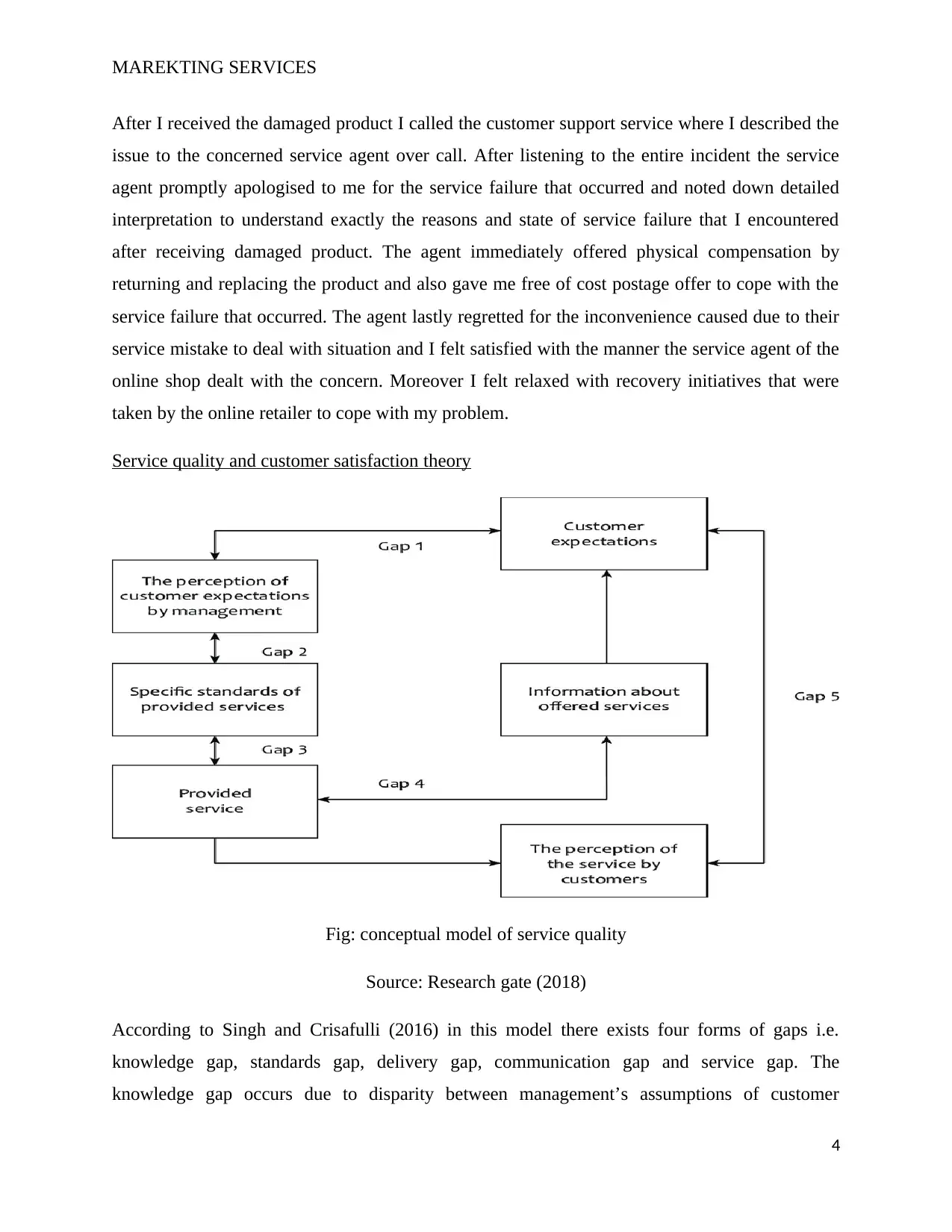
Fig: conceptual model of service quality
Source: Research gate (2018)
According to Singh and Crisafulli (2016) in this model there exists four forms of gaps i.e.
knowledge gap, standards gap, delivery gap, communication gap and service gap. The
knowledge gap occurs due to disparity between management’s assumptions of customer
4
After I received the damaged product I called the customer support service where I described the
issue to the concerned service agent over call. After listening to the entire incident the service
agent promptly apologised to me for the service failure that occurred and noted down detailed
interpretation to understand exactly the reasons and state of service failure that I encountered
after receiving damaged product. The agent immediately offered physical compensation by
returning and replacing the product and also gave me free of cost postage offer to cope with the
service failure that occurred. The agent lastly regretted for the inconvenience caused due to their
service mistake to deal with situation and I felt satisfied with the manner the service agent of the
online shop dealt with the concern. Moreover I felt relaxed with recovery initiatives that were
taken by the online retailer to cope with my problem.
Service quality and customer satisfaction theory
Fig: conceptual model of service quality
Source: Research gate (2018)
According to Singh and Crisafulli (2016) in this model there exists four forms of gaps i.e.
knowledge gap, standards gap, delivery gap, communication gap and service gap. The
knowledge gap occurs due to disparity between management’s assumptions of customer
4
Paraphrase This Document
Need a fresh take? Get an instant paraphrase of this document with our AI Paraphraser
MAREKTING SERVICES
expectations and expectation that is actually perceived by a customer related to the service. This
gap occurs due to gaps in level of managing the services or lack of research acclimatization.
As opined by Hur and Jang (2016) the other gap that arises is standards gap which occurs due to
discrepancies between standards specified for a service to be delivered and the management’s
perception about consumer’s expectations. As such this gap is formed by assumption of utility,
management’s promise to deliver a set service quality against their low cost and short term
profits, lack of adequate methods of evaluating quality or transforming those dimensions into
standards or due to complications in endeavour to describe the justification for a specific attitude
of employees.
As stated by Choi and Choi (2014) the third gap is delivery gap that occurs due to discrepancy
amid quality standard established for service delivery and actual quality of service delivered. As
such this gap occurs due to low enthusiasm to perform, gap between employee-job fit, contention
and uncertainty of roles, inappropriate support and diffusion of supervision. According to Kazi
and Prabhu (2016) the fourth gap is communication gap that arises due to discrepancy between
absolute quality of service forwarded and quality of service specified in company’s external
communication. As such this gap occurs due to predisposition of overstating service quality that
can be delivered and lack of horizontal interaction.
In the scenario of service failure of receiving damaged headphones due to packaging damage that
affected the product quality the gap of service quality that occurred was due to delivery gap as
the online retailer provided a service delivery that was contrasting to actual standard that was set
for the given service. Also according to theory of customer satisfaction the positive encounters
that are received from service experience of a service delivery that is either unanticipated or
beyond common apprehensions tends to create happiness amongst customers (Fukawa and
Erevelles 2014). In context to the service failure incident though the quality of service delivered
witnessed a delivery gap and was unanticipated that led to displeasure but the manner the failure
was handled by the online retailer’s service executive on duty resulted into a positive customer
satisfaction due to the manner the problem was handled and due to prompt recovery measures
that were taken. As such in context with responsiveness dimension the employee of the online
retailing service provider gave an instant service recovery measure with a willingness to help
5
expectations and expectation that is actually perceived by a customer related to the service. This
gap occurs due to gaps in level of managing the services or lack of research acclimatization.
As opined by Hur and Jang (2016) the other gap that arises is standards gap which occurs due to
discrepancies between standards specified for a service to be delivered and the management’s
perception about consumer’s expectations. As such this gap is formed by assumption of utility,
management’s promise to deliver a set service quality against their low cost and short term
profits, lack of adequate methods of evaluating quality or transforming those dimensions into
standards or due to complications in endeavour to describe the justification for a specific attitude
of employees.
As stated by Choi and Choi (2014) the third gap is delivery gap that occurs due to discrepancy
amid quality standard established for service delivery and actual quality of service delivered. As
such this gap occurs due to low enthusiasm to perform, gap between employee-job fit, contention
and uncertainty of roles, inappropriate support and diffusion of supervision. According to Kazi
and Prabhu (2016) the fourth gap is communication gap that arises due to discrepancy between
absolute quality of service forwarded and quality of service specified in company’s external
communication. As such this gap occurs due to predisposition of overstating service quality that
can be delivered and lack of horizontal interaction.
In the scenario of service failure of receiving damaged headphones due to packaging damage that
affected the product quality the gap of service quality that occurred was due to delivery gap as
the online retailer provided a service delivery that was contrasting to actual standard that was set
for the given service. Also according to theory of customer satisfaction the positive encounters
that are received from service experience of a service delivery that is either unanticipated or
beyond common apprehensions tends to create happiness amongst customers (Fukawa and
Erevelles 2014). In context to the service failure incident though the quality of service delivered
witnessed a delivery gap and was unanticipated that led to displeasure but the manner the failure
was handled by the online retailer’s service executive on duty resulted into a positive customer
satisfaction due to the manner the problem was handled and due to prompt recovery measures
that were taken. As such in context with responsiveness dimension the employee of the online
retailing service provider gave an instant service recovery measure with a willingness to help
5
MAREKTING SERVICES
which made the encounter passive due to positive customer satisfaction that was received post
service delivery.
There are four forms of complaints: (Cheng, Chang, Chuang and Liao 2015)
Instrumental: in this complaint is asserted with intention of alarming an unexpected state of
encounter.
Non-instrumental: in this complaint is asserted without expectancy that an uncertain state of
encounter could be rectified.
Ostensive: in this complaint aimed at someone or something is beyond the dimension of
complainer
Reflexive: in this complain aims at certain internal expression of complainer
According to this theory the complaint that was raised in the present context of service failure
where a damaged product was received from the online retailer due to packaging defect was
identified to be instrumental complaint as in this the complaint was voiced to raise an alarm for
the damage of product that had occurred during transit due to packaging defect which was
unanticipated form of confrontation on part of customer (Riaz and Muhammad 2016). The
customer’s or complainant’s root cause of raising the complaint in this incident of service failure
was to rectify an unanticipated situation so as to get a certain control in form of service recovery
measure such as refund or replacement of order for the headphone product.
Recommendation and Service recovery strategy
Proposal of service recovery strategy and customer service function
6
which made the encounter passive due to positive customer satisfaction that was received post
service delivery.
There are four forms of complaints: (Cheng, Chang, Chuang and Liao 2015)
Instrumental: in this complaint is asserted with intention of alarming an unexpected state of
encounter.
Non-instrumental: in this complaint is asserted without expectancy that an uncertain state of
encounter could be rectified.
Ostensive: in this complaint aimed at someone or something is beyond the dimension of
complainer
Reflexive: in this complain aims at certain internal expression of complainer
According to this theory the complaint that was raised in the present context of service failure
where a damaged product was received from the online retailer due to packaging defect was
identified to be instrumental complaint as in this the complaint was voiced to raise an alarm for
the damage of product that had occurred during transit due to packaging defect which was
unanticipated form of confrontation on part of customer (Riaz and Muhammad 2016). The
customer’s or complainant’s root cause of raising the complaint in this incident of service failure
was to rectify an unanticipated situation so as to get a certain control in form of service recovery
measure such as refund or replacement of order for the headphone product.
Recommendation and Service recovery strategy
Proposal of service recovery strategy and customer service function
6
⊘ This is a preview!⊘
Do you want full access?
Subscribe today to unlock all pages.
Trusted by 1+ million students worldwide
MAREKTING SERVICES
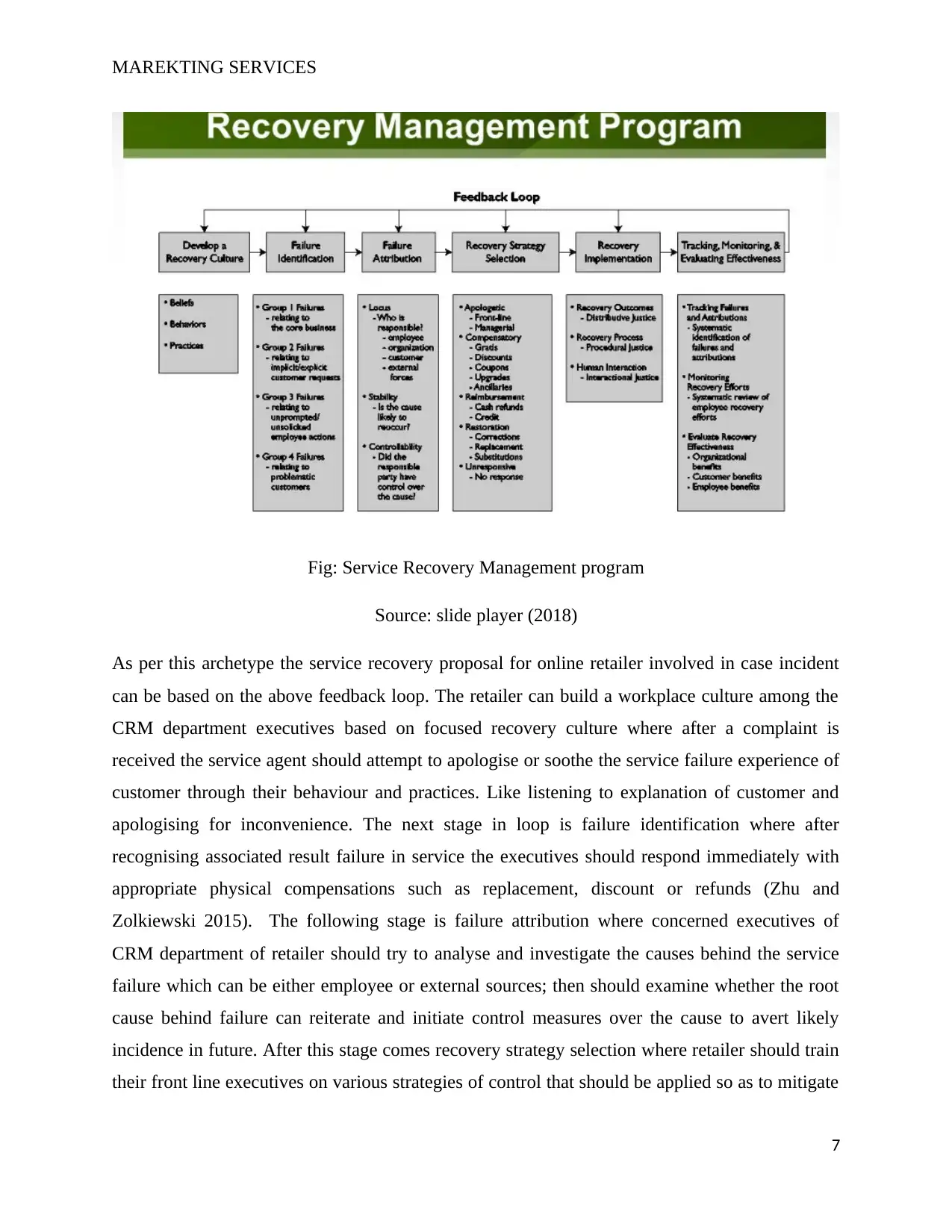
Fig: Service Recovery Management program
Source: slide player (2018)
As per this archetype the service recovery proposal for online retailer involved in case incident
can be based on the above feedback loop. The retailer can build a workplace culture among the
CRM department executives based on focused recovery culture where after a complaint is
received the service agent should attempt to apologise or soothe the service failure experience of
customer through their behaviour and practices. Like listening to explanation of customer and
apologising for inconvenience. The next stage in loop is failure identification where after
recognising associated result failure in service the executives should respond immediately with
appropriate physical compensations such as replacement, discount or refunds (Zhu and
Zolkiewski 2015). The following stage is failure attribution where concerned executives of
CRM department of retailer should try to analyse and investigate the causes behind the service
failure which can be either employee or external sources; then should examine whether the root
cause behind failure can reiterate and initiate control measures over the cause to avert likely
incidence in future. After this stage comes recovery strategy selection where retailer should train
their front line executives on various strategies of control that should be applied so as to mitigate
7
Fig: Service Recovery Management program
Source: slide player (2018)
As per this archetype the service recovery proposal for online retailer involved in case incident
can be based on the above feedback loop. The retailer can build a workplace culture among the
CRM department executives based on focused recovery culture where after a complaint is
received the service agent should attempt to apologise or soothe the service failure experience of
customer through their behaviour and practices. Like listening to explanation of customer and
apologising for inconvenience. The next stage in loop is failure identification where after
recognising associated result failure in service the executives should respond immediately with
appropriate physical compensations such as replacement, discount or refunds (Zhu and
Zolkiewski 2015). The following stage is failure attribution where concerned executives of
CRM department of retailer should try to analyse and investigate the causes behind the service
failure which can be either employee or external sources; then should examine whether the root
cause behind failure can reiterate and initiate control measures over the cause to avert likely
incidence in future. After this stage comes recovery strategy selection where retailer should train
their front line executives on various strategies of control that should be applied so as to mitigate
7
Paraphrase This Document
Need a fresh take? Get an instant paraphrase of this document with our AI Paraphraser
MAREKTING SERVICES
the poor customer encounter by being apologetic or by offering compensatory, reimbursement or
restoration options for service delivery (Fan-Yun Pai, Yeh and Liang-Yu 2017) The next stage
is recovery implementation where retailer should establish recovery results, procedure or
interactional justice for customer to handle the poor service delivery followed by last stage i.e.
tracking, monitoring and evaluating effectiveness of recovery program, where retailer can
establish process that can identify systematic failures, monitor reviews and assess recovery
effectiveness through organisational/employee/ customer benefits.
Recommendation
The online retailer of the case incidence can improve their customer after-purchase
behaviour dimension to retain and maintain customer loyalty by focusing on building
their employees expertise and role in dealing with unanticipated customer encounters.
The company can train their employees to make them learn strategies that can be applied
to manage service failures and should also train employees on soft skills like passion
where employees can engage with customers to deliver better experiences that can build
loyalty by pacifying their bad encounters and building positive impressions with proper
response.
The service executive of retailer can seek for constructive feedback from customer so as
to communicate a sense that their voice is being heard and taking proactive actions to
reach to customers on frequent basis to figure out what they perceive and what can be
improvised further in service process delivery.
Conclusion
Thus it can be concluded that adequate and effective response can help to restore confidence of
customers after they have experienced service failures with proper knowledge of recovery
measures and approaches and with constructive behaviour of employees who interact with
customers. As some service failures are accidental so identifying and analysing mitigation steps
helps to not only avert future incidences of service failure but also helps to retain customer
loyalty with better recovery initiatives taken by service organisation.
8
the poor customer encounter by being apologetic or by offering compensatory, reimbursement or
restoration options for service delivery (Fan-Yun Pai, Yeh and Liang-Yu 2017) The next stage
is recovery implementation where retailer should establish recovery results, procedure or
interactional justice for customer to handle the poor service delivery followed by last stage i.e.
tracking, monitoring and evaluating effectiveness of recovery program, where retailer can
establish process that can identify systematic failures, monitor reviews and assess recovery
effectiveness through organisational/employee/ customer benefits.
Recommendation
The online retailer of the case incidence can improve their customer after-purchase
behaviour dimension to retain and maintain customer loyalty by focusing on building
their employees expertise and role in dealing with unanticipated customer encounters.
The company can train their employees to make them learn strategies that can be applied
to manage service failures and should also train employees on soft skills like passion
where employees can engage with customers to deliver better experiences that can build
loyalty by pacifying their bad encounters and building positive impressions with proper
response.
The service executive of retailer can seek for constructive feedback from customer so as
to communicate a sense that their voice is being heard and taking proactive actions to
reach to customers on frequent basis to figure out what they perceive and what can be
improvised further in service process delivery.
Conclusion
Thus it can be concluded that adequate and effective response can help to restore confidence of
customers after they have experienced service failures with proper knowledge of recovery
measures and approaches and with constructive behaviour of employees who interact with
customers. As some service failures are accidental so identifying and analysing mitigation steps
helps to not only avert future incidences of service failure but also helps to retain customer
loyalty with better recovery initiatives taken by service organisation.
8
MAREKTING SERVICES
References
Balaji, M. S., Roy, S. K. and Quazi, A. (2017). Customers’ emotion regulation strategies in
service failure encounters. European Journal of Marketing, [Online] 51(5), 960-982. Available:
doi: http://dx.doi.org/10.1108/EJM-03-2015-0169 [Accessed on 6 Oct. 2018]
Cheng, Y., Chang, C., Chuang, S. and Liao, Y. (2015). Guilt no longer a sin: The effect of guilt
in the service recovery paradox. Journal of Service Theory and Practice, [Online] 25(6), 836-
853. Available: https://search.proquest.com/docview/1768594235?accountid=30552 [Accessed
on 6 Oct. 2018]
Choi, B. and Choi, B. (2014). The effects of perceived service recovery justice on customer
affection, loyalty, and word-of-mouth. European Journal of Marketing, [Online] 48(1), 108-131.
Available: doi: http://dx.doi.org/10.1108/EJM-06-2011-0299 [Accessed on 6 Oct. 2018]
Fan-Yun Pai, Yeh, T. and Liang-Yu, L. (2017). Relationship level and customer response to
service recovery. Social Indicators Research, [Online], 1-19. Available: doi:
http://dx.doi.org/10.1007/s11205-017-1820-0 [Accessed on 6 Oct. 2018]
Fukawa, N. and Erevelles, S. (2014). Perceived reasonableness and morals in service encounters.
Journal of Business Ethics, [Online] 125(3), 381-400. Available: doi:
http://dx.doi.org/10.1007/s10551-013-1918-5 [Accessed on 6 Oct. 2018]
Hur, J. and Jang, S. (2016). Toward service recovery strategies: The role of consumer-
organization relationship norms. The Journal of Services Marketing, [Online] 30(7), 724-735.
Available: https://search.proquest.com/docview/1844291906?accountid=30552[Accessed on 6
Oct. 2018]
Kazi, R. and Prabhu, S. (2016). Literature review of service failure, service recovery and their
effects on consumers and service employees. Telecom Business Review, [Online] 9(1), 39-45.
Available: https://search.proquest.com/docview/1845009370?accountid=30552 [Accessed on 6
Oct. 2018]
Riaz, Z. and Muhammad, I. K. (2016). Impact of service failure severity and agreeableness on
consumer switchover intention. Asia Pacific Journal of Marketing and Logistics, [Online] 28(3),
9
References
Balaji, M. S., Roy, S. K. and Quazi, A. (2017). Customers’ emotion regulation strategies in
service failure encounters. European Journal of Marketing, [Online] 51(5), 960-982. Available:
doi: http://dx.doi.org/10.1108/EJM-03-2015-0169 [Accessed on 6 Oct. 2018]
Cheng, Y., Chang, C., Chuang, S. and Liao, Y. (2015). Guilt no longer a sin: The effect of guilt
in the service recovery paradox. Journal of Service Theory and Practice, [Online] 25(6), 836-
853. Available: https://search.proquest.com/docview/1768594235?accountid=30552 [Accessed
on 6 Oct. 2018]
Choi, B. and Choi, B. (2014). The effects of perceived service recovery justice on customer
affection, loyalty, and word-of-mouth. European Journal of Marketing, [Online] 48(1), 108-131.
Available: doi: http://dx.doi.org/10.1108/EJM-06-2011-0299 [Accessed on 6 Oct. 2018]
Fan-Yun Pai, Yeh, T. and Liang-Yu, L. (2017). Relationship level and customer response to
service recovery. Social Indicators Research, [Online], 1-19. Available: doi:
http://dx.doi.org/10.1007/s11205-017-1820-0 [Accessed on 6 Oct. 2018]
Fukawa, N. and Erevelles, S. (2014). Perceived reasonableness and morals in service encounters.
Journal of Business Ethics, [Online] 125(3), 381-400. Available: doi:
http://dx.doi.org/10.1007/s10551-013-1918-5 [Accessed on 6 Oct. 2018]
Hur, J. and Jang, S. (2016). Toward service recovery strategies: The role of consumer-
organization relationship norms. The Journal of Services Marketing, [Online] 30(7), 724-735.
Available: https://search.proquest.com/docview/1844291906?accountid=30552[Accessed on 6
Oct. 2018]
Kazi, R. and Prabhu, S. (2016). Literature review of service failure, service recovery and their
effects on consumers and service employees. Telecom Business Review, [Online] 9(1), 39-45.
Available: https://search.proquest.com/docview/1845009370?accountid=30552 [Accessed on 6
Oct. 2018]
Riaz, Z. and Muhammad, I. K. (2016). Impact of service failure severity and agreeableness on
consumer switchover intention. Asia Pacific Journal of Marketing and Logistics, [Online] 28(3),
9
⊘ This is a preview!⊘
Do you want full access?
Subscribe today to unlock all pages.
Trusted by 1+ million students worldwide
MAREKTING SERVICES
420-434. Available: doi: http://dx.doi.org/10.1108/APJML-07-2015-0106 [Accessed on 6 Oct.
2018]
Singh, J. and Crisafulli, B. (2016). Managing online service recovery: Procedures, justice and
customer satisfaction. Journal of Service Theory and Practice, [Online] 26(6), 764-787.
Available: https://search.proquest.com/docview/1835459265?accountid=30552 [Accessed on 6
Oct. 2018]
Zhu, X. and Zolkiewski, J. (2015). Exploring service failure in a business-to-business context.
The Journal of Services Marketing, [Online] 29(5), 367-379. Available:
https://search.proquest.com/docview/1697381252?accountid=30552 [Accessed on 6 Oct. 2018]
10
420-434. Available: doi: http://dx.doi.org/10.1108/APJML-07-2015-0106 [Accessed on 6 Oct.
2018]
Singh, J. and Crisafulli, B. (2016). Managing online service recovery: Procedures, justice and
customer satisfaction. Journal of Service Theory and Practice, [Online] 26(6), 764-787.
Available: https://search.proquest.com/docview/1835459265?accountid=30552 [Accessed on 6
Oct. 2018]
Zhu, X. and Zolkiewski, J. (2015). Exploring service failure in a business-to-business context.
The Journal of Services Marketing, [Online] 29(5), 367-379. Available:
https://search.proquest.com/docview/1697381252?accountid=30552 [Accessed on 6 Oct. 2018]
10

1 out of 10


Your All-in-One AI-Powered Toolkit for Academic Success.
+13062052269
info@desklib.com
Available 24*7 on WhatsApp / Email
![[object Object]](/_next/static/media/star-bottom.7253800d.svg)
Unlock your academic potential
Copyright © 2020–2026 A2Z Services. All Rights Reserved. Developed and managed by ZUCOL.