Sexual Health of LGB People: Stress, Mental Health, and Global Issues
VerifiedAdded on 2020/03/23
|6
|1908
|69
Essay
AI Summary
This essay delves into the sexual health of lesbians, gay men, and bisexuals (LGBs), exploring the stressors they face globally due to their sexuality. It analyzes two readings, examining the impact of discrimination, prejudice, and violence on LGB mental health. The essay highlights the use of sexuality as an analytical category, discussing psychological problems such as impaired self-image and dissatisfaction. It references studies that show LGB individuals are more likely to experience mental stress and explores the role of government policies and cultural sensitivity in addressing these issues. Furthermore, the essay examines the influence of urban stressors, such as poverty and poor sanitation, on the mental health of LGB communities in developing countries. It also emphasizes the need for global understanding and support, advocating for the protection of LGB rights and the implementation of cross-cultural competency to foster inclusivity.
0
Introduction to Sexuality Studies
Introduction to Sexuality Studies

Paraphrase This Document
Need a fresh take? Get an instant paraphrase of this document with our AI Paraphraser
1
Student ID:
Name:
Topic: Sexual Health
Lesbians, gay men, and bisexuals (LGBs) people are divided into various parts
according to their characteristics such as age, gender, culture, race, caste, income, and
residential status. Even being considerably different from each other, most LGB people face
similar stressful circumstances throughout the world, such as discrimination, humiliation,
rejection, prejudice, and violence (Jetten et al. 2001). This essay will examine various
stressors meet by LGB people over the world due to their sexuality. The essay will analyse
two readings, first by Ilan H. Meyer & Mary E. Northridge (2007), 242-267, called “The
health of sexual minorities: Public health perspectives on lesbian, gay, bisexual and
transgender populations.” The second reading is by Meredith J. Greif & F. Nii-Amoo Dodoo
(2015), 57-66, called “How community physical, structural, and social stressors relate to
mental health in the urban slums of Accra, Ghana.” The key issues of these reading are
relating to the stress faced by LGB people due to their sexuality and its impact on their
mental health. Further, the essay will analyse the use of sexuality as a primary analytical
category and the psychological problems faced by homosexuals, such as impaired self-image
and dissatisfaction with their sexuality, because they are treated with denigration or contempt.
According to Meyer & Northridge (2007), the LGB people are more likely to suffer
mental stress which leads to affective disorders, substance use, and suicide. The developing
countries are facing challenges relating to urban health; much research has suggested that
poor communities in developing countries are suffering from diseases such as diabetes,
respiratory illness, and premature death. Depression is one of the primary contributors to
increasing illness in between impoverished communities’ worldwide (Bird et al. 2010).
Further, the issues are relating to use of sexuality as a central analytical category. The essay
will provide various arguments regarding cultural sensitivity for different sexuality
perspective and discuss the ethical values and cultural competence required for a productive
global citizen. The reason for using sexuality as an analytical category is because there is lack
of government policies to protect homosexual peoples from prejudice and mental problems.
Meyer & Northridge (2007) provided in his study that there are particular
individualities of minority identity that may be influenced by the stress factors and health
Student ID:
Name:
Topic: Sexual Health
Lesbians, gay men, and bisexuals (LGBs) people are divided into various parts
according to their characteristics such as age, gender, culture, race, caste, income, and
residential status. Even being considerably different from each other, most LGB people face
similar stressful circumstances throughout the world, such as discrimination, humiliation,
rejection, prejudice, and violence (Jetten et al. 2001). This essay will examine various
stressors meet by LGB people over the world due to their sexuality. The essay will analyse
two readings, first by Ilan H. Meyer & Mary E. Northridge (2007), 242-267, called “The
health of sexual minorities: Public health perspectives on lesbian, gay, bisexual and
transgender populations.” The second reading is by Meredith J. Greif & F. Nii-Amoo Dodoo
(2015), 57-66, called “How community physical, structural, and social stressors relate to
mental health in the urban slums of Accra, Ghana.” The key issues of these reading are
relating to the stress faced by LGB people due to their sexuality and its impact on their
mental health. Further, the essay will analyse the use of sexuality as a primary analytical
category and the psychological problems faced by homosexuals, such as impaired self-image
and dissatisfaction with their sexuality, because they are treated with denigration or contempt.
According to Meyer & Northridge (2007), the LGB people are more likely to suffer
mental stress which leads to affective disorders, substance use, and suicide. The developing
countries are facing challenges relating to urban health; much research has suggested that
poor communities in developing countries are suffering from diseases such as diabetes,
respiratory illness, and premature death. Depression is one of the primary contributors to
increasing illness in between impoverished communities’ worldwide (Bird et al. 2010).
Further, the issues are relating to use of sexuality as a central analytical category. The essay
will provide various arguments regarding cultural sensitivity for different sexuality
perspective and discuss the ethical values and cultural competence required for a productive
global citizen. The reason for using sexuality as an analytical category is because there is lack
of government policies to protect homosexual peoples from prejudice and mental problems.
Meyer & Northridge (2007) provided in his study that there are particular
individualities of minority identity that may be influenced by the stress factors and health
2
outcomes. The minority identities might relate to the mental health caused due to interaction
with different stressors. The study suggested that substantial commitment to gay character
may increase the influence of stressor which is connected with homosexuality. Meyer &
Northridge (2007) divided the personality into three parts and provided the individual impact
of stressors. The prominence identify may exacerbate the level of homosexuality stress
because they are significantly committed towards their status; it augments the effects of the
stressor. The valences identities are focused more on self-validation, negative valence are
vulnerable towards mental health issues. As per Meyer & Dean (1998), while suffering from
anti-gay violence issues, positive valence gay men fared better than negative valence gay
men. Integration of identity means a combination of different minority identities, as per the
research of Crawford et al. (2002); the integration type of personality is related to high
positive effects.
Meyer (2002) suggested LGB minority stress model which combined the factors
regarding stress discussed in this study, the essential parts of this model are coping, genetic
backgrounds, personalities, and appraisals. The model provides that minority stress processes
include prejudice events against sexualities, the expectancy of denial & discrimination,
internalised homophobia, and various other stress-ameliorating factors. As per Greif &
Dodoo (2015), in the case of poor communities in developing countries, there are several
urban contexts which adversely influence the mental health of minorities. The elements such
as disorder in the city, social conditions, substance abuse, and depression are the critical
factors in mental illness of poor community peoples. The result of Greif & Dodoo (2015)
study provided that people suffered powerlessness more than depression, the issues of people
include poverty, unemployment, and poor sanitation. The healthcare policies established by
the government did not provide proper remedies relating to depression of poor communities.
According to Williamson (2000), these factors influence the mental health of LGB
people because there is lack of government disciplinary procedures against the issue. The
LGB people face discrimination and prejudice throughout their life, the study of Meyer &
Northridge (2007) provided that LGB is more likely to suffer from a prejudice event as
compared to heterosexual peoples, such as firing from job, discrimination and violate due to
their sexuality. Most of the ethical communities did not accept LGB people, and there is lack
of government regulations for their protections. These factors adversely affect the mental
health of LGB people while leading to higher suicide and psychological problems rates. For
increasing the development in urban countries, the government overlooks the health of poor
outcomes. The minority identities might relate to the mental health caused due to interaction
with different stressors. The study suggested that substantial commitment to gay character
may increase the influence of stressor which is connected with homosexuality. Meyer &
Northridge (2007) divided the personality into three parts and provided the individual impact
of stressors. The prominence identify may exacerbate the level of homosexuality stress
because they are significantly committed towards their status; it augments the effects of the
stressor. The valences identities are focused more on self-validation, negative valence are
vulnerable towards mental health issues. As per Meyer & Dean (1998), while suffering from
anti-gay violence issues, positive valence gay men fared better than negative valence gay
men. Integration of identity means a combination of different minority identities, as per the
research of Crawford et al. (2002); the integration type of personality is related to high
positive effects.
Meyer (2002) suggested LGB minority stress model which combined the factors
regarding stress discussed in this study, the essential parts of this model are coping, genetic
backgrounds, personalities, and appraisals. The model provides that minority stress processes
include prejudice events against sexualities, the expectancy of denial & discrimination,
internalised homophobia, and various other stress-ameliorating factors. As per Greif &
Dodoo (2015), in the case of poor communities in developing countries, there are several
urban contexts which adversely influence the mental health of minorities. The elements such
as disorder in the city, social conditions, substance abuse, and depression are the critical
factors in mental illness of poor community peoples. The result of Greif & Dodoo (2015)
study provided that people suffered powerlessness more than depression, the issues of people
include poverty, unemployment, and poor sanitation. The healthcare policies established by
the government did not provide proper remedies relating to depression of poor communities.
According to Williamson (2000), these factors influence the mental health of LGB
people because there is lack of government disciplinary procedures against the issue. The
LGB people face discrimination and prejudice throughout their life, the study of Meyer &
Northridge (2007) provided that LGB is more likely to suffer from a prejudice event as
compared to heterosexual peoples, such as firing from job, discrimination and violate due to
their sexuality. Most of the ethical communities did not accept LGB people, and there is lack
of government regulations for their protections. These factors adversely affect the mental
health of LGB people while leading to higher suicide and psychological problems rates. For
increasing the development in urban countries, the government overlooks the health of poor
⊘ This is a preview!⊘
Do you want full access?
Subscribe today to unlock all pages.

Trusted by 1+ million students worldwide
3
communities. Stafford et al. (2008) depicted that the minorities in metropolitan cities suffer
from health, employment, and poverty issues. The rate of depression is considerably high in
such developing countries which show the requirement of improved government regulations.
The requirement of sexuality as a primary analytical category is significantly useful
for this period. As per Mirowsky & Ross (1989), the sexuality of people has been a matter of
controversies throughout the history. In past few decades, many countries have accepted the
sexuality regulations of peoples because of liberal protest conducted by peoples. But, the
LGB community still faces various discriminations and prejudice in the society. Most ethnic
communities did not accept the homosexuality regulations, and they openly protest against
such laws. Crocker & Major (1989) provided that only a few developing countries have
recognized the right of LGB peoples, and there is still a requirement for global
implementation of sexuality regulations. Most of the countries still considered homosexuality
as a crime and the LGB people face horrible behaviour from people of such nations. The
government should pass rules regarding the protection of LGB peoples, to provide them
better opportunities in the society.
The government should determine the extent up to which the sexuality as an
analytical category should be applied. As a perspective from homosexual people, they suffer
challenges while getting a job, higher education, marriage, loans and much more. The
analytical category should be used to provide them benefits in employment, education, and
marriage. Equal opportunities and better social conditions should be provided to LGB
peoples, which can be achieved by dividing them into the analytical category. Better
opportunities can improve the mental states of the homosexual peoples (Operario & Fiske
2001). In case of developing countries, the requirement of sexuality as an analytical category
is significantly essential because most of the homosexual people there suffer from poverty,
diseases, depression, discrimination, and mental health issues. As a global citizen, it is
necessary that people understand the problems face by LGB community throughout the world
and support them. The awareness regarding the right of LGB people is growing every day;
many new regulations are introducing by the government to protect their rights. As per
D’Emilio (1983), a cross-cultural competency should be established to welcome the LGB
people into societies, as a global citizen, it is the responsibility of peoples to implement such
policy efficiently.
communities. Stafford et al. (2008) depicted that the minorities in metropolitan cities suffer
from health, employment, and poverty issues. The rate of depression is considerably high in
such developing countries which show the requirement of improved government regulations.
The requirement of sexuality as a primary analytical category is significantly useful
for this period. As per Mirowsky & Ross (1989), the sexuality of people has been a matter of
controversies throughout the history. In past few decades, many countries have accepted the
sexuality regulations of peoples because of liberal protest conducted by peoples. But, the
LGB community still faces various discriminations and prejudice in the society. Most ethnic
communities did not accept the homosexuality regulations, and they openly protest against
such laws. Crocker & Major (1989) provided that only a few developing countries have
recognized the right of LGB peoples, and there is still a requirement for global
implementation of sexuality regulations. Most of the countries still considered homosexuality
as a crime and the LGB people face horrible behaviour from people of such nations. The
government should pass rules regarding the protection of LGB peoples, to provide them
better opportunities in the society.
The government should determine the extent up to which the sexuality as an
analytical category should be applied. As a perspective from homosexual people, they suffer
challenges while getting a job, higher education, marriage, loans and much more. The
analytical category should be used to provide them benefits in employment, education, and
marriage. Equal opportunities and better social conditions should be provided to LGB
peoples, which can be achieved by dividing them into the analytical category. Better
opportunities can improve the mental states of the homosexual peoples (Operario & Fiske
2001). In case of developing countries, the requirement of sexuality as an analytical category
is significantly essential because most of the homosexual people there suffer from poverty,
diseases, depression, discrimination, and mental health issues. As a global citizen, it is
necessary that people understand the problems face by LGB community throughout the world
and support them. The awareness regarding the right of LGB people is growing every day;
many new regulations are introducing by the government to protect their rights. As per
D’Emilio (1983), a cross-cultural competency should be established to welcome the LGB
people into societies, as a global citizen, it is the responsibility of peoples to implement such
policy efficiently.
Paraphrase This Document
Need a fresh take? Get an instant paraphrase of this document with our AI Paraphraser
4
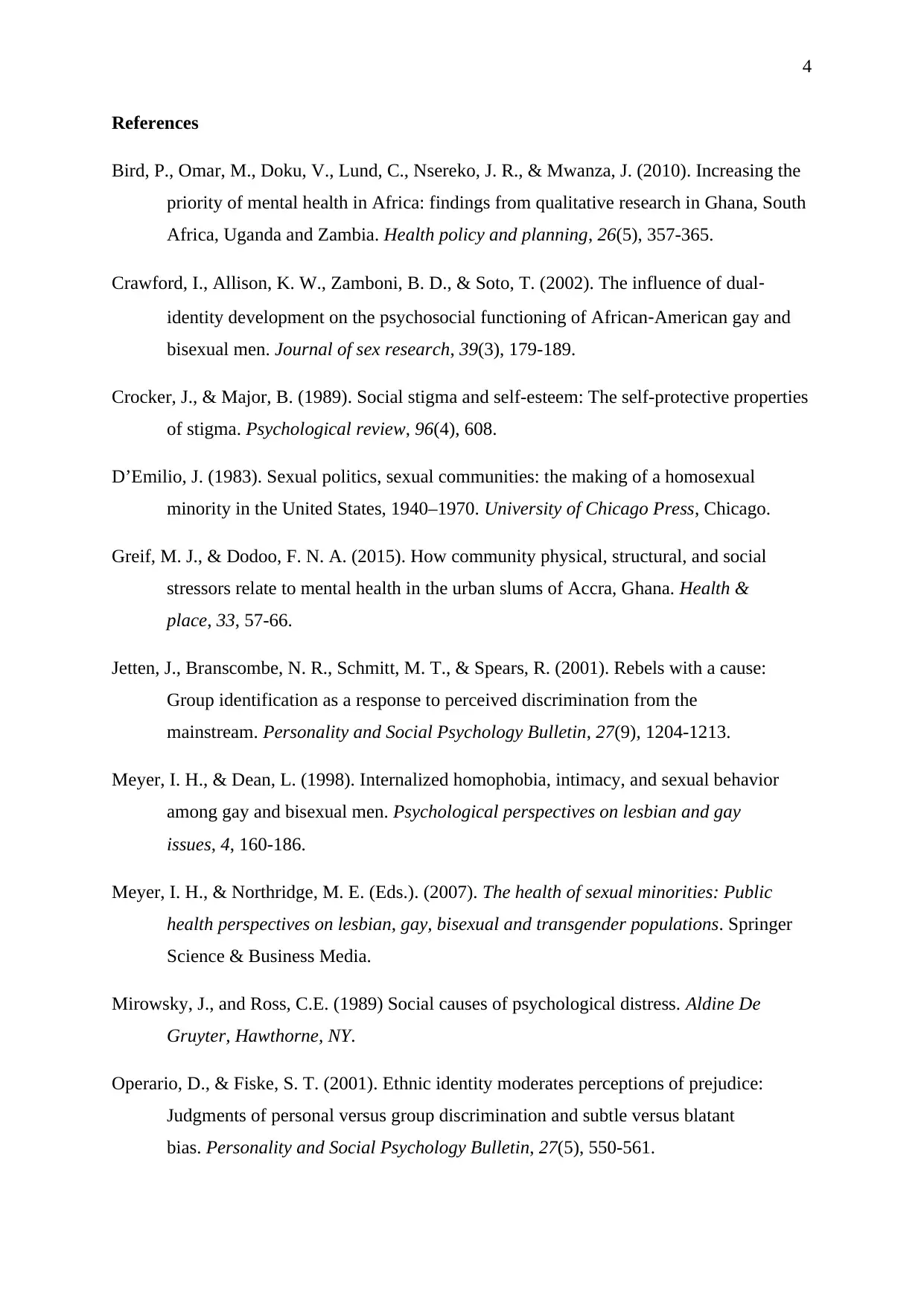
References
Bird, P., Omar, M., Doku, V., Lund, C., Nsereko, J. R., & Mwanza, J. (2010). Increasing the
priority of mental health in Africa: findings from qualitative research in Ghana, South
Africa, Uganda and Zambia. Health policy and planning, 26(5), 357-365.
Crawford, I., Allison, K. W., Zamboni, B. D., & Soto, T. (2002). The influence of dual‐
identity development on the psychosocial functioning of African‐American gay and
bisexual men. Journal of sex research, 39(3), 179-189.
Crocker, J., & Major, B. (1989). Social stigma and self-esteem: The self-protective properties
of stigma. Psychological review, 96(4), 608.
D’Emilio, J. (1983). Sexual politics, sexual communities: the making of a homosexual
minority in the United States, 1940–1970. University of Chicago Press, Chicago.
Greif, M. J., & Dodoo, F. N. A. (2015). How community physical, structural, and social
stressors relate to mental health in the urban slums of Accra, Ghana. Health &
place, 33, 57-66.
Jetten, J., Branscombe, N. R., Schmitt, M. T., & Spears, R. (2001). Rebels with a cause:
Group identification as a response to perceived discrimination from the
mainstream. Personality and Social Psychology Bulletin, 27(9), 1204-1213.
Meyer, I. H., & Dean, L. (1998). Internalized homophobia, intimacy, and sexual behavior
among gay and bisexual men. Psychological perspectives on lesbian and gay
issues, 4, 160-186.
Meyer, I. H., & Northridge, M. E. (Eds.). (2007). The health of sexual minorities: Public
health perspectives on lesbian, gay, bisexual and transgender populations. Springer
Science & Business Media.
Mirowsky, J., and Ross, C.E. (1989) Social causes of psychological distress. Aldine De
Gruyter, Hawthorne, NY.
Operario, D., & Fiske, S. T. (2001). Ethnic identity moderates perceptions of prejudice:
Judgments of personal versus group discrimination and subtle versus blatant
bias. Personality and Social Psychology Bulletin, 27(5), 550-561.
References
Bird, P., Omar, M., Doku, V., Lund, C., Nsereko, J. R., & Mwanza, J. (2010). Increasing the
priority of mental health in Africa: findings from qualitative research in Ghana, South
Africa, Uganda and Zambia. Health policy and planning, 26(5), 357-365.
Crawford, I., Allison, K. W., Zamboni, B. D., & Soto, T. (2002). The influence of dual‐
identity development on the psychosocial functioning of African‐American gay and
bisexual men. Journal of sex research, 39(3), 179-189.
Crocker, J., & Major, B. (1989). Social stigma and self-esteem: The self-protective properties
of stigma. Psychological review, 96(4), 608.
D’Emilio, J. (1983). Sexual politics, sexual communities: the making of a homosexual
minority in the United States, 1940–1970. University of Chicago Press, Chicago.
Greif, M. J., & Dodoo, F. N. A. (2015). How community physical, structural, and social
stressors relate to mental health in the urban slums of Accra, Ghana. Health &
place, 33, 57-66.
Jetten, J., Branscombe, N. R., Schmitt, M. T., & Spears, R. (2001). Rebels with a cause:
Group identification as a response to perceived discrimination from the
mainstream. Personality and Social Psychology Bulletin, 27(9), 1204-1213.
Meyer, I. H., & Dean, L. (1998). Internalized homophobia, intimacy, and sexual behavior
among gay and bisexual men. Psychological perspectives on lesbian and gay
issues, 4, 160-186.
Meyer, I. H., & Northridge, M. E. (Eds.). (2007). The health of sexual minorities: Public
health perspectives on lesbian, gay, bisexual and transgender populations. Springer
Science & Business Media.
Mirowsky, J., and Ross, C.E. (1989) Social causes of psychological distress. Aldine De
Gruyter, Hawthorne, NY.
Operario, D., & Fiske, S. T. (2001). Ethnic identity moderates perceptions of prejudice:
Judgments of personal versus group discrimination and subtle versus blatant
bias. Personality and Social Psychology Bulletin, 27(5), 550-561.
5
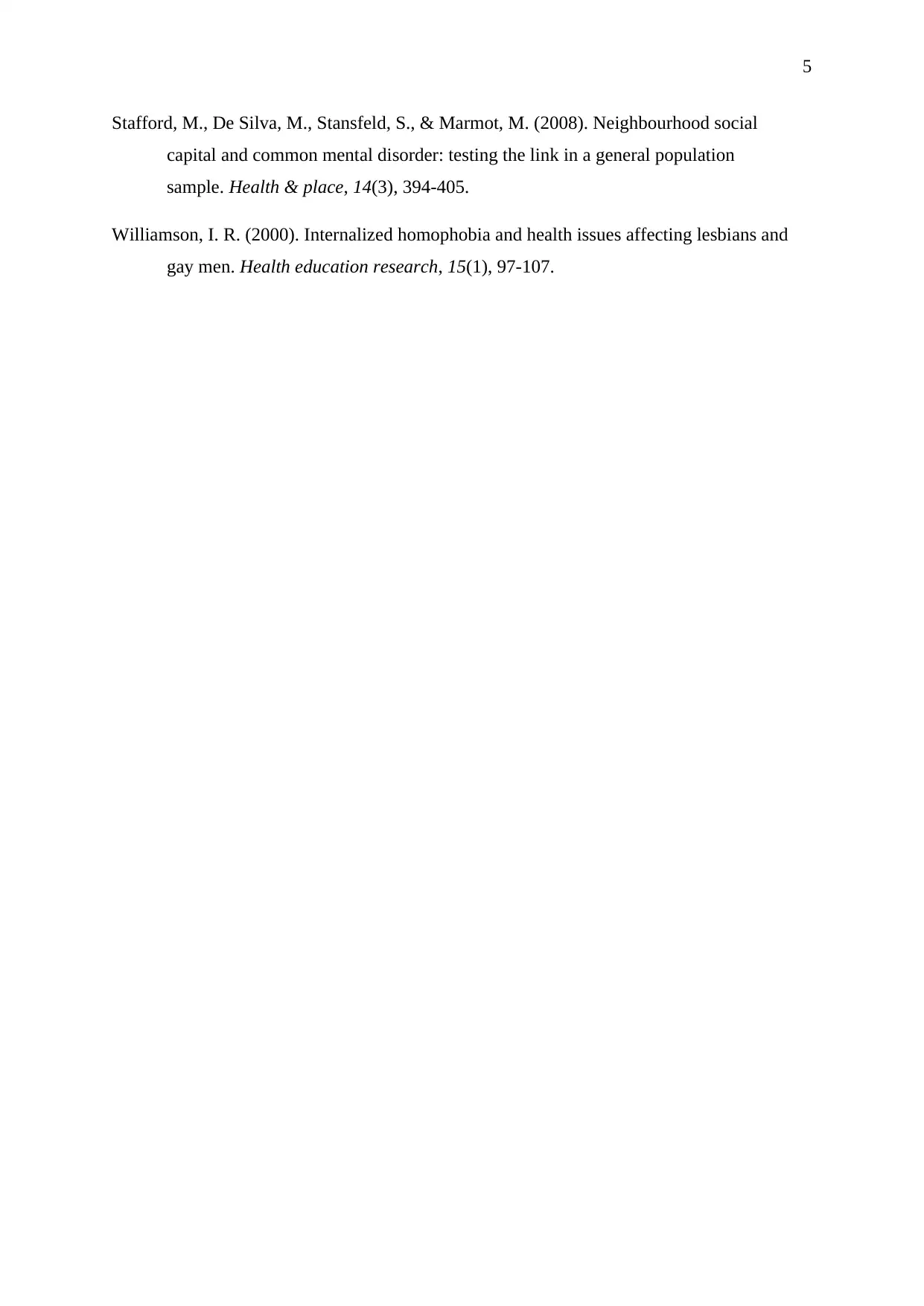
Stafford, M., De Silva, M., Stansfeld, S., & Marmot, M. (2008). Neighbourhood social
capital and common mental disorder: testing the link in a general population
sample. Health & place, 14(3), 394-405.
Williamson, I. R. (2000). Internalized homophobia and health issues affecting lesbians and
gay men. Health education research, 15(1), 97-107.
Stafford, M., De Silva, M., Stansfeld, S., & Marmot, M. (2008). Neighbourhood social
capital and common mental disorder: testing the link in a general population
sample. Health & place, 14(3), 394-405.
Williamson, I. R. (2000). Internalized homophobia and health issues affecting lesbians and
gay men. Health education research, 15(1), 97-107.
⊘ This is a preview!⊘
Do you want full access?
Subscribe today to unlock all pages.
Trusted by 1+ million students worldwide

1 out of 6


Your All-in-One AI-Powered Toolkit for Academic Success.
+13062052269
info@desklib.com
Available 24*7 on WhatsApp / Email
![[object Object]](/_next/static/media/star-bottom.7253800d.svg)
Unlock your academic potential
Copyright © 2020–2026 A2Z Services. All Rights Reserved. Developed and managed by ZUCOL.