SFIA Skills Framework: Professionalism and Project Management Analysis

Verified

Added on  2021/06/18

|8
|1640
|28
Report
AI Summary
This report delves into the Skills Framework for the Information Age (SFIA) and its application within information system project management. It begins by defining professionalism according to various theorists, highlighting attributes such as specialized knowledge, competency, honesty, integrity, and accountability. The report then provides a general introduction to SFIA, explaining its role as an internationally recognized standard for skills and competencies in the digital age. It emphasizes SFIA's importance in identifying necessary skills for career development, assessing individual skills, and standardizing performance. The report further outlines the specific skills required for group projects, including professional, knowledge, and behavioral skills, aligning these with SFIA's framework. Finally, it presents an assessment of a student's current personal SFIA skills based on autonomy, complexity, and influence, providing a comprehensive overview of the framework's practical application.
Document Page
Information System Project Management 1
Information System Project Management
Student Name
Course Title
Professor’s Name
University
City and State
Date
tabler-icon-diamond-filled.svg

Paraphrase This Document

Need a fresh take? Get an instant paraphrase of this document with our AI Paraphraser
Document Page
Information System Project Management 2
Definition of Professionalism
According to Ozga, and Lawn, (2017) these theorists define professionalism as the
strict adherence to a number of attributes such as honesty, competency, specialized
knowledge, self-regulation, courtesy as well as accountability when it comes to dealings that
involve companies or individual business settings. Accordingly, these traits in most cases
entail a high level of excellence that goes past the essential needs. Certainly, the definition of
professionalism implies that it encompasses a range of attributes and together as a whole
these traits are capable of defining an individual’s professional (Burford, Morrow, Rothwell,
Carter, and Illing, 2014, p 363). To expound on what professionalism means this paper
describes its attributes
Specialized knowledge: accordingly, professionals are known for their specialized
knowledge which comprises a greater personal commitment whose target is to develop and
enhance their skills. The most important aspect is that individuals specialised knowledge
work diligently for their success and always strive to keep their knowledge up-t- date in order
for them to keep on delivering high-quality services (Sfia-online.org, 2018). Competency
allows professionals to get work done in the most reliable way, and they also keep their
promises. Honesty and integrity are expressed by professionals to keep their word and to win
other people’s trust (Biesta, 2015, p. 75). Accountability makes professionals to be held
responsible for their actions, words, and thoughts.
General Introduction to SFIA
The Skills Framework for the Information Age (SFIA) is a framework that describes
the necessary skills needed by professionals in their duties that involve information as well as
communications technologies (Sfia-online.org, 2018). SFIA was launched during the dawn of
the millennium and it keeps on being updated. As a result, SFIA has stood out to be the
Document Page
Information System Project Management 3
internationally embraced and accepted standard language for skills in addition to
competencies that are essential in the present digital edge (Sfia-online.org, 2018). SFIA has
made strides to reach where it is through working jointly with the development style by
including an open consultation and allowing input from all walks of individuals who have
real-time practical experiences of management skills in educational as well as corporate
settings. Actually, through these aspects, SFIA is come out as most outstanding among others
across the globe (Sfia-online.org, 2018). As a result of its enormous theoretical techniques, it
has made its adoption to be highly liked by both small and big organizations as well as
individuals globally. The SFIA Framework commenced as a United Kingdom initiative,
which was later preceded by various personal skills I initiatives, with some backdating to the
1990s. These individuals team up and work together as a team to prove a single definitive
framework for the information technology industry. Therefore, from the dawn of the
millennium SFIA has been and continues to be the de facto international IT skills framework
that is utilized in approximately 200 nations both by individuals as well as companies to
exemplify and manage their skills (Sfia-online.org, 2018). Currently, SFIA stands out as the
most relevant and most significant framework since it is easy and generic as well as its
constantly updating through consultative practices where its spacious worldwide user base
join hands to work on drafting, initiating and reviewing updates to the Framework (Sfia-
online.org, 2018). Even though a majority of competency and skills frameworks and
specialist are able to trace their origin back to FSIA, the SFIA Framework stand out as
independent and self-sustaining having a well-established supportive environmental
framework and its consumers.
Importance of SFIA
SFIA is a standardised framework whose primary objective is to categorise the skills
of information communication and technology professionals working levels of autonomy as
Document Page
Information System Project Management 4
well as accountability that suits with their level of experience and professional responsibility
(Costa, and Santos, 2017, p. 728). SFIA is significant in a number of ways. To begin with,
SFIA framework plays a significant role in the identification of the necessary skills that an
individual should possess to help them develop for them to advance in their carrier.
Accordingly, the assessment of one’s skills alongside SFIA framework plays an essential role
in the following ways:
It enables an individual to identify their expert areas that need development, and in
the process, it helps them to come up with well-thought-out plans on how to reach
their goals and objectives.
SFIA helps people to develop through working together in their development course
with their line mentor for feedback (Siekmann, and Fowler, 2017).
SFIA enables individuals to create their present skills profile as it places them in a
position that makes them identify their strengths in line with the international
standards which encompass information communication and technology
competencies.
SFIA aids people to be capable to understand their present capacity to plan for their
forthcoming career moves
SFIA has facilitated the immensely operational companies that have become more
and more focused on making sure that deliver the best results.
SFIA support the public sector to standardize its performance
At the same time, SFIA plays a significant role in inspiring managers to clearly define
their organization's performance expectations to the staff
Skills Required for the Group Project
tabler-icon-diamond-filled.svg

Paraphrase This Document

Need a fresh take? Get an instant paraphrase of this document with our AI Paraphraser
Document Page
Information System Project Management 5
The primary skills required for the group include professional skills, knowledge and
behavioural skills. Therefore, in the case of this group, the earlier mentioned skills fit with the
service management carriers in particular project management because it involves
behavioural skills, knowledge as well as professional skills (Siekmann, and Fowler, 2017).
Project management entails working with project team members, thus these are people who
have different behavioural skills knowledge and professional skills because they handle
different divisions of the project. Therefore, SFIA defines what professional skills is to help
the project team players be able to understand what is required of them in the project. At the
same time, project management involves people of different behaviours thus it has to set out
its behavioural skills in describing its way of working (Pereira, Ferreira, and Amaral, 2017, p
434). Lastly but not least, project management call s for knowledge. Subsequently, the
knowledge of project management can be traced to SFIA support in enhancing alignment
with the needed professional skills for managing a project (El Banna, Farouk, and Saleh,
2016, p. 4).
Assessment of a Student’s Current Personal SFIA Skills
The current student assessment personal SFIA skills are based on autonomy,
complexity, and influence.
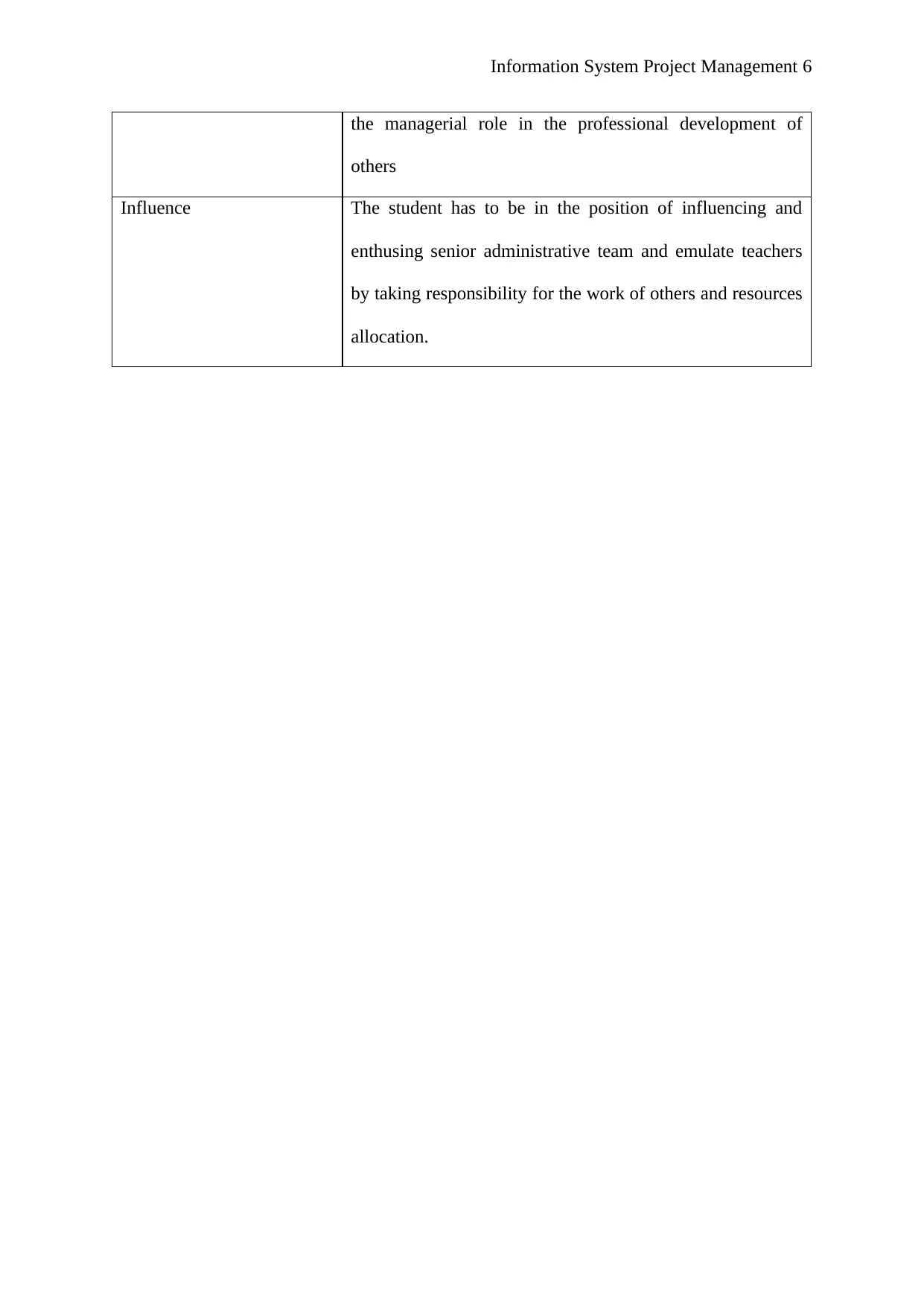
Assessment Criteria Description
Autonomy The application has to have the potential to work
successfully in a wide direction and be completely
responsible for attaining the allotted tasks (Von Konsky,
Miller, and Jones, 2016).
Complexity The student should be in the position to make decisions that
advocate for the project success and shared gaols by taking
Document Page
Information System Project Management 6
the managerial role in the professional development of
others
Influence The student has to be in the position of influencing and
enthusing senior administrative team and emulate teachers
by taking responsibility for the work of others and resources
allocation.
Document Page
Information System Project Management 7
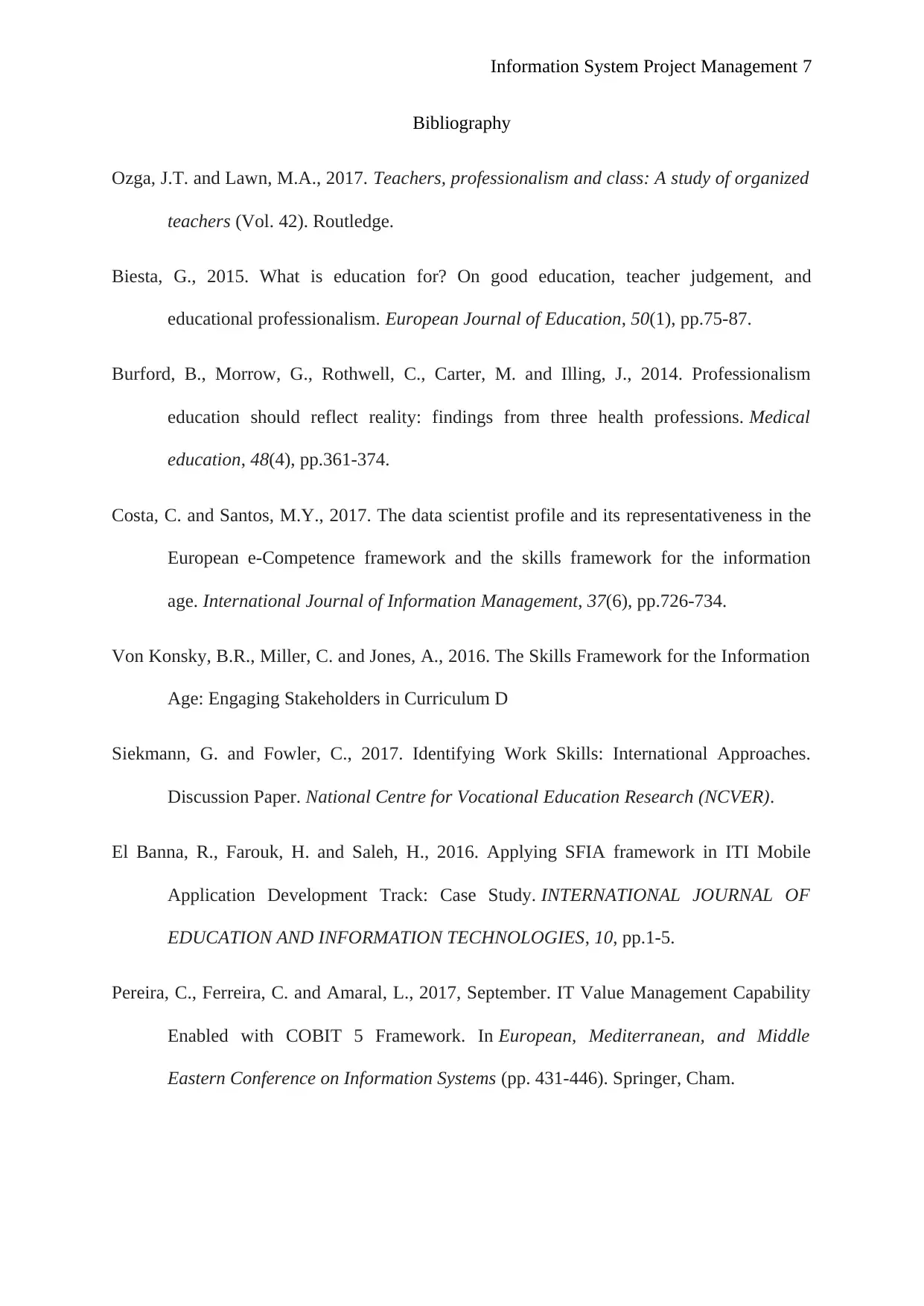
Bibliography
Ozga, J.T. and Lawn, M.A., 2017. Teachers, professionalism and class: A study of organized
teachers (Vol. 42). Routledge.
Biesta, G., 2015. What is education for? On good education, teacher judgement, and
educational professionalism. European Journal of Education, 50(1), pp.75-87.
Burford, B., Morrow, G., Rothwell, C., Carter, M. and Illing, J., 2014. Professionalism
education should reflect reality: findings from three health professions. Medical
education, 48(4), pp.361-374.
Costa, C. and Santos, M.Y., 2017. The data scientist profile and its representativeness in the
European e-Competence framework and the skills framework for the information
age. International Journal of Information Management, 37(6), pp.726-734.
Von Konsky, B.R., Miller, C. and Jones, A., 2016. The Skills Framework for the Information
Age: Engaging Stakeholders in Curriculum D
Siekmann, G. and Fowler, C., 2017. Identifying Work Skills: International Approaches.
Discussion Paper. National Centre for Vocational Education Research (NCVER).
El Banna, R., Farouk, H. and Saleh, H., 2016. Applying SFIA framework in ITI Mobile
Application Development Track: Case Study. INTERNATIONAL JOURNAL OF
EDUCATION AND INFORMATION TECHNOLOGIES, 10, pp.1-5.
Pereira, C., Ferreira, C. and Amaral, L., 2017, September. IT Value Management Capability
Enabled with COBIT 5 Framework. In European, Mediterranean, and Middle
Eastern Conference on Information Systems (pp. 431-446). Springer, Cham.
tabler-icon-diamond-filled.svg

Paraphrase This Document

Need a fresh take? Get an instant paraphrase of this document with our AI Paraphraser
Document Page
Information System Project Management 8
Sfia-online.org. (2018). The Skills Framework for the Information Age - SFIA — SFIA.
[online] Available at: https://www.sfia-online.org/en/reference-guide [Accessed 23
May 2018].
chevron_up_icon
1 out of 8
circle_padding
hide_on_mobile
zoom_out_icon
[object Object]