Comprehensive Report on Shallow Foundation Bearing Capacity
VerifiedAdded on 2021/06/17
|19
|3588
|298
Report
AI Summary
This report delves into the critical aspects of shallow foundation bearing capacity, a fundamental concept in civil engineering. It explores the methodologies of Hansen and Meyerhof, providing detailed calculations for various load scenarios, including vertical, horizontal, and combined loads with moments. The analysis covers the ultimate bearing capacity of the soil and the factors influencing it, such as soil properties, foundation shape, and load inclination. The report includes examples and equations to determine the bearing capacity of shallow foundations, offering insights into the design considerations and the importance of understanding soil behavior under different loading conditions. This comprehensive overview is invaluable for students studying foundation design and soil mechanics, highlighting the importance of ensuring structural integrity and stability in construction projects.
Contents
Abstract.......................................................................................................................................................2
Introduction.................................................................................................................................................4
Methodology...............................................................................................................................................6
Conclusion.................................................................................................................................................17
Reference..................................................................................................................................................18
Abstract.......................................................................................................................................................2
Introduction.................................................................................................................................................4
Methodology...............................................................................................................................................6
Conclusion.................................................................................................................................................17
Reference..................................................................................................................................................18

Paraphrase This Document
Need a fresh take? Get an instant paraphrase of this document with our AI Paraphraser
Abstract
Load bearing capacity of foundation is a component of its measurement and shape, its
installation depth, physico-mechanical properties of the soil base and load geometry. Foundation
are for the most part characterized into shallow foundation and deep foundation. Shallow
foundations are those kinds of foundations that transmit basic burdens to the soil strata at a
moderately little depth. Hansen’s characterizes shallow foundation as that which is laid at a
depth Df not surpassing the width B of the foundation, that is Df/B≤1. In any case, other research
considers have demonstrated that Df/B can be as vast as 3 to 4 for shallow foundations.
It is an ordinary trusts that with a specific end goal to expand the load bearing limit of shallow
foundation and decrease stresses on the soil base, the base region (width) is expanded. Numerous
examinations directed throughout the years, on scale impact of shallow foundation on load
bearing capacity, have demonstrated that expansion base width of shallow foundation does not
really (dependably) mean increment in the load bearing capacity.
Shallow foundations of different kinds/shapes are known, with strip, square, rectangular and
round shapes being the most generally utilized. These regular kinds of shallow foundation have
distinctive shapes which just fluctuate from each other arrangement astute or by even cross-area.
Their vertical cross-sectional shapes(depending on the plan thickness) are essentially the same.
This makes the method of their association with the soil bases vertically, fundamentally the
same. Most investigations on the connection of establishments with soil bases are done utilizing
load-settlement approach. Numerous examinations, have been directed on the impact of
foundations shape on settlement and load bearing capacity of soils. Huge of these past
examinations considered the state of the foundation design shrewd. The cooperation of these
states of foundations with the soil bases is to such an extent that the soil over their bases adds to
the obstruction of the basic loads for the most part by surcharging the soil underneath the base of
the establishment. Consequently the investigation of other shallow foundations shapes, which
can both halfway appropriate/oppose auxiliary loads vertically along their trunks and bases, is
exhibited. V and T-shape establishments were considered alongside the customary rectangular
shape establishments. The analysis presents of load-settlement relationship of soil under
foundation with these shapes. This analysis is moored on the way that, it is normally trusted that
the settlement (disfigurement) basis is more basic than the bearing capacity one in the plans of
Load bearing capacity of foundation is a component of its measurement and shape, its
installation depth, physico-mechanical properties of the soil base and load geometry. Foundation
are for the most part characterized into shallow foundation and deep foundation. Shallow
foundations are those kinds of foundations that transmit basic burdens to the soil strata at a
moderately little depth. Hansen’s characterizes shallow foundation as that which is laid at a
depth Df not surpassing the width B of the foundation, that is Df/B≤1. In any case, other research
considers have demonstrated that Df/B can be as vast as 3 to 4 for shallow foundations.
It is an ordinary trusts that with a specific end goal to expand the load bearing limit of shallow
foundation and decrease stresses on the soil base, the base region (width) is expanded. Numerous
examinations directed throughout the years, on scale impact of shallow foundation on load
bearing capacity, have demonstrated that expansion base width of shallow foundation does not
really (dependably) mean increment in the load bearing capacity.
Shallow foundations of different kinds/shapes are known, with strip, square, rectangular and
round shapes being the most generally utilized. These regular kinds of shallow foundation have
distinctive shapes which just fluctuate from each other arrangement astute or by even cross-area.
Their vertical cross-sectional shapes(depending on the plan thickness) are essentially the same.
This makes the method of their association with the soil bases vertically, fundamentally the
same. Most investigations on the connection of establishments with soil bases are done utilizing
load-settlement approach. Numerous examinations, have been directed on the impact of
foundations shape on settlement and load bearing capacity of soils. Huge of these past
examinations considered the state of the foundation design shrewd. The cooperation of these
states of foundations with the soil bases is to such an extent that the soil over their bases adds to
the obstruction of the basic loads for the most part by surcharging the soil underneath the base of
the establishment. Consequently the investigation of other shallow foundations shapes, which
can both halfway appropriate/oppose auxiliary loads vertically along their trunks and bases, is
exhibited. V and T-shape establishments were considered alongside the customary rectangular
shape establishments. The analysis presents of load-settlement relationship of soil under
foundation with these shapes. This analysis is moored on the way that, it is normally trusted that
the settlement (disfigurement) basis is more basic than the bearing capacity one in the plans of

shallow foundation . For the most part the settlements of shallow foundation, for example,
cushion or strip footings are constrained to 25 mm. Concentrates on (particularly little scale)
shallow establishments have proposed that extreme bearing limit can be assessed at settlement of
10% of foundation width.
cushion or strip footings are constrained to 25 mm. Concentrates on (particularly little scale)
shallow establishments have proposed that extreme bearing limit can be assessed at settlement of
10% of foundation width.
⊘ This is a preview!⊘
Do you want full access?
Subscribe today to unlock all pages.

Trusted by 1+ million students worldwide
Introduction
Foundation t design comprises of two discrete parts: a definitive bearing capacity of the soil
under the foundation, and the middle of the road settlement that the balance can experience
without influencing the superstructure. A definitive bearing capacity goes for deciding the load
that the soil under the foundation can deal with before shear disappointment; while, the count of
the settlement caused by the superstructure ought not surpass the breaking points of the permitted
twisting for security, capacity and parts of development. Research on a definitive bearing
capacity issues can be done utilizing either systematic arrangements or trial analysis. The
previous could be considered through hypothesis of pliancy or limited component investigation,
while the last is accomplished through directing model, model and full-scale tests. A tasteful
arrangement is discovered just when hypothetical outcomes concur with those acquired
tentatively. A writing overview regarding the matter demonstrates that most of the bearing
capacity hypotheses include homogeneous soils under the foundation. Soil properties were
accepted to stay consistent for the bearing capacity analysis, and thusly expository arrangements,
similar to Hansen’s bearing capacity hypothesis, coordinated with the trial results. Nonetheless,
in situations where the soil properties shift with depth, a large portion of these speculations can't
be executed, and the diagnostic arrangements that think about the non-homogeneity of the soil
are approximations, and thus the outcomes are off base. Layered soil profiles are frequently
experienced whether normally saved or misleadingly made. Inside each layer, the soil might be
considered as homogeneous. A definitive load disappointment surface in the soil relies upon the
shear quality parameters of the soil layers, for example, the thickness of the upper layer; the
shape, size and insertion of balance; and the proportion of the thickness of the upper layer to the
width of the balance. In this manner, it is vital to decide the dirt profile and to ascertain the
bearing limit appropriately.
Foundation t design comprises of two discrete parts: a definitive bearing capacity of the soil
under the foundation, and the middle of the road settlement that the balance can experience
without influencing the superstructure. A definitive bearing capacity goes for deciding the load
that the soil under the foundation can deal with before shear disappointment; while, the count of
the settlement caused by the superstructure ought not surpass the breaking points of the permitted
twisting for security, capacity and parts of development. Research on a definitive bearing
capacity issues can be done utilizing either systematic arrangements or trial analysis. The
previous could be considered through hypothesis of pliancy or limited component investigation,
while the last is accomplished through directing model, model and full-scale tests. A tasteful
arrangement is discovered just when hypothetical outcomes concur with those acquired
tentatively. A writing overview regarding the matter demonstrates that most of the bearing
capacity hypotheses include homogeneous soils under the foundation. Soil properties were
accepted to stay consistent for the bearing capacity analysis, and thusly expository arrangements,
similar to Hansen’s bearing capacity hypothesis, coordinated with the trial results. Nonetheless,
in situations where the soil properties shift with depth, a large portion of these speculations can't
be executed, and the diagnostic arrangements that think about the non-homogeneity of the soil
are approximations, and thus the outcomes are off base. Layered soil profiles are frequently
experienced whether normally saved or misleadingly made. Inside each layer, the soil might be
considered as homogeneous. A definitive load disappointment surface in the soil relies upon the
shear quality parameters of the soil layers, for example, the thickness of the upper layer; the
shape, size and insertion of balance; and the proportion of the thickness of the upper layer to the
width of the balance. In this manner, it is vital to decide the dirt profile and to ascertain the
bearing limit appropriately.
Paraphrase This Document
Need a fresh take? Get an instant paraphrase of this document with our AI Paraphraser
Objectives
1. To determine the bearing capacity of shallow foundation when the foundation has only
vertical loads
2. To determine the bearing capacity of shallow when the foundation has only horizontal
loads
3. To determine the bearing capacity of shallow when the foundation has both the loads
4. To determine the bearing capacity of shallow when the foundation has both the loads and
moment according to x and y direction
1. To determine the bearing capacity of shallow foundation when the foundation has only
vertical loads
2. To determine the bearing capacity of shallow when the foundation has only horizontal
loads
3. To determine the bearing capacity of shallow when the foundation has both the loads
4. To determine the bearing capacity of shallow when the foundation has both the loads and
moment according to x and y direction
Methodology
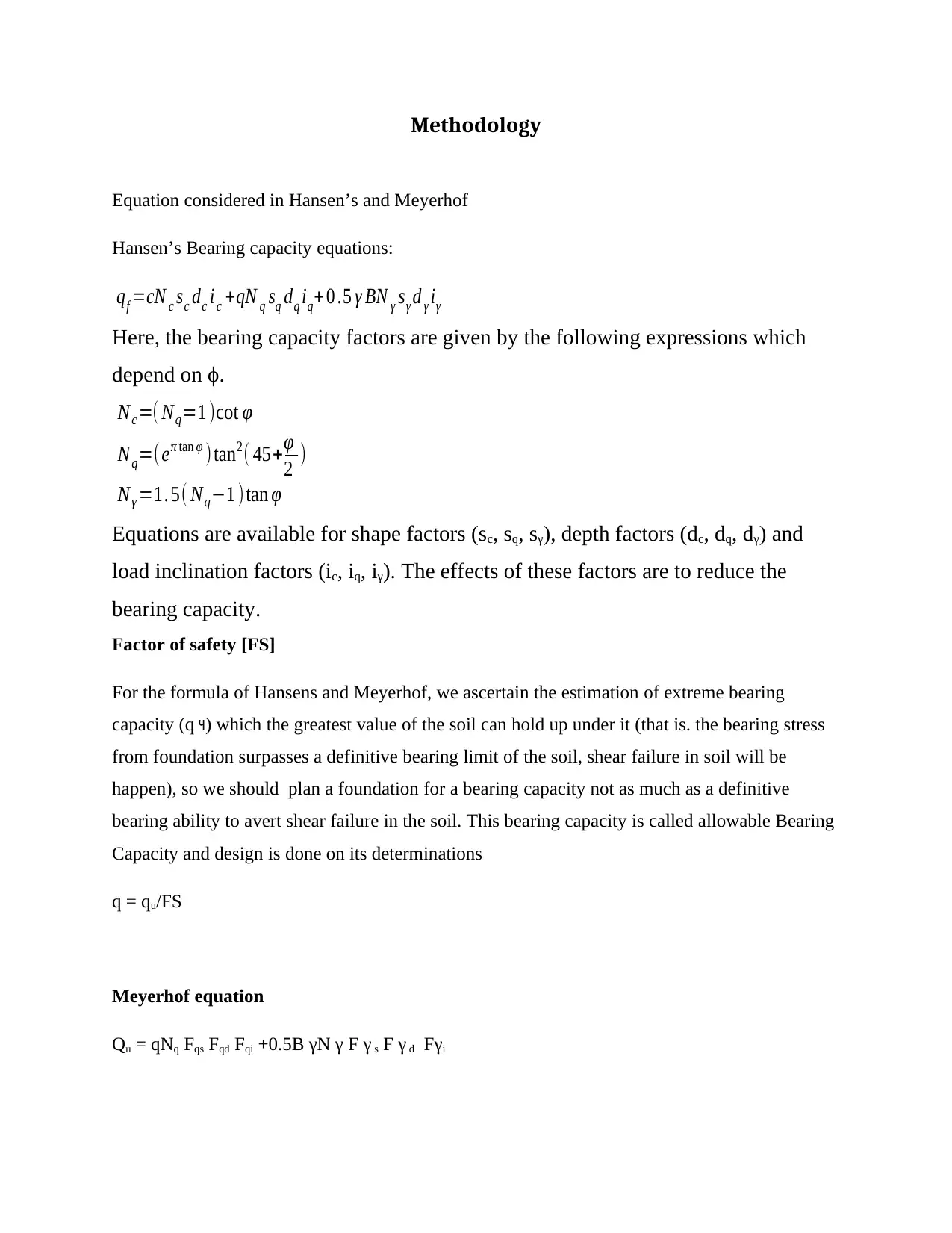
Equation considered in Hansen’s and Meyerhof
Hansen’s Bearing capacity equations:
qf =cN c sc dc ic +qN q sq dq iq+ 0 .5 γ BN γ sγ d γ iγ
Here, the bearing capacity factors are given by the following expressions which
depend on ϕ.
Nc =( Nq=1 )cot φ
Nq=(eπ tan φ )tan2( 45+φ
2 )
Nγ =1. 5( Nq−1 )tan φ
Equations are available for shape factors (sc, sq, sγ), depth factors (dc, dq, dγ) and
load inclination factors (ic, iq, iγ). The effects of these factors are to reduce the
bearing capacity.
Factor of safety [FS]
For the formula of Hansens and Meyerhof, we ascertain the estimation of extreme bearing
capacity (q ୳) which the greatest value of the soil can hold up under it (that is. the bearing stress
from foundation surpasses a definitive bearing limit of the soil, shear failure in soil will be
happen), so we should plan a foundation for a bearing capacity not as much as a definitive
bearing ability to avert shear failure in the soil. This bearing capacity is called allowable Bearing
Capacity and design is done on its determinations
q = qu/FS
Meyerhof equation
Qu = qNq Fqs Fqd Fqi +0.5B γN γ F γ s F γ d Fγi
Equation considered in Hansen’s and Meyerhof
Hansen’s Bearing capacity equations:
qf =cN c sc dc ic +qN q sq dq iq+ 0 .5 γ BN γ sγ d γ iγ
Here, the bearing capacity factors are given by the following expressions which
depend on ϕ.
Nc =( Nq=1 )cot φ
Nq=(eπ tan φ )tan2( 45+φ
2 )
Nγ =1. 5( Nq−1 )tan φ
Equations are available for shape factors (sc, sq, sγ), depth factors (dc, dq, dγ) and
load inclination factors (ic, iq, iγ). The effects of these factors are to reduce the
bearing capacity.
Factor of safety [FS]
For the formula of Hansens and Meyerhof, we ascertain the estimation of extreme bearing
capacity (q ୳) which the greatest value of the soil can hold up under it (that is. the bearing stress
from foundation surpasses a definitive bearing limit of the soil, shear failure in soil will be
happen), so we should plan a foundation for a bearing capacity not as much as a definitive
bearing ability to avert shear failure in the soil. This bearing capacity is called allowable Bearing
Capacity and design is done on its determinations
q = qu/FS
Meyerhof equation
Qu = qNq Fqs Fqd Fqi +0.5B γN γ F γ s F γ d Fγi
⊘ This is a preview!⊘
Do you want full access?
Subscribe today to unlock all pages.
Trusted by 1+ million students worldwide
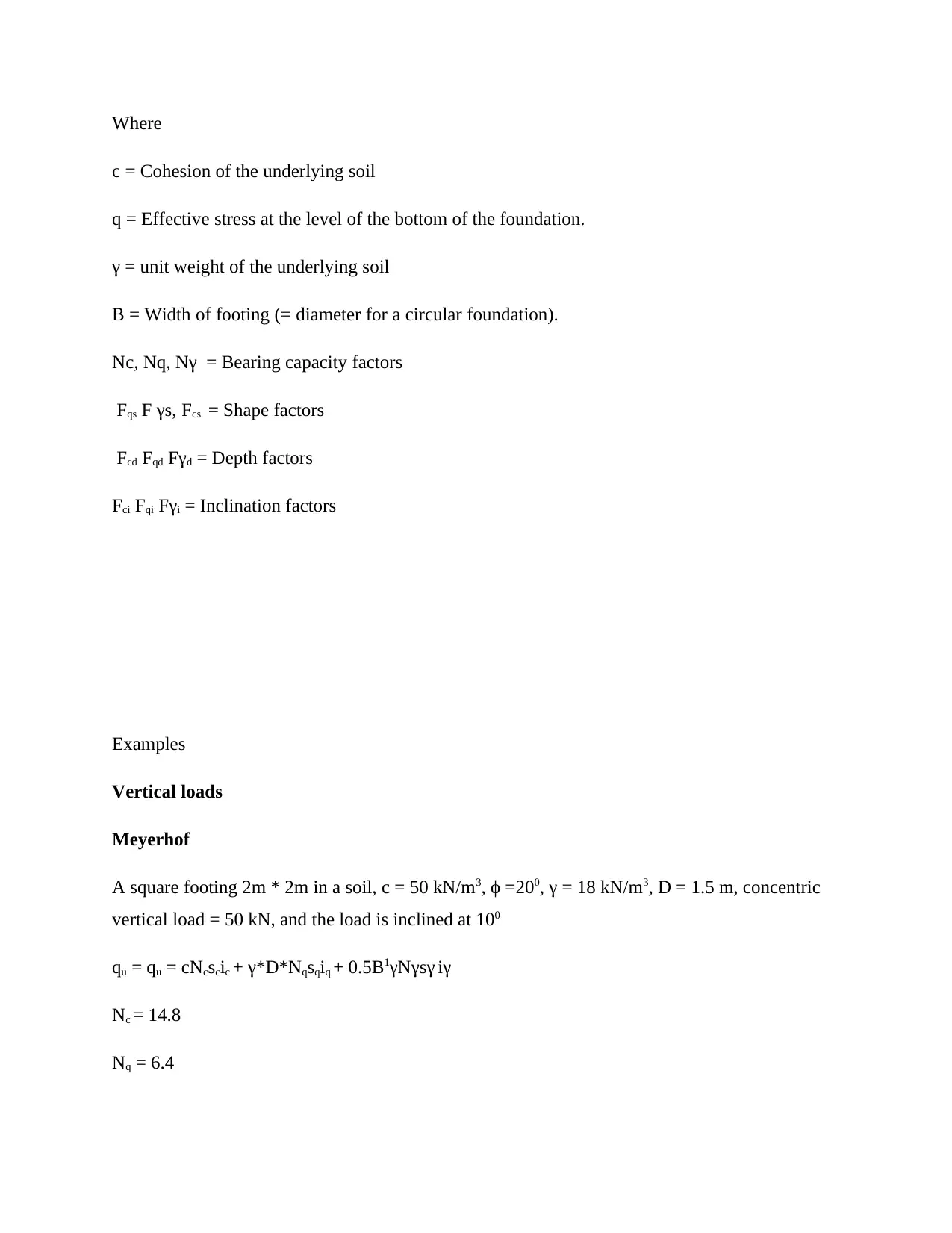
Where
c = Cohesion of the underlying soil
q = Effective stress at the level of the bottom of the foundation.
γ = unit weight of the underlying soil
B = Width of footing (= diameter for a circular foundation).
Nc, Nq, Nγ = Bearing capacity factors
Fqs F γs, Fcs = Shape factors
Fcd Fqd Fγd = Depth factors
Fci Fqi Fγi = Inclination factors
Examples
Vertical loads
Meyerhof
A square footing 2m * 2m in a soil, c = 50 kN/m3, ϕ =200, γ = 18 kN/m3, D = 1.5 m, concentric
vertical load = 50 kN, and the load is inclined at 100
qu = qu = cNcscic + γ*D*Nqsqiq + 0.5B1γNγsγ iγ
Nc = 14.8
Nq = 6.4
c = Cohesion of the underlying soil
q = Effective stress at the level of the bottom of the foundation.
γ = unit weight of the underlying soil
B = Width of footing (= diameter for a circular foundation).
Nc, Nq, Nγ = Bearing capacity factors
Fqs F γs, Fcs = Shape factors
Fcd Fqd Fγd = Depth factors
Fci Fqi Fγi = Inclination factors
Examples
Vertical loads
Meyerhof
A square footing 2m * 2m in a soil, c = 50 kN/m3, ϕ =200, γ = 18 kN/m3, D = 1.5 m, concentric
vertical load = 50 kN, and the load is inclined at 100
qu = qu = cNcscic + γ*D*Nqsqiq + 0.5B1γNγsγ iγ
Nc = 14.8
Nq = 6.4
Paraphrase This Document
Need a fresh take? Get an instant paraphrase of this document with our AI Paraphraser
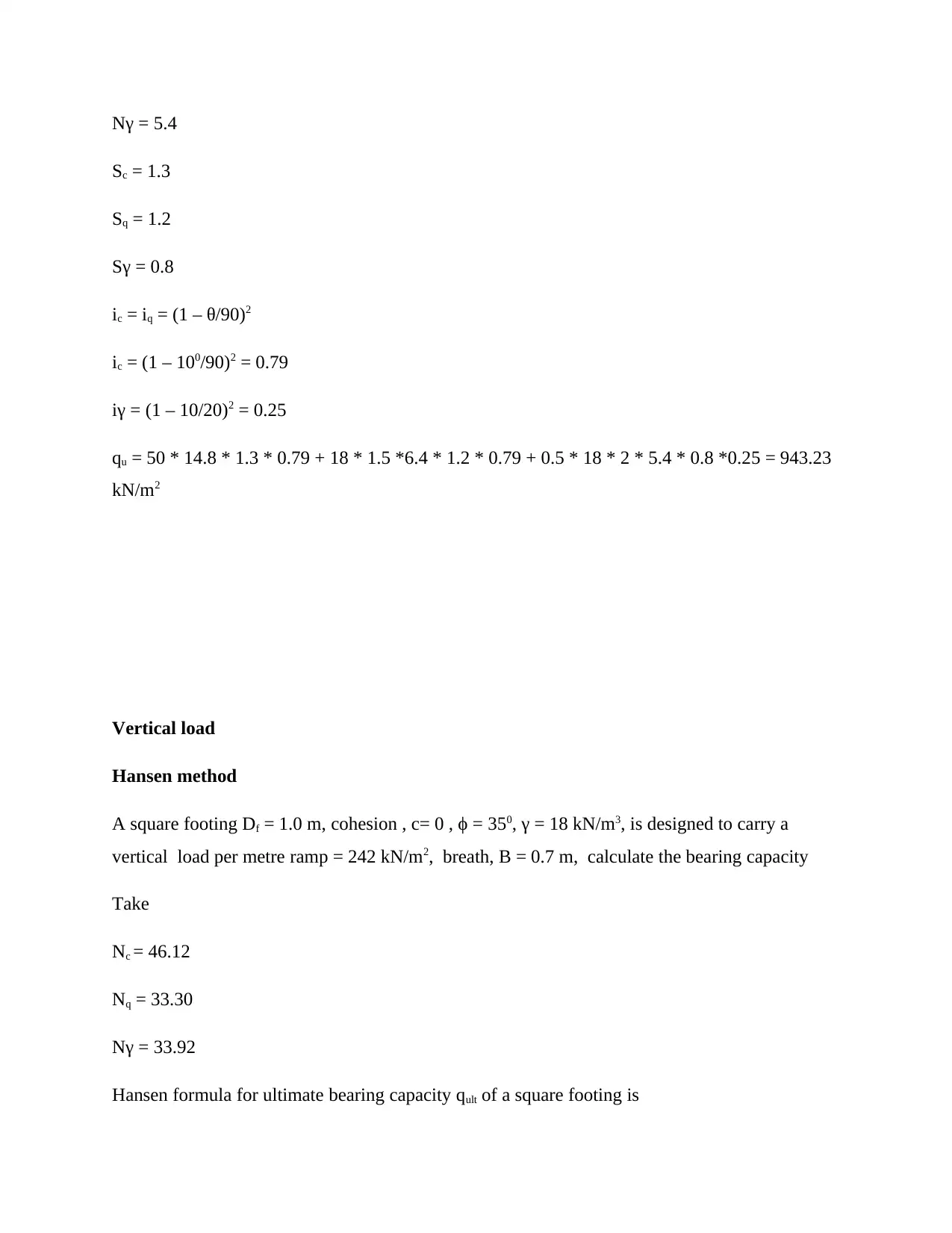
Nγ = 5.4
Sc = 1.3
Sq = 1.2
Sγ = 0.8
ic = iq = (1 – θ/90)2
ic = (1 – 100/90)2 = 0.79
iγ = (1 – 10/20)2 = 0.25
qu = 50 * 14.8 * 1.3 * 0.79 + 18 * 1.5 *6.4 * 1.2 * 0.79 + 0.5 * 18 * 2 * 5.4 * 0.8 *0.25 = 943.23
kN/m2
Vertical load
Hansen method
A square footing Df = 1.0 m, cohesion , c= 0 , ϕ = 350, γ = 18 kN/m3, is designed to carry a
vertical load per metre ramp = 242 kN/m2, breath, B = 0.7 m, calculate the bearing capacity
Take
Nc = 46.12
Nq = 33.30
Nγ = 33.92
Hansen formula for ultimate bearing capacity qult of a square footing is
Sc = 1.3
Sq = 1.2
Sγ = 0.8
ic = iq = (1 – θ/90)2
ic = (1 – 100/90)2 = 0.79
iγ = (1 – 10/20)2 = 0.25
qu = 50 * 14.8 * 1.3 * 0.79 + 18 * 1.5 *6.4 * 1.2 * 0.79 + 0.5 * 18 * 2 * 5.4 * 0.8 *0.25 = 943.23
kN/m2
Vertical load
Hansen method
A square footing Df = 1.0 m, cohesion , c= 0 , ϕ = 350, γ = 18 kN/m3, is designed to carry a
vertical load per metre ramp = 242 kN/m2, breath, B = 0.7 m, calculate the bearing capacity
Take
Nc = 46.12
Nq = 33.30
Nγ = 33.92
Hansen formula for ultimate bearing capacity qult of a square footing is
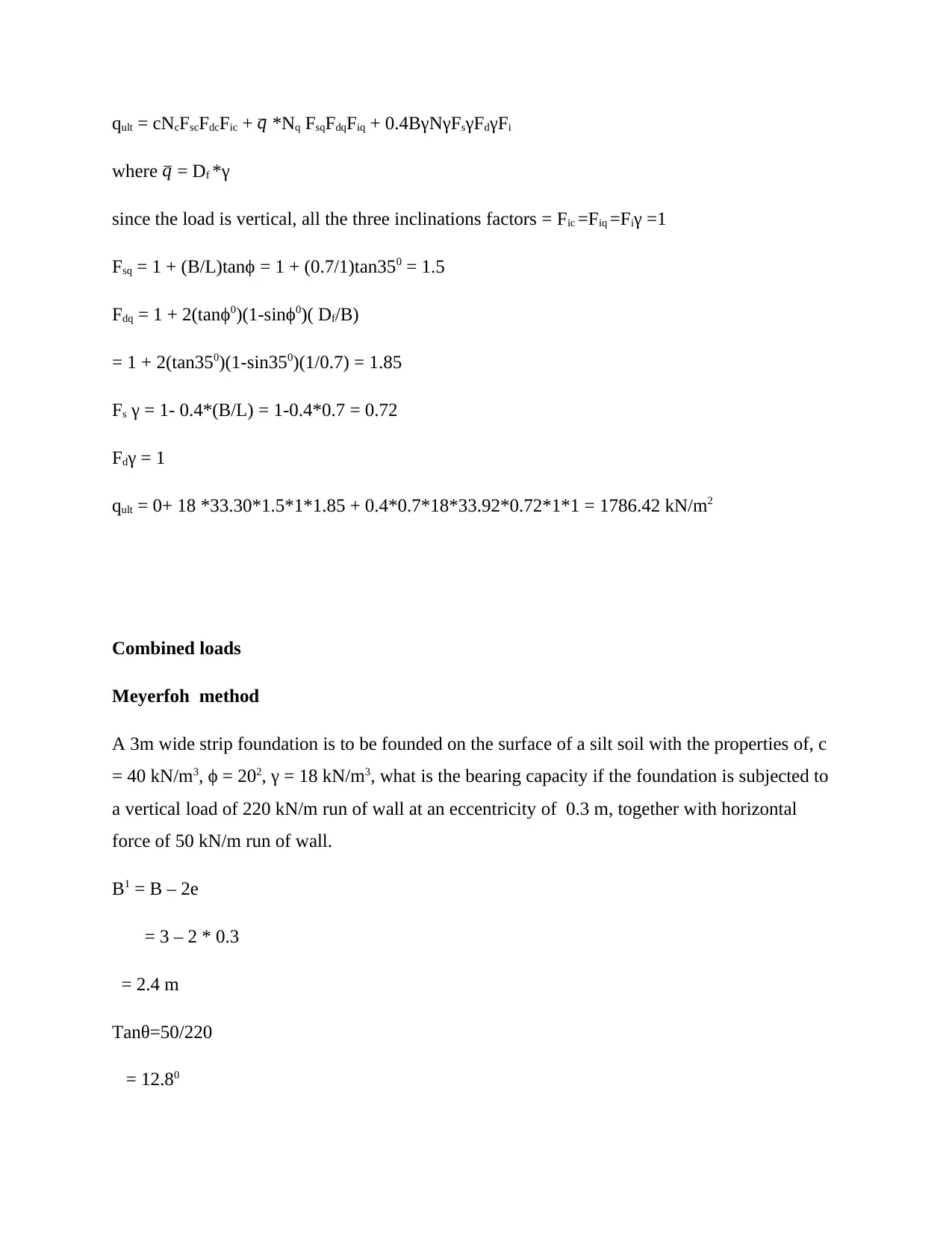
qult = cNcFscFdcFic + q *Nq FsqFdqFiq + 0.4BγNγFsγFdγFi
where q = Df *γ
since the load is vertical, all the three inclinations factors = Fic =Fiq =Fiγ =1
Fsq = 1 + (B/L)tanϕ = 1 + (0.7/1)tan350 = 1.5
Fdq = 1 + 2(tanϕ0)(1-sinϕ0)( Df/B)
= 1 + 2(tan350)(1-sin350)(1/0.7) = 1.85
Fs γ = 1- 0.4*(B/L) = 1-0.4*0.7 = 0.72
Fdγ = 1
qult = 0+ 18 *33.30*1.5*1*1.85 + 0.4*0.7*18*33.92*0.72*1*1 = 1786.42 kN/m2
Combined loads
Meyerfoh method
A 3m wide strip foundation is to be founded on the surface of a silt soil with the properties of, c
= 40 kN/m3, ϕ = 202, γ = 18 kN/m3, what is the bearing capacity if the foundation is subjected to
a vertical load of 220 kN/m run of wall at an eccentricity of 0.3 m, together with horizontal
force of 50 kN/m run of wall.
B1 = B – 2e
= 3 – 2 * 0.3
= 2.4 m
Tanθ=50/220
= 12.80
where q = Df *γ
since the load is vertical, all the three inclinations factors = Fic =Fiq =Fiγ =1
Fsq = 1 + (B/L)tanϕ = 1 + (0.7/1)tan350 = 1.5
Fdq = 1 + 2(tanϕ0)(1-sinϕ0)( Df/B)
= 1 + 2(tan350)(1-sin350)(1/0.7) = 1.85
Fs γ = 1- 0.4*(B/L) = 1-0.4*0.7 = 0.72
Fdγ = 1
qult = 0+ 18 *33.30*1.5*1*1.85 + 0.4*0.7*18*33.92*0.72*1*1 = 1786.42 kN/m2
Combined loads
Meyerfoh method
A 3m wide strip foundation is to be founded on the surface of a silt soil with the properties of, c
= 40 kN/m3, ϕ = 202, γ = 18 kN/m3, what is the bearing capacity if the foundation is subjected to
a vertical load of 220 kN/m run of wall at an eccentricity of 0.3 m, together with horizontal
force of 50 kN/m run of wall.
B1 = B – 2e
= 3 – 2 * 0.3
= 2.4 m
Tanθ=50/220
= 12.80
⊘ This is a preview!⊘
Do you want full access?
Subscribe today to unlock all pages.
Trusted by 1+ million students worldwide
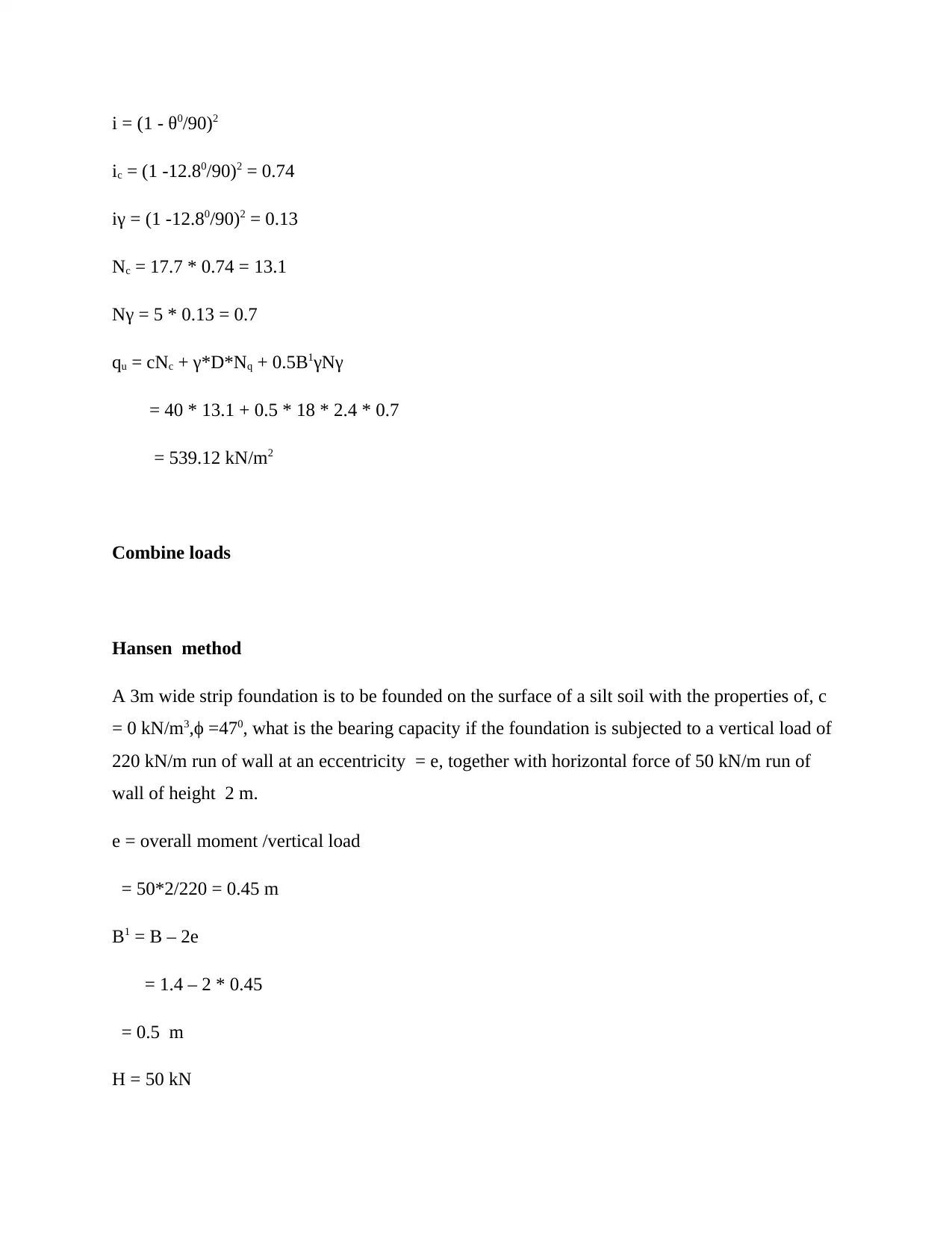
i = (1 - θ0/90)2
ic = (1 -12.80/90)2 = 0.74
iγ = (1 -12.80/90)2 = 0.13
Nc = 17.7 * 0.74 = 13.1
Nγ = 5 * 0.13 = 0.7
qu = cNc + γ*D*Nq + 0.5B1γNγ
= 40 * 13.1 + 0.5 * 18 * 2.4 * 0.7
= 539.12 kN/m2
Combine loads
Hansen method
A 3m wide strip foundation is to be founded on the surface of a silt soil with the properties of, c
= 0 kN/m3,ϕ =470, what is the bearing capacity if the foundation is subjected to a vertical load of
220 kN/m run of wall at an eccentricity = e, together with horizontal force of 50 kN/m run of
wall of height 2 m.
e = overall moment /vertical load
= 50*2/220 = 0.45 m
B1 = B – 2e
= 1.4 – 2 * 0.45
= 0.5 m
H = 50 kN
ic = (1 -12.80/90)2 = 0.74
iγ = (1 -12.80/90)2 = 0.13
Nc = 17.7 * 0.74 = 13.1
Nγ = 5 * 0.13 = 0.7
qu = cNc + γ*D*Nq + 0.5B1γNγ
= 40 * 13.1 + 0.5 * 18 * 2.4 * 0.7
= 539.12 kN/m2
Combine loads
Hansen method
A 3m wide strip foundation is to be founded on the surface of a silt soil with the properties of, c
= 0 kN/m3,ϕ =470, what is the bearing capacity if the foundation is subjected to a vertical load of
220 kN/m run of wall at an eccentricity = e, together with horizontal force of 50 kN/m run of
wall of height 2 m.
e = overall moment /vertical load
= 50*2/220 = 0.45 m
B1 = B – 2e
= 1.4 – 2 * 0.45
= 0.5 m
H = 50 kN
Paraphrase This Document
Need a fresh take? Get an instant paraphrase of this document with our AI Paraphraser
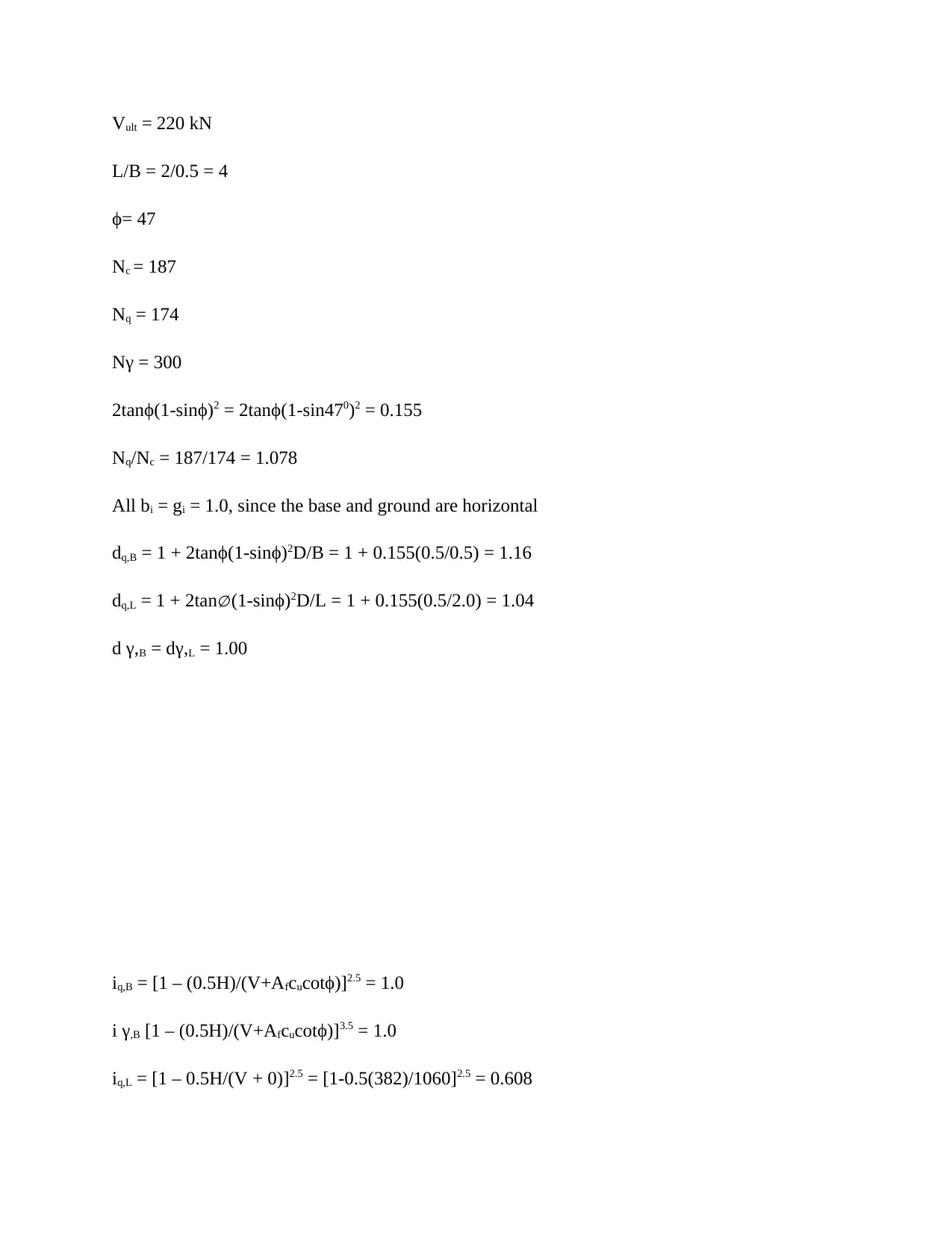
Vult = 220 kN
L/B = 2/0.5 = 4
ϕ= 47
Nc = 187
Nq = 174
Nγ = 300
2tanϕ(1-sinϕ)2 = 2tanϕ(1-sin470)2 = 0.155
Nq/Nc = 187/174 = 1.078
All bi = gi = 1.0, since the base and ground are horizontal
dq,B = 1 + 2tanϕ(1-sinϕ)2D/B = 1 + 0.155(0.5/0.5) = 1.16
dq,L = 1 + 2tan∅ (1-sinϕ)2D/L = 1 + 0.155(0.5/2.0) = 1.04
d γ,B = dγ,L = 1.00
iq,B = [1 – (0.5H)/(V+Afcucotϕ)]2.5 = 1.0
i γ,B [1 – (0.5H)/(V+Afcucotϕ)]3.5 = 1.0
iq,L = [1 – 0.5H/(V + 0)]2.5 = [1-0.5(382)/1060]2.5 = 0.608
L/B = 2/0.5 = 4
ϕ= 47
Nc = 187
Nq = 174
Nγ = 300
2tanϕ(1-sinϕ)2 = 2tanϕ(1-sin470)2 = 0.155
Nq/Nc = 187/174 = 1.078
All bi = gi = 1.0, since the base and ground are horizontal
dq,B = 1 + 2tanϕ(1-sinϕ)2D/B = 1 + 0.155(0.5/0.5) = 1.16
dq,L = 1 + 2tan∅ (1-sinϕ)2D/L = 1 + 0.155(0.5/2.0) = 1.04
d γ,B = dγ,L = 1.00
iq,B = [1 – (0.5H)/(V+Afcucotϕ)]2.5 = 1.0
i γ,B [1 – (0.5H)/(V+Afcucotϕ)]3.5 = 1.0
iq,L = [1 – 0.5H/(V + 0)]2.5 = [1-0.5(382)/1060]2.5 = 0.608
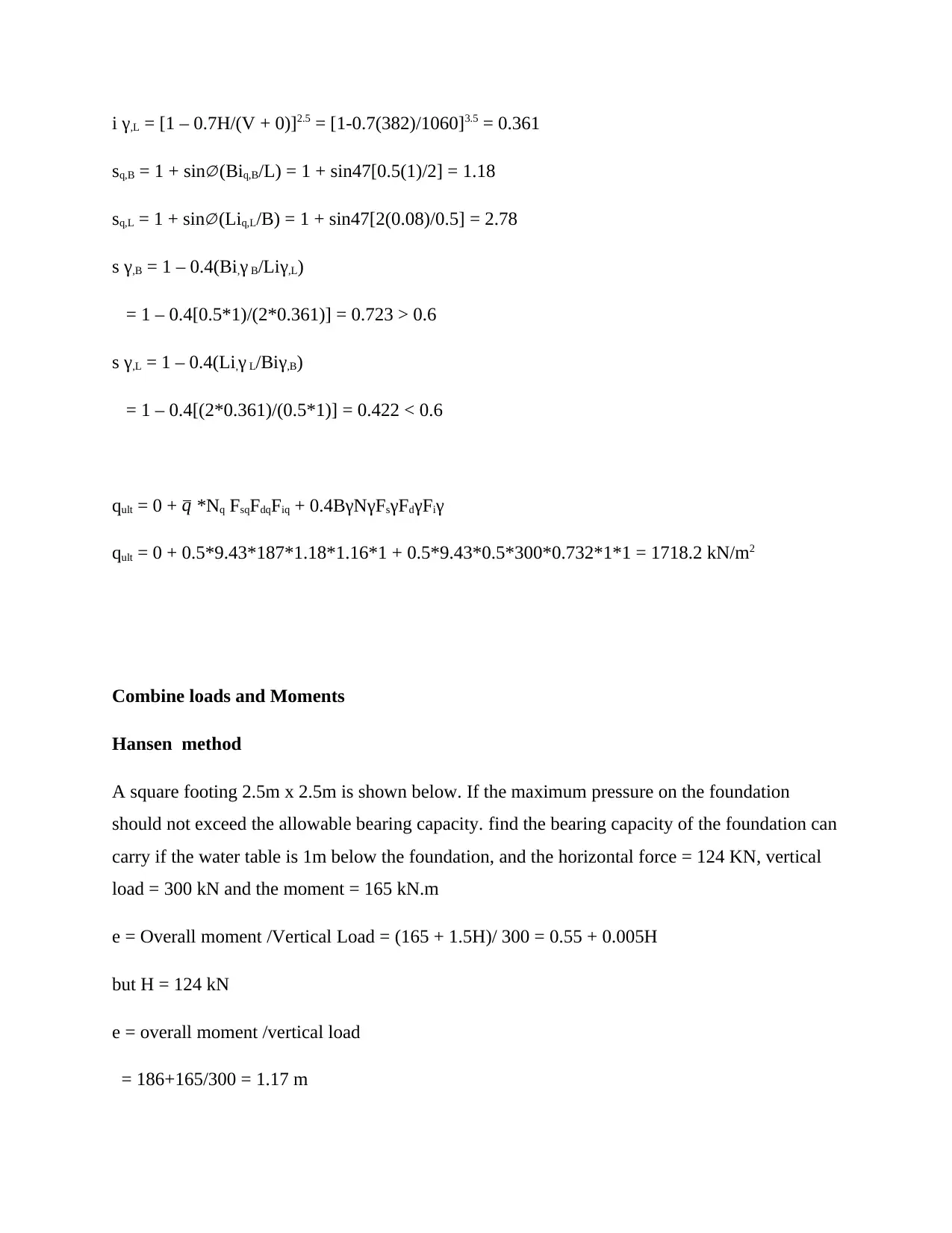
i γ,L = [1 – 0.7H/(V + 0)]2.5 = [1-0.7(382)/1060]3.5 = 0.361
sq,B = 1 + sin∅ (Biq,B/L) = 1 + sin47[0.5(1)/2] = 1.18
sq,L = 1 + sin∅ (Liq,L/B) = 1 + sin47[2(0.08)/0.5] = 2.78
s γ,B = 1 – 0.4(Bi,γ B/Liγ,L)
= 1 – 0.4[0.5*1)/(2*0.361)] = 0.723 > 0.6
s γ,L = 1 – 0.4(Li,γ L/Biγ,B)
= 1 – 0.4[(2*0.361)/(0.5*1)] = 0.422 < 0.6
qult = 0 + q *Nq FsqFdqFiq + 0.4BγNγFsγFdγFiγ
qult = 0 + 0.5*9.43*187*1.18*1.16*1 + 0.5*9.43*0.5*300*0.732*1*1 = 1718.2 kN/m2
Combine loads and Moments
Hansen method
A square footing 2.5m x 2.5m is shown below. If the maximum pressure on the foundation
should not exceed the allowable bearing capacity. find the bearing capacity of the foundation can
carry if the water table is 1m below the foundation, and the horizontal force = 124 KN, vertical
load = 300 kN and the moment = 165 kN.m
e = Overall moment /Vertical Load = (165 + 1.5H)/ 300 = 0.55 + 0.005H
but H = 124 kN
e = overall moment /vertical load
= 186+165/300 = 1.17 m
sq,B = 1 + sin∅ (Biq,B/L) = 1 + sin47[0.5(1)/2] = 1.18
sq,L = 1 + sin∅ (Liq,L/B) = 1 + sin47[2(0.08)/0.5] = 2.78
s γ,B = 1 – 0.4(Bi,γ B/Liγ,L)
= 1 – 0.4[0.5*1)/(2*0.361)] = 0.723 > 0.6
s γ,L = 1 – 0.4(Li,γ L/Biγ,B)
= 1 – 0.4[(2*0.361)/(0.5*1)] = 0.422 < 0.6
qult = 0 + q *Nq FsqFdqFiq + 0.4BγNγFsγFdγFiγ
qult = 0 + 0.5*9.43*187*1.18*1.16*1 + 0.5*9.43*0.5*300*0.732*1*1 = 1718.2 kN/m2
Combine loads and Moments
Hansen method
A square footing 2.5m x 2.5m is shown below. If the maximum pressure on the foundation
should not exceed the allowable bearing capacity. find the bearing capacity of the foundation can
carry if the water table is 1m below the foundation, and the horizontal force = 124 KN, vertical
load = 300 kN and the moment = 165 kN.m
e = Overall moment /Vertical Load = (165 + 1.5H)/ 300 = 0.55 + 0.005H
but H = 124 kN
e = overall moment /vertical load
= 186+165/300 = 1.17 m
⊘ This is a preview!⊘
Do you want full access?
Subscribe today to unlock all pages.
Trusted by 1+ million students worldwide

1 out of 19


Related Documents


Your All-in-One AI-Powered Toolkit for Academic Success.
+13062052269
info@desklib.com
Available 24*7 on WhatsApp / Email
![[object Object]](/_next/static/media/star-bottom.7253800d.svg)
Unlock your academic potential
Copyright © 2020–2026 A2Z Services. All Rights Reserved. Developed and managed by ZUCOL.