Anthropological Analysis: Exploring the Shamanic Tradition
VerifiedAdded on 2022/08/17
|9
|1632
|14
Essay
AI Summary
This essay provides an anthropological exploration of shamanism, examining its origins, practices, and significance across various cultures. It begins by defining shamanism and its core beliefs, including spiritualism and animism, highlighting the connection between humans and nature. The essay emphasizes the universal nature of shamanic traditions, which, despite regional variations, share a common worldview. It discusses the importance of shamanism in maintaining social cohesion, preserving cultural practices, and fostering respect for the environment. The essay further examines American Indian shamanism as a case study, illustrating how this culture embodies the core tenets of shamanism. The conclusion underscores the enduring relevance of shamanism in the modern world, particularly its emphasis on healing and its contribution to understanding the relationship between humans and the natural world. The essay draws on various scholarly sources to support its arguments, providing a comprehensive overview of the subject.
Running head: SHAMANIC TRADITION
Shamanic Tradition
Student’s name
University
Author’s note
Shamanic Tradition
Student’s name
University
Author’s note
Paraphrase This Document
Need a fresh take? Get an instant paraphrase of this document with our AI Paraphraser

SHAMANIC TRADITION
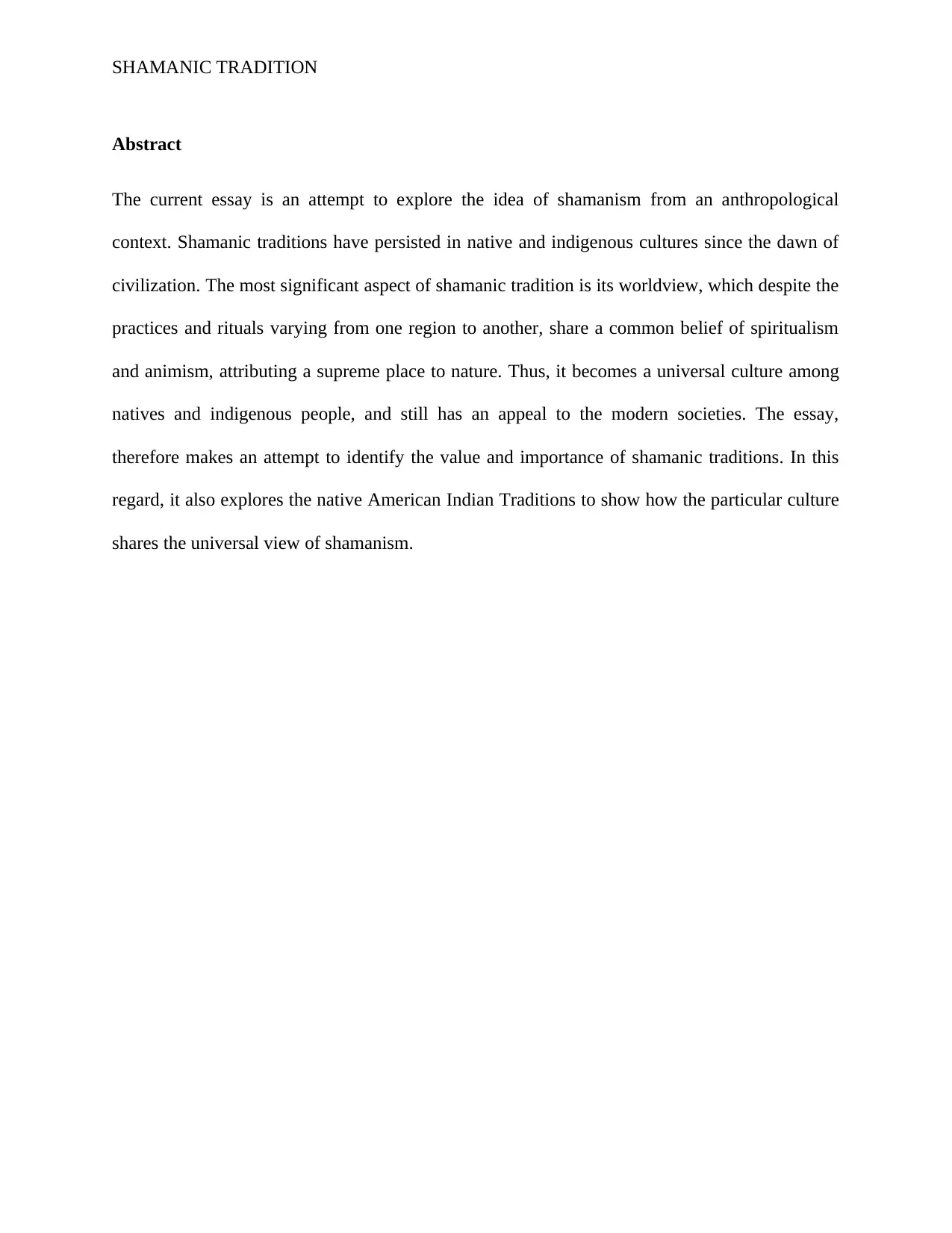
Abstract
The current essay is an attempt to explore the idea of shamanism from an anthropological
context. Shamanic traditions have persisted in native and indigenous cultures since the dawn of
civilization. The most significant aspect of shamanic tradition is its worldview, which despite the
practices and rituals varying from one region to another, share a common belief of spiritualism
and animism, attributing a supreme place to nature. Thus, it becomes a universal culture among
natives and indigenous people, and still has an appeal to the modern societies. The essay,
therefore makes an attempt to identify the value and importance of shamanic traditions. In this
regard, it also explores the native American Indian Traditions to show how the particular culture
shares the universal view of shamanism.
Abstract
The current essay is an attempt to explore the idea of shamanism from an anthropological
context. Shamanic traditions have persisted in native and indigenous cultures since the dawn of
civilization. The most significant aspect of shamanic tradition is its worldview, which despite the
practices and rituals varying from one region to another, share a common belief of spiritualism
and animism, attributing a supreme place to nature. Thus, it becomes a universal culture among
natives and indigenous people, and still has an appeal to the modern societies. The essay,
therefore makes an attempt to identify the value and importance of shamanic traditions. In this
regard, it also explores the native American Indian Traditions to show how the particular culture
shares the universal view of shamanism.

SHAMANIC TRADITION
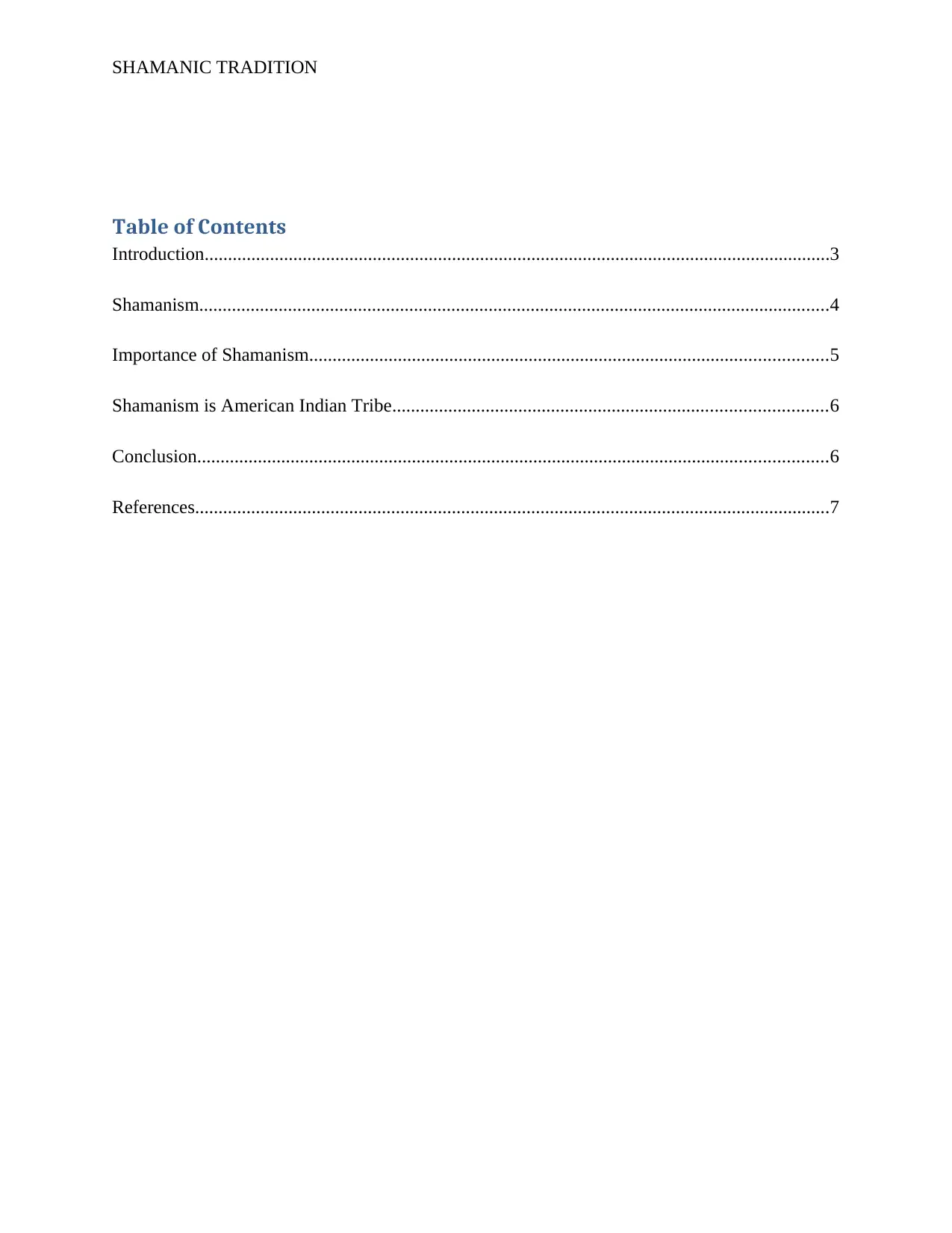
Table of Contents
Introduction......................................................................................................................................3
Shamanism.......................................................................................................................................4
Importance of Shamanism...............................................................................................................5
Shamanism is American Indian Tribe.............................................................................................6
Conclusion.......................................................................................................................................6
References........................................................................................................................................7
Table of Contents
Introduction......................................................................................................................................3
Shamanism.......................................................................................................................................4
Importance of Shamanism...............................................................................................................5
Shamanism is American Indian Tribe.............................................................................................6
Conclusion.......................................................................................................................................6
References........................................................................................................................................7
⊘ This is a preview!⊘
Do you want full access?
Subscribe today to unlock all pages.

Trusted by 1+ million students worldwide

SHAMANIC TRADITION
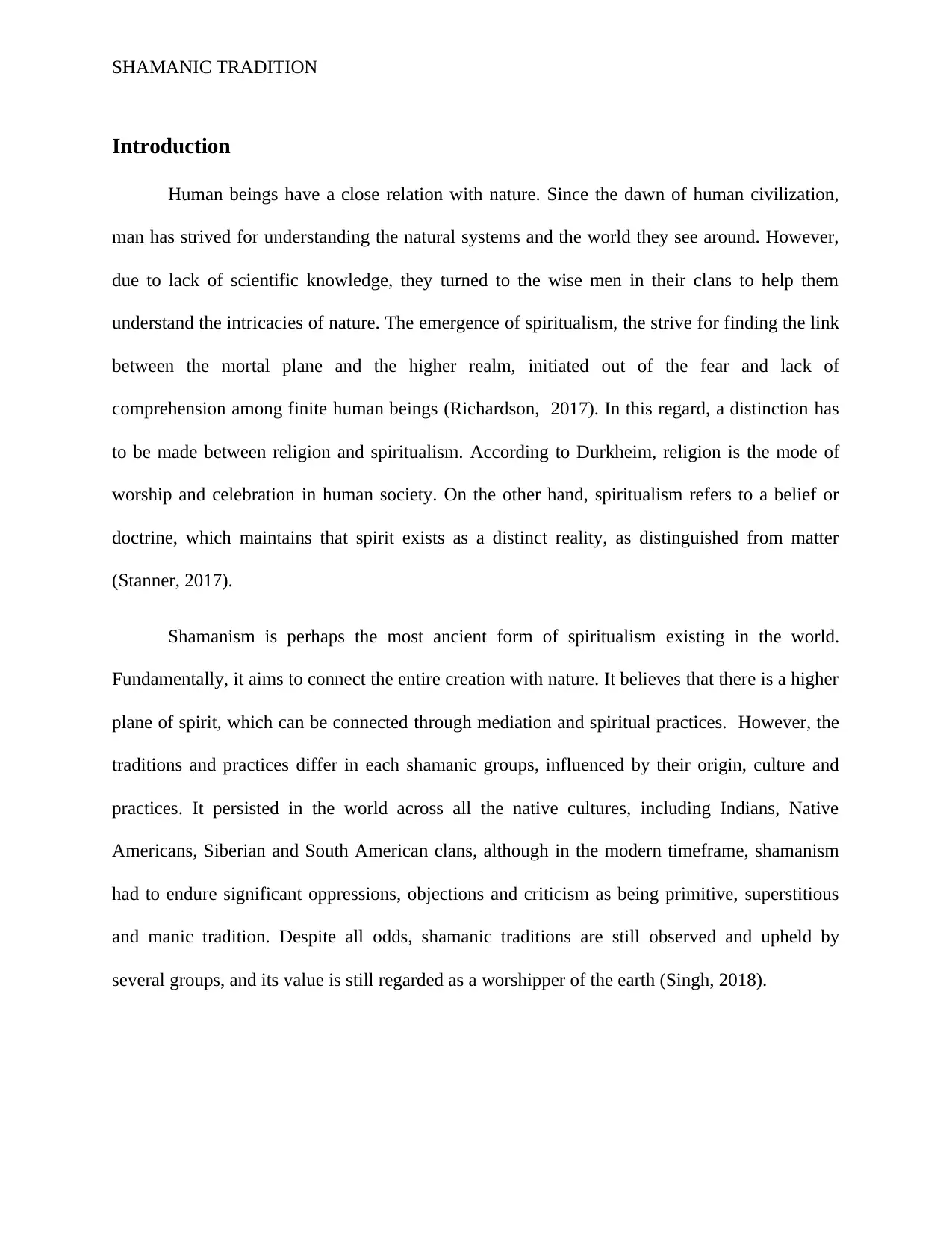
Introduction
Human beings have a close relation with nature. Since the dawn of human civilization,
man has strived for understanding the natural systems and the world they see around. However,
due to lack of scientific knowledge, they turned to the wise men in their clans to help them
understand the intricacies of nature. The emergence of spiritualism, the strive for finding the link
between the mortal plane and the higher realm, initiated out of the fear and lack of
comprehension among finite human beings (Richardson, 2017). In this regard, a distinction has
to be made between religion and spiritualism. According to Durkheim, religion is the mode of
worship and celebration in human society. On the other hand, spiritualism refers to a belief or
doctrine, which maintains that spirit exists as a distinct reality, as distinguished from matter
(Stanner, 2017).
Shamanism is perhaps the most ancient form of spiritualism existing in the world.
Fundamentally, it aims to connect the entire creation with nature. It believes that there is a higher
plane of spirit, which can be connected through mediation and spiritual practices. However, the
traditions and practices differ in each shamanic groups, influenced by their origin, culture and
practices. It persisted in the world across all the native cultures, including Indians, Native
Americans, Siberian and South American clans, although in the modern timeframe, shamanism
had to endure significant oppressions, objections and criticism as being primitive, superstitious
and manic tradition. Despite all odds, shamanic traditions are still observed and upheld by
several groups, and its value is still regarded as a worshipper of the earth (Singh, 2018).
Introduction
Human beings have a close relation with nature. Since the dawn of human civilization,
man has strived for understanding the natural systems and the world they see around. However,
due to lack of scientific knowledge, they turned to the wise men in their clans to help them
understand the intricacies of nature. The emergence of spiritualism, the strive for finding the link
between the mortal plane and the higher realm, initiated out of the fear and lack of
comprehension among finite human beings (Richardson, 2017). In this regard, a distinction has
to be made between religion and spiritualism. According to Durkheim, religion is the mode of
worship and celebration in human society. On the other hand, spiritualism refers to a belief or
doctrine, which maintains that spirit exists as a distinct reality, as distinguished from matter
(Stanner, 2017).
Shamanism is perhaps the most ancient form of spiritualism existing in the world.
Fundamentally, it aims to connect the entire creation with nature. It believes that there is a higher
plane of spirit, which can be connected through mediation and spiritual practices. However, the
traditions and practices differ in each shamanic groups, influenced by their origin, culture and
practices. It persisted in the world across all the native cultures, including Indians, Native
Americans, Siberian and South American clans, although in the modern timeframe, shamanism
had to endure significant oppressions, objections and criticism as being primitive, superstitious
and manic tradition. Despite all odds, shamanic traditions are still observed and upheld by
several groups, and its value is still regarded as a worshipper of the earth (Singh, 2018).
Paraphrase This Document
Need a fresh take? Get an instant paraphrase of this document with our AI Paraphraser

SHAMANIC TRADITION
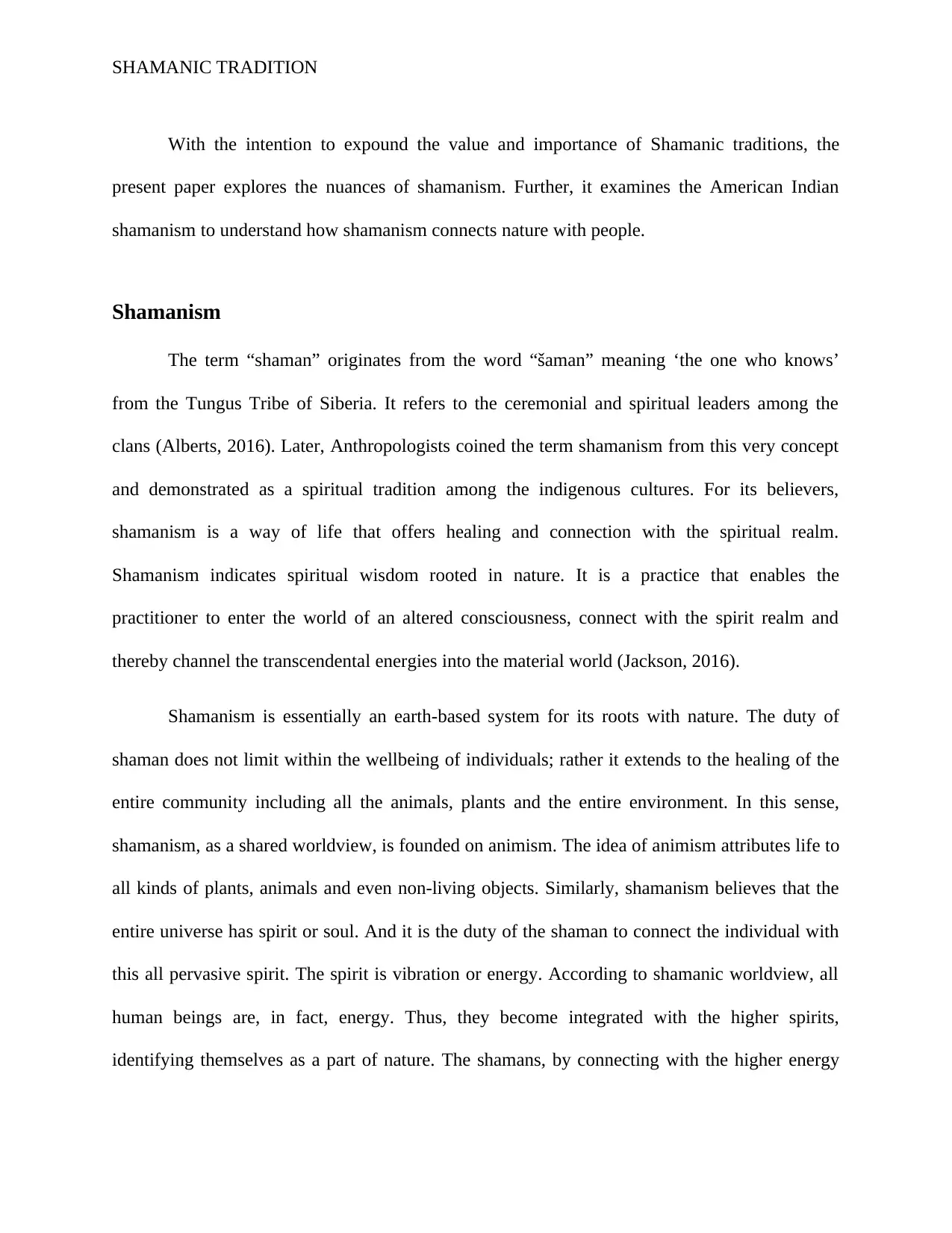
With the intention to expound the value and importance of Shamanic traditions, the
present paper explores the nuances of shamanism. Further, it examines the American Indian
shamanism to understand how shamanism connects nature with people.
Shamanism
The term “shaman” originates from the word “šaman” meaning ‘the one who knows’
from the Tungus Tribe of Siberia. It refers to the ceremonial and spiritual leaders among the
clans (Alberts, 2016). Later, Anthropologists coined the term shamanism from this very concept
and demonstrated as a spiritual tradition among the indigenous cultures. For its believers,
shamanism is a way of life that offers healing and connection with the spiritual realm.
Shamanism indicates spiritual wisdom rooted in nature. It is a practice that enables the
practitioner to enter the world of an altered consciousness, connect with the spirit realm and
thereby channel the transcendental energies into the material world (Jackson, 2016).
Shamanism is essentially an earth-based system for its roots with nature. The duty of
shaman does not limit within the wellbeing of individuals; rather it extends to the healing of the
entire community including all the animals, plants and the entire environment. In this sense,
shamanism, as a shared worldview, is founded on animism. The idea of animism attributes life to
all kinds of plants, animals and even non-living objects. Similarly, shamanism believes that the
entire universe has spirit or soul. And it is the duty of the shaman to connect the individual with
this all pervasive spirit. The spirit is vibration or energy. According to shamanic worldview, all
human beings are, in fact, energy. Thus, they become integrated with the higher spirits,
identifying themselves as a part of nature. The shamans, by connecting with the higher energy
With the intention to expound the value and importance of Shamanic traditions, the
present paper explores the nuances of shamanism. Further, it examines the American Indian
shamanism to understand how shamanism connects nature with people.
Shamanism
The term “shaman” originates from the word “šaman” meaning ‘the one who knows’
from the Tungus Tribe of Siberia. It refers to the ceremonial and spiritual leaders among the
clans (Alberts, 2016). Later, Anthropologists coined the term shamanism from this very concept
and demonstrated as a spiritual tradition among the indigenous cultures. For its believers,
shamanism is a way of life that offers healing and connection with the spiritual realm.
Shamanism indicates spiritual wisdom rooted in nature. It is a practice that enables the
practitioner to enter the world of an altered consciousness, connect with the spirit realm and
thereby channel the transcendental energies into the material world (Jackson, 2016).
Shamanism is essentially an earth-based system for its roots with nature. The duty of
shaman does not limit within the wellbeing of individuals; rather it extends to the healing of the
entire community including all the animals, plants and the entire environment. In this sense,
shamanism, as a shared worldview, is founded on animism. The idea of animism attributes life to
all kinds of plants, animals and even non-living objects. Similarly, shamanism believes that the
entire universe has spirit or soul. And it is the duty of the shaman to connect the individual with
this all pervasive spirit. The spirit is vibration or energy. According to shamanic worldview, all
human beings are, in fact, energy. Thus, they become integrated with the higher spirits,
identifying themselves as a part of nature. The shamans, by connecting with the higher energy

SHAMANIC TRADITION
and transmitting to the individual as well as the community, makes them stronger and fosters
healing from pain and suffering (Olson, 2017).
Importance of Shamanism
It is generally agreed upon that shamanic traditions originated from primitive hunter-
gatherer societies. Although varied in its practices and rituals, shamanism is shared across
different regions and communities, embedded in the fundamental beliefs of healing and
spirituality. Thus, despite its variations, shamanic tradition has become a worldview from
anthropological, historical as well as sociological perspectives.
The importance of shamanism is two-fold. First, the shamanic traditions in primitive and
indigenous communities helped to achieve the cohesion required to form a society. It also aids to
the social organization by maintaining social structures and customs. Evidences show that people
followed their own shaman and were guided by the visions of the shaman (Nielsen, Fischer &
Kashima, 2018).
Shamanism also offers an interesting insight regarding the human-nature relationship. By
ascribing the supreme position to the spirit realm, shamanism in every indigenous community
held the value of nature, and guided human beings to respect and protect the environment. The
hunters required the shaman’s permission before their escapades, and also were foretold which
animals to spare or which part of the region to be avoided. Moreover, the healing capacity of the
shamans was extended to all creatures, thus imparting respect for nature (Gheorghiu, Pásztor &
Bender, 2018).
and transmitting to the individual as well as the community, makes them stronger and fosters
healing from pain and suffering (Olson, 2017).
Importance of Shamanism
It is generally agreed upon that shamanic traditions originated from primitive hunter-
gatherer societies. Although varied in its practices and rituals, shamanism is shared across
different regions and communities, embedded in the fundamental beliefs of healing and
spirituality. Thus, despite its variations, shamanic tradition has become a worldview from
anthropological, historical as well as sociological perspectives.
The importance of shamanism is two-fold. First, the shamanic traditions in primitive and
indigenous communities helped to achieve the cohesion required to form a society. It also aids to
the social organization by maintaining social structures and customs. Evidences show that people
followed their own shaman and were guided by the visions of the shaman (Nielsen, Fischer &
Kashima, 2018).
Shamanism also offers an interesting insight regarding the human-nature relationship. By
ascribing the supreme position to the spirit realm, shamanism in every indigenous community
held the value of nature, and guided human beings to respect and protect the environment. The
hunters required the shaman’s permission before their escapades, and also were foretold which
animals to spare or which part of the region to be avoided. Moreover, the healing capacity of the
shamans was extended to all creatures, thus imparting respect for nature (Gheorghiu, Pásztor &
Bender, 2018).
⊘ This is a preview!⊘
Do you want full access?
Subscribe today to unlock all pages.

Trusted by 1+ million students worldwide

SHAMANIC TRADITION
Shamanism is American Indian Tribe
Shamanism constitutes the most significant aspect of the religious life among the
American Indians. They worshipped nature and all its forces, believing the spirits guide them and
protect them from dangers. Shamans among the Indians were characterized by supernatural
power acquired through divine vision, as a result of immediate personal experience. This vision
could endow on an individual naturally or following a quest. The primary duties of the shamans
included healing and satisfying the spirits for the betterment of the clan. Thus, it shares its
fundamental characteristics with the universal notion of shamanism. Moreover, Shamans among
American Indians were also endowed with magico-religious rites, such as Ghost Dance, to
protect the community from danger. It is opined by several scholars that shamans in these
communities had a crucial role in the social order and cohesion, for their care for the community
united the members as a group (Warren, 2017).
Conclusion
Shamanism, although initiated in a distant past, has regained interests and attention in the
contemporary world. In the past few decades, it has gained significant focus especially in the
western world. The most prominent feature of shamanism that appeals to the masses till date is
its emphasis on healing. However, the academic appeal of shamanism lies in its universal
worldview of spiritualism and its contact with nature. It signifies that almost all the primitive
spiritual and religious practice across the world was based on nature and its forces. Thus, it
reiterates the age0-old bond between man and the environment, attributing nature a fundamental
place in human life.
Shamanism is American Indian Tribe
Shamanism constitutes the most significant aspect of the religious life among the
American Indians. They worshipped nature and all its forces, believing the spirits guide them and
protect them from dangers. Shamans among the Indians were characterized by supernatural
power acquired through divine vision, as a result of immediate personal experience. This vision
could endow on an individual naturally or following a quest. The primary duties of the shamans
included healing and satisfying the spirits for the betterment of the clan. Thus, it shares its
fundamental characteristics with the universal notion of shamanism. Moreover, Shamans among
American Indians were also endowed with magico-religious rites, such as Ghost Dance, to
protect the community from danger. It is opined by several scholars that shamans in these
communities had a crucial role in the social order and cohesion, for their care for the community
united the members as a group (Warren, 2017).
Conclusion
Shamanism, although initiated in a distant past, has regained interests and attention in the
contemporary world. In the past few decades, it has gained significant focus especially in the
western world. The most prominent feature of shamanism that appeals to the masses till date is
its emphasis on healing. However, the academic appeal of shamanism lies in its universal
worldview of spiritualism and its contact with nature. It signifies that almost all the primitive
spiritual and religious practice across the world was based on nature and its forces. Thus, it
reiterates the age0-old bond between man and the environment, attributing nature a fundamental
place in human life.
Paraphrase This Document
Need a fresh take? Get an instant paraphrase of this document with our AI Paraphraser

SHAMANIC TRADITION
References
Alberts, T. K. (2016). Shamanism, discourse, modernity. Routledge.
Gheorghiu, D., Pásztor, E., & Bender, H. (Eds.). (2018). Archaeological Approaches to
Shamanism: Mind-body, Nature, and Culture. Cambridge Scholars Publishing.
Jackson, P. (2016). Horizons of Shamanism. Stockholm University Press.
Nielsen, M., Fischer, R., & Kashima, Y. (2018). Shamanism and the social nature of cumulative
culture. Behavioral and Brain Sciences, 41.
Olson, C. (2017). Ways of Healing and the Roles of Harmony, Purity, and Violent Rhetoric in
Japanese Shinto and Shamanism. Better Health through Spiritual Practices: A Guide to
Religious Behaviors and Perspectives that Benefit Mind and Body, 97.
Richardson, E. (2017). Primitive Spiritualism and Origin Stories. In Second Sight in the
Nineteenth Century (pp. 103-149). Palgrave Macmillan, London.
Singh, M. (2018). The cultural evolution of shamanism. Behavioral and Brain Sciences, 41.
Stanner, W. E. (2017). Reflections on Durkheim and aboriginal religion. In Social Organization
and Peasant Societies (pp. 217-240). Routledge.
Warren, L. S. (2017). God's red son: The Ghost Dance religion and the making of modern
America. Hachette UK.
References
Alberts, T. K. (2016). Shamanism, discourse, modernity. Routledge.
Gheorghiu, D., Pásztor, E., & Bender, H. (Eds.). (2018). Archaeological Approaches to
Shamanism: Mind-body, Nature, and Culture. Cambridge Scholars Publishing.
Jackson, P. (2016). Horizons of Shamanism. Stockholm University Press.
Nielsen, M., Fischer, R., & Kashima, Y. (2018). Shamanism and the social nature of cumulative
culture. Behavioral and Brain Sciences, 41.
Olson, C. (2017). Ways of Healing and the Roles of Harmony, Purity, and Violent Rhetoric in
Japanese Shinto and Shamanism. Better Health through Spiritual Practices: A Guide to
Religious Behaviors and Perspectives that Benefit Mind and Body, 97.
Richardson, E. (2017). Primitive Spiritualism and Origin Stories. In Second Sight in the
Nineteenth Century (pp. 103-149). Palgrave Macmillan, London.
Singh, M. (2018). The cultural evolution of shamanism. Behavioral and Brain Sciences, 41.
Stanner, W. E. (2017). Reflections on Durkheim and aboriginal religion. In Social Organization
and Peasant Societies (pp. 217-240). Routledge.
Warren, L. S. (2017). God's red son: The Ghost Dance religion and the making of modern
America. Hachette UK.

SHAMANIC TRADITION
⊘ This is a preview!⊘
Do you want full access?
Subscribe today to unlock all pages.

Trusted by 1+ million students worldwide
1 out of 9
Your All-in-One AI-Powered Toolkit for Academic Success.
+13062052269
info@desklib.com
Available 24*7 on WhatsApp / Email
Unlock your academic potential
Copyright © 2020–2025 A2Z Services. All Rights Reserved. Developed and managed by ZUCOL.