Case Study: Job Design and Labor Cost Trimming at Shearwear Company

Verified

Added on  2023/06/09

|6
|1004
|90
Case Study
AI Summary
This case study examines Shearwear's attempt to balance quality service with cost reduction through job design and labor cost trimming. It analyzes the suitability of job enrichment given the company's high managerial turnover and low employee morale. The study further investigates the impact of labor cost trimming on the company, detailing the reasons for its implementation, the assurances given to staff, and the new pay arrangements designed to maintain morale and productivity. The analysis considers the potential effects of these changes on both cost reduction and employee motivation, highlighting the importance of a balanced approach to human resource management in achieving organizational goals. Desklib provides access to similar case studies and study resources for students.
Document Page
Running head: CASE STUDY
CASE STUDY
Name of the Student
Name of the University
Author Note
tabler-icon-diamond-filled.svg

Paraphrase This Document

Need a fresh take? Get an instant paraphrase of this document with our AI Paraphraser
Document Page
1CASE STUDY
Table of Contents
Answer to Question 1: Job design and suitability...........................................................................2
Answer to Question 2: Labor cost trimming and after effects on the company..............................3
References........................................................................................................................................5
Document Page
2CASE STUDY
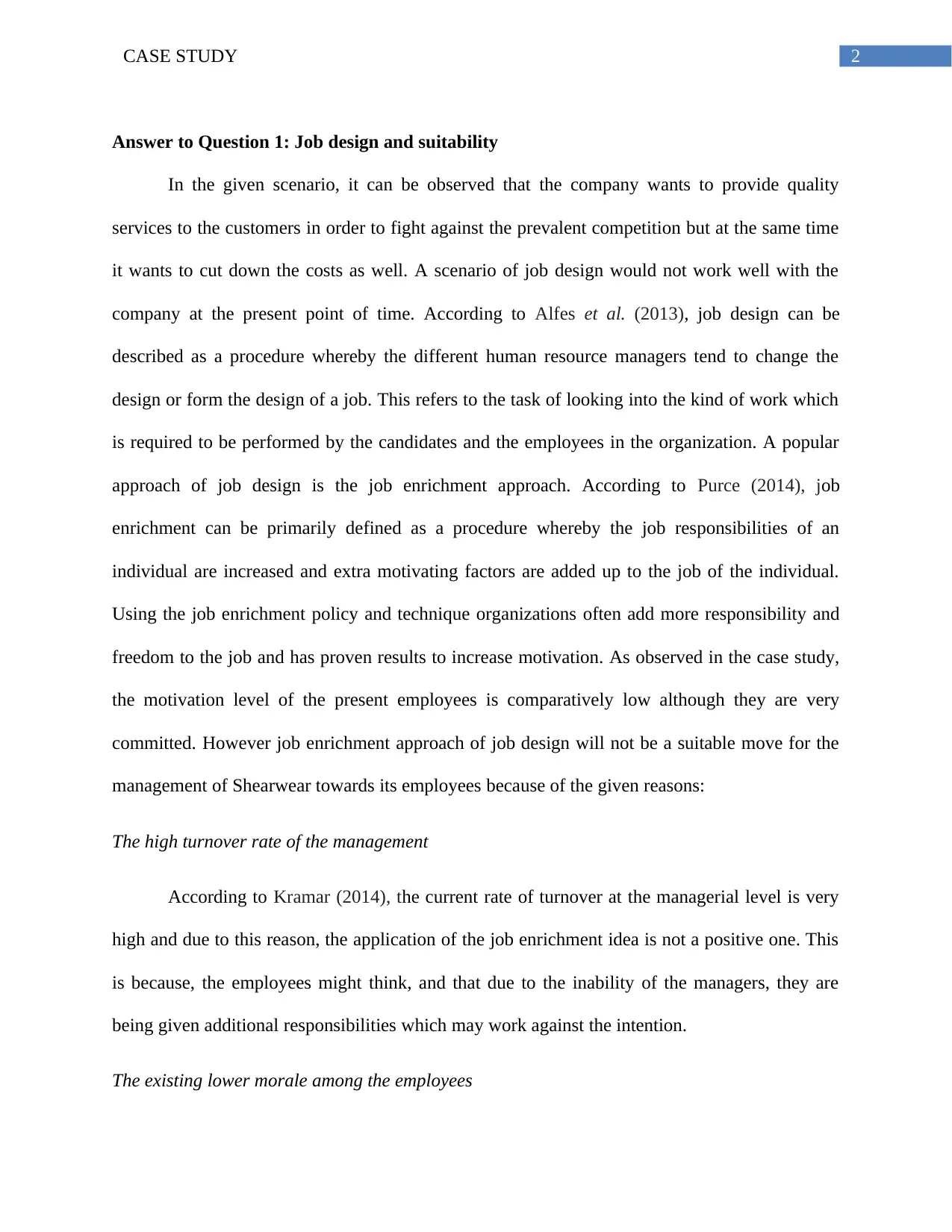
Answer to Question 1: Job design and suitability
In the given scenario, it can be observed that the company wants to provide quality
services to the customers in order to fight against the prevalent competition but at the same time
it wants to cut down the costs as well. A scenario of job design would not work well with the
company at the present point of time. According to Alfes et al. (2013), job design can be
described as a procedure whereby the different human resource managers tend to change the
design or form the design of a job. This refers to the task of looking into the kind of work which
is required to be performed by the candidates and the employees in the organization. A popular
approach of job design is the job enrichment approach. According to Purce (2014), job
enrichment can be primarily defined as a procedure whereby the job responsibilities of an
individual are increased and extra motivating factors are added up to the job of the individual.
Using the job enrichment policy and technique organizations often add more responsibility and
freedom to the job and has proven results to increase motivation. As observed in the case study,
the motivation level of the present employees is comparatively low although they are very
committed. However job enrichment approach of job design will not be a suitable move for the
management of Shearwear towards its employees because of the given reasons:
The high turnover rate of the management
According to Kramar (2014), the current rate of turnover at the managerial level is very
high and due to this reason, the application of the job enrichment idea is not a positive one. This
is because, the employees might think, and that due to the inability of the managers, they are
being given additional responsibilities which may work against the intention.
The existing lower morale among the employees
Document Page
3CASE STUDY
The employee morale is already quite low among the workers and enrichment with
additional responsibilities may come off as an additional burden to them. It will be difficult for
them to trust the managers.
Answer to Question 2: Labor cost trimming and after effects on the company
Reason why it happened
At Shearwater, the morale of the employees has remained comparatively low and they are
being forced from the management to reduce its costs and thus, the managing director had
decided to look into the different spheres in order to determine the areas where costs could have
been controlled. After analysis it was observed that the about cost is the only cost which can be
trimmed.
Impact on the company and Assurance given
Hence, the management went ahead with the task and promised the staff that the orders
were good for the medium time range and hence, redundancies shall be avoided. Hence, a new
pay arrangement was designed for the different staff members with the help of a periodic
management review. According to the case study, this review was done after a follow-up
consultation with the council comprising of the union as well as the non-union representatives.
Payment decisions
After the joint decision was made, the pay arrangements were agreed upon and the
following were laid down:
The staff involved in the manufacturing organization will be paid on a basic pay rate
which will be adjusted accordingly with the inflation rate.
tabler-icon-diamond-filled.svg

Paraphrase This Document

Need a fresh take? Get an instant paraphrase of this document with our AI Paraphraser
Document Page
4CASE STUDY
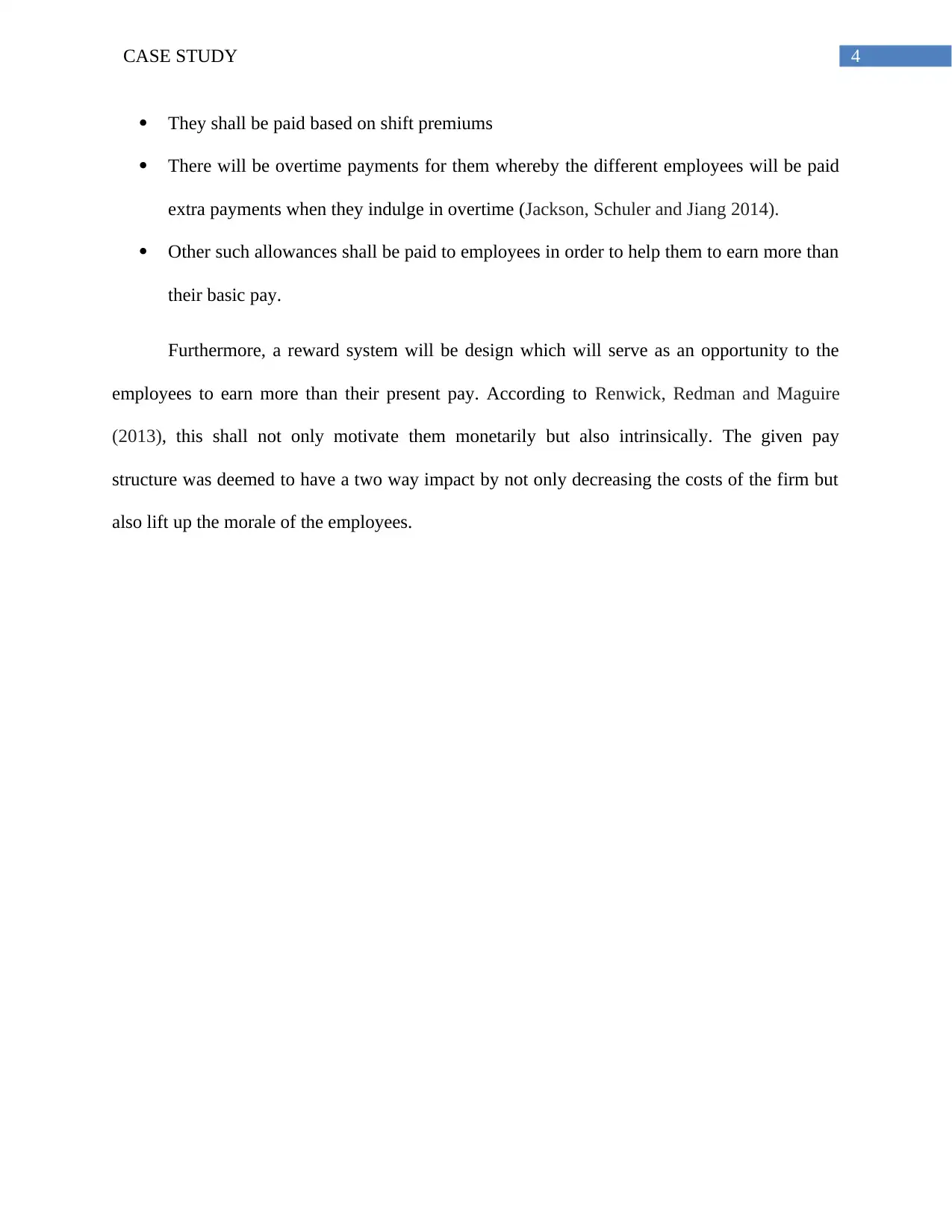
They shall be paid based on shift premiums
There will be overtime payments for them whereby the different employees will be paid
extra payments when they indulge in overtime (Jackson, Schuler and Jiang 2014).
Other such allowances shall be paid to employees in order to help them to earn more than
their basic pay.
Furthermore, a reward system will be design which will serve as an opportunity to the
employees to earn more than their present pay. According to Renwick, Redman and Maguire
(2013), this shall not only motivate them monetarily but also intrinsically. The given pay
structure was deemed to have a two way impact by not only decreasing the costs of the firm but
also lift up the morale of the employees.
Document Page
5CASE STUDY
References
Alfes, K., Shantz, A.D., Truss, C. and Soane, E.C., 2013. The link between perceived human
resource management practices, engagement and employee behaviour: a moderated mediation
model. The international journal of human resource management, 24(2), pp.330-351.
Jackson, S.E., Schuler, R.S. and Jiang, K., 2014. An aspirational framework for strategic human
resource management. The Academy of Management Annals, 8(1), pp.1-56.
Kramar, R., 2014. Beyond strategic human resource management: is sustainable human resource
management the next approach?. The International Journal of Human Resource
Management, 25(8), pp.1069-1089.
Purce, J., 2014. The impact of corporate strategy on human resource management. New
Perspectives on Human Resource Management (Routledge Revivals), 67.
Renwick, D.W., Redman, T. and Maguire, S., 2013. Green human resource management: A
review and research agenda. International Journal of Management Reviews, 15(1), pp.1-14.
chevron_up_icon
1 out of 6
circle_padding
hide_on_mobile
zoom_out_icon
[object Object]