Sheffield City Council's Policy to Increase Waste Recycling

Verified

Added on  2023/01/10

|6
|995
|22
Report
AI Summary
This report evaluates Sheffield City Council's proposed policy to increase domestic waste recycling through household inspections and fines. It discusses the design and implementation of a Randomized Controlled Trial (RCT) to assess the policy's effectiveness, including the collection of baseline data and the use of colored bins for waste segregation. The report further analyzes the monetary costs and benefits of implementing the policy city-wide, considering wider environmental objectives. Finally, it explores the potential for other UK councils to adopt the Sheffield policy, emphasizing its cost-effectiveness and the motivation it provides for residents to participate in waste segregation and recycling. The analysis highlights the importance of waste reduction and recycling in addressing environmental challenges.
Document Page
PUBLIC POLICY
tabler-icon-diamond-filled.svg

Paraphrase This Document

Need a fresh take? Get an instant paraphrase of this document with our AI Paraphraser
Document Page
TABLE OF CONTENTS
MAIN BODY..................................................................................................................................3
(c).................................................................................................................................................3
(d).................................................................................................................................................4
(e).................................................................................................................................................4
REFERENCES................................................................................................................................5
Document Page
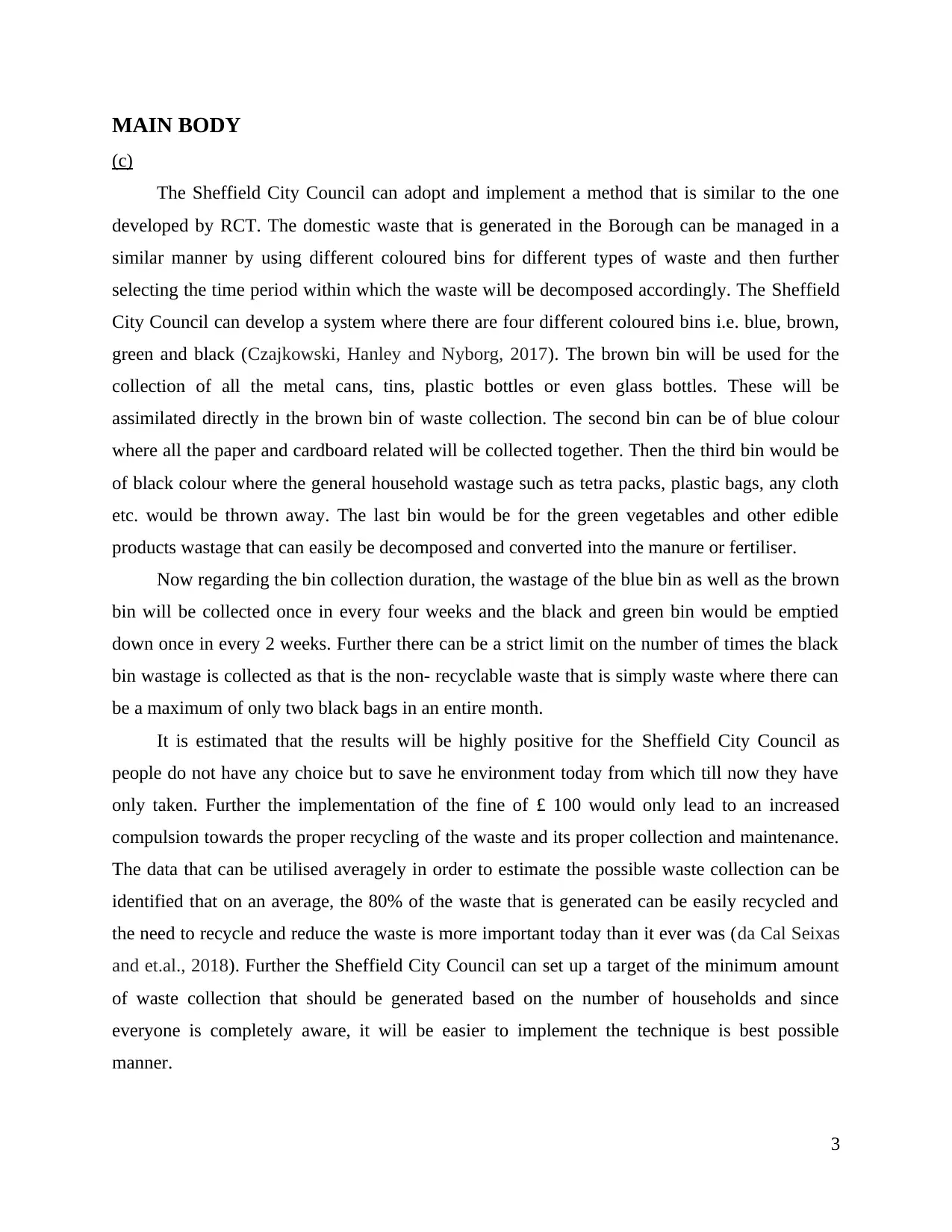
MAIN BODY
(c)
The Sheffield City Council can adopt and implement a method that is similar to the one
developed by RCT. The domestic waste that is generated in the Borough can be managed in a
similar manner by using different coloured bins for different types of waste and then further
selecting the time period within which the waste will be decomposed accordingly. The Sheffield
City Council can develop a system where there are four different coloured bins i.e. blue, brown,
green and black (Czajkowski, Hanley and Nyborg, 2017). The brown bin will be used for the
collection of all the metal cans, tins, plastic bottles or even glass bottles. These will be
assimilated directly in the brown bin of waste collection. The second bin can be of blue colour
where all the paper and cardboard related will be collected together. Then the third bin would be
of black colour where the general household wastage such as tetra packs, plastic bags, any cloth
etc. would be thrown away. The last bin would be for the green vegetables and other edible
products wastage that can easily be decomposed and converted into the manure or fertiliser.
Now regarding the bin collection duration, the wastage of the blue bin as well as the brown
bin will be collected once in every four weeks and the black and green bin would be emptied
down once in every 2 weeks. Further there can be a strict limit on the number of times the black
bin wastage is collected as that is the non- recyclable waste that is simply waste where there can
be a maximum of only two black bags in an entire month.
It is estimated that the results will be highly positive for the Sheffield City Council as
people do not have any choice but to save he environment today from which till now they have
only taken. Further the implementation of the fine of £ 100 would only lead to an increased
compulsion towards the proper recycling of the waste and its proper collection and maintenance.
The data that can be utilised averagely in order to estimate the possible waste collection can be
identified that on an average, the 80% of the waste that is generated can be easily recycled and
the need to recycle and reduce the waste is more important today than it ever was (da Cal Seixas
and et.al., 2018). Further the Sheffield City Council can set up a target of the minimum amount
of waste collection that should be generated based on the number of households and since
everyone is completely aware, it will be easier to implement the technique is best possible
manner.
3
Document Page
(d)
If the implementation of the RCT depicts a positive result then it should definitely be
implemented in the entire city because the system of RCT is really light on the cost aspect and
the resources required are not very modern or the ones requiring heavy investments (Davies,
2016). The monetary costs would mainly be incurred in the expense on the wastage collection
where the vehicles would be required to collect garbage form different areas, a garbage collector
and driver would be necessary, fuel would be required and then further the investment in the
recycling unit or plant is a onetime investment that is bound to incur but the advantages that it
will generate both in the environmental context as well as in the revenue generation, makes the
technique much more feasible and beneficial collectively. The revenue can be generated by
selling the recycled items again and hence the overall implementation of RCT will be more
beneficial.
(e)
There are many other types of council in UK who are facing the similar problem of waste
management and the model or policy that has been developed by Sheffield City Council can be
easily implemented in the other councils as well (Shearer and et.al., 2017). The current model
motivates the residents of the households themselves in taking the necessary efforts of
segregating their waste and this collectively is of immense help as the non recyclable waste is
easily identifiable and the limited use of black bin will further limit the overall generation of
redundant waste. Additionally the recycling model that has been developed is extremely cost
effective where the recycling can be done easily without any major compromise on the different
aspects that are associated with the increased expenditure. Hence the model that has been
developed by Sheffield City Council can be easily implemented in other councils as well.
4
tabler-icon-diamond-filled.svg

Paraphrase This Document

Need a fresh take? Get an instant paraphrase of this document with our AI Paraphraser
Document Page
REFERENCES
Books and Journals
Czajkowski, M., Hanley, N. and Nyborg, K., 2017. Social norms, morals and self-interest as
determinants of pro-environment behaviours: the case of household
recycling. Environmental and Resource Economics. 66(4). pp.647-670.
da Cal Seixas, S.R., and et.al., 2018. Water resources in the context of global environmental
change: Some perspectives for sustainability. In Handbook of Sustainability Science and
Research (pp. 87-102). Springer, Cham.
Davies, A., 2016. Development of a decision making tool for waste management: case study of a
local authority in Wales (Doctoral dissertation, Cardiff University).
Shearer, L., and et.al., 2017. A problem unstuck? Evaluating the effectiveness of sticker prompts
for encouraging household food waste recycling behaviour. Waste management. 60.
pp.164-172.
5
Document Page
6
chevron_up_icon
1 out of 6
circle_padding
hide_on_mobile
zoom_out_icon
[object Object]