Sherlock Holmes Film Analysis: Music, Drama, and Sound Design
VerifiedAdded on 2020/04/21
|6
|1536
|136
Report
AI Summary
This report provides a comprehensive analysis of the 2009 film 'Sherlock Holmes', directed by Guy Ritchie, focusing on the crucial role of music in enhancing the film's dramatic impact. The analysis delves into how music is used to create atmosphere, particularly in fight scenes, and to influence the audience's emotional engagement. The report examines the use of various musical elements, including tempo, pitch, and rhythm, to maintain suspense and elicit appropriate emotions. It highlights the contribution of a diverse range of instruments and the use of both diegetic and non-diegetic sounds in creating a rich and engaging auditory experience. The report also discusses the changing music themes and styles, composed by Hans Zimmer, and the use of different scales and modes to build tension and harmony. The conclusion emphasizes the effectiveness of music in creating drama and suspense, contributing significantly to the film's positive reviews and overall success. The report refers to several sources to support its claims, demonstrating a thorough understanding of film music theory and its application in the Sherlock Holmes film.

Name of student:
Registration number:
Unit Title:
Unit Code:
Name of supervisor:
Registration number:
Unit Title:
Unit Code:
Name of supervisor:
Paraphrase This Document
Need a fresh take? Get an instant paraphrase of this document with our AI Paraphraser

Introduction
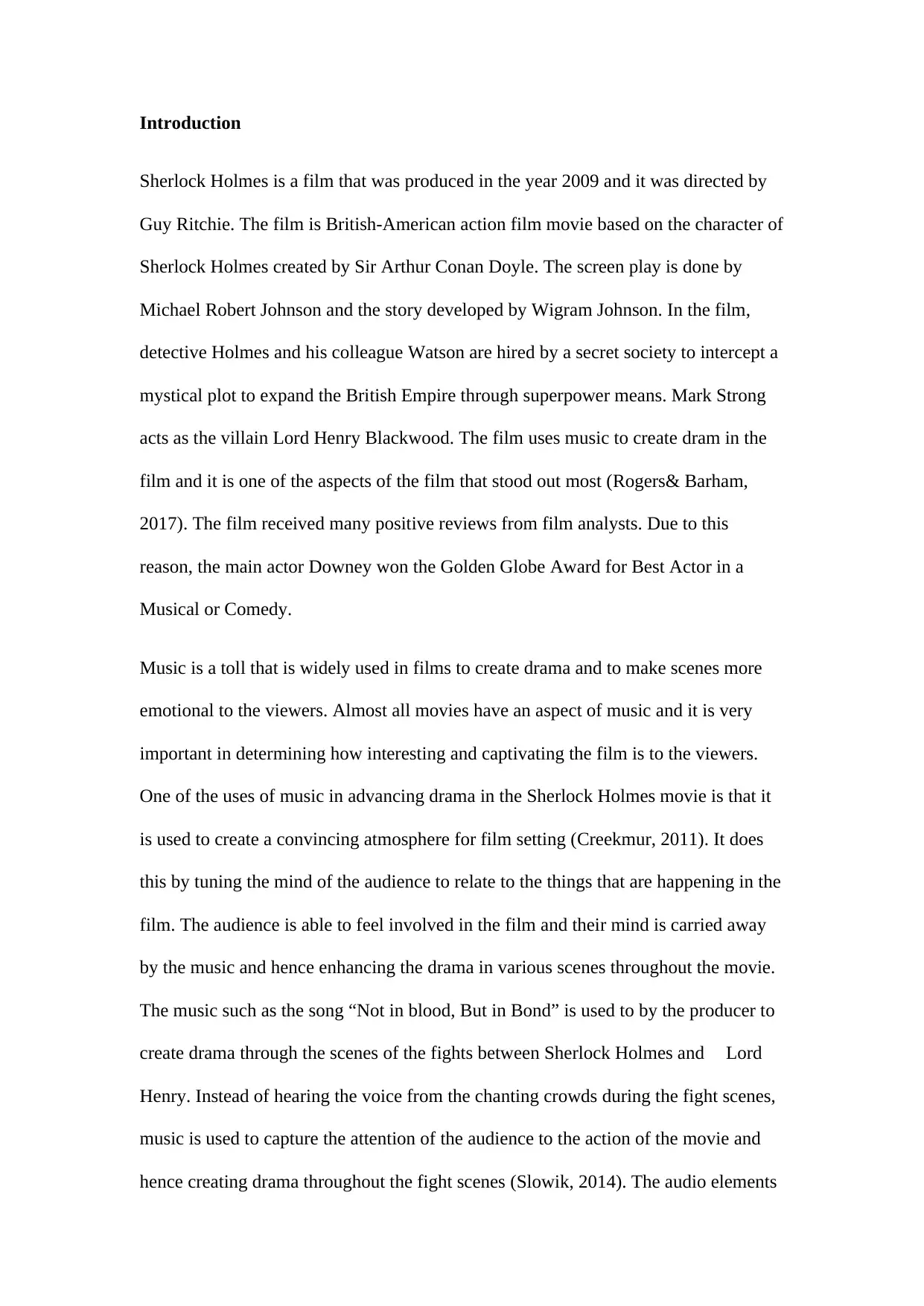
Sherlock Holmes is a film that was produced in the year 2009 and it was directed by
Guy Ritchie. The film is British-American action film movie based on the character of
Sherlock Holmes created by Sir Arthur Conan Doyle. The screen play is done by
Michael Robert Johnson and the story developed by Wigram Johnson. In the film,
detective Holmes and his colleague Watson are hired by a secret society to intercept a
mystical plot to expand the British Empire through superpower means. Mark Strong
acts as the villain Lord Henry Blackwood. The film uses music to create dram in the
film and it is one of the aspects of the film that stood out most (Rogers& Barham,
2017). The film received many positive reviews from film analysts. Due to this
reason, the main actor Downey won the Golden Globe Award for Best Actor in a
Musical or Comedy.
Music is a toll that is widely used in films to create drama and to make scenes more
emotional to the viewers. Almost all movies have an aspect of music and it is very
important in determining how interesting and captivating the film is to the viewers.
One of the uses of music in advancing drama in the Sherlock Holmes movie is that it
is used to create a convincing atmosphere for film setting (Creekmur, 2011). It does
this by tuning the mind of the audience to relate to the things that are happening in the
film. The audience is able to feel involved in the film and their mind is carried away
by the music and hence enhancing the drama in various scenes throughout the movie.
The music such as the song “Not in blood, But in Bond” is used to by the producer to
create drama through the scenes of the fights between Sherlock Holmes and Lord
Henry. Instead of hearing the voice from the chanting crowds during the fight scenes,
music is used to capture the attention of the audience to the action of the movie and
hence creating drama throughout the fight scenes (Slowik, 2014). The audio elements
Sherlock Holmes is a film that was produced in the year 2009 and it was directed by
Guy Ritchie. The film is British-American action film movie based on the character of
Sherlock Holmes created by Sir Arthur Conan Doyle. The screen play is done by
Michael Robert Johnson and the story developed by Wigram Johnson. In the film,
detective Holmes and his colleague Watson are hired by a secret society to intercept a
mystical plot to expand the British Empire through superpower means. Mark Strong
acts as the villain Lord Henry Blackwood. The film uses music to create dram in the
film and it is one of the aspects of the film that stood out most (Rogers& Barham,
2017). The film received many positive reviews from film analysts. Due to this
reason, the main actor Downey won the Golden Globe Award for Best Actor in a
Musical or Comedy.
Music is a toll that is widely used in films to create drama and to make scenes more
emotional to the viewers. Almost all movies have an aspect of music and it is very
important in determining how interesting and captivating the film is to the viewers.
One of the uses of music in advancing drama in the Sherlock Holmes movie is that it
is used to create a convincing atmosphere for film setting (Creekmur, 2011). It does
this by tuning the mind of the audience to relate to the things that are happening in the
film. The audience is able to feel involved in the film and their mind is carried away
by the music and hence enhancing the drama in various scenes throughout the movie.
The music such as the song “Not in blood, But in Bond” is used to by the producer to
create drama through the scenes of the fights between Sherlock Holmes and Lord
Henry. Instead of hearing the voice from the chanting crowds during the fight scenes,
music is used to capture the attention of the audience to the action of the movie and
hence creating drama throughout the fight scenes (Slowik, 2014). The audio elements

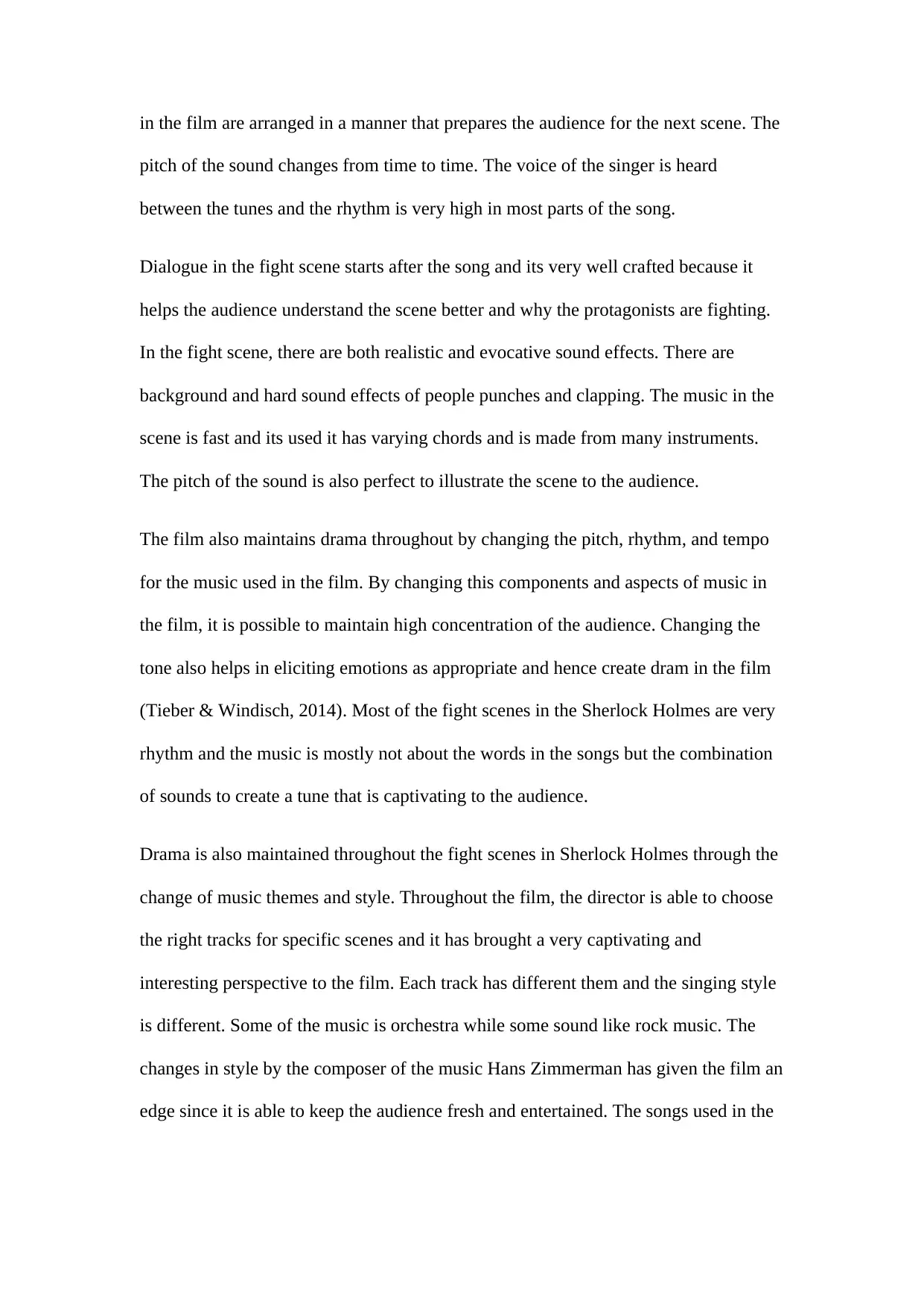
in the film are arranged in a manner that prepares the audience for the next scene. The
pitch of the sound changes from time to time. The voice of the singer is heard
between the tunes and the rhythm is very high in most parts of the song.
Dialogue in the fight scene starts after the song and its very well crafted because it
helps the audience understand the scene better and why the protagonists are fighting.
In the fight scene, there are both realistic and evocative sound effects. There are
background and hard sound effects of people punches and clapping. The music in the
scene is fast and its used it has varying chords and is made from many instruments.
The pitch of the sound is also perfect to illustrate the scene to the audience.
The film also maintains drama throughout by changing the pitch, rhythm, and tempo
for the music used in the film. By changing this components and aspects of music in
the film, it is possible to maintain high concentration of the audience. Changing the
tone also helps in eliciting emotions as appropriate and hence create dram in the film
(Tieber & Windisch, 2014). Most of the fight scenes in the Sherlock Holmes are very
rhythm and the music is mostly not about the words in the songs but the combination
of sounds to create a tune that is captivating to the audience.
Drama is also maintained throughout the fight scenes in Sherlock Holmes through the
change of music themes and style. Throughout the film, the director is able to choose
the right tracks for specific scenes and it has brought a very captivating and
interesting perspective to the film. Each track has different them and the singing style
is different. Some of the music is orchestra while some sound like rock music. The
changes in style by the composer of the music Hans Zimmerman has given the film an
edge since it is able to keep the audience fresh and entertained. The songs used in the
pitch of the sound changes from time to time. The voice of the singer is heard
between the tunes and the rhythm is very high in most parts of the song.
Dialogue in the fight scene starts after the song and its very well crafted because it
helps the audience understand the scene better and why the protagonists are fighting.
In the fight scene, there are both realistic and evocative sound effects. There are
background and hard sound effects of people punches and clapping. The music in the
scene is fast and its used it has varying chords and is made from many instruments.
The pitch of the sound is also perfect to illustrate the scene to the audience.
The film also maintains drama throughout by changing the pitch, rhythm, and tempo
for the music used in the film. By changing this components and aspects of music in
the film, it is possible to maintain high concentration of the audience. Changing the
tone also helps in eliciting emotions as appropriate and hence create dram in the film
(Tieber & Windisch, 2014). Most of the fight scenes in the Sherlock Holmes are very
rhythm and the music is mostly not about the words in the songs but the combination
of sounds to create a tune that is captivating to the audience.
Drama is also maintained throughout the fight scenes in Sherlock Holmes through the
change of music themes and style. Throughout the film, the director is able to choose
the right tracks for specific scenes and it has brought a very captivating and
interesting perspective to the film. Each track has different them and the singing style
is different. Some of the music is orchestra while some sound like rock music. The
changes in style by the composer of the music Hans Zimmerman has given the film an
edge since it is able to keep the audience fresh and entertained. The songs used in the
⊘ This is a preview!⊘
Do you want full access?
Subscribe today to unlock all pages.

Trusted by 1+ million students worldwide

film are enticing and they keep changing and hence drama is created throughout the
movie.
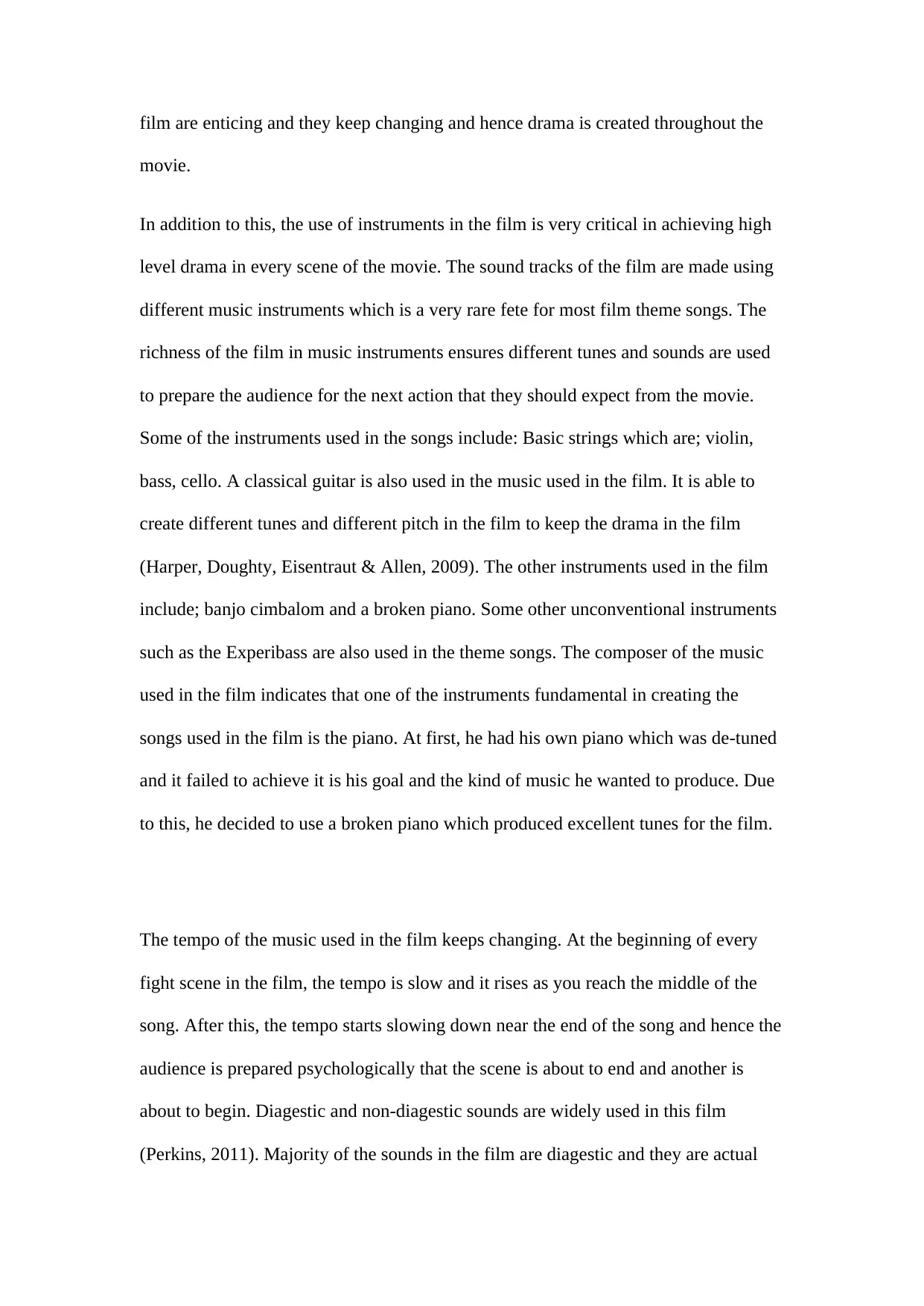
In addition to this, the use of instruments in the film is very critical in achieving high
level drama in every scene of the movie. The sound tracks of the film are made using
different music instruments which is a very rare fete for most film theme songs. The
richness of the film in music instruments ensures different tunes and sounds are used
to prepare the audience for the next action that they should expect from the movie.
Some of the instruments used in the songs include: Basic strings which are; violin,
bass, cello. A classical guitar is also used in the music used in the film. It is able to
create different tunes and different pitch in the film to keep the drama in the film
(Harper, Doughty, Eisentraut & Allen, 2009). The other instruments used in the film
include; banjo cimbalom and a broken piano. Some other unconventional instruments
such as the Experibass are also used in the theme songs. The composer of the music
used in the film indicates that one of the instruments fundamental in creating the
songs used in the film is the piano. At first, he had his own piano which was de-tuned
and it failed to achieve it is his goal and the kind of music he wanted to produce. Due
to this, he decided to use a broken piano which produced excellent tunes for the film.
The tempo of the music used in the film keeps changing. At the beginning of every
fight scene in the film, the tempo is slow and it rises as you reach the middle of the
song. After this, the tempo starts slowing down near the end of the song and hence the
audience is prepared psychologically that the scene is about to end and another is
about to begin. Diagestic and non-diagestic sounds are widely used in this film
(Perkins, 2011). Majority of the sounds in the film are diagestic and they are actual
movie.
In addition to this, the use of instruments in the film is very critical in achieving high
level drama in every scene of the movie. The sound tracks of the film are made using
different music instruments which is a very rare fete for most film theme songs. The
richness of the film in music instruments ensures different tunes and sounds are used
to prepare the audience for the next action that they should expect from the movie.
Some of the instruments used in the songs include: Basic strings which are; violin,
bass, cello. A classical guitar is also used in the music used in the film. It is able to
create different tunes and different pitch in the film to keep the drama in the film
(Harper, Doughty, Eisentraut & Allen, 2009). The other instruments used in the film
include; banjo cimbalom and a broken piano. Some other unconventional instruments
such as the Experibass are also used in the theme songs. The composer of the music
used in the film indicates that one of the instruments fundamental in creating the
songs used in the film is the piano. At first, he had his own piano which was de-tuned
and it failed to achieve it is his goal and the kind of music he wanted to produce. Due
to this, he decided to use a broken piano which produced excellent tunes for the film.
The tempo of the music used in the film keeps changing. At the beginning of every
fight scene in the film, the tempo is slow and it rises as you reach the middle of the
song. After this, the tempo starts slowing down near the end of the song and hence the
audience is prepared psychologically that the scene is about to end and another is
about to begin. Diagestic and non-diagestic sounds are widely used in this film
(Perkins, 2011). Majority of the sounds in the film are diagestic and they are actual
Paraphrase This Document
Need a fresh take? Get an instant paraphrase of this document with our AI Paraphraser

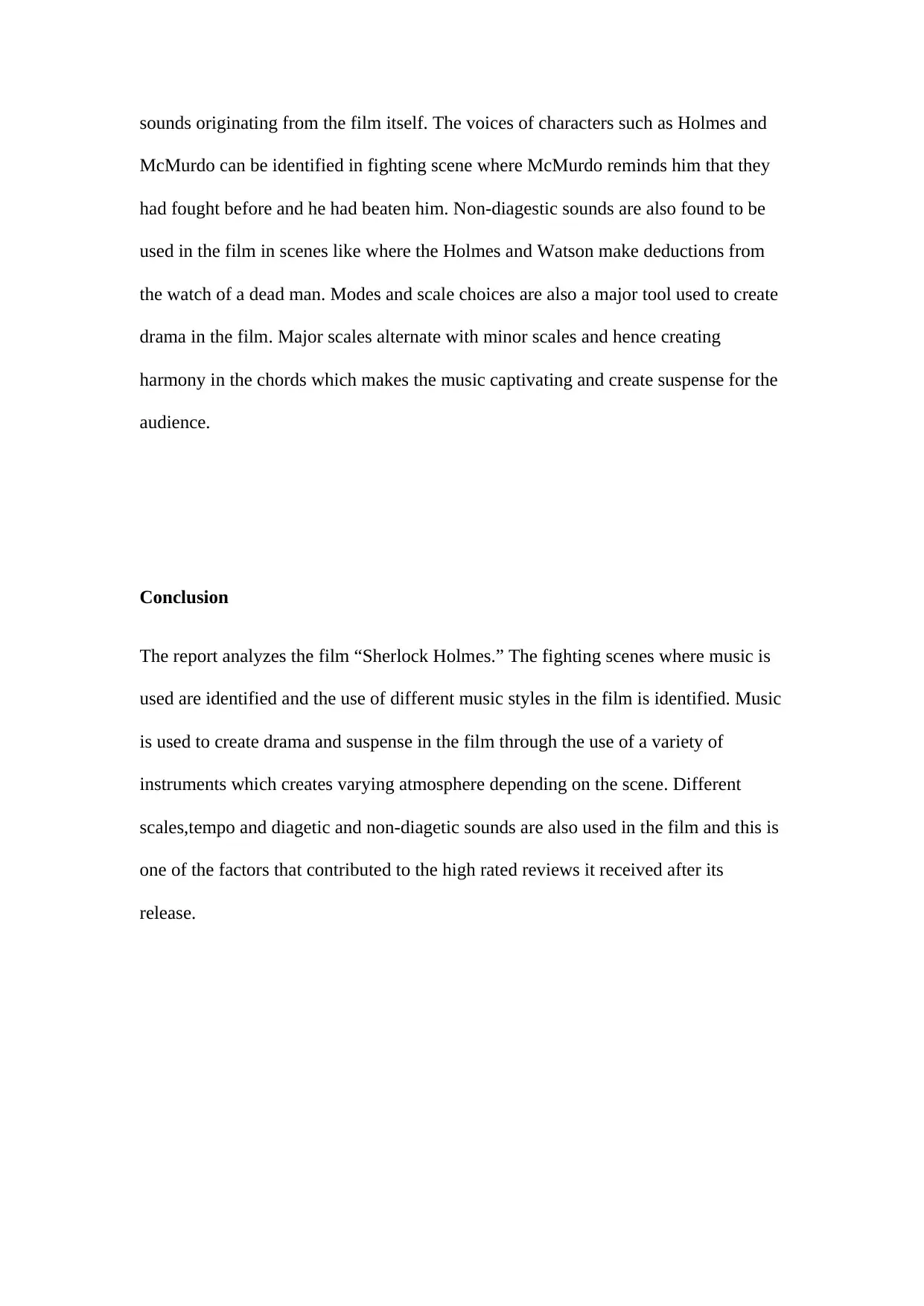
sounds originating from the film itself. The voices of characters such as Holmes and
McMurdo can be identified in fighting scene where McMurdo reminds him that they
had fought before and he had beaten him. Non-diagestic sounds are also found to be
used in the film in scenes like where the Holmes and Watson make deductions from
the watch of a dead man. Modes and scale choices are also a major tool used to create
drama in the film. Major scales alternate with minor scales and hence creating
harmony in the chords which makes the music captivating and create suspense for the
audience.
Conclusion
The report analyzes the film “Sherlock Holmes.” The fighting scenes where music is
used are identified and the use of different music styles in the film is identified. Music
is used to create drama and suspense in the film through the use of a variety of
instruments which creates varying atmosphere depending on the scene. Different
scales,tempo and diagetic and non-diagetic sounds are also used in the film and this is
one of the factors that contributed to the high rated reviews it received after its
release.
McMurdo can be identified in fighting scene where McMurdo reminds him that they
had fought before and he had beaten him. Non-diagestic sounds are also found to be
used in the film in scenes like where the Holmes and Watson make deductions from
the watch of a dead man. Modes and scale choices are also a major tool used to create
drama in the film. Major scales alternate with minor scales and hence creating
harmony in the chords which makes the music captivating and create suspense for the
audience.
Conclusion
The report analyzes the film “Sherlock Holmes.” The fighting scenes where music is
used are identified and the use of different music styles in the film is identified. Music
is used to create drama and suspense in the film through the use of a variety of
instruments which creates varying atmosphere depending on the scene. Different
scales,tempo and diagetic and non-diagetic sounds are also used in the film and this is
one of the factors that contributed to the high rated reviews it received after its
release.

References
Creekmur, C. K. (2011). The International Film Musical. Edinburgh, Univ. Press.
Harper, G., Doughty, R., Eisentraut, J., & Allen, D. (2009). Sound And Music In Film
And Visual Media: An Overview. Http://Site.Ebrary.Com/Id/10925629.
Perkins, C. (2011). American Smart Cinema. Edinburgh, Edinburgh University Press.
Rogers, H., & Barham, J. (2017). The Music And Sound Of Experimental Film.
Rothbart, P. (2013). The Synergy Of Film And Music: Sight And Sound In Five
Hollywood Films. Lanham, Md, Scarecrow Press.
Slowik, M. (2014). After The Silents: Hollywood Film Music In The Early Sound Era,
1926-1934. New York, Columbia University Press.
http://Ebookcentral.Proquest.Com/Lib/Concordiaab-Ebooks/Detail.Action?
Docid=1801703.
Tieber, C., & Windisch, A. K. (2014). The Sounds Of Silent Films: New Perspectives
On History, Theory And Practice.
http://Www.Dawsonera.Com/Depp/Reader/Protected/External/Abstractview/
S9781137410726.
Creekmur, C. K. (2011). The International Film Musical. Edinburgh, Univ. Press.
Harper, G., Doughty, R., Eisentraut, J., & Allen, D. (2009). Sound And Music In Film
And Visual Media: An Overview. Http://Site.Ebrary.Com/Id/10925629.
Perkins, C. (2011). American Smart Cinema. Edinburgh, Edinburgh University Press.
Rogers, H., & Barham, J. (2017). The Music And Sound Of Experimental Film.
Rothbart, P. (2013). The Synergy Of Film And Music: Sight And Sound In Five
Hollywood Films. Lanham, Md, Scarecrow Press.
Slowik, M. (2014). After The Silents: Hollywood Film Music In The Early Sound Era,
1926-1934. New York, Columbia University Press.
http://Ebookcentral.Proquest.Com/Lib/Concordiaab-Ebooks/Detail.Action?
Docid=1801703.
Tieber, C., & Windisch, A. K. (2014). The Sounds Of Silent Films: New Perspectives
On History, Theory And Practice.
http://Www.Dawsonera.Com/Depp/Reader/Protected/External/Abstractview/
S9781137410726.
⊘ This is a preview!⊘
Do you want full access?
Subscribe today to unlock all pages.

Trusted by 1+ million students worldwide
1 out of 6
Your All-in-One AI-Powered Toolkit for Academic Success.
+13062052269
info@desklib.com
Available 24*7 on WhatsApp / Email
Unlock your academic potential
Copyright © 2020–2025 A2Z Services. All Rights Reserved. Developed and managed by ZUCOL.