Sherlock & Watson Toys: Partnership, Company Law and Director Duties
VerifiedAdded on 2019/12/03
|9
|2515
|322
Case Study
AI Summary
This case study examines the legal issues faced by Sherlock & Watson Toys, a UK-based business operating under both partnership and company law frameworks. The analysis delves into the applicability of the Partnership Act 1890 and the Companies Act 2006, providing legal advice to Melissa Sherlock on various matters. The study explores partner responsibilities, including the implications of actions taken by individual partners, such as Jason Hudson's order with a non-compliant supplier. It also covers the termination of partnerships and the rights of partners. Furthermore, the case study examines the appointment and removal of company directors, outlining the relevant legal provisions and documentation required. The document analyzes the legal rights and protections afforded to directors, providing a comprehensive overview of the legal considerations for Sherlock & Watson Toys.

Case study

Paraphrase This Document
Need a fresh take? Get an instant paraphrase of this document with our AI Paraphraser
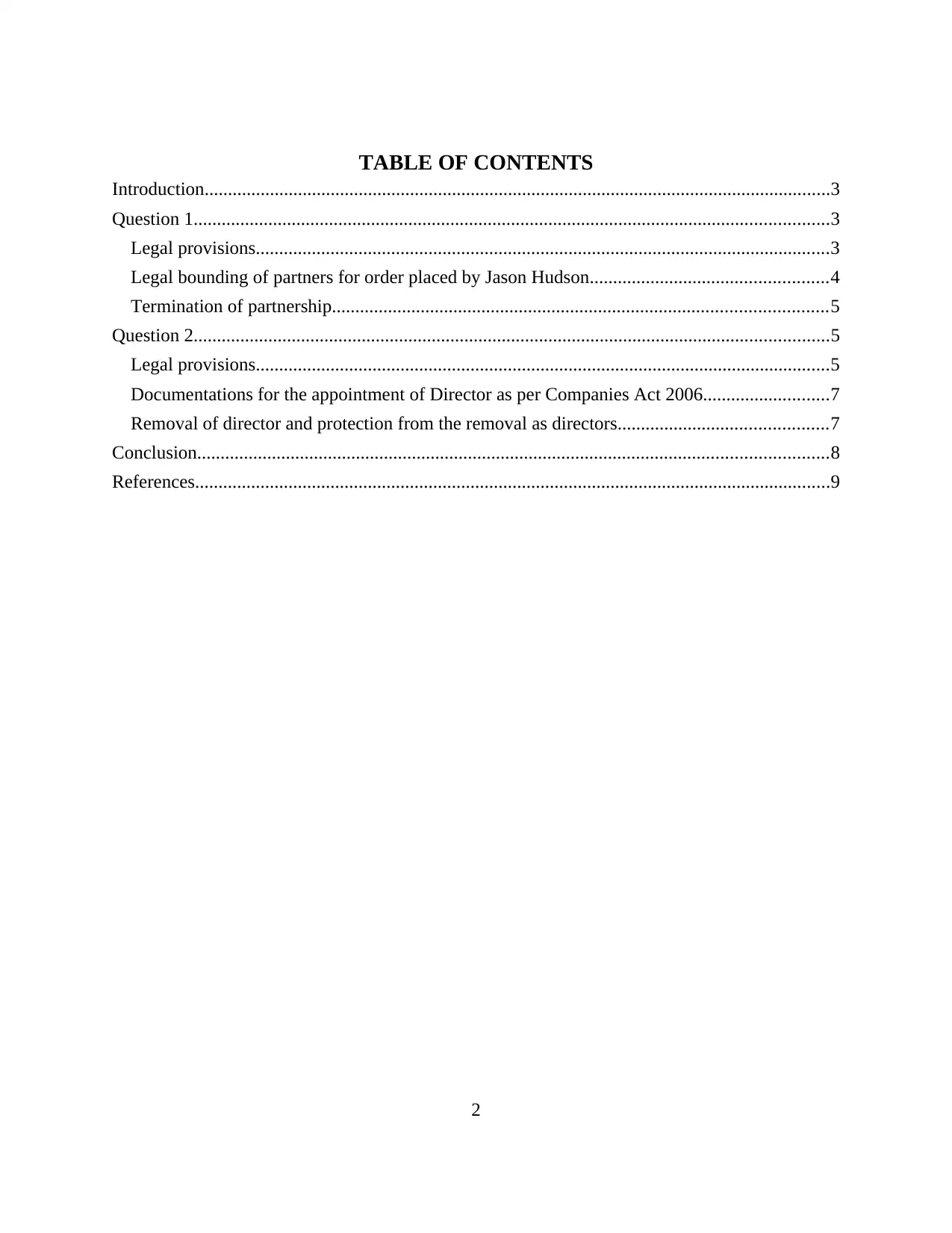
TABLE OF CONTENTS
Introduction......................................................................................................................................3
Question 1........................................................................................................................................3
Legal provisions...........................................................................................................................3
Legal bounding of partners for order placed by Jason Hudson...................................................4
Termination of partnership..........................................................................................................5
Question 2........................................................................................................................................5
Legal provisions...........................................................................................................................5
Documentations for the appointment of Director as per Companies Act 2006...........................7
Removal of director and protection from the removal as directors.............................................7
Conclusion.......................................................................................................................................8
References........................................................................................................................................9
2
Introduction......................................................................................................................................3
Question 1........................................................................................................................................3
Legal provisions...........................................................................................................................3
Legal bounding of partners for order placed by Jason Hudson...................................................4
Termination of partnership..........................................................................................................5
Question 2........................................................................................................................................5
Legal provisions...........................................................................................................................5
Documentations for the appointment of Director as per Companies Act 2006...........................7
Removal of director and protection from the removal as directors.............................................7
Conclusion.......................................................................................................................................8
References........................................................................................................................................9
2
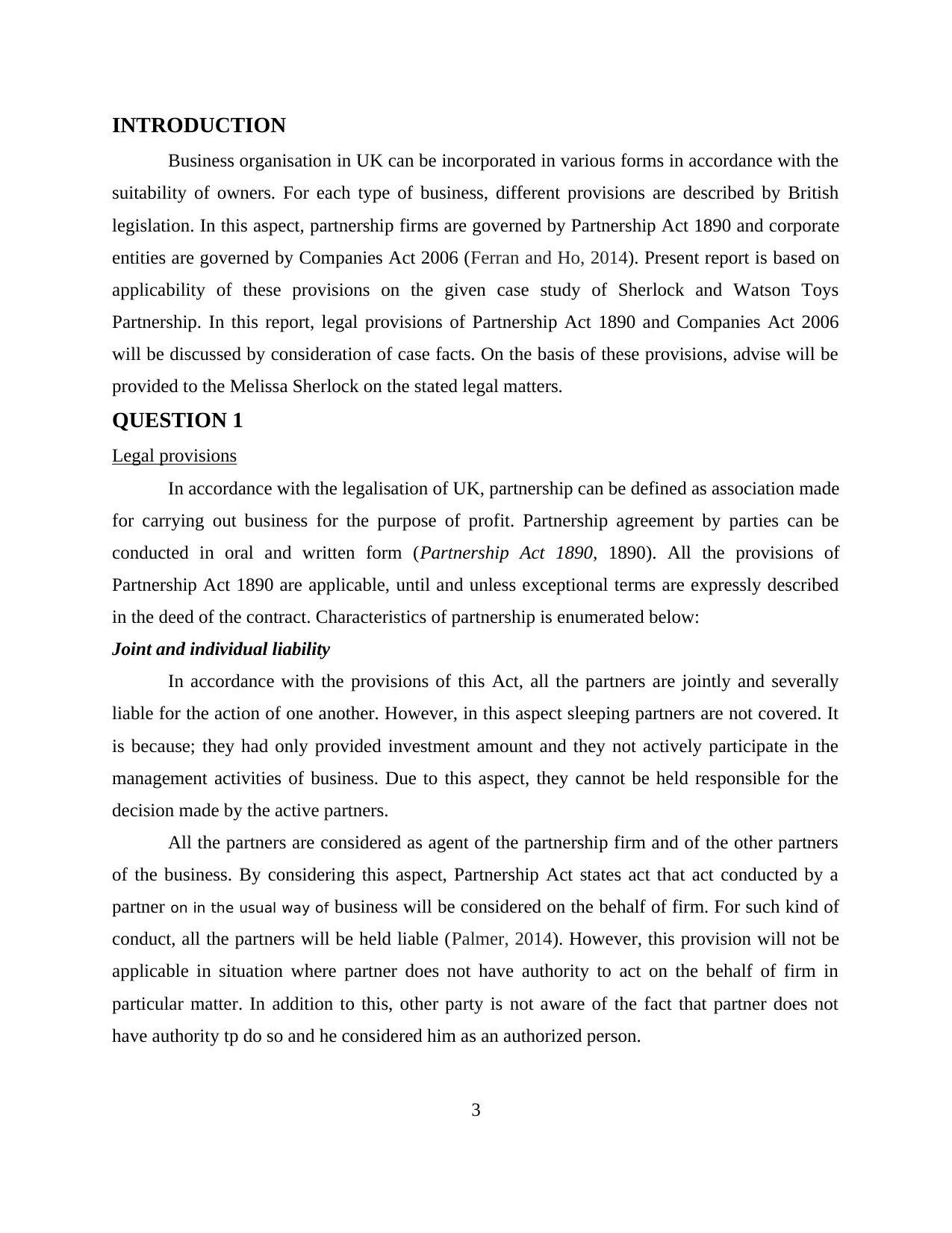
INTRODUCTION
Business organisation in UK can be incorporated in various forms in accordance with the
suitability of owners. For each type of business, different provisions are described by British
legislation. In this aspect, partnership firms are governed by Partnership Act 1890 and corporate
entities are governed by Companies Act 2006 (Ferran and Ho, 2014). Present report is based on
applicability of these provisions on the given case study of Sherlock and Watson Toys
Partnership. In this report, legal provisions of Partnership Act 1890 and Companies Act 2006
will be discussed by consideration of case facts. On the basis of these provisions, advise will be
provided to the Melissa Sherlock on the stated legal matters.
QUESTION 1
Legal provisions
In accordance with the legalisation of UK, partnership can be defined as association made
for carrying out business for the purpose of profit. Partnership agreement by parties can be
conducted in oral and written form (Partnership Act 1890, 1890). All the provisions of
Partnership Act 1890 are applicable, until and unless exceptional terms are expressly described
in the deed of the contract. Characteristics of partnership is enumerated below:
Joint and individual liability
In accordance with the provisions of this Act, all the partners are jointly and severally
liable for the action of one another. However, in this aspect sleeping partners are not covered. It
is because; they had only provided investment amount and they not actively participate in the
management activities of business. Due to this aspect, they cannot be held responsible for the
decision made by the active partners.
All the partners are considered as agent of the partnership firm and of the other partners
of the business. By considering this aspect, Partnership Act states act that act conducted by a
partner on in the usual way of business will be considered on the behalf of firm. For such kind of
conduct, all the partners will be held liable (Palmer, 2014). However, this provision will not be
applicable in situation where partner does not have authority to act on the behalf of firm in
particular matter. In addition to this, other party is not aware of the fact that partner does not
have authority tp do so and he considered him as an authorized person.
3
Business organisation in UK can be incorporated in various forms in accordance with the
suitability of owners. For each type of business, different provisions are described by British
legislation. In this aspect, partnership firms are governed by Partnership Act 1890 and corporate
entities are governed by Companies Act 2006 (Ferran and Ho, 2014). Present report is based on
applicability of these provisions on the given case study of Sherlock and Watson Toys
Partnership. In this report, legal provisions of Partnership Act 1890 and Companies Act 2006
will be discussed by consideration of case facts. On the basis of these provisions, advise will be
provided to the Melissa Sherlock on the stated legal matters.
QUESTION 1
Legal provisions
In accordance with the legalisation of UK, partnership can be defined as association made
for carrying out business for the purpose of profit. Partnership agreement by parties can be
conducted in oral and written form (Partnership Act 1890, 1890). All the provisions of
Partnership Act 1890 are applicable, until and unless exceptional terms are expressly described
in the deed of the contract. Characteristics of partnership is enumerated below:
Joint and individual liability
In accordance with the provisions of this Act, all the partners are jointly and severally
liable for the action of one another. However, in this aspect sleeping partners are not covered. It
is because; they had only provided investment amount and they not actively participate in the
management activities of business. Due to this aspect, they cannot be held responsible for the
decision made by the active partners.
All the partners are considered as agent of the partnership firm and of the other partners
of the business. By considering this aspect, Partnership Act states act that act conducted by a
partner on in the usual way of business will be considered on the behalf of firm. For such kind of
conduct, all the partners will be held liable (Palmer, 2014). However, this provision will not be
applicable in situation where partner does not have authority to act on the behalf of firm in
particular matter. In addition to this, other party is not aware of the fact that partner does not
have authority tp do so and he considered him as an authorized person.
3
⊘ This is a preview!⊘
Do you want full access?
Subscribe today to unlock all pages.

Trusted by 1+ million students worldwide
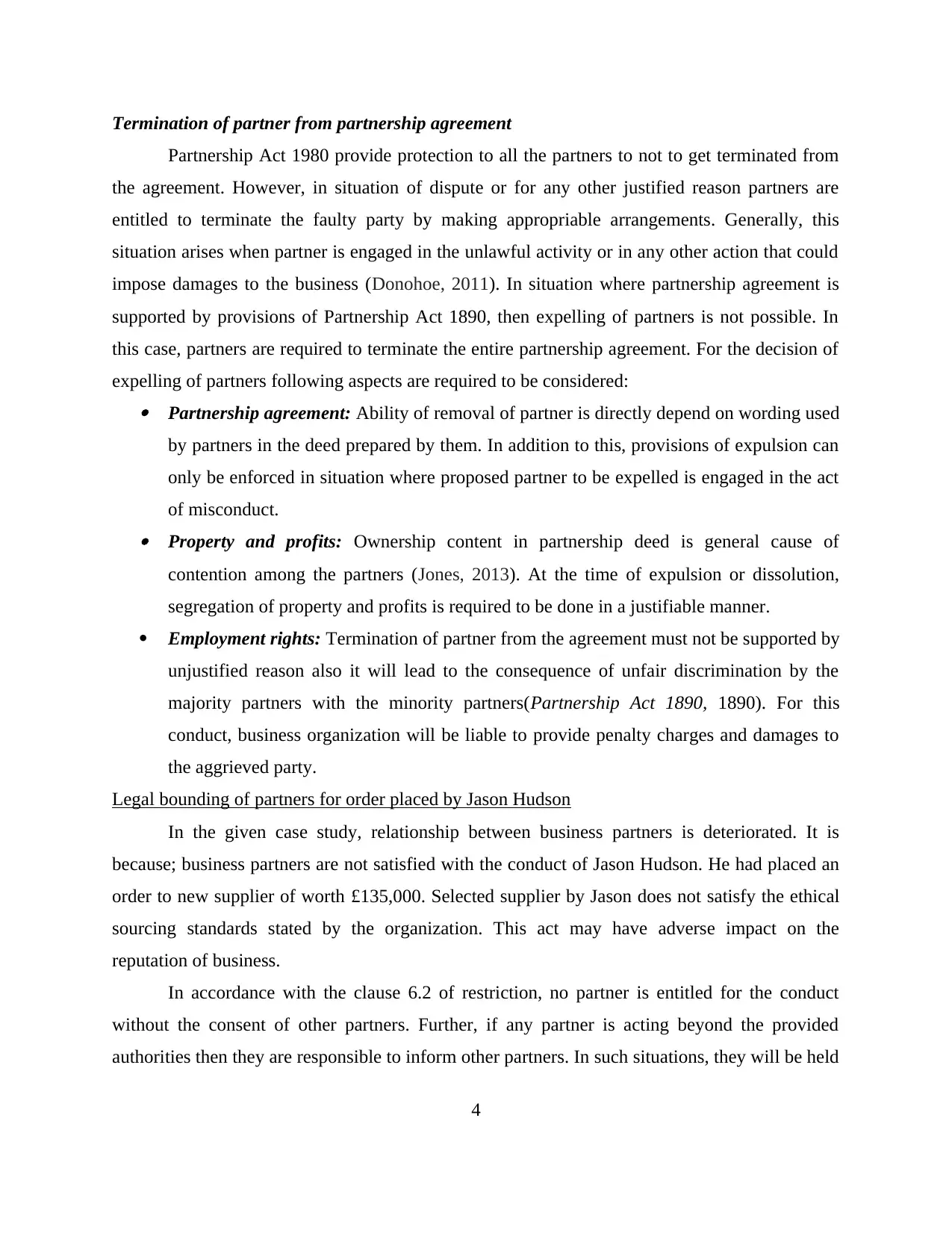
Termination of partner from partnership agreement
Partnership Act 1980 provide protection to all the partners to not to get terminated from
the agreement. However, in situation of dispute or for any other justified reason partners are
entitled to terminate the faulty party by making appropriable arrangements. Generally, this
situation arises when partner is engaged in the unlawful activity or in any other action that could
impose damages to the business (Donohoe, 2011). In situation where partnership agreement is
supported by provisions of Partnership Act 1890, then expelling of partners is not possible. In
this case, partners are required to terminate the entire partnership agreement. For the decision of
expelling of partners following aspects are required to be considered: Partnership agreement: Ability of removal of partner is directly depend on wording used
by partners in the deed prepared by them. In addition to this, provisions of expulsion can
only be enforced in situation where proposed partner to be expelled is engaged in the act
of misconduct. Property and profits: Ownership content in partnership deed is general cause of
contention among the partners (Jones, 2013). At the time of expulsion or dissolution,
segregation of property and profits is required to be done in a justifiable manner.
Employment rights: Termination of partner from the agreement must not be supported by
unjustified reason also it will lead to the consequence of unfair discrimination by the
majority partners with the minority partners(Partnership Act 1890, 1890). For this
conduct, business organization will be liable to provide penalty charges and damages to
the aggrieved party.
Legal bounding of partners for order placed by Jason Hudson
In the given case study, relationship between business partners is deteriorated. It is
because; business partners are not satisfied with the conduct of Jason Hudson. He had placed an
order to new supplier of worth £135,000. Selected supplier by Jason does not satisfy the ethical
sourcing standards stated by the organization. This act may have adverse impact on the
reputation of business.
In accordance with the clause 6.2 of restriction, no partner is entitled for the conduct
without the consent of other partners. Further, if any partner is acting beyond the provided
authorities then they are responsible to inform other partners. In such situations, they will be held
4
Partnership Act 1980 provide protection to all the partners to not to get terminated from
the agreement. However, in situation of dispute or for any other justified reason partners are
entitled to terminate the faulty party by making appropriable arrangements. Generally, this
situation arises when partner is engaged in the unlawful activity or in any other action that could
impose damages to the business (Donohoe, 2011). In situation where partnership agreement is
supported by provisions of Partnership Act 1890, then expelling of partners is not possible. In
this case, partners are required to terminate the entire partnership agreement. For the decision of
expelling of partners following aspects are required to be considered: Partnership agreement: Ability of removal of partner is directly depend on wording used
by partners in the deed prepared by them. In addition to this, provisions of expulsion can
only be enforced in situation where proposed partner to be expelled is engaged in the act
of misconduct. Property and profits: Ownership content in partnership deed is general cause of
contention among the partners (Jones, 2013). At the time of expulsion or dissolution,
segregation of property and profits is required to be done in a justifiable manner.
Employment rights: Termination of partner from the agreement must not be supported by
unjustified reason also it will lead to the consequence of unfair discrimination by the
majority partners with the minority partners(Partnership Act 1890, 1890). For this
conduct, business organization will be liable to provide penalty charges and damages to
the aggrieved party.
Legal bounding of partners for order placed by Jason Hudson
In the given case study, relationship between business partners is deteriorated. It is
because; business partners are not satisfied with the conduct of Jason Hudson. He had placed an
order to new supplier of worth £135,000. Selected supplier by Jason does not satisfy the ethical
sourcing standards stated by the organization. This act may have adverse impact on the
reputation of business.
In accordance with the clause 6.2 of restriction, no partner is entitled for the conduct
without the consent of other partners. Further, if any partner is acting beyond the provided
authorities then they are responsible to inform other partners. In such situations, they will be held
4
Paraphrase This Document
Need a fresh take? Get an instant paraphrase of this document with our AI Paraphraser
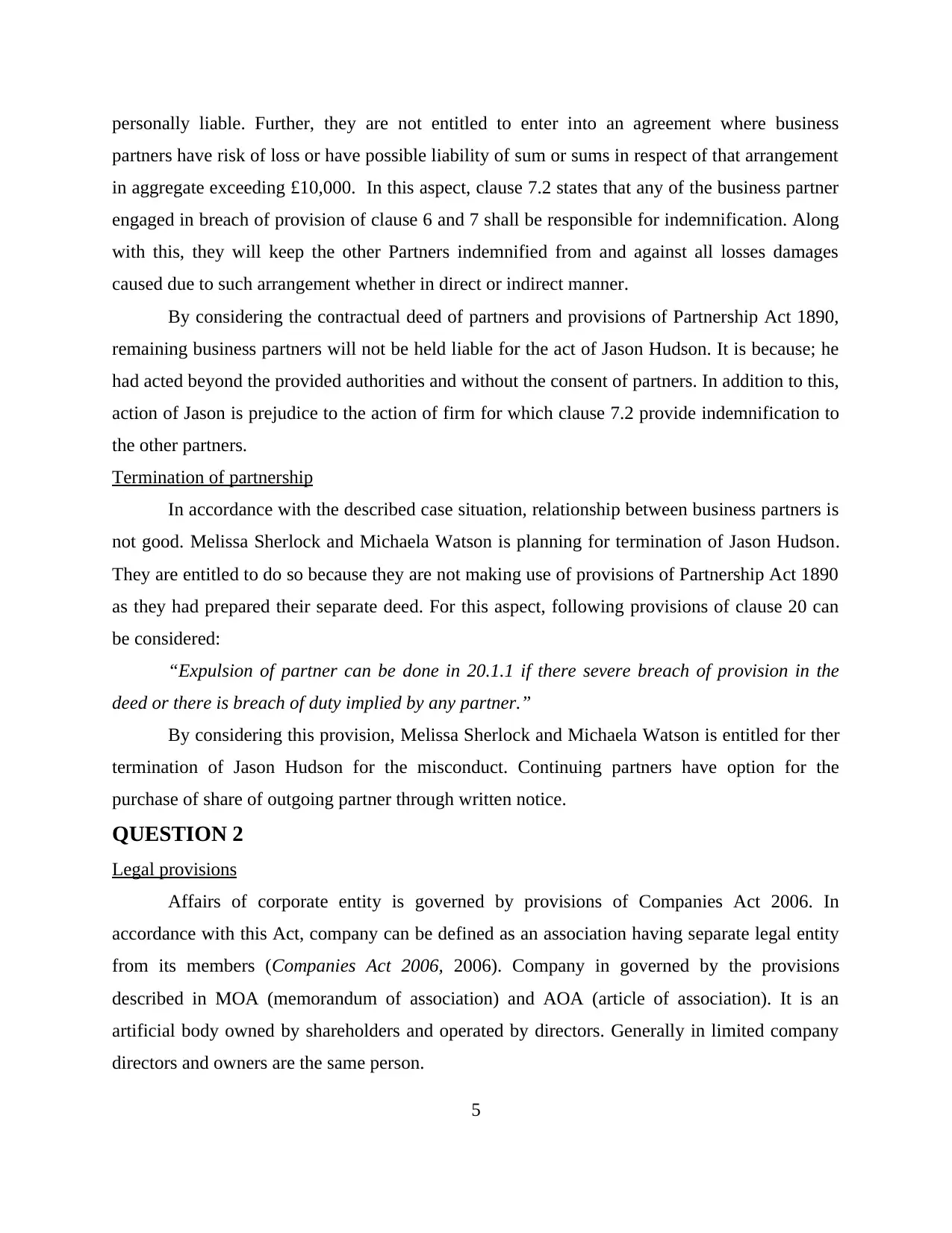
personally liable. Further, they are not entitled to enter into an agreement where business
partners have risk of loss or have possible liability of sum or sums in respect of that arrangement
in aggregate exceeding £10,000. In this aspect, clause 7.2 states that any of the business partner
engaged in breach of provision of clause 6 and 7 shall be responsible for indemnification. Along
with this, they will keep the other Partners indemnified from and against all losses damages
caused due to such arrangement whether in direct or indirect manner.
By considering the contractual deed of partners and provisions of Partnership Act 1890,
remaining business partners will not be held liable for the act of Jason Hudson. It is because; he
had acted beyond the provided authorities and without the consent of partners. In addition to this,
action of Jason is prejudice to the action of firm for which clause 7.2 provide indemnification to
the other partners.
Termination of partnership
In accordance with the described case situation, relationship between business partners is
not good. Melissa Sherlock and Michaela Watson is planning for termination of Jason Hudson.
They are entitled to do so because they are not making use of provisions of Partnership Act 1890
as they had prepared their separate deed. For this aspect, following provisions of clause 20 can
be considered:
“Expulsion of partner can be done in 20.1.1 if there severe breach of provision in the
deed or there is breach of duty implied by any partner.”
By considering this provision, Melissa Sherlock and Michaela Watson is entitled for ther
termination of Jason Hudson for the misconduct. Continuing partners have option for the
purchase of share of outgoing partner through written notice.
QUESTION 2
Legal provisions
Affairs of corporate entity is governed by provisions of Companies Act 2006. In
accordance with this Act, company can be defined as an association having separate legal entity
from its members (Companies Act 2006, 2006). Company in governed by the provisions
described in MOA (memorandum of association) and AOA (article of association). It is an
artificial body owned by shareholders and operated by directors. Generally in limited company
directors and owners are the same person.
5
partners have risk of loss or have possible liability of sum or sums in respect of that arrangement
in aggregate exceeding £10,000. In this aspect, clause 7.2 states that any of the business partner
engaged in breach of provision of clause 6 and 7 shall be responsible for indemnification. Along
with this, they will keep the other Partners indemnified from and against all losses damages
caused due to such arrangement whether in direct or indirect manner.
By considering the contractual deed of partners and provisions of Partnership Act 1890,
remaining business partners will not be held liable for the act of Jason Hudson. It is because; he
had acted beyond the provided authorities and without the consent of partners. In addition to this,
action of Jason is prejudice to the action of firm for which clause 7.2 provide indemnification to
the other partners.
Termination of partnership
In accordance with the described case situation, relationship between business partners is
not good. Melissa Sherlock and Michaela Watson is planning for termination of Jason Hudson.
They are entitled to do so because they are not making use of provisions of Partnership Act 1890
as they had prepared their separate deed. For this aspect, following provisions of clause 20 can
be considered:
“Expulsion of partner can be done in 20.1.1 if there severe breach of provision in the
deed or there is breach of duty implied by any partner.”
By considering this provision, Melissa Sherlock and Michaela Watson is entitled for ther
termination of Jason Hudson for the misconduct. Continuing partners have option for the
purchase of share of outgoing partner through written notice.
QUESTION 2
Legal provisions
Affairs of corporate entity is governed by provisions of Companies Act 2006. In
accordance with this Act, company can be defined as an association having separate legal entity
from its members (Companies Act 2006, 2006). Company in governed by the provisions
described in MOA (memorandum of association) and AOA (article of association). It is an
artificial body owned by shareholders and operated by directors. Generally in limited company
directors and owners are the same person.
5
Appointment of Director
Appointment of director is mainly based on the provisions of company's articles. Stated
articles by organizations are based on either Model Articles or Table A (in situation where
company is incorporated before 2009). By considering the provisions of Model Articles and
Table A, shareholders of the company are entitled for the appointment of director (Ferran and
Ho, 2014). According to the Model Articles, existing directors of company are also entitled for
the appointment of new directors.
In accordance with the Article 17 of the Companies Act 2006, any individual willing for
the appointment of director (if permitted by law) is entitled to do so (Clarkson, 2010). For this
aspect, ordinary resolution is required to be passed in a general meeting or it can also be done by
the resolution of directors.
This appointment is required to notified to the Company House through form of AP01.
Further, existing directors of the company are required to show details of the appointed director
in proper manner.
Termination of Director
In accordance with the Section 168 of the Companies Act 2006, ordinary resolution can
be passed in the company for removal of director prior to the completion of their period of office.
In situation where, another person is required to be recruited on the place of existing director
then special noticed is required to be passed through the resolution (Companies Act 2006, 2006).
Vacancy created by the removal of director cannot be filled in that meeting. However, casual
director can be appointed for the operations of the company.
Cited section will not be considered in situation where director is removed in against of
compensation or damages payable for their termination and appointment of another person at
their position (Apme and et al.2004). Power for removal of direct exist in the articles of the
company apart from this section.
Protection to the director from the termination
As per the provisions of company legislation of UK, director has right to protest against
the act of their removal. In accordance with the Section 168, company is required to send notice
to the proposed director for the termination. Directors are entitled to heard on the resolution in
the general meeting of company (Talbot, 2014). Further, director can provide letter (notification)
6
Appointment of director is mainly based on the provisions of company's articles. Stated
articles by organizations are based on either Model Articles or Table A (in situation where
company is incorporated before 2009). By considering the provisions of Model Articles and
Table A, shareholders of the company are entitled for the appointment of director (Ferran and
Ho, 2014). According to the Model Articles, existing directors of company are also entitled for
the appointment of new directors.
In accordance with the Article 17 of the Companies Act 2006, any individual willing for
the appointment of director (if permitted by law) is entitled to do so (Clarkson, 2010). For this
aspect, ordinary resolution is required to be passed in a general meeting or it can also be done by
the resolution of directors.
This appointment is required to notified to the Company House through form of AP01.
Further, existing directors of the company are required to show details of the appointed director
in proper manner.
Termination of Director
In accordance with the Section 168 of the Companies Act 2006, ordinary resolution can
be passed in the company for removal of director prior to the completion of their period of office.
In situation where, another person is required to be recruited on the place of existing director
then special noticed is required to be passed through the resolution (Companies Act 2006, 2006).
Vacancy created by the removal of director cannot be filled in that meeting. However, casual
director can be appointed for the operations of the company.
Cited section will not be considered in situation where director is removed in against of
compensation or damages payable for their termination and appointment of another person at
their position (Apme and et al.2004). Power for removal of direct exist in the articles of the
company apart from this section.
Protection to the director from the termination
As per the provisions of company legislation of UK, director has right to protest against
the act of their removal. In accordance with the Section 168, company is required to send notice
to the proposed director for the termination. Directors are entitled to heard on the resolution in
the general meeting of company (Talbot, 2014). Further, director can provide letter (notification)
6
⊘ This is a preview!⊘
Do you want full access?
Subscribe today to unlock all pages.
Trusted by 1+ million students worldwide
to the members of company. In situation where copy of request in received in reasonable time
then directors will be heard after reading out the letter at the time of meeting.
In situation where director is shareholder of the company then provision of Article 9 will
also be applied described in “Table A” in the former Model Articles in the schedules attached to
the Companies Act 1948. In accordance with this provision; If poll is proposed for the removal of director from company then one vote of proposed
director for removal will be equivalent to the three votes.
If poll is proposed for the amendment in the provisions of this article then also one vote
of proposed director will be equivalent to the three votes.
Documentations for the appointment of Director as per Companies Act 2006
For the implementation of new investment strategy of 3PPP appointment of Melissa
Sherlock, Michaela Watson, Jason Hudson and Richard Bird will be done as directors of the
company. For this aspect, resolution will be passed by existing directors of the company i.e.
Catherine Jones and Susan Morris. As per the provisions of Model Article, existing directors are
entitled for the appointment of new director through resolution. Notification of appointment of
director will be submitted to the company house through form AP01. This form is required to be
supported by complete information of these directors and their service agreement. These
documents will be submitted by existing directors of the company.
Removal of director and protection from the removal as directors
In accordance with the contractual deed, Melissa Sherlock and other directors will be
removed from their position after the completion of their 5 year service agreement. However, by
the section of Companies Act 168, directors can be terminated through ordinary resolution in the
meeting of company by existing directors.
Melissa Sherlock does not own shares of the company, thus she cannot make use of
article 9. However, she is entitled for the protest against the proposal for removal of her position
as directors. For this aspect, she is required to make notification (reasonable length of letter) in
meeting. She will be heard by the members prior to the announcement of final decision.
CONCLUSION
In accordance with the present study, conclusion can be drawn that all partners are
required to act in responsible and ethical manner. In situation, where they are engaged in an
7
then directors will be heard after reading out the letter at the time of meeting.
In situation where director is shareholder of the company then provision of Article 9 will
also be applied described in “Table A” in the former Model Articles in the schedules attached to
the Companies Act 1948. In accordance with this provision; If poll is proposed for the removal of director from company then one vote of proposed
director for removal will be equivalent to the three votes.
If poll is proposed for the amendment in the provisions of this article then also one vote
of proposed director will be equivalent to the three votes.
Documentations for the appointment of Director as per Companies Act 2006
For the implementation of new investment strategy of 3PPP appointment of Melissa
Sherlock, Michaela Watson, Jason Hudson and Richard Bird will be done as directors of the
company. For this aspect, resolution will be passed by existing directors of the company i.e.
Catherine Jones and Susan Morris. As per the provisions of Model Article, existing directors are
entitled for the appointment of new director through resolution. Notification of appointment of
director will be submitted to the company house through form AP01. This form is required to be
supported by complete information of these directors and their service agreement. These
documents will be submitted by existing directors of the company.
Removal of director and protection from the removal as directors
In accordance with the contractual deed, Melissa Sherlock and other directors will be
removed from their position after the completion of their 5 year service agreement. However, by
the section of Companies Act 168, directors can be terminated through ordinary resolution in the
meeting of company by existing directors.
Melissa Sherlock does not own shares of the company, thus she cannot make use of
article 9. However, she is entitled for the protest against the proposal for removal of her position
as directors. For this aspect, she is required to make notification (reasonable length of letter) in
meeting. She will be heard by the members prior to the announcement of final decision.
CONCLUSION
In accordance with the present study, conclusion can be drawn that all partners are
required to act in responsible and ethical manner. In situation, where they are engaged in an
7
Paraphrase This Document
Need a fresh take? Get an instant paraphrase of this document with our AI Paraphraser
unethical conduct then provision of joint liability will not be applicable for the remaining
business partners. In addition to this, guilty party will have individual responsibility to provide
damages to the injured party. For severe misconduct, they can also be terminated from the
partnership agreement. Company is an artificial person, thus directors are appointed for the fair
operations of the company. For the appointment and termination of director appropriable process
is required to be followed by the existing directors of the company. These actions must be
supported by the justifiable reason. In situation of unfair conduct, provide protection to the
aggrieved party is described in provisions of company law.
8
business partners. In addition to this, guilty party will have individual responsibility to provide
damages to the injured party. For severe misconduct, they can also be terminated from the
partnership agreement. Company is an artificial person, thus directors are appointed for the fair
operations of the company. For the appointment and termination of director appropriable process
is required to be followed by the existing directors of the company. These actions must be
supported by the justifiable reason. In situation of unfair conduct, provide protection to the
aggrieved party is described in provisions of company law.
8
REFERENCES
Books and journals
Apme, and et al, 2004. Business Aspects of Optometry: Association of Practice Management
Educators. Elsevier Health Sciences.
Clarkson, K.W., 2010. Business law. Text and Cases: Legal. Cengage learning.
Donohoe, S., 2011. The WW Gear case. conditions precedent and construction contracts",
Structural Survey. 29 (2) pp.99 – 105.
Ferran, E. and Ho, L. C., 2014. Principles of corporate finance law. Oxford University Press.
Jones, L., 2013. Introduction to Business Law. Oxford University Press.
Palmer, C. R., 2014. Common law environmental protection: the future of private nuisance, Part
I. International Journal of Law in the Built Environment. 6 (1/2). pp.21 – 42.
Talbot, L. E., 2014. Operationalizing Sustainability in Company Law Reform Through a Labour-
Centred Approach: A UK Perspective. European Company Law. 11(2).
Online
Companies Act 2006. 2006. [Online] Available through:
<http://www.legislation.gov.uk/ukpga/2006/46/contents>. [Accessed on 5th December
2015].
Partnership Act 1890. 1890. [Online] Available through:
<http://www.legislation.gov.uk/ukpga/Vict/53-54/39/section/25>. [Accessed on 5th
December 2015].
9
Books and journals
Apme, and et al, 2004. Business Aspects of Optometry: Association of Practice Management
Educators. Elsevier Health Sciences.
Clarkson, K.W., 2010. Business law. Text and Cases: Legal. Cengage learning.
Donohoe, S., 2011. The WW Gear case. conditions precedent and construction contracts",
Structural Survey. 29 (2) pp.99 – 105.
Ferran, E. and Ho, L. C., 2014. Principles of corporate finance law. Oxford University Press.
Jones, L., 2013. Introduction to Business Law. Oxford University Press.
Palmer, C. R., 2014. Common law environmental protection: the future of private nuisance, Part
I. International Journal of Law in the Built Environment. 6 (1/2). pp.21 – 42.
Talbot, L. E., 2014. Operationalizing Sustainability in Company Law Reform Through a Labour-
Centred Approach: A UK Perspective. European Company Law. 11(2).
Online
Companies Act 2006. 2006. [Online] Available through:
<http://www.legislation.gov.uk/ukpga/2006/46/contents>. [Accessed on 5th December
2015].
Partnership Act 1890. 1890. [Online] Available through:
<http://www.legislation.gov.uk/ukpga/Vict/53-54/39/section/25>. [Accessed on 5th
December 2015].
9
⊘ This is a preview!⊘
Do you want full access?
Subscribe today to unlock all pages.
Trusted by 1+ million students worldwide

1 out of 9


Related Documents


Your All-in-One AI-Powered Toolkit for Academic Success.
+13062052269
info@desklib.com
Available 24*7 on WhatsApp / Email
![[object Object]](/_next/static/media/star-bottom.7253800d.svg)
Unlock your academic potential
Copyright © 2020–2026 A2Z Services. All Rights Reserved. Developed and managed by ZUCOL.