Strategic Human Resource Management and Employment Relations Report
VerifiedAdded on 2023/01/05
|12
|3721
|43
Report
AI Summary
This report provides a detailed exploration of Strategic Human Resource Management (SHRM) and Employment Relations. It begins by defining business strategy and human resource strategy, evaluating their relationship, and examining vertical alignment and horizontal integration. The report then delves into the theoretical perspectives of SHRM, including the Universalist, Contingency, and Resource-Based View approaches, alongside an analysis of performance management and reward systems. The paper further examines the nature and theoretical perspectives of employment relations, identifying key actors and their roles in the changing landscape of employment. Finally, it offers recommendations for improving employee participation and voice to enhance employment relationships, concluding with a summary of the key findings and references.

qwertyuiopasdfghjklzxcvbnmqw
ertyuiopasdfghjklzxcvbnmqwert
yuiopasdfghjklzxcvbnmqwertyui
opasdfghjklzxcvbnmqwertyuiop
asdfghjklzxcvbnmqwertyuiopasd
fghjklzxcvbnmqwertyuiopasdfgh
jklzxcvbnmqwertyuiopasdfghjkl
zxcvbnmqwertyuiopasdfghjklzxc
vbnmqwertyuiopasdfghjklzxcvb
nmqwertyuiopasdfghjklzxcvbnm
qwertyuiopasdfghjklzxcvbnmqw
ertyuiopasdfghjklzxcvbnmqwert
yuiopasdfghjklzxcvbnmqwertyui
opasdfghjklzxcvbnmqwertyuiop
asdfghjklzxcvbnmqwertyuiopasd
fghjklzxcvbnmqwertyuiopasdfgh
jklzxcvbnmrtyuiopasdfghjklzxcv
Strategic human resource management
ertyuiopasdfghjklzxcvbnmqwert
yuiopasdfghjklzxcvbnmqwertyui
opasdfghjklzxcvbnmqwertyuiop
asdfghjklzxcvbnmqwertyuiopasd
fghjklzxcvbnmqwertyuiopasdfgh
jklzxcvbnmqwertyuiopasdfghjkl
zxcvbnmqwertyuiopasdfghjklzxc
vbnmqwertyuiopasdfghjklzxcvb
nmqwertyuiopasdfghjklzxcvbnm
qwertyuiopasdfghjklzxcvbnmqw
ertyuiopasdfghjklzxcvbnmqwert
yuiopasdfghjklzxcvbnmqwertyui
opasdfghjklzxcvbnmqwertyuiop
asdfghjklzxcvbnmqwertyuiopasd
fghjklzxcvbnmqwertyuiopasdfgh
jklzxcvbnmrtyuiopasdfghjklzxcv
Strategic human resource management

Paraphrase This Document
Need a fresh take? Get an instant paraphrase of this document with our AI Paraphraser
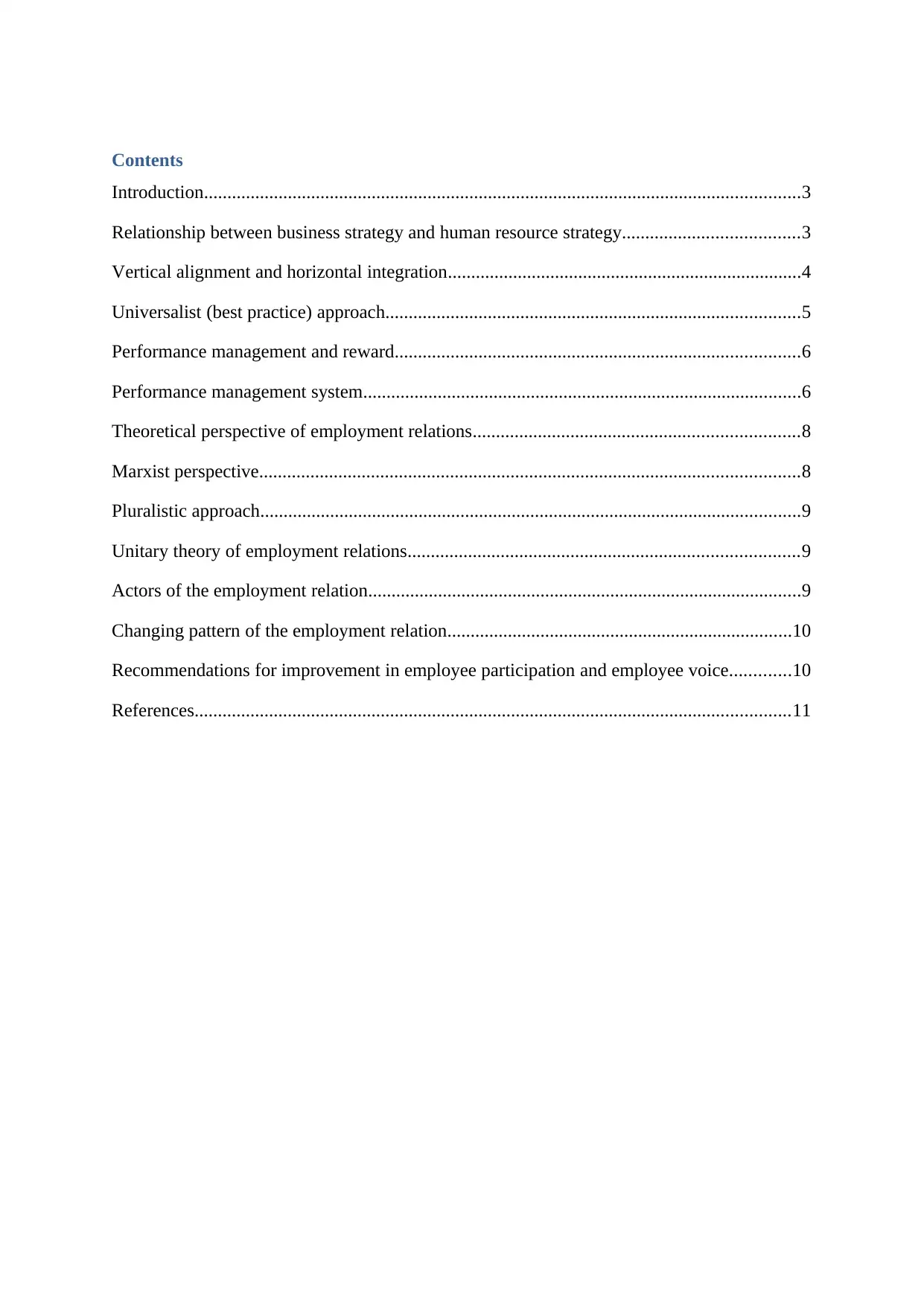
Contents
Introduction................................................................................................................................3
Relationship between business strategy and human resource strategy......................................3
Vertical alignment and horizontal integration............................................................................4
Universalist (best practice) approach.........................................................................................5
Performance management and reward.......................................................................................6
Performance management system..............................................................................................6
Theoretical perspective of employment relations......................................................................8
Marxist perspective....................................................................................................................8
Pluralistic approach....................................................................................................................9
Unitary theory of employment relations....................................................................................9
Actors of the employment relation.............................................................................................9
Changing pattern of the employment relation..........................................................................10
Recommendations for improvement in employee participation and employee voice.............10
References................................................................................................................................11
Introduction................................................................................................................................3
Relationship between business strategy and human resource strategy......................................3
Vertical alignment and horizontal integration............................................................................4
Universalist (best practice) approach.........................................................................................5
Performance management and reward.......................................................................................6
Performance management system..............................................................................................6
Theoretical perspective of employment relations......................................................................8
Marxist perspective....................................................................................................................8
Pluralistic approach....................................................................................................................9
Unitary theory of employment relations....................................................................................9
Actors of the employment relation.............................................................................................9
Changing pattern of the employment relation..........................................................................10
Recommendations for improvement in employee participation and employee voice.............10
References................................................................................................................................11
Introduction
In the recent time, it is significant for the organisation to effectively manage the business
strategy and human resource strategy by working effectively on different aspects. In the
paper, discussion has been carried on the employment relations and SHRM. It has also
explained the relationship between the business strategy and human resource strategy as well
as taken into account the models of SHRM. Further discussion has been carried on the human
resource practices in the performance management and reward. At the end, recommendations
has been provided regarding the employee contribution and employee voice for the
betterment of the organisation.
Task 1
Relationship between business strategy and human resource strategy
Business strategy is the long term planning of any business regarding how business will
achieve the goals, as well as satisfies the customers. It is also said to be the master plan that
company management implements in order to maintain the competitive position by carry out
its operation effectively. From the business perspective, it is said to be the long-term desired
direction, image and destination of the business organisation. business strategy are therefore
actions taken on the management part in order to increase the market position of the company
as well as overall business performance. The business strategy mainly includes the major
competitors that are also doing better in the market with their innovative approaches.
therefore, business strategy allows the organisation to measure the performance and growth
of the organisation against the desired goals.
Human resource strategy on the other hand are said to be the policies that is made by the
organisation of different people. It helps in maintaining the sustainable competitive
advantage. It is therefore said to be the long term planning made for the human resource
development in the organisation. It is said to be one of the significant part of the strategic
management. It therefore directs the actions of the people. When business strategy is formed
after that human resource strategy is made so that people follow, the actions required for
achieve the business goals. It tends to manage all the work. William (2017) has also stated
In the recent time, it is significant for the organisation to effectively manage the business
strategy and human resource strategy by working effectively on different aspects. In the
paper, discussion has been carried on the employment relations and SHRM. It has also
explained the relationship between the business strategy and human resource strategy as well
as taken into account the models of SHRM. Further discussion has been carried on the human
resource practices in the performance management and reward. At the end, recommendations
has been provided regarding the employee contribution and employee voice for the
betterment of the organisation.
Task 1
Relationship between business strategy and human resource strategy
Business strategy is the long term planning of any business regarding how business will
achieve the goals, as well as satisfies the customers. It is also said to be the master plan that
company management implements in order to maintain the competitive position by carry out
its operation effectively. From the business perspective, it is said to be the long-term desired
direction, image and destination of the business organisation. business strategy are therefore
actions taken on the management part in order to increase the market position of the company
as well as overall business performance. The business strategy mainly includes the major
competitors that are also doing better in the market with their innovative approaches.
therefore, business strategy allows the organisation to measure the performance and growth
of the organisation against the desired goals.
Human resource strategy on the other hand are said to be the policies that is made by the
organisation of different people. It helps in maintaining the sustainable competitive
advantage. It is therefore said to be the long term planning made for the human resource
development in the organisation. It is said to be one of the significant part of the strategic
management. It therefore directs the actions of the people. When business strategy is formed
after that human resource strategy is made so that people follow, the actions required for
achieve the business goals. It tends to manage all the work. William (2017) has also stated
⊘ This is a preview!⊘
Do you want full access?
Subscribe today to unlock all pages.

Trusted by 1+ million students worldwide
that human resource includes the strategic factor which further plays an essential role in the
implementation of strategy at organisation.
Human resource as well as business strategy is connected with each other because without the
effective implementation of business strategy, it is not possible to bring the effective working
on the side of employees. Every HR function of the organisation also depends on the business
strategy that further helps in meeting the needs of the organisation. Paauwe and Boon (2018)
has also effectively observes that problems are seen in the human resource strategies when
organisation fail to effectively deploy the human resource. Business strategy assists the
organisation in case of any issue facing from competitors. In the absence of effective and
competent human resource, it is not possible for the organisation to carry out the process or
any strategy.
Vertical alignment and horizontal integration
Both these factors are most significant factors for maintain the positive relationship between
the organisation business and human resource strategy. Vertical alignment is said to be the
linking of HRM strategy with the business strategy. IN this alignment, every member of the
organisation is aware of the company objectives. It tends to ensure that all the resources are
in proper place to fulfil the company goals. As compare to this, horizontal integration is said
to be the linkage between different elements of the human resource strategy such as training,
recruitment, reward and performance management (Mone and London, 2018).
Task 2
Strategic human resource management: theoretical perspective
Strategic human resource management is said to be the alignment of business goals with its
human resources that further improves the satisfaction, motivation, productivity, and thereby
overall performance. Strategic human resource management solves the business obstacles.
The major objective of the strategic human resource management is to solve the issues related
to the organisation structure, culture, resource matching, effectiveness, and performance.
Therefore, strategic human resource management is said to be the concept that links the
management as well as every individual to the business organisation as a whole. It tends to
fulfil the long-term requirement instead of daily policies (Bailey, Mankin, Kelliher and
Garavan, 2018).
implementation of strategy at organisation.
Human resource as well as business strategy is connected with each other because without the
effective implementation of business strategy, it is not possible to bring the effective working
on the side of employees. Every HR function of the organisation also depends on the business
strategy that further helps in meeting the needs of the organisation. Paauwe and Boon (2018)
has also effectively observes that problems are seen in the human resource strategies when
organisation fail to effectively deploy the human resource. Business strategy assists the
organisation in case of any issue facing from competitors. In the absence of effective and
competent human resource, it is not possible for the organisation to carry out the process or
any strategy.
Vertical alignment and horizontal integration
Both these factors are most significant factors for maintain the positive relationship between
the organisation business and human resource strategy. Vertical alignment is said to be the
linking of HRM strategy with the business strategy. IN this alignment, every member of the
organisation is aware of the company objectives. It tends to ensure that all the resources are
in proper place to fulfil the company goals. As compare to this, horizontal integration is said
to be the linkage between different elements of the human resource strategy such as training,
recruitment, reward and performance management (Mone and London, 2018).
Task 2
Strategic human resource management: theoretical perspective
Strategic human resource management is said to be the alignment of business goals with its
human resources that further improves the satisfaction, motivation, productivity, and thereby
overall performance. Strategic human resource management solves the business obstacles.
The major objective of the strategic human resource management is to solve the issues related
to the organisation structure, culture, resource matching, effectiveness, and performance.
Therefore, strategic human resource management is said to be the concept that links the
management as well as every individual to the business organisation as a whole. It tends to
fulfil the long-term requirement instead of daily policies (Bailey, Mankin, Kelliher and
Garavan, 2018).
Paraphrase This Document
Need a fresh take? Get an instant paraphrase of this document with our AI Paraphraser
Strategic human resource management helps the organisation in analysing as well as
identifying the threats and opportunities that are crucial for nay business organisation to
achieve success. With the help of strategic human resource management, it is easy to
formulate the business strategy. Strategic human resource management also assist the
organisation in retailing the skilled and competent people in the organisation that further
proves to be helpful for the organisation in its growth. With the help of this, it is also
beneficial for the organisation to meet the expectations of customers effectively.
Universalist (best practice) approach
This approach is related to the different HR issues such as training and development,
recruitment, employee motivation, selection. It is applicable to each and every organisation
irrespective of the situation. It has given the attention to such things that is being argued on
the statement that HRM is proactive, integrative and long-term approach of managing people.
It has relied on one thing that there is always one best approach for managing the people at
workplace. Therefore, a single of authority is significant which is effectively available at the
top management. top management have the effective knowledge regarding different aspects
of the organisation that effectively helps in handling the complex situation.
Contingency or best fit approach on the other hand is not agree with the universal
applications to stress and HR issues that is application in the wide range of organisational
policies. It therefore believes that the HR policies as well as strategies in several areas of
development, selection, reward and appraisal should be linked with the corporate strategy. It
believes that everything varied based on the business sector, organisation size, nature if work
as well as strategy. Based on the organisational circumstances, the best approach of managing
people tends to vary. Every organisation has different working environment based on several
things. Due to this, function of the organisation is also done in different way.
The resource based view presents the shift in the thinking of the SHRM by giving emphasis
on the internal resources of the organisation rather than focusing on the performance in
external terms. It therefore helps in understanding the conditions when human resource
become valuable, scarce, organisational specific, and difficult to imitate resource (Bromiley
and Rau, 2016). The resource based view therefore mainly identify HR function or
department as the strategic player for maintaining the sustainable competitive advantage
(Cascio, 2015). It also identifies the resources as the human, physical, organisational
identifying the threats and opportunities that are crucial for nay business organisation to
achieve success. With the help of strategic human resource management, it is easy to
formulate the business strategy. Strategic human resource management also assist the
organisation in retailing the skilled and competent people in the organisation that further
proves to be helpful for the organisation in its growth. With the help of this, it is also
beneficial for the organisation to meet the expectations of customers effectively.
Universalist (best practice) approach
This approach is related to the different HR issues such as training and development,
recruitment, employee motivation, selection. It is applicable to each and every organisation
irrespective of the situation. It has given the attention to such things that is being argued on
the statement that HRM is proactive, integrative and long-term approach of managing people.
It has relied on one thing that there is always one best approach for managing the people at
workplace. Therefore, a single of authority is significant which is effectively available at the
top management. top management have the effective knowledge regarding different aspects
of the organisation that effectively helps in handling the complex situation.
Contingency or best fit approach on the other hand is not agree with the universal
applications to stress and HR issues that is application in the wide range of organisational
policies. It therefore believes that the HR policies as well as strategies in several areas of
development, selection, reward and appraisal should be linked with the corporate strategy. It
believes that everything varied based on the business sector, organisation size, nature if work
as well as strategy. Based on the organisational circumstances, the best approach of managing
people tends to vary. Every organisation has different working environment based on several
things. Due to this, function of the organisation is also done in different way.
The resource based view presents the shift in the thinking of the SHRM by giving emphasis
on the internal resources of the organisation rather than focusing on the performance in
external terms. It therefore helps in understanding the conditions when human resource
become valuable, scarce, organisational specific, and difficult to imitate resource (Bromiley
and Rau, 2016). The resource based view therefore mainly identify HR function or
department as the strategic player for maintaining the sustainable competitive advantage
(Cascio, 2015). It also identifies the resources as the human, physical, organisational
resources. It therefore believes that these resources are essential for a firm to carry out the
work in an effective manner. As compare to the above two perspective, it believes mainly in
carrying the different functions of HR.
Performance management and reward
Performance management is said to be the continuous process of identifying, measuring, and
then developing the performance of the workforce in organisation. In this, every person’s
objective and performance is connected with the overall objectives of the enterprise. It also
makes sure that every employee is properly aware about his or her function at job in effective
manner (Noe, Hollenbeck, Gerhart and Wright, 2017). It is rightly stated that the performance
should be directly link with the reward policies so that the objective to reward the employee
performance and retaining of competent people can be achieved.
Performance management and organisation development also have direct link. It is also said
to be the approach of management change that helps in improving the competitiveness and
organisational performance. Change is most significant element in the organisation that tends
to improve the productivity of the organisation in effective manner. The most significant way
of therefor motivating employees in the organisation is recognising their skills with the help
of reward system. Reward system us also based on the contribution of the individual and
team of the organisation.
Performance management system
It is said to be the proper and systematic approach for measuring the employee’s performance
in the organisation. It is the process through which any organisation align its goals, mission,
and objective with the resources that are available. The competency knowledge and skills can
also be identified with the help of this process that can further improved by training,
guidance, mentoring, and coaching to the employees. Therefore, the management of
employees performance is the first and foremost goal of the performance management system
in any organisation. It is a tool through which overall goal of the organisation is followed.
The process of performance management includes several steps that are as follows:
Step 1: Pre-Requisitesal
work in an effective manner. As compare to the above two perspective, it believes mainly in
carrying the different functions of HR.
Performance management and reward
Performance management is said to be the continuous process of identifying, measuring, and
then developing the performance of the workforce in organisation. In this, every person’s
objective and performance is connected with the overall objectives of the enterprise. It also
makes sure that every employee is properly aware about his or her function at job in effective
manner (Noe, Hollenbeck, Gerhart and Wright, 2017). It is rightly stated that the performance
should be directly link with the reward policies so that the objective to reward the employee
performance and retaining of competent people can be achieved.
Performance management and organisation development also have direct link. It is also said
to be the approach of management change that helps in improving the competitiveness and
organisational performance. Change is most significant element in the organisation that tends
to improve the productivity of the organisation in effective manner. The most significant way
of therefor motivating employees in the organisation is recognising their skills with the help
of reward system. Reward system us also based on the contribution of the individual and
team of the organisation.
Performance management system
It is said to be the proper and systematic approach for measuring the employee’s performance
in the organisation. It is the process through which any organisation align its goals, mission,
and objective with the resources that are available. The competency knowledge and skills can
also be identified with the help of this process that can further improved by training,
guidance, mentoring, and coaching to the employees. Therefore, the management of
employees performance is the first and foremost goal of the performance management system
in any organisation. It is a tool through which overall goal of the organisation is followed.
The process of performance management includes several steps that are as follows:
Step 1: Pre-Requisitesal
⊘ This is a preview!⊘
Do you want full access?
Subscribe today to unlock all pages.
Trusted by 1+ million students worldwide
It is true that organisation loose its goal. Due to this, it is significant to define the purpose of
the organisation clearly to the new as well as existing employees in order to coordinate the
working of every team member. The three primary stages are being defined by the
organisation for defining the short term and long term objectives. The first stage is the at the
level of organisation where overall objective is being defined such as long term vision,
values, as well as mission of the organisation. the second stage is the department level where
management tends to assign the target for achieving the objectives. The last stage is the
individual level where each department provides the target to each person.
Step 2: performance planning
In this, three attributes are included:
1. Results: it is said to be the significant tool for measuring the department as well as
employees performance. In this, discussion is carried on regarding the achievements as well
as gaps in the performance. Therefore, employees get enough knowledge to improve their
performance.
2. Behaviour: It is true that the measuring of individual behaviour is one of the
significant challenges in the organisation. Therefore, behaviour can only be monitored by
ensuring close observation by the human resource department as well as supervisor.
Stage 3: performance execution
It is considered as the most significant stage because the whole procedure tends to rely on it.
The major responsibility of the performance execution lies with the employees that is further
followed by the department. However, responsibility of the manager is high such as
providing proper resources, ensuring the effective sue of tools and equipment by the
employees. Managers are also required to provide time-to-time feedback to the subordinates
so that they can improve their performance further.
Stage 4: Performance assessment
It is the next stage comes after performance execution. Under this stage, managers as well as
employees both arte responsible for measuring and assessing the performance of employees
against the targets set. Therefore, it includes the individual behaviour, targets, attitudes,
behaviour, as well as special achievement. In this stage, every individual person performance
is being measured so that further steps can be taken.
the organisation clearly to the new as well as existing employees in order to coordinate the
working of every team member. The three primary stages are being defined by the
organisation for defining the short term and long term objectives. The first stage is the at the
level of organisation where overall objective is being defined such as long term vision,
values, as well as mission of the organisation. the second stage is the department level where
management tends to assign the target for achieving the objectives. The last stage is the
individual level where each department provides the target to each person.
Step 2: performance planning
In this, three attributes are included:
1. Results: it is said to be the significant tool for measuring the department as well as
employees performance. In this, discussion is carried on regarding the achievements as well
as gaps in the performance. Therefore, employees get enough knowledge to improve their
performance.
2. Behaviour: It is true that the measuring of individual behaviour is one of the
significant challenges in the organisation. Therefore, behaviour can only be monitored by
ensuring close observation by the human resource department as well as supervisor.
Stage 3: performance execution
It is considered as the most significant stage because the whole procedure tends to rely on it.
The major responsibility of the performance execution lies with the employees that is further
followed by the department. However, responsibility of the manager is high such as
providing proper resources, ensuring the effective sue of tools and equipment by the
employees. Managers are also required to provide time-to-time feedback to the subordinates
so that they can improve their performance further.
Stage 4: Performance assessment
It is the next stage comes after performance execution. Under this stage, managers as well as
employees both arte responsible for measuring and assessing the performance of employees
against the targets set. Therefore, it includes the individual behaviour, targets, attitudes,
behaviour, as well as special achievement. In this stage, every individual person performance
is being measured so that further steps can be taken.
Paraphrase This Document
Need a fresh take? Get an instant paraphrase of this document with our AI Paraphraser
Stage 5: review of performance
It is said to be the platform where superior as well as subordinates exchange the feedback of
performance and provide review against each target. In order to make the performance review
successful, it is better to exchange and involve the dialogue that is significant for the manager
and employee. In addition to this, they also discuss regarding the significant training
programs that are essential for the improvement of knowledge and skills, targets as well as
expectations of the manager and employees.
Stage 7: renewal of performance
It is already discussed that the process of performance management is on going process. Once
the performance is being reviewed, the next thing is to start the performance appraisal again.
However, it should be aligned with the organisations objectives, goals, and mission. In this
stage, if any deficiency is being seen, the performance management again starts from the step
1.
Theoretical perspective of employment relations
Marxist perspective
This view states the clash between the employer a well as worker. This states that workers
always try their best to maximise the profit by paying less to the workers. As compare to this,
workers believe that they are the most significant part of the production process. Therefore,
they should get the fair share of the profits by forming the trade union (Su, Wright and
Ulrich, 2018). Due to the improper result, clashes has been seen where workers take the
control of companies. This was most popular in the 20th century where workers were paid too
less wages. In this way, this approach gives emphasis on the inequalities presents between the
labour and capital. Due to this, the trade union gives the natural response on the side of
labour.
Pluralistic approach
This approach works on the different interest of both the parties. It believes that conflict
between the two parties is obvious due to the different interest. Both parties tend to work on
their own interest. Employer always seeks to work for gaining the higher productivity at the
lower cost. As compare to this, employees also want the higher remuneration, increased
It is said to be the platform where superior as well as subordinates exchange the feedback of
performance and provide review against each target. In order to make the performance review
successful, it is better to exchange and involve the dialogue that is significant for the manager
and employee. In addition to this, they also discuss regarding the significant training
programs that are essential for the improvement of knowledge and skills, targets as well as
expectations of the manager and employees.
Stage 7: renewal of performance
It is already discussed that the process of performance management is on going process. Once
the performance is being reviewed, the next thing is to start the performance appraisal again.
However, it should be aligned with the organisations objectives, goals, and mission. In this
stage, if any deficiency is being seen, the performance management again starts from the step
1.
Theoretical perspective of employment relations
Marxist perspective
This view states the clash between the employer a well as worker. This states that workers
always try their best to maximise the profit by paying less to the workers. As compare to this,
workers believe that they are the most significant part of the production process. Therefore,
they should get the fair share of the profits by forming the trade union (Su, Wright and
Ulrich, 2018). Due to the improper result, clashes has been seen where workers take the
control of companies. This was most popular in the 20th century where workers were paid too
less wages. In this way, this approach gives emphasis on the inequalities presents between the
labour and capital. Due to this, the trade union gives the natural response on the side of
labour.
Pluralistic approach
This approach works on the different interest of both the parties. It believes that conflict
between the two parties is obvious due to the different interest. Both parties tend to work on
their own interest. Employer always seeks to work for gaining the higher productivity at the
lower cost. As compare to this, employees also want the higher remuneration, increased
benefits and better conditions of working. In spite of the violence, the negotiation is needed
to reach at the middle ground. The most significant part of this model is that the workers
identifies that it is their major interest of them to be loyal to the employer same as they are
loyal to union. Employers also know that better working condition and fair wages tends to
make the employees more productive.
Unitary theory of employment relations
The unitary perspective relates to the cooperation. Workers and employers both are seen as
the same team. They also share the same values and same interest as well as goals in the
organisation. under this model, conflict is seen as the evil. This has stated unions as the
outside force that fights for the loyalty of employees and at the same time zeniths employees
against management. this theory effectively manages the employment relationship by
matching to the opinions and views of the management.
Actors of the employment relation
Employment relation is seen as the interaction between different actors. However, it is
majorly comprises of the employees, unions, employers, management and state. Each actor
play different role. The major responsibility of the management is to hire the competent
workers by ensuring the effective communication with the concerned parties. There are times
when workers do not get the payment on time. Therefore, the role of union is to improve the
social well-being of the members. in order to ensure the better working of the employees,
unions better deal with the employer regarding the issues of employees. These actors tend to
manage the issues that are emerging in the workplace. Employees are therefore the significant
factor that improves the relation between the employer by ensuring effective communication
(Cao, Duan and 2015). It is true that effective communication solves so many problems that
an organisation is facing.
Changing pattern of the employment relation
The nature of employment relationship in recent time is changing rapidly. The impact of the
labour standards and markets, tax, economy, as well as living wage and system of social
security is required to be addresses. The major challenge is to encourage the creativity and
innovation for the competitive and sustainable market economy. Due to the open market
system, management has to face the several diversity issues. Due to this, cultural diversity
to reach at the middle ground. The most significant part of this model is that the workers
identifies that it is their major interest of them to be loyal to the employer same as they are
loyal to union. Employers also know that better working condition and fair wages tends to
make the employees more productive.
Unitary theory of employment relations
The unitary perspective relates to the cooperation. Workers and employers both are seen as
the same team. They also share the same values and same interest as well as goals in the
organisation. under this model, conflict is seen as the evil. This has stated unions as the
outside force that fights for the loyalty of employees and at the same time zeniths employees
against management. this theory effectively manages the employment relationship by
matching to the opinions and views of the management.
Actors of the employment relation
Employment relation is seen as the interaction between different actors. However, it is
majorly comprises of the employees, unions, employers, management and state. Each actor
play different role. The major responsibility of the management is to hire the competent
workers by ensuring the effective communication with the concerned parties. There are times
when workers do not get the payment on time. Therefore, the role of union is to improve the
social well-being of the members. in order to ensure the better working of the employees,
unions better deal with the employer regarding the issues of employees. These actors tend to
manage the issues that are emerging in the workplace. Employees are therefore the significant
factor that improves the relation between the employer by ensuring effective communication
(Cao, Duan and 2015). It is true that effective communication solves so many problems that
an organisation is facing.
Changing pattern of the employment relation
The nature of employment relationship in recent time is changing rapidly. The impact of the
labour standards and markets, tax, economy, as well as living wage and system of social
security is required to be addresses. The major challenge is to encourage the creativity and
innovation for the competitive and sustainable market economy. Due to the open market
system, management has to face the several diversity issues. Due to this, cultural diversity
⊘ This is a preview!⊘
Do you want full access?
Subscribe today to unlock all pages.
Trusted by 1+ million students worldwide
has become essential to manage the work force. The first individual approach tends to give
emphasis on the direct negotiation between employee and employer. It states that employers
are prepared in advance to offer very less chance to the employee to enter into negotiation
(Mumford, 2016). Second approach is related to the collective arrangement between the
representatives of employees who determines the major conditions. The major conditions
includes the changes that employees want in the organisation such as better organisation
culture, better accommodation of any other changes.
Recommendations for improvement in employee participation and employee voice
Employee voice is said to be the situation where employees have the opportunity to give
some input in the decision-making. When employees are given the chance to give their
suggestions and ideas in the decision-making, employees also work effectively. In several
organisations such as Google, employees have the opportunity to share their valuable views
and ideas and those are being considered. It is therefore recommended to the organisation for
giving emphasis on the valuable ideas of employees at the time of making decision. For
ensuring the retention of employees in the organisation for long time, it is better to give voice
to the ideas of the employees.
Conclusion
In the limelight of above discussion, it can be concluded that success of an organisation
directly depends on the quality of its human resource and business strategy. It is being
analysed that that business strategy also succeed with the availability and proper performance
of the employees. several theories presents in the organisation that helps the organisation in
effective manner. Each perspective such as contingency, Universalist as well as resource
based view have their own strength and weakness. The way in which employees of the
organisation are managed hugely impact the performance of the organisation.
References
Bailey, C., Mankin, D., Kelliher, C. and Garavan, T., 2018. Strategic human resource
management. Oxford University Press.
emphasis on the direct negotiation between employee and employer. It states that employers
are prepared in advance to offer very less chance to the employee to enter into negotiation
(Mumford, 2016). Second approach is related to the collective arrangement between the
representatives of employees who determines the major conditions. The major conditions
includes the changes that employees want in the organisation such as better organisation
culture, better accommodation of any other changes.
Recommendations for improvement in employee participation and employee voice
Employee voice is said to be the situation where employees have the opportunity to give
some input in the decision-making. When employees are given the chance to give their
suggestions and ideas in the decision-making, employees also work effectively. In several
organisations such as Google, employees have the opportunity to share their valuable views
and ideas and those are being considered. It is therefore recommended to the organisation for
giving emphasis on the valuable ideas of employees at the time of making decision. For
ensuring the retention of employees in the organisation for long time, it is better to give voice
to the ideas of the employees.
Conclusion
In the limelight of above discussion, it can be concluded that success of an organisation
directly depends on the quality of its human resource and business strategy. It is being
analysed that that business strategy also succeed with the availability and proper performance
of the employees. several theories presents in the organisation that helps the organisation in
effective manner. Each perspective such as contingency, Universalist as well as resource
based view have their own strength and weakness. The way in which employees of the
organisation are managed hugely impact the performance of the organisation.
References
Bailey, C., Mankin, D., Kelliher, C. and Garavan, T., 2018. Strategic human resource
management. Oxford University Press.
Paraphrase This Document
Need a fresh take? Get an instant paraphrase of this document with our AI Paraphraser
Bromiley, P. and Rau, D., 2016. Operations management and the resource based view:
Another view. Journal of Operations Management, 41, pp.95-106.
Cao, G., Duan, Y. and Li, G., 2015. Linking business analytics to decision making
effectiveness: A path model analysis. IEEE Transactions on Engineering
Management, 62(3), pp.384-395.
Cascio, W.F., 2015. Managing human resources. McGraw-Hill.
Davies, A., 2018. Industrial relations and new technology. United Kingdom: Routledge.
Delery, J.E. and Roumpi, D., 2017. Strategic human resource management, human capital
and competitive advantage: is the field going in circles?. Human Resource Management
Journal, 27(1), pp.1-21.
Dubin, R., 2017. The world of work: Industrial society and human relations. Taylor &
Francis.
Gerrish, E., 2016. The impact of performance management on performance in public
organizations: A meta‐analysis. Public Administration Review, 76(1), pp.48-66.
Harrison, T. and Bazzy, J.D., 2017. Aligning organizational culture and strategic human
resource management. Journal of Management Development, 36(10), pp.1260-1269.
Mone, E.M. and London, M., 2018. Employee engagement through effective performance
management: A practical guide for managers. Routledge.
Mumford, C., 2016. Finding a voice at work? New perspectives on employment
relations. Personnel Review. 11(5).
Noe, R.A., Hollenbeck, J.R., Gerhart, B. and Wright, P.M., 2017. Human resource
management: Gaining a competitive advantage. New York, NY: McGraw-Hill Education.
Paauwe, J. and Boon, C., 2018. Strategic HRM: A critical review. In Human Resource
Management (pp. 49-73). United Kingdom: Routledge.
Soomro, N. and Shamsi, A.F., 2018. Measuring SHRM Vertical and Horizontal Fit: Scale
Development and Validation. Abasyn University Journal of Social Sciences, 11(1).
Another view. Journal of Operations Management, 41, pp.95-106.
Cao, G., Duan, Y. and Li, G., 2015. Linking business analytics to decision making
effectiveness: A path model analysis. IEEE Transactions on Engineering
Management, 62(3), pp.384-395.
Cascio, W.F., 2015. Managing human resources. McGraw-Hill.
Davies, A., 2018. Industrial relations and new technology. United Kingdom: Routledge.
Delery, J.E. and Roumpi, D., 2017. Strategic human resource management, human capital
and competitive advantage: is the field going in circles?. Human Resource Management
Journal, 27(1), pp.1-21.
Dubin, R., 2017. The world of work: Industrial society and human relations. Taylor &
Francis.
Gerrish, E., 2016. The impact of performance management on performance in public
organizations: A meta‐analysis. Public Administration Review, 76(1), pp.48-66.
Harrison, T. and Bazzy, J.D., 2017. Aligning organizational culture and strategic human
resource management. Journal of Management Development, 36(10), pp.1260-1269.
Mone, E.M. and London, M., 2018. Employee engagement through effective performance
management: A practical guide for managers. Routledge.
Mumford, C., 2016. Finding a voice at work? New perspectives on employment
relations. Personnel Review. 11(5).
Noe, R.A., Hollenbeck, J.R., Gerhart, B. and Wright, P.M., 2017. Human resource
management: Gaining a competitive advantage. New York, NY: McGraw-Hill Education.
Paauwe, J. and Boon, C., 2018. Strategic HRM: A critical review. In Human Resource
Management (pp. 49-73). United Kingdom: Routledge.
Soomro, N. and Shamsi, A.F., 2018. Measuring SHRM Vertical and Horizontal Fit: Scale
Development and Validation. Abasyn University Journal of Social Sciences, 11(1).
Su, Z.X., Wright, P.M. and Ulrich, M.D., 2018. Going beyond the SHRM paradigm:
Examining four approaches to governing employees. Journal of Management, 44(4),
pp.1598-1619.
Williams, S., 2017. Introducing Employment Relations. Oxford University Press.
Examining four approaches to governing employees. Journal of Management, 44(4),
pp.1598-1619.
Williams, S., 2017. Introducing Employment Relations. Oxford University Press.
⊘ This is a preview!⊘
Do you want full access?
Subscribe today to unlock all pages.
Trusted by 1+ million students worldwide

1 out of 12


Related Documents


Your All-in-One AI-Powered Toolkit for Academic Success.
+13062052269
info@desklib.com
Available 24*7 on WhatsApp / Email
![[object Object]](/_next/static/media/star-bottom.7253800d.svg)
Unlock your academic potential
Copyright © 2020–2026 A2Z Services. All Rights Reserved. Developed and managed by ZUCOL.