Parsons’ Sick Role Theory and Palliative Care: A Critical Analysis
VerifiedAdded on 2023/06/18
|7
|2105
|75
Essay
AI Summary
This essay provides a comprehensive analysis of Talcott Parsons' 'Sick Role' theory and its relevance in contemporary Western healthcare, discussing the rights and responsibilities of individuals deemed 'sick.' It delves into arguments surrounding the theory, particularly from Marxist perspectives, which critique the medicalization process. Furthermore, the essay examines palliative care, addressing whether it primarily relieves or produces suffering, its relationship with the medicalization of dying, and its overall impact on the quality of life for patients and their families facing serious illnesses. The study concludes that palliative care plays a vital role in critical cases by alleviating pain and stress, while also acknowledging the critical impacts of Parsons' sick theory on behaviors in healthcare.

Questions

Paraphrase This Document
Need a fresh take? Get an instant paraphrase of this document with our AI Paraphraser
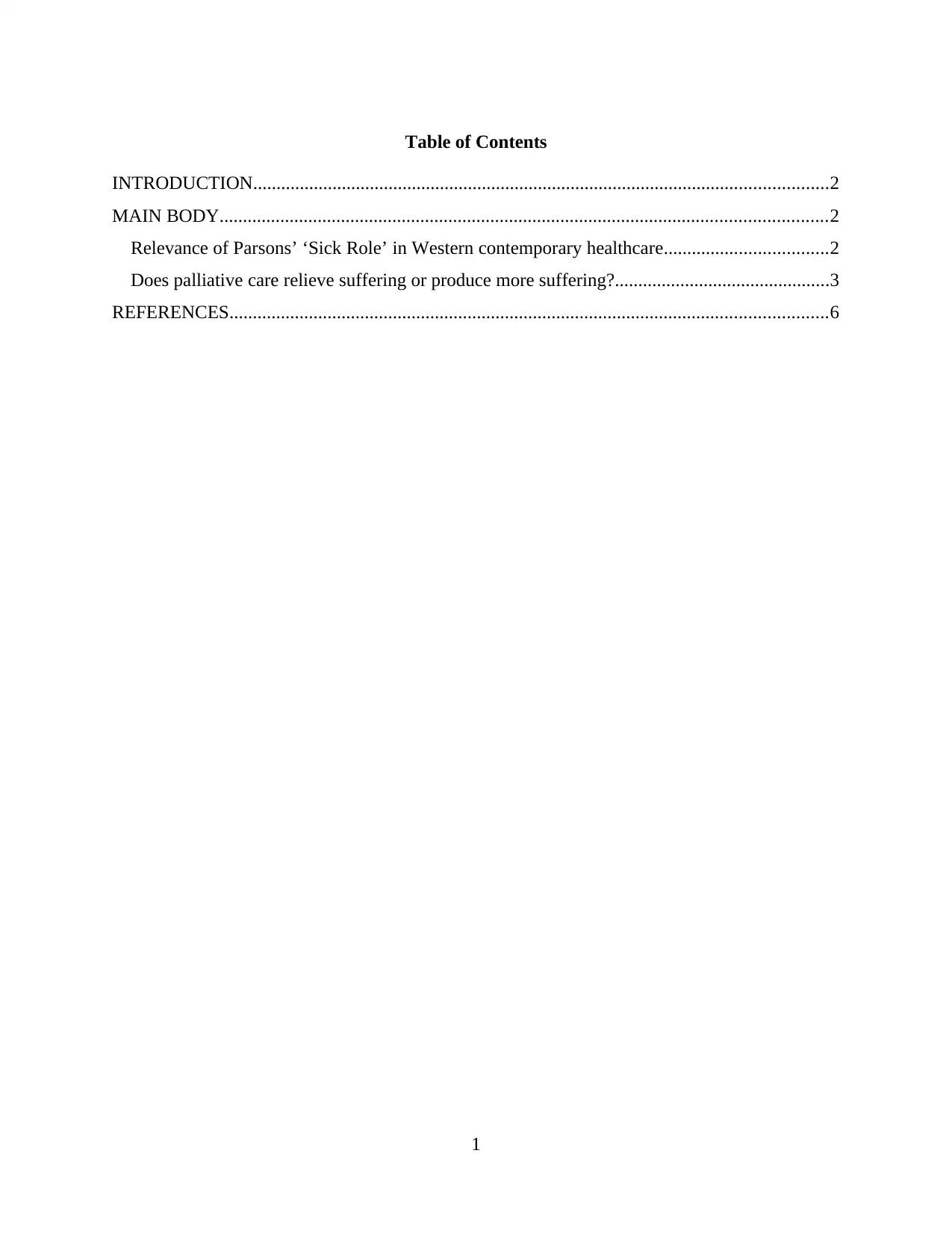
Table of Contents
INTRODUCTION...........................................................................................................................2
MAIN BODY..................................................................................................................................2
Relevance of Parsons’ ‘Sick Role’ in Western contemporary healthcare...................................2
Does palliative care relieve suffering or produce more suffering?..............................................3
REFERENCES................................................................................................................................6
1
INTRODUCTION...........................................................................................................................2
MAIN BODY..................................................................................................................................2
Relevance of Parsons’ ‘Sick Role’ in Western contemporary healthcare...................................2
Does palliative care relieve suffering or produce more suffering?..............................................3
REFERENCES................................................................................................................................6
1
INTRODUCTION
Palliative care is an approach that helps in improving Patients as well as their families’
quality of life who are suffering from illness and health related problems (Avati and et.al., 2018).
This essay is going to discuss some views of Parsons regarding ‘Sick Role’ and how people with
sickness can get some rights and responsibilities. It will discuss some argumentative views who
believe that sick roles have negative impacts and there is no relationship between doctor and sick
patients as doctors in 21st century wants to earn money rather improving health.
MAIN BODY
Relevance of Parsons’ ‘Sick Role’ in Western contemporary healthcare
Sick role theory that is defined by Talcott Parsons in 1951, explained some roles of all those people
who are ill and suffer from some diseases. Parsons argued that people who are sick cannot perform
functions as like a normal individuals and their duties should be changed. He also saw sick role as a form
of deviance or abnormality and the reason behind viewing this role as abnormal is incapability of ill
person to perform roles as like people who are in well-condition (Talcott Parsons and the Theory of
the Sick Role, 2016). He also stated that society can be developed when it has some productive members
and if ill person is not able to perform his/her roles like going for studies, going to office and earn money
for fostering their families then what are their meaning and how can they be productive and help
society’s development and growth. But there are numbers of advantages that have been given o
sick people. For example: if a student does not go to school for long days then teachers and
administrators will see this as deviant but if he is ill then they will allow their leaves or absence.
So, for this purpose, people need to take legitimization from doctors as legitimization is a proof
that shows that an individual is truly sick. Parsons has discussed 2 roles and 2 responsibilities for
sick people (Yang, 2020).as per this, he said that ill patients have one main right to not to be
blamed for illness and other main right to get some flexibility by others. The main responsibility
of sick or ill person is to make priority to get well soon and also getting appropriate as well as
effective treatment for illness.
But there are numbers of arguments of Parsons’s sick theory and one of the main person who argued
is: Marxist persuasion. He states that medicalization and process of treating people with serious
illness has damaging impacts on their health because their main aim has become to earn profit
2
Palliative care is an approach that helps in improving Patients as well as their families’
quality of life who are suffering from illness and health related problems (Avati and et.al., 2018).
This essay is going to discuss some views of Parsons regarding ‘Sick Role’ and how people with
sickness can get some rights and responsibilities. It will discuss some argumentative views who
believe that sick roles have negative impacts and there is no relationship between doctor and sick
patients as doctors in 21st century wants to earn money rather improving health.
MAIN BODY
Relevance of Parsons’ ‘Sick Role’ in Western contemporary healthcare
Sick role theory that is defined by Talcott Parsons in 1951, explained some roles of all those people
who are ill and suffer from some diseases. Parsons argued that people who are sick cannot perform
functions as like a normal individuals and their duties should be changed. He also saw sick role as a form
of deviance or abnormality and the reason behind viewing this role as abnormal is incapability of ill
person to perform roles as like people who are in well-condition (Talcott Parsons and the Theory of
the Sick Role, 2016). He also stated that society can be developed when it has some productive members
and if ill person is not able to perform his/her roles like going for studies, going to office and earn money
for fostering their families then what are their meaning and how can they be productive and help
society’s development and growth. But there are numbers of advantages that have been given o
sick people. For example: if a student does not go to school for long days then teachers and
administrators will see this as deviant but if he is ill then they will allow their leaves or absence.
So, for this purpose, people need to take legitimization from doctors as legitimization is a proof
that shows that an individual is truly sick. Parsons has discussed 2 roles and 2 responsibilities for
sick people (Yang, 2020).as per this, he said that ill patients have one main right to not to be
blamed for illness and other main right to get some flexibility by others. The main responsibility
of sick or ill person is to make priority to get well soon and also getting appropriate as well as
effective treatment for illness.
But there are numbers of arguments of Parsons’s sick theory and one of the main person who argued
is: Marxist persuasion. He states that medicalization and process of treating people with serious
illness has damaging impacts on their health because their main aim has become to earn profit
2
⊘ This is a preview!⊘
Do you want full access?
Subscribe today to unlock all pages.

Trusted by 1+ million students worldwide
rather than the health of population. For supporting this view, Illich argued and stated that
seeking medical guidance and advice as well as ensuing all their processes mainly leads some
serious problems than the problems that patient has suffered in the first place (Greco, 2019). For
discussing in more detail they gave examples with 3 types of illness such as:
Clinical: It is a type of illness where patients become more ill only because of hospital
environment and other factors such as: inappropriate surgery, hospital based infection and virus
related diseases.
Social: Diversity in society that has negative mental impacts is known as social iatrogenesis.
Mild depression, hyperactivity are examples of this.
Cultural: It refers to ways as how once areas of life have become medicalised and it became
difficult to deal with stressful life event (Meadows and et.al., 2019).
Overall, it can be said that views of Parsons regarding sick role and sick theory has critical
impacts on people’ behaviours. It has great impacts only when patients are fairly sick. When patients take
undue advantages then sick role can have negative impacts on society.
Does palliative care relieve suffering or produce more suffering?
Before discussing about consequences and advantages of palliative care, it is important to
discuss the main concept of palliative care. As per the WHO, it is stated that palliative care
specialized medical care that is given to people who face or suffer from serious illness. The main
focus on this type of care is on providing relief from the stress of illness and symptoms (Rietjens
and et.al., 2017). Overall goal of palliative care is improving quality of life for patients and
family.
Uses of this care and consequences in healthcare
In regard to critical impacts, it is known that palliative care is being given by trained team
of doctors, nurses and others who work collaboratively. The main effectiveness of this care is, it
is based on patients´ special needs and not on patients’ prognosis. Other effectiveness of this care
is it is being given with curative treatment (Pham and et.al., 2020). There are numbers of
advantages if this care is being given by trained professionals such as: it can improve quality of
life, relieve suffering from stress to patients and being given with collaboration of trained nurses
and doctors.
Johnson, Butow, Kerridge and Tattersall, (2018) argued and said that managing people
with serious illness and pain is quite difficult and there is requirements of extra work,
3
seeking medical guidance and advice as well as ensuing all their processes mainly leads some
serious problems than the problems that patient has suffered in the first place (Greco, 2019). For
discussing in more detail they gave examples with 3 types of illness such as:
Clinical: It is a type of illness where patients become more ill only because of hospital
environment and other factors such as: inappropriate surgery, hospital based infection and virus
related diseases.
Social: Diversity in society that has negative mental impacts is known as social iatrogenesis.
Mild depression, hyperactivity are examples of this.
Cultural: It refers to ways as how once areas of life have become medicalised and it became
difficult to deal with stressful life event (Meadows and et.al., 2019).
Overall, it can be said that views of Parsons regarding sick role and sick theory has critical
impacts on people’ behaviours. It has great impacts only when patients are fairly sick. When patients take
undue advantages then sick role can have negative impacts on society.
Does palliative care relieve suffering or produce more suffering?
Before discussing about consequences and advantages of palliative care, it is important to
discuss the main concept of palliative care. As per the WHO, it is stated that palliative care
specialized medical care that is given to people who face or suffer from serious illness. The main
focus on this type of care is on providing relief from the stress of illness and symptoms (Rietjens
and et.al., 2017). Overall goal of palliative care is improving quality of life for patients and
family.
Uses of this care and consequences in healthcare
In regard to critical impacts, it is known that palliative care is being given by trained team
of doctors, nurses and others who work collaboratively. The main effectiveness of this care is, it
is based on patients´ special needs and not on patients’ prognosis. Other effectiveness of this care
is it is being given with curative treatment (Pham and et.al., 2020). There are numbers of
advantages if this care is being given by trained professionals such as: it can improve quality of
life, relieve suffering from stress to patients and being given with collaboration of trained nurses
and doctors.
Johnson, Butow, Kerridge and Tattersall, (2018) argued and said that managing people
with serious illness and pain is quite difficult and there is requirements of extra work,
3
Paraphrase This Document
Need a fresh take? Get an instant paraphrase of this document with our AI Paraphraser
commitment, adaption and meeting different needs and all these can lead stress and uncertainty.
People at this stage require to manage the situation and optimize living while dying. People at
this stage become negative and stressed and they are less likely to cooperate to doctors and
nurses that can increase problems. Some other problems that are associated with this care: denial
of diagnostic test, discouragement of hospitalization when patients enter hospice care.
Participation in clinical trial is not allowed because they are considered life-prolonging.
So, overall, on the basis of this argument, it can be said that problems with palliative care
is not from doctors and nurses side as it all occurs from patients’ side. This care improves quality
of life and relieve pain. So, it clears this statement that palliative care relieves suffering and it
does not produce more pain and suffering. In some cases, it might increase pain where patients
suffer from most serious illness and for reliving them from pain, doctors need to provide
treatment and drugs with high dose.
Relationship between palliative care and medicalisation of dying
In regard to medicalization, it can be said that it refers a procedure that is being used by
healthcare professionals to treat human conditions or illness and they are defined as medical
condition. For getting more details related to specific disease and human problems, support staff
make such problems as the main subject of their medical study, prevention and treatment. There
are some negative impacts of medicalisation because doctors take samples to patients’ bodies in
order to get some critical outcomes and proving them. For example: For proving that vaccination
as if it has positive outcomes or not, some doctors have been selected but in some cases it
happens when such experiments and medicalisation process can violent patients’ bodies
(Koksvik and et.al., 2020). This process can violate bodies of dying patients with mechanical
hums, restraints, tubes and others.
On contrary side, Driessen, Borgstrom and Cohn, (2021) stated that medicalisation of
dying has some positive impacts because the main aim of this process is to reduce patients’ pain
and suffering. It does not speed up or delay the progression of death. And in palliative care¸
patients are being given effective treatment that can help them in relieving pain and make them
stressed free. It is all about a hope and acceptance. Progression of death cannot be delayed but
medicalisation process help patients in decreasing their pain that they face with serious illness
and at the time of palliative care. Medical services related to death as something to be resisted,
avoided and postponed. In regard to relation between process of medicalisation and palliative
4
People at this stage require to manage the situation and optimize living while dying. People at
this stage become negative and stressed and they are less likely to cooperate to doctors and
nurses that can increase problems. Some other problems that are associated with this care: denial
of diagnostic test, discouragement of hospitalization when patients enter hospice care.
Participation in clinical trial is not allowed because they are considered life-prolonging.
So, overall, on the basis of this argument, it can be said that problems with palliative care
is not from doctors and nurses side as it all occurs from patients’ side. This care improves quality
of life and relieve pain. So, it clears this statement that palliative care relieves suffering and it
does not produce more pain and suffering. In some cases, it might increase pain where patients
suffer from most serious illness and for reliving them from pain, doctors need to provide
treatment and drugs with high dose.
Relationship between palliative care and medicalisation of dying
In regard to medicalization, it can be said that it refers a procedure that is being used by
healthcare professionals to treat human conditions or illness and they are defined as medical
condition. For getting more details related to specific disease and human problems, support staff
make such problems as the main subject of their medical study, prevention and treatment. There
are some negative impacts of medicalisation because doctors take samples to patients’ bodies in
order to get some critical outcomes and proving them. For example: For proving that vaccination
as if it has positive outcomes or not, some doctors have been selected but in some cases it
happens when such experiments and medicalisation process can violent patients’ bodies
(Koksvik and et.al., 2020). This process can violate bodies of dying patients with mechanical
hums, restraints, tubes and others.
On contrary side, Driessen, Borgstrom and Cohn, (2021) stated that medicalisation of
dying has some positive impacts because the main aim of this process is to reduce patients’ pain
and suffering. It does not speed up or delay the progression of death. And in palliative care¸
patients are being given effective treatment that can help them in relieving pain and make them
stressed free. It is all about a hope and acceptance. Progression of death cannot be delayed but
medicalisation process help patients in decreasing their pain that they face with serious illness
and at the time of palliative care. Medical services related to death as something to be resisted,
avoided and postponed. In regard to relation between process of medicalisation and palliative
4
care it can be said that, palliative care has encouraged medicines and medical treatments to be
gentler in order to relieve patients from pain in its acceptance of death that has parallel
development in the medical system that has doubled efforts in the opposite direction.
It is found that quarter of beds in the UK are occupied with patients who are at their last
year of life. Numbers of people are given non-palliative care or treatments at the time of their
final day. More than 50% of patients with severe disease like cancer and dementia receive
palliative or tube feeding care. But this process sometimes increase pain but patients have hope
that it can decrease their pain and can improve their quality of lives. The main aim of
medicalisation in palliative care is to make this care for all as reality.
CONCLUSION
It has been summarized from the above study that palliative care plays a vital role in critical
cases and serious illness as it helps patients in decreasing their pain and stress that they
experience in serious illness. It has further discussed requirements for palliative care and relation
of this care with medicalisation as this process is also being used in critical situations where
patients get admitted when they are last year of life. Parsons’ sick theory has some critical
impacts in western contemporary healthcare.
5
gentler in order to relieve patients from pain in its acceptance of death that has parallel
development in the medical system that has doubled efforts in the opposite direction.
It is found that quarter of beds in the UK are occupied with patients who are at their last
year of life. Numbers of people are given non-palliative care or treatments at the time of their
final day. More than 50% of patients with severe disease like cancer and dementia receive
palliative or tube feeding care. But this process sometimes increase pain but patients have hope
that it can decrease their pain and can improve their quality of lives. The main aim of
medicalisation in palliative care is to make this care for all as reality.
CONCLUSION
It has been summarized from the above study that palliative care plays a vital role in critical
cases and serious illness as it helps patients in decreasing their pain and stress that they
experience in serious illness. It has further discussed requirements for palliative care and relation
of this care with medicalisation as this process is also being used in critical situations where
patients get admitted when they are last year of life. Parsons’ sick theory has some critical
impacts in western contemporary healthcare.
5
⊘ This is a preview!⊘
Do you want full access?
Subscribe today to unlock all pages.
Trusted by 1+ million students worldwide
REFERENCES
Books and journal
Avati, A. and et.al., 2018. Improving palliative care with deep learning. BMC medical
informatics and decision making. 18(4). pp.55-64.
Driessen, A., Borgstrom, E. and Cohn, S., 2021. Placing death and dying: Making place at the
end of life. Social Science & Medicine. p.113974.
Greco, M., 2019. On illness and value: biopolitics, psychosomatics, participating bodies. Medical
humanities. 45(2). pp.107-115.
Johnson, S.B., Butow, P.N., Kerridge, I. and Tattersall, M.H., 2018. Patient autonomy and
advance care planning: a qualitative study of oncologist and palliative care physicians’
perspectives. Supportive Care in Cancer. 26(2). pp.565-574.
Koksvik, G.H. and et.al., 2020. Medicalisation, suffering and control at the end of life: The
interplay of deep continuous palliative sedation and assisted dying. Health.
p.1363459320976746.
Meadows, G.N. and et.al., 2019. Resolving the paradox of increased mental health expenditure
and stable prevalence. Australian & New Zealand Journal of Psychiatry. 53(9).
pp.844-850.
Pham, L. and et.al., 2020. Early integration of palliative care: translation, cross‐cultural
adaptation and content validity of the Supportive and Palliative Care Indicators Tool in
a Swedish healthcare context. Scandinavian journal of caring sciences. 34(3). pp.762-
771.
Rietjens, J.A. and et.al., 2017. Definition and recommendations for advance care planning: an
international consensus supported by the European Association for Palliative
Care. The Lancet Oncology. 18(9). pp.e543-e551.
Yang, J., 2020. State and the sick role: a study of sick models in the pre-reform China. Social
Theory & Health. 18(4). pp.395-409.
Online
Talcott Parsons and the Theory of the Sick Role. 2016. [Online]. Available through: <
https://kar.kent.ac.uk/62743/55/Talcott%20Parsons%20and%20the%20theory%20of%20the
%20%27Sick%20Role%27%202004.pdf>
6
Books and journal
Avati, A. and et.al., 2018. Improving palliative care with deep learning. BMC medical
informatics and decision making. 18(4). pp.55-64.
Driessen, A., Borgstrom, E. and Cohn, S., 2021. Placing death and dying: Making place at the
end of life. Social Science & Medicine. p.113974.
Greco, M., 2019. On illness and value: biopolitics, psychosomatics, participating bodies. Medical
humanities. 45(2). pp.107-115.
Johnson, S.B., Butow, P.N., Kerridge, I. and Tattersall, M.H., 2018. Patient autonomy and
advance care planning: a qualitative study of oncologist and palliative care physicians’
perspectives. Supportive Care in Cancer. 26(2). pp.565-574.
Koksvik, G.H. and et.al., 2020. Medicalisation, suffering and control at the end of life: The
interplay of deep continuous palliative sedation and assisted dying. Health.
p.1363459320976746.
Meadows, G.N. and et.al., 2019. Resolving the paradox of increased mental health expenditure
and stable prevalence. Australian & New Zealand Journal of Psychiatry. 53(9).
pp.844-850.
Pham, L. and et.al., 2020. Early integration of palliative care: translation, cross‐cultural
adaptation and content validity of the Supportive and Palliative Care Indicators Tool in
a Swedish healthcare context. Scandinavian journal of caring sciences. 34(3). pp.762-
771.
Rietjens, J.A. and et.al., 2017. Definition and recommendations for advance care planning: an
international consensus supported by the European Association for Palliative
Care. The Lancet Oncology. 18(9). pp.e543-e551.
Yang, J., 2020. State and the sick role: a study of sick models in the pre-reform China. Social
Theory & Health. 18(4). pp.395-409.
Online
Talcott Parsons and the Theory of the Sick Role. 2016. [Online]. Available through: <
https://kar.kent.ac.uk/62743/55/Talcott%20Parsons%20and%20the%20theory%20of%20the
%20%27Sick%20Role%27%202004.pdf>
6

1 out of 7


Related Documents


Your All-in-One AI-Powered Toolkit for Academic Success.
+13062052269
info@desklib.com
Available 24*7 on WhatsApp / Email
![[object Object]](/_next/static/media/star-bottom.7253800d.svg)
Unlock your academic potential
Copyright © 2020–2026 A2Z Services. All Rights Reserved. Developed and managed by ZUCOL.