Comprehensive Report on Sickle Cell Anemia: A Blood Disorder
VerifiedAdded on 2022/09/24
|12
|2405
|20
Report
AI Summary
This report provides a comprehensive overview of sickle cell anemia, a genetic blood disorder characterized by abnormally shaped red blood cells. It delves into the pathogenesis, highlighting the hereditary factors that contribute to the disease's origin and development. The report details the various symptoms, including episodic pain, vision concerns, and frequent infections, and explains how these symptoms can manifest. Furthermore, it explores the expert diagnostic procedures, such as blood tests and genetic screenings, used to identify the disease at an early stage. The report also examines the available treatment options, including blood transfusions, medications, and bone marrow transplants, while acknowledging the absence of a complete cure. The conclusion emphasizes the importance of early diagnosis and the potential for managing the disease through various interventions, including genetic testing and carrier screening to prevent the disease's transmission, and also the potential side effects of treatment options.

Running head: BLOOD DISEASE
BLOOD DISEASE
Name of the Student
Name of the University
Author Note
BLOOD DISEASE
Name of the Student
Name of the University
Author Note

Paraphrase This Document
Need a fresh take? Get an instant paraphrase of this document with our AI Paraphraser
1BLOOD DISEASE
Table of Contents
Introduction................................................................................................................................2
Pathogenesis:..........................................................................................................................2
Symptoms:..............................................................................................................................3
Expert Diagnosis:...................................................................................................................4
Treatment:..............................................................................................................................6
Conclusion..................................................................................................................................7
References:.................................................................................................................................8
Table of Contents
Introduction................................................................................................................................2
Pathogenesis:..........................................................................................................................2
Symptoms:..............................................................................................................................3
Expert Diagnosis:...................................................................................................................4
Treatment:..............................................................................................................................6
Conclusion..................................................................................................................................7
References:.................................................................................................................................8
2BLOOD DISEASE
Introduction
The disorder found in the red blood cells, where the lack of the red blood cells
projects challenges in carrying oxygen across the whole body is known as sickle cell anemia.
In general state of health, the shape of the red blood cells are found to be round, however, in
the condition of sickle cell anemia, the shape of the blood cells turns into crescent moons or
sickles. Sickle cell anemia depicts the disorders that lead to the break down of the cells. After
transformation of the shape in the shape of a sickle, these cells portrays shorter life and
thereby leading to the lower rate of health blood cells (Fitzhugh and Walters 2017). This
blood disease can also cause pain due to the blockage of blood flow, which is also known as
sickle cell crisis. The purpose of the paper is to present a discussion on a blood disease, by
depicting its source, symptoms, potential diagnosis and treatment procedures. The selected
blood disease for this paper is sickle cell anemia. The paper will be concluded by rephrasing
the main ideas with allocated treatment ideas.
Pathogenesis:
Pathogenesis reflects the biological mechanism of a disease, which actually leads the
human body and functioning to the state of disease. Pathogenesis also refers to the term
utilized for describing the state of origin and growth of a specific disease, while helping to
determine the nature of the disease, recurrent, chronic and acute. In case of the sickle cell
anemia, the origin of this disease can majorly be dependent over hereditary reasons, as father
and mother passes the gene of sickle cells in children, causing the state of sickle cell trait.
The trait of sickle cell takes place by inheriting normal Hb A, which is normal hemoglobin
gene from one of the parent along with a Hb S, which is sickle hemoglobin gene from another
parent (Slaughter and Dilworth-Anderson 2017). This combination result in AS and causes
sickle cell trait. The person suffering from this condition can also be known for the carrier of
Introduction
The disorder found in the red blood cells, where the lack of the red blood cells
projects challenges in carrying oxygen across the whole body is known as sickle cell anemia.
In general state of health, the shape of the red blood cells are found to be round, however, in
the condition of sickle cell anemia, the shape of the blood cells turns into crescent moons or
sickles. Sickle cell anemia depicts the disorders that lead to the break down of the cells. After
transformation of the shape in the shape of a sickle, these cells portrays shorter life and
thereby leading to the lower rate of health blood cells (Fitzhugh and Walters 2017). This
blood disease can also cause pain due to the blockage of blood flow, which is also known as
sickle cell crisis. The purpose of the paper is to present a discussion on a blood disease, by
depicting its source, symptoms, potential diagnosis and treatment procedures. The selected
blood disease for this paper is sickle cell anemia. The paper will be concluded by rephrasing
the main ideas with allocated treatment ideas.
Pathogenesis:
Pathogenesis reflects the biological mechanism of a disease, which actually leads the
human body and functioning to the state of disease. Pathogenesis also refers to the term
utilized for describing the state of origin and growth of a specific disease, while helping to
determine the nature of the disease, recurrent, chronic and acute. In case of the sickle cell
anemia, the origin of this disease can majorly be dependent over hereditary reasons, as father
and mother passes the gene of sickle cells in children, causing the state of sickle cell trait.
The trait of sickle cell takes place by inheriting normal Hb A, which is normal hemoglobin
gene from one of the parent along with a Hb S, which is sickle hemoglobin gene from another
parent (Slaughter and Dilworth-Anderson 2017). This combination result in AS and causes
sickle cell trait. The person suffering from this condition can also be known for the carrier of
⊘ This is a preview!⊘
Do you want full access?
Subscribe today to unlock all pages.

Trusted by 1+ million students worldwide
3BLOOD DISEASE
sickle cell. The adaption or passage of an abnormal hemoglobin through one of the parent
results in the origin of sickle cell anemia. A person cannot develop the blood disease in the
inheritance of a combination of normal hemoglobin gene and sickle cell gene. The disease
originates and develops by causing mutation within the gene, which instructs the body for
constructing iron-rich compound. The instructions enable the red blood cells to enable the
flow of blood and the inability of carrying oxygen from lungs towards the whole body
(Stotesbury et al. 2018). However, in case of sickle cell anemia, the abnormality in the red
blood cells results in the sticky and rigid nature of the cells, which restricts the free flow of
the blood. The disease can only be developed if both father and mother pass down the
abnormal gene. People inferentially carrying one defective or one sickle cell gene do not
reflect symptoms. However, being the carrier of the gene, they have the potential for passing
down the gene amongst their offspring.
Symptoms:
The symptoms and signs for the sickle cell anemia can start appearing during four to
five months olds age of a child, however it may vary from person-to-person. Although, the
form or type of sickle cell anemia may vary but reflects the similar symptoms. However, the
severity of those symptoms can be distinctiveness for different individual. The symptoms and
sign for sickle cell anemia involves:
Episodic pain- One of the major and evident symptoms in this blood disease can be
periodic sign of pain, which is also termed as pain crises. The pain is known to
develop when the flow of blood is blocked or disturbed by sickle-shaped blood cells.
The intensity of pain may vary by lasting up to few weeks to few hours (Naqvi, M.
and Ecker, J., 2017). The chronic pain can also result in damaging of ulcers; joint
damage and can affect bone strength.
sickle cell. The adaption or passage of an abnormal hemoglobin through one of the parent
results in the origin of sickle cell anemia. A person cannot develop the blood disease in the
inheritance of a combination of normal hemoglobin gene and sickle cell gene. The disease
originates and develops by causing mutation within the gene, which instructs the body for
constructing iron-rich compound. The instructions enable the red blood cells to enable the
flow of blood and the inability of carrying oxygen from lungs towards the whole body
(Stotesbury et al. 2018). However, in case of sickle cell anemia, the abnormality in the red
blood cells results in the sticky and rigid nature of the cells, which restricts the free flow of
the blood. The disease can only be developed if both father and mother pass down the
abnormal gene. People inferentially carrying one defective or one sickle cell gene do not
reflect symptoms. However, being the carrier of the gene, they have the potential for passing
down the gene amongst their offspring.
Symptoms:
The symptoms and signs for the sickle cell anemia can start appearing during four to
five months olds age of a child, however it may vary from person-to-person. Although, the
form or type of sickle cell anemia may vary but reflects the similar symptoms. However, the
severity of those symptoms can be distinctiveness for different individual. The symptoms and
sign for sickle cell anemia involves:
Episodic pain- One of the major and evident symptoms in this blood disease can be
periodic sign of pain, which is also termed as pain crises. The pain is known to
develop when the flow of blood is blocked or disturbed by sickle-shaped blood cells.
The intensity of pain may vary by lasting up to few weeks to few hours (Naqvi, M.
and Ecker, J., 2017). The chronic pain can also result in damaging of ulcers; joint
damage and can affect bone strength.
Paraphrase This Document
Need a fresh take? Get an instant paraphrase of this document with our AI Paraphraser
4BLOOD DISEASE
Vision concerns: Eyesight plugging caused due to the damaging or disturbance in the
blood vessels is a common symptom of this disease (Hebbel, Belcher and Vercellotti
2020).
Feet and hand swelling: The reasons for swelling can be the blockage of proper blood
flow in feet and hands.
Growth delay or delay in puberty- The nutrients and oxygen needed for the body is
deduced from red blood cells and with the shortage of slow growth or unhealthy cells
can result in delayed puberty or growth in infants and children (Connes et al. 2018).
Frequent infections: Babies can start experiencing high frequency in getting infected.
The spleen is usually damaged by sickle cells leading to vulnerability and infections.
The disease can determine by pain in arms, legs, chest and back.
Pain and sever swelling in feet and hand can be another set of signs.
Infected people may also suffer from jaundice with yellowing of skin and eyes.
Bedwetting can be another sign in case of the sickle cell anemia amongst children.
Consistent irritability and fatigue can also be reflected as the disease of sickle cell
anemia.
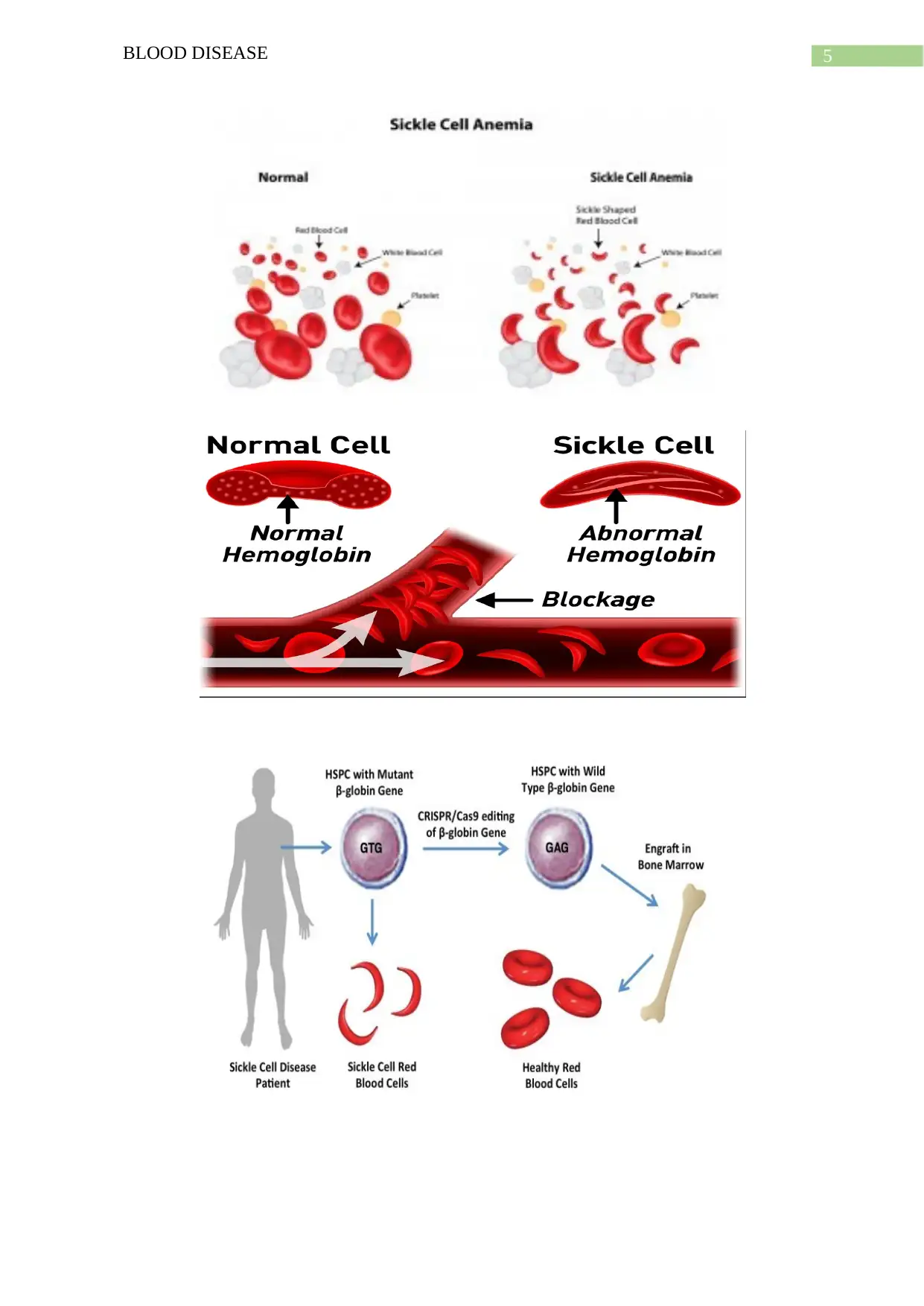
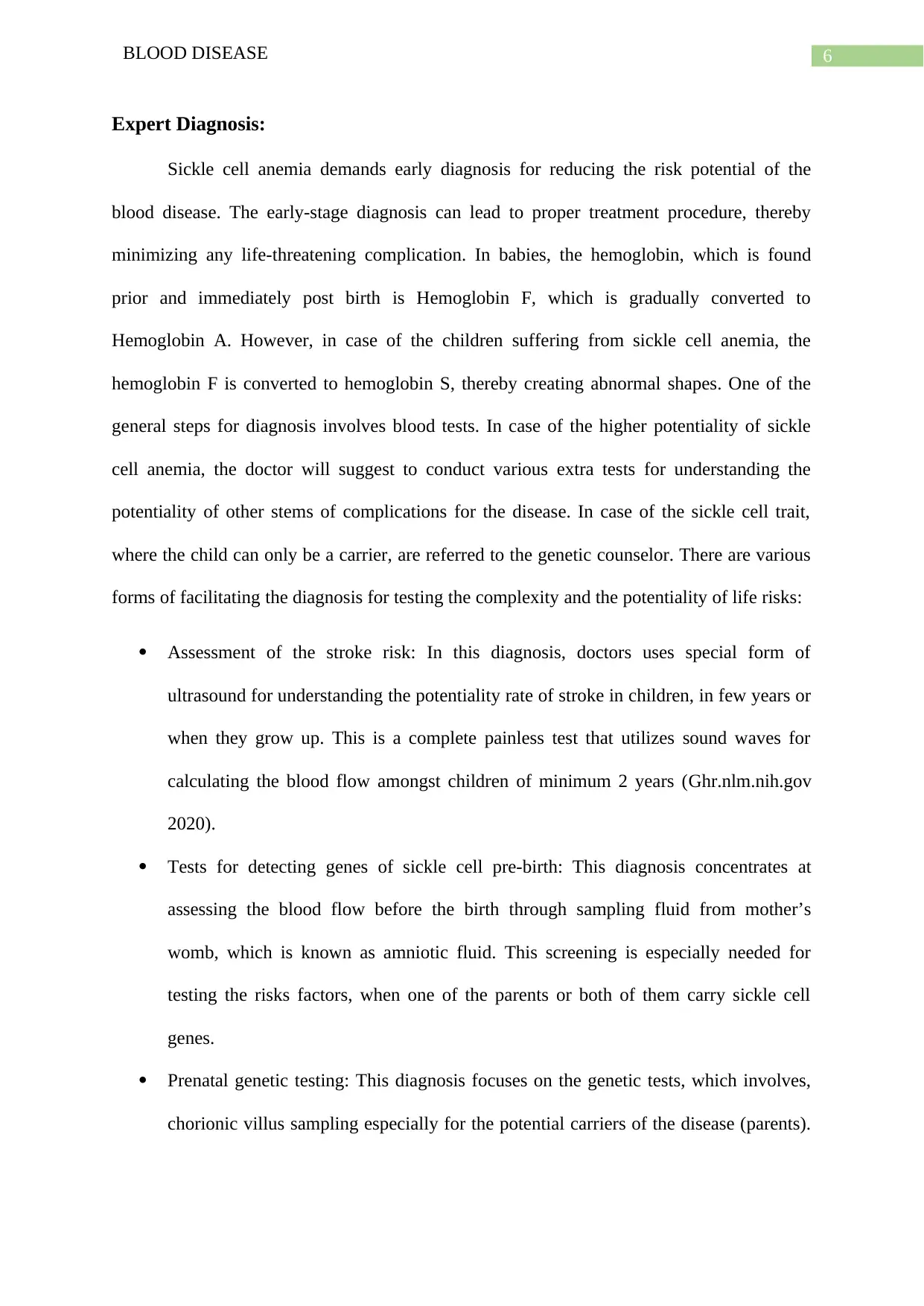
Symptoms and transformation of cells can also be understood through few visuals:
Vision concerns: Eyesight plugging caused due to the damaging or disturbance in the
blood vessels is a common symptom of this disease (Hebbel, Belcher and Vercellotti
2020).
Feet and hand swelling: The reasons for swelling can be the blockage of proper blood
flow in feet and hands.
Growth delay or delay in puberty- The nutrients and oxygen needed for the body is
deduced from red blood cells and with the shortage of slow growth or unhealthy cells
can result in delayed puberty or growth in infants and children (Connes et al. 2018).
Frequent infections: Babies can start experiencing high frequency in getting infected.
The spleen is usually damaged by sickle cells leading to vulnerability and infections.
The disease can determine by pain in arms, legs, chest and back.
Pain and sever swelling in feet and hand can be another set of signs.
Infected people may also suffer from jaundice with yellowing of skin and eyes.
Bedwetting can be another sign in case of the sickle cell anemia amongst children.
Consistent irritability and fatigue can also be reflected as the disease of sickle cell
anemia.
Symptoms and transformation of cells can also be understood through few visuals:
5BLOOD DISEASE
⊘ This is a preview!⊘
Do you want full access?
Subscribe today to unlock all pages.
Trusted by 1+ million students worldwide
6BLOOD DISEASE
Expert Diagnosis:
Sickle cell anemia demands early diagnosis for reducing the risk potential of the
blood disease. The early-stage diagnosis can lead to proper treatment procedure, thereby
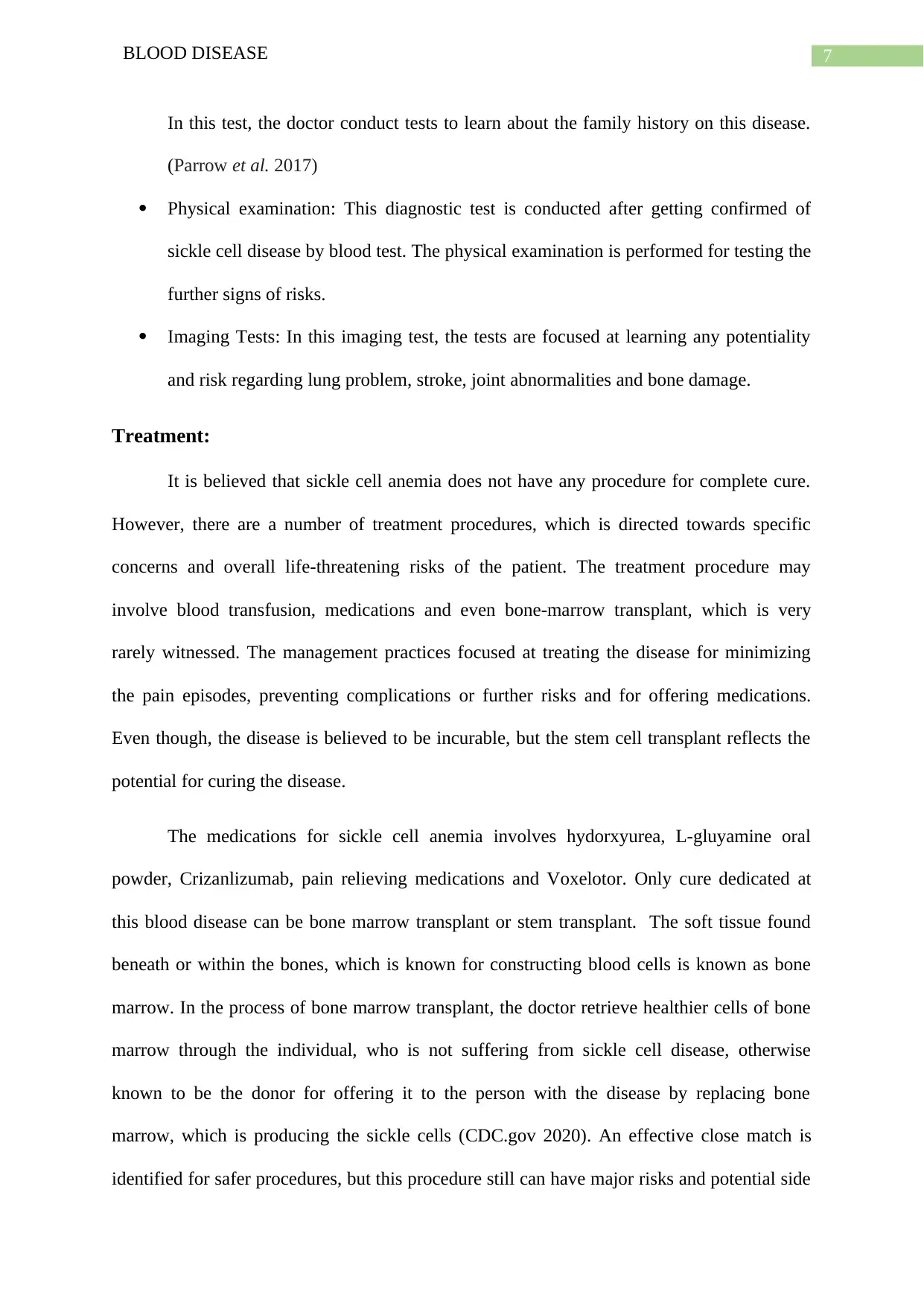
minimizing any life-threatening complication. In babies, the hemoglobin, which is found
prior and immediately post birth is Hemoglobin F, which is gradually converted to
Hemoglobin A. However, in case of the children suffering from sickle cell anemia, the
hemoglobin F is converted to hemoglobin S, thereby creating abnormal shapes. One of the
general steps for diagnosis involves blood tests. In case of the higher potentiality of sickle
cell anemia, the doctor will suggest to conduct various extra tests for understanding the
potentiality of other stems of complications for the disease. In case of the sickle cell trait,
where the child can only be a carrier, are referred to the genetic counselor. There are various
forms of facilitating the diagnosis for testing the complexity and the potentiality of life risks:
Assessment of the stroke risk: In this diagnosis, doctors uses special form of
ultrasound for understanding the potentiality rate of stroke in children, in few years or
when they grow up. This is a complete painless test that utilizes sound waves for
calculating the blood flow amongst children of minimum 2 years (Ghr.nlm.nih.gov
2020).
Tests for detecting genes of sickle cell pre-birth: This diagnosis concentrates at
assessing the blood flow before the birth through sampling fluid from mother’s
womb, which is known as amniotic fluid. This screening is especially needed for
testing the risks factors, when one of the parents or both of them carry sickle cell
genes.
Prenatal genetic testing: This diagnosis focuses on the genetic tests, which involves,
chorionic villus sampling especially for the potential carriers of the disease (parents).
Expert Diagnosis:
Sickle cell anemia demands early diagnosis for reducing the risk potential of the
blood disease. The early-stage diagnosis can lead to proper treatment procedure, thereby
minimizing any life-threatening complication. In babies, the hemoglobin, which is found
prior and immediately post birth is Hemoglobin F, which is gradually converted to
Hemoglobin A. However, in case of the children suffering from sickle cell anemia, the
hemoglobin F is converted to hemoglobin S, thereby creating abnormal shapes. One of the
general steps for diagnosis involves blood tests. In case of the higher potentiality of sickle
cell anemia, the doctor will suggest to conduct various extra tests for understanding the
potentiality of other stems of complications for the disease. In case of the sickle cell trait,
where the child can only be a carrier, are referred to the genetic counselor. There are various
forms of facilitating the diagnosis for testing the complexity and the potentiality of life risks:
Assessment of the stroke risk: In this diagnosis, doctors uses special form of
ultrasound for understanding the potentiality rate of stroke in children, in few years or
when they grow up. This is a complete painless test that utilizes sound waves for
calculating the blood flow amongst children of minimum 2 years (Ghr.nlm.nih.gov
2020).
Tests for detecting genes of sickle cell pre-birth: This diagnosis concentrates at
assessing the blood flow before the birth through sampling fluid from mother’s
womb, which is known as amniotic fluid. This screening is especially needed for
testing the risks factors, when one of the parents or both of them carry sickle cell
genes.
Prenatal genetic testing: This diagnosis focuses on the genetic tests, which involves,
chorionic villus sampling especially for the potential carriers of the disease (parents).
Paraphrase This Document
Need a fresh take? Get an instant paraphrase of this document with our AI Paraphraser
7BLOOD DISEASE
In this test, the doctor conduct tests to learn about the family history on this disease.
(Parrow et al. 2017)
Physical examination: This diagnostic test is conducted after getting confirmed of
sickle cell disease by blood test. The physical examination is performed for testing the
further signs of risks.
Imaging Tests: In this imaging test, the tests are focused at learning any potentiality
and risk regarding lung problem, stroke, joint abnormalities and bone damage.
Treatment:
It is believed that sickle cell anemia does not have any procedure for complete cure.
However, there are a number of treatment procedures, which is directed towards specific
concerns and overall life-threatening risks of the patient. The treatment procedure may
involve blood transfusion, medications and even bone-marrow transplant, which is very
rarely witnessed. The management practices focused at treating the disease for minimizing
the pain episodes, preventing complications or further risks and for offering medications.
Even though, the disease is believed to be incurable, but the stem cell transplant reflects the
potential for curing the disease.
The medications for sickle cell anemia involves hydorxyurea, L-gluyamine oral
powder, Crizanlizumab, pain relieving medications and Voxelotor. Only cure dedicated at
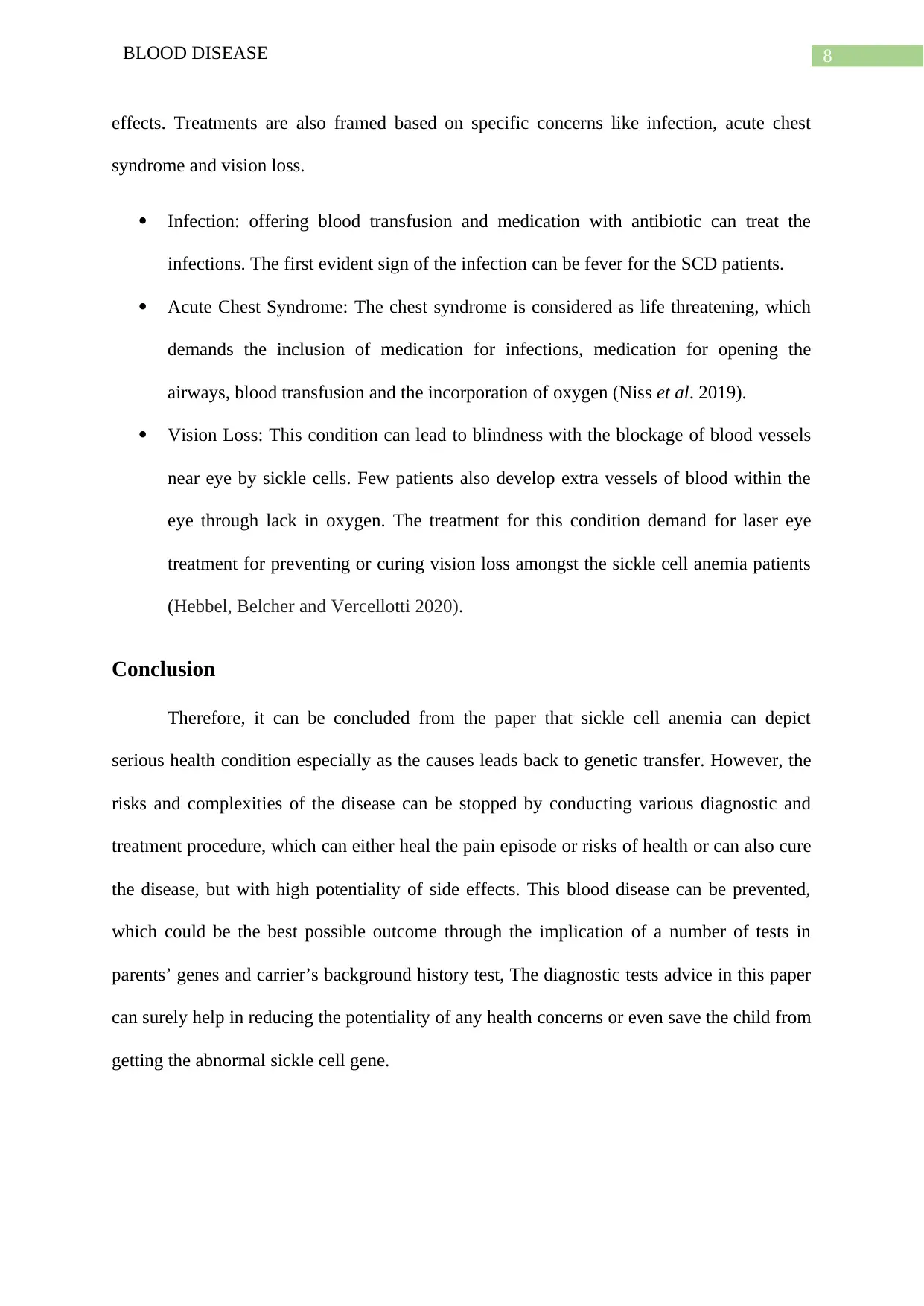
this blood disease can be bone marrow transplant or stem transplant. The soft tissue found
beneath or within the bones, which is known for constructing blood cells is known as bone
marrow. In the process of bone marrow transplant, the doctor retrieve healthier cells of bone
marrow through the individual, who is not suffering from sickle cell disease, otherwise
known to be the donor for offering it to the person with the disease by replacing bone
marrow, which is producing the sickle cells (CDC.gov 2020). An effective close match is
identified for safer procedures, but this procedure still can have major risks and potential side
In this test, the doctor conduct tests to learn about the family history on this disease.
(Parrow et al. 2017)
Physical examination: This diagnostic test is conducted after getting confirmed of
sickle cell disease by blood test. The physical examination is performed for testing the
further signs of risks.
Imaging Tests: In this imaging test, the tests are focused at learning any potentiality
and risk regarding lung problem, stroke, joint abnormalities and bone damage.
Treatment:
It is believed that sickle cell anemia does not have any procedure for complete cure.
However, there are a number of treatment procedures, which is directed towards specific
concerns and overall life-threatening risks of the patient. The treatment procedure may
involve blood transfusion, medications and even bone-marrow transplant, which is very
rarely witnessed. The management practices focused at treating the disease for minimizing
the pain episodes, preventing complications or further risks and for offering medications.
Even though, the disease is believed to be incurable, but the stem cell transplant reflects the
potential for curing the disease.
The medications for sickle cell anemia involves hydorxyurea, L-gluyamine oral
powder, Crizanlizumab, pain relieving medications and Voxelotor. Only cure dedicated at
this blood disease can be bone marrow transplant or stem transplant. The soft tissue found
beneath or within the bones, which is known for constructing blood cells is known as bone
marrow. In the process of bone marrow transplant, the doctor retrieve healthier cells of bone
marrow through the individual, who is not suffering from sickle cell disease, otherwise
known to be the donor for offering it to the person with the disease by replacing bone
marrow, which is producing the sickle cells (CDC.gov 2020). An effective close match is
identified for safer procedures, but this procedure still can have major risks and potential side
8BLOOD DISEASE
effects. Treatments are also framed based on specific concerns like infection, acute chest
syndrome and vision loss.
Infection: offering blood transfusion and medication with antibiotic can treat the
infections. The first evident sign of the infection can be fever for the SCD patients.
Acute Chest Syndrome: The chest syndrome is considered as life threatening, which
demands the inclusion of medication for infections, medication for opening the
airways, blood transfusion and the incorporation of oxygen (Niss et al. 2019).
Vision Loss: This condition can lead to blindness with the blockage of blood vessels
near eye by sickle cells. Few patients also develop extra vessels of blood within the
eye through lack in oxygen. The treatment for this condition demand for laser eye
treatment for preventing or curing vision loss amongst the sickle cell anemia patients
(Hebbel, Belcher and Vercellotti 2020).
Conclusion
Therefore, it can be concluded from the paper that sickle cell anemia can depict
serious health condition especially as the causes leads back to genetic transfer. However, the
risks and complexities of the disease can be stopped by conducting various diagnostic and
treatment procedure, which can either heal the pain episode or risks of health or can also cure
the disease, but with high potentiality of side effects. This blood disease can be prevented,
which could be the best possible outcome through the implication of a number of tests in
parents’ genes and carrier’s background history test, The diagnostic tests advice in this paper
can surely help in reducing the potentiality of any health concerns or even save the child from
getting the abnormal sickle cell gene.
effects. Treatments are also framed based on specific concerns like infection, acute chest
syndrome and vision loss.
Infection: offering blood transfusion and medication with antibiotic can treat the
infections. The first evident sign of the infection can be fever for the SCD patients.
Acute Chest Syndrome: The chest syndrome is considered as life threatening, which
demands the inclusion of medication for infections, medication for opening the
airways, blood transfusion and the incorporation of oxygen (Niss et al. 2019).
Vision Loss: This condition can lead to blindness with the blockage of blood vessels
near eye by sickle cells. Few patients also develop extra vessels of blood within the
eye through lack in oxygen. The treatment for this condition demand for laser eye
treatment for preventing or curing vision loss amongst the sickle cell anemia patients
(Hebbel, Belcher and Vercellotti 2020).
Conclusion
Therefore, it can be concluded from the paper that sickle cell anemia can depict
serious health condition especially as the causes leads back to genetic transfer. However, the
risks and complexities of the disease can be stopped by conducting various diagnostic and
treatment procedure, which can either heal the pain episode or risks of health or can also cure
the disease, but with high potentiality of side effects. This blood disease can be prevented,
which could be the best possible outcome through the implication of a number of tests in
parents’ genes and carrier’s background history test, The diagnostic tests advice in this paper
can surely help in reducing the potentiality of any health concerns or even save the child from
getting the abnormal sickle cell gene.
⊘ This is a preview!⊘
Do you want full access?
Subscribe today to unlock all pages.
Trusted by 1+ million students worldwide
9BLOOD DISEASE
References:
CDC.gov 2020. Centers for Disease Control and Prevention.. Complications And Treatments
Of Sickle Cell Disease | CDC. [Online] Available at:
https://www.cdc.gov/ncbddd/sicklecell/treatments.html
Connes, P., Renoux, C., Romana, M., Abkarian, M., Joly, P., Martin, C., Hardy-Dessources,
M.D. and Ballas, S.K., 2018. Blood rheological abnormalities in sickle cell anemia. Clinical
hemorheology and microcirculation, 68(2-3), pp.165-172.
Fitzhugh, C.D. and Walters, M.C., 2017. The case for HLA-identical sibling hematopoietic
stem cell transplantation in children with symptomatic sickle cell anemia. Blood
advances, 1(26), pp.2563-2567.
Ghr.nlm.nih.gov 2020. Genetics Home Reference. Sickle Cell Disease. [Online] Available at:
https://ghr.nlm.nih.gov/condition/sickle-cell-disease
Hebbel, R.P., Belcher, J.D. and Vercellotti, G.M., 2020. The multifaceted role of
ischemia/reperfusion in sickle cell anemia. The Journal of Clinical Investigation, 130(3),
pp.1062-1072.
Naqvi, M. and Ecker, J., 2017. Sickle cell disease. Maternal-Fetal Evidence Based
Guidelines, p.139.
References:
CDC.gov 2020. Centers for Disease Control and Prevention.. Complications And Treatments
Of Sickle Cell Disease | CDC. [Online] Available at:
https://www.cdc.gov/ncbddd/sicklecell/treatments.html
Connes, P., Renoux, C., Romana, M., Abkarian, M., Joly, P., Martin, C., Hardy-Dessources,
M.D. and Ballas, S.K., 2018. Blood rheological abnormalities in sickle cell anemia. Clinical
hemorheology and microcirculation, 68(2-3), pp.165-172.
Fitzhugh, C.D. and Walters, M.C., 2017. The case for HLA-identical sibling hematopoietic
stem cell transplantation in children with symptomatic sickle cell anemia. Blood
advances, 1(26), pp.2563-2567.
Ghr.nlm.nih.gov 2020. Genetics Home Reference. Sickle Cell Disease. [Online] Available at:
https://ghr.nlm.nih.gov/condition/sickle-cell-disease
Hebbel, R.P., Belcher, J.D. and Vercellotti, G.M., 2020. The multifaceted role of
ischemia/reperfusion in sickle cell anemia. The Journal of Clinical Investigation, 130(3),
pp.1062-1072.
Naqvi, M. and Ecker, J., 2017. Sickle cell disease. Maternal-Fetal Evidence Based
Guidelines, p.139.
Paraphrase This Document
Need a fresh take? Get an instant paraphrase of this document with our AI Paraphraser
10BLOOD DISEASE
Niss, O., Lane, A., Asnani, M., Yee, M.M., Raj, A., Creary, S.E., Fitzhugh, C.D., Bodas,
P.V., Saraf, S.L., Sarnaik, S. and Quinn, C.T., 2019. Progression of Albuminuria in Sickle
Cell Anemia: A Multicenter, Longitudinal Study.
Parrow, N.L., Tu, H., Nichols, J., Violet, P.C., Pittman, C.A., Fitzhugh, C., Fleming, R.E.,
Mohandas, N., Tisdale, J.F. and Levine, M., 2017. Measurements of red cell deformability
and hydration reflect HbF and HbA2 in blood from patients with sickle cell anemia. Blood
Cells, Molecules, and Diseases, 65, pp.41-50.
Slaughter, D.T. and Dilworth-Anderson, P., 2017. Sickle cell anemia, child competence, and
extended family life. In Black families (pp. 131-148). Routledge.
Stotesbury, H., Kirkham, F.J., Kölbel, M., Balfour, P., Clayden, J.D., Sahota, S., Sakaria, S.,
Saunders, D.E., Howard, J., Kesse-Adu, R. and Inusa, B., 2018. White matter integrity and
processing speed in sickle cell anemia. Neurology, 90(23), pp.e2042-e2050.
Niss, O., Lane, A., Asnani, M., Yee, M.M., Raj, A., Creary, S.E., Fitzhugh, C.D., Bodas,
P.V., Saraf, S.L., Sarnaik, S. and Quinn, C.T., 2019. Progression of Albuminuria in Sickle
Cell Anemia: A Multicenter, Longitudinal Study.
Parrow, N.L., Tu, H., Nichols, J., Violet, P.C., Pittman, C.A., Fitzhugh, C., Fleming, R.E.,
Mohandas, N., Tisdale, J.F. and Levine, M., 2017. Measurements of red cell deformability
and hydration reflect HbF and HbA2 in blood from patients with sickle cell anemia. Blood
Cells, Molecules, and Diseases, 65, pp.41-50.
Slaughter, D.T. and Dilworth-Anderson, P., 2017. Sickle cell anemia, child competence, and
extended family life. In Black families (pp. 131-148). Routledge.
Stotesbury, H., Kirkham, F.J., Kölbel, M., Balfour, P., Clayden, J.D., Sahota, S., Sakaria, S.,
Saunders, D.E., Howard, J., Kesse-Adu, R. and Inusa, B., 2018. White matter integrity and
processing speed in sickle cell anemia. Neurology, 90(23), pp.e2042-e2050.

11BLOOD DISEASE
⊘ This is a preview!⊘
Do you want full access?
Subscribe today to unlock all pages.
Trusted by 1+ million students worldwide

1 out of 12


Related Documents


Your All-in-One AI-Powered Toolkit for Academic Success.
+13062052269
info@desklib.com
Available 24*7 on WhatsApp / Email
![[object Object]](/_next/static/media/star-bottom.7253800d.svg)
Unlock your academic potential
Copyright © 2020–2026 A2Z Services. All Rights Reserved. Developed and managed by ZUCOL.