An Analysis of Nature's Importance in Wordsworth's Poetic Works
VerifiedAdded on 2023/05/31
|7
|1623
|302
Essay
AI Summary
This essay delves into the profound significance of nature in William Wordsworth's poetry, examining how nature serves as a source of inspiration, spiritual connection, and moral guidance. The analysis focuses on Wordsworth's unique perspective, highlighting his belief in nature's ability to elevate human awareness and foster transcendental expansion. The essay references key poems like 'Tintern Abbey' and 'The Prelude' to illustrate Wordsworth's evolving relationship with nature and his emphasis on the interconnectedness of humanity and the natural world. It explores how Wordsworth viewed nature as a nurturing force, a teacher, and a reflection of the divine, influencing his understanding of human character and ethical development. The essay further examines Wordsworth's concept of pantheism, his mystical experiences, and the impact of nature on his creative process and philosophical outlook, showcasing how nature provides solace, inspiration, and a deeper understanding of life's mysteries.
THE SIGNIFICANCE OF
NATURE IN WORDSWORTH'S
POETRY
All over Wordsworth’s effort, nature affords the ultimate
encouragement upon the human awareness. All exhibitions of the
normal creation—from the uppermost foothill to the modest
flower—produce honorable, preeminent considerations and
passionate feelings in the persons who perceive these indicators.
Wordsworth recurrently underlines the significance of nature in
the direction of a person’s knowledgeable and transcendental
expansion. A decent association with nature benefits individuals
to link to the mystical and the societal domains.
2018
NATURE IN WORDSWORTH'S
POETRY
All over Wordsworth’s effort, nature affords the ultimate
encouragement upon the human awareness. All exhibitions of the
normal creation—from the uppermost foothill to the modest
flower—produce honorable, preeminent considerations and
passionate feelings in the persons who perceive these indicators.
Wordsworth recurrently underlines the significance of nature in
the direction of a person’s knowledgeable and transcendental
expansion. A decent association with nature benefits individuals
to link to the mystical and the societal domains.
2018
Paraphrase This Document
Need a fresh take? Get an instant paraphrase of this document with our AI Paraphraser

Thesis
Wordsworth’s interpretation of nature had a groundbreaking and unique attitude to explain, and
had a specific view of situation to illustrate. The Poet acquired an insight of Life force in Nature
as well as developed aesthetic manifestations that charm the supreme “lyricists of nature”. His
assessment of nature stands different as of his contemporary composers. In Tintern Abbey as
well as in The Prelude, Wordsworth has outlined to what magnitude his adoration of Nature
continued to be settled and accepted through the numerous phases. The poet realized “glad
animal actions” and ascetic choice in wandering around Nature. Following a deer, the lyricist
flew around above the highlands, by the flank of the profound streams, and laterally the solitary
rivulets (Armstrong).
Nature remains a foundation of creativeness and asset to him. She was caring, delicate and
approachable to man’s concern in her. She under no circumstances deceived ‘the mind that
valued her’. He exulted in the center of nature as a believer and gratefully promised deeper
faithfulness to her. The confidence thus lay to bring forth contented outcomes; as the natural
surroundings did not merely lessen his meditative attitudes, but correspondingly conveyed the
sustenance for future considerations (Williams).
He had perceived the miseries of human race as reflected in Immortality Ode:
Each time he feels pain from the disillusionment of the domain, he finds space “in the lap of
natural environments”. She affords him with a mild touch besides pacifying impact.
1 | P a g e
"To me the meanest flower that blows can give
Thoughts that do often lie too deep for tears.”
Wordsworth’s interpretation of nature had a groundbreaking and unique attitude to explain, and
had a specific view of situation to illustrate. The Poet acquired an insight of Life force in Nature
as well as developed aesthetic manifestations that charm the supreme “lyricists of nature”. His
assessment of nature stands different as of his contemporary composers. In Tintern Abbey as
well as in The Prelude, Wordsworth has outlined to what magnitude his adoration of Nature
continued to be settled and accepted through the numerous phases. The poet realized “glad
animal actions” and ascetic choice in wandering around Nature. Following a deer, the lyricist
flew around above the highlands, by the flank of the profound streams, and laterally the solitary
rivulets (Armstrong).
Nature remains a foundation of creativeness and asset to him. She was caring, delicate and
approachable to man’s concern in her. She under no circumstances deceived ‘the mind that
valued her’. He exulted in the center of nature as a believer and gratefully promised deeper
faithfulness to her. The confidence thus lay to bring forth contented outcomes; as the natural
surroundings did not merely lessen his meditative attitudes, but correspondingly conveyed the
sustenance for future considerations (Williams).
He had perceived the miseries of human race as reflected in Immortality Ode:
Each time he feels pain from the disillusionment of the domain, he finds space “in the lap of
natural environments”. She affords him with a mild touch besides pacifying impact.
1 | P a g e
"To me the meanest flower that blows can give
Thoughts that do often lie too deep for tears.”

(Huang, Pei and Fu 113-115).
Outline of features
In his initial adolescence, he talks about the essence of Nature together by means of exultation of
Life force besides as a trainer of the observance and emotion. In the “Prelude”, we discover that
in the leading period Nature was:
(Green 935-962).
In the subsequent stage, Nature soon charmed primarily on the road to the minds as well as
sensed fondness while he perceives the tints of Natural surroundings, bits the smell of Natural
objects, touches the elements of Nature besides listening to the sweet-smelling blows of
landscape. Yet, as he matured, “Nature” was valued over an unreflecting impulse as he
articulates:
2 | P a g e
“The gift is yours,
Ye winds and sounding cataracts! Tis yours
Ye mountains! Thine, O nature! Thou hast fed
My lofty speculations and in thee,
For this uneasy hearts of ours, I find
A never failing principle of joy
And purest passion”
“But secondary to my own pursuits
And animal activities, and all
Their trivial pleasures”
Outline of features
In his initial adolescence, he talks about the essence of Nature together by means of exultation of
Life force besides as a trainer of the observance and emotion. In the “Prelude”, we discover that
in the leading period Nature was:
(Green 935-962).
In the subsequent stage, Nature soon charmed primarily on the road to the minds as well as
sensed fondness while he perceives the tints of Natural surroundings, bits the smell of Natural
objects, touches the elements of Nature besides listening to the sweet-smelling blows of
landscape. Yet, as he matured, “Nature” was valued over an unreflecting impulse as he
articulates:
2 | P a g e
“The gift is yours,
Ye winds and sounding cataracts! Tis yours
Ye mountains! Thine, O nature! Thou hast fed
My lofty speculations and in thee,
For this uneasy hearts of ours, I find
A never failing principle of joy
And purest passion”
“But secondary to my own pursuits
And animal activities, and all
Their trivial pleasures”
⊘ This is a preview!⊘
Do you want full access?
Subscribe today to unlock all pages.

Trusted by 1+ million students worldwide

(Roche)
Through “Tintern Abbey”, Wordsworth portrays Nature by means of an entity of an “aspiration
aimed at the picturesque”
(Huang, Pei and Fu 113-115)
In the phase of French Insurgence, he could identify in Natural settings-- ‘wretched song of
humanity’. His regard of natural environment was refined as observed in Tintern Abbey:
(Ackland 21-32).
3 | P a g e
“The props of my affections were removed,
And yet the building stood, as if sustained by its own spirit!”
“I cannot paint
What then I was. The sounding cataract
Haunted me like a passion: the tall rock,
The mountain, and the deep and gloomy wood,
Their colours and their forms, were then to me
An appetite”
“The still sad music of humanity,
Nor harsh nor grating, though of ample power
To chasten and subdue.”
Through “Tintern Abbey”, Wordsworth portrays Nature by means of an entity of an “aspiration
aimed at the picturesque”
(Huang, Pei and Fu 113-115)
In the phase of French Insurgence, he could identify in Natural settings-- ‘wretched song of
humanity’. His regard of natural environment was refined as observed in Tintern Abbey:
(Ackland 21-32).
3 | P a g e
“The props of my affections were removed,
And yet the building stood, as if sustained by its own spirit!”
“I cannot paint
What then I was. The sounding cataract
Haunted me like a passion: the tall rock,
The mountain, and the deep and gloomy wood,
Their colours and their forms, were then to me
An appetite”
“The still sad music of humanity,
Nor harsh nor grating, though of ample power
To chasten and subdue.”
Paraphrase This Document
Need a fresh take? Get an instant paraphrase of this document with our AI Paraphraser

He senses understanding of inspirational life force, the functioning of holy being in the entire
matters of Environment, comprehended the educative effect of Nature, in addition to the
supremacy of Natural surroundings to frame the human character and appeal. He regarded
“Nature” as the nurturer, the leading light, the custodian of his mind, and the character of his
ethical being generally acknowledged as “Pantheism”. The implication of Nature by means of
the omnipotent celestial life force is predominant in his writing as:
(Turner 623).
In accordance to his vision, Nature never deceives the mind that adores her. The outcome of
physical setting on the lyricist’s awareness is found in ‘The Excursion’. He became perplexed
by native background, and the special possessions of his familiarity with natural ambiances
are revealed in each works. “The Old Cumberland Beggar” displays the closeness to Nature as
well as Man besides being indistinguishable to their finding. A sensitivity of goodness cannot
remain disconnected “consistently from the unpleasant and utmost ruined, the dreadful and
most ruthless, of Nature’s arrangements, considerably not as much of Humans, yet in his genuine
extent:
(Williams).
Wordsworth’s “mysticism” signified a perceptive development on top of pursuit of the
imperceptible representativeness and its fear through examination system to an understanding of
4 | P a g e
“Whose dwelling is the light of setting suns,
And the round ocean and the living air,
And the blue sky, and in the mind of man”
“T is Nature’s law
That none, the meanest of created things,
Of forms created the most vile and brute,
The dullest or noxious should exist
Divorced from good”
matters of Environment, comprehended the educative effect of Nature, in addition to the
supremacy of Natural surroundings to frame the human character and appeal. He regarded
“Nature” as the nurturer, the leading light, the custodian of his mind, and the character of his
ethical being generally acknowledged as “Pantheism”. The implication of Nature by means of
the omnipotent celestial life force is predominant in his writing as:
(Turner 623).
In accordance to his vision, Nature never deceives the mind that adores her. The outcome of
physical setting on the lyricist’s awareness is found in ‘The Excursion’. He became perplexed
by native background, and the special possessions of his familiarity with natural ambiances
are revealed in each works. “The Old Cumberland Beggar” displays the closeness to Nature as
well as Man besides being indistinguishable to their finding. A sensitivity of goodness cannot
remain disconnected “consistently from the unpleasant and utmost ruined, the dreadful and
most ruthless, of Nature’s arrangements, considerably not as much of Humans, yet in his genuine
extent:
(Williams).
Wordsworth’s “mysticism” signified a perceptive development on top of pursuit of the
imperceptible representativeness and its fear through examination system to an understanding of
4 | P a g e
“Whose dwelling is the light of setting suns,
And the round ocean and the living air,
And the blue sky, and in the mind of man”
“T is Nature’s law
That none, the meanest of created things,
Of forms created the most vile and brute,
The dullest or noxious should exist
Divorced from good”

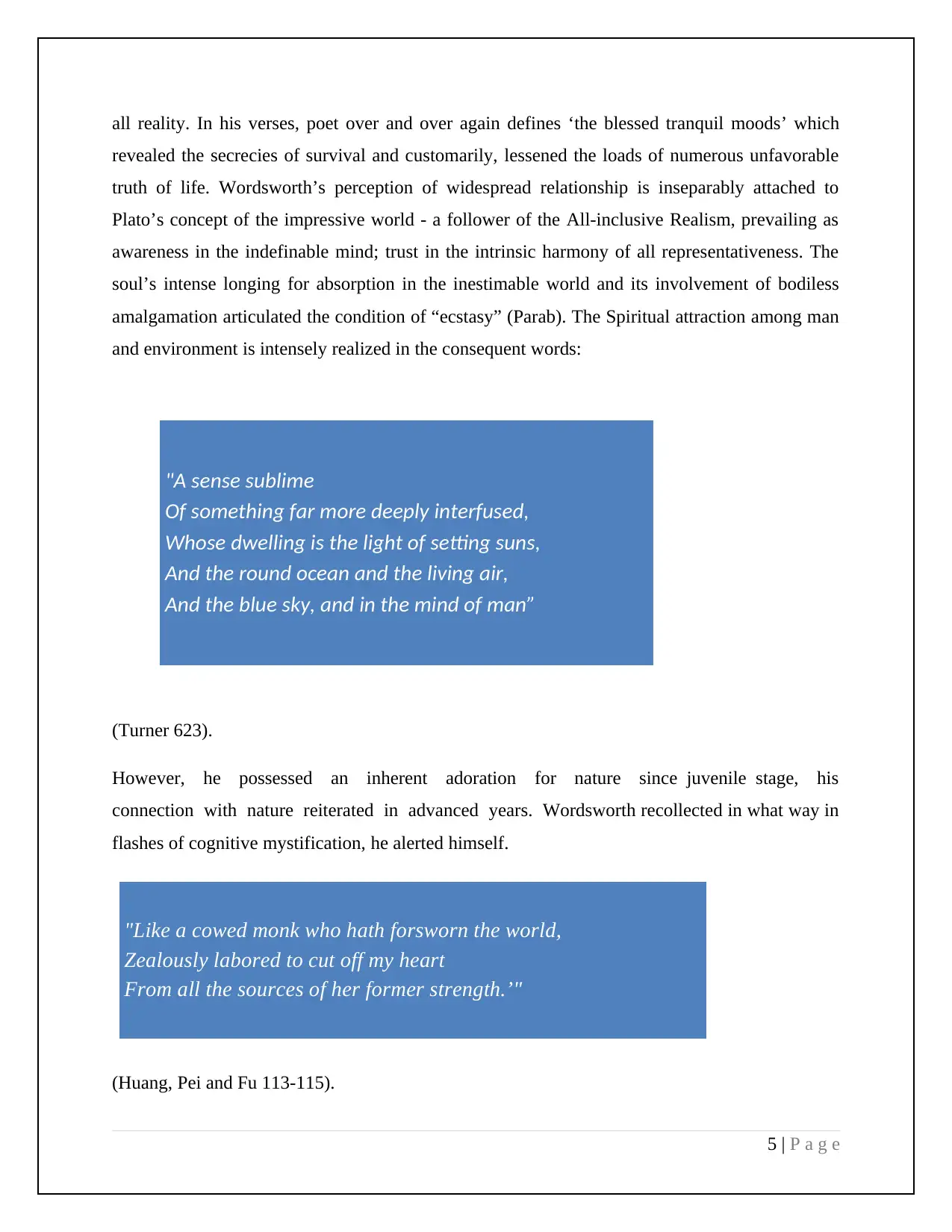
all reality. In his verses, poet over and over again defines ‘the blessed tranquil moods’ which
revealed the secrecies of survival and customarily, lessened the loads of numerous unfavorable
truth of life. Wordsworth’s perception of widespread relationship is inseparably attached to
Plato’s concept of the impressive world - a follower of the All-inclusive Realism, prevailing as
awareness in the indefinable mind; trust in the intrinsic harmony of all representativeness. The
soul’s intense longing for absorption in the inestimable world and its involvement of bodiless
amalgamation articulated the condition of “ecstasy” (Parab). The Spiritual attraction among man
and environment is intensely realized in the consequent words:
(Turner 623).
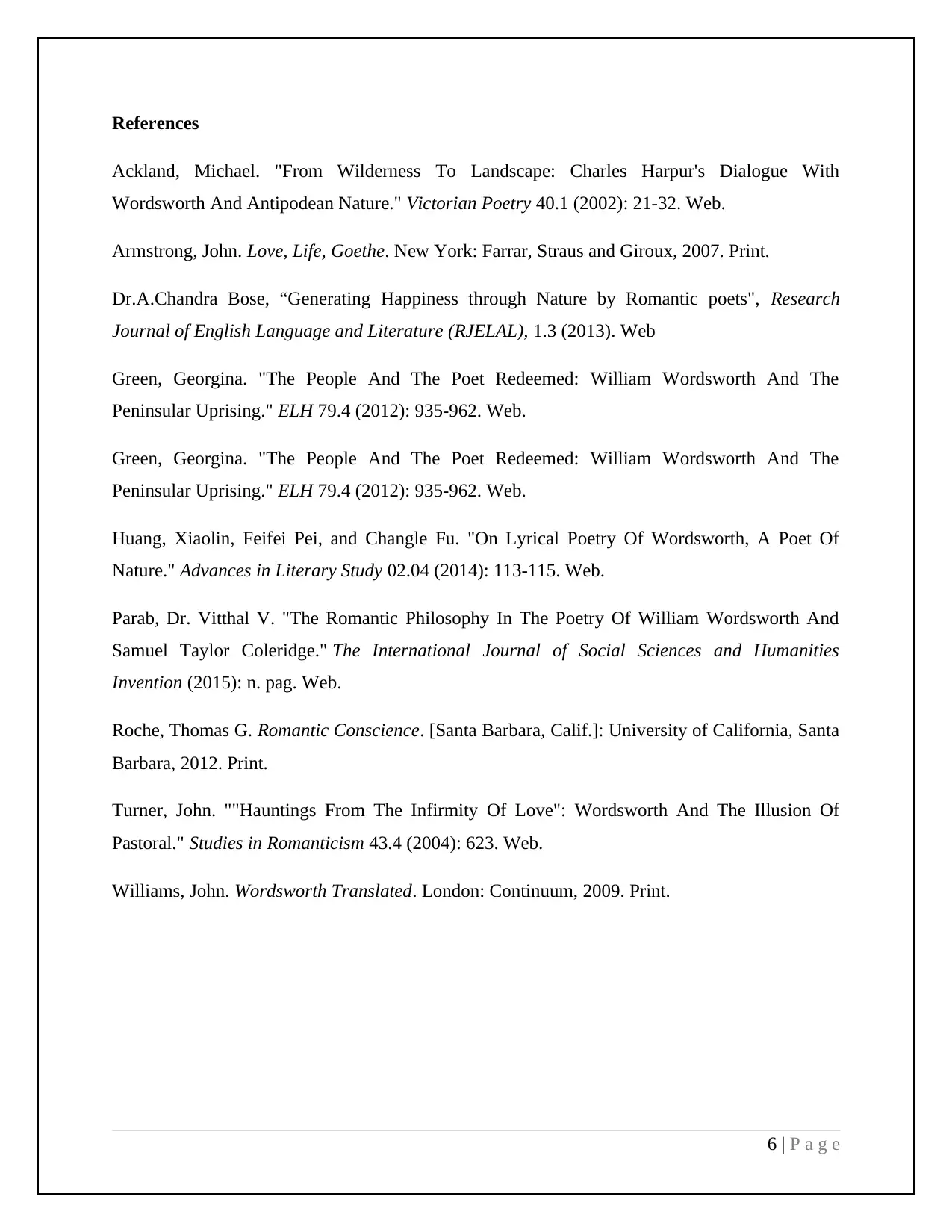
However, he possessed an inherent adoration for nature since juvenile stage, his
connection with nature reiterated in advanced years. Wordsworth recollected in what way in
flashes of cognitive mystification, he alerted himself.
(Huang, Pei and Fu 113-115).
5 | P a g e
"Like a cowed monk who hath forsworn the world,
Zealously labored to cut off my heart
From all the sources of her former strength.’"
"A sense sublime
Of something far more deeply interfused,
Whose dwelling is the light of setting suns,
And the round ocean and the living air,
And the blue sky, and in the mind of man”
revealed the secrecies of survival and customarily, lessened the loads of numerous unfavorable
truth of life. Wordsworth’s perception of widespread relationship is inseparably attached to
Plato’s concept of the impressive world - a follower of the All-inclusive Realism, prevailing as
awareness in the indefinable mind; trust in the intrinsic harmony of all representativeness. The
soul’s intense longing for absorption in the inestimable world and its involvement of bodiless
amalgamation articulated the condition of “ecstasy” (Parab). The Spiritual attraction among man
and environment is intensely realized in the consequent words:
(Turner 623).
However, he possessed an inherent adoration for nature since juvenile stage, his
connection with nature reiterated in advanced years. Wordsworth recollected in what way in
flashes of cognitive mystification, he alerted himself.
(Huang, Pei and Fu 113-115).
5 | P a g e
"Like a cowed monk who hath forsworn the world,
Zealously labored to cut off my heart
From all the sources of her former strength.’"
"A sense sublime
Of something far more deeply interfused,
Whose dwelling is the light of setting suns,
And the round ocean and the living air,
And the blue sky, and in the mind of man”
⊘ This is a preview!⊘
Do you want full access?
Subscribe today to unlock all pages.

Trusted by 1+ million students worldwide

References
Ackland, Michael. "From Wilderness To Landscape: Charles Harpur's Dialogue With
Wordsworth And Antipodean Nature." Victorian Poetry 40.1 (2002): 21-32. Web.
Armstrong, John. Love, Life, Goethe. New York: Farrar, Straus and Giroux, 2007. Print.
Dr.A.Chandra Bose, “Generating Happiness through Nature by Romantic poets", Research
Journal of English Language and Literature (RJELAL), 1.3 (2013). Web
Green, Georgina. "The People And The Poet Redeemed: William Wordsworth And The
Peninsular Uprising." ELH 79.4 (2012): 935-962. Web.
Green, Georgina. "The People And The Poet Redeemed: William Wordsworth And The
Peninsular Uprising." ELH 79.4 (2012): 935-962. Web.
Huang, Xiaolin, Feifei Pei, and Changle Fu. "On Lyrical Poetry Of Wordsworth, A Poet Of
Nature." Advances in Literary Study 02.04 (2014): 113-115. Web.
Parab, Dr. Vitthal V. "The Romantic Philosophy In The Poetry Of William Wordsworth And
Samuel Taylor Coleridge." The International Journal of Social Sciences and Humanities
Invention (2015): n. pag. Web.
Roche, Thomas G. Romantic Conscience. [Santa Barbara, Calif.]: University of California, Santa
Barbara, 2012. Print.
Turner, John. ""Hauntings From The Infirmity Of Love": Wordsworth And The Illusion Of
Pastoral." Studies in Romanticism 43.4 (2004): 623. Web.
Williams, John. Wordsworth Translated. London: Continuum, 2009. Print.
6 | P a g e
Ackland, Michael. "From Wilderness To Landscape: Charles Harpur's Dialogue With
Wordsworth And Antipodean Nature." Victorian Poetry 40.1 (2002): 21-32. Web.
Armstrong, John. Love, Life, Goethe. New York: Farrar, Straus and Giroux, 2007. Print.
Dr.A.Chandra Bose, “Generating Happiness through Nature by Romantic poets", Research
Journal of English Language and Literature (RJELAL), 1.3 (2013). Web
Green, Georgina. "The People And The Poet Redeemed: William Wordsworth And The
Peninsular Uprising." ELH 79.4 (2012): 935-962. Web.
Green, Georgina. "The People And The Poet Redeemed: William Wordsworth And The
Peninsular Uprising." ELH 79.4 (2012): 935-962. Web.
Huang, Xiaolin, Feifei Pei, and Changle Fu. "On Lyrical Poetry Of Wordsworth, A Poet Of
Nature." Advances in Literary Study 02.04 (2014): 113-115. Web.
Parab, Dr. Vitthal V. "The Romantic Philosophy In The Poetry Of William Wordsworth And
Samuel Taylor Coleridge." The International Journal of Social Sciences and Humanities
Invention (2015): n. pag. Web.
Roche, Thomas G. Romantic Conscience. [Santa Barbara, Calif.]: University of California, Santa
Barbara, 2012. Print.
Turner, John. ""Hauntings From The Infirmity Of Love": Wordsworth And The Illusion Of
Pastoral." Studies in Romanticism 43.4 (2004): 623. Web.
Williams, John. Wordsworth Translated. London: Continuum, 2009. Print.
6 | P a g e
1 out of 7
Your All-in-One AI-Powered Toolkit for Academic Success.
+13062052269
info@desklib.com
Available 24*7 on WhatsApp / Email
Unlock your academic potential
Copyright © 2020–2025 A2Z Services. All Rights Reserved. Developed and managed by ZUCOL.