Significance and Dramatic Purpose of Othello's Soliloquy in the Play

Verified

Added on  2022/09/16

|5
|917
|20
Essay
AI Summary
This essay examines the significance and dramatic purpose of Othello's soliloquy in Shakespeare's play. It focuses on the pivotal scene in Act III, Scene III, where Othello's trust in Desdemona crumbles under Iago's manipulation. The soliloquy reveals Othello's insecurities, particularly his racial prejudice and his belief in Iago's honesty, showcasing his tragic flaw. The essay highlights how the soliloquy establishes the foundation for Othello's downfall by illustrating his susceptibility to jealousy and Iago's influence. It analyzes the dramatic purpose of the soliloquy in revealing Othello's internal conflict, his shifting perceptions of Desdemona, and the gradual erosion of his trust, ultimately leading to the tragic consequences of the play. The essay emphasizes the importance of this soliloquy in understanding Othello's character and the dramatic arc of the play.
Document Page
Running Head: SIGNIFICANCE AND DRAMATIC PURPOSE OF OTHELLO’S
SOLILOQUY
Significance and Dramatic Purpose of Othello’s Soliloquy
Name of the Student
Name of the University
Author’s Note
tabler-icon-diamond-filled.svg

Paraphrase This Document

Need a fresh take? Get an instant paraphrase of this document with our AI Paraphraser
Document Page
1SIGNIFICANCE AND DRAMATIC PURPOSE OF OTHELLO’S SOLILOQUY
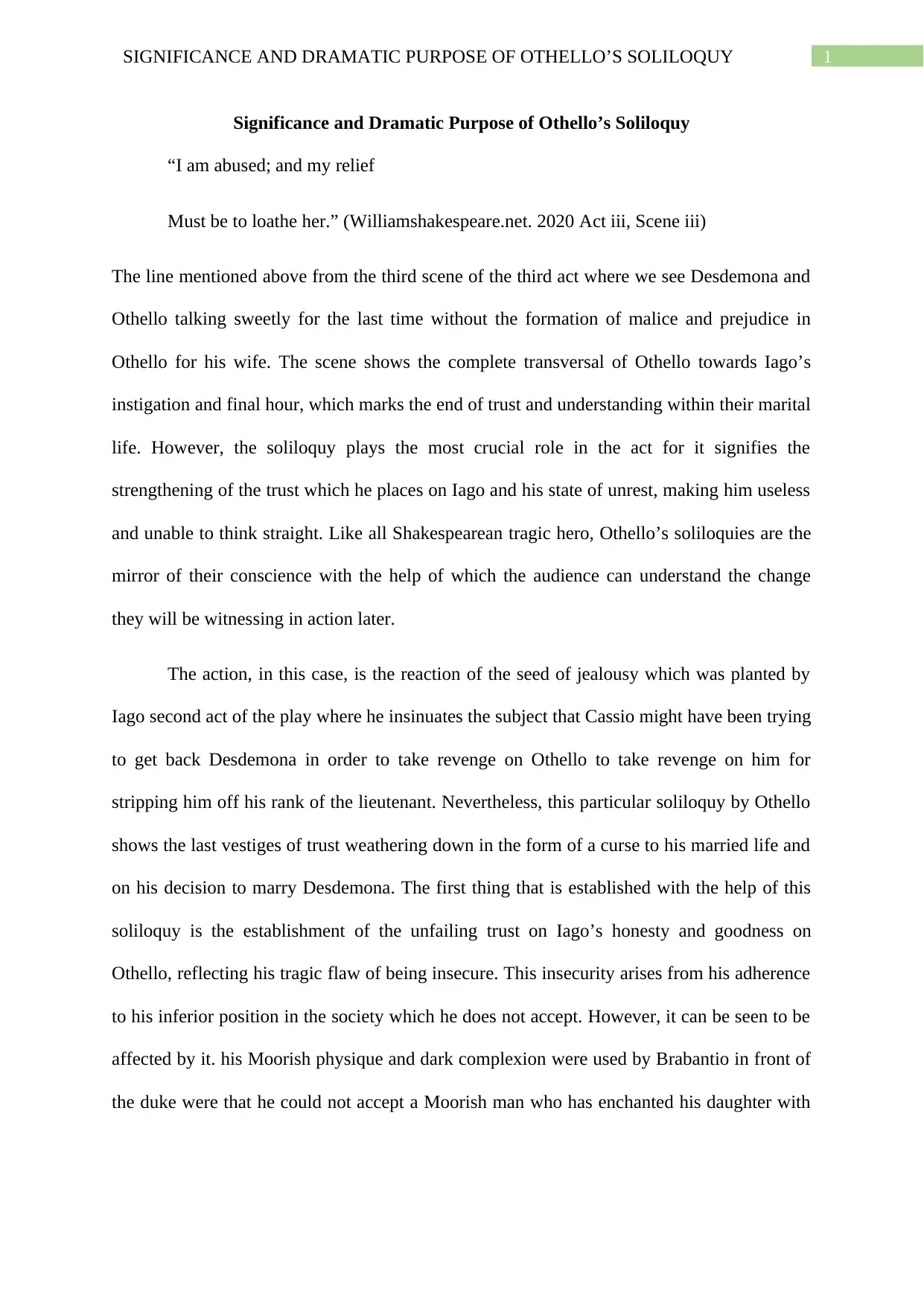
Significance and Dramatic Purpose of Othello’s Soliloquy
“I am abused; and my relief
Must be to loathe her.” (Williamshakespeare.net. 2020 Act iii, Scene iii)
The line mentioned above from the third scene of the third act where we see Desdemona and
Othello talking sweetly for the last time without the formation of malice and prejudice in
Othello for his wife. The scene shows the complete transversal of Othello towards Iago’s
instigation and final hour, which marks the end of trust and understanding within their marital
life. However, the soliloquy plays the most crucial role in the act for it signifies the
strengthening of the trust which he places on Iago and his state of unrest, making him useless
and unable to think straight. Like all Shakespearean tragic hero, Othello’s soliloquies are the
mirror of their conscience with the help of which the audience can understand the change
they will be witnessing in action later.
The action, in this case, is the reaction of the seed of jealousy which was planted by
Iago second act of the play where he insinuates the subject that Cassio might have been trying
to get back Desdemona in order to take revenge on Othello to take revenge on him for
stripping him off his rank of the lieutenant. Nevertheless, this particular soliloquy by Othello
shows the last vestiges of trust weathering down in the form of a curse to his married life and
on his decision to marry Desdemona. The first thing that is established with the help of this
soliloquy is the establishment of the unfailing trust on Iago’s honesty and goodness on
Othello, reflecting his tragic flaw of being insecure. This insecurity arises from his adherence
to his inferior position in the society which he does not accept. However, it can be seen to be
affected by it. his Moorish physique and dark complexion were used by Brabantio in front of
the duke were that he could not accept a Moorish man who has enchanted his daughter with
Document Page
2SIGNIFICANCE AND DRAMATIC PURPOSE OF OTHELLO’S SOLILOQUY
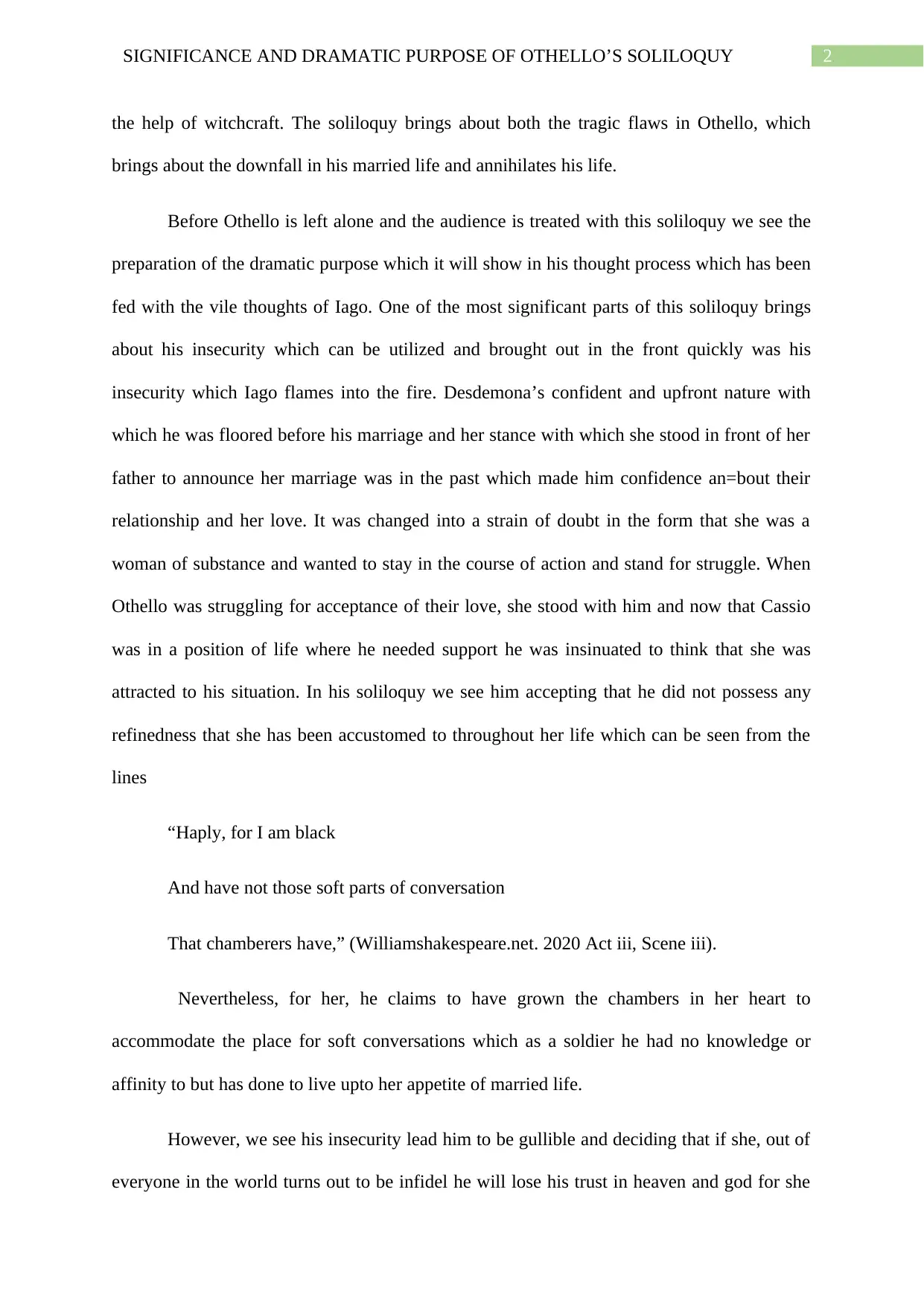
the help of witchcraft. The soliloquy brings about both the tragic flaws in Othello, which
brings about the downfall in his married life and annihilates his life.
Before Othello is left alone and the audience is treated with this soliloquy we see the
preparation of the dramatic purpose which it will show in his thought process which has been
fed with the vile thoughts of Iago. One of the most significant parts of this soliloquy brings
about his insecurity which can be utilized and brought out in the front quickly was his
insecurity which Iago flames into the fire. Desdemona’s confident and upfront nature with
which he was floored before his marriage and her stance with which she stood in front of her
father to announce her marriage was in the past which made him confidence an=bout their
relationship and her love. It was changed into a strain of doubt in the form that she was a
woman of substance and wanted to stay in the course of action and stand for struggle. When
Othello was struggling for acceptance of their love, she stood with him and now that Cassio
was in a position of life where he needed support he was insinuated to think that she was
attracted to his situation. In his soliloquy we see him accepting that he did not possess any
refinedness that she has been accustomed to throughout her life which can be seen from the
lines
“Haply, for I am black
And have not those soft parts of conversation
That chamberers have,” (Williamshakespeare.net. 2020 Act iii, Scene iii).
Nevertheless, for her, he claims to have grown the chambers in her heart to
accommodate the place for soft conversations which as a soldier he had no knowledge or
affinity to but has done to live upto her appetite of married life.
However, we see his insecurity lead him to be gullible and deciding that if she, out of
everyone in the world turns out to be infidel he will lose his trust in heaven and god for she
Document Page
3SIGNIFICANCE AND DRAMATIC PURPOSE OF OTHELLO’S SOLILOQUY
represented the ultimate truth for him. The end of the soliloquy gives the readers a small ray
of hope that he will be able to see through his wife. However, the dramatic purpose of the
soliloquy is to provide an understanding of how his trust has been completely shaken by Iago.
The seed of jealousy had become deep-rooted in his psyche when his determination to believe
in his wife’s loyalty unless he gets hold of evidence as soon as she talks about having faith on
her care when she tried to take care of his headache.
tabler-icon-diamond-filled.svg

Paraphrase This Document

Need a fresh take? Get an instant paraphrase of this document with our AI Paraphraser
Document Page
4SIGNIFICANCE AND DRAMATIC PURPOSE OF OTHELLO’S SOLILOQUY
References
Williamshakespeare.net. (2020). Othello by William Shakespeare - Free PDF eBook.
Retrieved 20 April 2020, from https://www.williamshakespeare.net/ebook-othello.jsp
chevron_up_icon
1 out of 5
circle_padding
hide_on_mobile
zoom_out_icon
[object Object]