Primatology Essay: The Significance of Primatology in Anthropology

Verified

Added on  2022/11/27

|4
|611
|440
Essay
AI Summary
This essay explores the crucial role of primatology within the field of anthropology, addressing how the study of nonhuman primates provides valuable insights into human behavior, evolution, and social structures. The essay emphasizes the significance of observing primate behavior, social dynamics, and genetic codes to understand the distinctions and connections between humans and other primates. It highlights the contributions of primatology to understanding human brain development, cross-cultural evolution, and the impact of ecological factors on primate societies, using examples from reading and films. The essay also touches upon the importance of primates in biodiversity and ecosystem health, referencing the classification and current threats to primate populations. It concludes by emphasizing the complementary relationship between anthropology and primatology in the study of human origins and evolution, underscoring the necessity of primatological research for strengthening anthropological studies.
Document Page
Running Head: IMPORTANCE OF PRIMATOLOGY IN ANTHROPOLOGY
IMPORTANCE OF PRIMATOLOGY IN ANTHROPOLOGY
Name of the Student
Name of the University
Author Note:
tabler-icon-diamond-filled.svg

Paraphrase This Document

Need a fresh take? Get an instant paraphrase of this document with our AI Paraphraser
Document Page
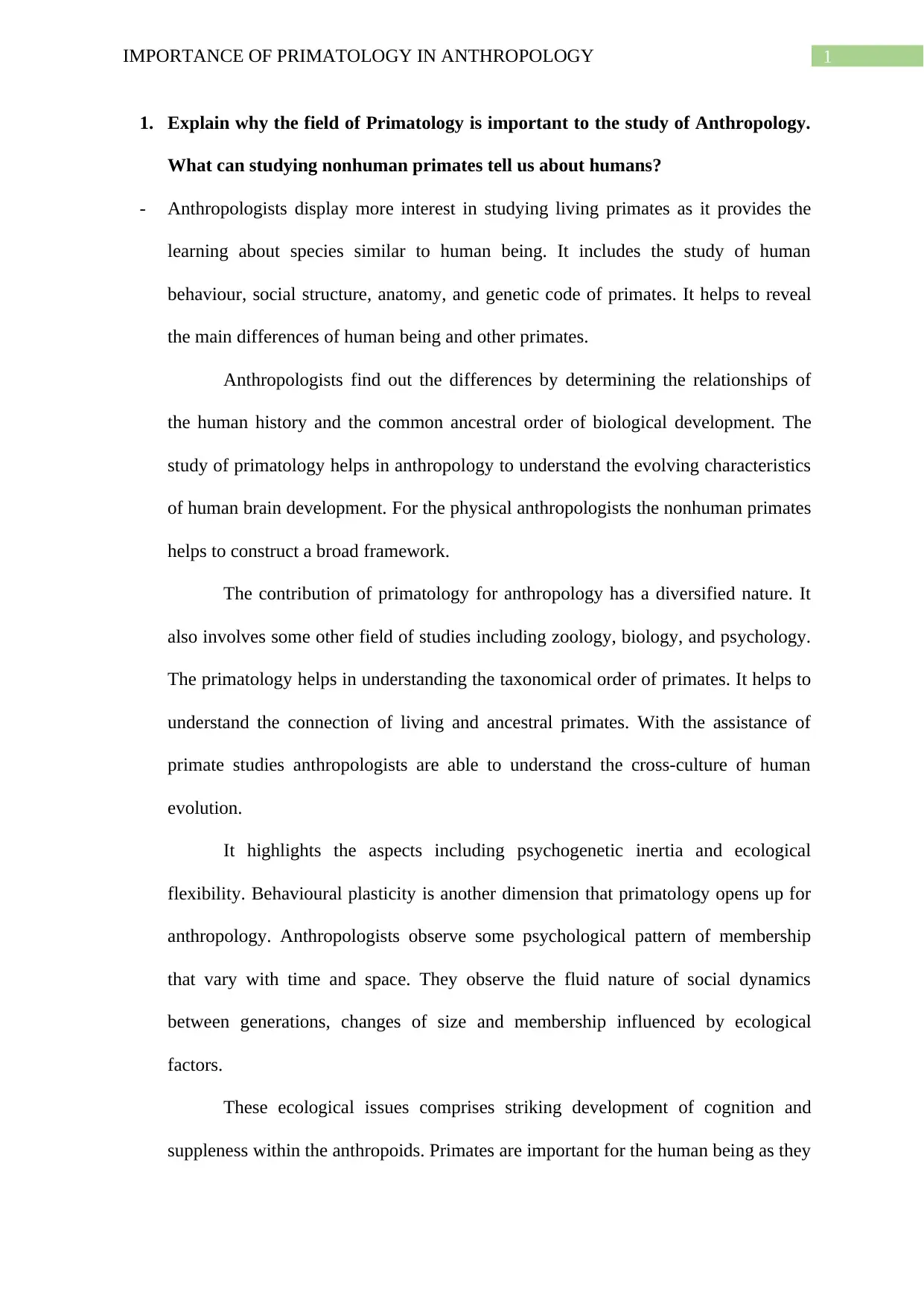
1IMPORTANCE OF PRIMATOLOGY IN ANTHROPOLOGY
1. Explain why the field of Primatology is important to the study of Anthropology.
What can studying nonhuman primates tell us about humans?
- Anthropologists display more interest in studying living primates as it provides the
learning about species similar to human being. It includes the study of human
behaviour, social structure, anatomy, and genetic code of primates. It helps to reveal
the main differences of human being and other primates.
Anthropologists find out the differences by determining the relationships of
the human history and the common ancestral order of biological development. The
study of primatology helps in anthropology to understand the evolving characteristics
of human brain development. For the physical anthropologists the nonhuman primates
helps to construct a broad framework.
The contribution of primatology for anthropology has a diversified nature. It
also involves some other field of studies including zoology, biology, and psychology.
The primatology helps in understanding the taxonomical order of primates. It helps to
understand the connection of living and ancestral primates. With the assistance of
primate studies anthropologists are able to understand the cross-culture of human
evolution.
It highlights the aspects including psychogenetic inertia and ecological
flexibility. Behavioural plasticity is another dimension that primatology opens up for
anthropology. Anthropologists observe some psychological pattern of membership
that vary with time and space. They observe the fluid nature of social dynamics
between generations, changes of size and membership influenced by ecological
factors.
These ecological issues comprises striking development of cognition and
suppleness within the anthropoids. Primates are important for the human being as they
Document Page
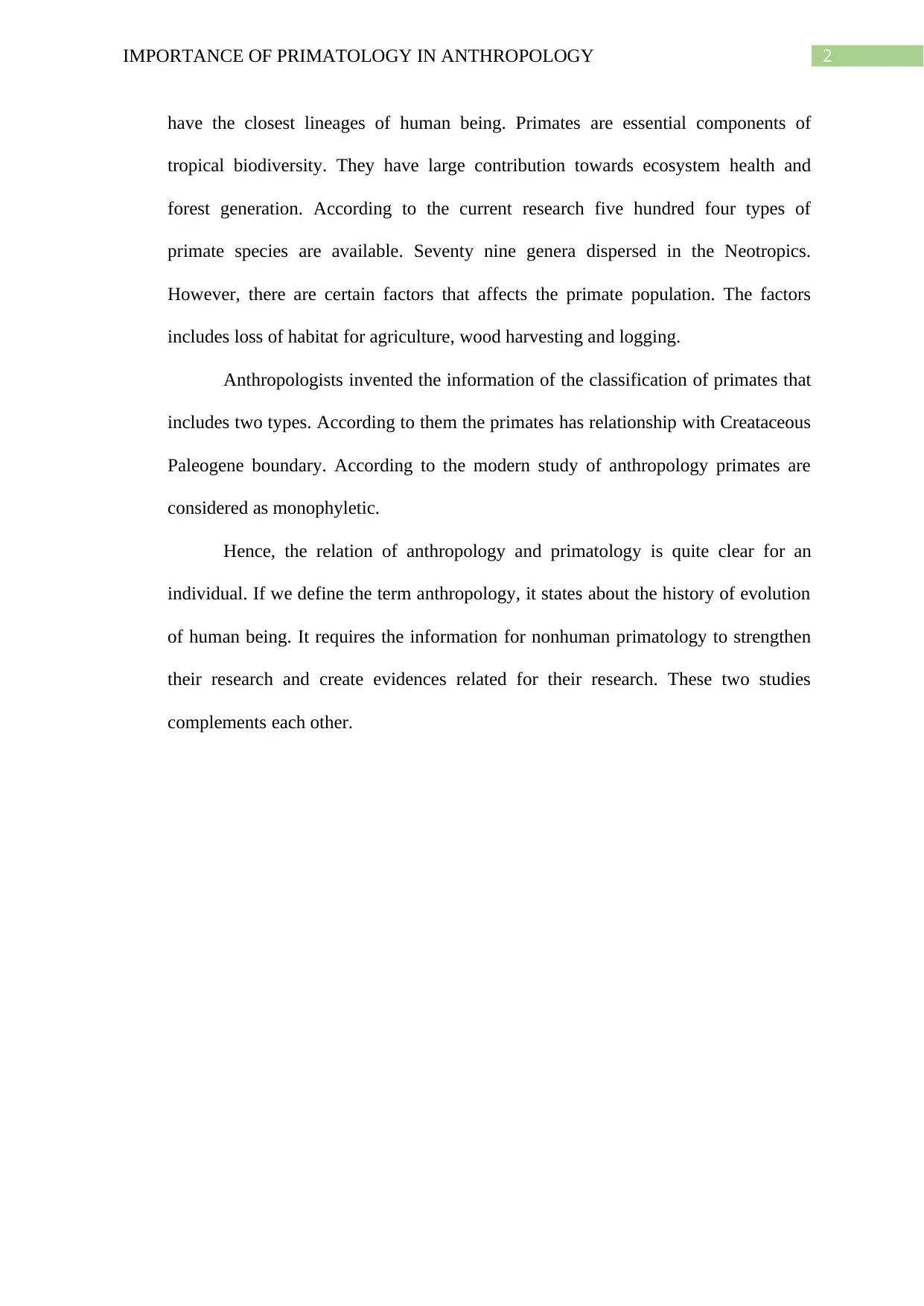
2IMPORTANCE OF PRIMATOLOGY IN ANTHROPOLOGY
have the closest lineages of human being. Primates are essential components of
tropical biodiversity. They have large contribution towards ecosystem health and
forest generation. According to the current research five hundred four types of
primate species are available. Seventy nine genera dispersed in the Neotropics.
However, there are certain factors that affects the primate population. The factors
includes loss of habitat for agriculture, wood harvesting and logging.
Anthropologists invented the information of the classification of primates that
includes two types. According to them the primates has relationship with Creataceous
Paleogene boundary. According to the modern study of anthropology primates are
considered as monophyletic.
Hence, the relation of anthropology and primatology is quite clear for an
individual. If we define the term anthropology, it states about the history of evolution
of human being. It requires the information for nonhuman primatology to strengthen
their research and create evidences related for their research. These two studies
complements each other.
Document Page
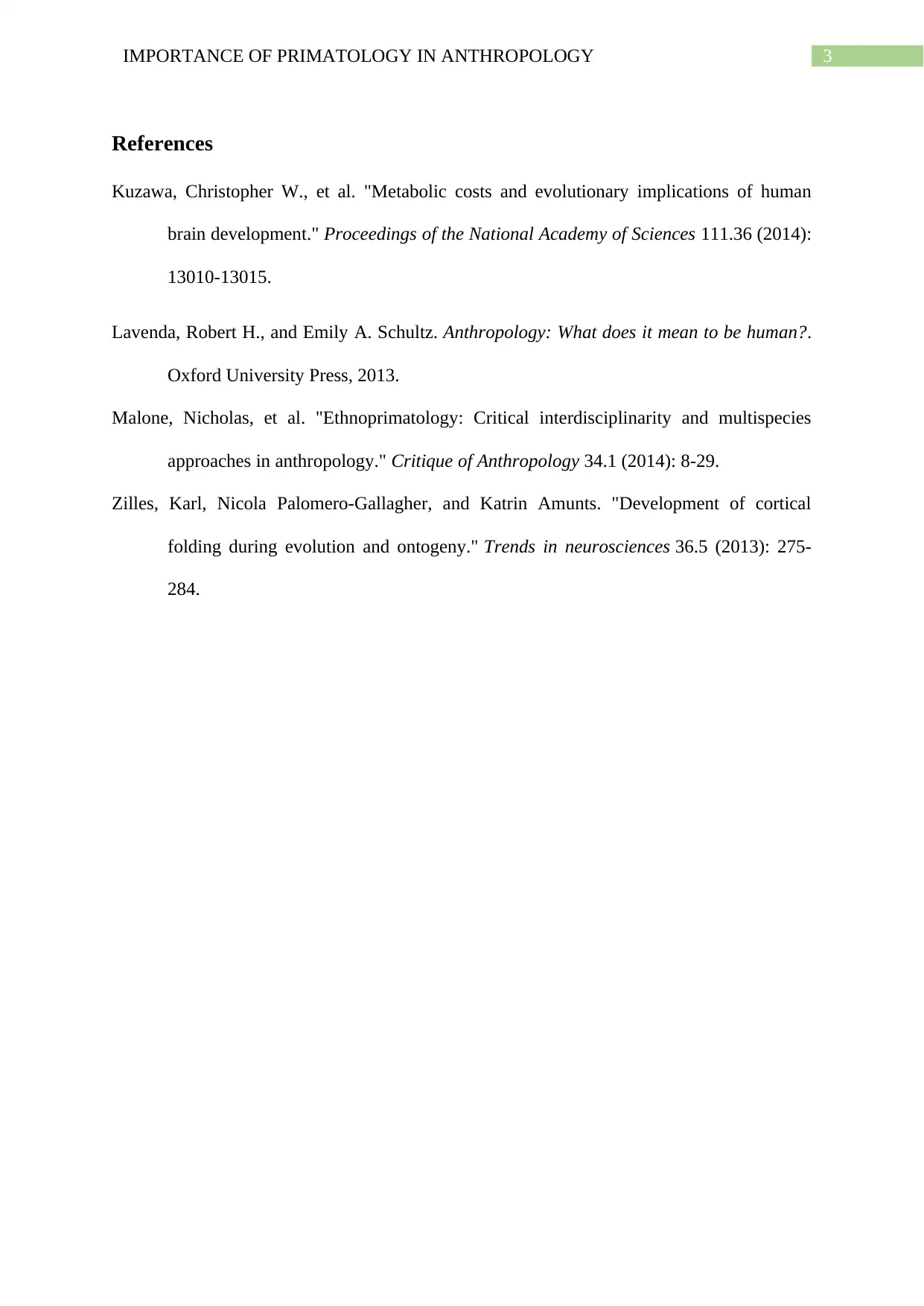
3IMPORTANCE OF PRIMATOLOGY IN ANTHROPOLOGY
References
Kuzawa, Christopher W., et al. "Metabolic costs and evolutionary implications of human
brain development." Proceedings of the National Academy of Sciences 111.36 (2014):
13010-13015.
Lavenda, Robert H., and Emily A. Schultz. Anthropology: What does it mean to be human?.
Oxford University Press, 2013.
Malone, Nicholas, et al. "Ethnoprimatology: Critical interdisciplinarity and multispecies
approaches in anthropology." Critique of Anthropology 34.1 (2014): 8-29.
Zilles, Karl, Nicola Palomero-Gallagher, and Katrin Amunts. "Development of cortical
folding during evolution and ontogeny." Trends in neurosciences 36.5 (2013): 275-
284.
chevron_up_icon
1 out of 4
circle_padding
hide_on_mobile
zoom_out_icon
[object Object]