Restaurant Business Plan for Singapore's Food and Beverage Industry
VerifiedAdded on 2020/04/15
|21
|3434
|38
Report
AI Summary
This report presents a detailed business plan for establishing a restaurant in Singapore's food and beverage industry. It begins with an introduction to the Singaporean market, highlighting its high food spending and the industry's contribution to the GDP, followed by an analysis of current trends, including changing consumer preferences, technological advancements, and the rise of e-commerce and sustainability. The plan outlines a unique restaurant concept, "Beach Incidents," a beachside establishment specializing in western cuisine, targeting young and middle-aged demographics, and located at Tanjong Beach, Sentosa. The report further delves into the restaurant's design, including color schemes, ambiance, and layout, as well as staffing and human resource considerations, including salary structures, work schedules, and benefits. The report also provides an overview of the restaurant's menu. The plan aims to capitalize on current trends in the Singaporean market and provide a unique dining experience.
Running Head: FOOD AND BEVERAGE MANAGEMENT
Food and beverage management
Food and beverage management

Paraphrase This Document
Need a fresh take? Get an instant paraphrase of this document with our AI Paraphraser
1
Food and Beverage Management
Table of Contents
Introduction................................................................................................................. 2
1.Introduction to Singapore Food and Beverage Industry...........................................3
2. Analysis of current Food and Beverage Industry trends.........................................4
3. Your Restaurant concept........................................................................................ 5
4. Design of restaurant................................................................................................6
5. Layout and Ergonomics..........................................................................................9
6. Human Resources................................................................................................ 10
7. Wines.................................................................................................................... 11
8. Alcoholic and Non-alcoholic Beverages................................................................12
9. Restaurant Menu...................................................................................................12
Conclusion................................................................................................................ 14
References................................................................................................................15
Food and Beverage Management
Table of Contents
Introduction................................................................................................................. 2
1.Introduction to Singapore Food and Beverage Industry...........................................3
2. Analysis of current Food and Beverage Industry trends.........................................4
3. Your Restaurant concept........................................................................................ 5
4. Design of restaurant................................................................................................6
5. Layout and Ergonomics..........................................................................................9
6. Human Resources................................................................................................ 10
7. Wines.................................................................................................................... 11
8. Alcoholic and Non-alcoholic Beverages................................................................12
9. Restaurant Menu...................................................................................................12
Conclusion................................................................................................................ 14
References................................................................................................................15
2
Food and Beverage Management
Introduction
With the development and swift changes in the field of technology and forces
of current trends in globalization, world has become a international village,
categorized by an explosive development in global business and competition.
Entrepreneurship that is one of the significant financial force for a country is
empowering people to search opportunity where others find Entrepreneurship, which
is one the most powerful financial force known to obstinate challenges. This study
will be based on setting up a restaurant business in the food and beverage industry
of Singapore. With all the specifications, a detail business plan will be set up for the
new restaurant business.
Food and Beverage Management
Introduction
With the development and swift changes in the field of technology and forces
of current trends in globalization, world has become a international village,
categorized by an explosive development in global business and competition.
Entrepreneurship that is one of the significant financial force for a country is
empowering people to search opportunity where others find Entrepreneurship, which
is one the most powerful financial force known to obstinate challenges. This study
will be based on setting up a restaurant business in the food and beverage industry
of Singapore. With all the specifications, a detail business plan will be set up for the
new restaurant business.
⊘ This is a preview!⊘
Do you want full access?
Subscribe today to unlock all pages.

Trusted by 1+ million students worldwide
3
Food and Beverage Management
1.Introduction to Singapore Food and Beverage Industry
According to the current statistical data, Singapore remains one of the utmost
interesting and important “food markets in Southeast Asia”. With a highest disposal
income rates, the average monthly per people capital food spending is around
C$220, on the basis of the Singapore Survey of Statistics Household Expenditure
(Baker & Friel, 2014). This current amount includes an regular monthly per capital
expenses of C$120 and C$100 on cooked and non-cooked food respectively.
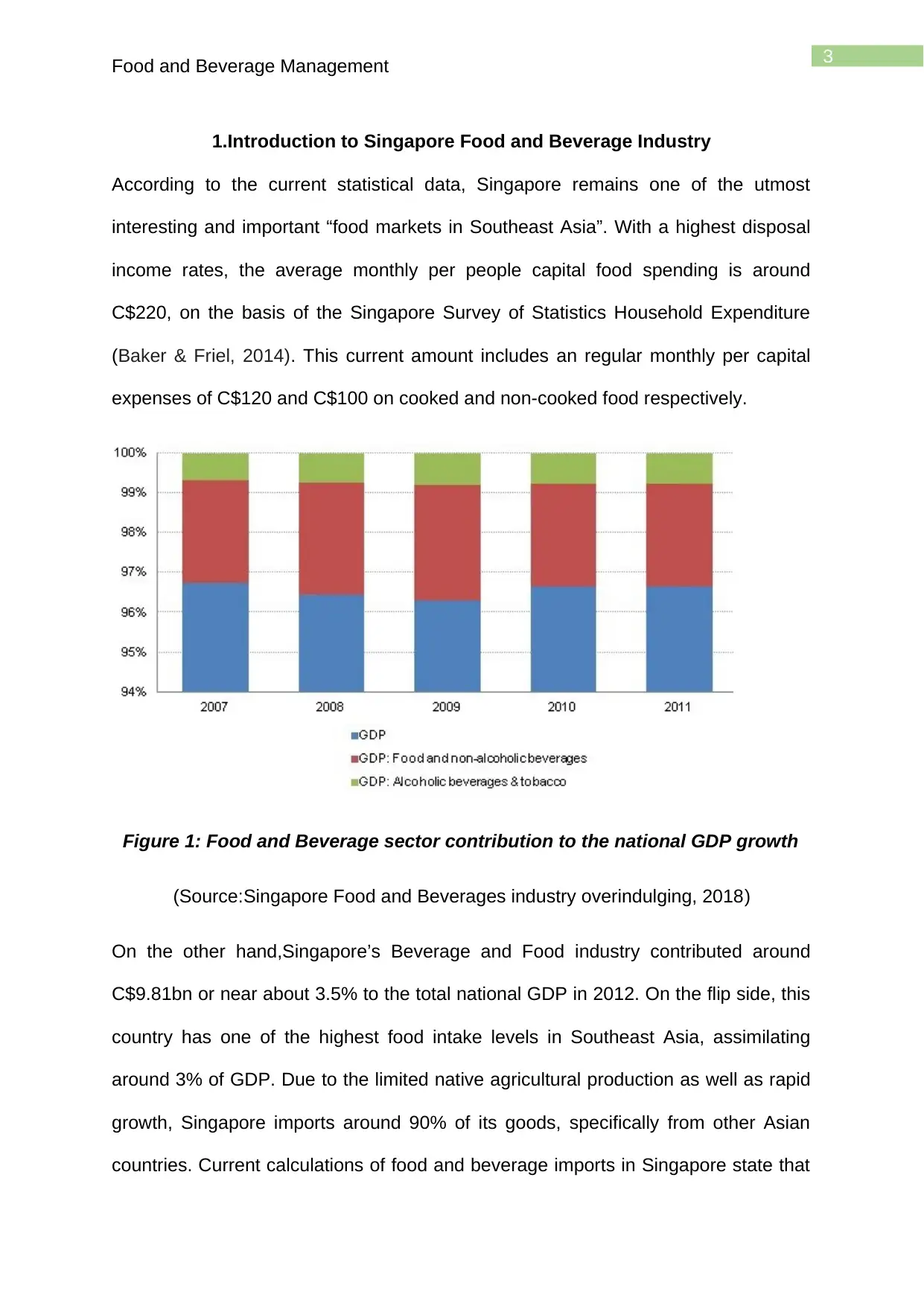
Figure 1: Food and Beverage sector contribution to the national GDP growth
(Source:Singapore Food and Beverages industry overindulging, 2018)
On the other hand,Singapore’s Beverage and Food industry contributed around
C$9.81bn or near about 3.5% to the total national GDP in 2012. On the flip side, this
country has one of the highest food intake levels in Southeast Asia, assimilating
around 3% of GDP. Due to the limited native agricultural production as well as rapid
growth, Singapore imports around 90% of its goods, specifically from other Asian
countries. Current calculations of food and beverage imports in Singapore state that
Food and Beverage Management
1.Introduction to Singapore Food and Beverage Industry
According to the current statistical data, Singapore remains one of the utmost
interesting and important “food markets in Southeast Asia”. With a highest disposal
income rates, the average monthly per people capital food spending is around
C$220, on the basis of the Singapore Survey of Statistics Household Expenditure
(Baker & Friel, 2014). This current amount includes an regular monthly per capital
expenses of C$120 and C$100 on cooked and non-cooked food respectively.
Figure 1: Food and Beverage sector contribution to the national GDP growth
(Source:Singapore Food and Beverages industry overindulging, 2018)
On the other hand,Singapore’s Beverage and Food industry contributed around
C$9.81bn or near about 3.5% to the total national GDP in 2012. On the flip side, this
country has one of the highest food intake levels in Southeast Asia, assimilating
around 3% of GDP. Due to the limited native agricultural production as well as rapid
growth, Singapore imports around 90% of its goods, specifically from other Asian
countries. Current calculations of food and beverage imports in Singapore state that
Paraphrase This Document
Need a fresh take? Get an instant paraphrase of this document with our AI Paraphraser
4
Food and Beverage Management
it has been account for near about 8% of GDP in the previous year ( Christmann,
Leong, Tan, Christmann& Leong, 2017). This country’s drink and food retailing
services accumulates near about 3000 department stores, supermarkets, provisions
that sell processed food items, Agri-cultural foods and others. Currently, total
revenue in Food and Beverage industry amounts to US$270m in 2018. This revenue
is predictable to exhibit an annual development degree around 27.5%, ensuing the
market volume of US$715m by 2022 (Dossey, Morales-Ramos & Rojas, 2016).
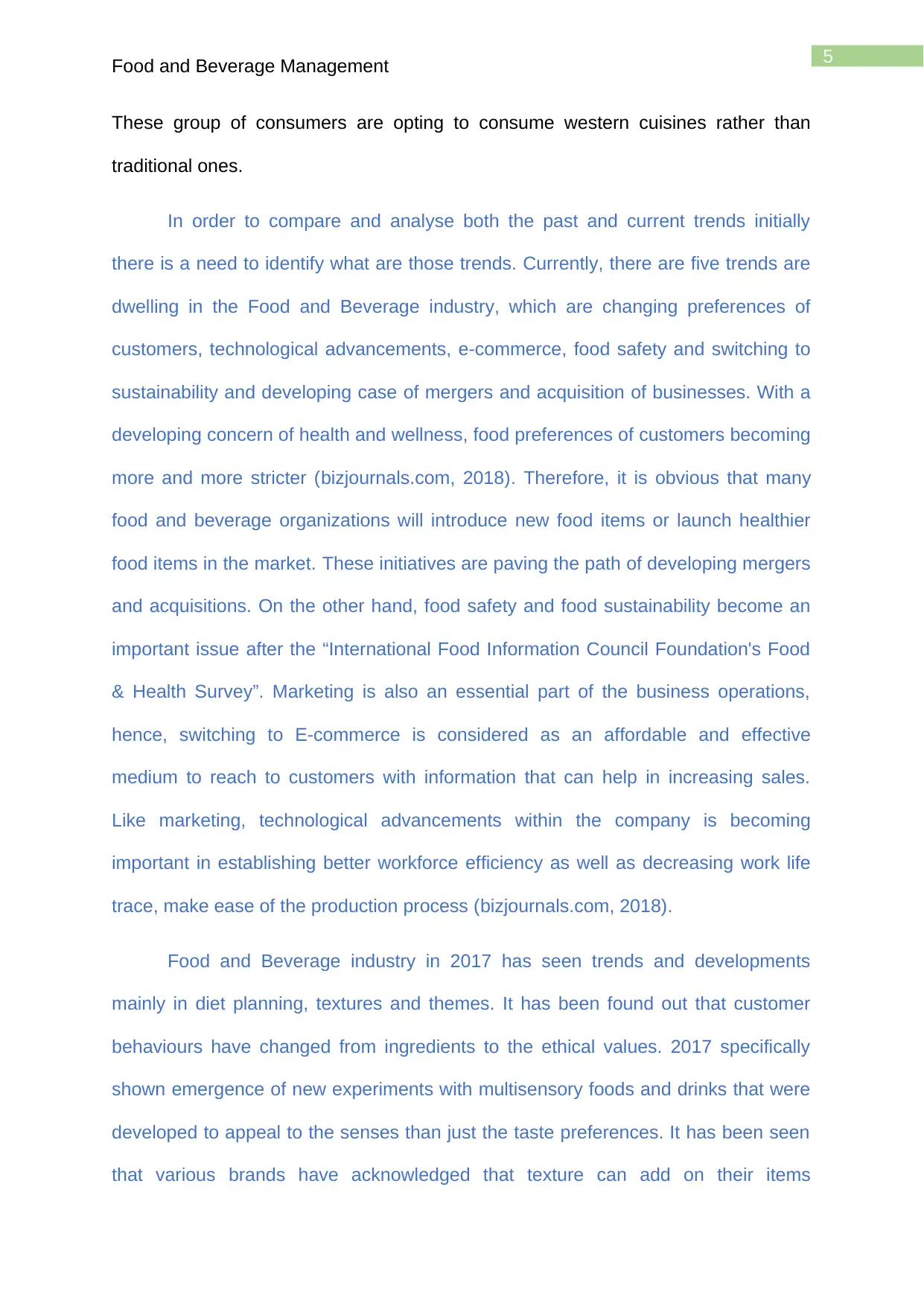
Figure 2: Food and Beverage services index
(Source:retailnews.asia, 2018)
2. Analysis of current Food and Beverage Industry trends
Currently, younger group of PMETs and middle aged PMETs are customers
with their increasing tastes are developing day by day in Singapore. The middle-
aged customer propensities are well-connected with their sophisticated of taste
needed significantly from their travels and the younger-aged group is highly
influenced by the modern cafes, eating style and others. On the other hand,
development in the inbound tourism is also developing taste and inclusion of
different food tastes in this country. Another group of travellers are self-governing
businesspersons who participate in Singapore and develop a Singaporean workforce
(allianceexperts.com, 2018). These overseas businessmen are capable to indulge in
worldly drinks and food in Singapore’s diverse selection. On the flip side, western
food taste effect has had families choose for beverage and foods shared to the west.
Food and Beverage Management
it has been account for near about 8% of GDP in the previous year ( Christmann,
Leong, Tan, Christmann& Leong, 2017). This country’s drink and food retailing
services accumulates near about 3000 department stores, supermarkets, provisions
that sell processed food items, Agri-cultural foods and others. Currently, total
revenue in Food and Beverage industry amounts to US$270m in 2018. This revenue
is predictable to exhibit an annual development degree around 27.5%, ensuing the
market volume of US$715m by 2022 (Dossey, Morales-Ramos & Rojas, 2016).
Figure 2: Food and Beverage services index
(Source:retailnews.asia, 2018)
2. Analysis of current Food and Beverage Industry trends
Currently, younger group of PMETs and middle aged PMETs are customers
with their increasing tastes are developing day by day in Singapore. The middle-
aged customer propensities are well-connected with their sophisticated of taste
needed significantly from their travels and the younger-aged group is highly
influenced by the modern cafes, eating style and others. On the other hand,
development in the inbound tourism is also developing taste and inclusion of
different food tastes in this country. Another group of travellers are self-governing
businesspersons who participate in Singapore and develop a Singaporean workforce
(allianceexperts.com, 2018). These overseas businessmen are capable to indulge in
worldly drinks and food in Singapore’s diverse selection. On the flip side, western
food taste effect has had families choose for beverage and foods shared to the west.
5
Food and Beverage Management
These group of consumers are opting to consume western cuisines rather than
traditional ones.
In order to compare and analyse both the past and current trends initially
there is a need to identify what are those trends. Currently, there are five trends are
dwelling in the Food and Beverage industry, which are changing preferences of
customers, technological advancements, e-commerce, food safety and switching to
sustainability and developing case of mergers and acquisition of businesses. With a
developing concern of health and wellness, food preferences of customers becoming
more and more stricter (bizjournals.com, 2018). Therefore, it is obvious that many
food and beverage organizations will introduce new food items or launch healthier
food items in the market. These initiatives are paving the path of developing mergers
and acquisitions. On the other hand, food safety and food sustainability become an
important issue after the “International Food Information Council Foundation's Food
& Health Survey”. Marketing is also an essential part of the business operations,
hence, switching to E-commerce is considered as an affordable and effective
medium to reach to customers with information that can help in increasing sales.
Like marketing, technological advancements within the company is becoming
important in establishing better workforce efficiency as well as decreasing work life
trace, make ease of the production process (bizjournals.com, 2018).
Food and Beverage industry in 2017 has seen trends and developments
mainly in diet planning, textures and themes. It has been found out that customer
behaviours have changed from ingredients to the ethical values. 2017 specifically
shown emergence of new experiments with multisensory foods and drinks that were
developed to appeal to the senses than just the taste preferences. It has been seen
that various brands have acknowledged that texture can add on their items
Food and Beverage Management
These group of consumers are opting to consume western cuisines rather than
traditional ones.
In order to compare and analyse both the past and current trends initially
there is a need to identify what are those trends. Currently, there are five trends are
dwelling in the Food and Beverage industry, which are changing preferences of
customers, technological advancements, e-commerce, food safety and switching to
sustainability and developing case of mergers and acquisition of businesses. With a
developing concern of health and wellness, food preferences of customers becoming
more and more stricter (bizjournals.com, 2018). Therefore, it is obvious that many
food and beverage organizations will introduce new food items or launch healthier
food items in the market. These initiatives are paving the path of developing mergers
and acquisitions. On the other hand, food safety and food sustainability become an
important issue after the “International Food Information Council Foundation's Food
& Health Survey”. Marketing is also an essential part of the business operations,
hence, switching to E-commerce is considered as an affordable and effective
medium to reach to customers with information that can help in increasing sales.
Like marketing, technological advancements within the company is becoming
important in establishing better workforce efficiency as well as decreasing work life
trace, make ease of the production process (bizjournals.com, 2018).
Food and Beverage industry in 2017 has seen trends and developments
mainly in diet planning, textures and themes. It has been found out that customer
behaviours have changed from ingredients to the ethical values. 2017 specifically
shown emergence of new experiments with multisensory foods and drinks that were
developed to appeal to the senses than just the taste preferences. It has been seen
that various brands have acknowledged that texture can add on their items
⊘ This is a preview!⊘
Do you want full access?
Subscribe today to unlock all pages.
Trusted by 1+ million students worldwide
6
Food and Beverage Management
(Johnson, 2015). Though the concern on balance diet and healthy eating was still
constant from the previous year in the Food and Beverage industry and in urge of
balancing busy lifestyle, concepts like ‘meat-free Monday’ or ‘free-from Friday’ have
emerged in the previous years. On the other hand, with effective technological
involvement in developing customer engagement, more personalized service
offerings have increased in 2017.
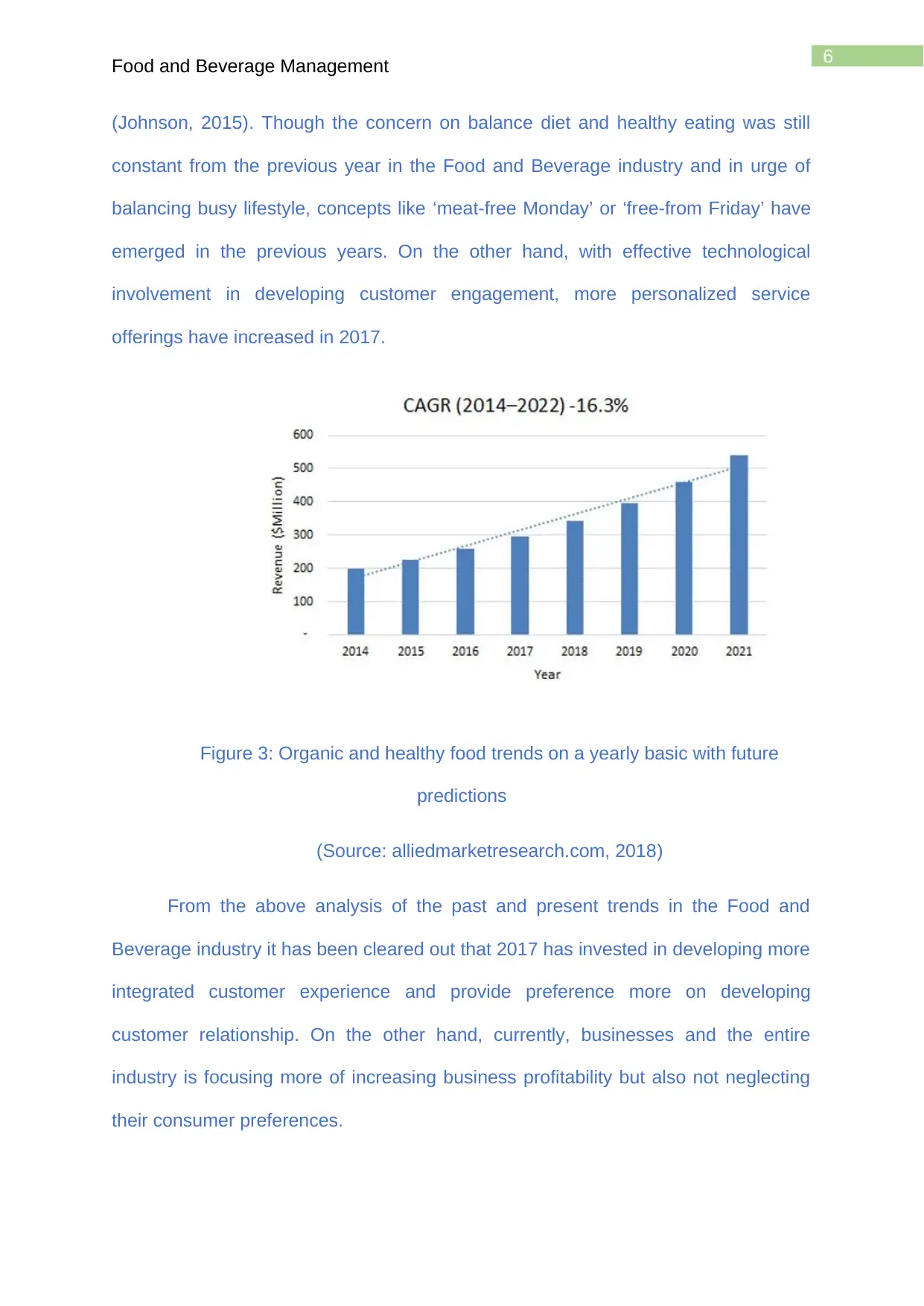
Figure 3: Organic and healthy food trends on a yearly basic with future
predictions
(Source: alliedmarketresearch.com, 2018)
From the above analysis of the past and present trends in the Food and
Beverage industry it has been cleared out that 2017 has invested in developing more
integrated customer experience and provide preference more on developing
customer relationship. On the other hand, currently, businesses and the entire
industry is focusing more of increasing business profitability but also not neglecting
their consumer preferences.
Food and Beverage Management
(Johnson, 2015). Though the concern on balance diet and healthy eating was still
constant from the previous year in the Food and Beverage industry and in urge of
balancing busy lifestyle, concepts like ‘meat-free Monday’ or ‘free-from Friday’ have
emerged in the previous years. On the other hand, with effective technological
involvement in developing customer engagement, more personalized service
offerings have increased in 2017.
Figure 3: Organic and healthy food trends on a yearly basic with future
predictions
(Source: alliedmarketresearch.com, 2018)
From the above analysis of the past and present trends in the Food and
Beverage industry it has been cleared out that 2017 has invested in developing more
integrated customer experience and provide preference more on developing
customer relationship. On the other hand, currently, businesses and the entire
industry is focusing more of increasing business profitability but also not neglecting
their consumer preferences.
Paraphrase This Document
Need a fresh take? Get an instant paraphrase of this document with our AI Paraphraser
7
Food and Beverage Management
These types of trends in consumer tastes and preferences in the Singapore
Food and Beverage industry will be helpful for the new entrepreneurship venture.
This trends will be helpful for the establishment of western style restaurant in this
country. Western style of foods and drinks will help in attracting consumers for the
new business. Developing revenue, brand value and attracting new consumer group
will be easy with these trends.
3. Your Restaurant concept
Main concept
Apart from the traditional and other types of restaurant available in the Singapore
market as well as all around the world, this restaurant is aiming at providing foods
and other beverages to customers with a unique theme around them. This restaurant
will provide a great pleasure to the travellers who wants to have a taste of their
meals and drinks, relaxing on the beach. The concept of the restaurant will be a
beach restaurant. Name of the restaurant will be “Beach Incidents”. This restaurant
will have no typical restaurant set up, people will be able to take their meals from the
counter and have it at the sea shore. Only they have to payment first for their meals
and drinks. Both the domestic and foreign people will be delighted to visit and have a
dinner or lunch at this type of restaurant while smelling the sea.
Cuisine preference
The main cuisine of the restaurant will be western cuisine along with the traditional
food items and drinks of Singapore.
Target market
Food and Beverage Management
These types of trends in consumer tastes and preferences in the Singapore
Food and Beverage industry will be helpful for the new entrepreneurship venture.
This trends will be helpful for the establishment of western style restaurant in this
country. Western style of foods and drinks will help in attracting consumers for the
new business. Developing revenue, brand value and attracting new consumer group
will be easy with these trends.
3. Your Restaurant concept
Main concept
Apart from the traditional and other types of restaurant available in the Singapore
market as well as all around the world, this restaurant is aiming at providing foods
and other beverages to customers with a unique theme around them. This restaurant
will provide a great pleasure to the travellers who wants to have a taste of their
meals and drinks, relaxing on the beach. The concept of the restaurant will be a
beach restaurant. Name of the restaurant will be “Beach Incidents”. This restaurant
will have no typical restaurant set up, people will be able to take their meals from the
counter and have it at the sea shore. Only they have to payment first for their meals
and drinks. Both the domestic and foreign people will be delighted to visit and have a
dinner or lunch at this type of restaurant while smelling the sea.
Cuisine preference
The main cuisine of the restaurant will be western cuisine along with the traditional
food items and drinks of Singapore.
Target market
8
Food and Beverage Management
The target market of this restaurant will be young-aged people and the middle-aged
people. The young-aged people will be appropriate for this type of beach restaurant
and they are more habituated with the western cuisine. The middle-aged people,
counting both the overseas travellers and domestic people, will be interested in
experiencing the western cuisine and the traditional one.
Location and direct competitors
The restaurant will be located at Tanjong Beach, Sentosa. The direct competitors will
be Tanjong beach club, Old Habits, LeBar, The Cliff and others near the beach.
4. Design of restaurant
Colour scheme of the restaurant
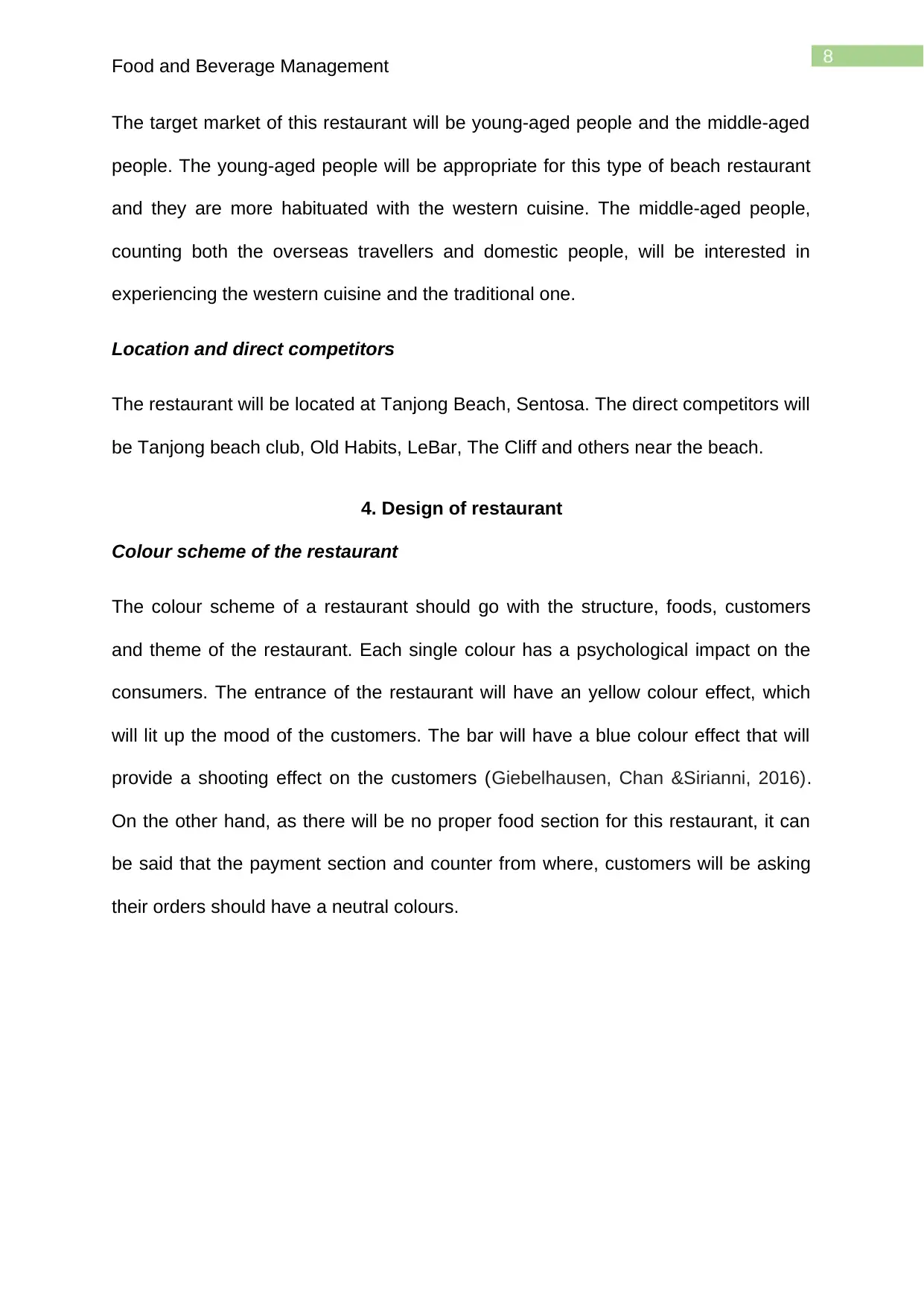
The colour scheme of a restaurant should go with the structure, foods, customers
and theme of the restaurant. Each single colour has a psychological impact on the
consumers. The entrance of the restaurant will have an yellow colour effect, which
will lit up the mood of the customers. The bar will have a blue colour effect that will
provide a shooting effect on the customers (Giebelhausen, Chan &Sirianni, 2016).
On the other hand, as there will be no proper food section for this restaurant, it can
be said that the payment section and counter from where, customers will be asking
their orders should have a neutral colours.
Food and Beverage Management
The target market of this restaurant will be young-aged people and the middle-aged
people. The young-aged people will be appropriate for this type of beach restaurant
and they are more habituated with the western cuisine. The middle-aged people,
counting both the overseas travellers and domestic people, will be interested in
experiencing the western cuisine and the traditional one.
Location and direct competitors
The restaurant will be located at Tanjong Beach, Sentosa. The direct competitors will
be Tanjong beach club, Old Habits, LeBar, The Cliff and others near the beach.
4. Design of restaurant
Colour scheme of the restaurant
The colour scheme of a restaurant should go with the structure, foods, customers
and theme of the restaurant. Each single colour has a psychological impact on the
consumers. The entrance of the restaurant will have an yellow colour effect, which
will lit up the mood of the customers. The bar will have a blue colour effect that will
provide a shooting effect on the customers (Giebelhausen, Chan &Sirianni, 2016).
On the other hand, as there will be no proper food section for this restaurant, it can
be said that the payment section and counter from where, customers will be asking
their orders should have a neutral colours.
⊘ This is a preview!⊘
Do you want full access?
Subscribe today to unlock all pages.
Trusted by 1+ million students worldwide
9
Food and Beverage Management
Figure 4: Colour scheme
(Source:Giebelhausen, Chan &Sirianni, 2016)
Ambience of the restaurant
Entire ambience for a restaurant is created through the lightning, music, decorations
of the available rooms. This restaurant as said above will not have a proper and
traditional building set up should carefully select the lightning and music as well as
decorations for their available spaces. This restaurant will have both the slow tempo
music at the food section and high tempo music at the bar section where most of the
party people or young-group of customers will visit. On the other hand, the lightning
will be changing lights including the mood of relaxation and fun making scenarios at
the beach (Uriarte,Hernández, Zamora &Isalgue, 2016). The decoration of the
restaurant will be depending on the food and drinks available. Decoration will be
based on 3D cinematography process, in which people will have pictorial version of
all available items at the bar and food court along with the menu. Apart from these
Food and Beverage Management
Figure 4: Colour scheme
(Source:Giebelhausen, Chan &Sirianni, 2016)
Ambience of the restaurant
Entire ambience for a restaurant is created through the lightning, music, decorations
of the available rooms. This restaurant as said above will not have a proper and
traditional building set up should carefully select the lightning and music as well as
decorations for their available spaces. This restaurant will have both the slow tempo
music at the food section and high tempo music at the bar section where most of the
party people or young-group of customers will visit. On the other hand, the lightning
will be changing lights including the mood of relaxation and fun making scenarios at
the beach (Uriarte,Hernández, Zamora &Isalgue, 2016). The decoration of the
restaurant will be depending on the food and drinks available. Decoration will be
based on 3D cinematography process, in which people will have pictorial version of
all available items at the bar and food court along with the menu. Apart from these
Paraphrase This Document
Need a fresh take? Get an instant paraphrase of this document with our AI Paraphraser
10
Food and Beverage Management
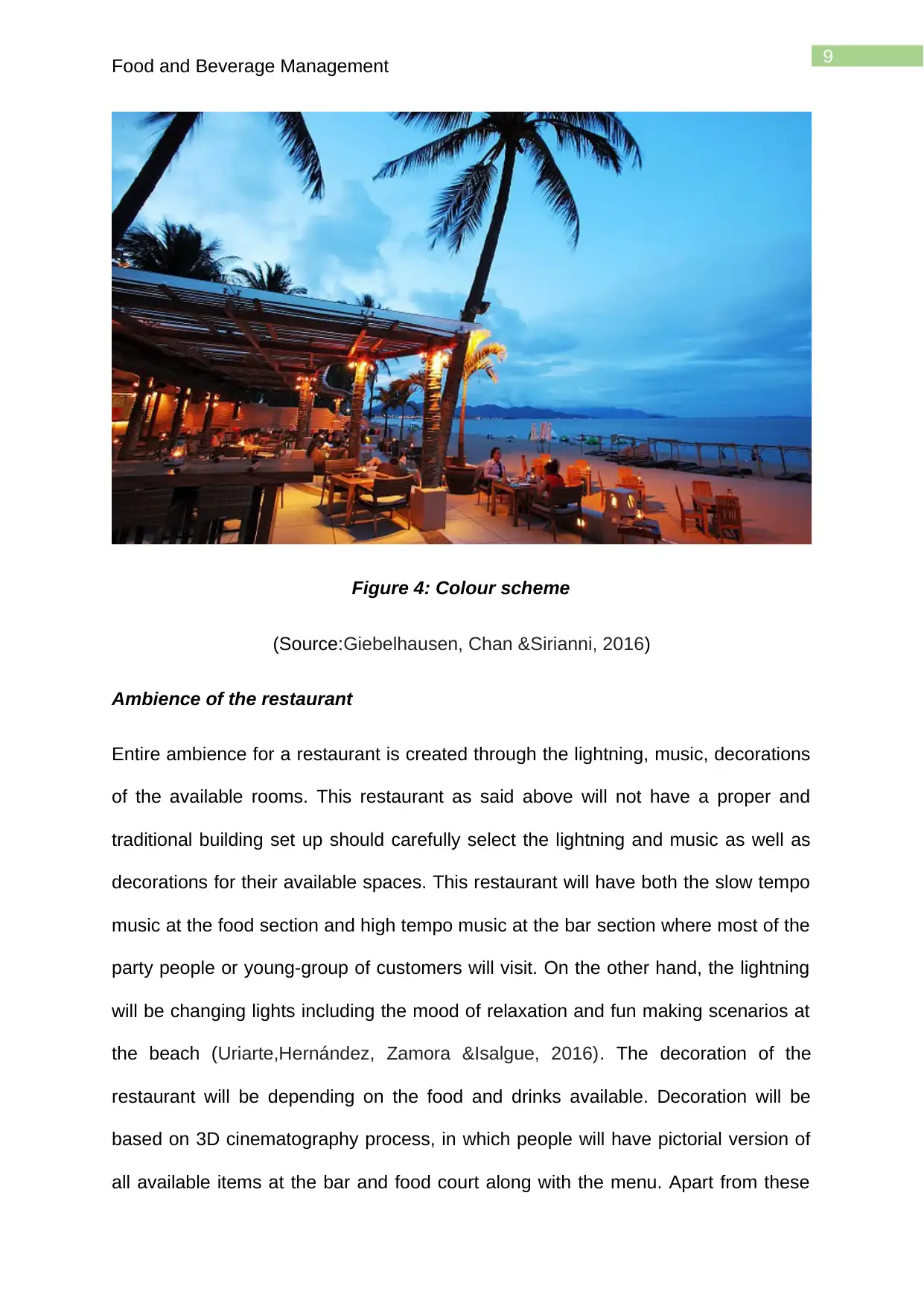
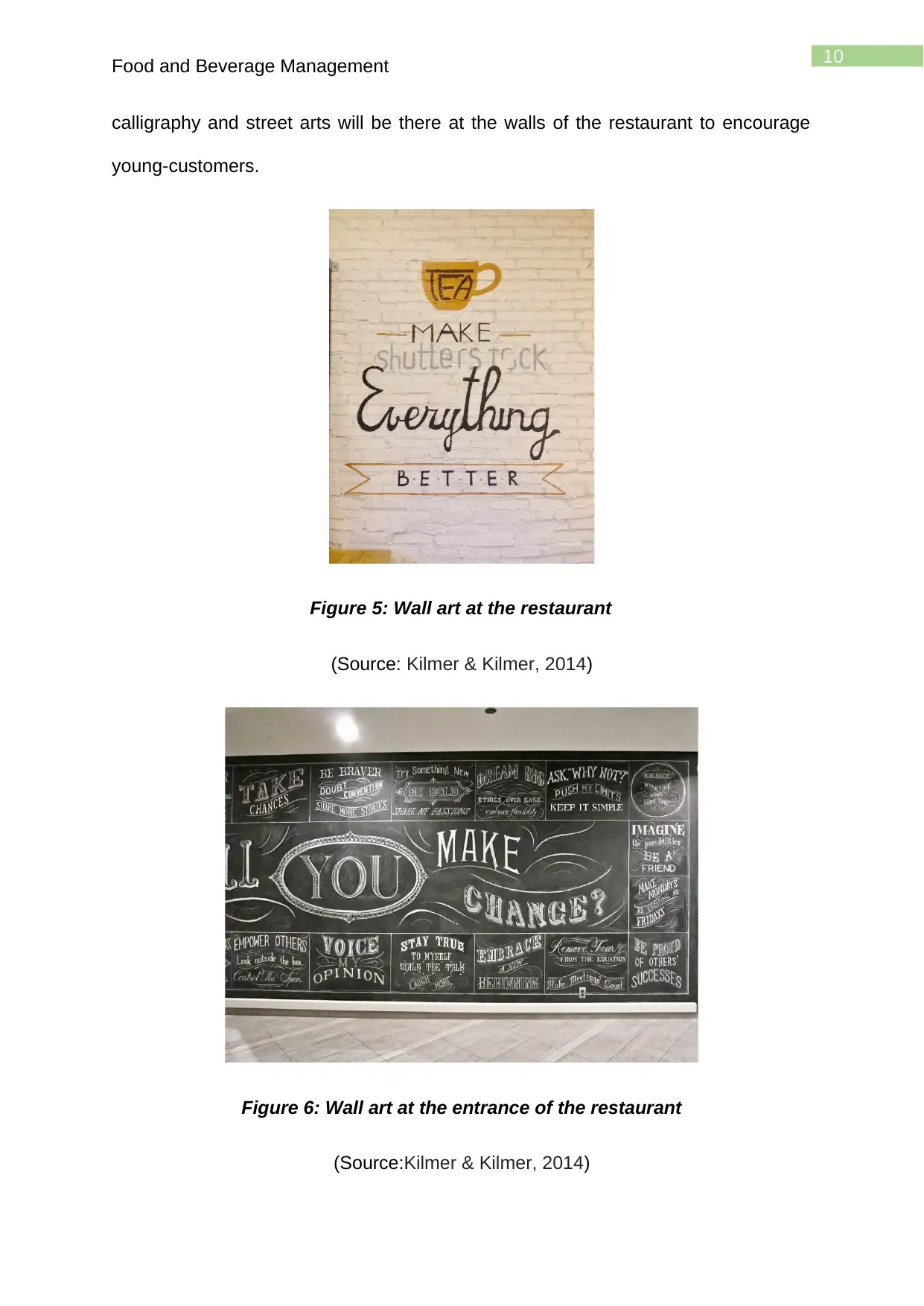
calligraphy and street arts will be there at the walls of the restaurant to encourage
young-customers.
Figure 5: Wall art at the restaurant
(Source: Kilmer & Kilmer, 2014)
Figure 6: Wall art at the entrance of the restaurant
(Source:Kilmer & Kilmer, 2014)
Food and Beverage Management
calligraphy and street arts will be there at the walls of the restaurant to encourage
young-customers.
Figure 5: Wall art at the restaurant
(Source: Kilmer & Kilmer, 2014)
Figure 6: Wall art at the entrance of the restaurant
(Source:Kilmer & Kilmer, 2014)
11
Food and Beverage Management
Figure 7: Sample of street arts at the restaurant walls
(Source: Kilmer & Kilmer, 2014)
5. Layout and Ergonomics
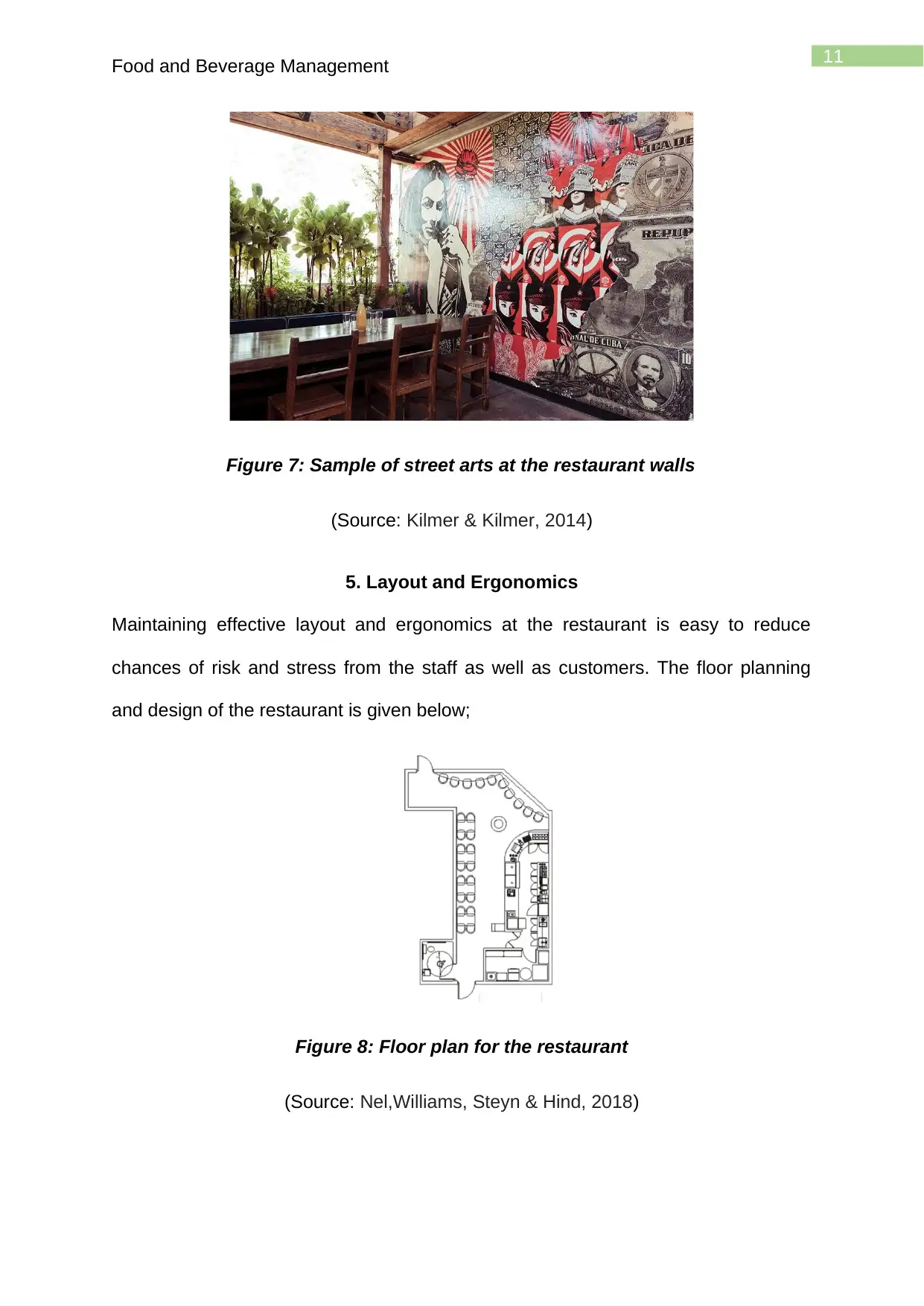
Maintaining effective layout and ergonomics at the restaurant is easy to reduce
chances of risk and stress from the staff as well as customers. The floor planning
and design of the restaurant is given below;
Figure 8: Floor plan for the restaurant
(Source: Nel,Williams, Steyn & Hind, 2018)
Food and Beverage Management
Figure 7: Sample of street arts at the restaurant walls
(Source: Kilmer & Kilmer, 2014)
5. Layout and Ergonomics
Maintaining effective layout and ergonomics at the restaurant is easy to reduce
chances of risk and stress from the staff as well as customers. The floor planning
and design of the restaurant is given below;
Figure 8: Floor plan for the restaurant
(Source: Nel,Williams, Steyn & Hind, 2018)
⊘ This is a preview!⊘
Do you want full access?
Subscribe today to unlock all pages.
Trusted by 1+ million students worldwide

1 out of 21


Your All-in-One AI-Powered Toolkit for Academic Success.
+13062052269
info@desklib.com
Available 24*7 on WhatsApp / Email
![[object Object]](/_next/static/media/star-bottom.7253800d.svg)
Unlock your academic potential
Copyright © 2020–2026 A2Z Services. All Rights Reserved. Developed and managed by ZUCOL.