International Indirect Taxation: A Report on Single Market Framework
VerifiedAdded on 2022/11/14
|26
|8029
|274
Report
AI Summary
This report, prepared for officials of Germany, France, Japan, and Singapore (GeFJaS), investigates the feasibility of establishing a single market framework, drawing inspiration from the EU model. The report analyzes the implications of international indirect taxation, particularly Value Added Tax (VAT) and excise duties, within the context of fostering economic growth and reducing unemployment. It explores the advantages and disadvantages of a single market, emphasizing the creation of a level playing field and the simplification of tax systems to combat fraud and promote revenue collection. The report includes country-specific analyses, a literature review, and technical knowledge related to VAT, such as identifying end-users, distance selling, and the application of VAT on imports. The conclusion highlights the achievements and objectives of a single market framework, emphasizing the importance of a uniform taxation policy to stabilize tax receipts and promote economic competitiveness. The report aims to provide a comprehensive understanding of the challenges and opportunities associated with implementing a single market for GeFJaS, offering recommendations based on the EU's experiences and current economic conditions.
international indirect
taxation
A Report on Single
Market Framework
taxation
A Report on Single
Market Framework

Paraphrase This Document
Need a fresh take? Get an instant paraphrase of this document with our AI Paraphraser
INTERNATIONAL INDIRECT TAXATION
A Report on Single Market Framework
Contents
Executive Summary...................................................................................................................3
1. Introduction........................................................................................................................4
1.1. VAT and Single Market...............................................................................................4
1.2. Advantages & Disadvantages of a Single Market.........................................................5
1.3. Creating Level Playing Field........................................................................................6
1.4. Key Statement on Single Market..................................................................................6
1.5. Objective of Single Market...........................................................................................6
2. Country Specific.................................................................................................................7
2.1. GERMANY..................................................................................................................7
2.2. FRANCE......................................................................................................................8
2.3. JAPAN.........................................................................................................................9
2.4. SINGAPORE.............................................................................................................11
3. Literature Review.............................................................................................................12
3.1. Rationale for Choice...................................................................................................12
3.2. Creating a Single Market and VAT-Justification........................................................12
3.3. Approach and Results – A Summary..........................................................................13
3.4. EU Council Directive on VAT...................................................................................13
3.5. Academic Paper Sources – Single Market..................................................................14
3.6. Academic Paper Sources – VAT................................................................................14
3.7. Official Journal of EU................................................................................................14
3.8. Scope of VAT for a Single Market.............................................................................14
3.9. Territorial Scope of a Single Market..........................................................................14
4. Technical Knowledge.......................................................................................................15
4.1. Identifying the End-user.............................................................................................15
4.2. Supplies – Full and Partial Exemption........................................................................15
4.3. Distance Selling / Reverse Charges............................................................................15
4.4. VAT MOSS / Digital Supply......................................................................................16
4.5. Payment on Account...................................................................................................16
4.6. Flat Rate Scheme........................................................................................................16
4.7. Differentiating Goods and Services............................................................................16
4.8. Residual Input Tax.....................................................................................................16
Page | 1
A Report on Single Market Framework
Contents
Executive Summary...................................................................................................................3
1. Introduction........................................................................................................................4
1.1. VAT and Single Market...............................................................................................4
1.2. Advantages & Disadvantages of a Single Market.........................................................5
1.3. Creating Level Playing Field........................................................................................6
1.4. Key Statement on Single Market..................................................................................6
1.5. Objective of Single Market...........................................................................................6
2. Country Specific.................................................................................................................7
2.1. GERMANY..................................................................................................................7
2.2. FRANCE......................................................................................................................8
2.3. JAPAN.........................................................................................................................9
2.4. SINGAPORE.............................................................................................................11
3. Literature Review.............................................................................................................12
3.1. Rationale for Choice...................................................................................................12
3.2. Creating a Single Market and VAT-Justification........................................................12
3.3. Approach and Results – A Summary..........................................................................13
3.4. EU Council Directive on VAT...................................................................................13
3.5. Academic Paper Sources – Single Market..................................................................14
3.6. Academic Paper Sources – VAT................................................................................14
3.7. Official Journal of EU................................................................................................14
3.8. Scope of VAT for a Single Market.............................................................................14
3.9. Territorial Scope of a Single Market..........................................................................14
4. Technical Knowledge.......................................................................................................15
4.1. Identifying the End-user.............................................................................................15
4.2. Supplies – Full and Partial Exemption........................................................................15
4.3. Distance Selling / Reverse Charges............................................................................15
4.4. VAT MOSS / Digital Supply......................................................................................16
4.5. Payment on Account...................................................................................................16
4.6. Flat Rate Scheme........................................................................................................16
4.7. Differentiating Goods and Services............................................................................16
4.8. Residual Input Tax.....................................................................................................16
Page | 1
INTERNATIONAL INDIRECT TAXATION
A Report on Single Market Framework
4.9. Distance Selling / Cross Border..................................................................................16
4.10. Application of VAT on Import...............................................................................16
5. Conclusion.........................................................................................................................17
5.1. Standard Rate of Tax..................................................................................................17
5.2. Achievements of a Single Market Framework............................................................17
5.3. Objectives Fulfilled and Consequences......................................................................17
5.3.1. Objectives Fulfilled...........................................................................................17
5.3.2. Consequences....................................................................................................18
6. BIBLIOGRAPHY............................................................................................................18
6.1. Academic Paper Sources – Single Market..................................................................18
6.2. Academic Paper Sources – VAT................................................................................20
6.3. Reference List............................................................................................................21
Page | 2
A Report on Single Market Framework
4.9. Distance Selling / Cross Border..................................................................................16
4.10. Application of VAT on Import...............................................................................16
5. Conclusion.........................................................................................................................17
5.1. Standard Rate of Tax..................................................................................................17
5.2. Achievements of a Single Market Framework............................................................17
5.3. Objectives Fulfilled and Consequences......................................................................17
5.3.1. Objectives Fulfilled...........................................................................................17
5.3.2. Consequences....................................................................................................18
6. BIBLIOGRAPHY............................................................................................................18
6.1. Academic Paper Sources – Single Market..................................................................18
6.2. Academic Paper Sources – VAT................................................................................20
6.3. Reference List............................................................................................................21
Page | 2
⊘ This is a preview!⊘
Do you want full access?
Subscribe today to unlock all pages.

Trusted by 1+ million students worldwide
INTERNATIONAL INDIRECT TAXATION
A Report on Single Market Framework
Executive Summary
The four big economies of the world, Germany, France, Japan and Singapore, although
not large enough to compete with the USA, China or Russia, have enough economic
strength to unite as a Single Market and challenge the tycoons. Under such presumption,
their Ministers of Finance agreed to discuss and formulate a fiscal policy, which will be
responding to two of their major challenges: (a) Promotion of their Economic Growth;
and (b) helping them to reduce unemployment in their respective countries.
The basic concept of this policy is to explore considerations for creating a Single
Market. The aim of such a fiscal policy is to convert their respective national markets
into a single market, so that new opportunities are opened for the industries to provide
immediate access to millions of consumers. This will also strengthen the economies of
these four nations and make them stronger to face the emerging competitiveness in
world markets. The Ministers agreed that the purpose of the policy is not to have a
common currency symbol but about bonding their local markets into a single market.
The Ministers also declared that promoting a single market policy has become
necessary, particularly because of differentiating taxes such as VAT and Excise. In this
regard the following reasons were found pertinent –
VAT has emerged as a tax which contributes significantly to every government’s
revenue collection, by including both the goods sold and services provided in the
free markets
A controlled VAT needs to be implemented so that it becomes a basic element in
the development of a single market.
VAT has now emerged, both through its conception and legislations, as a
Community Tax, hence one of the main factor and objective of this single market
policy is to promote a common system of VAT in all the member nations.
The Ministers also agreed unanimously that Excise, when levied disproportionately
on goods produced and sold in the open markets, although increases revenue intake
for the government, it also decreases the purchasing power of the consumer,
thereby indirectly affecting the industry.
Page | 3
A Report on Single Market Framework
Executive Summary
The four big economies of the world, Germany, France, Japan and Singapore, although
not large enough to compete with the USA, China or Russia, have enough economic
strength to unite as a Single Market and challenge the tycoons. Under such presumption,
their Ministers of Finance agreed to discuss and formulate a fiscal policy, which will be
responding to two of their major challenges: (a) Promotion of their Economic Growth;
and (b) helping them to reduce unemployment in their respective countries.
The basic concept of this policy is to explore considerations for creating a Single
Market. The aim of such a fiscal policy is to convert their respective national markets
into a single market, so that new opportunities are opened for the industries to provide
immediate access to millions of consumers. This will also strengthen the economies of
these four nations and make them stronger to face the emerging competitiveness in
world markets. The Ministers agreed that the purpose of the policy is not to have a
common currency symbol but about bonding their local markets into a single market.
The Ministers also declared that promoting a single market policy has become
necessary, particularly because of differentiating taxes such as VAT and Excise. In this
regard the following reasons were found pertinent –
VAT has emerged as a tax which contributes significantly to every government’s
revenue collection, by including both the goods sold and services provided in the
free markets
A controlled VAT needs to be implemented so that it becomes a basic element in
the development of a single market.
VAT has now emerged, both through its conception and legislations, as a
Community Tax, hence one of the main factor and objective of this single market
policy is to promote a common system of VAT in all the member nations.
The Ministers also agreed unanimously that Excise, when levied disproportionately
on goods produced and sold in the open markets, although increases revenue intake
for the government, it also decreases the purchasing power of the consumer,
thereby indirectly affecting the industry.
Page | 3
Paraphrase This Document
Need a fresh take? Get an instant paraphrase of this document with our AI Paraphraser
INTERNATIONAL INDIRECT TAXATION
A Report on Single Market Framework
A single market will not only remove these disproportionate taxing streams, it will also
give boost to the industries and trading houses by increasing their business volumes. An
increased consumption by the consumers, under a single tax regime, for a single market,
will automatically increase the revenue collection of nations participating in this
amalgamation.
Page | 4
A Report on Single Market Framework
A single market will not only remove these disproportionate taxing streams, it will also
give boost to the industries and trading houses by increasing their business volumes. An
increased consumption by the consumers, under a single tax regime, for a single market,
will automatically increase the revenue collection of nations participating in this
amalgamation.
Page | 4
INTERNATIONAL INDIRECT TAXATION
A Report on Single Market Framework
1. Introduction
1.1. VAT and Single Market
It was in April 1973 that Value Added Tax (VAT) was introduced in the European
Union (EU) when Britain joined EU. Since then, till the present, VAT has undergone
many changes and cam to be addressed as Transitional VAT-system in many advanced
economies of the world, assert Hoffman et al, (2015). Although introduction of VAT
was considered as a major forward step for abolishing the irregular Purchase Tax, it
only reflected the process, albeit partly, of the economic integration which was taking
place all across the globe and especially in the EU, as per Bhattacharjee &
Bhattacharya, (2018). The results achieved by the EU, over the last four decades, has
prompted the Finance Ministers of Germany, France, Japan and Singapore to follow in
the steps of the EU and achieve, albeit much more than EU, by integrating the core
market sectors of their respective countries into a Single Market, to be known as
GeFJaS, through a process of consolidating their taxes, especially VAT and Excise by
introducing a single market policy, as explained by Pfeiffer & Ursprung-Steindl (eds.),
(2015). Learning from the EU experience, GeFJaS will not aim at a common currency
or a common flag but will be attempting to consolidate itself into a commercially
managed conglomerate so that it can effectively counter the fast emerging
competitiveness in the world, says CEC, (1996).
Finance Ministers of GeFJaS have agreed in unison, to discuss more specific and
compelling lines on which a Fiscal Policy can be formulated, as detailed by Lang et al
(eds.), (2009), for ably responding to the two most challenging issues which they are
facing in the current economic scenario –
(a) Promotion of Mutually beneficial Economic Growth; and (b) Reduction of
Unemployment Rate in their respective countries. At the core of the Fiscal Policy is the
need of a Single Market, as per OECD, (2014). Aim set by the Finance Ministers is to
help GeFJaS become a professionally and commercially managed Single Market, which
can open up fresh opportunities for the industries falling under GeFJaS. This will not
only bring prosperity to millions of consumers in GeFJaS, it will also strengthen the
economies of the member nations for fighting market competitiveness which is fast
capturing the world economy, assert Pfeiffer & Ursprung-Steindl (eds.), (2015).
Page | 5
A Report on Single Market Framework
1. Introduction
1.1. VAT and Single Market
It was in April 1973 that Value Added Tax (VAT) was introduced in the European
Union (EU) when Britain joined EU. Since then, till the present, VAT has undergone
many changes and cam to be addressed as Transitional VAT-system in many advanced
economies of the world, assert Hoffman et al, (2015). Although introduction of VAT
was considered as a major forward step for abolishing the irregular Purchase Tax, it
only reflected the process, albeit partly, of the economic integration which was taking
place all across the globe and especially in the EU, as per Bhattacharjee &
Bhattacharya, (2018). The results achieved by the EU, over the last four decades, has
prompted the Finance Ministers of Germany, France, Japan and Singapore to follow in
the steps of the EU and achieve, albeit much more than EU, by integrating the core
market sectors of their respective countries into a Single Market, to be known as
GeFJaS, through a process of consolidating their taxes, especially VAT and Excise by
introducing a single market policy, as explained by Pfeiffer & Ursprung-Steindl (eds.),
(2015). Learning from the EU experience, GeFJaS will not aim at a common currency
or a common flag but will be attempting to consolidate itself into a commercially
managed conglomerate so that it can effectively counter the fast emerging
competitiveness in the world, says CEC, (1996).
Finance Ministers of GeFJaS have agreed in unison, to discuss more specific and
compelling lines on which a Fiscal Policy can be formulated, as detailed by Lang et al
(eds.), (2009), for ably responding to the two most challenging issues which they are
facing in the current economic scenario –
(a) Promotion of Mutually beneficial Economic Growth; and (b) Reduction of
Unemployment Rate in their respective countries. At the core of the Fiscal Policy is the
need of a Single Market, as per OECD, (2014). Aim set by the Finance Ministers is to
help GeFJaS become a professionally and commercially managed Single Market, which
can open up fresh opportunities for the industries falling under GeFJaS. This will not
only bring prosperity to millions of consumers in GeFJaS, it will also strengthen the
economies of the member nations for fighting market competitiveness which is fast
capturing the world economy, assert Pfeiffer & Ursprung-Steindl (eds.), (2015).
Page | 5
⊘ This is a preview!⊘
Do you want full access?
Subscribe today to unlock all pages.
Trusted by 1+ million students worldwide
INTERNATIONAL INDIRECT TAXATION
A Report on Single Market Framework
1.2. Advantages & Disadvantages of a Single Market
The decision of GeFJaS Ministers to implement Single Market policy was in earnest
because of the rapid progress taking place in global economy. The member nations of
GeFJaS find implementation of the policy essential so that they can take full advantage
of a strengthened single market right from its inception, as per Ecker, (2013). The
advantage can become manifold once taxes like VAT and Excise are implemented. A
uniform VAT can be helpful because –
Free circulation of goods and services in the entire GeFJaS zone will be benefitted
by uniform VAT
From its implementation through a legislation, VAT can be treated as a Community
Tax as the objective is to implement a common VAT system in GeFJaS.
The present VAT system in GeFJaS shall be under the transitional regime and it is
essential to understand that the present system creates unnecessary costs for the trade
sector and, finally, for the consumers, according to Muller et al (eds.), (2017). The
preliminary estimates made by the Ministers suggest that the direct administrative cost
born by the trade sector on the periodic transactions carried out in the individual
Member Nations is about 5 times more than what they will be bearing after the policy is
implemented in the entire GeFJaS zone, explain Hafner, Robin & Hoorens, (2014).
1.3. Creating Level Playing Field
Eliminating the unnecessary costs will definitely benefit the GeFJaS members in
combating economic competitiveness in the world, as per Mendel & Bevacqua, (2010).
Along with this factor, the cutdown costs will be creating a Level Playing Field for the
entire SME sector in GeFJaS zone. In the final discussions on the White Paper on
Economic Growth, Market Competitiveness and Eradication of Unemployment, the
GeFJaS Ministers unanimously agreed on the results presented for the above three
factors connected with the SME sector, explains Bakker (ed.), (2009).
Another important factor for creating a level playing field is reduction and/or
stabilisation of the individual nation’s budgetary deficits. Hence, the member nations of
GeFJaS must have a Uniform Taxation Policy so that they can contribute towards their
targeted objectives and also stabilise their tax receipts, assert Hoffman et al, (2015).
Page | 6
A Report on Single Market Framework
1.2. Advantages & Disadvantages of a Single Market
The decision of GeFJaS Ministers to implement Single Market policy was in earnest
because of the rapid progress taking place in global economy. The member nations of
GeFJaS find implementation of the policy essential so that they can take full advantage
of a strengthened single market right from its inception, as per Ecker, (2013). The
advantage can become manifold once taxes like VAT and Excise are implemented. A
uniform VAT can be helpful because –
Free circulation of goods and services in the entire GeFJaS zone will be benefitted
by uniform VAT
From its implementation through a legislation, VAT can be treated as a Community
Tax as the objective is to implement a common VAT system in GeFJaS.
The present VAT system in GeFJaS shall be under the transitional regime and it is
essential to understand that the present system creates unnecessary costs for the trade
sector and, finally, for the consumers, according to Muller et al (eds.), (2017). The
preliminary estimates made by the Ministers suggest that the direct administrative cost
born by the trade sector on the periodic transactions carried out in the individual
Member Nations is about 5 times more than what they will be bearing after the policy is
implemented in the entire GeFJaS zone, explain Hafner, Robin & Hoorens, (2014).
1.3. Creating Level Playing Field
Eliminating the unnecessary costs will definitely benefit the GeFJaS members in
combating economic competitiveness in the world, as per Mendel & Bevacqua, (2010).
Along with this factor, the cutdown costs will be creating a Level Playing Field for the
entire SME sector in GeFJaS zone. In the final discussions on the White Paper on
Economic Growth, Market Competitiveness and Eradication of Unemployment, the
GeFJaS Ministers unanimously agreed on the results presented for the above three
factors connected with the SME sector, explains Bakker (ed.), (2009).
Another important factor for creating a level playing field is reduction and/or
stabilisation of the individual nation’s budgetary deficits. Hence, the member nations of
GeFJaS must have a Uniform Taxation Policy so that they can contribute towards their
targeted objectives and also stabilise their tax receipts, assert Hoffman et al, (2015).
Page | 6
Paraphrase This Document
Need a fresh take? Get an instant paraphrase of this document with our AI Paraphraser
INTERNATIONAL INDIRECT TAXATION
A Report on Single Market Framework
1.4. Key Statement on Single Market
This paper, as per Muller et al (eds.), (2017), again stresses that the most suitable way
for achieving the targeted goals lies in promoting economic growth and generating
employment. This will increase tax revenue collection for the member nations and will
also reduce the expenditure, explains Basu, (2013). The other factor which can make tax
revenue collection more effective is a simplified tax system. This also makes
implementing of the policy by strengthening the tax system and combating fraud,
according to Adam, Besley & Blundell, (2011).
1.5. Objective of Single Market
The objective of a Single Market, according to Knodel, (2009), is to –
Create a situation where goods and services can be freely circulated as tax paid
commodities.
Create a simple tax system so that it remains protected from evasion and fraud.
Facilitate the system to become a major contributor to revenue collection
through a VAT Fiscal Policy.
2. Country Specific
2.1. GERMANY
2.1.1. Main Features
Economic Freedom Score of Germany is 73.5 and this ranks Germany’s economy as
24th freest as per 2019 Index. Its ranking in the EU region is 14th among the 44
countries, according to Mendel & Bevacqua, (2010). On the basis of these rankings,
Germany is above the world and regional averages.
2.1.2. Trade Features
Germany’s regulatory framework is strong and efficient and facilitates activities of free
enterprises. This allows businesses to operate as dynamically as in other parts of the
world, assert Forte & Oppenheim, (2011). The regulatory changes of 2017 introduced
certain restrictions on temporary employment and this allows the government to
maintain monetary stability, Subsidies have been at all-time high since 2018 and the
subsidy expenditure continues to rise. Germany’s Business Freedom score is 83.3%;
Labor Freedom score is 52.8%; and Monetary Freedom score is 77.9% as per Ault,
Arnold & Gest, (2010).
Page | 7
A Report on Single Market Framework
1.4. Key Statement on Single Market
This paper, as per Muller et al (eds.), (2017), again stresses that the most suitable way
for achieving the targeted goals lies in promoting economic growth and generating
employment. This will increase tax revenue collection for the member nations and will
also reduce the expenditure, explains Basu, (2013). The other factor which can make tax
revenue collection more effective is a simplified tax system. This also makes
implementing of the policy by strengthening the tax system and combating fraud,
according to Adam, Besley & Blundell, (2011).
1.5. Objective of Single Market
The objective of a Single Market, according to Knodel, (2009), is to –
Create a situation where goods and services can be freely circulated as tax paid
commodities.
Create a simple tax system so that it remains protected from evasion and fraud.
Facilitate the system to become a major contributor to revenue collection
through a VAT Fiscal Policy.
2. Country Specific
2.1. GERMANY
2.1.1. Main Features
Economic Freedom Score of Germany is 73.5 and this ranks Germany’s economy as
24th freest as per 2019 Index. Its ranking in the EU region is 14th among the 44
countries, according to Mendel & Bevacqua, (2010). On the basis of these rankings,
Germany is above the world and regional averages.
2.1.2. Trade Features
Germany’s regulatory framework is strong and efficient and facilitates activities of free
enterprises. This allows businesses to operate as dynamically as in other parts of the
world, assert Forte & Oppenheim, (2011). The regulatory changes of 2017 introduced
certain restrictions on temporary employment and this allows the government to
maintain monetary stability, Subsidies have been at all-time high since 2018 and the
subsidy expenditure continues to rise. Germany’s Business Freedom score is 83.3%;
Labor Freedom score is 52.8%; and Monetary Freedom score is 77.9% as per Ault,
Arnold & Gest, (2010).
Page | 7
INTERNATIONAL INDIRECT TAXATION
A Report on Single Market Framework
2.1.3. Economic / Political Features
Both, on the economic as well as political front, Germany remains EU’s most influential
member. It has a strong latitude towards freedom of business and investment. The
government’s policies of long-term entrepreneurial growth and competitiveness are
backed by a liberal attitude towards globalisation, well-preserved property rights and a
robust regulatory governance, as per Tiley & Loutzenhiser, (2012).
2.1.4. Import / Export Features
Germany’s total combined value of exports and imports equals to 86.9% of its GDP.
The average of import/export tariff rate is 2.0%. Germany’s FDI Inflow is $34.7 billion.
On the 2019 Index, Germany has Trade Freedom ratio of 86.0%, an Investment
Freedom ratio of 80.0% and a Financial Freedom ratio of 70.0%. Among the GeFJaS
members, Germany has the 2nd rank, asserts Ault, Arnold & Gest, (2010).
2.1.5. Population / GDP Growth Feature
Germany’s population is 82.7 million and its GDP (PPP) is $4.2 trillion. The Per Capita
income of its citizens is $50,425 and the country has an overall growth of 2.5% with an
average 1.7% growth considered on a 5-year compounded annual growth, say Miller &
Oats, (2012).
2.1.6. Employment / Unemployment Feature
Unemployment rate of Germany stands at 3.8% and is lower than the world and region
levels.
2.1.7. Inflation / Gini Coefficient Rate
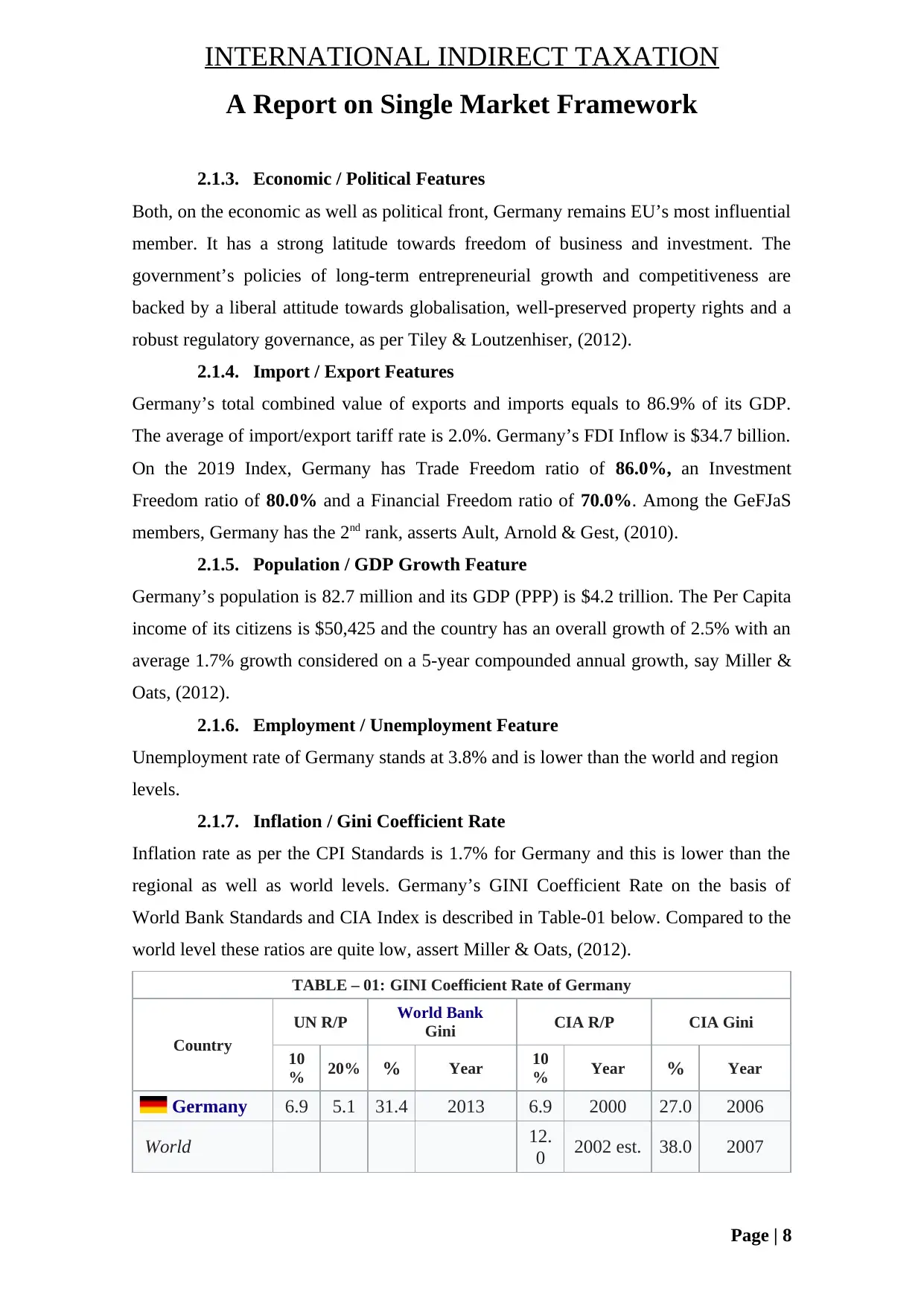
Inflation rate as per the CPI Standards is 1.7% for Germany and this is lower than the
regional as well as world levels. Germany’s GINI Coefficient Rate on the basis of
World Bank Standards and CIA Index is described in Table-01 below. Compared to the
world level these ratios are quite low, assert Miller & Oats, (2012).
TABLE – 01: GINI Coefficient Rate of Germany
Country
UN R/P World Bank
Gini CIA R/P CIA Gini
10
% 20% % Year 10
% Year % Year
Germany 6.9 5.1 31.4 2013 6.9 2000 27.0 2006
World 12.
0 2002 est. 38.0 2007
Page | 8
A Report on Single Market Framework
2.1.3. Economic / Political Features
Both, on the economic as well as political front, Germany remains EU’s most influential
member. It has a strong latitude towards freedom of business and investment. The
government’s policies of long-term entrepreneurial growth and competitiveness are
backed by a liberal attitude towards globalisation, well-preserved property rights and a
robust regulatory governance, as per Tiley & Loutzenhiser, (2012).
2.1.4. Import / Export Features
Germany’s total combined value of exports and imports equals to 86.9% of its GDP.
The average of import/export tariff rate is 2.0%. Germany’s FDI Inflow is $34.7 billion.
On the 2019 Index, Germany has Trade Freedom ratio of 86.0%, an Investment
Freedom ratio of 80.0% and a Financial Freedom ratio of 70.0%. Among the GeFJaS
members, Germany has the 2nd rank, asserts Ault, Arnold & Gest, (2010).
2.1.5. Population / GDP Growth Feature
Germany’s population is 82.7 million and its GDP (PPP) is $4.2 trillion. The Per Capita
income of its citizens is $50,425 and the country has an overall growth of 2.5% with an
average 1.7% growth considered on a 5-year compounded annual growth, say Miller &
Oats, (2012).
2.1.6. Employment / Unemployment Feature
Unemployment rate of Germany stands at 3.8% and is lower than the world and region
levels.
2.1.7. Inflation / Gini Coefficient Rate
Inflation rate as per the CPI Standards is 1.7% for Germany and this is lower than the
regional as well as world levels. Germany’s GINI Coefficient Rate on the basis of
World Bank Standards and CIA Index is described in Table-01 below. Compared to the
world level these ratios are quite low, assert Miller & Oats, (2012).
TABLE – 01: GINI Coefficient Rate of Germany
Country
UN R/P World Bank
Gini CIA R/P CIA Gini
10
% 20% % Year 10
% Year % Year
Germany 6.9 5.1 31.4 2013 6.9 2000 27.0 2006
World 12.
0 2002 est. 38.0 2007
Page | 8
⊘ This is a preview!⊘
Do you want full access?
Subscribe today to unlock all pages.
Trusted by 1+ million students worldwide
INTERNATIONAL INDIRECT TAXATION
A Report on Single Market Framework
2.2. FRANCE
2.2.1. Main Features
Economic Freedom Score of France is 63.8 and this ranks its economy as 71st freest as
per 2019 Index. Its ranking in the EU region is 35th among the 44 countries, as per
Mendel & Bevacqua, (2010). On the basis of these rankings, France is above the world
but is below the regional averages, as per Campbell (ed), (2011).
2.2.2. Trade Features
Overall, the regulatory framework of France is relatively efficient, although its labour
market remains burdened because of strict regulations, hence its lacks in capacity of
generating a vibrant employment growth, assert Forte & Oppenheim, (2011). France’s
Business Freedom score is 81.2%; Labor Freedom score is 45.2%; and Monetary
Freedom score is 79.1% as per Campbell (ed), (2011).
2.2.3. Economic / Political Features
Although France has partial or fully privatized large enterprises, the government still
plays a strong role in sectors such as public transport, power and arms manufacturing, as
per Tiley & Loutzenhiser, (2012).
2.2.4. Import / Export Features
France’s total combined value of exports and imports equals to 62.9% of its GDP. The
average of import/export tariff rate is 2.0%. France’s FDI Inflow is $49.8 billion. France
imposes a number of non-tariff trade barriers and these include regulations related to
technical and product-specific subsidies and quotas. It also restricts investments in
selected sectors, declares Wheelright, (2013). On the 2019 Index, France has Trade
Freedom ratio of 81.0%, an Investment Freedom ratio of 75.0% and a Financial
Freedom ratio of 70.0%. Among the GeFJaS members, France stands at the 3rd rank.
2.2.5. Population / GDP Growth Feature
France’s population is 64.8 million and its GDP (PPP) is $2.8 trillion. The Per Capita
income of its citizens is $43,761 and the country has an overall growth of 1.8% with an
average 1.1% growth considered on a 5-year compounded annual growth, states
Wheelright, (2013).
2.2.6. Employment / Unemployment Feature
Unemployment rate of France stands at 9.4% and is quite high compared to the world
and region levels, asserts Wheelright, (2013).
Page | 9
A Report on Single Market Framework
2.2. FRANCE
2.2.1. Main Features
Economic Freedom Score of France is 63.8 and this ranks its economy as 71st freest as
per 2019 Index. Its ranking in the EU region is 35th among the 44 countries, as per
Mendel & Bevacqua, (2010). On the basis of these rankings, France is above the world
but is below the regional averages, as per Campbell (ed), (2011).
2.2.2. Trade Features
Overall, the regulatory framework of France is relatively efficient, although its labour
market remains burdened because of strict regulations, hence its lacks in capacity of
generating a vibrant employment growth, assert Forte & Oppenheim, (2011). France’s
Business Freedom score is 81.2%; Labor Freedom score is 45.2%; and Monetary
Freedom score is 79.1% as per Campbell (ed), (2011).
2.2.3. Economic / Political Features
Although France has partial or fully privatized large enterprises, the government still
plays a strong role in sectors such as public transport, power and arms manufacturing, as
per Tiley & Loutzenhiser, (2012).
2.2.4. Import / Export Features
France’s total combined value of exports and imports equals to 62.9% of its GDP. The
average of import/export tariff rate is 2.0%. France’s FDI Inflow is $49.8 billion. France
imposes a number of non-tariff trade barriers and these include regulations related to
technical and product-specific subsidies and quotas. It also restricts investments in
selected sectors, declares Wheelright, (2013). On the 2019 Index, France has Trade
Freedom ratio of 81.0%, an Investment Freedom ratio of 75.0% and a Financial
Freedom ratio of 70.0%. Among the GeFJaS members, France stands at the 3rd rank.
2.2.5. Population / GDP Growth Feature
France’s population is 64.8 million and its GDP (PPP) is $2.8 trillion. The Per Capita
income of its citizens is $43,761 and the country has an overall growth of 1.8% with an
average 1.1% growth considered on a 5-year compounded annual growth, states
Wheelright, (2013).
2.2.6. Employment / Unemployment Feature
Unemployment rate of France stands at 9.4% and is quite high compared to the world
and region levels, asserts Wheelright, (2013).
Page | 9
Paraphrase This Document
Need a fresh take? Get an instant paraphrase of this document with our AI Paraphraser
INTERNATIONAL INDIRECT TAXATION
A Report on Single Market Framework
2.2.7. Inflation / Gini Coefficient Rate
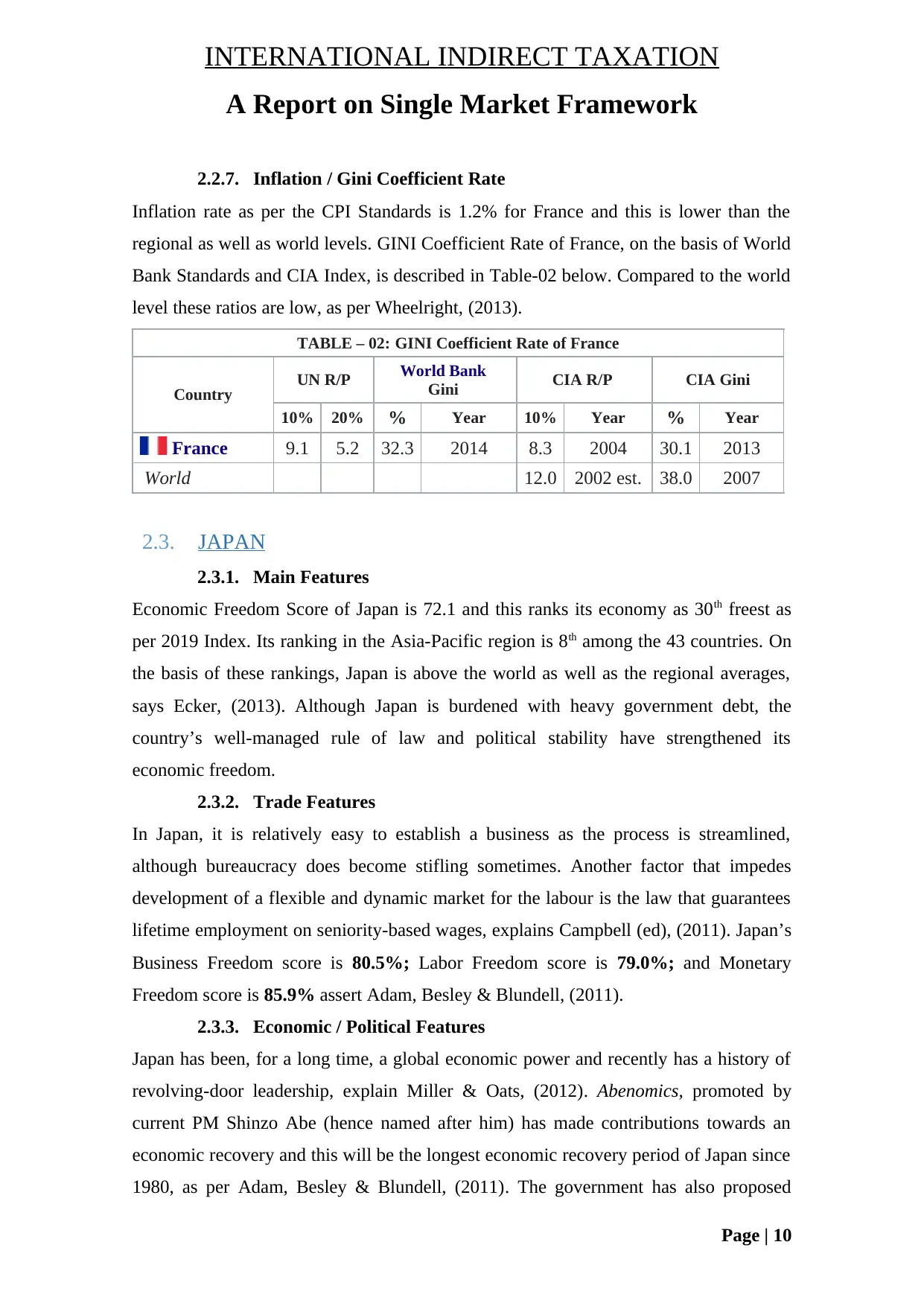
Inflation rate as per the CPI Standards is 1.2% for France and this is lower than the
regional as well as world levels. GINI Coefficient Rate of France, on the basis of World
Bank Standards and CIA Index, is described in Table-02 below. Compared to the world
level these ratios are low, as per Wheelright, (2013).
TABLE – 02: GINI Coefficient Rate of France
Country UN R/P World Bank
Gini CIA R/P CIA Gini
10% 20% % Year 10% Year % Year
France 9.1 5.2 32.3 2014 8.3 2004 30.1 2013
World 12.0 2002 est. 38.0 2007
2.3. JAPAN
2.3.1. Main Features
Economic Freedom Score of Japan is 72.1 and this ranks its economy as 30th freest as
per 2019 Index. Its ranking in the Asia-Pacific region is 8th among the 43 countries. On
the basis of these rankings, Japan is above the world as well as the regional averages,
says Ecker, (2013). Although Japan is burdened with heavy government debt, the
country’s well-managed rule of law and political stability have strengthened its
economic freedom.
2.3.2. Trade Features
In Japan, it is relatively easy to establish a business as the process is streamlined,
although bureaucracy does become stifling sometimes. Another factor that impedes
development of a flexible and dynamic market for the labour is the law that guarantees
lifetime employment on seniority-based wages, explains Campbell (ed), (2011). Japan’s
Business Freedom score is 80.5%; Labor Freedom score is 79.0%; and Monetary
Freedom score is 85.9% assert Adam, Besley & Blundell, (2011).
2.3.3. Economic / Political Features
Japan has been, for a long time, a global economic power and recently has a history of
revolving-door leadership, explain Miller & Oats, (2012). Abenomics, promoted by
current PM Shinzo Abe (hence named after him) has made contributions towards an
economic recovery and this will be the longest economic recovery period of Japan since
1980, as per Adam, Besley & Blundell, (2011). The government has also proposed
Page | 10
A Report on Single Market Framework
2.2.7. Inflation / Gini Coefficient Rate
Inflation rate as per the CPI Standards is 1.2% for France and this is lower than the
regional as well as world levels. GINI Coefficient Rate of France, on the basis of World
Bank Standards and CIA Index, is described in Table-02 below. Compared to the world
level these ratios are low, as per Wheelright, (2013).
TABLE – 02: GINI Coefficient Rate of France
Country UN R/P World Bank
Gini CIA R/P CIA Gini
10% 20% % Year 10% Year % Year
France 9.1 5.2 32.3 2014 8.3 2004 30.1 2013
World 12.0 2002 est. 38.0 2007
2.3. JAPAN
2.3.1. Main Features
Economic Freedom Score of Japan is 72.1 and this ranks its economy as 30th freest as
per 2019 Index. Its ranking in the Asia-Pacific region is 8th among the 43 countries. On
the basis of these rankings, Japan is above the world as well as the regional averages,
says Ecker, (2013). Although Japan is burdened with heavy government debt, the
country’s well-managed rule of law and political stability have strengthened its
economic freedom.
2.3.2. Trade Features
In Japan, it is relatively easy to establish a business as the process is streamlined,
although bureaucracy does become stifling sometimes. Another factor that impedes
development of a flexible and dynamic market for the labour is the law that guarantees
lifetime employment on seniority-based wages, explains Campbell (ed), (2011). Japan’s
Business Freedom score is 80.5%; Labor Freedom score is 79.0%; and Monetary
Freedom score is 85.9% assert Adam, Besley & Blundell, (2011).
2.3.3. Economic / Political Features
Japan has been, for a long time, a global economic power and recently has a history of
revolving-door leadership, explain Miller & Oats, (2012). Abenomics, promoted by
current PM Shinzo Abe (hence named after him) has made contributions towards an
economic recovery and this will be the longest economic recovery period of Japan since
1980, as per Adam, Besley & Blundell, (2011). The government has also proposed
Page | 10
INTERNATIONAL INDIRECT TAXATION
A Report on Single Market Framework
Trade Liberalization as a goal. Political stability, combined with a well-maintained rule
of law, has strengthened the country’s economic freedom, explain Miller & Oats,
(2012).
2.3.4. Import / Export Features
Japan’s total combined value of exports and imports equals to 31.3% of its GDP. The
average of import/export tariff rate is 2.5%. Japan’s FDI Inflow is $10.4 billion.
According to WTO, Japan had imposed 381 non-tariff measures. On the 2019 Index,
Japan has Trade Freedom ratio of 80.0%, an Investment Freedom ratio of 70.0% and a
Financial Freedom ratio of 60.0%. Among the GeFJaS members, Japan stands at the 4th
rank, as per Forte & Oppenheim, (2011).
2.3.5. Population / GDP Growth Feature
Japan’s population is 126.7 million and its GDP (PPP) is $5.4 trillion. The Per Capita
income of its citizens is $42,832 and the country has an overall growth of 1.7% with an
average 1.3% growth considered on a 5-year compounded annual growth, asserts
Hoffman et al, (2015).
2.3.6. Employment / Unemployment Feature
Unemployment rate of Japan stands at 2.8% and is very low compared to the world and
region levels, as per Forte & Oppenheim, (2011).
2.3.7. Inflation / Gini Coefficient Rate
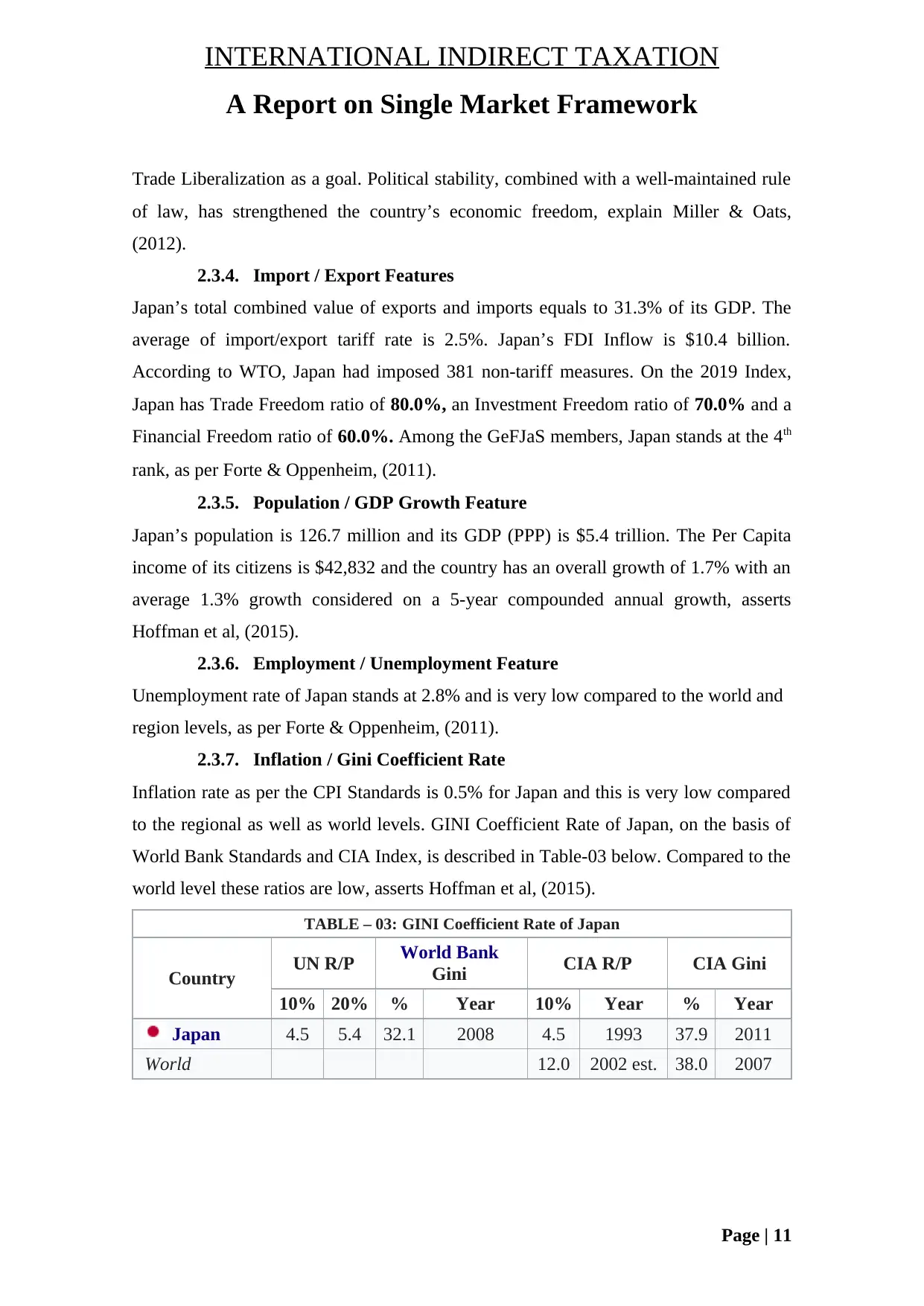
Inflation rate as per the CPI Standards is 0.5% for Japan and this is very low compared
to the regional as well as world levels. GINI Coefficient Rate of Japan, on the basis of
World Bank Standards and CIA Index, is described in Table-03 below. Compared to the
world level these ratios are low, asserts Hoffman et al, (2015).
TABLE – 03: GINI Coefficient Rate of Japan
Country UN R/P World Bank
Gini CIA R/P CIA Gini
10% 20% % Year 10% Year % Year
Japan 4.5 5.4 32.1 2008 4.5 1993 37.9 2011
World 12.0 2002 est. 38.0 2007
Page | 11
A Report on Single Market Framework
Trade Liberalization as a goal. Political stability, combined with a well-maintained rule
of law, has strengthened the country’s economic freedom, explain Miller & Oats,
(2012).
2.3.4. Import / Export Features
Japan’s total combined value of exports and imports equals to 31.3% of its GDP. The
average of import/export tariff rate is 2.5%. Japan’s FDI Inflow is $10.4 billion.
According to WTO, Japan had imposed 381 non-tariff measures. On the 2019 Index,
Japan has Trade Freedom ratio of 80.0%, an Investment Freedom ratio of 70.0% and a
Financial Freedom ratio of 60.0%. Among the GeFJaS members, Japan stands at the 4th
rank, as per Forte & Oppenheim, (2011).
2.3.5. Population / GDP Growth Feature
Japan’s population is 126.7 million and its GDP (PPP) is $5.4 trillion. The Per Capita
income of its citizens is $42,832 and the country has an overall growth of 1.7% with an
average 1.3% growth considered on a 5-year compounded annual growth, asserts
Hoffman et al, (2015).
2.3.6. Employment / Unemployment Feature
Unemployment rate of Japan stands at 2.8% and is very low compared to the world and
region levels, as per Forte & Oppenheim, (2011).
2.3.7. Inflation / Gini Coefficient Rate
Inflation rate as per the CPI Standards is 0.5% for Japan and this is very low compared
to the regional as well as world levels. GINI Coefficient Rate of Japan, on the basis of
World Bank Standards and CIA Index, is described in Table-03 below. Compared to the
world level these ratios are low, asserts Hoffman et al, (2015).
TABLE – 03: GINI Coefficient Rate of Japan
Country UN R/P World Bank
Gini CIA R/P CIA Gini
10% 20% % Year 10% Year % Year
Japan 4.5 5.4 32.1 2008 4.5 1993 37.9 2011
World 12.0 2002 est. 38.0 2007
Page | 11
⊘ This is a preview!⊘
Do you want full access?
Subscribe today to unlock all pages.
Trusted by 1+ million students worldwide

1 out of 26


Your All-in-One AI-Powered Toolkit for Academic Success.
+13062052269
info@desklib.com
Available 24*7 on WhatsApp / Email
![[object Object]](/_next/static/media/star-bottom.7253800d.svg)
Unlock your academic potential
Copyright © 2020–2026 A2Z Services. All Rights Reserved. Developed and managed by ZUCOL.