Analysis of SINTEF Lean Project: Leadership Styles & Techniques
VerifiedAdded on 2023/03/31
|23
|3581
|116
Report
AI Summary
This report analyzes various leadership styles applicable to SINTEF (Stiftelsen for industriell og teknisk forskning) to enhance its success, focusing on leadership characteristics required within a team and various tools and techniques for implementation across SINTEF's departments. It discusses authoritarian, participative, transformational, and transactional leadership, ultimately recommending transactional leadership for SINTEF due to its emphasis on management, organization, and presentation. The report highlights the pros and cons of transactional leadership, emphasizing its suitability for coordinating departments and improving efficiency. It also identifies key characteristics of team members, such as understanding goals, sharing credit, fulfilling obligations, and maintaining truthfulness and patience. Furthermore, the report explores various tools and techniques like cause-and-effect analysis, check sheets, Pareto analysis, RACI matrix, risk management techniques, critical path method, and control charts to facilitate lean business operations within SINTEF.
RUNNING HEAD: LEADING LEAN PROJECT 0
SINTEF: Leading Lean Project
SINTEF: Leading Lean Project

Paraphrase This Document
Need a fresh take? Get an instant paraphrase of this document with our AI Paraphraser
SINTEF: LEADING LEAN PROJECT 1
Executive summary
This report gives the knowledge about the organization named SINTEF and various
leadership styles which can help any organization to enhance their growth. Leadership styles
help the management of the organization to work effectively. SINTEF is one of the largest
independent research organization. SINTEF 2000 employees delivered applied research,
innovation, technology growth, knowledge and solutions for customers large and small across
the globe.
Every year thousands of the projects are been carried out by the company. A member
should always have leadership quality which can help the person to run the team. In this
report, those characteristics can be seen which should be applied to the person personally.
Various tools and techniques can be seen which can enhance the work of the various
departments of SINTEF. From the 60 years, the company has been developing various
innovative ideas and developed solution for society and customer globally.
Executive summary
This report gives the knowledge about the organization named SINTEF and various
leadership styles which can help any organization to enhance their growth. Leadership styles
help the management of the organization to work effectively. SINTEF is one of the largest
independent research organization. SINTEF 2000 employees delivered applied research,
innovation, technology growth, knowledge and solutions for customers large and small across
the globe.
Every year thousands of the projects are been carried out by the company. A member
should always have leadership quality which can help the person to run the team. In this
report, those characteristics can be seen which should be applied to the person personally.
Various tools and techniques can be seen which can enhance the work of the various
departments of SINTEF. From the 60 years, the company has been developing various
innovative ideas and developed solution for society and customer globally.
SINTEF: LEADING LEAN PROJECT 2
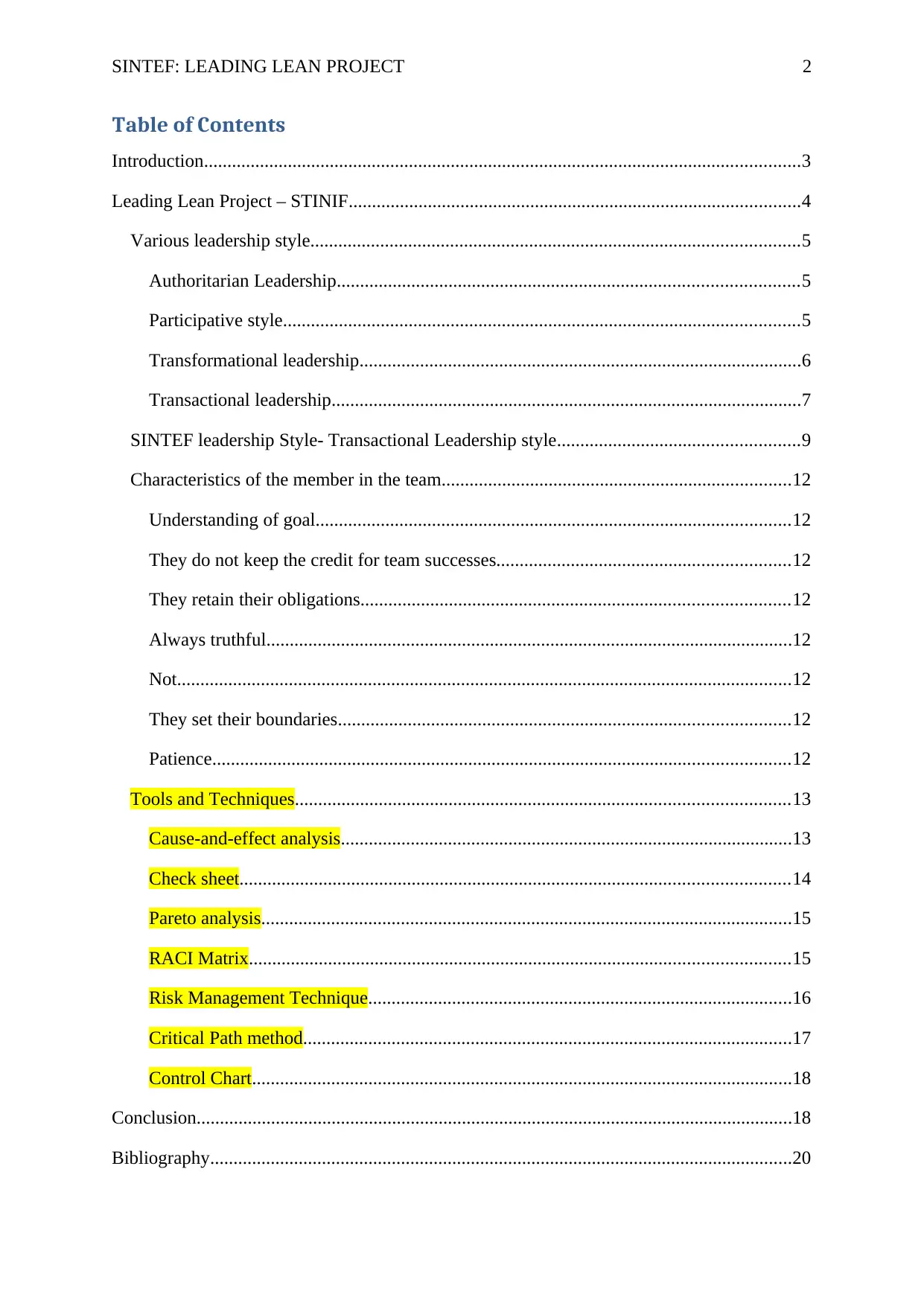
Table of Contents
Introduction................................................................................................................................3
Leading Lean Project – STINIF.................................................................................................4
Various leadership style.........................................................................................................5
Authoritarian Leadership...................................................................................................5
Participative style...............................................................................................................5
Transformational leadership...............................................................................................6
Transactional leadership.....................................................................................................7
SINTEF leadership Style- Transactional Leadership style....................................................9
Characteristics of the member in the team...........................................................................12
Understanding of goal......................................................................................................12
They do not keep the credit for team successes...............................................................12
They retain their obligations............................................................................................12
Always truthful.................................................................................................................12
Not....................................................................................................................................12
They set their boundaries.................................................................................................12
Patience............................................................................................................................12
Tools and Techniques..........................................................................................................13
Cause-and-effect analysis.................................................................................................13
Check sheet......................................................................................................................14
Pareto analysis..................................................................................................................15
RACI Matrix....................................................................................................................15
Risk Management Technique...........................................................................................16
Critical Path method.........................................................................................................17
Control Chart....................................................................................................................18
Conclusion................................................................................................................................18
Bibliography.............................................................................................................................20
Table of Contents
Introduction................................................................................................................................3
Leading Lean Project – STINIF.................................................................................................4
Various leadership style.........................................................................................................5
Authoritarian Leadership...................................................................................................5
Participative style...............................................................................................................5
Transformational leadership...............................................................................................6
Transactional leadership.....................................................................................................7
SINTEF leadership Style- Transactional Leadership style....................................................9
Characteristics of the member in the team...........................................................................12
Understanding of goal......................................................................................................12
They do not keep the credit for team successes...............................................................12
They retain their obligations............................................................................................12
Always truthful.................................................................................................................12
Not....................................................................................................................................12
They set their boundaries.................................................................................................12
Patience............................................................................................................................12
Tools and Techniques..........................................................................................................13
Cause-and-effect analysis.................................................................................................13
Check sheet......................................................................................................................14
Pareto analysis..................................................................................................................15
RACI Matrix....................................................................................................................15
Risk Management Technique...........................................................................................16
Critical Path method.........................................................................................................17
Control Chart....................................................................................................................18
Conclusion................................................................................................................................18
Bibliography.............................................................................................................................20
⊘ This is a preview!⊘
Do you want full access?
Subscribe today to unlock all pages.

Trusted by 1+ million students worldwide
SINTEF: LEADING LEAN PROJECT 3
Introduction
This report will be going to emphasis on the various leadership styles. This will also
focus on the one particular leadership style that can be applied in the SINTEF to enhance
their success and leadership characteristics that are required in A TEAM and various tools
and techniques which can be implemented in the departments of the SINTEF.
SINTEF (Stiftelsen for industriell og teknisk forskning) i.e. The Foundation for
Industrial and Technical Research founded in 1950 and headquartered in Trondheim,
Norway. The aim of the company is to conduct research and development projects. This is an
independent research organization with 200 employees from 75 countries. The process of the
company can be enhanced by applying various theories (Carlile, 2013).
Lean is a global philosophy for the communication of work tasks and company, and
various types of tools and techniques that can be implemented in the various organization
levels. By implementing the lean system, the company can achieve success and business
development because this system helps in maintaining the good balance by philosophical
viewpoint and improvements at operational stages. This will also help in strengthening the
competitiveness of the organization. SINTEF has wide experience in line management and
management of Lean procedures. SINTEF strength is that they adapt Lean work in the
organization to the present situation and grade of maturity with Lean, regardless of an
organization (Chiarini, 2012).
Lean is an often-used adjective in organization nowadays, but there is some
misperception over its correct meaning. Overall, the aim of Lean is to capitalize value by
minimizing leftover. In different words, it can be said that developing more value in less
resource. Lean was developed on the factory ground, so many persons assume of it as a
manufacturing method (Bell, 2014). This paper will focus on various leadership styles that
can be applied appropriately in the STINIF organization.
Introduction
This report will be going to emphasis on the various leadership styles. This will also
focus on the one particular leadership style that can be applied in the SINTEF to enhance
their success and leadership characteristics that are required in A TEAM and various tools
and techniques which can be implemented in the departments of the SINTEF.
SINTEF (Stiftelsen for industriell og teknisk forskning) i.e. The Foundation for
Industrial and Technical Research founded in 1950 and headquartered in Trondheim,
Norway. The aim of the company is to conduct research and development projects. This is an
independent research organization with 200 employees from 75 countries. The process of the
company can be enhanced by applying various theories (Carlile, 2013).
Lean is a global philosophy for the communication of work tasks and company, and
various types of tools and techniques that can be implemented in the various organization
levels. By implementing the lean system, the company can achieve success and business
development because this system helps in maintaining the good balance by philosophical
viewpoint and improvements at operational stages. This will also help in strengthening the
competitiveness of the organization. SINTEF has wide experience in line management and
management of Lean procedures. SINTEF strength is that they adapt Lean work in the
organization to the present situation and grade of maturity with Lean, regardless of an
organization (Chiarini, 2012).
Lean is an often-used adjective in organization nowadays, but there is some
misperception over its correct meaning. Overall, the aim of Lean is to capitalize value by
minimizing leftover. In different words, it can be said that developing more value in less
resource. Lean was developed on the factory ground, so many persons assume of it as a
manufacturing method (Bell, 2014). This paper will focus on various leadership styles that
can be applied appropriately in the STINIF organization.
Paraphrase This Document
Need a fresh take? Get an instant paraphrase of this document with our AI Paraphraser
SINTEF: LEADING LEAN PROJECT 4
Leading Lean Project – STINIF
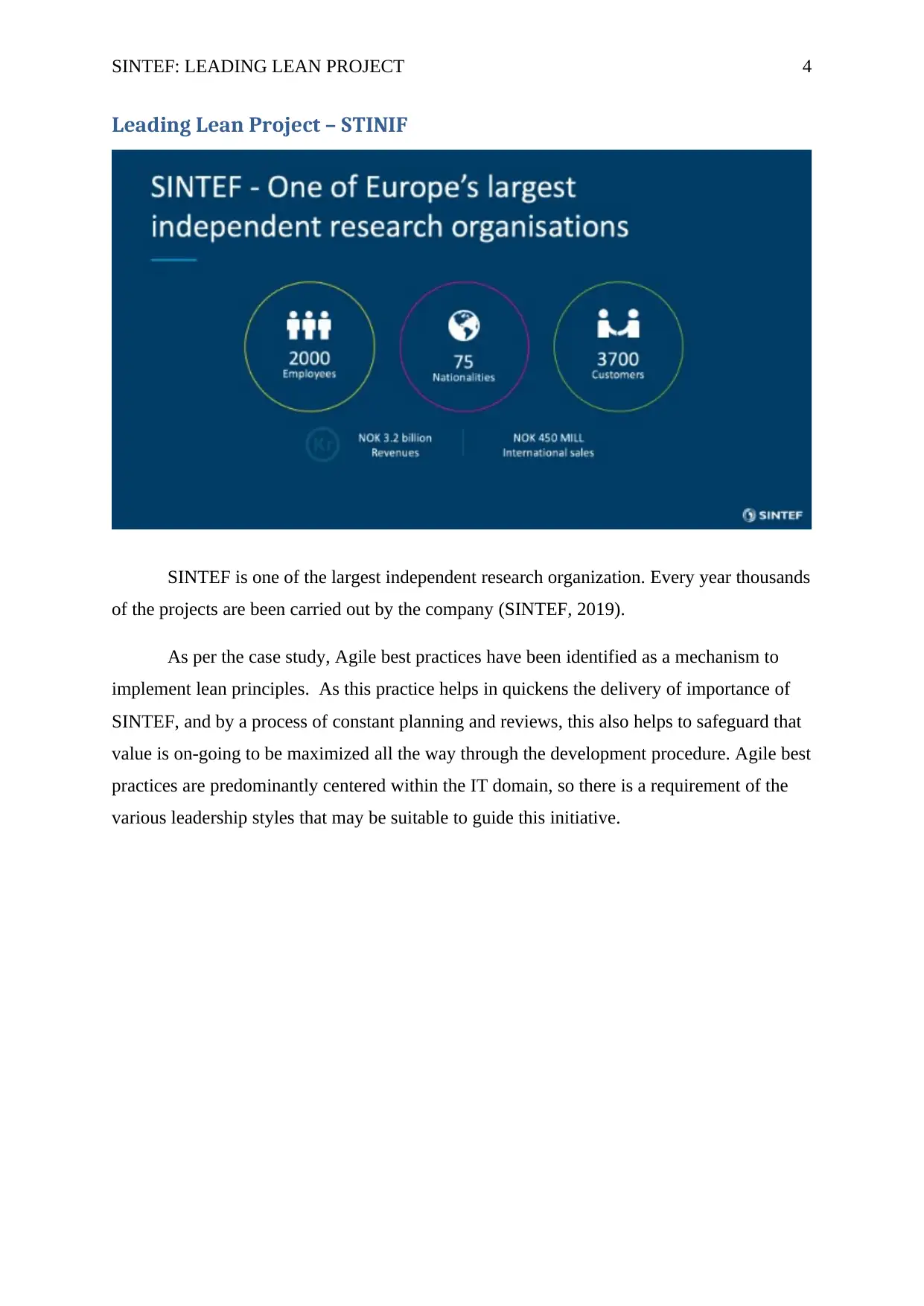
SINTEF is one of the largest independent research organization. Every year thousands
of the projects are been carried out by the company (SINTEF, 2019).
As per the case study, Agile best practices have been identified as a mechanism to
implement lean principles. As this practice helps in quickens the delivery of importance of
SINTEF, and by a process of constant planning and reviews, this also helps to safeguard that
value is on-going to be maximized all the way through the development procedure. Agile best
practices are predominantly centered within the IT domain, so there is a requirement of the
various leadership styles that may be suitable to guide this initiative.
Leading Lean Project – STINIF
SINTEF is one of the largest independent research organization. Every year thousands
of the projects are been carried out by the company (SINTEF, 2019).
As per the case study, Agile best practices have been identified as a mechanism to
implement lean principles. As this practice helps in quickens the delivery of importance of
SINTEF, and by a process of constant planning and reviews, this also helps to safeguard that
value is on-going to be maximized all the way through the development procedure. Agile best
practices are predominantly centered within the IT domain, so there is a requirement of the
various leadership styles that may be suitable to guide this initiative.
SINTEF: LEADING LEAN PROJECT 5
Various leadership style
Authoritarian Leadership
(Cherry, 2019).
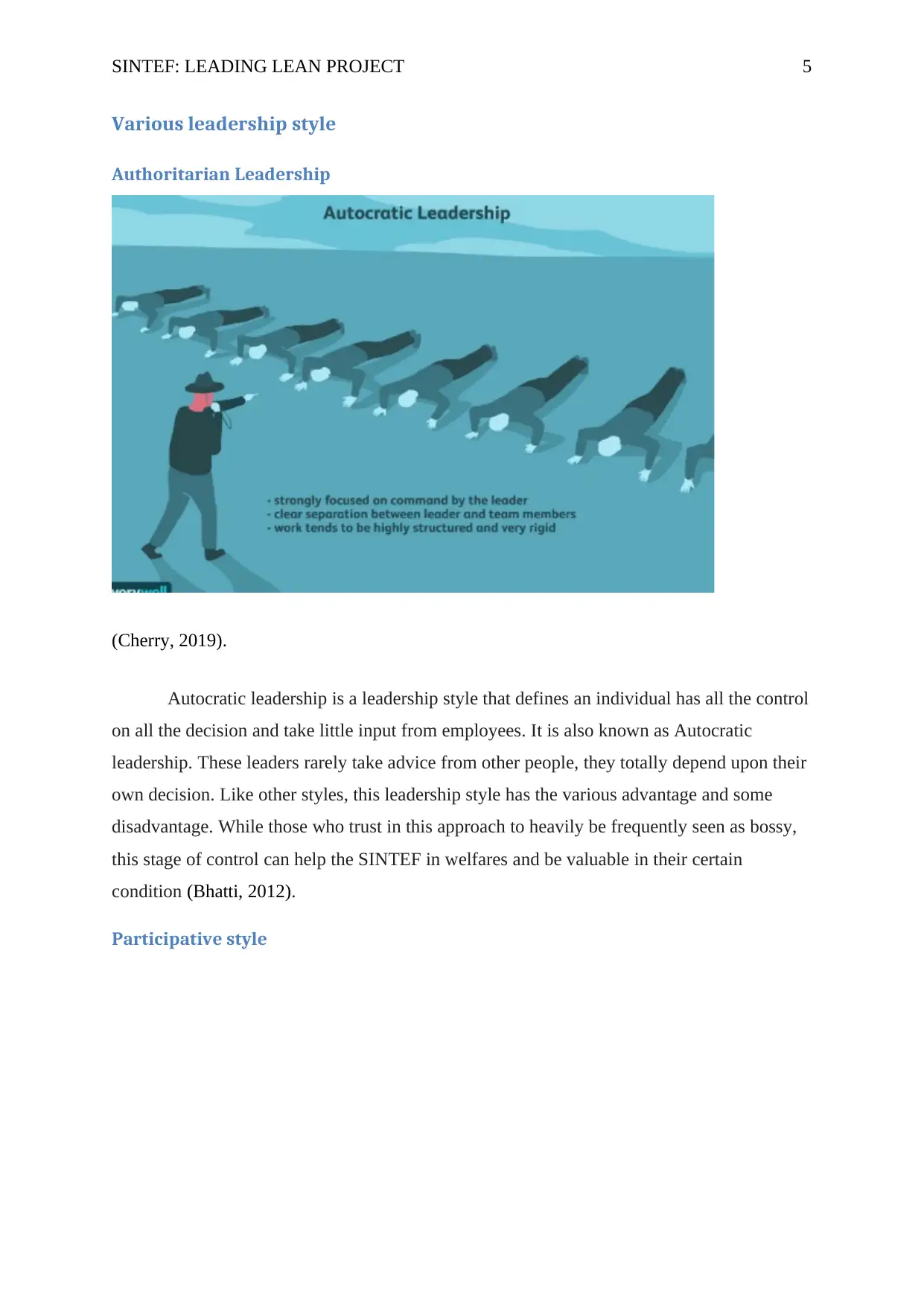
Autocratic leadership is a leadership style that defines an individual has all the control
on all the decision and take little input from employees. It is also known as Autocratic
leadership. These leaders rarely take advice from other people, they totally depend upon their
own decision. Like other styles, this leadership style has the various advantage and some
disadvantage. While those who trust in this approach to heavily be frequently seen as bossy,
this stage of control can help the SINTEF in welfares and be valuable in their certain
condition (Bhatti, 2012).
Participative style
Various leadership style
Authoritarian Leadership
(Cherry, 2019).
Autocratic leadership is a leadership style that defines an individual has all the control
on all the decision and take little input from employees. It is also known as Autocratic
leadership. These leaders rarely take advice from other people, they totally depend upon their
own decision. Like other styles, this leadership style has the various advantage and some
disadvantage. While those who trust in this approach to heavily be frequently seen as bossy,
this stage of control can help the SINTEF in welfares and be valuable in their certain
condition (Bhatti, 2012).
Participative style
⊘ This is a preview!⊘
Do you want full access?
Subscribe today to unlock all pages.
Trusted by 1+ million students worldwide
SINTEF: LEADING LEAN PROJECT 6
(Cherry, 2018).
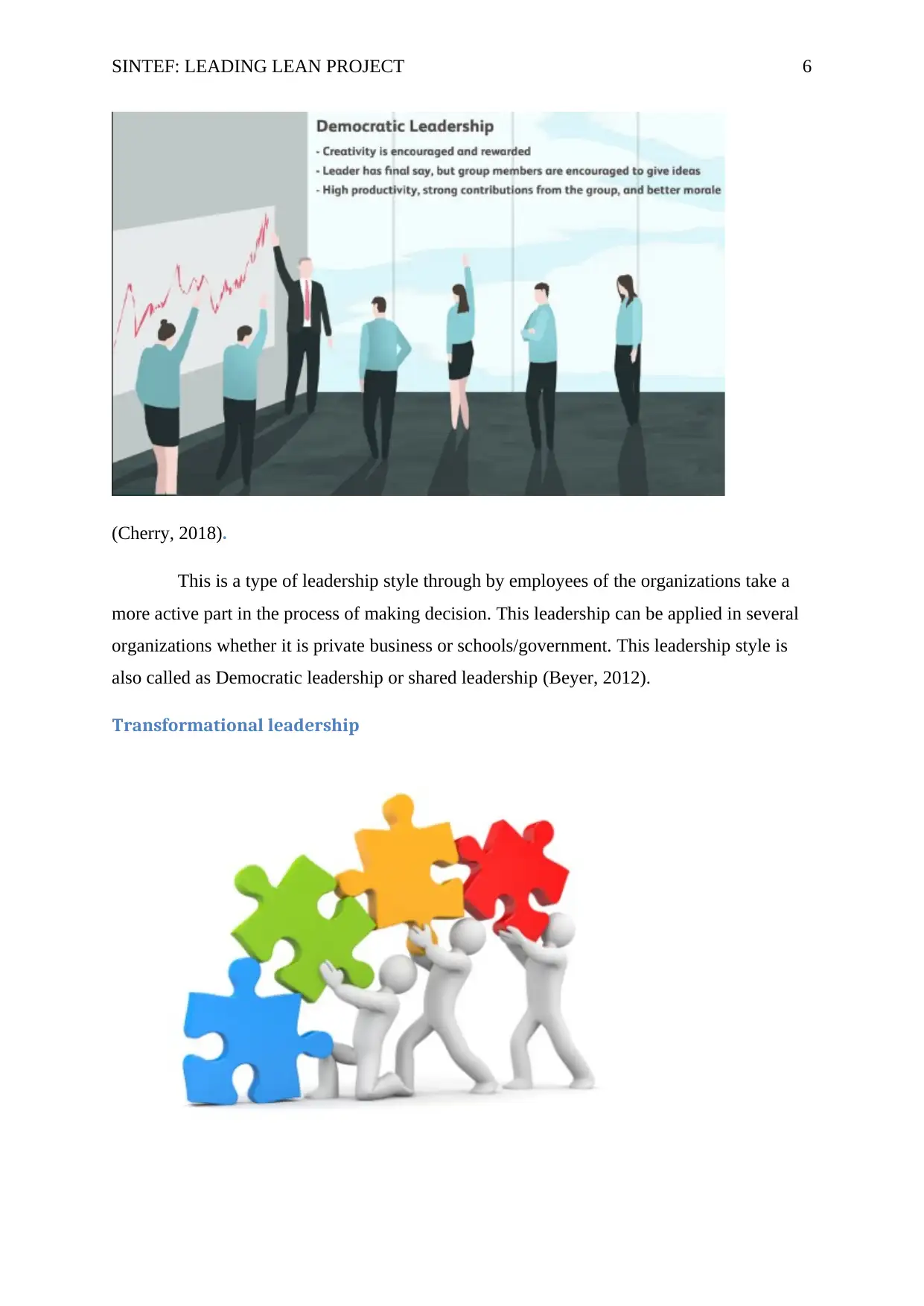
This is a type of leadership style through by employees of the organizations take a
more active part in the process of making decision. This leadership can be applied in several
organizations whether it is private business or schools/government. This leadership style is
also called as Democratic leadership or shared leadership (Beyer, 2012).
Transformational leadership
(Cherry, 2018).
This is a type of leadership style through by employees of the organizations take a
more active part in the process of making decision. This leadership can be applied in several
organizations whether it is private business or schools/government. This leadership style is
also called as Democratic leadership or shared leadership (Beyer, 2012).
Transformational leadership
Paraphrase This Document
Need a fresh take? Get an instant paraphrase of this document with our AI Paraphraser
SINTEF: LEADING LEAN PROJECT 7
(PennState, 2013).
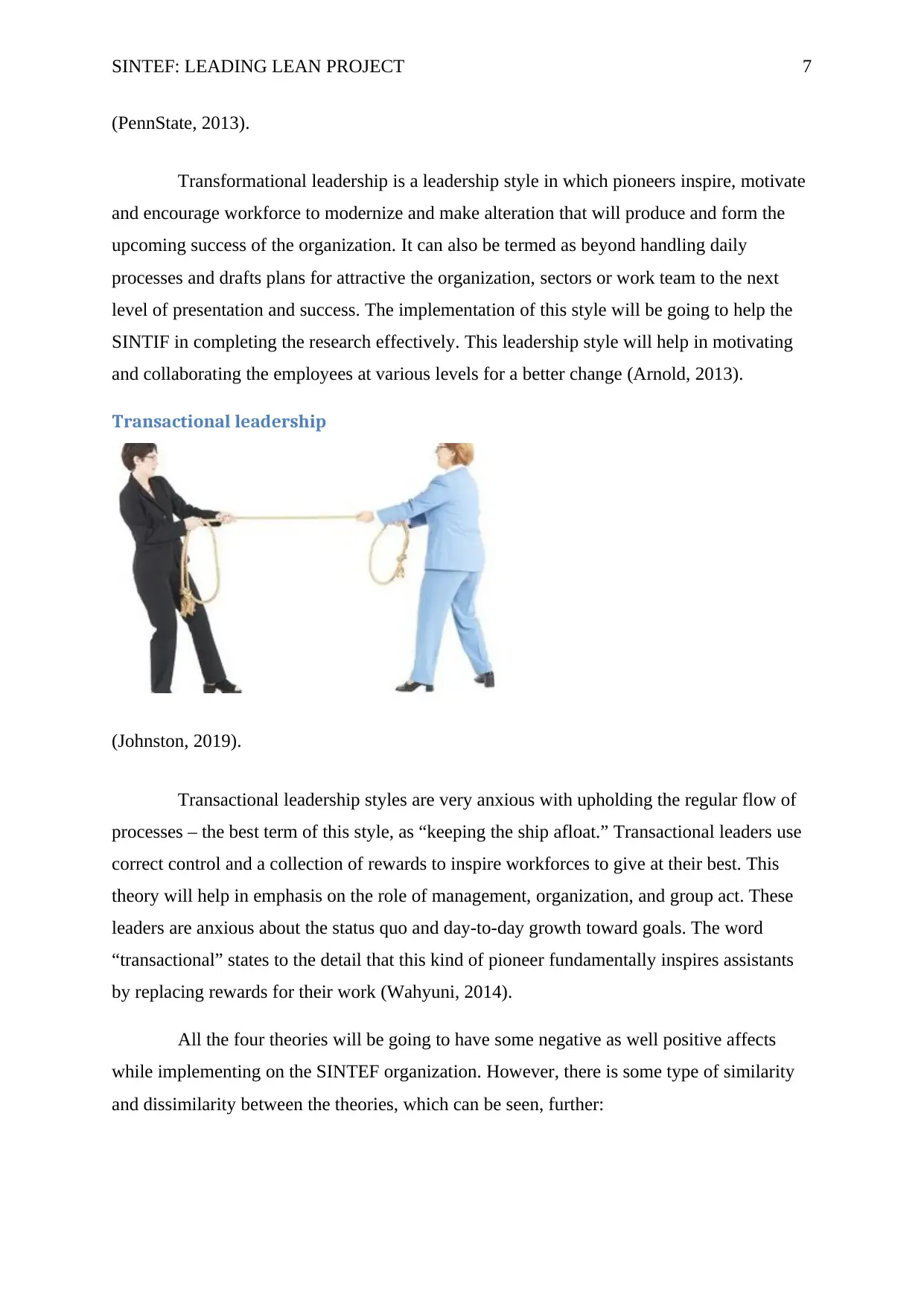
Transformational leadership is a leadership style in which pioneers inspire, motivate
and encourage workforce to modernize and make alteration that will produce and form the
upcoming success of the organization. It can also be termed as beyond handling daily
processes and drafts plans for attractive the organization, sectors or work team to the next
level of presentation and success. The implementation of this style will be going to help the
SINTIF in completing the research effectively. This leadership style will help in motivating
and collaborating the employees at various levels for a better change (Arnold, 2013).
Transactional leadership
(Johnston, 2019).
Transactional leadership styles are very anxious with upholding the regular flow of
processes – the best term of this style, as “keeping the ship afloat.” Transactional leaders use
correct control and a collection of rewards to inspire workforces to give at their best. This
theory will help in emphasis on the role of management, organization, and group act. These
leaders are anxious about the status quo and day-to-day growth toward goals. The word
“transactional” states to the detail that this kind of pioneer fundamentally inspires assistants
by replacing rewards for their work (Wahyuni, 2014).
All the four theories will be going to have some negative as well positive affects
while implementing on the SINTEF organization. However, there is some type of similarity
and dissimilarity between the theories, which can be seen, further:
(PennState, 2013).
Transformational leadership is a leadership style in which pioneers inspire, motivate
and encourage workforce to modernize and make alteration that will produce and form the
upcoming success of the organization. It can also be termed as beyond handling daily
processes and drafts plans for attractive the organization, sectors or work team to the next
level of presentation and success. The implementation of this style will be going to help the
SINTIF in completing the research effectively. This leadership style will help in motivating
and collaborating the employees at various levels for a better change (Arnold, 2013).
Transactional leadership
(Johnston, 2019).
Transactional leadership styles are very anxious with upholding the regular flow of
processes – the best term of this style, as “keeping the ship afloat.” Transactional leaders use
correct control and a collection of rewards to inspire workforces to give at their best. This
theory will help in emphasis on the role of management, organization, and group act. These
leaders are anxious about the status quo and day-to-day growth toward goals. The word
“transactional” states to the detail that this kind of pioneer fundamentally inspires assistants
by replacing rewards for their work (Wahyuni, 2014).
All the four theories will be going to have some negative as well positive affects
while implementing on the SINTEF organization. However, there is some type of similarity
and dissimilarity between the theories, which can be seen, further:
SINTEF: LEADING LEAN PROJECT 8
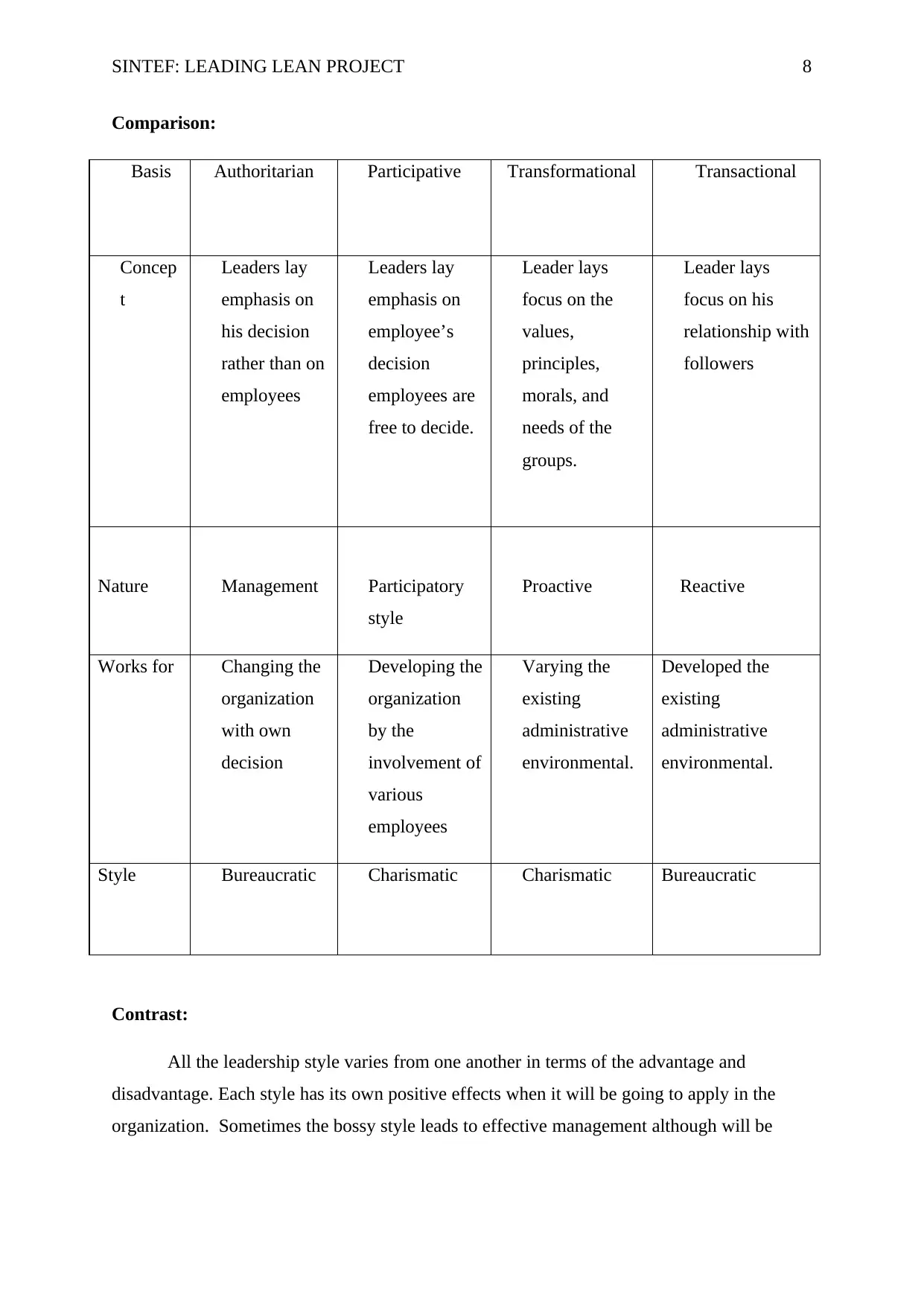
Comparison:
Basis Authoritarian Participative Transformational Transactional
Concep
t
Leaders lay
emphasis on
his decision
rather than on
employees
Leaders lay
emphasis on
employee’s
decision
employees are
free to decide.
Leader lays
focus on the
values,
principles,
morals, and
needs of the
groups.
Leader lays
focus on his
relationship with
followers
Nature Management Participatory
style
Proactive Reactive
Works for Changing the
organization
with own
decision
Developing the
organization
by the
involvement of
various
employees
Varying the
existing
administrative
environmental.
Developed the
existing
administrative
environmental.
Style Bureaucratic Charismatic Charismatic Bureaucratic
Contrast:
All the leadership style varies from one another in terms of the advantage and
disadvantage. Each style has its own positive effects when it will be going to apply in the
organization. Sometimes the bossy style leads to effective management although will be
Comparison:
Basis Authoritarian Participative Transformational Transactional
Concep
t
Leaders lay
emphasis on
his decision
rather than on
employees
Leaders lay
emphasis on
employee’s
decision
employees are
free to decide.
Leader lays
focus on the
values,
principles,
morals, and
needs of the
groups.
Leader lays
focus on his
relationship with
followers
Nature Management Participatory
style
Proactive Reactive
Works for Changing the
organization
with own
decision
Developing the
organization
by the
involvement of
various
employees
Varying the
existing
administrative
environmental.
Developed the
existing
administrative
environmental.
Style Bureaucratic Charismatic Charismatic Bureaucratic
Contrast:
All the leadership style varies from one another in terms of the advantage and
disadvantage. Each style has its own positive effects when it will be going to apply in the
organization. Sometimes the bossy style leads to effective management although will be
⊘ This is a preview!⊘
Do you want full access?
Subscribe today to unlock all pages.
Trusted by 1+ million students worldwide
SINTEF: LEADING LEAN PROJECT 9
going have a negative impact on the employees but the result depends upon the situation of
the organization as and when applies in the organization.
SINTEF leadership Style- Transactional Leadership style
Best leadership style for SINTEF organization is Transactional leadership as
Transactional leadership/Management is a portion of a style of leadership which emphasis on
management, organization, and presentation; it is an internal portion of the Full Range
Leadership Model. Transactional style helps the various departments to coordinate with each
other and enhance the efficiency of their work (Risambessy, 2012).
Transactional leadership is a style of leadership in which managers encourage
passivity by supporters through prizes and punishments. Through a prizes and punishments
structure, transactional leaders are capable to keep groups motivated for a fixed period of
time. They are some of the characteristics that are as follows:
Emphasis on the short-term objective;
Favor organized rules and processes;
Flourish on subsequent rules and complete things properly;
Revel ineffectiveness;
Incline to be stubborn; and,
Contrasting to variation.
There are various pros and cons of transactional leadership:
going have a negative impact on the employees but the result depends upon the situation of
the organization as and when applies in the organization.
SINTEF leadership Style- Transactional Leadership style
Best leadership style for SINTEF organization is Transactional leadership as
Transactional leadership/Management is a portion of a style of leadership which emphasis on
management, organization, and presentation; it is an internal portion of the Full Range
Leadership Model. Transactional style helps the various departments to coordinate with each
other and enhance the efficiency of their work (Risambessy, 2012).
Transactional leadership is a style of leadership in which managers encourage
passivity by supporters through prizes and punishments. Through a prizes and punishments
structure, transactional leaders are capable to keep groups motivated for a fixed period of
time. They are some of the characteristics that are as follows:
Emphasis on the short-term objective;
Favor organized rules and processes;
Flourish on subsequent rules and complete things properly;
Revel ineffectiveness;
Incline to be stubborn; and,
Contrasting to variation.
There are various pros and cons of transactional leadership:
Paraphrase This Document
Need a fresh take? Get an instant paraphrase of this document with our AI Paraphraser
SINTEF: LEADING LEAN PROJECT 10
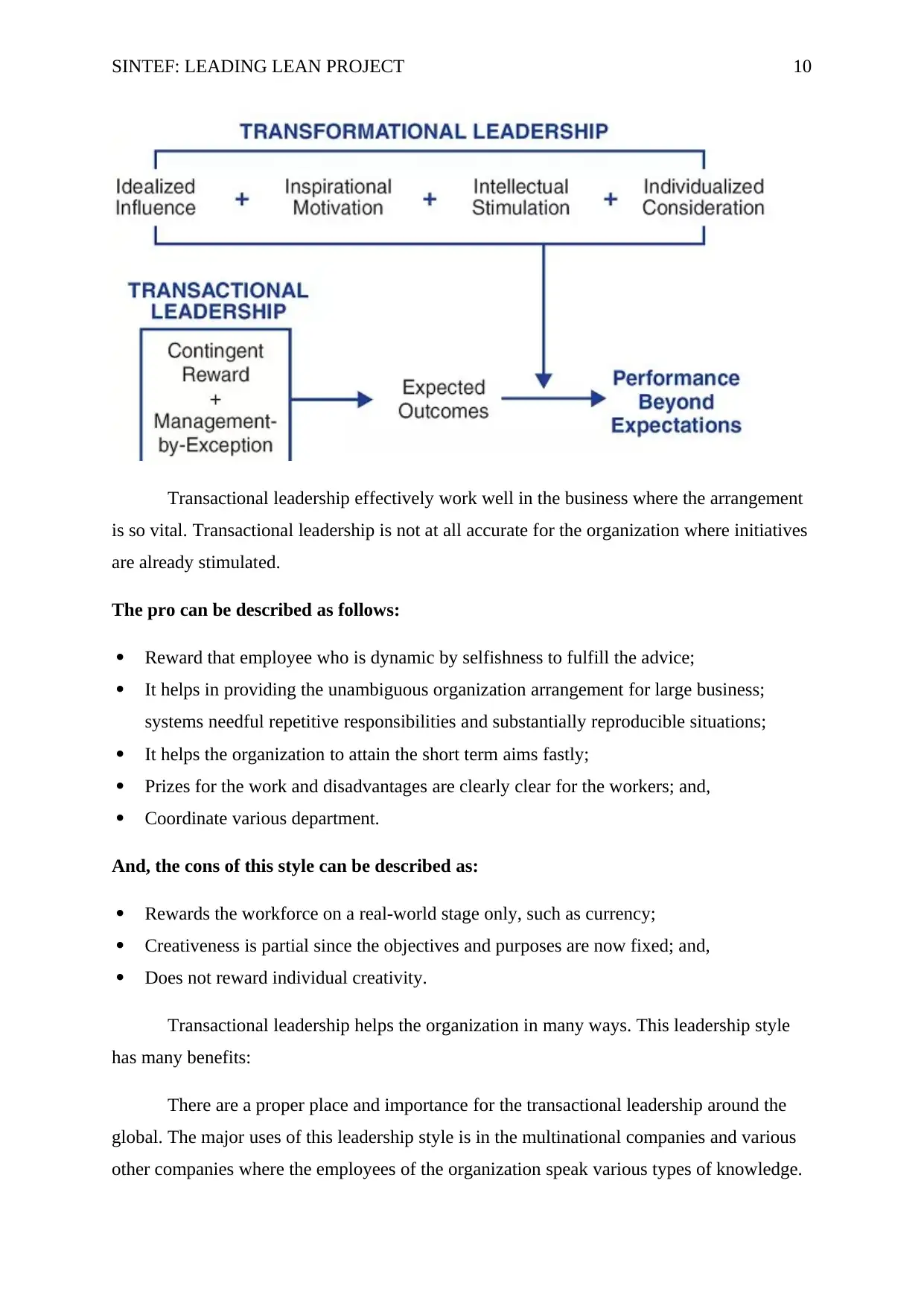
Transactional leadership effectively work well in the business where the arrangement
is so vital. Transactional leadership is not at all accurate for the organization where initiatives
are already stimulated.
The pro can be described as follows:
Reward that employee who is dynamic by selfishness to fulfill the advice;
It helps in providing the unambiguous organization arrangement for large business;
systems needful repetitive responsibilities and substantially reproducible situations;
It helps the organization to attain the short term aims fastly;
Prizes for the work and disadvantages are clearly clear for the workers; and,
Coordinate various department.
And, the cons of this style can be described as:
Rewards the workforce on a real-world stage only, such as currency;
Creativeness is partial since the objectives and purposes are now fixed; and,
Does not reward individual creativity.
Transactional leadership helps the organization in many ways. This leadership style
has many benefits:
There are a proper place and importance for the transactional leadership around the
global. The major uses of this leadership style is in the multinational companies and various
other companies where the employees of the organization speak various types of knowledge.
Transactional leadership effectively work well in the business where the arrangement
is so vital. Transactional leadership is not at all accurate for the organization where initiatives
are already stimulated.
The pro can be described as follows:
Reward that employee who is dynamic by selfishness to fulfill the advice;
It helps in providing the unambiguous organization arrangement for large business;
systems needful repetitive responsibilities and substantially reproducible situations;
It helps the organization to attain the short term aims fastly;
Prizes for the work and disadvantages are clearly clear for the workers; and,
Coordinate various department.
And, the cons of this style can be described as:
Rewards the workforce on a real-world stage only, such as currency;
Creativeness is partial since the objectives and purposes are now fixed; and,
Does not reward individual creativity.
Transactional leadership helps the organization in many ways. This leadership style
has many benefits:
There are a proper place and importance for the transactional leadership around the
global. The major uses of this leadership style is in the multinational companies and various
other companies where the employees of the organization speak various types of knowledge.
SINTEF: LEADING LEAN PROJECT 11
Once the organization is settled and wants to learn, it becomes easy for the workforce to
complete the task positively of the organization. This can be easily achieved since
transactional leadership is easy to understand and do not need wide training. This is very easy
to appreciate and easy to implement through much of the organization. The first responders,
regulating organization, and military organization applies this style in their organization so
that the organization parts are consistent.
This theory will be going to help the organization to deal in the time of crisis, where
everyone will be knowing about what is required to be performed and which tasks are to be
done under pressure.
This theory can be applied in the organizational structure of SINTEF, as it is analysis
that all the management of the company is much appropriate but there is a lack of
coordination between the department of the organization. As experienced very, it results in a
problem of managing the various departments. Superior management of SINTEF makes a
decision that tends to effects the subordinates. Superior management does not coordinate with
the other departments and seems to be clumsy many times. The IT service of the company
seems to be messy at many times and the time tracking solution and project management are
quite clunky (Gustomo, 2012).
It is advisable to the superior management to apply the transformational theory and
democratic theory which will overall be going to help the company in its growth. This will
also help in keeping the employees well satisfied.
Upper management or the organization should make discussion with lower
management and employees than take the decision, e.g. Web CMS system, Intranet software,
etc., which must be discussed with actual customers.
Some important decisions have been made by "upper management" of the SINTEF as
a collective, with no one taking the blames for really bad outcomes and diffusing
responsibility. So to eliminate such type of union in the organization it is very important to
apply this leadership style in the structure of SINTEF.
Overall, just to increase the top management involvement in the employees it is very
much necessary to apply this style in the management of the organization. So that the
employees do not feel disgraced and will work happily (Y Scouts, 2019).
Once the organization is settled and wants to learn, it becomes easy for the workforce to
complete the task positively of the organization. This can be easily achieved since
transactional leadership is easy to understand and do not need wide training. This is very easy
to appreciate and easy to implement through much of the organization. The first responders,
regulating organization, and military organization applies this style in their organization so
that the organization parts are consistent.
This theory will be going to help the organization to deal in the time of crisis, where
everyone will be knowing about what is required to be performed and which tasks are to be
done under pressure.
This theory can be applied in the organizational structure of SINTEF, as it is analysis
that all the management of the company is much appropriate but there is a lack of
coordination between the department of the organization. As experienced very, it results in a
problem of managing the various departments. Superior management of SINTEF makes a
decision that tends to effects the subordinates. Superior management does not coordinate with
the other departments and seems to be clumsy many times. The IT service of the company
seems to be messy at many times and the time tracking solution and project management are
quite clunky (Gustomo, 2012).
It is advisable to the superior management to apply the transformational theory and
democratic theory which will overall be going to help the company in its growth. This will
also help in keeping the employees well satisfied.
Upper management or the organization should make discussion with lower
management and employees than take the decision, e.g. Web CMS system, Intranet software,
etc., which must be discussed with actual customers.
Some important decisions have been made by "upper management" of the SINTEF as
a collective, with no one taking the blames for really bad outcomes and diffusing
responsibility. So to eliminate such type of union in the organization it is very important to
apply this leadership style in the structure of SINTEF.
Overall, just to increase the top management involvement in the employees it is very
much necessary to apply this style in the management of the organization. So that the
employees do not feel disgraced and will work happily (Y Scouts, 2019).
⊘ This is a preview!⊘
Do you want full access?
Subscribe today to unlock all pages.
Trusted by 1+ million students worldwide

1 out of 23


Related Documents


Your All-in-One AI-Powered Toolkit for Academic Success.
+13062052269
info@desklib.com
Available 24*7 on WhatsApp / Email
![[object Object]](/_next/static/media/star-bottom.7253800d.svg)
Unlock your academic potential
Copyright © 2020–2026 A2Z Services. All Rights Reserved. Developed and managed by ZUCOL.