Integrated Business Management Project: Sip & Gossip Coffee Shop
VerifiedAdded on 2023/06/11
|30
|8892
|422
Report
AI Summary
This report presents an integrated business management project focusing on the startup of a coffee shop named "Sip & Gossip" in Brisbane, Australia. It explores the background of the business, the history and production of coffee, and the advantages and disadvantages of creating such a startup. The report also addresses the problem of budget and other challenges associated with the new venture, including location vitality and communication with consumers. A comprehensive business plan is outlined, considering the contemporary market conditions and the potential for long-term sustainability. The study concludes that the proposed business idea is competent, with risk factors that can be managed to create a successful and hospitable coffee shop experience.

Integrated Business Management Project

Paraphrase This Document
Need a fresh take? Get an instant paraphrase of this document with our AI Paraphraser
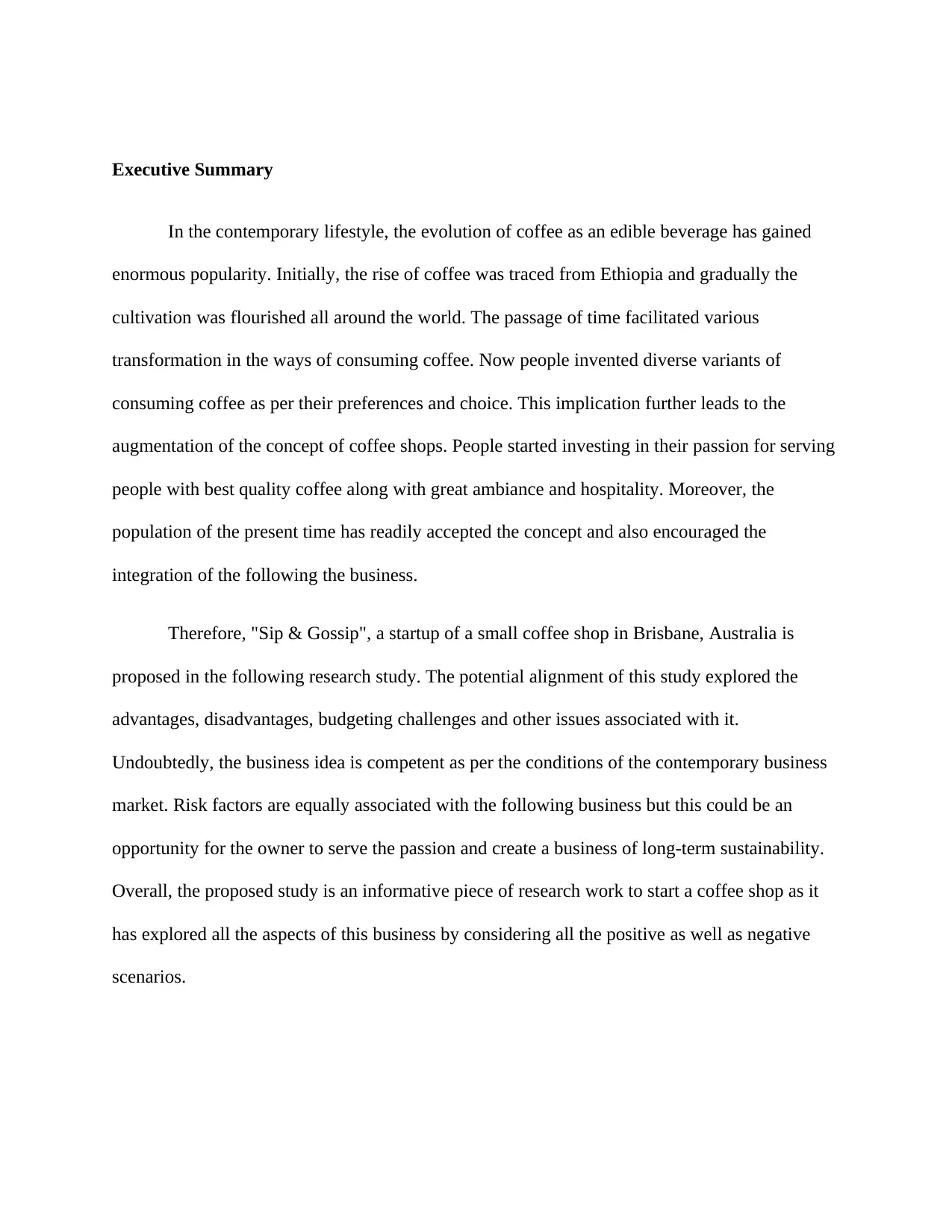
Executive Summary
In the contemporary lifestyle, the evolution of coffee as an edible beverage has gained
enormous popularity. Initially, the rise of coffee was traced from Ethiopia and gradually the
cultivation was flourished all around the world. The passage of time facilitated various
transformation in the ways of consuming coffee. Now people invented diverse variants of
consuming coffee as per their preferences and choice. This implication further leads to the
augmentation of the concept of coffee shops. People started investing in their passion for serving
people with best quality coffee along with great ambiance and hospitality. Moreover, the
population of the present time has readily accepted the concept and also encouraged the
integration of the following the business.
Therefore, "Sip & Gossip", a startup of a small coffee shop in Brisbane, Australia is
proposed in the following research study. The potential alignment of this study explored the
advantages, disadvantages, budgeting challenges and other issues associated with it.
Undoubtedly, the business idea is competent as per the conditions of the contemporary business
market. Risk factors are equally associated with the following business but this could be an
opportunity for the owner to serve the passion and create a business of long-term sustainability.
Overall, the proposed study is an informative piece of research work to start a coffee shop as it
has explored all the aspects of this business by considering all the positive as well as negative
scenarios.
In the contemporary lifestyle, the evolution of coffee as an edible beverage has gained
enormous popularity. Initially, the rise of coffee was traced from Ethiopia and gradually the
cultivation was flourished all around the world. The passage of time facilitated various
transformation in the ways of consuming coffee. Now people invented diverse variants of
consuming coffee as per their preferences and choice. This implication further leads to the
augmentation of the concept of coffee shops. People started investing in their passion for serving
people with best quality coffee along with great ambiance and hospitality. Moreover, the
population of the present time has readily accepted the concept and also encouraged the
integration of the following the business.
Therefore, "Sip & Gossip", a startup of a small coffee shop in Brisbane, Australia is
proposed in the following research study. The potential alignment of this study explored the
advantages, disadvantages, budgeting challenges and other issues associated with it.
Undoubtedly, the business idea is competent as per the conditions of the contemporary business
market. Risk factors are equally associated with the following business but this could be an
opportunity for the owner to serve the passion and create a business of long-term sustainability.
Overall, the proposed study is an informative piece of research work to start a coffee shop as it
has explored all the aspects of this business by considering all the positive as well as negative
scenarios.
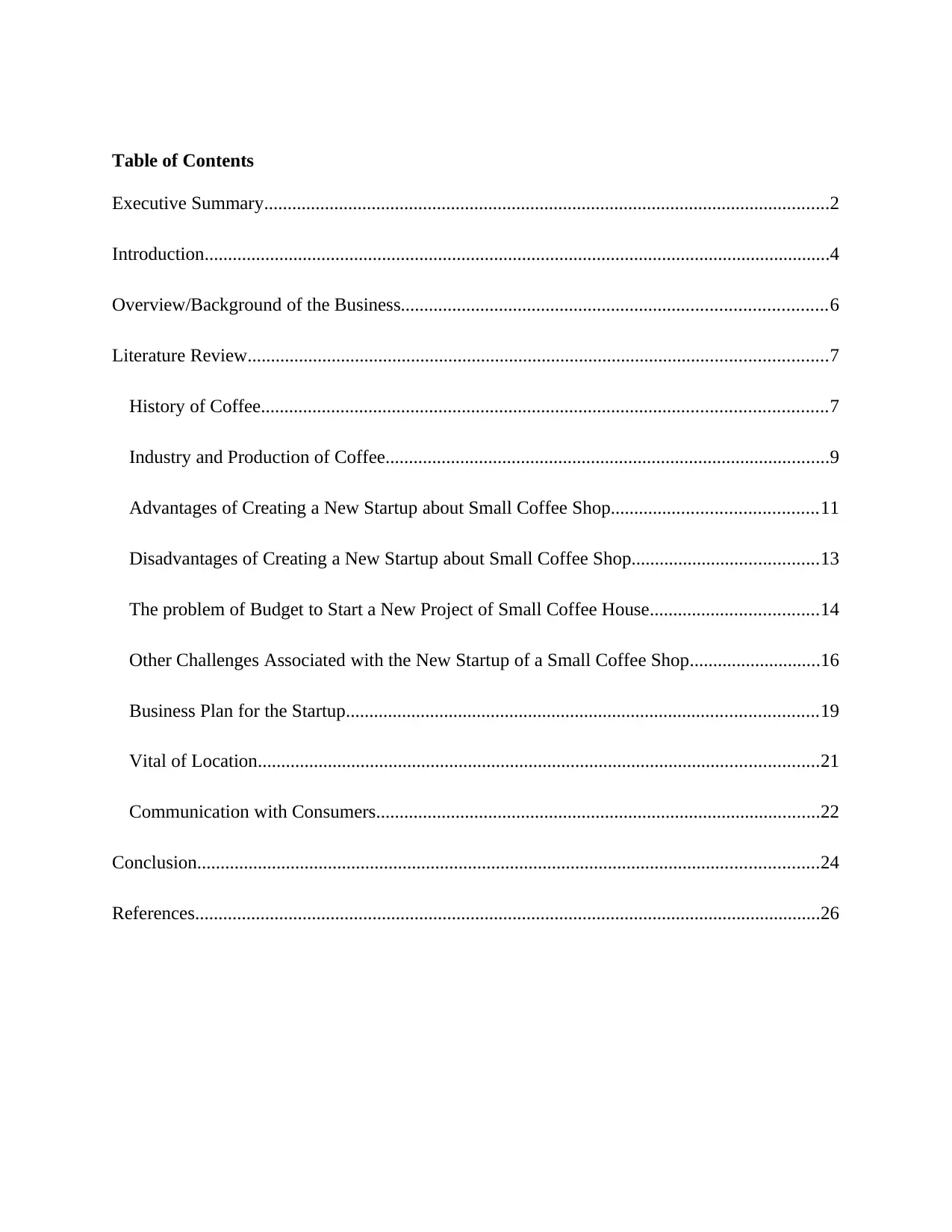
Table of Contents
Executive Summary.........................................................................................................................2
Introduction......................................................................................................................................4
Overview/Background of the Business...........................................................................................6
Literature Review............................................................................................................................7
History of Coffee.........................................................................................................................7
Industry and Production of Coffee...............................................................................................9
Advantages of Creating a New Startup about Small Coffee Shop............................................11
Disadvantages of Creating a New Startup about Small Coffee Shop........................................13
The problem of Budget to Start a New Project of Small Coffee House....................................14
Other Challenges Associated with the New Startup of a Small Coffee Shop............................16
Business Plan for the Startup.....................................................................................................19
Vital of Location........................................................................................................................21
Communication with Consumers...............................................................................................22
Conclusion.....................................................................................................................................24
References......................................................................................................................................26
Executive Summary.........................................................................................................................2
Introduction......................................................................................................................................4
Overview/Background of the Business...........................................................................................6
Literature Review............................................................................................................................7
History of Coffee.........................................................................................................................7
Industry and Production of Coffee...............................................................................................9
Advantages of Creating a New Startup about Small Coffee Shop............................................11
Disadvantages of Creating a New Startup about Small Coffee Shop........................................13
The problem of Budget to Start a New Project of Small Coffee House....................................14
Other Challenges Associated with the New Startup of a Small Coffee Shop............................16
Business Plan for the Startup.....................................................................................................19
Vital of Location........................................................................................................................21
Communication with Consumers...............................................................................................22
Conclusion.....................................................................................................................................24
References......................................................................................................................................26
⊘ This is a preview!⊘
Do you want full access?
Subscribe today to unlock all pages.

Trusted by 1+ million students worldwide
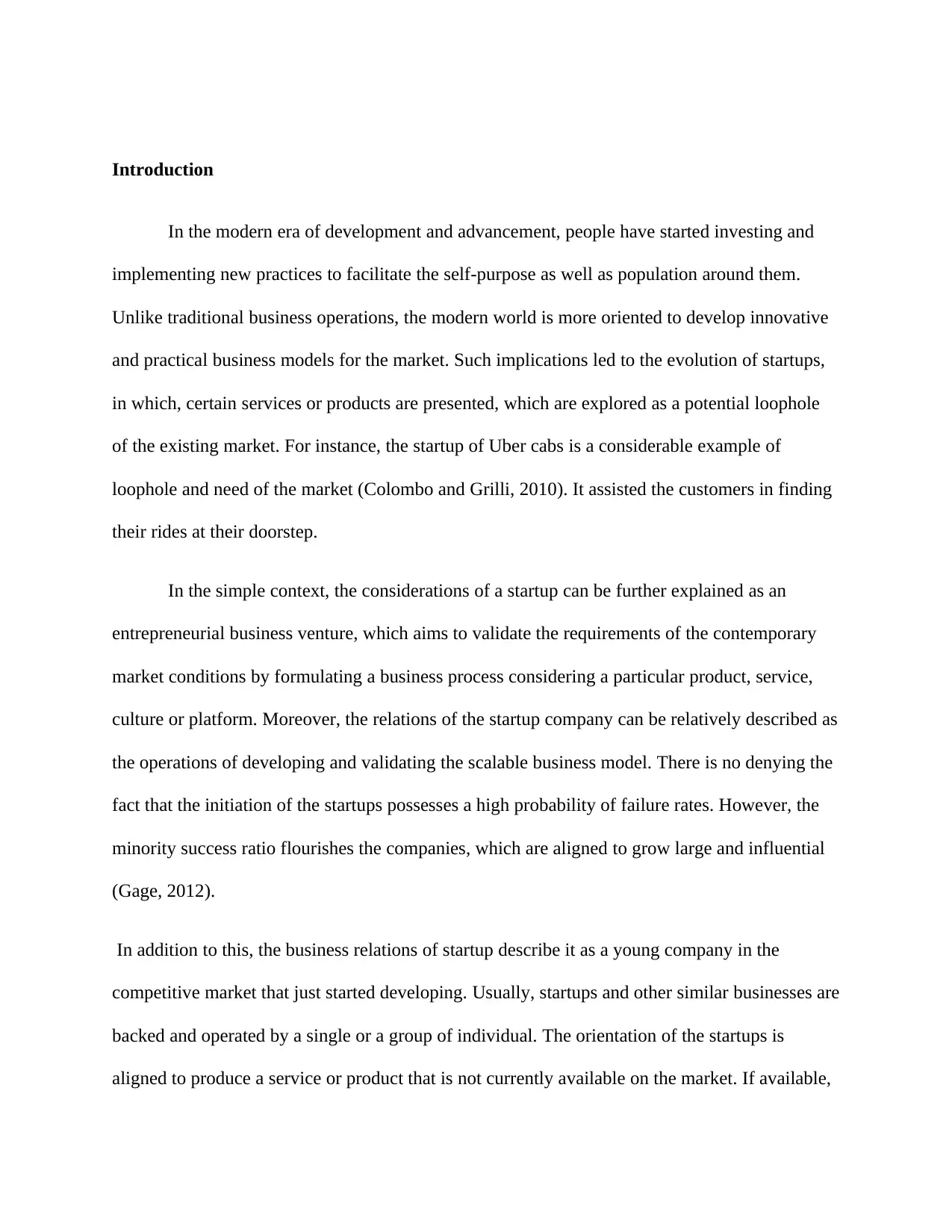
Introduction
In the modern era of development and advancement, people have started investing and
implementing new practices to facilitate the self-purpose as well as population around them.
Unlike traditional business operations, the modern world is more oriented to develop innovative
and practical business models for the market. Such implications led to the evolution of startups,
in which, certain services or products are presented, which are explored as a potential loophole
of the existing market. For instance, the startup of Uber cabs is a considerable example of
loophole and need of the market (Colombo and Grilli, 2010). It assisted the customers in finding
their rides at their doorstep.
In the simple context, the considerations of a startup can be further explained as an
entrepreneurial business venture, which aims to validate the requirements of the contemporary
market conditions by formulating a business process considering a particular product, service,
culture or platform. Moreover, the relations of the startup company can be relatively described as
the operations of developing and validating the scalable business model. There is no denying the
fact that the initiation of the startups possesses a high probability of failure rates. However, the
minority success ratio flourishes the companies, which are aligned to grow large and influential
(Gage, 2012).
In addition to this, the business relations of startup describe it as a young company in the
competitive market that just started developing. Usually, startups and other similar businesses are
backed and operated by a single or a group of individual. The orientation of the startups is
aligned to produce a service or product that is not currently available on the market. If available,
In the modern era of development and advancement, people have started investing and
implementing new practices to facilitate the self-purpose as well as population around them.
Unlike traditional business operations, the modern world is more oriented to develop innovative
and practical business models for the market. Such implications led to the evolution of startups,
in which, certain services or products are presented, which are explored as a potential loophole
of the existing market. For instance, the startup of Uber cabs is a considerable example of
loophole and need of the market (Colombo and Grilli, 2010). It assisted the customers in finding
their rides at their doorstep.
In the simple context, the considerations of a startup can be further explained as an
entrepreneurial business venture, which aims to validate the requirements of the contemporary
market conditions by formulating a business process considering a particular product, service,
culture or platform. Moreover, the relations of the startup company can be relatively described as
the operations of developing and validating the scalable business model. There is no denying the
fact that the initiation of the startups possesses a high probability of failure rates. However, the
minority success ratio flourishes the companies, which are aligned to grow large and influential
(Gage, 2012).
In addition to this, the business relations of startup describe it as a young company in the
competitive market that just started developing. Usually, startups and other similar businesses are
backed and operated by a single or a group of individual. The orientation of the startups is
aligned to produce a service or product that is not currently available on the market. If available,
Paraphrase This Document
Need a fresh take? Get an instant paraphrase of this document with our AI Paraphraser
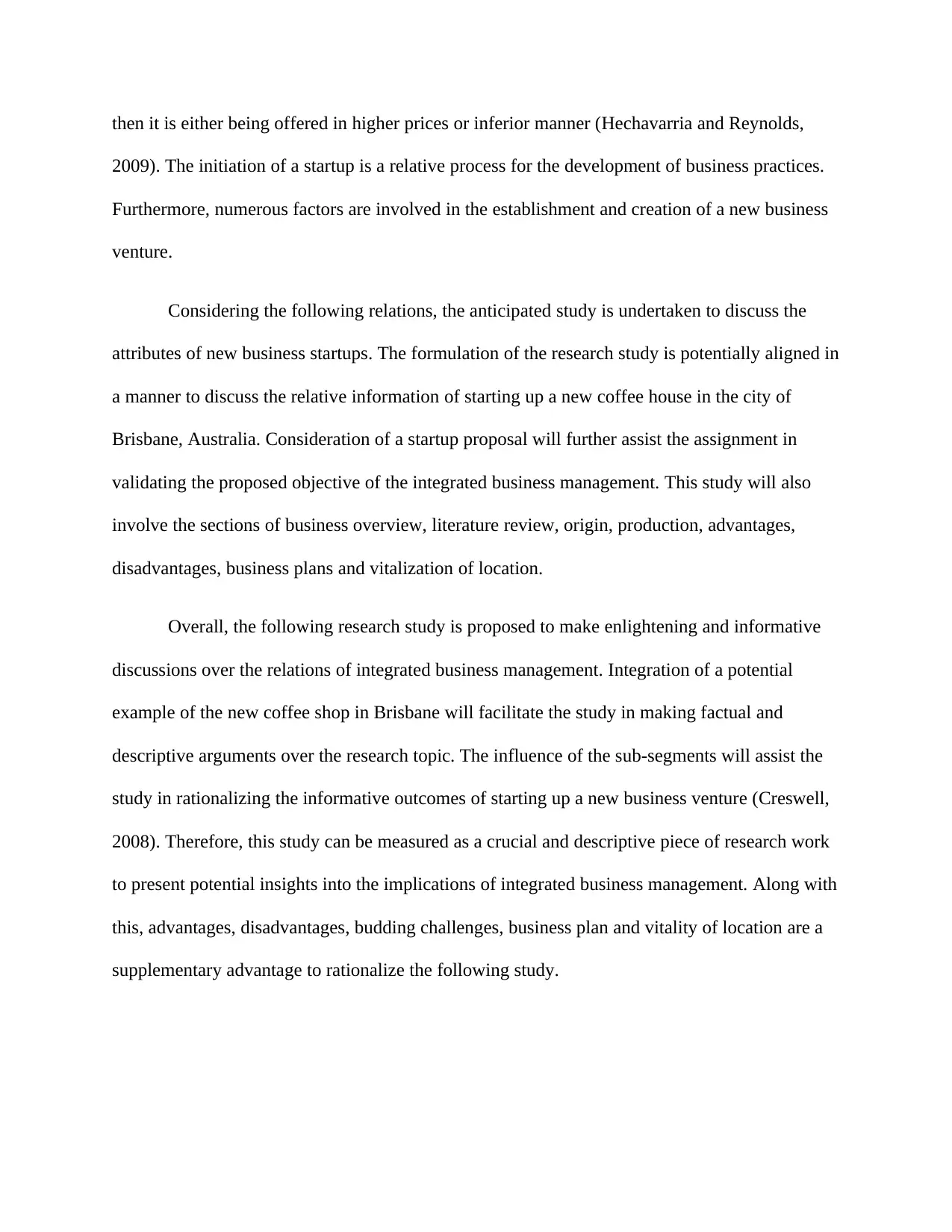
then it is either being offered in higher prices or inferior manner (Hechavarria and Reynolds,
2009). The initiation of a startup is a relative process for the development of business practices.
Furthermore, numerous factors are involved in the establishment and creation of a new business
venture.
Considering the following relations, the anticipated study is undertaken to discuss the
attributes of new business startups. The formulation of the research study is potentially aligned in
a manner to discuss the relative information of starting up a new coffee house in the city of
Brisbane, Australia. Consideration of a startup proposal will further assist the assignment in
validating the proposed objective of the integrated business management. This study will also
involve the sections of business overview, literature review, origin, production, advantages,
disadvantages, business plans and vitalization of location.
Overall, the following research study is proposed to make enlightening and informative
discussions over the relations of integrated business management. Integration of a potential
example of the new coffee shop in Brisbane will facilitate the study in making factual and
descriptive arguments over the research topic. The influence of the sub-segments will assist the
study in rationalizing the informative outcomes of starting up a new business venture (Creswell,
2008). Therefore, this study can be measured as a crucial and descriptive piece of research work
to present potential insights into the implications of integrated business management. Along with
this, advantages, disadvantages, budding challenges, business plan and vitality of location are a
supplementary advantage to rationalize the following study.
2009). The initiation of a startup is a relative process for the development of business practices.
Furthermore, numerous factors are involved in the establishment and creation of a new business
venture.
Considering the following relations, the anticipated study is undertaken to discuss the
attributes of new business startups. The formulation of the research study is potentially aligned in
a manner to discuss the relative information of starting up a new coffee house in the city of
Brisbane, Australia. Consideration of a startup proposal will further assist the assignment in
validating the proposed objective of the integrated business management. This study will also
involve the sections of business overview, literature review, origin, production, advantages,
disadvantages, business plans and vitalization of location.
Overall, the following research study is proposed to make enlightening and informative
discussions over the relations of integrated business management. Integration of a potential
example of the new coffee shop in Brisbane will facilitate the study in making factual and
descriptive arguments over the research topic. The influence of the sub-segments will assist the
study in rationalizing the informative outcomes of starting up a new business venture (Creswell,
2008). Therefore, this study can be measured as a crucial and descriptive piece of research work
to present potential insights into the implications of integrated business management. Along with
this, advantages, disadvantages, budding challenges, business plan and vitality of location are a
supplementary advantage to rationalize the following study.
Overview/Background of the Business
Every morning, wakening from bed with bleary eyes is more certain to die. Though it's a
recurring process of everyday life, the morning sensation of wakening eyes prised by sunlight
makes it challenging to initiate a single undertaking. This brings the urge of caffeine shots to
boost the metabolism and satisfy the pine for coffee. The desperate plea for coffee or caffeine
also facilitates the delivering from tiredness. Considering this need and evenness of the product,
business ventures started investing in the following business of serving coffee to the customers
(Mineharu, et al., 2010). With the passage of time, the following business advanced by
introducing specialized blended coffees and other variants.
In the context of the aforementioned research study, a startup of a new coffee shop is
proposed in Brisbane, Australia. The culture of coffee shops is quite evolving and certain in the
city of Brisbane. Despite acquired market by the established businesses, no sense of
competitiveness can be detected in the following business. Even more, the establishments of
coffee-peddling bars and cafes are considerably lot more than just a coffee shop because many
places have relatively started the business of dinner trading, boutiques and serving local beers
(Oba, et al., 2010). The taste of coffee is trending and it is even flourishing the business ventures
aligned to it.
As per the market relations, there is no denying the fact that Brisbane is growing as a
major market player in the Australian coffee culture. From fancy outlets to old building
courtyards, coffee shop brew bars and hand-roasted blends can be seen all around the city of
Brisbane. All the ventures are functioning with diverse considerations to facilitate the customer
relationship by satisfying the blend of coffee (Asadi, Zhou and Yang, 2009). Competitive factors
Every morning, wakening from bed with bleary eyes is more certain to die. Though it's a
recurring process of everyday life, the morning sensation of wakening eyes prised by sunlight
makes it challenging to initiate a single undertaking. This brings the urge of caffeine shots to
boost the metabolism and satisfy the pine for coffee. The desperate plea for coffee or caffeine
also facilitates the delivering from tiredness. Considering this need and evenness of the product,
business ventures started investing in the following business of serving coffee to the customers
(Mineharu, et al., 2010). With the passage of time, the following business advanced by
introducing specialized blended coffees and other variants.
In the context of the aforementioned research study, a startup of a new coffee shop is
proposed in Brisbane, Australia. The culture of coffee shops is quite evolving and certain in the
city of Brisbane. Despite acquired market by the established businesses, no sense of
competitiveness can be detected in the following business. Even more, the establishments of
coffee-peddling bars and cafes are considerably lot more than just a coffee shop because many
places have relatively started the business of dinner trading, boutiques and serving local beers
(Oba, et al., 2010). The taste of coffee is trending and it is even flourishing the business ventures
aligned to it.
As per the market relations, there is no denying the fact that Brisbane is growing as a
major market player in the Australian coffee culture. From fancy outlets to old building
courtyards, coffee shop brew bars and hand-roasted blends can be seen all around the city of
Brisbane. All the ventures are functioning with diverse considerations to facilitate the customer
relationship by satisfying the blend of coffee (Asadi, Zhou and Yang, 2009). Competitive factors
⊘ This is a preview!⊘
Do you want full access?
Subscribe today to unlock all pages.
Trusted by 1+ million students worldwide
are condensed to nominal as all the coffee shops located there are dedicated to a diverse range of
blended coffees and other delicacies.
The following research study is undertaken to propose the startup of a new coffee house
named as “Sip & Gossip” in the city of Brisbane, Australia. The urge requirement and
contemporary market conditions prompted the investment in the sector of coffee and food culture
(Monshouwer, Van Laar, and Vollebergh, 2011). The orientation of the research is to bring some
innovative concepts and services to the market for food and beverages in Brisbane by providing
good quality food, beverages, ambiance, services, and hospitality. Even, the name itself justifies
the visionary outcome of the researcher as “Sip & Gossip” is a collective upshot of sipping
coffee, relaxing, refreshment, chatting and gossiping.
The proposed business idea is a startup for sure but it will present a comprehensive
example of high-quality services and hospitality in the business of food and beverages to the
customers. In addition to this, the location of the coffee shop in Brisbane will also act as a
facilitating factor in the successful business startup. Rising involvement of Brisbane coffee
market and evenness of the product will majorly act as a contributing factor for "Sip & Gossip".
Literature Review
History of Coffee
In the contemporary lifestyle as well as business market, coffee is considered as the most
valuable commodity, which is legally traded. After oil, it is the second most dealing entity that is
used for both businesses as well as consumption. The stats further justify the utilization by
presenting that every single day approximately 2.25 billion cups of coffee are consumed all
blended coffees and other delicacies.
The following research study is undertaken to propose the startup of a new coffee house
named as “Sip & Gossip” in the city of Brisbane, Australia. The urge requirement and
contemporary market conditions prompted the investment in the sector of coffee and food culture
(Monshouwer, Van Laar, and Vollebergh, 2011). The orientation of the research is to bring some
innovative concepts and services to the market for food and beverages in Brisbane by providing
good quality food, beverages, ambiance, services, and hospitality. Even, the name itself justifies
the visionary outcome of the researcher as “Sip & Gossip” is a collective upshot of sipping
coffee, relaxing, refreshment, chatting and gossiping.
The proposed business idea is a startup for sure but it will present a comprehensive
example of high-quality services and hospitality in the business of food and beverages to the
customers. In addition to this, the location of the coffee shop in Brisbane will also act as a
facilitating factor in the successful business startup. Rising involvement of Brisbane coffee
market and evenness of the product will majorly act as a contributing factor for "Sip & Gossip".
Literature Review
History of Coffee
In the contemporary lifestyle as well as business market, coffee is considered as the most
valuable commodity, which is legally traded. After oil, it is the second most dealing entity that is
used for both businesses as well as consumption. The stats further justify the utilization by
presenting that every single day approximately 2.25 billion cups of coffee are consumed all
Paraphrase This Document
Need a fresh take? Get an instant paraphrase of this document with our AI Paraphraser
around the world. With the existence of numerous fruits around us since the ages, coffee’s
origination is considered as an enveloped mystery. It is believed by the people that a goat herder
named Kaldi discovered the fruit of coffee when he observed that his goats are highly vigorous
after eating the red fruits plucked from the shrubs of coffee tree (Luttinger and Dicum, 2011).
Some academicians even believe that the origination of the coffee is traced from the
regions of Ethiopia since the date back to 10th century. It could be originated earlier as well
because of traits of coffee consumption are marked according to earlier legends and reports. The
Sufi monasteries of Yemen have presented the most primitive evidence of drinking coffee and
presence of coffee tree since the 15th-century world. With the passage of time, during the 16th
century, the consumption of coffee reached the domain of Middle East, South India (Coorg),
Persia, Northern Africa, Turkey and Horn of Africa (Ellis, 2011). Furthermore, it even stretched
its consumption to Balkans, South East Asia, America, Italy and remaining countries of Europe.
In addition to this, academic researchers also certify that the term "Coffee" is rooted in
many different languages all around the world. In the language of Yemen, it is named as Qawah,
which is a romantic term used for wine. Further transformation led its name to Turkish kahveh
and then to Dutch koffie and lastly to Coffee in English. This justifies the origination, evolution,
and development of coffee from the earlier times to the modern world (Davis, et al., 2011).
In addition to this, the latest version of roasted coffee and beans is projected to be
originated from Arabia. In the 13th century, coffee gained enormous popularity in various
Muslim countries due to stimulant power contribution, which helped the parishioners during long
prayer sessions. Till the era of the 16th century, coffee crops and farming was restricted to the
regions of Arabia and Africa only. Afterward, an Indian pilgrim named as Baba Budan bought
origination is considered as an enveloped mystery. It is believed by the people that a goat herder
named Kaldi discovered the fruit of coffee when he observed that his goats are highly vigorous
after eating the red fruits plucked from the shrubs of coffee tree (Luttinger and Dicum, 2011).
Some academicians even believe that the origination of the coffee is traced from the
regions of Ethiopia since the date back to 10th century. It could be originated earlier as well
because of traits of coffee consumption are marked according to earlier legends and reports. The
Sufi monasteries of Yemen have presented the most primitive evidence of drinking coffee and
presence of coffee tree since the 15th-century world. With the passage of time, during the 16th
century, the consumption of coffee reached the domain of Middle East, South India (Coorg),
Persia, Northern Africa, Turkey and Horn of Africa (Ellis, 2011). Furthermore, it even stretched
its consumption to Balkans, South East Asia, America, Italy and remaining countries of Europe.
In addition to this, academic researchers also certify that the term "Coffee" is rooted in
many different languages all around the world. In the language of Yemen, it is named as Qawah,
which is a romantic term used for wine. Further transformation led its name to Turkish kahveh
and then to Dutch koffie and lastly to Coffee in English. This justifies the origination, evolution,
and development of coffee from the earlier times to the modern world (Davis, et al., 2011).
In addition to this, the latest version of roasted coffee and beans is projected to be
originated from Arabia. In the 13th century, coffee gained enormous popularity in various
Muslim countries due to stimulant power contribution, which helped the parishioners during long
prayer sessions. Till the era of the 16th century, coffee crops and farming was restricted to the
regions of Arabia and Africa only. Afterward, an Indian pilgrim named as Baba Budan bought
fertile coffee beans from Mecca, which further lead to the revolution of competitive coffee trade
in European countries. The first European-owned coffee state was founded in the year 1616 In
Sri Lanka. Thereafter, Ceylon and Java were also discovered as coffee estates in 1696. The
comprehensive progression further facilitated the growth of coffee by French in the Caribbean,
Spanish in Central America and the Portuguese in Brazil (Wolf, Bray and Popkin, 2008).
Furthermore, the business development leads to the establishment of European coffee shops in
Italy and France and also justified the business relations by flourishing enormous popularity.
Industry and Production of Coffee
Coffee is one of the most popular and universally consumed food beverage or
commodity. A major section of coffee is produced in developing countries such as South
America; however, it is mostly consumed in the regions of industrialized economies. In various
developing countries, around 25 million people are solely dependent on the business of coffee
production or trading in order to earn their livings. Brazil, who was the largest exporter of coffee
in September 2017, has an estimated population of approximately 5 million small producers
relying upon the business of coffee production by harvesting and cultivating the 3 billion coffee
plants there (Murthy and Naidu, 2012).
Coffee cultivation is unlike sugarcane cultivation or cattle breeding as it comprises more
labor-intensive culture than alternatives culture. Furthermore, the progressions are less aligned to
automation practices and hence, require constant attention and heed. The export considerations
of the coffee production indicate toward a remarkable business of the industry as it falls under
the category of major export commodity. In 2004, it was recorded as the top agricultural export
for 12 countries in the world. However, in 2005, coffee was documented as the seventh largest
in European countries. The first European-owned coffee state was founded in the year 1616 In
Sri Lanka. Thereafter, Ceylon and Java were also discovered as coffee estates in 1696. The
comprehensive progression further facilitated the growth of coffee by French in the Caribbean,
Spanish in Central America and the Portuguese in Brazil (Wolf, Bray and Popkin, 2008).
Furthermore, the business development leads to the establishment of European coffee shops in
Italy and France and also justified the business relations by flourishing enormous popularity.
Industry and Production of Coffee
Coffee is one of the most popular and universally consumed food beverage or
commodity. A major section of coffee is produced in developing countries such as South
America; however, it is mostly consumed in the regions of industrialized economies. In various
developing countries, around 25 million people are solely dependent on the business of coffee
production or trading in order to earn their livings. Brazil, who was the largest exporter of coffee
in September 2017, has an estimated population of approximately 5 million small producers
relying upon the business of coffee production by harvesting and cultivating the 3 billion coffee
plants there (Murthy and Naidu, 2012).
Coffee cultivation is unlike sugarcane cultivation or cattle breeding as it comprises more
labor-intensive culture than alternatives culture. Furthermore, the progressions are less aligned to
automation practices and hence, require constant attention and heed. The export considerations
of the coffee production indicate toward a remarkable business of the industry as it falls under
the category of major export commodity. In 2004, it was recorded as the top agricultural export
for 12 countries in the world. However, in 2005, coffee was documented as the seventh largest
⊘ This is a preview!⊘
Do you want full access?
Subscribe today to unlock all pages.
Trusted by 1+ million students worldwide
legal export commodity by value. And most importantly, from the year 1970 to 2000, the
production and trading of coffee are evident as the second most valuable entity exported by the
developing countries. The consistency and uniformity of the business for 30 long years justify
the market conditions are business potential of the industry (Mussatto, et al., 2012).
Moreover, green (unroasted) coffee beans are also a market leading commodity in terms
of export relations. The trading of following entities falls under the attributes of future contract
on exchanges such as the New York Board of Trade, the London International Financial Futures
and Options Exchange, New York Intercontinental Exchange and New York Mercantile
Exchange. Globally, Brazil is the leading producer of green coffee followed by Vietnam,
Indonesia, Colombia, and Ethiopia. In addition to this, the port of Hamburg, Germany is also a
renowned name in the business of coffee production and trading as it the world’s largest transfer
point for coffee (Clifford, 2012).
Now, the production of coffee is defined as the industrial process of converting raw
coffee berries of the coffee plant to the form of edible coffee. The pulp from the coffee fruit is
removed to extract the seeds, which are then dried. As the dependency on coffee production is
highly rated in developing countries, local processing of coffee also assists the local population
as well the government in generating hefty revenue (Mussatto, et al., 2011).
Production of coffee from the scratch is a long and throughout the process of approximately 5-6
years. Coffee plants do not even flower for three to four years since plantation. Afterward,
flowering, ripening and drying process also takes time. The initial phase of coffee production is
picking up of coffee fruits either by strip picking method or selective picking method.
Afterward, processing of the berries/fruits is done to remove the pulp and fruit layers over the
production and trading of coffee are evident as the second most valuable entity exported by the
developing countries. The consistency and uniformity of the business for 30 long years justify
the market conditions are business potential of the industry (Mussatto, et al., 2012).
Moreover, green (unroasted) coffee beans are also a market leading commodity in terms
of export relations. The trading of following entities falls under the attributes of future contract
on exchanges such as the New York Board of Trade, the London International Financial Futures
and Options Exchange, New York Intercontinental Exchange and New York Mercantile
Exchange. Globally, Brazil is the leading producer of green coffee followed by Vietnam,
Indonesia, Colombia, and Ethiopia. In addition to this, the port of Hamburg, Germany is also a
renowned name in the business of coffee production and trading as it the world’s largest transfer
point for coffee (Clifford, 2012).
Now, the production of coffee is defined as the industrial process of converting raw
coffee berries of the coffee plant to the form of edible coffee. The pulp from the coffee fruit is
removed to extract the seeds, which are then dried. As the dependency on coffee production is
highly rated in developing countries, local processing of coffee also assists the local population
as well the government in generating hefty revenue (Mussatto, et al., 2011).
Production of coffee from the scratch is a long and throughout the process of approximately 5-6
years. Coffee plants do not even flower for three to four years since plantation. Afterward,
flowering, ripening and drying process also takes time. The initial phase of coffee production is
picking up of coffee fruits either by strip picking method or selective picking method.
Afterward, processing of the berries/fruits is done to remove the pulp and fruit layers over the
Paraphrase This Document
Need a fresh take? Get an instant paraphrase of this document with our AI Paraphraser
seeds through a wet process, dry process or semi-dry process. Furthermore, the extracted beans
are brought to the final process of milling undertakes to clean and sort the coffee beans. Hulling,
polishing, grading, cleaning, and sorting are the potential methods involved in the procedure of
milling. Overall, the process of coffee production is an elongated as well expensive industrial
method (Gouvea, et al., 2009).
Advantages of Creating a New Startup about Small Coffee Shop
According to Kilmer (2014), distant from the following considerations of history, market
conditions, production and industry of coffee, there are also some potential advantages
associated to the start-up of small coffee shops (Kilmer, 2014). The following advantages are
discussed below:
The sense of Freedom: Owning a personal coffee shop seems quite fascinating as it could
help the owner in getting the sense of freedom, which is usually dreamt by many people.
It can also facilitate the lifestyle and work culture alike many successful business owners
(Higdon, 2016).
Be Your Own Boss: Startup of a new small coffee shop could also deal with the
considerations of employment practices of an individual. This could be an opportunity for
the person to utilize business skills, passion, compassion and work experience for
steering own ship of entrepreneurship. Also, being your own boss is a determined vision
of each and every working employee (Papachristos, et al., 2011).
Profitability: Gaining profitability in the business of coffee shop ventures is a great task
to achieve, but if achieved once, then it could facilitate the owner with all the
developments and temptations of life. Success is also highly addictive like coffee and
are brought to the final process of milling undertakes to clean and sort the coffee beans. Hulling,
polishing, grading, cleaning, and sorting are the potential methods involved in the procedure of
milling. Overall, the process of coffee production is an elongated as well expensive industrial
method (Gouvea, et al., 2009).
Advantages of Creating a New Startup about Small Coffee Shop
According to Kilmer (2014), distant from the following considerations of history, market
conditions, production and industry of coffee, there are also some potential advantages
associated to the start-up of small coffee shops (Kilmer, 2014). The following advantages are
discussed below:
The sense of Freedom: Owning a personal coffee shop seems quite fascinating as it could
help the owner in getting the sense of freedom, which is usually dreamt by many people.
It can also facilitate the lifestyle and work culture alike many successful business owners
(Higdon, 2016).
Be Your Own Boss: Startup of a new small coffee shop could also deal with the
considerations of employment practices of an individual. This could be an opportunity for
the person to utilize business skills, passion, compassion and work experience for
steering own ship of entrepreneurship. Also, being your own boss is a determined vision
of each and every working employee (Papachristos, et al., 2011).
Profitability: Gaining profitability in the business of coffee shop ventures is a great task
to achieve, but if achieved once, then it could facilitate the owner with all the
developments and temptations of life. Success is also highly addictive like coffee and
business of coffee shops could boost the profitability, expansions and customer service
relations (Pulido, 2017).
Uplift the Community: The further benefit or satisfaction associated with starting of a
coffee shop is un-quantifiable as it provides a magnificent lifestyle to the owner as well
to the owner's community. Some businessmen consider it as a primary concern for the
startup; however, others believe it as additional benefits of having a personal business
(Higdon, 2016).
Permit of Expressing Creativity: Creating a startup of the coffee shop also assists the
owner in shedding the opinions and perspectives of other people in order to develop and
execute personal ideas. The attributes of expression of creativity could lead to the sense
of satisfaction and business development (Papachristos, et al., 2011).
More Socialized with Neighborhoods: This employment is favorable in numerous ways
because the owner of the coffee house if getting paid for the work he\she is happy to do.
Meeting new people, making friends, gossiping and serving people with happiness is the
working profile and people are readily paying for this. Thus, a nice coffee shop not only
gives profitable business, it also eases the engagement of owner with new people and
neighbors (Pulido, 2017).
Comprehensive Consideration of Sharing Great Coffee with Passion: Owning a good
coffee shop is a potential segment of occupation to align the passion for coffee along with
spending quality time with friends as well as family. Overall, it hastens the passion for
coffee and sociality to a new level (Higdon, 2016).
Builds a Lasting Business: Starting up a small coffee house is a long-lasting planning of
the sustainable and unremitting business. Neither the coffee goes out of style not the
relations (Pulido, 2017).
Uplift the Community: The further benefit or satisfaction associated with starting of a
coffee shop is un-quantifiable as it provides a magnificent lifestyle to the owner as well
to the owner's community. Some businessmen consider it as a primary concern for the
startup; however, others believe it as additional benefits of having a personal business
(Higdon, 2016).
Permit of Expressing Creativity: Creating a startup of the coffee shop also assists the
owner in shedding the opinions and perspectives of other people in order to develop and
execute personal ideas. The attributes of expression of creativity could lead to the sense
of satisfaction and business development (Papachristos, et al., 2011).
More Socialized with Neighborhoods: This employment is favorable in numerous ways
because the owner of the coffee house if getting paid for the work he\she is happy to do.
Meeting new people, making friends, gossiping and serving people with happiness is the
working profile and people are readily paying for this. Thus, a nice coffee shop not only
gives profitable business, it also eases the engagement of owner with new people and
neighbors (Pulido, 2017).
Comprehensive Consideration of Sharing Great Coffee with Passion: Owning a good
coffee shop is a potential segment of occupation to align the passion for coffee along with
spending quality time with friends as well as family. Overall, it hastens the passion for
coffee and sociality to a new level (Higdon, 2016).
Builds a Lasting Business: Starting up a small coffee house is a long-lasting planning of
the sustainable and unremitting business. Neither the coffee goes out of style not the
⊘ This is a preview!⊘
Do you want full access?
Subscribe today to unlock all pages.
Trusted by 1+ million students worldwide

1 out of 30


Related Documents


Your All-in-One AI-Powered Toolkit for Academic Success.
+13062052269
info@desklib.com
Available 24*7 on WhatsApp / Email
![[object Object]](/_next/static/media/star-bottom.7253800d.svg)
Unlock your academic potential
Copyright © 2020–2026 A2Z Services. All Rights Reserved. Developed and managed by ZUCOL.