SITA Business Strategy Report
VerifiedAdded on 2019/09/30
|12
|2616
|288
Report
AI Summary
This report examines SITA's strategic decision regarding a potential partnership with ABC Systems to distribute their IT service, Service X. The report analyzes the issue of whether SITA should enter a five-year contract with ABC Systems, considering the implications of using SITA's sales agents and database. Several alternatives are explored, including using direct channels, becoming an exclusive distributor, a friendly takeover/acquisition, and a supplier buyout. A decision criteria framework is used to compare these alternatives based on qualitative factors (competitive advantage, ease of implementation, ethics, flexibility, resource utilization) and quantitative factors (profit, cost, ROI, market share, cash flow). The report ultimately recommends a supplier buyout as the most advantageous option for SITA, highlighting the benefits of reduced costs, improved quality control, diversification, and reduced competition. The report concludes with implementation and implications for SITA, emphasizing the importance of ethical considerations and the potential for an exclusive distribution agreement as a secondary option.
1. Executive Summary
SITA is a world leading specialist in air transport communication and information
technology. They were established in 1949 and currently provide services to over 2,800
consumers, culminating 90% of the airline business globally (Sita. 2015).
This report however assumes that there has not been any legal contract between SITA
and ABC Systems. Therefore, suggesting alternatives and applying implications and
implementations from SITA’s point of view.
Ethically, supplier buyouts need to be done with the consent of both the parties (SITA
and ABC Systems) drawing a detailed contract with agreements on payments, profits
and service distributions.
Supplier buyouts have been a popular trend in recent business environment (through a
managers perspective), specially when the supplier is of a smaller size (Alkhafaji 1991).
Therefore, supplier buyout has been highly concentrated on, in this report. This would
assist SITA to capture market share with effective costing and profitability. Therefore,
suggesting supplier buyouts to be a vital option for SITA, analysing their long-term
return on investment (Alkhafaji 1991).
This video Report was based on SITA
https://www.youtube.com/watch?
v=7LhAA5DXmjo&feature=youtu.be
SITA is a world leading specialist in air transport communication and information
technology. They were established in 1949 and currently provide services to over 2,800
consumers, culminating 90% of the airline business globally (Sita. 2015).
This report however assumes that there has not been any legal contract between SITA
and ABC Systems. Therefore, suggesting alternatives and applying implications and
implementations from SITA’s point of view.
Ethically, supplier buyouts need to be done with the consent of both the parties (SITA
and ABC Systems) drawing a detailed contract with agreements on payments, profits
and service distributions.
Supplier buyouts have been a popular trend in recent business environment (through a
managers perspective), specially when the supplier is of a smaller size (Alkhafaji 1991).
Therefore, supplier buyout has been highly concentrated on, in this report. This would
assist SITA to capture market share with effective costing and profitability. Therefore,
suggesting supplier buyouts to be a vital option for SITA, analysing their long-term
return on investment (Alkhafaji 1991).
This video Report was based on SITA
https://www.youtube.com/watch?
v=7LhAA5DXmjo&feature=youtu.be

Paraphrase This Document
Need a fresh take? Get an instant paraphrase of this document with our AI Paraphraser
2. Issue
SITA has been approached by ABC systems, providing SITA an opportunity to become
a sale agent or distributor for their IT service (service X). Service X harmonizes with
SITA’s current services- satellite services and transmission, including weather services.
However, the issue lies on whether SITA should get into a five-year contract with ABC
systems, which allows them to use SITA’s sales agents to sell service X. However,
SITA is uncertain about the approach it needs to establish in order to globalise service
X- as it may also involve developing the service for their competitors and potentially
using their database.
3. Causes
ABC system’s is a small company, in comparison to SITA and can only potentially
reach to consumers in their home country. Therefore, ABC System was compelled to
work with SITA for numerous reasons, as discussed below.
3.1 Number of Sales Agent
ABC System only has approximately two to three sales agents in their home country.
However, while collaborating with SITA, they would be able to approach 170 countries
through SITA’s sales agents, ranging from 200 to 300 agents.
3.2 SITA’s Cloud Computing Data Centres
Service X needs SITA’s cloud computing systems to operate globally. SITA currently
has 4 centres worldwide, which would be ideal for ABC System’s to promote their
service on a global platform and reach out to an international audience.
3.3 SITA’s Consumer Database
ABC Systems could potentially reach out SITA’s elaborate consumer database. Service
X’s potential consumers include- space launchers, governments, rocket builders,
engine builders and simulator testers. These consumers could be efficiently contacted
through SITA’s detailed consumer database involving- Boeing, Airbus and other
airspace companies.
SITA has been approached by ABC systems, providing SITA an opportunity to become
a sale agent or distributor for their IT service (service X). Service X harmonizes with
SITA’s current services- satellite services and transmission, including weather services.
However, the issue lies on whether SITA should get into a five-year contract with ABC
systems, which allows them to use SITA’s sales agents to sell service X. However,
SITA is uncertain about the approach it needs to establish in order to globalise service
X- as it may also involve developing the service for their competitors and potentially
using their database.
3. Causes
ABC system’s is a small company, in comparison to SITA and can only potentially
reach to consumers in their home country. Therefore, ABC System was compelled to
work with SITA for numerous reasons, as discussed below.
3.1 Number of Sales Agent
ABC System only has approximately two to three sales agents in their home country.
However, while collaborating with SITA, they would be able to approach 170 countries
through SITA’s sales agents, ranging from 200 to 300 agents.
3.2 SITA’s Cloud Computing Data Centres
Service X needs SITA’s cloud computing systems to operate globally. SITA currently
has 4 centres worldwide, which would be ideal for ABC System’s to promote their
service on a global platform and reach out to an international audience.
3.3 SITA’s Consumer Database
ABC Systems could potentially reach out SITA’s elaborate consumer database. Service
X’s potential consumers include- space launchers, governments, rocket builders,
engine builders and simulator testers. These consumers could be efficiently contacted
through SITA’s detailed consumer database involving- Boeing, Airbus and other
airspace companies.
3.4 Advertising and Marketing Collaboration
Due to ABC System’s lack of manpower and global presence, it would be vital for them
to collaborate with SITA. This would involve collaborating their sale agents, marketing
and advertising strategies.
3.5 Service X- Development
Due to the presence of various types of potential consumers; it is vital for ABC system’s
to cooperate with SITA to analyse and satisfy their consumer’s demands and develop
service X accordingly. This would be effective as ABC system is willing to consider
feedback from SITA regarding their service.
4. Alternatives
4.1. Introduce Direct Channels
SITA may choose to use their direct staffs as a direct channel distribution strategy,
instead of collaborating with ABC System’s. This strategy would assist SITA in
controlling their operations instead of relying on ABC’s sales force, who potentially lack
global presence and experience (Nicolau 2013).
This would allow SITA to develop service X according to their consumer’s demand and
provide them with high service quality and consistency; through which they have
established themselves in the market (Nicolau 2013).
SITA would be able to efficiently promote service X in the global platform, using their
consumer database, existing cloud computing data centres and marketing agents;
without collaborating with ABC Systems- instituting higher productivity(Nicolau 2013).
4.2. Exclusive Distributor
SITA should consider signing a contract stating itself to be an exclusive distributor. This
would allow SITA to decrease their competition, directed at the same service (Asker
2015). This is achieved as service X is demanded by a niche-market and utilizing
SITA’s connection, they would be able to capture considerable amount of market share
(Asker 2015).
Due to ABC System’s lack of manpower and global presence, it would be vital for them
to collaborate with SITA. This would involve collaborating their sale agents, marketing
and advertising strategies.
3.5 Service X- Development
Due to the presence of various types of potential consumers; it is vital for ABC system’s
to cooperate with SITA to analyse and satisfy their consumer’s demands and develop
service X accordingly. This would be effective as ABC system is willing to consider
feedback from SITA regarding their service.
4. Alternatives
4.1. Introduce Direct Channels
SITA may choose to use their direct staffs as a direct channel distribution strategy,
instead of collaborating with ABC System’s. This strategy would assist SITA in
controlling their operations instead of relying on ABC’s sales force, who potentially lack
global presence and experience (Nicolau 2013).
This would allow SITA to develop service X according to their consumer’s demand and
provide them with high service quality and consistency; through which they have
established themselves in the market (Nicolau 2013).
SITA would be able to efficiently promote service X in the global platform, using their
consumer database, existing cloud computing data centres and marketing agents;
without collaborating with ABC Systems- instituting higher productivity(Nicolau 2013).
4.2. Exclusive Distributor
SITA should consider signing a contract stating itself to be an exclusive distributor. This
would allow SITA to decrease their competition, directed at the same service (Asker
2015). This is achieved as service X is demanded by a niche-market and utilizing
SITA’s connection, they would be able to capture considerable amount of market share
(Asker 2015).
⊘ This is a preview!⊘
Do you want full access?
Subscribe today to unlock all pages.

Trusted by 1+ million students worldwide
Concurrently, ABC Systems would be able to decrease their manufacturing costs, and
control the consistency and quality of their service; factoring in value-based pricing
strategies in the long run and increasing their profits.
4.3 Friendly Takeover/ Acquisition
Service X has been tested by SITA and proven to be a productive service. Acquisition
of ABC systems could be possible after the 5 year contract (if service X is still profitable
for SITA). This would benefit SITA in various ways.
SITA already has an elaborate existing database, including- airlines, airline
manufacturers (Airbus and Boeing), airport-based organizations and air traffic
management companies. This would allow SITA to control their customer database and
would not have to specifically share it with ABC systems (Easterwood 2015). SITA
would not have to share potential profits from selling service X, through their sales
agents either (Easterwood 2015).
4.4 Supplier Buyout
ABC System is using SITA’s customer database and sales agents to sell service X.
SITA is willing to adapt service X according to their customer’s demand, by investing in
its development. Therefore, SITA could utilize this investment in buying out the service
completely, instead of investing in its development continuously. This would reduce
SITA’s cost and the investment would be beneficial in the long run (Alkhafaji 1991).
If Service X is successful, it would definitely increase SITA’s competition. However,
SITA would potentially have first mover advantage amongst its competitors, and would
still gain potential profits from Service X in the long run (Alkhafaji 1991).
Since SITA is considering evolving Service X in accordance to their customer demand,
buying out the service would help SITA capture the market share ABC Systems hasn’t
been able to capture; internationally.
control the consistency and quality of their service; factoring in value-based pricing
strategies in the long run and increasing their profits.
4.3 Friendly Takeover/ Acquisition
Service X has been tested by SITA and proven to be a productive service. Acquisition
of ABC systems could be possible after the 5 year contract (if service X is still profitable
for SITA). This would benefit SITA in various ways.
SITA already has an elaborate existing database, including- airlines, airline
manufacturers (Airbus and Boeing), airport-based organizations and air traffic
management companies. This would allow SITA to control their customer database and
would not have to specifically share it with ABC systems (Easterwood 2015). SITA
would not have to share potential profits from selling service X, through their sales
agents either (Easterwood 2015).
4.4 Supplier Buyout
ABC System is using SITA’s customer database and sales agents to sell service X.
SITA is willing to adapt service X according to their customer’s demand, by investing in
its development. Therefore, SITA could utilize this investment in buying out the service
completely, instead of investing in its development continuously. This would reduce
SITA’s cost and the investment would be beneficial in the long run (Alkhafaji 1991).
If Service X is successful, it would definitely increase SITA’s competition. However,
SITA would potentially have first mover advantage amongst its competitors, and would
still gain potential profits from Service X in the long run (Alkhafaji 1991).
Since SITA is considering evolving Service X in accordance to their customer demand,
buying out the service would help SITA capture the market share ABC Systems hasn’t
been able to capture; internationally.
Paraphrase This Document
Need a fresh take? Get an instant paraphrase of this document with our AI Paraphraser
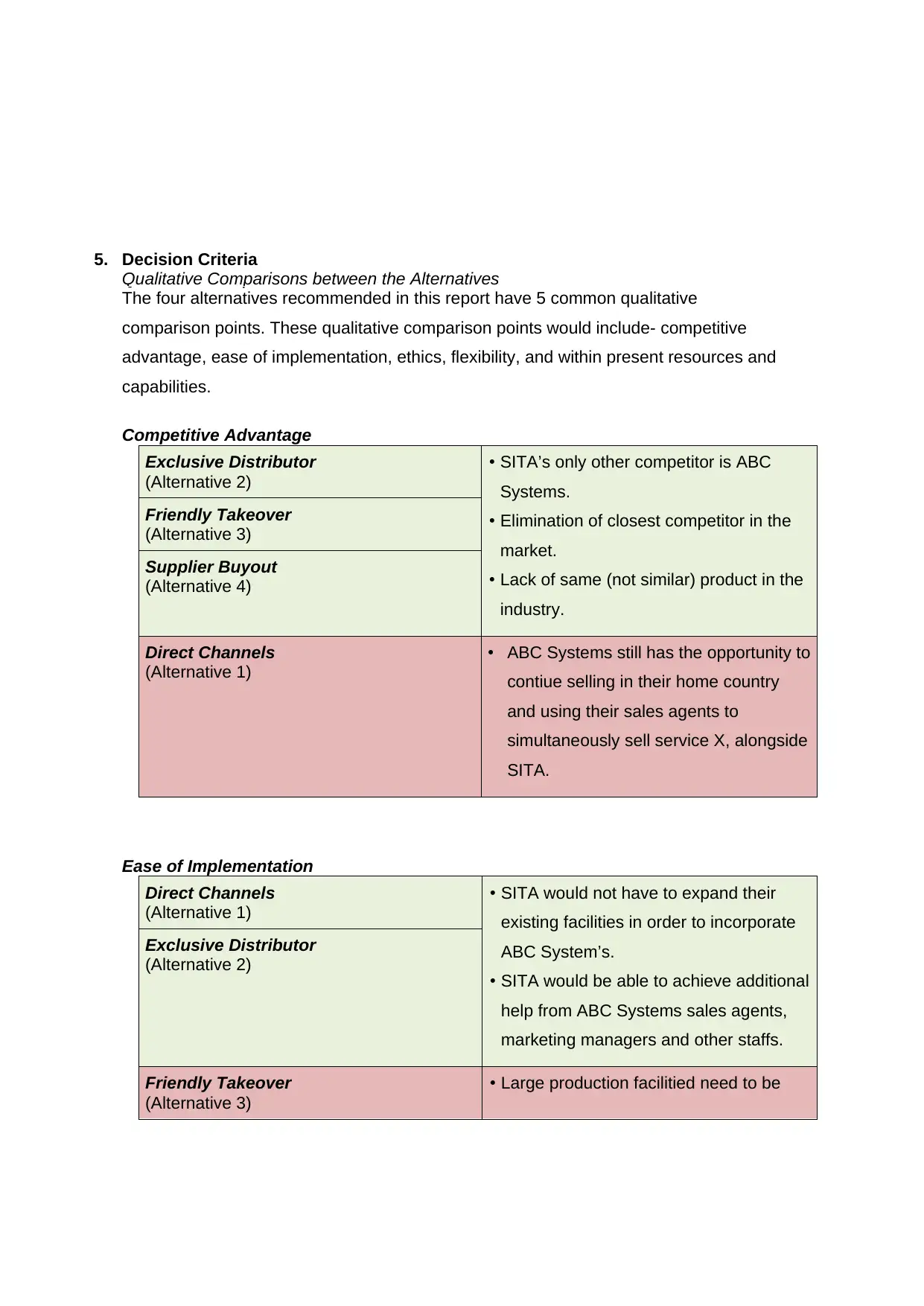
5. Decision Criteria
Qualitative Comparisons between the Alternatives
The four alternatives recommended in this report have 5 common qualitative
comparison points. These qualitative comparison points would include- competitive
advantage, ease of implementation, ethics, flexibility, and within present resources and
capabilities.
Competitive Advantage
Exclusive Distributor
(Alternative 2)
• SITA’s only other competitor is ABC
Systems.
• Elimination of closest competitor in the
market.
• Lack of same (not similar) product in the
industry.
Friendly Takeover
(Alternative 3)
Supplier Buyout
(Alternative 4)
Direct Channels
(Alternative 1)
• ABC Systems still has the opportunity to
contiue selling in their home country
and using their sales agents to
simultaneously sell service X, alongside
SITA.
Ease of Implementation
Direct Channels
(Alternative 1)
• SITA would not have to expand their
existing facilities in order to incorporate
ABC System’s.
• SITA would be able to achieve additional
help from ABC Systems sales agents,
marketing managers and other staffs.
Exclusive Distributor
(Alternative 2)
Friendly Takeover
(Alternative 3)
• Large production facilitied need to be
Qualitative Comparisons between the Alternatives
The four alternatives recommended in this report have 5 common qualitative
comparison points. These qualitative comparison points would include- competitive
advantage, ease of implementation, ethics, flexibility, and within present resources and
capabilities.
Competitive Advantage
Exclusive Distributor
(Alternative 2)
• SITA’s only other competitor is ABC
Systems.
• Elimination of closest competitor in the
market.
• Lack of same (not similar) product in the
industry.
Friendly Takeover
(Alternative 3)
Supplier Buyout
(Alternative 4)
Direct Channels
(Alternative 1)
• ABC Systems still has the opportunity to
contiue selling in their home country
and using their sales agents to
simultaneously sell service X, alongside
SITA.
Ease of Implementation
Direct Channels
(Alternative 1)
• SITA would not have to expand their
existing facilities in order to incorporate
ABC System’s.
• SITA would be able to achieve additional
help from ABC Systems sales agents,
marketing managers and other staffs.
Exclusive Distributor
(Alternative 2)
Friendly Takeover
(Alternative 3)
• Large production facilitied need to be
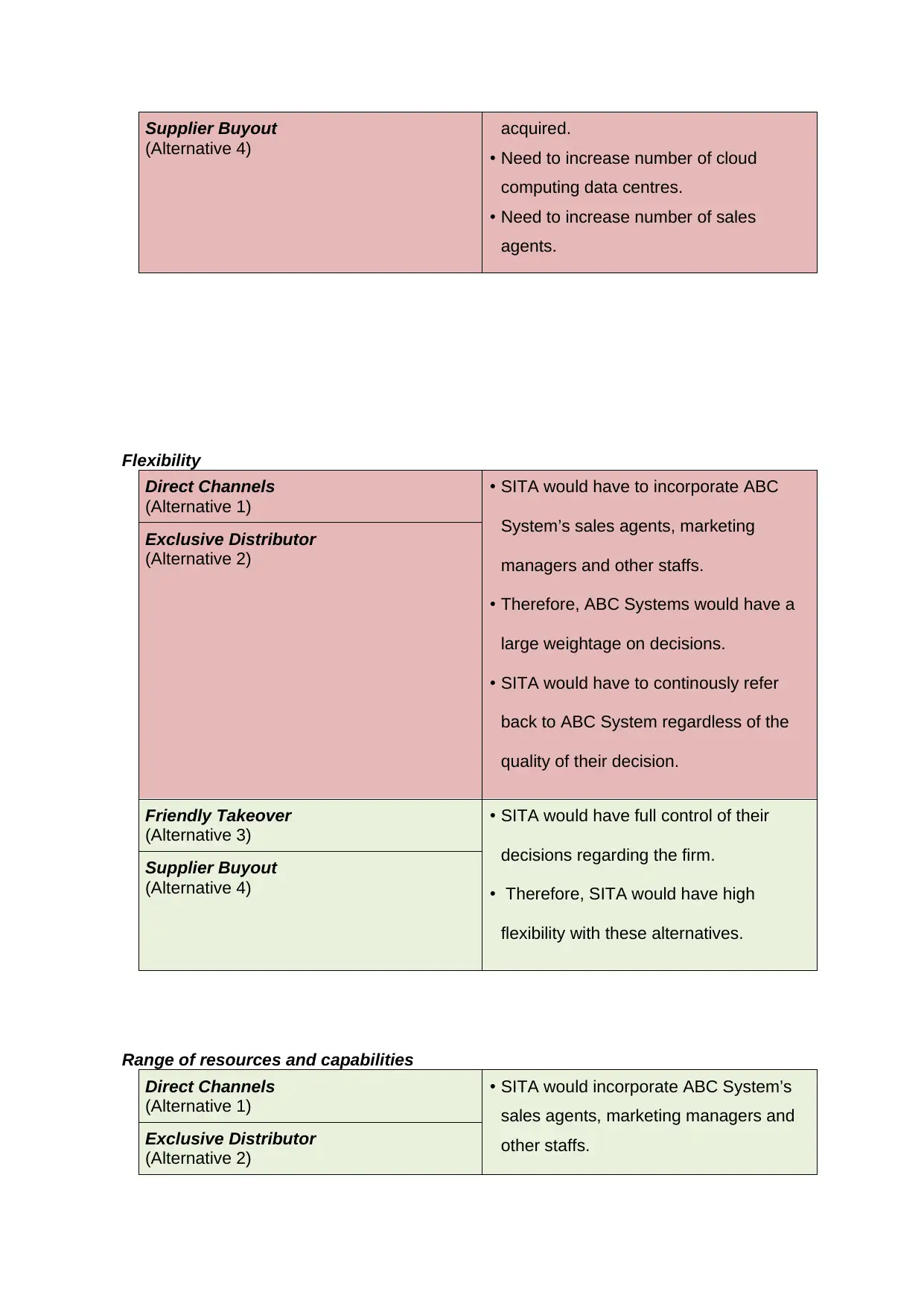
acquired.
• Need to increase number of cloud
computing data centres.
• Need to increase number of sales
agents.
Supplier Buyout
(Alternative 4)
Flexibility
Direct Channels
(Alternative 1)
• SITA would have to incorporate ABC
System’s sales agents, marketing
managers and other staffs.
• Therefore, ABC Systems would have a
large weightage on decisions.
• SITA would have to continously refer
back to ABC System regardless of the
quality of their decision.
Exclusive Distributor
(Alternative 2)
Friendly Takeover
(Alternative 3)
• SITA would have full control of their
decisions regarding the firm.
• Therefore, SITA would have high
flexibility with these alternatives.
Supplier Buyout
(Alternative 4)
Range of resources and capabilities
Direct Channels
(Alternative 1)
• SITA would incorporate ABC System’s
sales agents, marketing managers and
other staffs.Exclusive Distributor
(Alternative 2)
• Need to increase number of cloud
computing data centres.
• Need to increase number of sales
agents.
Supplier Buyout
(Alternative 4)
Flexibility
Direct Channels
(Alternative 1)
• SITA would have to incorporate ABC
System’s sales agents, marketing
managers and other staffs.
• Therefore, ABC Systems would have a
large weightage on decisions.
• SITA would have to continously refer
back to ABC System regardless of the
quality of their decision.
Exclusive Distributor
(Alternative 2)
Friendly Takeover
(Alternative 3)
• SITA would have full control of their
decisions regarding the firm.
• Therefore, SITA would have high
flexibility with these alternatives.
Supplier Buyout
(Alternative 4)
Range of resources and capabilities
Direct Channels
(Alternative 1)
• SITA would incorporate ABC System’s
sales agents, marketing managers and
other staffs.Exclusive Distributor
(Alternative 2)
⊘ This is a preview!⊘
Do you want full access?
Subscribe today to unlock all pages.
Trusted by 1+ million students worldwide
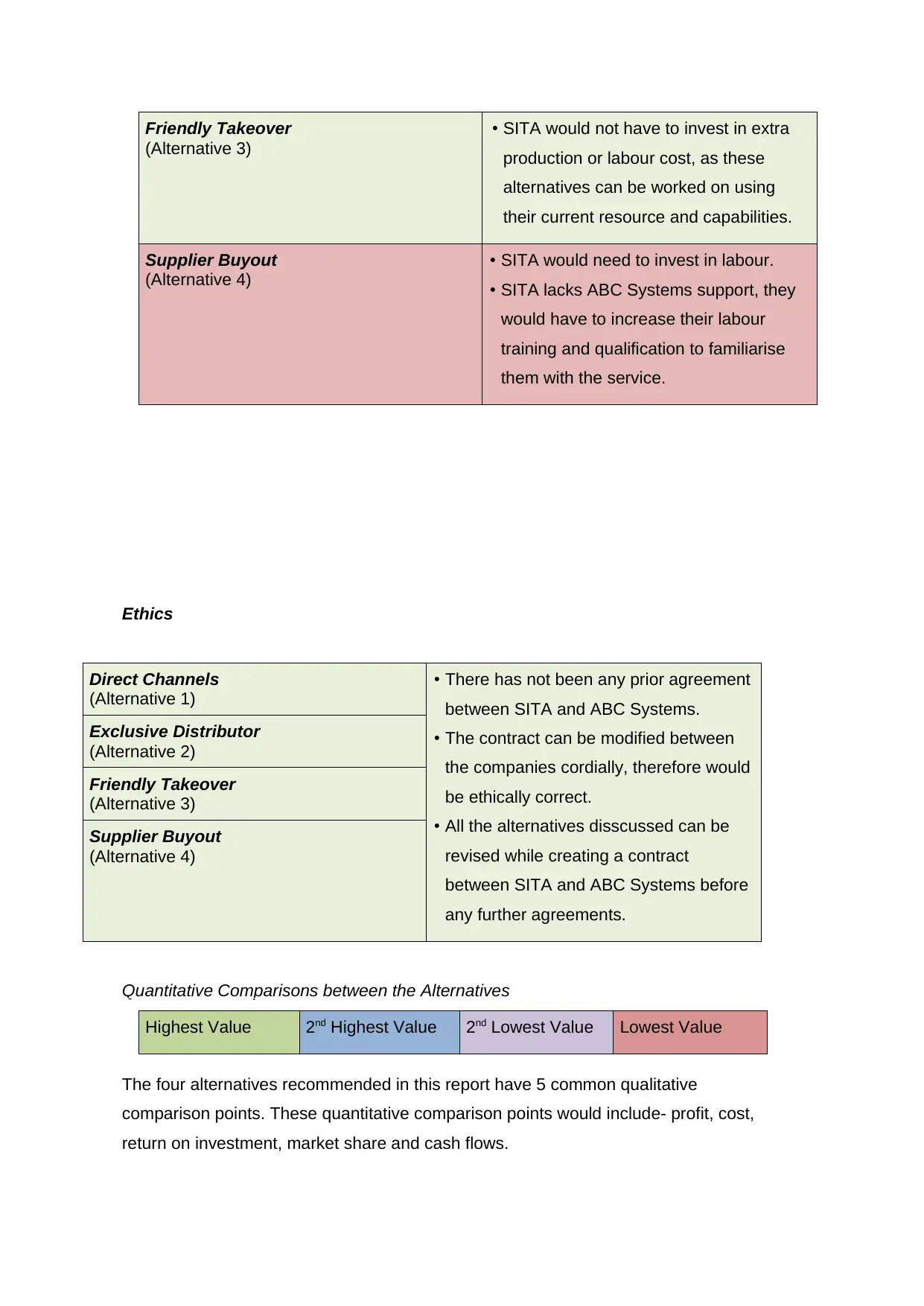
• SITA would not have to invest in extra
production or labour cost, as these
alternatives can be worked on using
their current resource and capabilities.
Friendly Takeover
(Alternative 3)
Supplier Buyout
(Alternative 4)
• SITA would need to invest in labour.
• SITA lacks ABC Systems support, they
would have to increase their labour
training and qualification to familiarise
them with the service.
Ethics
Direct Channels
(Alternative 1)
• There has not been any prior agreement
between SITA and ABC Systems.
• The contract can be modified between
the companies cordially, therefore would
be ethically correct.
• All the alternatives disscussed can be
revised while creating a contract
between SITA and ABC Systems before
any further agreements.
Exclusive Distributor
(Alternative 2)
Friendly Takeover
(Alternative 3)
Supplier Buyout
(Alternative 4)
Quantitative Comparisons between the Alternatives
Highest Value 2nd Highest Value 2nd Lowest Value Lowest Value
The four alternatives recommended in this report have 5 common qualitative
comparison points. These quantitative comparison points would include- profit, cost,
return on investment, market share and cash flows.
production or labour cost, as these
alternatives can be worked on using
their current resource and capabilities.
Friendly Takeover
(Alternative 3)
Supplier Buyout
(Alternative 4)
• SITA would need to invest in labour.
• SITA lacks ABC Systems support, they
would have to increase their labour
training and qualification to familiarise
them with the service.
Ethics
Direct Channels
(Alternative 1)
• There has not been any prior agreement
between SITA and ABC Systems.
• The contract can be modified between
the companies cordially, therefore would
be ethically correct.
• All the alternatives disscussed can be
revised while creating a contract
between SITA and ABC Systems before
any further agreements.
Exclusive Distributor
(Alternative 2)
Friendly Takeover
(Alternative 3)
Supplier Buyout
(Alternative 4)
Quantitative Comparisons between the Alternatives
Highest Value 2nd Highest Value 2nd Lowest Value Lowest Value
The four alternatives recommended in this report have 5 common qualitative
comparison points. These quantitative comparison points would include- profit, cost,
return on investment, market share and cash flows.
Paraphrase This Document
Need a fresh take? Get an instant paraphrase of this document with our AI Paraphraser
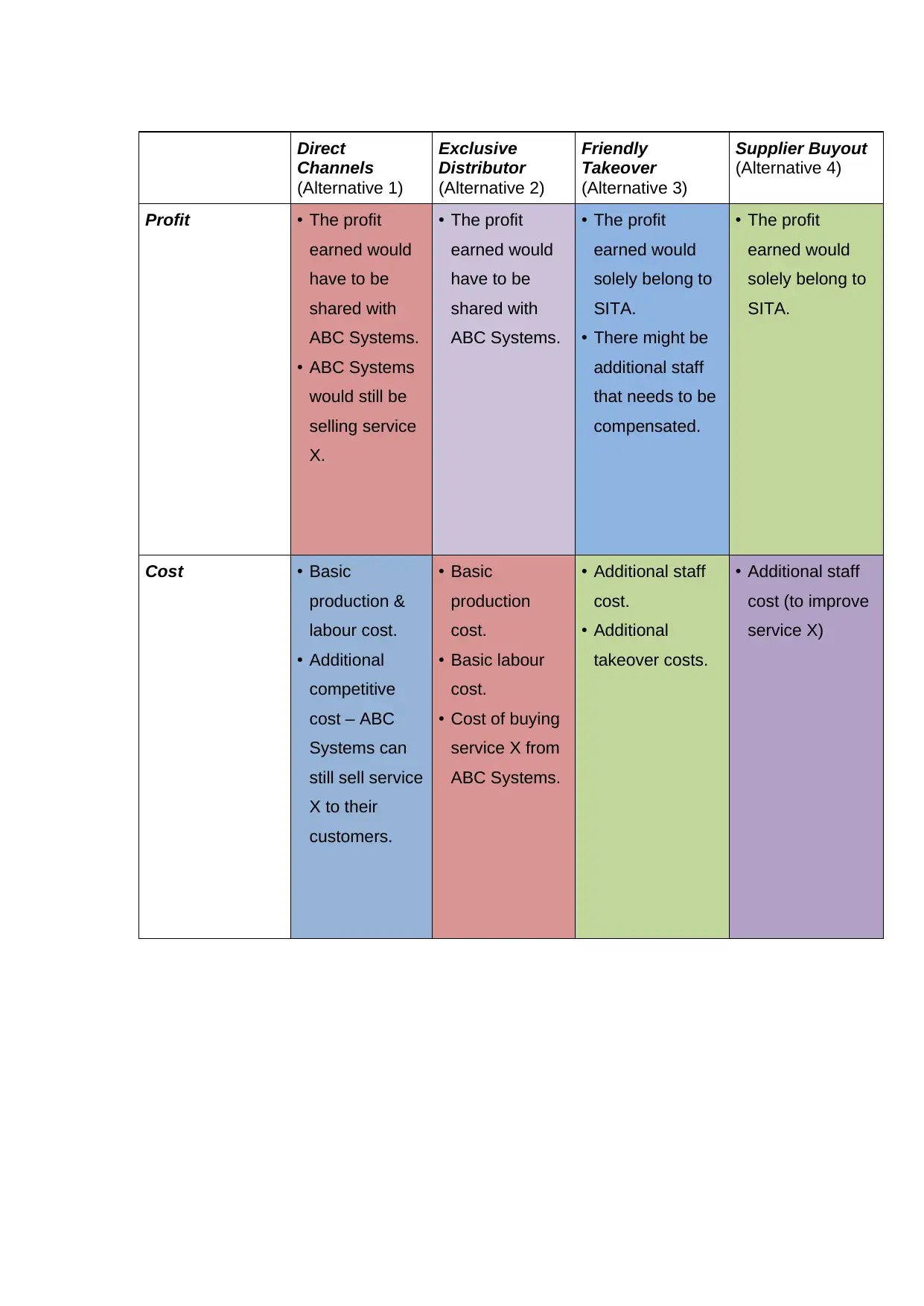
Direct
Channels
(Alternative 1)
Exclusive
Distributor
(Alternative 2)
Friendly
Takeover
(Alternative 3)
Supplier Buyout
(Alternative 4)
Profit • The profit
earned would
have to be
shared with
ABC Systems.
• ABC Systems
would still be
selling service
X.
• The profit
earned would
have to be
shared with
ABC Systems.
• The profit
earned would
solely belong to
SITA.
• There might be
additional staff
that needs to be
compensated.
• The profit
earned would
solely belong to
SITA.
Cost • Basic
production &
labour cost.
• Additional
competitive
cost – ABC
Systems can
still sell service
X to their
customers.
• Basic
production
cost.
• Basic labour
cost.
• Cost of buying
service X from
ABC Systems.
• Additional staff
cost.
• Additional
takeover costs.
• Additional staff
cost (to improve
service X)
Channels
(Alternative 1)
Exclusive
Distributor
(Alternative 2)
Friendly
Takeover
(Alternative 3)
Supplier Buyout
(Alternative 4)
Profit • The profit
earned would
have to be
shared with
ABC Systems.
• ABC Systems
would still be
selling service
X.
• The profit
earned would
have to be
shared with
ABC Systems.
• The profit
earned would
solely belong to
SITA.
• There might be
additional staff
that needs to be
compensated.
• The profit
earned would
solely belong to
SITA.
Cost • Basic
production &
labour cost.
• Additional
competitive
cost – ABC
Systems can
still sell service
X to their
customers.
• Basic
production
cost.
• Basic labour
cost.
• Cost of buying
service X from
ABC Systems.
• Additional staff
cost.
• Additional
takeover costs.
• Additional staff
cost (to improve
service X)
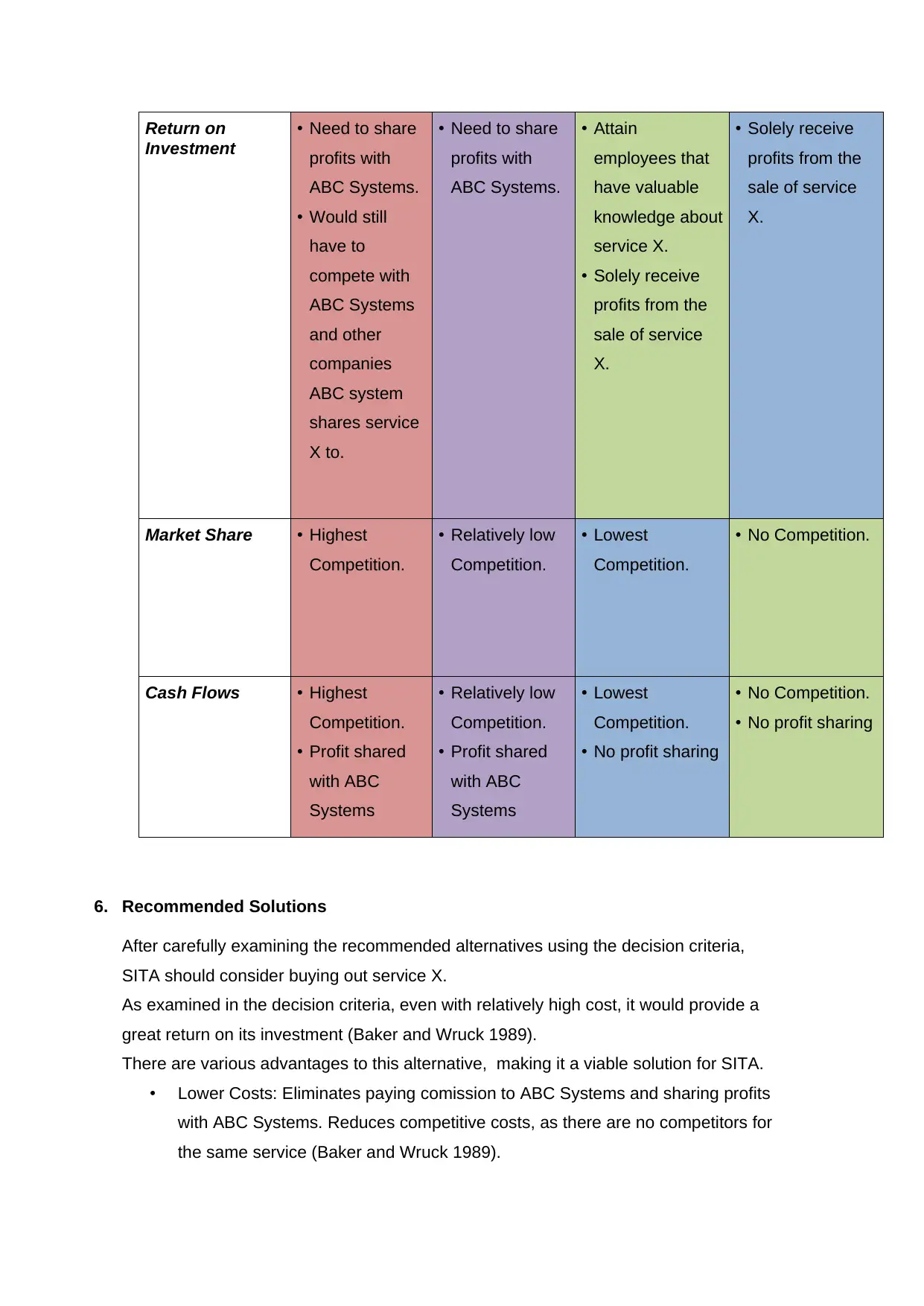
Return on
Investment
• Need to share
profits with
ABC Systems.
• Would still
have to
compete with
ABC Systems
and other
companies
ABC system
shares service
X to.
• Need to share
profits with
ABC Systems.
• Attain
employees that
have valuable
knowledge about
service X.
• Solely receive
profits from the
sale of service
X.
• Solely receive
profits from the
sale of service
X.
Market Share • Highest
Competition.
• Relatively low
Competition.
• Lowest
Competition.
• No Competition.
Cash Flows • Highest
Competition.
• Profit shared
with ABC
Systems
• Relatively low
Competition.
• Profit shared
with ABC
Systems
• Lowest
Competition.
• No profit sharing
• No Competition.
• No profit sharing
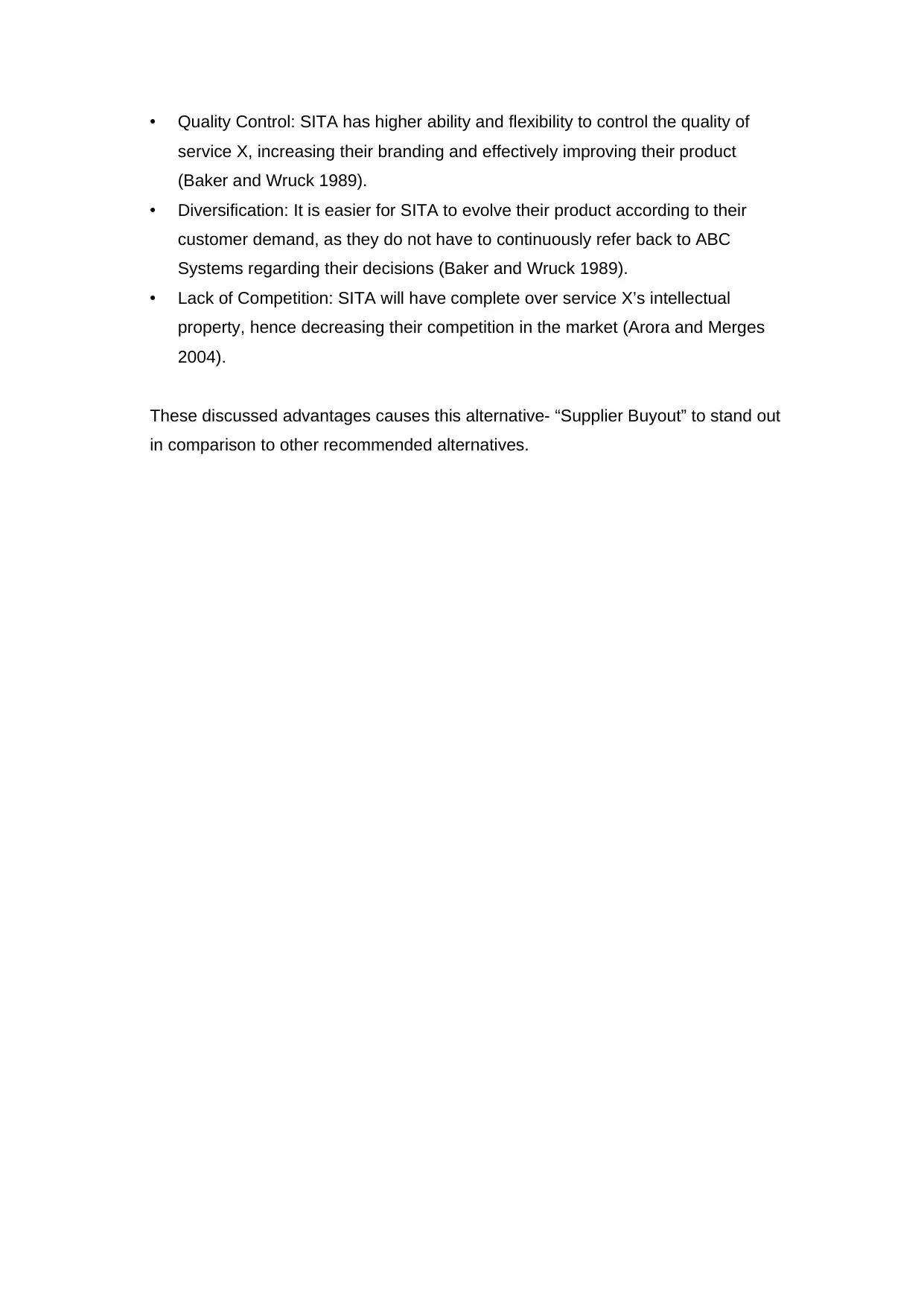
6. Recommended Solutions
After carefully examining the recommended alternatives using the decision criteria,
SITA should consider buying out service X.
As examined in the decision criteria, even with relatively high cost, it would provide a
great return on its investment (Baker and Wruck 1989).
There are various advantages to this alternative, making it a viable solution for SITA.
• Lower Costs: Eliminates paying comission to ABC Systems and sharing profits
with ABC Systems. Reduces competitive costs, as there are no competitors for
the same service (Baker and Wruck 1989).
Investment
• Need to share
profits with
ABC Systems.
• Would still
have to
compete with
ABC Systems
and other
companies
ABC system
shares service
X to.
• Need to share
profits with
ABC Systems.
• Attain
employees that
have valuable
knowledge about
service X.
• Solely receive
profits from the
sale of service
X.
• Solely receive
profits from the
sale of service
X.
Market Share • Highest
Competition.
• Relatively low
Competition.
• Lowest
Competition.
• No Competition.
Cash Flows • Highest
Competition.
• Profit shared
with ABC
Systems
• Relatively low
Competition.
• Profit shared
with ABC
Systems
• Lowest
Competition.
• No profit sharing
• No Competition.
• No profit sharing
6. Recommended Solutions
After carefully examining the recommended alternatives using the decision criteria,
SITA should consider buying out service X.
As examined in the decision criteria, even with relatively high cost, it would provide a
great return on its investment (Baker and Wruck 1989).
There are various advantages to this alternative, making it a viable solution for SITA.
• Lower Costs: Eliminates paying comission to ABC Systems and sharing profits
with ABC Systems. Reduces competitive costs, as there are no competitors for
the same service (Baker and Wruck 1989).
⊘ This is a preview!⊘
Do you want full access?
Subscribe today to unlock all pages.
Trusted by 1+ million students worldwide
• Quality Control: SITA has higher ability and flexibility to control the quality of
service X, increasing their branding and effectively improving their product
(Baker and Wruck 1989).
• Diversification: It is easier for SITA to evolve their product according to their
customer demand, as they do not have to continuously refer back to ABC
Systems regarding their decisions (Baker and Wruck 1989).
• Lack of Competition: SITA will have complete over service X’s intellectual
property, hence decreasing their competition in the market (Arora and Merges
2004).
These discussed advantages causes this alternative- “Supplier Buyout” to stand out
in comparison to other recommended alternatives.
service X, increasing their branding and effectively improving their product
(Baker and Wruck 1989).
• Diversification: It is easier for SITA to evolve their product according to their
customer demand, as they do not have to continuously refer back to ABC
Systems regarding their decisions (Baker and Wruck 1989).
• Lack of Competition: SITA will have complete over service X’s intellectual
property, hence decreasing their competition in the market (Arora and Merges
2004).
These discussed advantages causes this alternative- “Supplier Buyout” to stand out
in comparison to other recommended alternatives.
Paraphrase This Document
Need a fresh take? Get an instant paraphrase of this document with our AI Paraphraser
7. Implementations & Implications
SITA could potentially strategise a supplier buyout as a postitive investment in their
product portfolio. Since, service X highly relates with other services provided by SITA, it
integrates with SITA’s corporate image.
SITA could sign a contract with ABC Systems whereby they purchase the service for a
negotiated amount of monetary value. Since ABC Systems has restricted number of
employees and cloud computing facilities- it only makes sense for them to take up
SITA’s offer- with a large customer database and loyalty.
Since SITA has already tested service X, the basic analysis of the service has already
been discovered. Therefore, even if ABC Systems is not willing to sign a contract for a
‘supplier buyout’, SITA could always replicate service X. This idea would not be ethical
at SITA’s front, specially because they preach to corporate social responsibility and
pride themselves to be ethical.
Therefore, if the supplier buyout contract has been voided by ABC Systems- SITA
should consider discussing exclusivity with their distribution rights (exclusive
distributors), which would be the next best alternative (as disccused in the decision
criteria).
SITA could potentially strategise a supplier buyout as a postitive investment in their
product portfolio. Since, service X highly relates with other services provided by SITA, it
integrates with SITA’s corporate image.
SITA could sign a contract with ABC Systems whereby they purchase the service for a
negotiated amount of monetary value. Since ABC Systems has restricted number of
employees and cloud computing facilities- it only makes sense for them to take up
SITA’s offer- with a large customer database and loyalty.
Since SITA has already tested service X, the basic analysis of the service has already
been discovered. Therefore, even if ABC Systems is not willing to sign a contract for a
‘supplier buyout’, SITA could always replicate service X. This idea would not be ethical
at SITA’s front, specially because they preach to corporate social responsibility and
pride themselves to be ethical.
Therefore, if the supplier buyout contract has been voided by ABC Systems- SITA
should consider discussing exclusivity with their distribution rights (exclusive
distributors), which would be the next best alternative (as disccused in the decision
criteria).
8. References
Alkhafaji, Abbass F. 1991. 'Management Perceptions Towards Buyouts'. Management
Decision 29 (7). doi:10.1108/00251749110007058.
Arora, A., and R. P. Merges. 2004. 'Specialized Supply Firms, Property Rights And Firm
Boundaries'. Industrial And Corporate Change 13 (3): 451-475.
doi:10.1093/icc/dth018.
Asker, John William. 2015. 'Diagnosing Foreclosure Due To Exclusive Dealing'. SSRN
Electronic Journal. Accessed October 15. doi:10.2139/ssrn.609162.
Baker, George P., and Karen H. Wruck. 1989. 'Organizational Changes And Value
Creation In Leveraged Buyouts'. Journal Of Financial Economics 25 (2): 163-
190. doi:10.1016/0304-405x(89)90080-9.
Easterwood, Cintia M. 2015. 'Takeovers And Incentives For Earnings Management: An
Empirical Analysis'. Journal Of Applied Business Research (JABR) 14 (1): 29-
48. http://cluteinstitute.com/ojs/index.php/JABR/article/view/5726.
Nicolau, Juan L. 2013. 'Direct Versus Indirect Channels'. European Journal Of
Marketing 47 (1/2): 260-278. doi:10.1108/03090561311285547.
Sita. create success together,. 2015. 'Home | SITA'. http://www.sita.aero.
Alkhafaji, Abbass F. 1991. 'Management Perceptions Towards Buyouts'. Management
Decision 29 (7). doi:10.1108/00251749110007058.
Arora, A., and R. P. Merges. 2004. 'Specialized Supply Firms, Property Rights And Firm
Boundaries'. Industrial And Corporate Change 13 (3): 451-475.
doi:10.1093/icc/dth018.
Asker, John William. 2015. 'Diagnosing Foreclosure Due To Exclusive Dealing'. SSRN
Electronic Journal. Accessed October 15. doi:10.2139/ssrn.609162.
Baker, George P., and Karen H. Wruck. 1989. 'Organizational Changes And Value
Creation In Leveraged Buyouts'. Journal Of Financial Economics 25 (2): 163-
190. doi:10.1016/0304-405x(89)90080-9.
Easterwood, Cintia M. 2015. 'Takeovers And Incentives For Earnings Management: An
Empirical Analysis'. Journal Of Applied Business Research (JABR) 14 (1): 29-
48. http://cluteinstitute.com/ojs/index.php/JABR/article/view/5726.
Nicolau, Juan L. 2013. 'Direct Versus Indirect Channels'. European Journal Of
Marketing 47 (1/2): 260-278. doi:10.1108/03090561311285547.
Sita. create success together,. 2015. 'Home | SITA'. http://www.sita.aero.
⊘ This is a preview!⊘
Do you want full access?
Subscribe today to unlock all pages.
Trusted by 1+ million students worldwide

1 out of 12


Your All-in-One AI-Powered Toolkit for Academic Success.
+13062052269
info@desklib.com
Available 24*7 on WhatsApp / Email
![[object Object]](/_next/static/media/star-bottom.7253800d.svg)
Unlock your academic potential
Copyright © 2020–2026 A2Z Services. All Rights Reserved. Developed and managed by ZUCOL.