Routine Site Monitoring: CRA Activities and Responsibilities
VerifiedAdded on  2021/04/21
|9
|1799
|214
Report
AI Summary
This report provides a detailed overview of routine site monitoring in clinical trials, emphasizing the crucial role of Clinical Research Associates (CRAs). It outlines the activities conducted by CRAs throughout the trial lifecycle, from site selection and initiation to regular monitoring and site closeout. The report covers various aspects of CRA responsibilities, including communication with investigators and sponsors, verification of data and documentation, management of investigational products, and ensuring subject safety and regulatory compliance. Different types of site visits, such as site selection, initiation, regular monitoring, and closeout visits, are discussed, highlighting the specific tasks and knowledge required for each. The report also emphasizes the importance of source data verification, adverse event reporting, and maintaining the integrity of clinical trial data. Overall, the report underscores the significance of CRA activities in ensuring the quality, reliability, and ethical conduct of clinical trials, ultimately protecting the rights and well-being of research subjects. The report concludes by summarizing the critical role of CRAs in maintaining communication between sponsors and investigators, conducting verification processes, and ensuring adherence to approved protocols. The report also includes comprehensive references to support the information presented.
Running Head: ROUTINE SITE MONITORING 0
Routine Site Monitoring and activities conducted by CRA
Student details
Routine Site Monitoring and activities conducted by CRA
Student details
Paraphrase This Document
Need a fresh take? Get an instant paraphrase of this document with our AI Paraphraser

ROUTINE SITE MONITORING 1
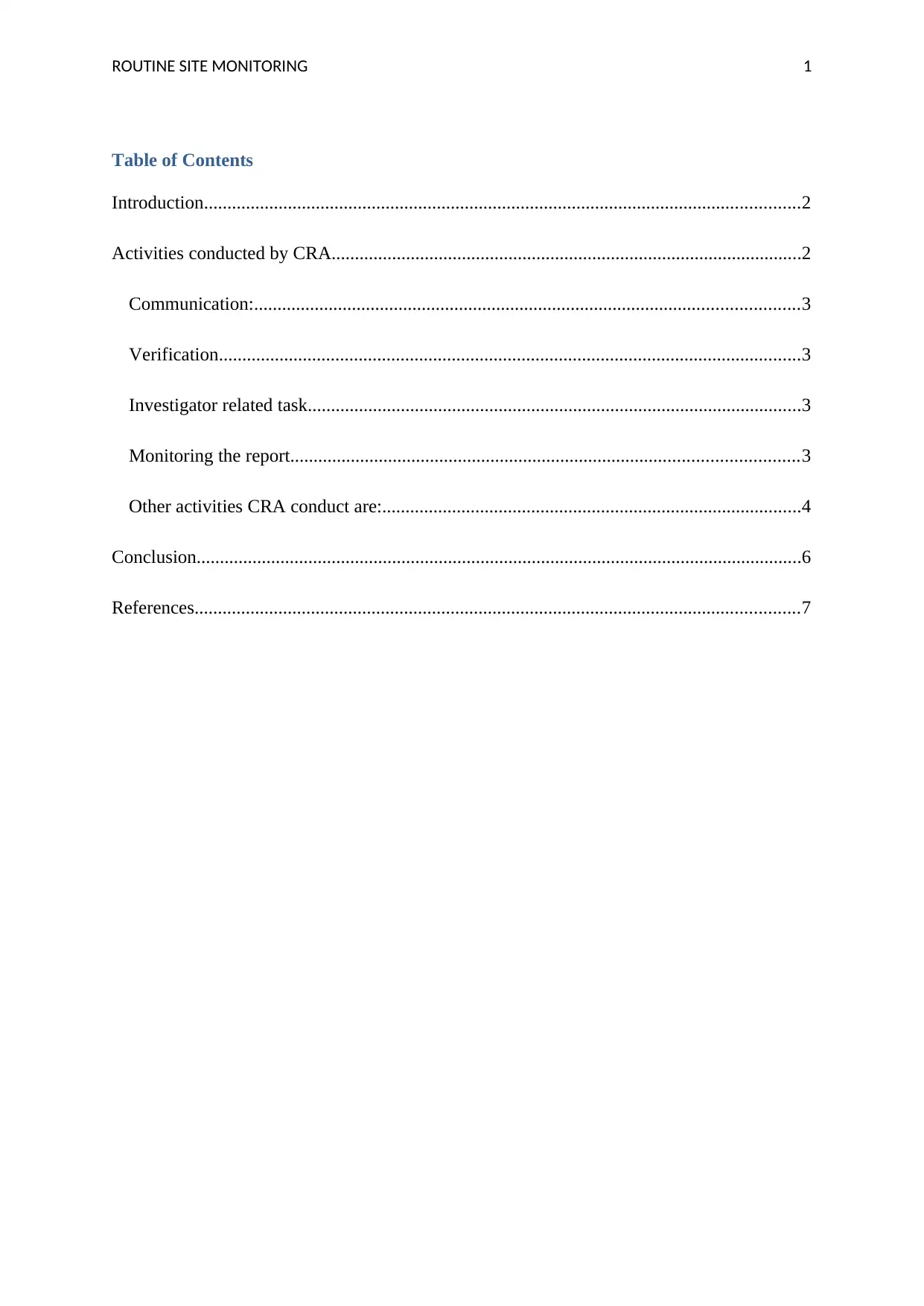
Table of Contents
Introduction................................................................................................................................2
Activities conducted by CRA.....................................................................................................2
Communication:.....................................................................................................................3
Verification.............................................................................................................................3
Investigator related task..........................................................................................................3
Monitoring the report.............................................................................................................3
Other activities CRA conduct are:..........................................................................................4
Conclusion..................................................................................................................................6
References..................................................................................................................................7
Table of Contents
Introduction................................................................................................................................2
Activities conducted by CRA.....................................................................................................2
Communication:.....................................................................................................................3
Verification.............................................................................................................................3
Investigator related task..........................................................................................................3
Monitoring the report.............................................................................................................3
Other activities CRA conduct are:..........................................................................................4
Conclusion..................................................................................................................................6
References..................................................................................................................................7

ROUTINE SITE MONITORING 2
Introduction
Routine monitoring visits are described as any visit that takes place after the initiation of the
site and up until the closing of the side. The monitors’ visits the sites to make sure that all the
regulations, subject, and safety measure are followed, the record has been taken or noted
timely and in a reliable manner, handling of the investigational product is carried out as per
the protocol and guidelines. The purpose of site monitoring visits also includes ensuring that
there no significant difference from the planned study and to protect the subject safety 1.
Regulatory requirements for a CRA
ï‚· A CRA or study monitor should be trained appropriately
ï‚· Should have the clinical or scientific knowledge
ï‚· Should have documented qualification
Activities conducted by CRA
CRA or a monitor is the one who is responsible for visiting the sites to make that the clinical
trials conducted properly. The study monitor or the CRA is a site advocate & the liaison for
the sponsor’s operational processes. Monitors are appointed by the sponsors. The CRAs
activities include visiting sites, to make sure the compliances, subject safety. After the CRA
is assigned a site, he or she establishes CRA guidelines 2. The guidelines include
ï‚· The Internal communication chain of CRA
ï‚· The authorized person to whom the CRA will report about the incidence or about the
visit
ï‚· The communication of the CRA with the site
ï‚· Communication with sponsors
Introduction
Routine monitoring visits are described as any visit that takes place after the initiation of the
site and up until the closing of the side. The monitors’ visits the sites to make sure that all the
regulations, subject, and safety measure are followed, the record has been taken or noted
timely and in a reliable manner, handling of the investigational product is carried out as per
the protocol and guidelines. The purpose of site monitoring visits also includes ensuring that
there no significant difference from the planned study and to protect the subject safety 1.
Regulatory requirements for a CRA
ï‚· A CRA or study monitor should be trained appropriately
ï‚· Should have the clinical or scientific knowledge
ï‚· Should have documented qualification
Activities conducted by CRA
CRA or a monitor is the one who is responsible for visiting the sites to make that the clinical
trials conducted properly. The study monitor or the CRA is a site advocate & the liaison for
the sponsor’s operational processes. Monitors are appointed by the sponsors. The CRAs
activities include visiting sites, to make sure the compliances, subject safety. After the CRA
is assigned a site, he or she establishes CRA guidelines 2. The guidelines include
ï‚· The Internal communication chain of CRA
ï‚· The authorized person to whom the CRA will report about the incidence or about the
visit
ï‚· The communication of the CRA with the site
ï‚· Communication with sponsors
⊘ This is a preview!⊘
Do you want full access?
Subscribe today to unlock all pages.

Trusted by 1+ million students worldwide

ROUTINE SITE MONITORING 3
Activities conducted by CRA
Communication:
A monitor is also responsible for the communication between the investigator and the
sponsor. In addition, communicating the deviations from the SOPs, protocols, and GCP to the
authorized investigator and taking necessary action designed to stop the recurrence of the
deviations 3.
Verification
ï‚· A CRA or monitor is responsible for verifying the qualification of the investigator and
associated resources during the whole study
ï‚· Verify the storage, dispensation, and return of the investigational product.
ï‚· Verifying that the information is collected in a written format before each the
subject’s participation in a trial 4.
Investigator related task
ï‚· Make sure that the investigator is following the approved protocol or amendments
ï‚· The main task of the CRA is to make sure that an investigator should be provided
updated investigators brochure and safety information.
ï‚· Making sure that the investigator and the staff of the investigator is informed about
the task on the time 5
ï‚· Verify the eligibility of the subject that is enrolled by the investigators
ï‚· Also, verify that the investigators and his/her trail staff are appropriately performing
the function according to the protocol and not delegated the work to other staff 6.
Monitoring the report
The monitor submits a written report to the sponsor after each site visit. The report includes
the date, site, name of the investigator, monitor, and other individuals. It also contains the
Activities conducted by CRA
Communication:
A monitor is also responsible for the communication between the investigator and the
sponsor. In addition, communicating the deviations from the SOPs, protocols, and GCP to the
authorized investigator and taking necessary action designed to stop the recurrence of the
deviations 3.
Verification
ï‚· A CRA or monitor is responsible for verifying the qualification of the investigator and
associated resources during the whole study
ï‚· Verify the storage, dispensation, and return of the investigational product.
ï‚· Verifying that the information is collected in a written format before each the
subject’s participation in a trial 4.
Investigator related task
ï‚· Make sure that the investigator is following the approved protocol or amendments
ï‚· The main task of the CRA is to make sure that an investigator should be provided
updated investigators brochure and safety information.
ï‚· Making sure that the investigator and the staff of the investigator is informed about
the task on the time 5
ï‚· Verify the eligibility of the subject that is enrolled by the investigators
ï‚· Also, verify that the investigators and his/her trail staff are appropriately performing
the function according to the protocol and not delegated the work to other staff 6.
Monitoring the report
The monitor submits a written report to the sponsor after each site visit. The report includes
the date, site, name of the investigator, monitor, and other individuals. It also contains the
Paraphrase This Document
Need a fresh take? Get an instant paraphrase of this document with our AI Paraphraser

ROUTINE SITE MONITORING 4
summary of the review and statement of the work done, deviations, deficiencies, actions are
taken, conclusion and recommendations 7.
Other activities CRA conduct are:
ï‚· To inform the investigator if any error has been found related the CRF, omission or
illegibility. The monitor is responsible to ensure that the correction, deletions or
additions are made to make CRF changes.
ï‚· The CRA determines whether an investigator is appropriately maintaining the
necessary documents. He/she also determines that all the adverse events are timely
reported by GCP, the IRB, the protocol, the sponsor and other applicable authorities.
ï‚· Regulatory compliances
ï‚· Source data verification
ï‚· Completion of the case report forms (CRFs)
ï‚· Adverse event reporting 8
The activities conducted by a CRA varies with the type of visits
Types of site monitor visits
Site selection visits
Also known as pre-study visits or site qualification visits takes place to ensure the capability
of the investigator and the clinical site to conduct a study. During these types of visits, both
coordinator and investigator should be available at the sites. During these types of site visits,
the sponsor sends CRA for a site selection visit. In addition, CRA makes sure that the
assigned site has sufficient experience to conduct the study. These types of sites are easy
generally straightforward and comparatively easy because it does not require a CRA to have
depth knowledge 9.
summary of the review and statement of the work done, deviations, deficiencies, actions are
taken, conclusion and recommendations 7.
Other activities CRA conduct are:
ï‚· To inform the investigator if any error has been found related the CRF, omission or
illegibility. The monitor is responsible to ensure that the correction, deletions or
additions are made to make CRF changes.
ï‚· The CRA determines whether an investigator is appropriately maintaining the
necessary documents. He/she also determines that all the adverse events are timely
reported by GCP, the IRB, the protocol, the sponsor and other applicable authorities.
ï‚· Regulatory compliances
ï‚· Source data verification
ï‚· Completion of the case report forms (CRFs)
ï‚· Adverse event reporting 8
The activities conducted by a CRA varies with the type of visits
Types of site monitor visits
Site selection visits
Also known as pre-study visits or site qualification visits takes place to ensure the capability
of the investigator and the clinical site to conduct a study. During these types of visits, both
coordinator and investigator should be available at the sites. During these types of site visits,
the sponsor sends CRA for a site selection visit. In addition, CRA makes sure that the
assigned site has sufficient experience to conduct the study. These types of sites are easy
generally straightforward and comparatively easy because it does not require a CRA to have
depth knowledge 9.

ROUTINE SITE MONITORING 5
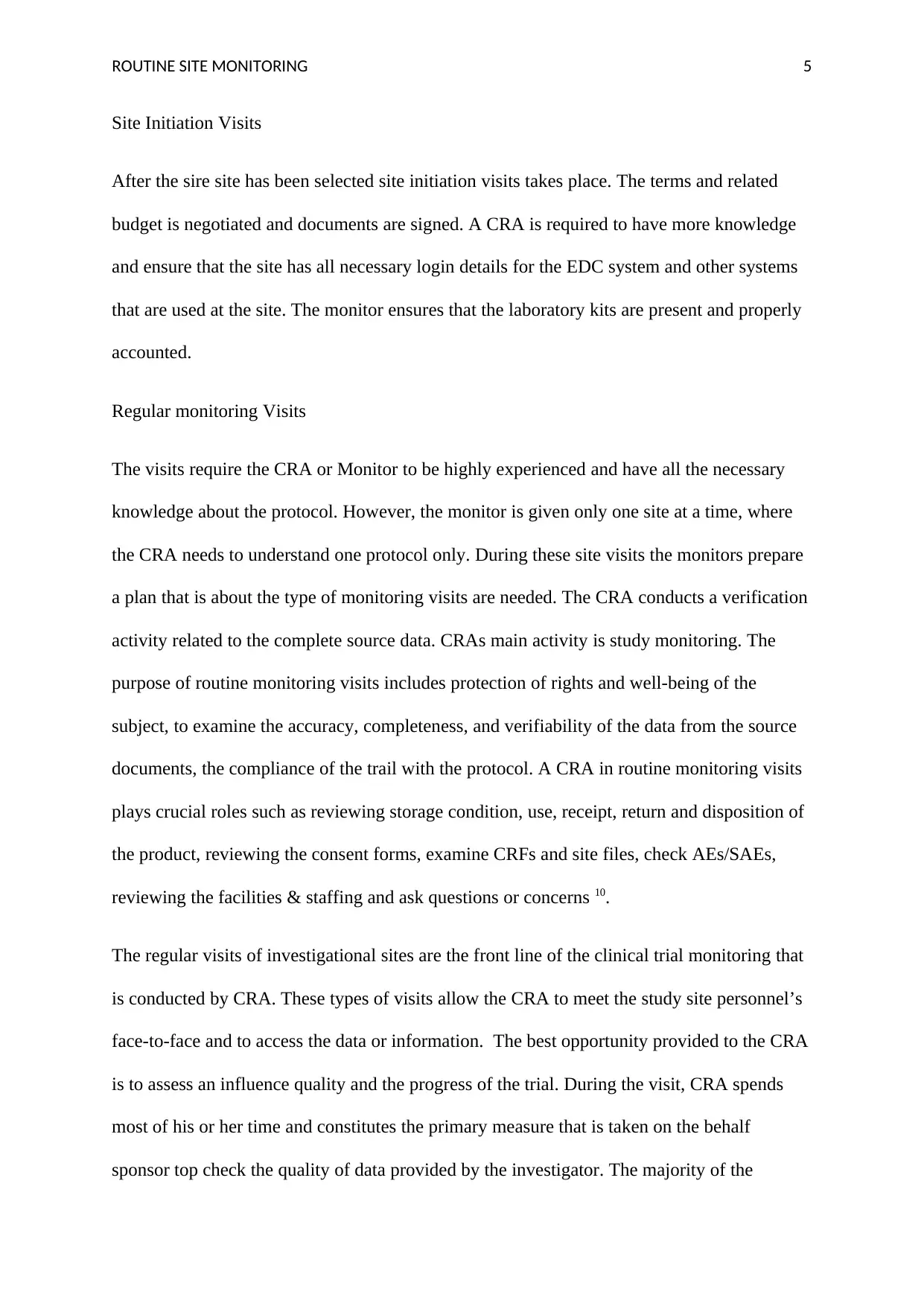
Site Initiation Visits
After the sire site has been selected site initiation visits takes place. The terms and related
budget is negotiated and documents are signed. A CRA is required to have more knowledge
and ensure that the site has all necessary login details for the EDC system and other systems
that are used at the site. The monitor ensures that the laboratory kits are present and properly
accounted.
Regular monitoring Visits
The visits require the CRA or Monitor to be highly experienced and have all the necessary
knowledge about the protocol. However, the monitor is given only one site at a time, where
the CRA needs to understand one protocol only. During these site visits the monitors prepare
a plan that is about the type of monitoring visits are needed. The CRA conducts a verification
activity related to the complete source data. CRAs main activity is study monitoring. The
purpose of routine monitoring visits includes protection of rights and well-being of the
subject, to examine the accuracy, completeness, and verifiability of the data from the source
documents, the compliance of the trail with the protocol. A CRA in routine monitoring visits
plays crucial roles such as reviewing storage condition, use, receipt, return and disposition of
the product, reviewing the consent forms, examine CRFs and site files, check AEs/SAEs,
reviewing the facilities & staffing and ask questions or concerns 10.
The regular visits of investigational sites are the front line of the clinical trial monitoring that
is conducted by CRA. These types of visits allow the CRA to meet the study site personnel’s
face-to-face and to access the data or information. The best opportunity provided to the CRA
is to assess an influence quality and the progress of the trial. During the visit, CRA spends
most of his or her time and constitutes the primary measure that is taken on the behalf
sponsor top check the quality of data provided by the investigator. The majority of the
Site Initiation Visits
After the sire site has been selected site initiation visits takes place. The terms and related
budget is negotiated and documents are signed. A CRA is required to have more knowledge
and ensure that the site has all necessary login details for the EDC system and other systems
that are used at the site. The monitor ensures that the laboratory kits are present and properly
accounted.
Regular monitoring Visits
The visits require the CRA or Monitor to be highly experienced and have all the necessary
knowledge about the protocol. However, the monitor is given only one site at a time, where
the CRA needs to understand one protocol only. During these site visits the monitors prepare
a plan that is about the type of monitoring visits are needed. The CRA conducts a verification
activity related to the complete source data. CRAs main activity is study monitoring. The
purpose of routine monitoring visits includes protection of rights and well-being of the
subject, to examine the accuracy, completeness, and verifiability of the data from the source
documents, the compliance of the trail with the protocol. A CRA in routine monitoring visits
plays crucial roles such as reviewing storage condition, use, receipt, return and disposition of
the product, reviewing the consent forms, examine CRFs and site files, check AEs/SAEs,
reviewing the facilities & staffing and ask questions or concerns 10.
The regular visits of investigational sites are the front line of the clinical trial monitoring that
is conducted by CRA. These types of visits allow the CRA to meet the study site personnel’s
face-to-face and to access the data or information. The best opportunity provided to the CRA
is to assess an influence quality and the progress of the trial. During the visit, CRA spends
most of his or her time and constitutes the primary measure that is taken on the behalf
sponsor top check the quality of data provided by the investigator. The majority of the
⊘ This is a preview!⊘
Do you want full access?
Subscribe today to unlock all pages.

Trusted by 1+ million students worldwide

ROUTINE SITE MONITORING 6
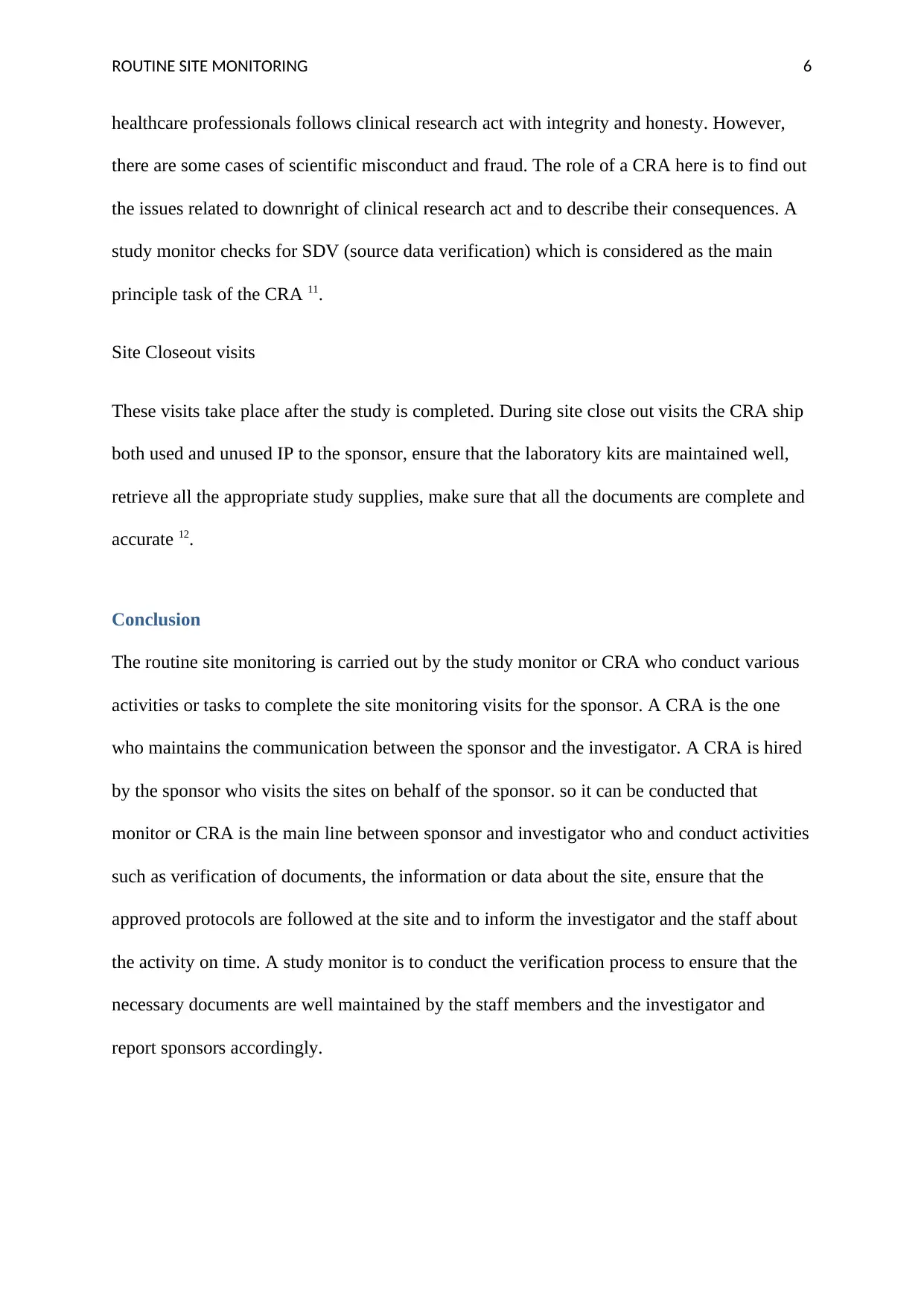
healthcare professionals follows clinical research act with integrity and honesty. However,
there are some cases of scientific misconduct and fraud. The role of a CRA here is to find out
the issues related to downright of clinical research act and to describe their consequences. A
study monitor checks for SDV (source data verification) which is considered as the main
principle task of the CRA 11.
Site Closeout visits
These visits take place after the study is completed. During site close out visits the CRA ship
both used and unused IP to the sponsor, ensure that the laboratory kits are maintained well,
retrieve all the appropriate study supplies, make sure that all the documents are complete and
accurate 12.
Conclusion
The routine site monitoring is carried out by the study monitor or CRA who conduct various
activities or tasks to complete the site monitoring visits for the sponsor. A CRA is the one
who maintains the communication between the sponsor and the investigator. A CRA is hired
by the sponsor who visits the sites on behalf of the sponsor. so it can be conducted that
monitor or CRA is the main line between sponsor and investigator who and conduct activities
such as verification of documents, the information or data about the site, ensure that the
approved protocols are followed at the site and to inform the investigator and the staff about
the activity on time. A study monitor is to conduct the verification process to ensure that the
necessary documents are well maintained by the staff members and the investigator and
report sponsors accordingly.
healthcare professionals follows clinical research act with integrity and honesty. However,
there are some cases of scientific misconduct and fraud. The role of a CRA here is to find out
the issues related to downright of clinical research act and to describe their consequences. A
study monitor checks for SDV (source data verification) which is considered as the main
principle task of the CRA 11.
Site Closeout visits
These visits take place after the study is completed. During site close out visits the CRA ship
both used and unused IP to the sponsor, ensure that the laboratory kits are maintained well,
retrieve all the appropriate study supplies, make sure that all the documents are complete and
accurate 12.
Conclusion
The routine site monitoring is carried out by the study monitor or CRA who conduct various
activities or tasks to complete the site monitoring visits for the sponsor. A CRA is the one
who maintains the communication between the sponsor and the investigator. A CRA is hired
by the sponsor who visits the sites on behalf of the sponsor. so it can be conducted that
monitor or CRA is the main line between sponsor and investigator who and conduct activities
such as verification of documents, the information or data about the site, ensure that the
approved protocols are followed at the site and to inform the investigator and the staff about
the activity on time. A study monitor is to conduct the verification process to ensure that the
necessary documents are well maintained by the staff members and the investigator and
report sponsors accordingly.
Paraphrase This Document
Need a fresh take? Get an instant paraphrase of this document with our AI Paraphraser

ROUTINE SITE MONITORING 7
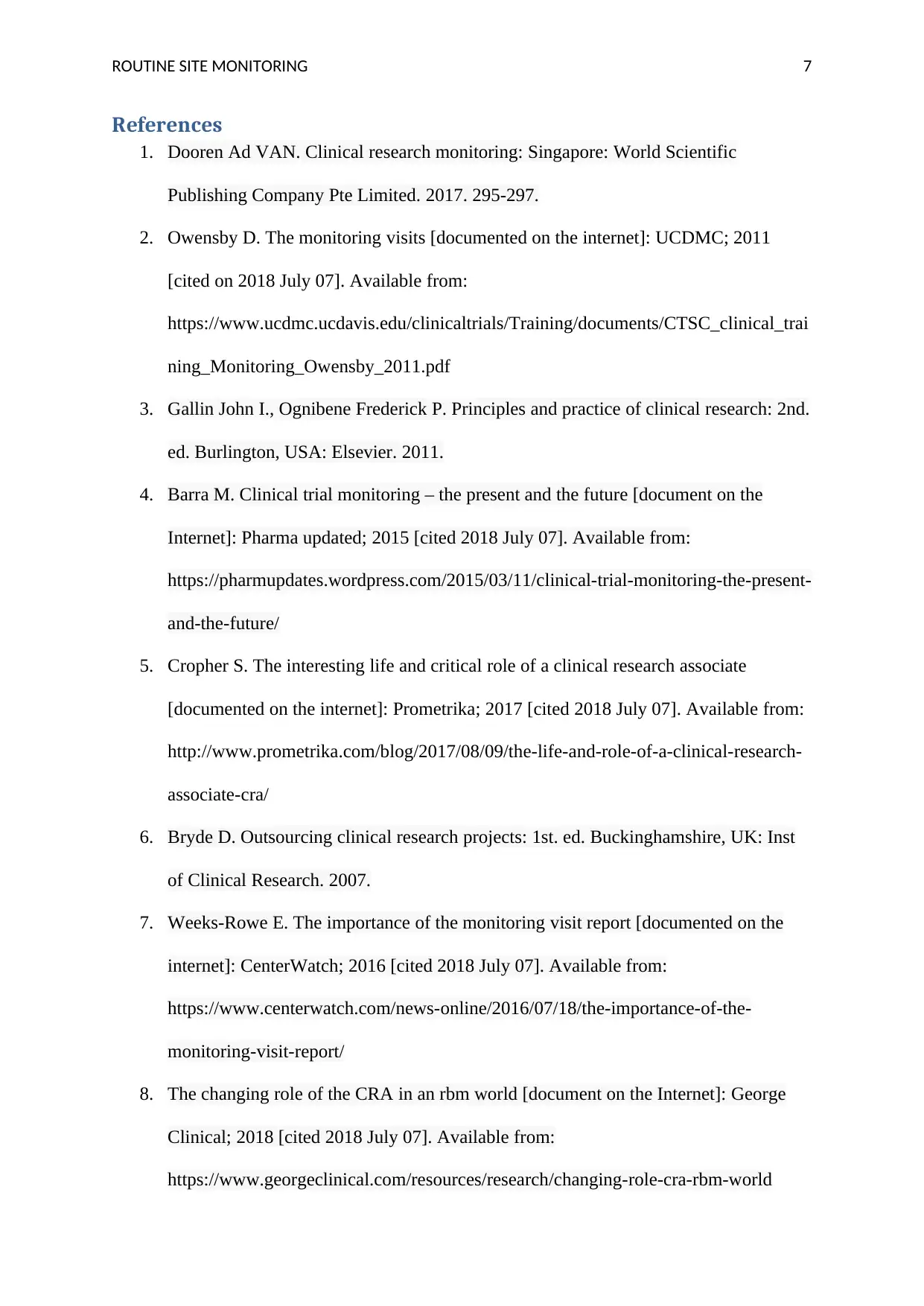
References
1. Dooren Ad VAN. Clinical research monitoring: Singapore: World Scientific
Publishing Company Pte Limited. 2017. 295-297.
2. Owensby D. The monitoring visits [documented on the internet]: UCDMC; 2011
[cited on 2018 July 07]. Available from:
https://www.ucdmc.ucdavis.edu/clinicaltrials/Training/documents/CTSC_clinical_trai
ning_Monitoring_Owensby_2011.pdf
3. Gallin John I., Ognibene Frederick P. Principles and practice of clinical research: 2nd.
ed. Burlington, USA: Elsevier. 2011.
4. Barra M. Clinical trial monitoring – the present and the future [document on the
Internet]: Pharma updated; 2015 [cited 2018 July 07]. Available from:
https://pharmupdates.wordpress.com/2015/03/11/clinical-trial-monitoring-the-present-
and-the-future/
5. Cropher S. The interesting life and critical role of a clinical research associate
[documented on the internet]: Prometrika; 2017 [cited 2018 July 07]. Available from:
http://www.prometrika.com/blog/2017/08/09/the-life-and-role-of-a-clinical-research-
associate-cra/
6. Bryde D. Outsourcing clinical research projects: 1st. ed. Buckinghamshire, UK: Inst
of Clinical Research. 2007.
7. Weeks-Rowe E. The importance of the monitoring visit report [documented on the
internet]: CenterWatch; 2016 [cited 2018 July 07]. Available from:
https://www.centerwatch.com/news-online/2016/07/18/the-importance-of-the-
monitoring-visit-report/
8. The changing role of the CRA in an rbm world [document on the Internet]: George
Clinical; 2018 [cited 2018 July 07]. Available from:
https://www.georgeclinical.com/resources/research/changing-role-cra-rbm-world
References
1. Dooren Ad VAN. Clinical research monitoring: Singapore: World Scientific
Publishing Company Pte Limited. 2017. 295-297.
2. Owensby D. The monitoring visits [documented on the internet]: UCDMC; 2011
[cited on 2018 July 07]. Available from:
https://www.ucdmc.ucdavis.edu/clinicaltrials/Training/documents/CTSC_clinical_trai
ning_Monitoring_Owensby_2011.pdf
3. Gallin John I., Ognibene Frederick P. Principles and practice of clinical research: 2nd.
ed. Burlington, USA: Elsevier. 2011.
4. Barra M. Clinical trial monitoring – the present and the future [document on the
Internet]: Pharma updated; 2015 [cited 2018 July 07]. Available from:
https://pharmupdates.wordpress.com/2015/03/11/clinical-trial-monitoring-the-present-
and-the-future/
5. Cropher S. The interesting life and critical role of a clinical research associate
[documented on the internet]: Prometrika; 2017 [cited 2018 July 07]. Available from:
http://www.prometrika.com/blog/2017/08/09/the-life-and-role-of-a-clinical-research-
associate-cra/
6. Bryde D. Outsourcing clinical research projects: 1st. ed. Buckinghamshire, UK: Inst
of Clinical Research. 2007.
7. Weeks-Rowe E. The importance of the monitoring visit report [documented on the
internet]: CenterWatch; 2016 [cited 2018 July 07]. Available from:
https://www.centerwatch.com/news-online/2016/07/18/the-importance-of-the-
monitoring-visit-report/
8. The changing role of the CRA in an rbm world [document on the Internet]: George
Clinical; 2018 [cited 2018 July 07]. Available from:
https://www.georgeclinical.com/resources/research/changing-role-cra-rbm-world

ROUTINE SITE MONITORING 8
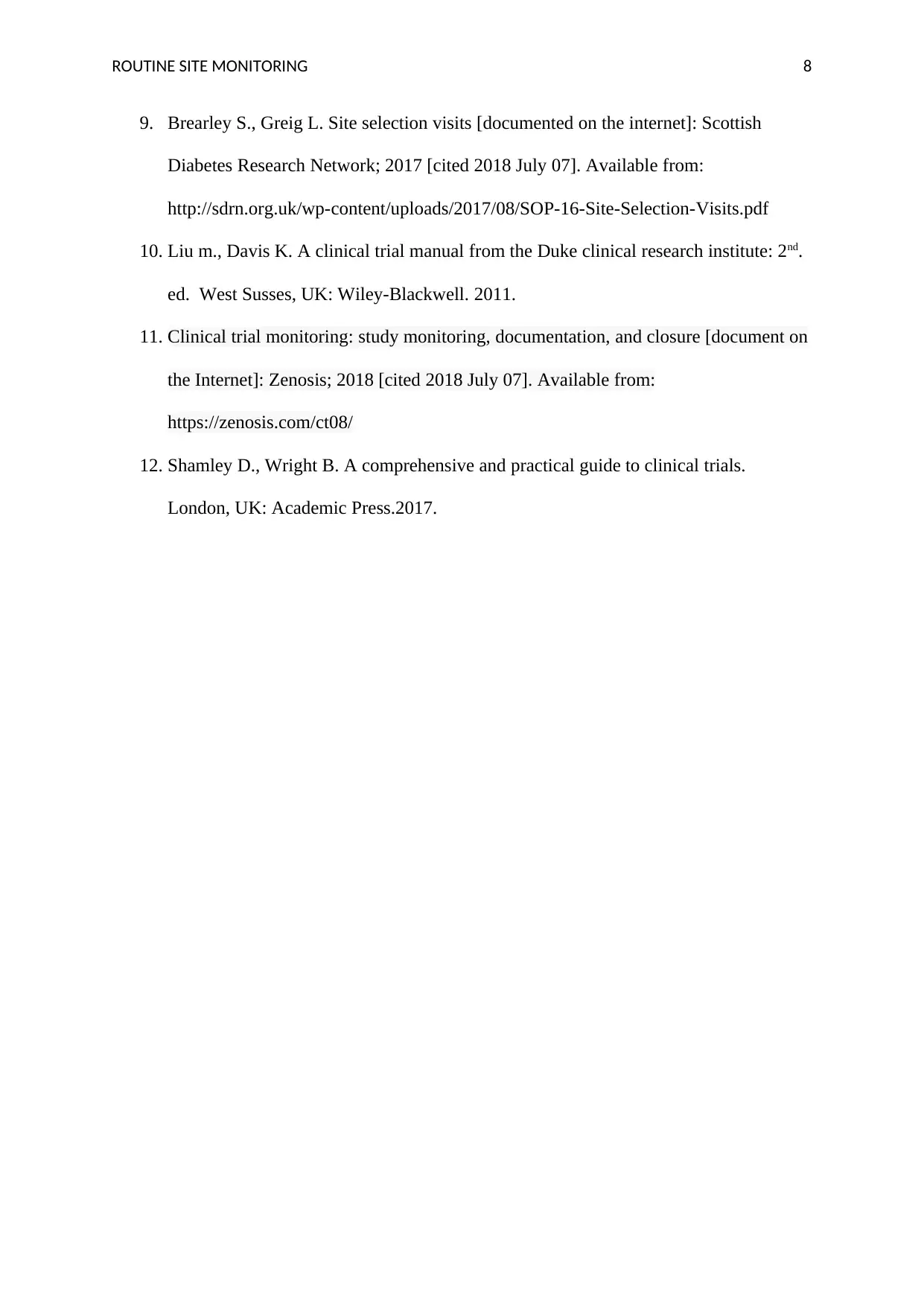
9. Brearley S., Greig L. Site selection visits [documented on the internet]: Scottish
Diabetes Research Network; 2017 [cited 2018 July 07]. Available from:
http://sdrn.org.uk/wp-content/uploads/2017/08/SOP-16-Site-Selection-Visits.pdf
10. Liu m., Davis K. A clinical trial manual from the Duke clinical research institute: 2nd.
ed. West Susses, UK: Wiley-Blackwell. 2011.
11. Clinical trial monitoring: study monitoring, documentation, and closure [document on
the Internet]: Zenosis; 2018 [cited 2018 July 07]. Available from:
https://zenosis.com/ct08/
12. Shamley D., Wright B. A comprehensive and practical guide to clinical trials.
London, UK: Academic Press.2017.
9. Brearley S., Greig L. Site selection visits [documented on the internet]: Scottish
Diabetes Research Network; 2017 [cited 2018 July 07]. Available from:
http://sdrn.org.uk/wp-content/uploads/2017/08/SOP-16-Site-Selection-Visits.pdf
10. Liu m., Davis K. A clinical trial manual from the Duke clinical research institute: 2nd.
ed. West Susses, UK: Wiley-Blackwell. 2011.
11. Clinical trial monitoring: study monitoring, documentation, and closure [document on
the Internet]: Zenosis; 2018 [cited 2018 July 07]. Available from:
https://zenosis.com/ct08/
12. Shamley D., Wright B. A comprehensive and practical guide to clinical trials.
London, UK: Academic Press.2017.
⊘ This is a preview!⊘
Do you want full access?
Subscribe today to unlock all pages.

Trusted by 1+ million students worldwide
1 out of 9
Related Documents
Your All-in-One AI-Powered Toolkit for Academic Success.
 +13062052269
info@desklib.com
Available 24*7 on WhatsApp / Email
Unlock your academic potential
Copyright © 2020–2025 A2Z Services. All Rights Reserved. Developed and managed by ZUCOL.