SITXCOM002 Show Social and Cultural Sensitivity Assignment Analysis
VerifiedAdded on 2022/09/17
|53
|6553
|26
Homework Assignment
AI Summary
This document presents a completed assignment for the unit SITXCOM002, focusing on demonstrating social and cultural sensitivity in a workplace context. It addresses key aspects such as defining cultural responsivity, identifying ways to treat people with respect, and understanding Australian anti-discrimination laws. The assignment delves into verbal and non-verbal communication skills, non-discriminatory practices, and strategies for overcoming language barriers. It also explores conflict resolution, including identifying cultural issues that may cause misunderstandings, providing advice on resolving conflicts, and understanding the role of mediation. Furthermore, the assignment considers social and cultural factors when dealing with disputes and discusses escalating unresolved issues to appropriate supervisors. The provided answers demonstrate an understanding of respecting diverse backgrounds, effective communication, and promoting an inclusive work environment.
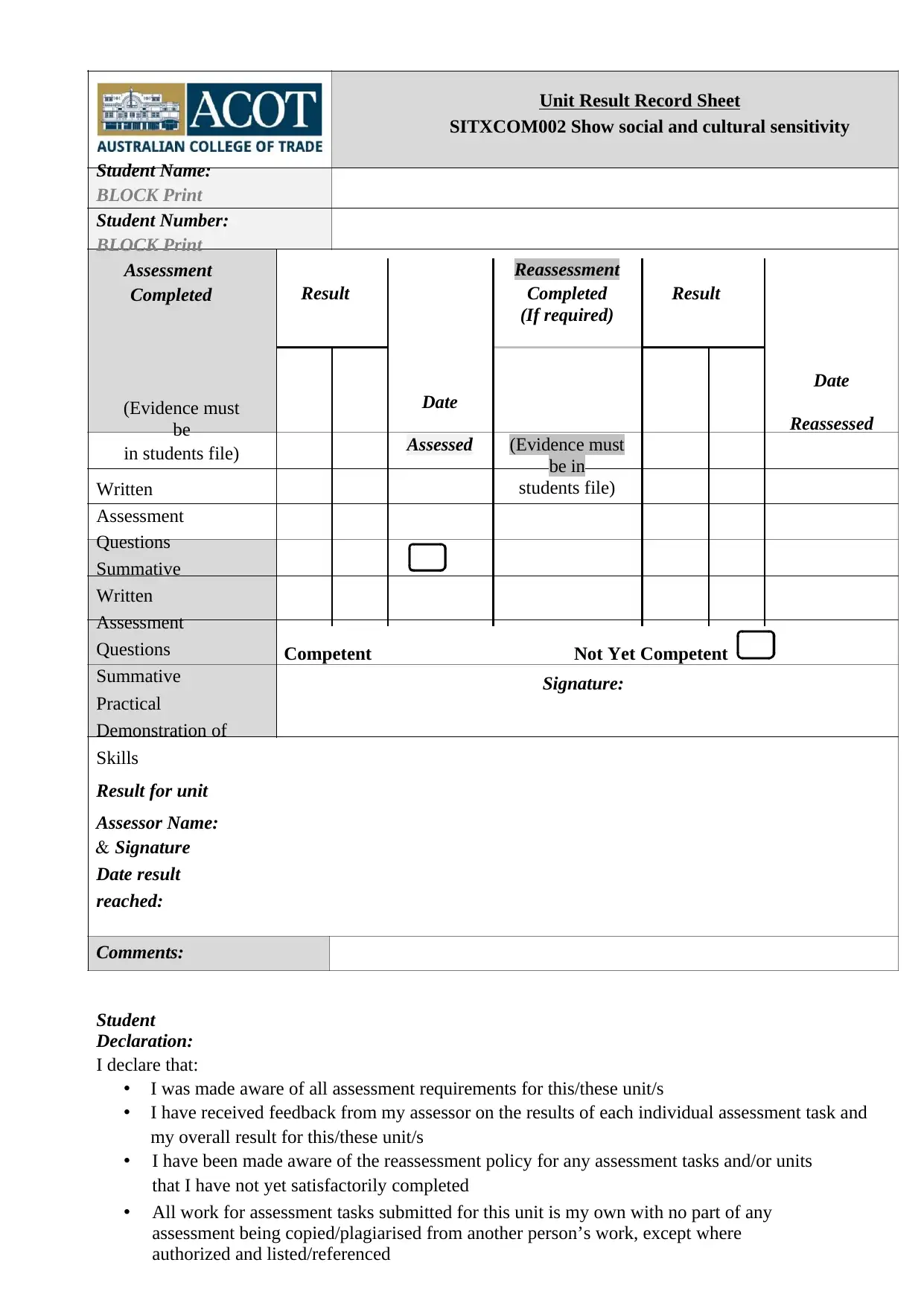
Unit Result Record Sheet
SITXCOM002 Show social and cultural sensitivity
Student Name:
BLOCK Print
Student Number:
BLOCK Print
Assessment
Completed
(Evidence must
be
in students file)
Written
Assessment
Questions
Summative
Written
Assessment
Questions
Summative
Practical
Demonstration of
Skills
Result for unit
Assessor Name:
& Signature
Date result
reached:
Comments:
Student
Declaration:
I declare that:
Reassessment
Result Completed Result
(If required)
Date
Date
Reassessed
Assessed (Evidence must
be in
students file)
Competent Not Yet Competent
Signature:
• I was made aware of all assessment requirements for this/these unit/s
• I have received feedback from my assessor on the results of each individual assessment task and
my overall result for this/these unit/s
• I have been made aware of the reassessment policy for any assessment tasks and/or units
that I have not yet satisfactorily completed
• All work for assessment tasks submitted for this unit is my own with no part of any
assessment being copied/plagiarised from another person’s work, except where
authorized and listed/referenced
SITXCOM002 Show social and cultural sensitivity
Student Name:
BLOCK Print
Student Number:
BLOCK Print
Assessment
Completed
(Evidence must
be
in students file)
Written
Assessment
Questions
Summative
Written
Assessment
Questions
Summative
Practical
Demonstration of
Skills
Result for unit
Assessor Name:
& Signature
Date result
reached:
Comments:
Student
Declaration:
I declare that:
Reassessment
Result Completed Result
(If required)
Date
Date
Reassessed
Assessed (Evidence must
be in
students file)
Competent Not Yet Competent
Signature:
• I was made aware of all assessment requirements for this/these unit/s
• I have received feedback from my assessor on the results of each individual assessment task and
my overall result for this/these unit/s
• I have been made aware of the reassessment policy for any assessment tasks and/or units
that I have not yet satisfactorily completed
• All work for assessment tasks submitted for this unit is my own with no part of any
assessment being copied/plagiarised from another person’s work, except where
authorized and listed/referenced

Paraphrase This Document
Need a fresh take? Get an instant paraphrase of this document with our AI Paraphraser
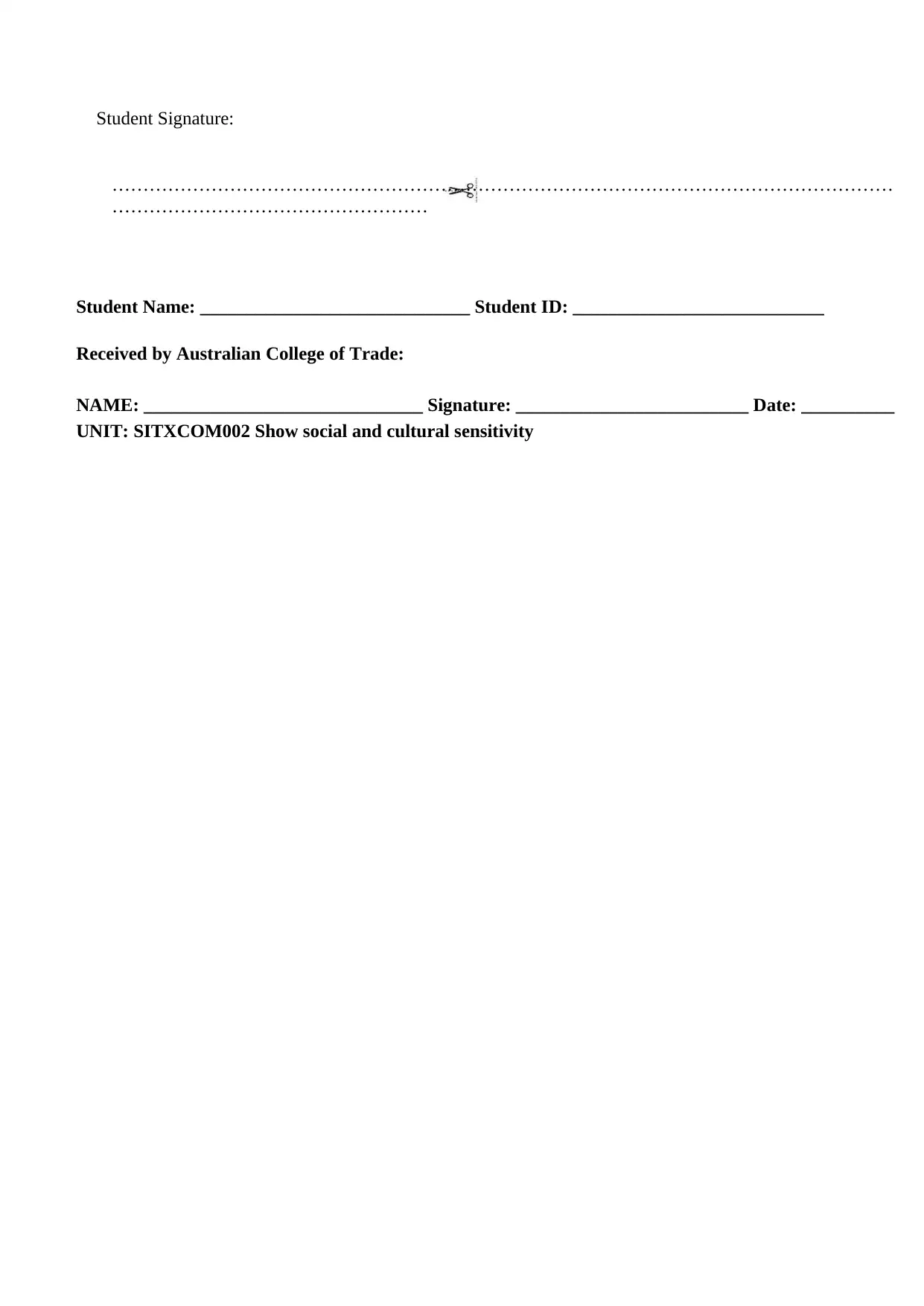
Student Signature:
………………………………………………………………………………………………………………
……………………………………………
Student Name: _____________________________ Student ID: ___________________________
Received by Australian College of Trade:
NAME: ______________________________ Signature: _________________________ Date: __________
UNIT: SITXCOM002 Show social and cultural sensitivity
………………………………………………………………………………………………………………
……………………………………………
Student Name: _____________________________ Student ID: ___________________________
Received by Australian College of Trade:
NAME: ______________________________ Signature: _________________________ Date: __________
UNIT: SITXCOM002 Show social and cultural sensitivity

P a g e | 1
SITXCOM002
Show social and cultural sensitivity
Learner Workbook
VCID. ACOT Training and Assessment/SITXCOM002/Learner Workbook/V1.2/July 2019
SITXCOM002
Show social and cultural sensitivity
Learner Workbook
VCID. ACOT Training and Assessment/SITXCOM002/Learner Workbook/V1.2/July 2019
⊘ This is a preview!⊘
Do you want full access?
Subscribe today to unlock all pages.

Trusted by 1+ million students worldwide
P a g e | 2
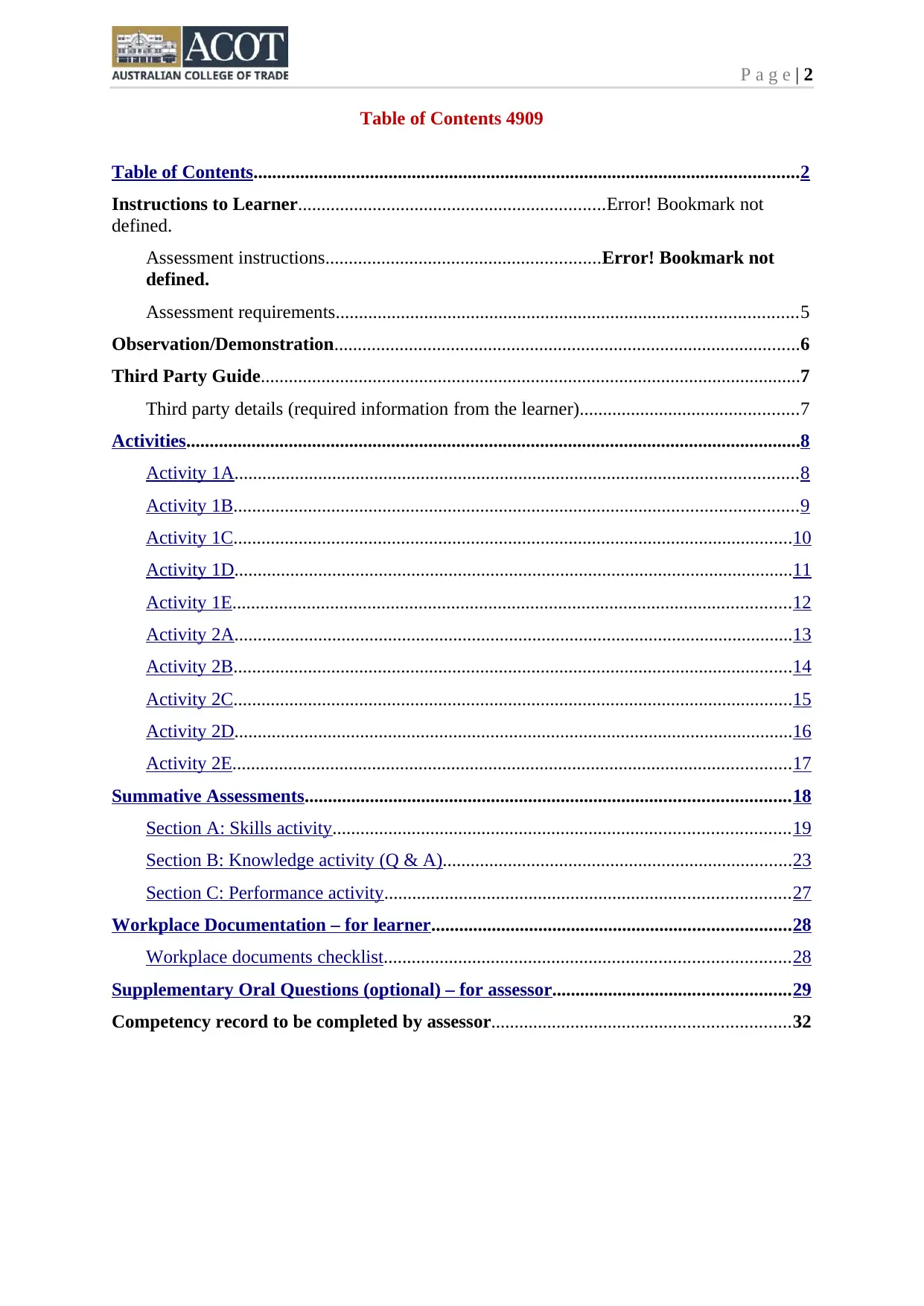
Table of Contents 4909
Table of Contents.....................................................................................................................2
Instructions to Learner..................................................................Error! Bookmark not
defined.
Assessment instructions...........................................................Error! Bookmark not
defined.
Assessment requirements...................................................................................................5
Observation/Demonstration....................................................................................................6
Third Party Guide....................................................................................................................7
Third party details (required information from the learner)...............................................7
Activities....................................................................................................................................8
Activity 1A.........................................................................................................................8
Activity 1B.........................................................................................................................9
Activity 1C........................................................................................................................10
Activity 1D........................................................................................................................11
Activity 1E........................................................................................................................12
Activity 2A........................................................................................................................13
Activity 2B........................................................................................................................14
Activity 2C........................................................................................................................15
Activity 2D........................................................................................................................16
Activity 2E........................................................................................................................17
Summative Assessments........................................................................................................18
Section A: Skills activity..................................................................................................19
Section B: Knowledge activity (Q & A)...........................................................................23
Section C: Performance activity.......................................................................................27
Workplace Documentation – for learner.............................................................................28
Workplace documents checklist.......................................................................................28
Supplementary Oral Questions (optional) – for assessor...................................................29
Competency record to be completed by assessor................................................................32
Table of Contents 4909
Table of Contents.....................................................................................................................2
Instructions to Learner..................................................................Error! Bookmark not
defined.
Assessment instructions...........................................................Error! Bookmark not
defined.
Assessment requirements...................................................................................................5
Observation/Demonstration....................................................................................................6
Third Party Guide....................................................................................................................7
Third party details (required information from the learner)...............................................7
Activities....................................................................................................................................8
Activity 1A.........................................................................................................................8
Activity 1B.........................................................................................................................9
Activity 1C........................................................................................................................10
Activity 1D........................................................................................................................11
Activity 1E........................................................................................................................12
Activity 2A........................................................................................................................13
Activity 2B........................................................................................................................14
Activity 2C........................................................................................................................15
Activity 2D........................................................................................................................16
Activity 2E........................................................................................................................17
Summative Assessments........................................................................................................18
Section A: Skills activity..................................................................................................19
Section B: Knowledge activity (Q & A)...........................................................................23
Section C: Performance activity.......................................................................................27
Workplace Documentation – for learner.............................................................................28
Workplace documents checklist.......................................................................................28
Supplementary Oral Questions (optional) – for assessor...................................................29
Competency record to be completed by assessor................................................................32
Paraphrase This Document
Need a fresh take? Get an instant paraphrase of this document with our AI Paraphraser
VCID. ACOT Training and Assessment/SITXCOM002/Learner Workbook/V1.2/July 2019
P a g e | 3
Instructions to Learner
Assessment instructions
Overview
Prior to commencing the assessments, your trainer/assessor will explain each assessment
task and the terms and conditions relating to the submission of your assessment task. Please
consult with your trainer/assessor if you are unsure of any questions. It is important that
you understand and adhere to the terms and conditions, and address fully each assessment
task. If any assessment task is not fully addressed, then your assessment task will be
returned to you for resubmission. Your trainer/assessor will remain available to support you
throughout the assessment process.
Written work
Assessment tasks are used to measure your understanding and underpinning skills and
knowledge of the overall unit of competency. When undertaking any written assessment
tasks, please ensure that you address the following criteria:
➢ Address each question including any sub-points
➢ Demonstrate that you have researched the topic thoroughly
➢ Cover the topic in a logical, structured manner
➢ Your assessment tasks are well presented, well referenced and word processed
➢ Your assessment tasks include your full legal name on each and every page.
Active participation
It is a condition of enrolment that you actively participate in your studies. Active
participation is completing all the assessment tasks on time.
Plagiarism
Plagiarism is taking and using someone else's thoughts, writings or inventions and
representing them as your own. Plagiarism is a serious act and may result in a learner’s
exclusion from a course. When you have any doubts about including the work of other
authors in your assessment, please consult your trainer/assessor. The following list outlines
some of the activities for which a learner can be accused of plagiarism:
➢ Presenting any work by another individual as one's own unintentionally
➢ Handing in assessments markedly similar to or copied from another learner
➢ Presenting the work of another individual or group as their own work
➢ Handing in assessments without the adequate acknowledgement of sources used,
including assessments taken totally or in part from the internet.
If it is identified that you have plagiarised within your assessment, then a meeting will be
organised to discuss this with you, and further action may be taken accordingly.
Collusion
VCID. ACOT Training and Assessment/SITXCOM002/Learner Workbook/V1.2/July 2019
Instructions to Learner
Assessment instructions
Overview
Prior to commencing the assessments, your trainer/assessor will explain each assessment
task and the terms and conditions relating to the submission of your assessment task. Please
consult with your trainer/assessor if you are unsure of any questions. It is important that
you understand and adhere to the terms and conditions, and address fully each assessment
task. If any assessment task is not fully addressed, then your assessment task will be
returned to you for resubmission. Your trainer/assessor will remain available to support you
throughout the assessment process.
Written work
Assessment tasks are used to measure your understanding and underpinning skills and
knowledge of the overall unit of competency. When undertaking any written assessment
tasks, please ensure that you address the following criteria:
➢ Address each question including any sub-points
➢ Demonstrate that you have researched the topic thoroughly
➢ Cover the topic in a logical, structured manner
➢ Your assessment tasks are well presented, well referenced and word processed
➢ Your assessment tasks include your full legal name on each and every page.
Active participation
It is a condition of enrolment that you actively participate in your studies. Active
participation is completing all the assessment tasks on time.
Plagiarism
Plagiarism is taking and using someone else's thoughts, writings or inventions and
representing them as your own. Plagiarism is a serious act and may result in a learner’s
exclusion from a course. When you have any doubts about including the work of other
authors in your assessment, please consult your trainer/assessor. The following list outlines
some of the activities for which a learner can be accused of plagiarism:
➢ Presenting any work by another individual as one's own unintentionally
➢ Handing in assessments markedly similar to or copied from another learner
➢ Presenting the work of another individual or group as their own work
➢ Handing in assessments without the adequate acknowledgement of sources used,
including assessments taken totally or in part from the internet.
If it is identified that you have plagiarised within your assessment, then a meeting will be
organised to discuss this with you, and further action may be taken accordingly.
Collusion
VCID. ACOT Training and Assessment/SITXCOM002/Learner Workbook/V1.2/July 2019
⊘ This is a preview!⊘
Do you want full access?
Subscribe today to unlock all pages.
Trusted by 1+ million students worldwide
P a g e | 4
Collusion is the presentation by a learner of an assignment as their own that is, in fact, the
result in whole or in part of unauthorised collaboration with another person or persons.
Collusion involves the cooperation of two or more learners in plagiarism or other forms of
academic misconduct and, as such, both parties are subject to disciplinary action. Collusion
or copying from other learners is not permitted and will result in a “0” grade and NYC.
Assessments must be typed using document software such as (or similar to) MS Office.
Handwritten assessments will not be accepted (unless, prior written confirmation is provided
by the trainer/assessor to confirm).
Competency outcome
There are two outcomes of assessments: S = Satisfactory and NS = Not Satisfactory
(requires more training and experience).
Once the learner has satisfactorily completed all the tasks for this module the learner
will be awarded “Competent” (C) or “Not yet Competent” (NYC) for the relevant unit
of competency.
If you are deemed “Not Yet Competent” you will be provided with feedback from your
assessor and will be given another chance to resubmit your assessment task(s). If you are still
deemed as “Not Yet Competent” you will be required to re-enrol in the unit of competency.
Additional evidence
If we, at our sole discretion, determine that we require additional or alternative
information/evidence in order to determine competency, you must provide us with such
information/evidence, subject to privacy and confidentiality issues. We retain this right at
any time, including after submission of your assessments.
Confidentiality
We will treat anything, including information about your job, workplace, employer, with
strict confidence, in accordance with the law. However, you are responsible for ensuring
that you do not provide us with anything regarding any third party including your employer,
colleagues and others, that they do not consent to the disclosure of. While we may ask you
to provide information or details about aspects of your employer and workplace, you are
responsible for obtaining necessary consents and ensuring that privacy rights and
confidentiality obligations are not breached by you in supplying us with such information.
Assessment appeals process
If you feel that you have been unfairly treated during your assessment, and you are not
happy with your assessment and/or the outcome as a result of that treatment, you have the
right to lodge an appeal. You must first discuss the issue with your trainer/assessor. If you
would like to proceed further with the request after discussions with your trainer/assessor,
you need to lodge your appeal to the course coordinator, in writing, outlining the reason(s)
for the appeal.
Recognised prior learning
Candidates will be able to have their previous experience or expertise recognised on request.
Collusion is the presentation by a learner of an assignment as their own that is, in fact, the
result in whole or in part of unauthorised collaboration with another person or persons.
Collusion involves the cooperation of two or more learners in plagiarism or other forms of
academic misconduct and, as such, both parties are subject to disciplinary action. Collusion
or copying from other learners is not permitted and will result in a “0” grade and NYC.
Assessments must be typed using document software such as (or similar to) MS Office.
Handwritten assessments will not be accepted (unless, prior written confirmation is provided
by the trainer/assessor to confirm).
Competency outcome
There are two outcomes of assessments: S = Satisfactory and NS = Not Satisfactory
(requires more training and experience).
Once the learner has satisfactorily completed all the tasks for this module the learner
will be awarded “Competent” (C) or “Not yet Competent” (NYC) for the relevant unit
of competency.
If you are deemed “Not Yet Competent” you will be provided with feedback from your
assessor and will be given another chance to resubmit your assessment task(s). If you are still
deemed as “Not Yet Competent” you will be required to re-enrol in the unit of competency.
Additional evidence
If we, at our sole discretion, determine that we require additional or alternative
information/evidence in order to determine competency, you must provide us with such
information/evidence, subject to privacy and confidentiality issues. We retain this right at
any time, including after submission of your assessments.
Confidentiality
We will treat anything, including information about your job, workplace, employer, with
strict confidence, in accordance with the law. However, you are responsible for ensuring
that you do not provide us with anything regarding any third party including your employer,
colleagues and others, that they do not consent to the disclosure of. While we may ask you
to provide information or details about aspects of your employer and workplace, you are
responsible for obtaining necessary consents and ensuring that privacy rights and
confidentiality obligations are not breached by you in supplying us with such information.
Assessment appeals process
If you feel that you have been unfairly treated during your assessment, and you are not
happy with your assessment and/or the outcome as a result of that treatment, you have the
right to lodge an appeal. You must first discuss the issue with your trainer/assessor. If you
would like to proceed further with the request after discussions with your trainer/assessor,
you need to lodge your appeal to the course coordinator, in writing, outlining the reason(s)
for the appeal.
Recognised prior learning
Candidates will be able to have their previous experience or expertise recognised on request.
Paraphrase This Document
Need a fresh take? Get an instant paraphrase of this document with our AI Paraphraser

VCID. ACOT Training and Assessment/SITXCOM002/Learner Workbook/V1.2/July 2019
P a g e | 5
Special needs
Candidates with special needs should notify their trainer/assessor to request any required
adjustments as soon as possible. This will enable the trainer/assessor to address the identified
needs immediately.
Assessment requirements
Assessment can either be:
➢ Direct observation
➢ Product-based methods e.g. reports, role plays, work samples
➢ Portfolios – annotated and validated
➢ Questioning
➢ Third party evidence.
If submitting third party evidence, the Third Party Observation/Demonstration document
must be completed by the agreed third party.
Third parties can be:
➢ Supervisors
➢ Trainers
➢ Team members
➢ Clients
➢ Consumers.
The third party observation must be submitted to your trainer/assessor, as directed.
The third party observation is to be used by the assessor to assist them in determining
competency.
The assessment activities in this workbook assess aspects of all the elements, performance
criteria, skills and knowledge and performance requirements of the unit of competency.
To demonstrate competence in this unit you must undertake all activities in this workbook
and have them deemed satisfactory by the assessor. If you do not answer some questions or
perform certain tasks, and therefore you are deemed to be Not Yet Competent, your
trainer/assessor may ask you supplementary questions to determine your competence. Once
you have demonstrated the required level of performance, you will be deemed competent in
this unit.
Should you still be deemed Not Yet Competent, you will have the opportunity to
resubmit your assessments or appeal the result.
As part of the assessment process, all learners must abide by any relevant assessment
policies as provided during induction.
If you feel you are not yet ready to be assessed or that this assessment is unfair, please
contact your assessor to discuss your options. You have the right to formally appeal any
outcome and, if you wish to do so, discuss this with your trainer/assessor.
Special needs
Candidates with special needs should notify their trainer/assessor to request any required
adjustments as soon as possible. This will enable the trainer/assessor to address the identified
needs immediately.
Assessment requirements
Assessment can either be:
➢ Direct observation
➢ Product-based methods e.g. reports, role plays, work samples
➢ Portfolios – annotated and validated
➢ Questioning
➢ Third party evidence.
If submitting third party evidence, the Third Party Observation/Demonstration document
must be completed by the agreed third party.
Third parties can be:
➢ Supervisors
➢ Trainers
➢ Team members
➢ Clients
➢ Consumers.
The third party observation must be submitted to your trainer/assessor, as directed.
The third party observation is to be used by the assessor to assist them in determining
competency.
The assessment activities in this workbook assess aspects of all the elements, performance
criteria, skills and knowledge and performance requirements of the unit of competency.
To demonstrate competence in this unit you must undertake all activities in this workbook
and have them deemed satisfactory by the assessor. If you do not answer some questions or
perform certain tasks, and therefore you are deemed to be Not Yet Competent, your
trainer/assessor may ask you supplementary questions to determine your competence. Once
you have demonstrated the required level of performance, you will be deemed competent in
this unit.
Should you still be deemed Not Yet Competent, you will have the opportunity to
resubmit your assessments or appeal the result.
As part of the assessment process, all learners must abide by any relevant assessment
policies as provided during induction.
If you feel you are not yet ready to be assessed or that this assessment is unfair, please
contact your assessor to discuss your options. You have the right to formally appeal any
outcome and, if you wish to do so, discuss this with your trainer/assessor.
⊘ This is a preview!⊘
Do you want full access?
Subscribe today to unlock all pages.
Trusted by 1+ million students worldwide
VCID. ACOT Training and Assessment/SITXCOM002/Learner Workbook/V1.2/July 2019
Paraphrase This Document
Need a fresh take? Get an instant paraphrase of this document with our AI Paraphraser
P a g e | 6
Observation/Demonstration
Throughout this unit, you will be expected to show your competency of the elements through
observations or demonstrations. Your trainer/assessor will have a list of demonstrations you
must complete or tasks to be observed. The observations and demonstrations will be
completed as well as the activities found in this workbook.
An explanation of observations and demonstrations:
Observation is on-the-job
The observation will usually require:
➢ Performing a work-based skill or task
➢ Interaction with colleagues and/or customers.
Demonstration is off-the-job
A demonstration will require:
➢ Performing a skill or task that is asked of you
➢ Undertaking a simulation exercise.
Your trainer/assessor will inform you of which one of the above they would like you to
do. The observation/demonstration will cover one of the unit’s elements.
The observation/demonstration will take place either in the workplace or the training
environment, depending on the task to be undertaken and whether it is an observation or
demonstration. Your trainer/assessor will ensure you are provided with the correct
equipment and/or materials to complete the task. They will also inform you of how long you
have to complete the task.
You should be able to demonstrate the skills, knowledge and performance criteria
required for competency in this unit, as seen in the Learner Guide.
VCID. ACOT Training and Assessment/SITXCOM002/Learner Workbook/V1.2/July 2019
Observation/Demonstration
Throughout this unit, you will be expected to show your competency of the elements through
observations or demonstrations. Your trainer/assessor will have a list of demonstrations you
must complete or tasks to be observed. The observations and demonstrations will be
completed as well as the activities found in this workbook.
An explanation of observations and demonstrations:
Observation is on-the-job
The observation will usually require:
➢ Performing a work-based skill or task
➢ Interaction with colleagues and/or customers.
Demonstration is off-the-job
A demonstration will require:
➢ Performing a skill or task that is asked of you
➢ Undertaking a simulation exercise.
Your trainer/assessor will inform you of which one of the above they would like you to
do. The observation/demonstration will cover one of the unit’s elements.
The observation/demonstration will take place either in the workplace or the training
environment, depending on the task to be undertaken and whether it is an observation or
demonstration. Your trainer/assessor will ensure you are provided with the correct
equipment and/or materials to complete the task. They will also inform you of how long you
have to complete the task.
You should be able to demonstrate the skills, knowledge and performance criteria
required for competency in this unit, as seen in the Learner Guide.
VCID. ACOT Training and Assessment/SITXCOM002/Learner Workbook/V1.2/July 2019
P a g e | 7
Third Party Guide
You should supply details of the third party to the assessor before you commence the
activities (see below), unless the assessor has already selected a third party themselves. The
assessor can then contact the third party in instances where they require more evidence to
determine competency, or they cannot observe certain tasks themselves.
The reasons to use a third party may include:
➢ Assessment is required in the workplace
➢ Where there are health and safety issues related to observation
➢ Patient confidentiality and privacy issues are involved.
If you are not employed, or able to complete demonstrative tasks in the workplace, you will
need to inform the assessor. They will be able to provide you with a simulated environment
in which to complete these tasks.
We would prefer that, wherever possible, these be “live” issues for your industry and require
application of the principles that you are learning as part of your training. Where this is not
possible, you and your third party should simulate the activity tasks and demonstrations that
you believe would be likely to arise in your organisation or job role.
Third party evidence can also be used to provide “everyday evidence” of tasks included in
your work role that relate to the unit of competency but are not a part of the formal
assessment process.
The third party is not to be used as a co-assessor – the assessor must make the final
decision on competency themselves. Documents relevant to collection of third-party
evidence are included in the Third Party section in the Observations/Demonstrations
document.
Third party details (where required from the learner)
A third party may be required for observations or demonstrations; please provide details
below of your nominated third party and obtain their signature to confirm their agreement to
participate. This information will be required by your trainer/assessor in advance of arranging
any future observations or demonstrations.
Third party name:
______________________________________________________________
Position of third party:
______________________________________________________________
Telephone number:
______________________________________________________________
Email address:
______________________________________________________________
Declaration for nominated third party
I declare my intention to act as third party for (learner’s name here)
__________________________
Third Party Guide
You should supply details of the third party to the assessor before you commence the
activities (see below), unless the assessor has already selected a third party themselves. The
assessor can then contact the third party in instances where they require more evidence to
determine competency, or they cannot observe certain tasks themselves.
The reasons to use a third party may include:
➢ Assessment is required in the workplace
➢ Where there are health and safety issues related to observation
➢ Patient confidentiality and privacy issues are involved.
If you are not employed, or able to complete demonstrative tasks in the workplace, you will
need to inform the assessor. They will be able to provide you with a simulated environment
in which to complete these tasks.
We would prefer that, wherever possible, these be “live” issues for your industry and require
application of the principles that you are learning as part of your training. Where this is not
possible, you and your third party should simulate the activity tasks and demonstrations that
you believe would be likely to arise in your organisation or job role.
Third party evidence can also be used to provide “everyday evidence” of tasks included in
your work role that relate to the unit of competency but are not a part of the formal
assessment process.
The third party is not to be used as a co-assessor – the assessor must make the final
decision on competency themselves. Documents relevant to collection of third-party
evidence are included in the Third Party section in the Observations/Demonstrations
document.
Third party details (where required from the learner)
A third party may be required for observations or demonstrations; please provide details
below of your nominated third party and obtain their signature to confirm their agreement to
participate. This information will be required by your trainer/assessor in advance of arranging
any future observations or demonstrations.
Third party name:
______________________________________________________________
Position of third party:
______________________________________________________________
Telephone number:
______________________________________________________________
Email address:
______________________________________________________________
Declaration for nominated third party
I declare my intention to act as third party for (learner’s name here)
__________________________
⊘ This is a preview!⊘
Do you want full access?
Subscribe today to unlock all pages.
Trusted by 1+ million students worldwide

1 out of 53


Related Documents


Your All-in-One AI-Powered Toolkit for Academic Success.
+13062052269
info@desklib.com
Available 24*7 on WhatsApp / Email
![[object Object]](/_next/static/media/star-bottom.7253800d.svg)
Unlock your academic potential
Copyright © 2020–2026 A2Z Services. All Rights Reserved. Developed and managed by ZUCOL.