SITXFSA001 & SITXFSA002 Assignment: Food Safety & Handling Practices
VerifiedAdded on 2023/04/21
|32
|6669
|124
Homework Assignment
AI Summary
This assignment solution focuses on food safety and hygienic practices, addressing key areas within the SITXFSA001 and SITXFSA002 frameworks. It explores information sources for food safety laws, the necessity of food safety programs (FSPs), and individual responsibilities within an FSP. The assignment further discusses the potential consequences of improper food storage, actions to take when ill at work, and the purpose of HACCP-based food safety plans. Critical limits at various stages of the food production pathway are identified, along with safe food handling practices for different food types. Finally, it addresses potential food and hygiene hazards in the workplace, detailing corrective actions and reporting procedures. Desklib provides a platform to access this and other solved assignments to aid students in their studies.
1 of 32
NextPreviousPrintSave
SITXFSA001 Use hygienic practice for food safety
SITXFSA002 Participate in safe food handling practices
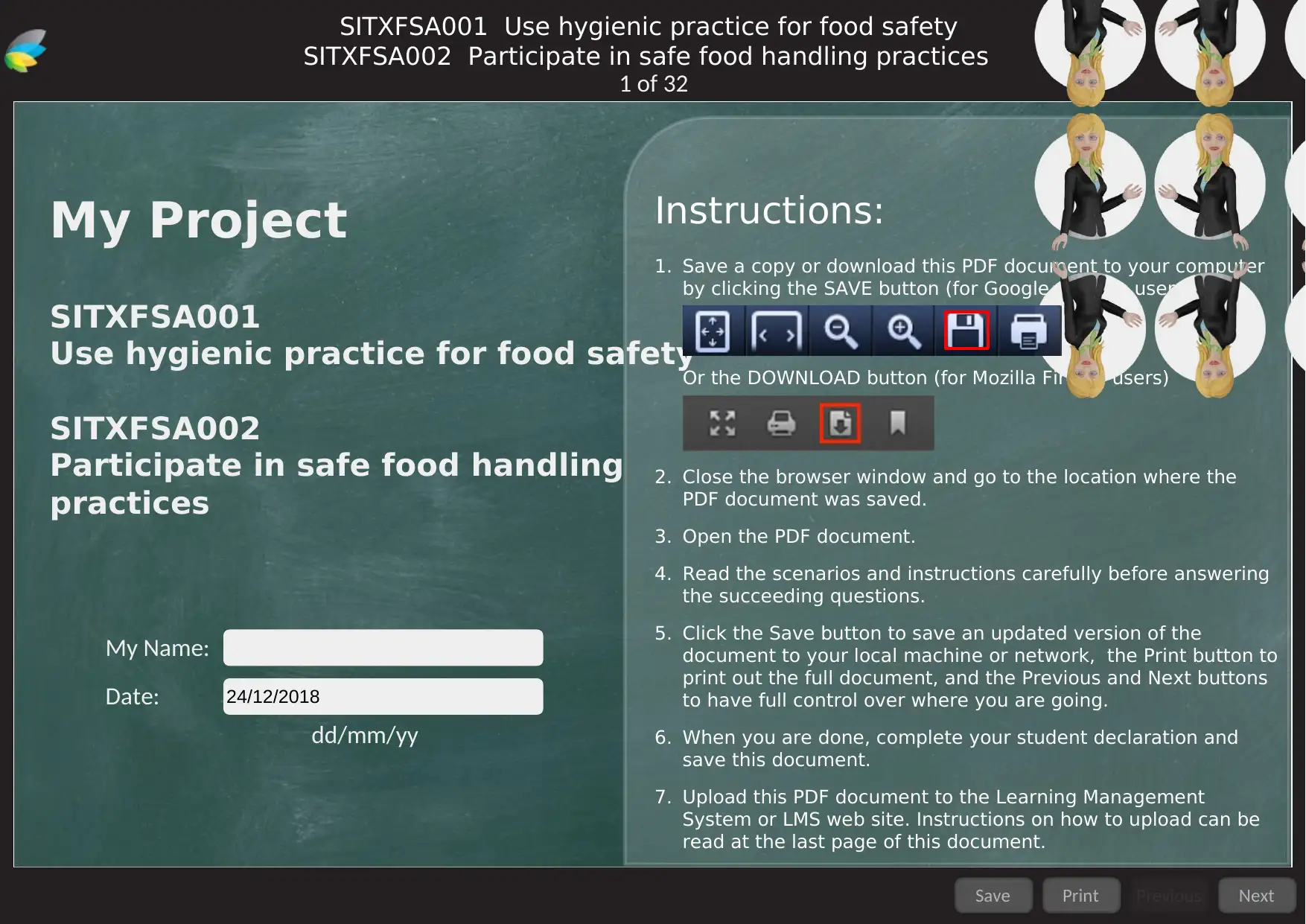
My Project
SITXFSA001
Use hygienic practice for food safety
SITXFSA002
Participate in safe food handling
practices
My Name:
Date:
dd/mm/yy
Instructions:
1. Save a copy or download this PDF document to your computer
by clicking the SAVE button (for Google Chrome users)
Or the DOWNLOAD button (for Mozilla Firefox users)
2. Close the browser window and go to the location where the
PDF document was saved.
3. Open the PDF document.
4. Read the scenarios and instructions carefully before answering
the succeeding questions.
5. Click the Save button to save an updated version of the
document to your local machine or network, the Print button to
print out the full document, and the Previous and Next buttons
to have full control over where you are going.
6. When you are done, complete your student declaration and
save this document.
7. Upload this PDF document to the Learning Management
System or LMS web site. Instructions on how to upload can be
read at the last page of this document.
24/12/2018
NextPreviousPrintSave
SITXFSA001 Use hygienic practice for food safety
SITXFSA002 Participate in safe food handling practices
My Project
SITXFSA001
Use hygienic practice for food safety
SITXFSA002
Participate in safe food handling
practices
My Name:
Date:
dd/mm/yy
Instructions:
1. Save a copy or download this PDF document to your computer
by clicking the SAVE button (for Google Chrome users)
Or the DOWNLOAD button (for Mozilla Firefox users)
2. Close the browser window and go to the location where the
PDF document was saved.
3. Open the PDF document.
4. Read the scenarios and instructions carefully before answering
the succeeding questions.
5. Click the Save button to save an updated version of the
document to your local machine or network, the Print button to
print out the full document, and the Previous and Next buttons
to have full control over where you are going.
6. When you are done, complete your student declaration and
save this document.
7. Upload this PDF document to the Learning Management
System or LMS web site. Instructions on how to upload can be
read at the last page of this document.
24/12/2018

Paraphrase This Document
Need a fresh take? Get an instant paraphrase of this document with our AI Paraphraser
2 of 32
NextPreviousPrintSave
SITXFSA001 Use hygienic practice for food safety
SITXFSA002 Participate in safe food handling practices
My Response
Answer the following questions in detail.
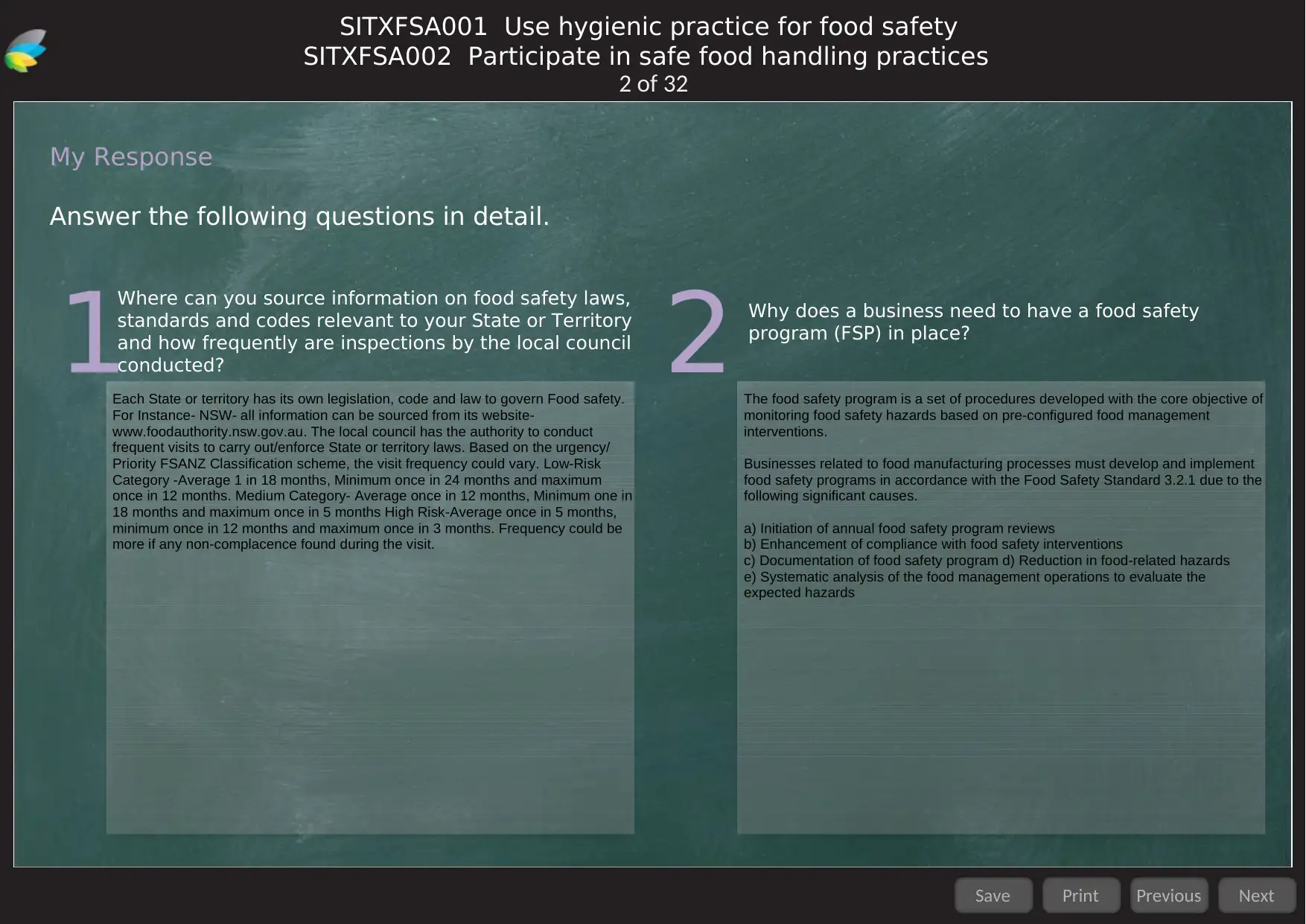
Where can you source information on food safety laws,
standards and codes relevant to your State or Territory
and how frequently are inspections by the local council
conducted?1 Why does a business need to have a food safety
program (FSP) in place?
2Each State or territory has its own legislation, code and law to govern Food safety.
For Instance- NSW- all information can be sourced from its website-
www.foodauthority.nsw.gov.au. The local council has the authority to conduct
frequent visits to carry out/enforce State or territory laws. Based on the urgency/
Priority FSANZ Classification scheme, the visit frequency could vary. Low-Risk
Category -Average 1 in 18 months, Minimum once in 24 months and maximum
once in 12 months. Medium Category- Average once in 12 months, Minimum one in
18 months and maximum once in 5 months High Risk-Average once in 5 months,
minimum once in 12 months and maximum once in 3 months. Frequency could be
more if any non-complacence found during the visit.
The food safety program is a set of procedures developed with the core objective of
monitoring food safety hazards based on pre-configured food management
interventions.
Businesses related to food manufacturing processes must develop and implement
food safety programs in accordance with the Food Safety Standard 3.2.1 due to the
following significant causes.
a) Initiation of annual food safety program reviews
b) Enhancement of compliance with food safety interventions
c) Documentation of food safety program d) Reduction in food-related hazards
e) Systematic analysis of the food management operations to evaluate the
expected hazards
NextPreviousPrintSave
SITXFSA001 Use hygienic practice for food safety
SITXFSA002 Participate in safe food handling practices
My Response
Answer the following questions in detail.
Where can you source information on food safety laws,
standards and codes relevant to your State or Territory
and how frequently are inspections by the local council
conducted?1 Why does a business need to have a food safety
program (FSP) in place?
2Each State or territory has its own legislation, code and law to govern Food safety.
For Instance- NSW- all information can be sourced from its website-
www.foodauthority.nsw.gov.au. The local council has the authority to conduct
frequent visits to carry out/enforce State or territory laws. Based on the urgency/
Priority FSANZ Classification scheme, the visit frequency could vary. Low-Risk
Category -Average 1 in 18 months, Minimum once in 24 months and maximum
once in 12 months. Medium Category- Average once in 12 months, Minimum one in
18 months and maximum once in 5 months High Risk-Average once in 5 months,
minimum once in 12 months and maximum once in 3 months. Frequency could be
more if any non-complacence found during the visit.
The food safety program is a set of procedures developed with the core objective of
monitoring food safety hazards based on pre-configured food management
interventions.
Businesses related to food manufacturing processes must develop and implement
food safety programs in accordance with the Food Safety Standard 3.2.1 due to the
following significant causes.
a) Initiation of annual food safety program reviews
b) Enhancement of compliance with food safety interventions
c) Documentation of food safety program d) Reduction in food-related hazards
e) Systematic analysis of the food management operations to evaluate the
expected hazards
3 of 32
NextPreviousPrintSave
SITXFSA001 Use hygienic practice for food safety
SITXFSA002 Participate in safe food handling practices
My Response
Answer the following questions in detail.
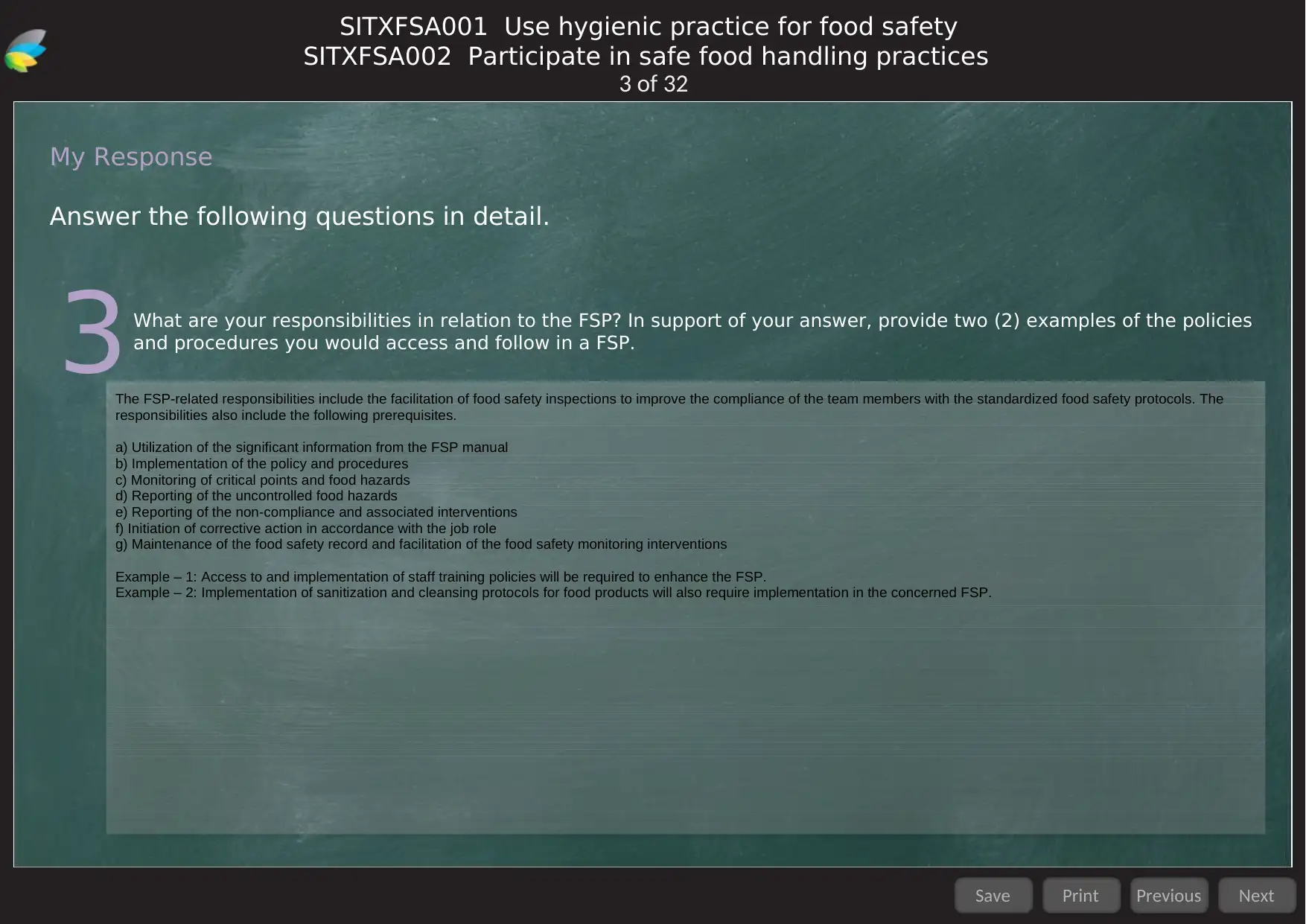
What are your responsibilities in relation to the FSP? In support of your answer, provide two (2) examples of the policies
and procedures you would access and follow in a FSP.
3The FSP-related responsibilities include the facilitation of food safety inspections to improve the compliance of the team members with the standardized food safety protocols. The
responsibilities also include the following prerequisites.
a) Utilization of the significant information from the FSP manual
b) Implementation of the policy and procedures
c) Monitoring of critical points and food hazards
d) Reporting of the uncontrolled food hazards
e) Reporting of the non-compliance and associated interventions
f) Initiation of corrective action in accordance with the job role
g) Maintenance of the food safety record and facilitation of the food safety monitoring interventions
Example – 1: Access to and implementation of staff training policies will be required to enhance the FSP.
Example – 2: Implementation of sanitization and cleansing protocols for food products will also require implementation in the concerned FSP.
NextPreviousPrintSave
SITXFSA001 Use hygienic practice for food safety
SITXFSA002 Participate in safe food handling practices
My Response
Answer the following questions in detail.
What are your responsibilities in relation to the FSP? In support of your answer, provide two (2) examples of the policies
and procedures you would access and follow in a FSP.
3The FSP-related responsibilities include the facilitation of food safety inspections to improve the compliance of the team members with the standardized food safety protocols. The
responsibilities also include the following prerequisites.
a) Utilization of the significant information from the FSP manual
b) Implementation of the policy and procedures
c) Monitoring of critical points and food hazards
d) Reporting of the uncontrolled food hazards
e) Reporting of the non-compliance and associated interventions
f) Initiation of corrective action in accordance with the job role
g) Maintenance of the food safety record and facilitation of the food safety monitoring interventions
Example – 1: Access to and implementation of staff training policies will be required to enhance the FSP.
Example – 2: Implementation of sanitization and cleansing protocols for food products will also require implementation in the concerned FSP.
⊘ This is a preview!⊘
Do you want full access?
Subscribe today to unlock all pages.

Trusted by 1+ million students worldwide
4 of 32
NextPreviousPrintSave
SITXFSA001 Use hygienic practice for food safety
SITXFSA002 Participate in safe food handling practices
My Response
Answer the following questions in detail.
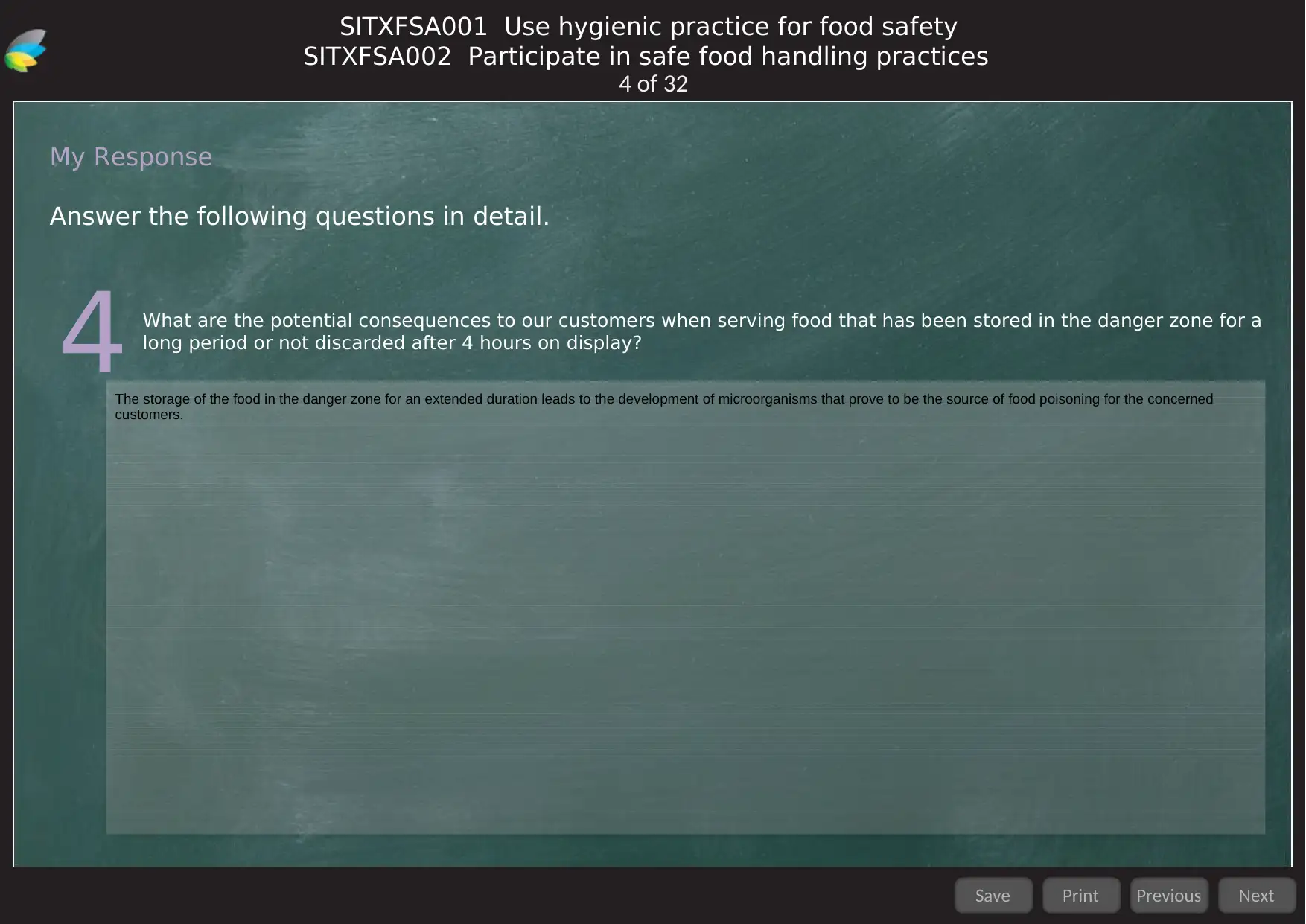
What are the potential consequences to our customers when serving food that has been stored in the danger zone for a
long period or not discarded after 4 hours on display?
4The storage of the food in the danger zone for an extended duration leads to the development of microorganisms that prove to be the source of food poisoning for the concerned
customers.
NextPreviousPrintSave
SITXFSA001 Use hygienic practice for food safety
SITXFSA002 Participate in safe food handling practices
My Response
Answer the following questions in detail.
What are the potential consequences to our customers when serving food that has been stored in the danger zone for a
long period or not discarded after 4 hours on display?
4The storage of the food in the danger zone for an extended duration leads to the development of microorganisms that prove to be the source of food poisoning for the concerned
customers.
Paraphrase This Document
Need a fresh take? Get an instant paraphrase of this document with our AI Paraphraser
5 of 32
NextPreviousPrintSave
SITXFSA001 Use hygienic practice for food safety
SITXFSA002 Participate in safe food handling practices
My Response
Answer the following questions in detail.
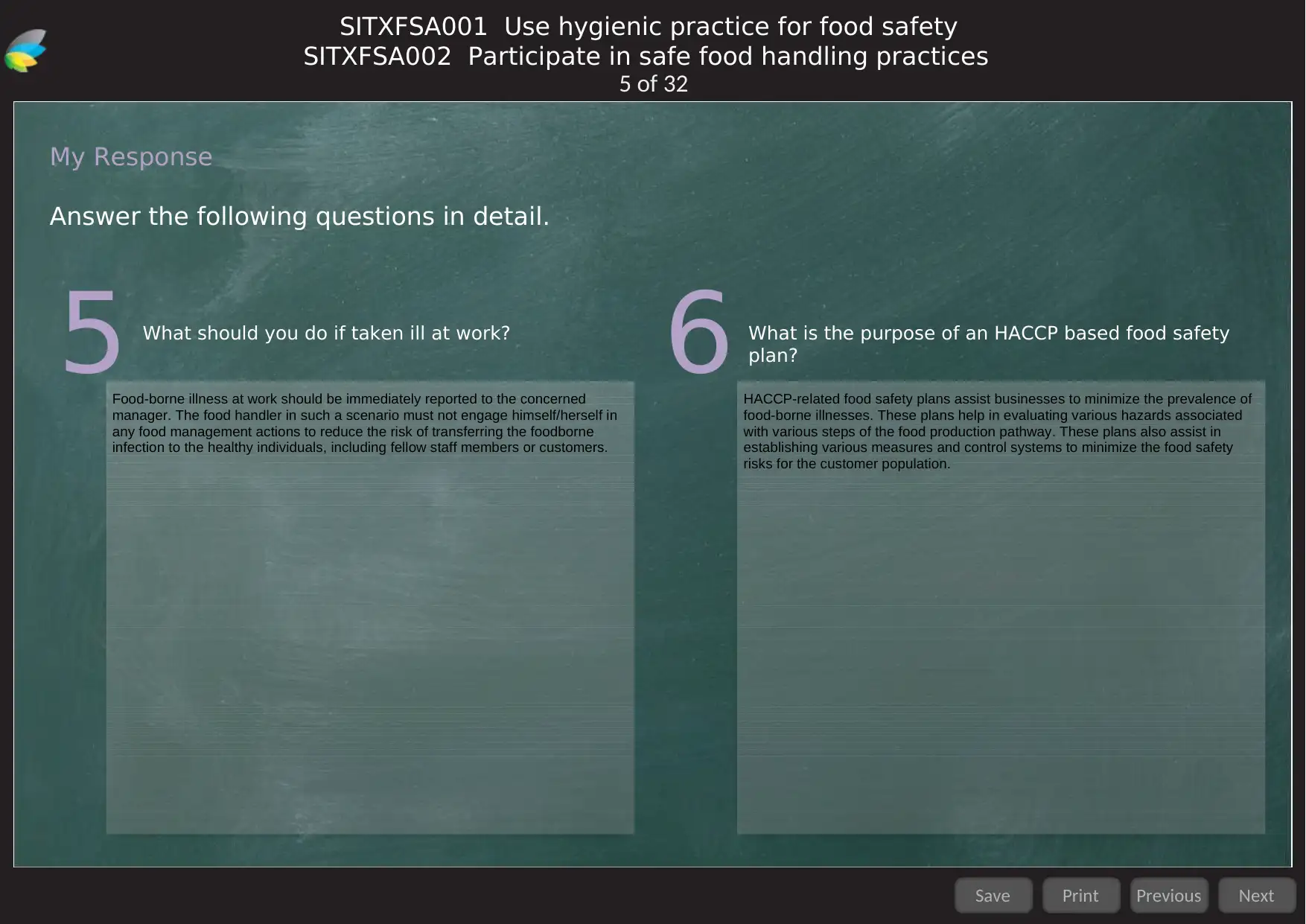
What should you do if taken ill at work?
5 What is the purpose of an HACCP based food safety
plan?
6Food-borne illness at work should be immediately reported to the concerned
manager. The food handler in such a scenario must not engage himself/herself in
any food management actions to reduce the risk of transferring the foodborne
infection to the healthy individuals, including fellow staff members or customers.
HACCP-related food safety plans assist businesses to minimize the prevalence of
food-borne illnesses. These plans help in evaluating various hazards associated
with various steps of the food production pathway. These plans also assist in
establishing various measures and control systems to minimize the food safety
risks for the customer population.
NextPreviousPrintSave
SITXFSA001 Use hygienic practice for food safety
SITXFSA002 Participate in safe food handling practices
My Response
Answer the following questions in detail.
What should you do if taken ill at work?
5 What is the purpose of an HACCP based food safety
plan?
6Food-borne illness at work should be immediately reported to the concerned
manager. The food handler in such a scenario must not engage himself/herself in
any food management actions to reduce the risk of transferring the foodborne
infection to the healthy individuals, including fellow staff members or customers.
HACCP-related food safety plans assist businesses to minimize the prevalence of
food-borne illnesses. These plans help in evaluating various hazards associated
with various steps of the food production pathway. These plans also assist in
establishing various measures and control systems to minimize the food safety
risks for the customer population.
6 of 32
NextPreviousPrintSave
SITXFSA001 Use hygienic practice for food safety
SITXFSA002 Participate in safe food handling practices
My Response
Answer the following questions in detail.
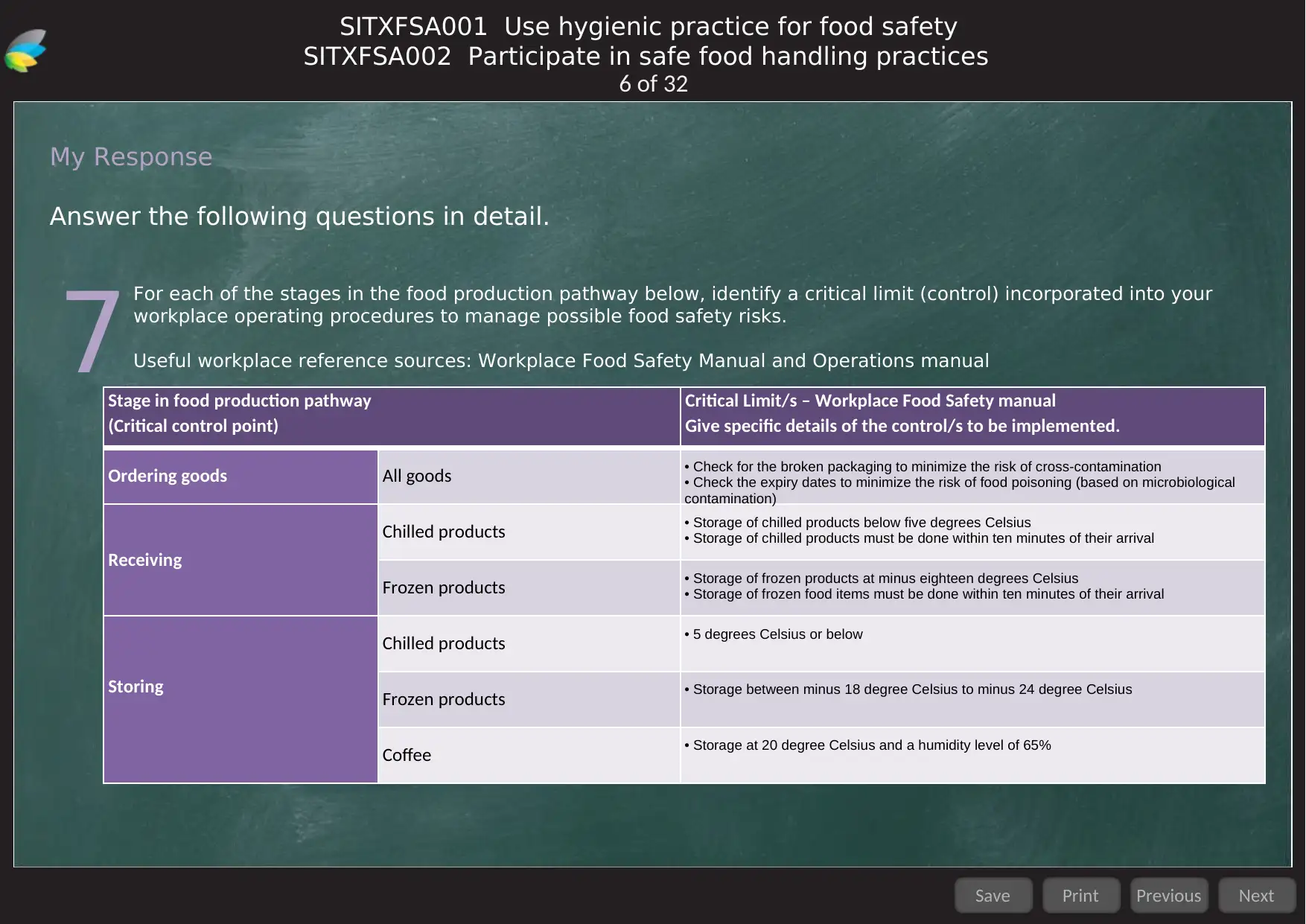
For each of the stages in the food production pathway below, identify a critical limit (control) incorporated into your
workplace operating procedures to manage possible food safety risks.
Useful workplace reference sources: Workplace Food Safety Manual and Operations manual7Stage in food production pathway
(Critical control point)
Critical Limit/s – Workplace Food Safety manual
Give specific details of the control/s to be implemented.
Ordering goods All goods
Receiving
Chilled products
Frozen products
Storing
Chilled products
Frozen products
Coffee
• Check for the broken packaging to minimize the risk of cross-contamination
• Check the expiry dates to minimize the risk of food poisoning (based on microbiological
contamination)
• Storage of chilled products below five degrees Celsius
• Storage of chilled products must be done within ten minutes of their arrival
• Storage of frozen products at minus eighteen degrees Celsius
• Storage of frozen food items must be done within ten minutes of their arrival
• 5 degrees Celsius or below
• Storage between minus 18 degree Celsius to minus 24 degree Celsius
• Storage at 20 degree Celsius and a humidity level of 65%
NextPreviousPrintSave
SITXFSA001 Use hygienic practice for food safety
SITXFSA002 Participate in safe food handling practices
My Response
Answer the following questions in detail.
For each of the stages in the food production pathway below, identify a critical limit (control) incorporated into your
workplace operating procedures to manage possible food safety risks.
Useful workplace reference sources: Workplace Food Safety Manual and Operations manual7Stage in food production pathway
(Critical control point)
Critical Limit/s – Workplace Food Safety manual
Give specific details of the control/s to be implemented.
Ordering goods All goods
Receiving
Chilled products
Frozen products
Storing
Chilled products
Frozen products
Coffee
• Check for the broken packaging to minimize the risk of cross-contamination
• Check the expiry dates to minimize the risk of food poisoning (based on microbiological
contamination)
• Storage of chilled products below five degrees Celsius
• Storage of chilled products must be done within ten minutes of their arrival
• Storage of frozen products at minus eighteen degrees Celsius
• Storage of frozen food items must be done within ten minutes of their arrival
• 5 degrees Celsius or below
• Storage between minus 18 degree Celsius to minus 24 degree Celsius
• Storage at 20 degree Celsius and a humidity level of 65%
⊘ This is a preview!⊘
Do you want full access?
Subscribe today to unlock all pages.
Trusted by 1+ million students worldwide
7 of 32
NextPreviousPrintSave
SITXFSA001 Use hygienic practice for food safety
SITXFSA002 Participate in safe food handling practices
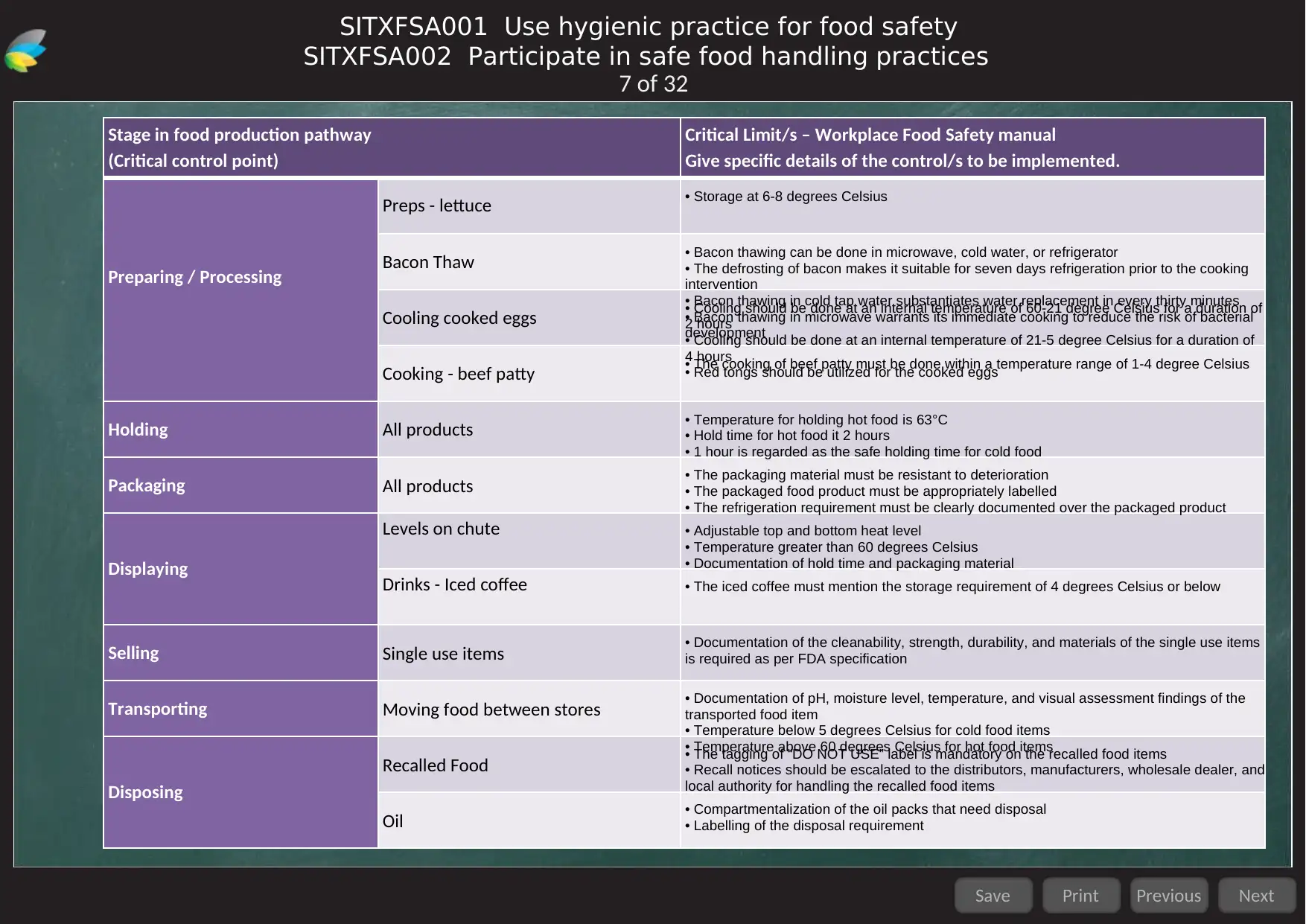
Stage in food production pathway
(Critical control point)
Critical Limit/s – Workplace Food Safety manual
Give specific details of the control/s to be implemented.
Preparing / Processing
Preps - lettuce
Bacon Thaw
Cooling cooked eggs
Cooking - beef patty
Holding All products
Packaging All products
Displaying
Levels on chute
Drinks - Iced coffee
Selling Single use items
Transporting Moving food between stores
Disposing
Recalled Food
Oil
• Storage at 6-8 degrees Celsius
• Compartmentalization of the oil packs that need disposal
• Labelling of the disposal requirement
• Bacon thawing can be done in microwave, cold water, or refrigerator
• The defrosting of bacon makes it suitable for seven days refrigeration prior to the cooking
intervention
• Bacon thawing in cold tap water substantiates water replacement in every thirty minutes
• Bacon thawing in microwave warrants its immediate cooking to reduce the risk of bacterial
development
• Cooling should be done at an internal temperature of 60-21 degree Celsius for a duration of
2 hours
• Cooling should be done at an internal temperature of 21-5 degree Celsius for a duration of
4 hours
• Red tongs should be utilized for the cooked eggs
• The cooking of beef patty must be done within a temperature range of 1-4 degree Celsius
• Temperature for holding hot food is 63°C
• Hold time for hot food it 2 hours
• 1 hour is regarded as the safe holding time for cold food
• The packaging material must be resistant to deterioration
• The packaged food product must be appropriately labelled
• The refrigeration requirement must be clearly documented over the packaged product
• Adjustable top and bottom heat level
• Temperature greater than 60 degrees Celsius
• Documentation of hold time and packaging material
• The iced coffee must mention the storage requirement of 4 degrees Celsius or below
• Documentation of the cleanability, strength, durability, and materials of the single use items
is required as per FDA specification
• Documentation of pH, moisture level, temperature, and visual assessment findings of the
transported food item
• Temperature below 5 degrees Celsius for cold food items
• Temperature above 60 degrees Celsius for hot food items
• The tagging of “DO NOT USE” label is mandatory on the recalled food items
• Recall notices should be escalated to the distributors, manufacturers, wholesale dealer, and
local authority for handling the recalled food items
NextPreviousPrintSave
SITXFSA001 Use hygienic practice for food safety
SITXFSA002 Participate in safe food handling practices
Stage in food production pathway
(Critical control point)
Critical Limit/s – Workplace Food Safety manual
Give specific details of the control/s to be implemented.
Preparing / Processing
Preps - lettuce
Bacon Thaw
Cooling cooked eggs
Cooking - beef patty
Holding All products
Packaging All products
Displaying
Levels on chute
Drinks - Iced coffee
Selling Single use items
Transporting Moving food between stores
Disposing
Recalled Food
Oil
• Storage at 6-8 degrees Celsius
• Compartmentalization of the oil packs that need disposal
• Labelling of the disposal requirement
• Bacon thawing can be done in microwave, cold water, or refrigerator
• The defrosting of bacon makes it suitable for seven days refrigeration prior to the cooking
intervention
• Bacon thawing in cold tap water substantiates water replacement in every thirty minutes
• Bacon thawing in microwave warrants its immediate cooking to reduce the risk of bacterial
development
• Cooling should be done at an internal temperature of 60-21 degree Celsius for a duration of
2 hours
• Cooling should be done at an internal temperature of 21-5 degree Celsius for a duration of
4 hours
• Red tongs should be utilized for the cooked eggs
• The cooking of beef patty must be done within a temperature range of 1-4 degree Celsius
• Temperature for holding hot food is 63°C
• Hold time for hot food it 2 hours
• 1 hour is regarded as the safe holding time for cold food
• The packaging material must be resistant to deterioration
• The packaged food product must be appropriately labelled
• The refrigeration requirement must be clearly documented over the packaged product
• Adjustable top and bottom heat level
• Temperature greater than 60 degrees Celsius
• Documentation of hold time and packaging material
• The iced coffee must mention the storage requirement of 4 degrees Celsius or below
• Documentation of the cleanability, strength, durability, and materials of the single use items
is required as per FDA specification
• Documentation of pH, moisture level, temperature, and visual assessment findings of the
transported food item
• Temperature below 5 degrees Celsius for cold food items
• Temperature above 60 degrees Celsius for hot food items
• The tagging of “DO NOT USE” label is mandatory on the recalled food items
• Recall notices should be escalated to the distributors, manufacturers, wholesale dealer, and
local authority for handling the recalled food items
Paraphrase This Document
Need a fresh take? Get an instant paraphrase of this document with our AI Paraphraser
8 of 32
NextPreviousPrintSave
SITXFSA001 Use hygienic practice for food safety
SITXFSA002 Participate in safe food handling practices
My Response
Answer the following questions in detail.
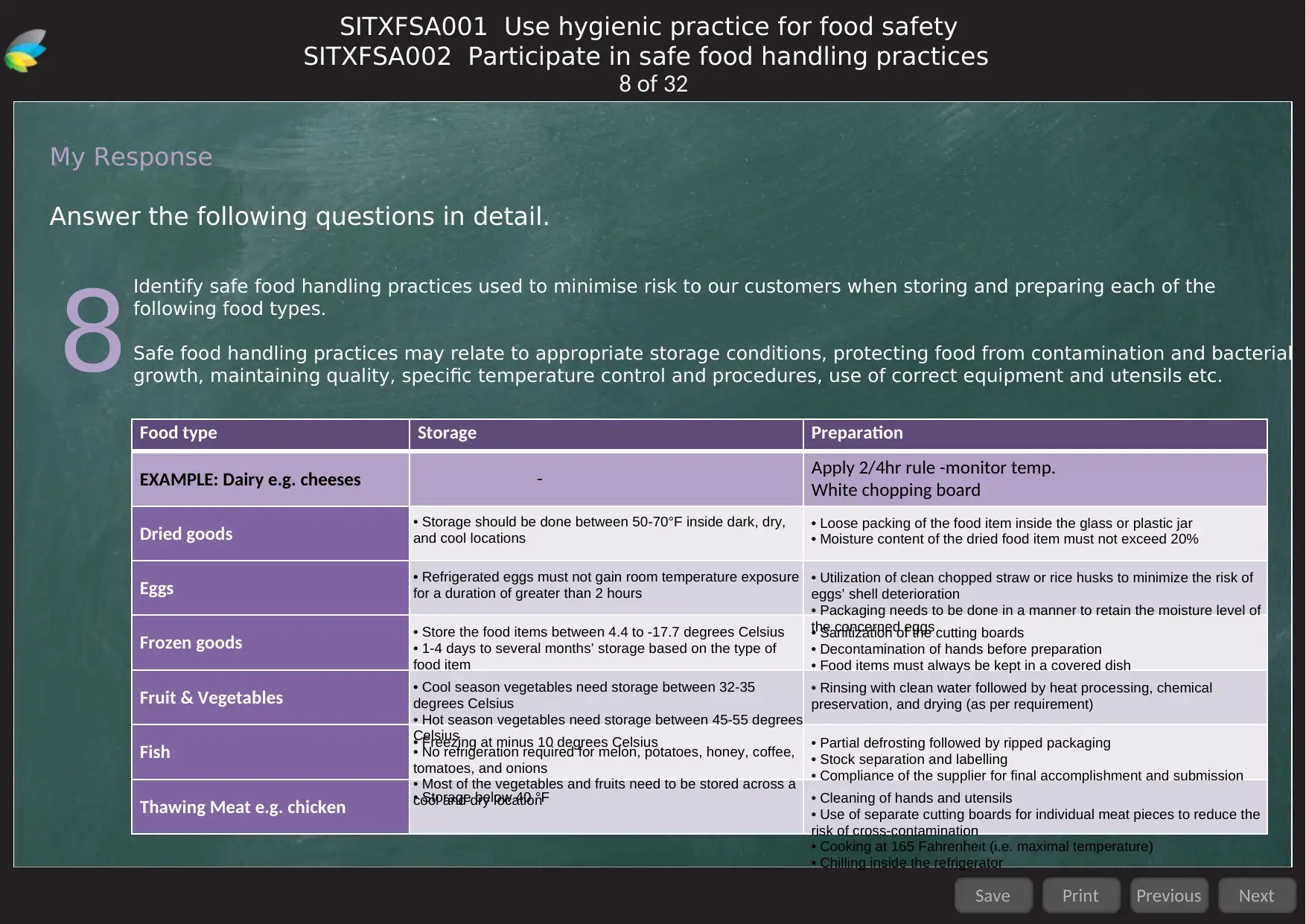
Identify safe food handling practices used to minimise risk to our customers when storing and preparing each of the
following food types.
Safe food handling practices may relate to appropriate storage conditions, protecting food from contamination and bacterial
growth, maintaining quality, specific temperature control and procedures, use of correct equipment and utensils etc.
8Food type Storage Preparation
EXAMPLE: Dairy e.g. cheeses - Apply 2/4hr rule -monitor temp.
White chopping board
Dried goods
Eggs
Frozen goods
Fruit & Vegetables
Fish
Thawing Meat e.g. chicken
• Storage should be done between 50-70°F inside dark, dry,
and cool locations
• Refrigerated eggs must not gain room temperature exposure
for a duration of greater than 2 hours
• Store the food items between 4.4 to -17.7 degrees Celsius
• 1-4 days to several months’ storage based on the type of
food item
• Cool season vegetables need storage between 32-35
degrees Celsius
• Hot season vegetables need storage between 45-55 degrees
Celsius
• No refrigeration required for melon, potatoes, honey, coffee,
tomatoes, and onions
• Most of the vegetables and fruits need to be stored across a
cool and dry location
• Freezing at minus 10 degrees Celsius
• Storage below 40 °F
• Loose packing of the food item inside the glass or plastic jar
• Moisture content of the dried food item must not exceed 20%
• Utilization of clean chopped straw or rice husks to minimize the risk of
eggs’ shell deterioration
• Packaging needs to be done in a manner to retain the moisture level of
the concerned eggs• Sanitization of the cutting boards
• Decontamination of hands before preparation
• Food items must always be kept in a covered dish
• Rinsing with clean water followed by heat processing, chemical
preservation, and drying (as per requirement)
• Partial defrosting followed by ripped packaging
• Stock separation and labelling
• Compliance of the supplier for final accomplishment and submission
• Cleaning of hands and utensils
• Use of separate cutting boards for individual meat pieces to reduce the
risk of cross-contamination
• Cooking at 165 Fahrenheit (i.e. maximal temperature)
• Chilling inside the refrigerator
NextPreviousPrintSave
SITXFSA001 Use hygienic practice for food safety
SITXFSA002 Participate in safe food handling practices
My Response
Answer the following questions in detail.
Identify safe food handling practices used to minimise risk to our customers when storing and preparing each of the
following food types.
Safe food handling practices may relate to appropriate storage conditions, protecting food from contamination and bacterial
growth, maintaining quality, specific temperature control and procedures, use of correct equipment and utensils etc.
8Food type Storage Preparation
EXAMPLE: Dairy e.g. cheeses - Apply 2/4hr rule -monitor temp.
White chopping board
Dried goods
Eggs
Frozen goods
Fruit & Vegetables
Fish
Thawing Meat e.g. chicken
• Storage should be done between 50-70°F inside dark, dry,
and cool locations
• Refrigerated eggs must not gain room temperature exposure
for a duration of greater than 2 hours
• Store the food items between 4.4 to -17.7 degrees Celsius
• 1-4 days to several months’ storage based on the type of
food item
• Cool season vegetables need storage between 32-35
degrees Celsius
• Hot season vegetables need storage between 45-55 degrees
Celsius
• No refrigeration required for melon, potatoes, honey, coffee,
tomatoes, and onions
• Most of the vegetables and fruits need to be stored across a
cool and dry location
• Freezing at minus 10 degrees Celsius
• Storage below 40 °F
• Loose packing of the food item inside the glass or plastic jar
• Moisture content of the dried food item must not exceed 20%
• Utilization of clean chopped straw or rice husks to minimize the risk of
eggs’ shell deterioration
• Packaging needs to be done in a manner to retain the moisture level of
the concerned eggs• Sanitization of the cutting boards
• Decontamination of hands before preparation
• Food items must always be kept in a covered dish
• Rinsing with clean water followed by heat processing, chemical
preservation, and drying (as per requirement)
• Partial defrosting followed by ripped packaging
• Stock separation and labelling
• Compliance of the supplier for final accomplishment and submission
• Cleaning of hands and utensils
• Use of separate cutting boards for individual meat pieces to reduce the
risk of cross-contamination
• Cooking at 165 Fahrenheit (i.e. maximal temperature)
• Chilling inside the refrigerator
9 of 32
NextPreviousPrintSave
SITXFSA001 Use hygienic practice for food safety
SITXFSA002 Participate in safe food handling practices
My Response
Answer the following questions in detail.
Identify (1) food hazard and one (1) hygiene hazard that could occur in your workplace and potentially affect the health and
safety of customers/colleagues.
For each hazard, indicate the corrective action you would take to minimise or remove the risk, and how should you report
/record what has happened per organisational procedures.
9Hygiene Hazard Action to Control Action to Report / Record
Food hazard Action to Control Action to Report / Record
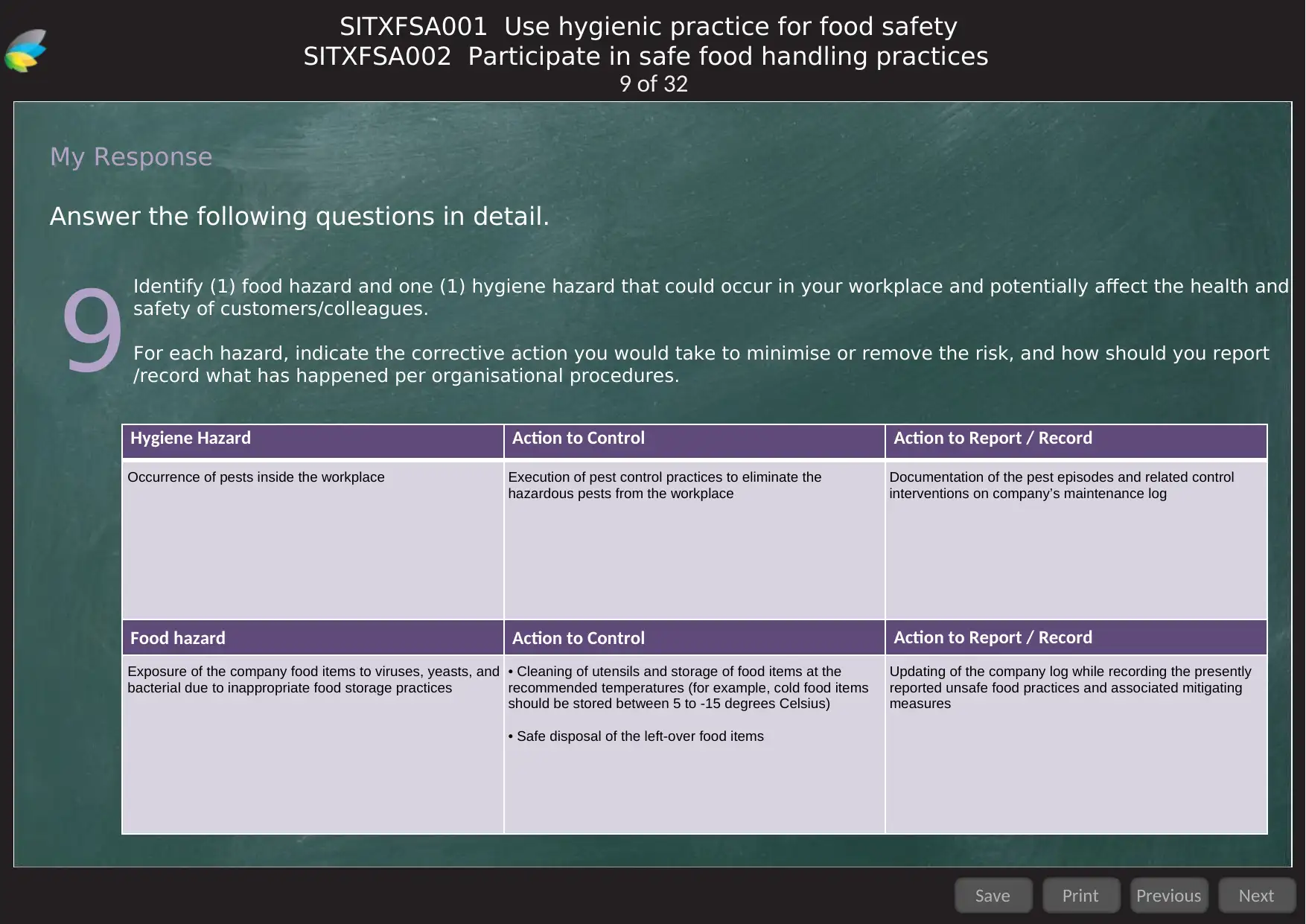
Occurrence of pests inside the workplace Execution of pest control practices to eliminate the
hazardous pests from the workplace
Documentation of the pest episodes and related control
interventions on company’s maintenance log
Exposure of the company food items to viruses, yeasts, and
bacterial due to inappropriate food storage practices
• Cleaning of utensils and storage of food items at the
recommended temperatures (for example, cold food items
should be stored between 5 to -15 degrees Celsius)
• Safe disposal of the left-over food items
Updating of the company log while recording the presently
reported unsafe food practices and associated mitigating
measures
NextPreviousPrintSave
SITXFSA001 Use hygienic practice for food safety
SITXFSA002 Participate in safe food handling practices
My Response
Answer the following questions in detail.
Identify (1) food hazard and one (1) hygiene hazard that could occur in your workplace and potentially affect the health and
safety of customers/colleagues.
For each hazard, indicate the corrective action you would take to minimise or remove the risk, and how should you report
/record what has happened per organisational procedures.
9Hygiene Hazard Action to Control Action to Report / Record
Food hazard Action to Control Action to Report / Record
Occurrence of pests inside the workplace Execution of pest control practices to eliminate the
hazardous pests from the workplace
Documentation of the pest episodes and related control
interventions on company’s maintenance log
Exposure of the company food items to viruses, yeasts, and
bacterial due to inappropriate food storage practices
• Cleaning of utensils and storage of food items at the
recommended temperatures (for example, cold food items
should be stored between 5 to -15 degrees Celsius)
• Safe disposal of the left-over food items
Updating of the company log while recording the presently
reported unsafe food practices and associated mitigating
measures
⊘ This is a preview!⊘
Do you want full access?
Subscribe today to unlock all pages.
Trusted by 1+ million students worldwide
10 of 32
NextPreviousPrintSave
SITXFSA001 Use hygienic practice for food safety
SITXFSA002 Participate in safe food handling practices
My Response
Answer the following questions in detail.
In restaurants and bars that provide salad bars
for counter meals, and single use items for
takeaway orders and drinks, what methods can
be used to ensure the safety of the food sold to
customers?10 Briefly describe 3 different food safety monitoring
techniques used within hospitality businesses that
prepare and sell food.
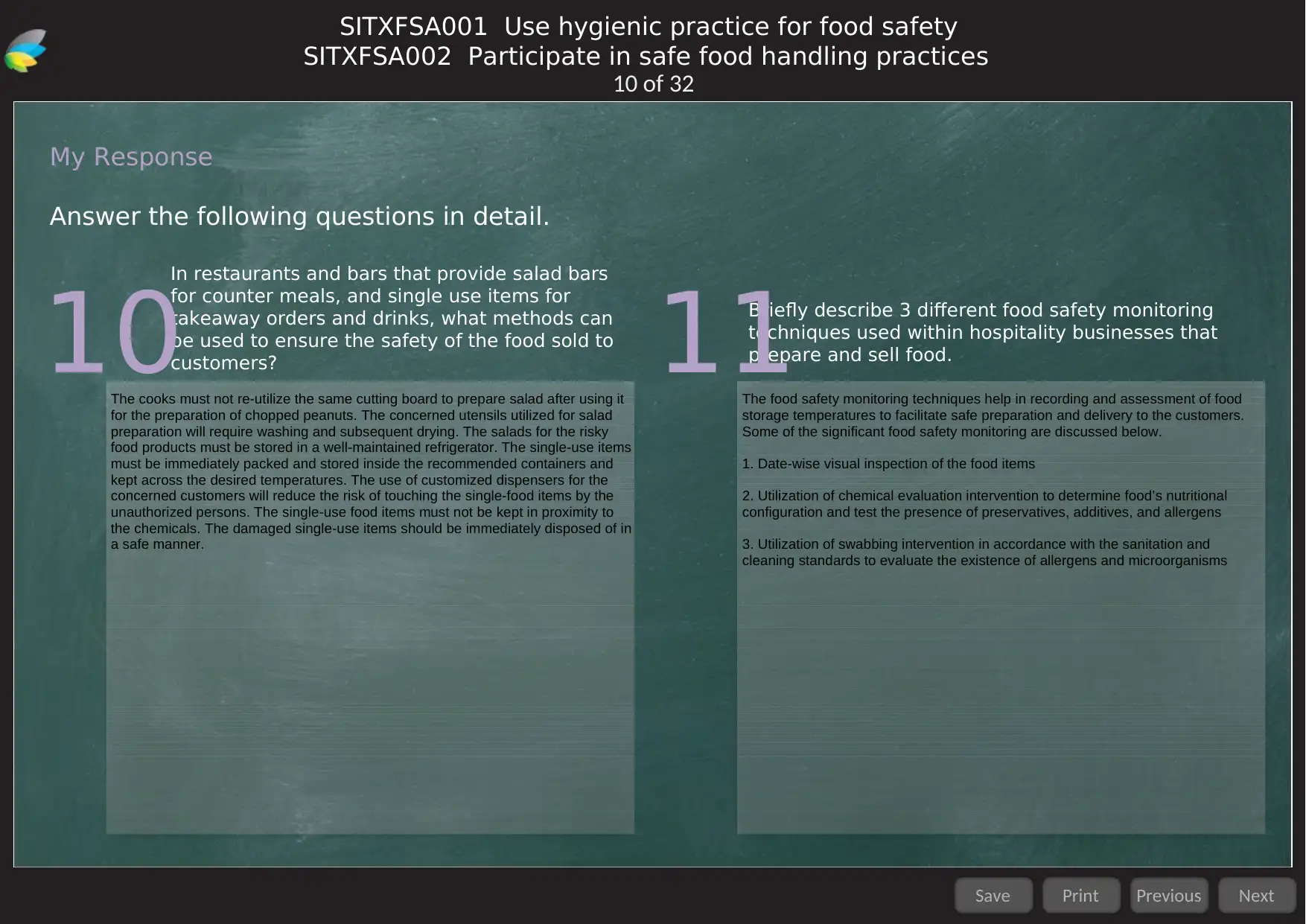
11The cooks must not re-utilize the same cutting board to prepare salad after using it
for the preparation of chopped peanuts. The concerned utensils utilized for salad
preparation will require washing and subsequent drying. The salads for the risky
food products must be stored in a well-maintained refrigerator. The single-use items
must be immediately packed and stored inside the recommended containers and
kept across the desired temperatures. The use of customized dispensers for the
concerned customers will reduce the risk of touching the single-food items by the
unauthorized persons. The single-use food items must not be kept in proximity to
the chemicals. The damaged single-use items should be immediately disposed of in
a safe manner.
The food safety monitoring techniques help in recording and assessment of food
storage temperatures to facilitate safe preparation and delivery to the customers.
Some of the significant food safety monitoring are discussed below.
1. Date-wise visual inspection of the food items
2. Utilization of chemical evaluation intervention to determine food’s nutritional
configuration and test the presence of preservatives, additives, and allergens
3. Utilization of swabbing intervention in accordance with the sanitation and
cleaning standards to evaluate the existence of allergens and microorganisms
NextPreviousPrintSave
SITXFSA001 Use hygienic practice for food safety
SITXFSA002 Participate in safe food handling practices
My Response
Answer the following questions in detail.
In restaurants and bars that provide salad bars
for counter meals, and single use items for
takeaway orders and drinks, what methods can
be used to ensure the safety of the food sold to
customers?10 Briefly describe 3 different food safety monitoring
techniques used within hospitality businesses that
prepare and sell food.
11The cooks must not re-utilize the same cutting board to prepare salad after using it
for the preparation of chopped peanuts. The concerned utensils utilized for salad
preparation will require washing and subsequent drying. The salads for the risky
food products must be stored in a well-maintained refrigerator. The single-use items
must be immediately packed and stored inside the recommended containers and
kept across the desired temperatures. The use of customized dispensers for the
concerned customers will reduce the risk of touching the single-food items by the
unauthorized persons. The single-use food items must not be kept in proximity to
the chemicals. The damaged single-use items should be immediately disposed of in
a safe manner.
The food safety monitoring techniques help in recording and assessment of food
storage temperatures to facilitate safe preparation and delivery to the customers.
Some of the significant food safety monitoring are discussed below.
1. Date-wise visual inspection of the food items
2. Utilization of chemical evaluation intervention to determine food’s nutritional
configuration and test the presence of preservatives, additives, and allergens
3. Utilization of swabbing intervention in accordance with the sanitation and
cleaning standards to evaluate the existence of allergens and microorganisms
Paraphrase This Document
Need a fresh take? Get an instant paraphrase of this document with our AI Paraphraser
11 of 32
NextPreviousPrintSave
SITXFSA001 Use hygienic practice for food safety
SITXFSA002 Participate in safe food handling practices
My Response
Answer the following questions in detail.
Briefly explain the Food Safety and Hygiene
monitoring and recording procedures within your
workplace.
12 When taking the temperature of a cooked chicken
product, how should you prepare and use the
temperature probe?
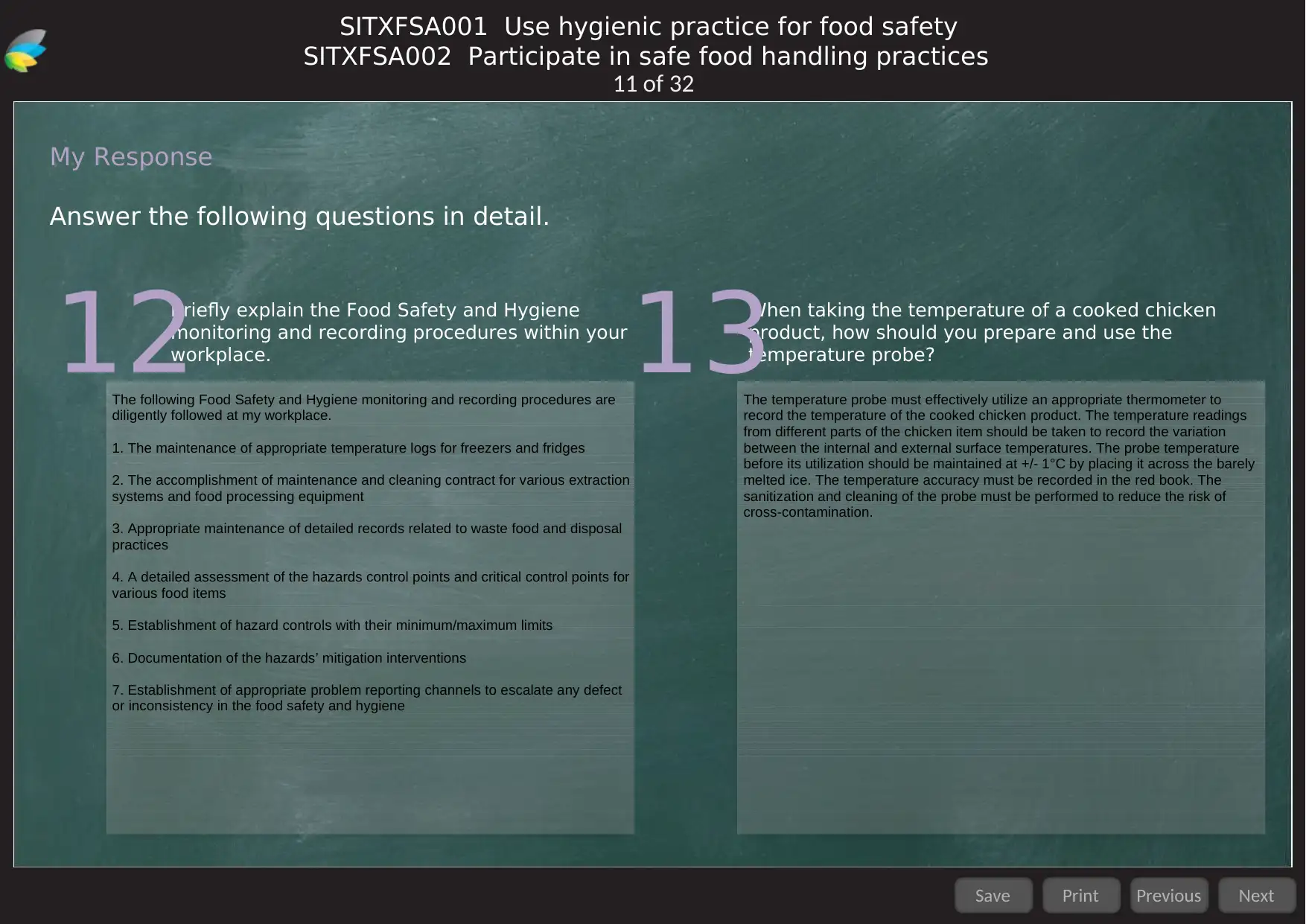
13The following Food Safety and Hygiene monitoring and recording procedures are
diligently followed at my workplace.
1. The maintenance of appropriate temperature logs for freezers and fridges
2. The accomplishment of maintenance and cleaning contract for various extraction
systems and food processing equipment
3. Appropriate maintenance of detailed records related to waste food and disposal
practices
4. A detailed assessment of the hazards control points and critical control points for
various food items
5. Establishment of hazard controls with their minimum/maximum limits
6. Documentation of the hazards’ mitigation interventions
7. Establishment of appropriate problem reporting channels to escalate any defect
or inconsistency in the food safety and hygiene
The temperature probe must effectively utilize an appropriate thermometer to
record the temperature of the cooked chicken product. The temperature readings
from different parts of the chicken item should be taken to record the variation
between the internal and external surface temperatures. The probe temperature
before its utilization should be maintained at +/- 1°C by placing it across the barely
melted ice. The temperature accuracy must be recorded in the red book. The
sanitization and cleaning of the probe must be performed to reduce the risk of
cross-contamination.
NextPreviousPrintSave
SITXFSA001 Use hygienic practice for food safety
SITXFSA002 Participate in safe food handling practices
My Response
Answer the following questions in detail.
Briefly explain the Food Safety and Hygiene
monitoring and recording procedures within your
workplace.
12 When taking the temperature of a cooked chicken
product, how should you prepare and use the
temperature probe?
13The following Food Safety and Hygiene monitoring and recording procedures are
diligently followed at my workplace.
1. The maintenance of appropriate temperature logs for freezers and fridges
2. The accomplishment of maintenance and cleaning contract for various extraction
systems and food processing equipment
3. Appropriate maintenance of detailed records related to waste food and disposal
practices
4. A detailed assessment of the hazards control points and critical control points for
various food items
5. Establishment of hazard controls with their minimum/maximum limits
6. Documentation of the hazards’ mitigation interventions
7. Establishment of appropriate problem reporting channels to escalate any defect
or inconsistency in the food safety and hygiene
The temperature probe must effectively utilize an appropriate thermometer to
record the temperature of the cooked chicken product. The temperature readings
from different parts of the chicken item should be taken to record the variation
between the internal and external surface temperatures. The probe temperature
before its utilization should be maintained at +/- 1°C by placing it across the barely
melted ice. The temperature accuracy must be recorded in the red book. The
sanitization and cleaning of the probe must be performed to reduce the risk of
cross-contamination.
12 of 32
NextPreviousPrintSave
SITXFSA001 Use hygienic practice for food safety
SITXFSA002 Participate in safe food handling practices
My Response
Answer the following questions in detail.
How could you identify if a temperature probe was faulty or not providing accurate readings? What action would you
take? Your answer should include how you could check the accuracy of the temperature probe.
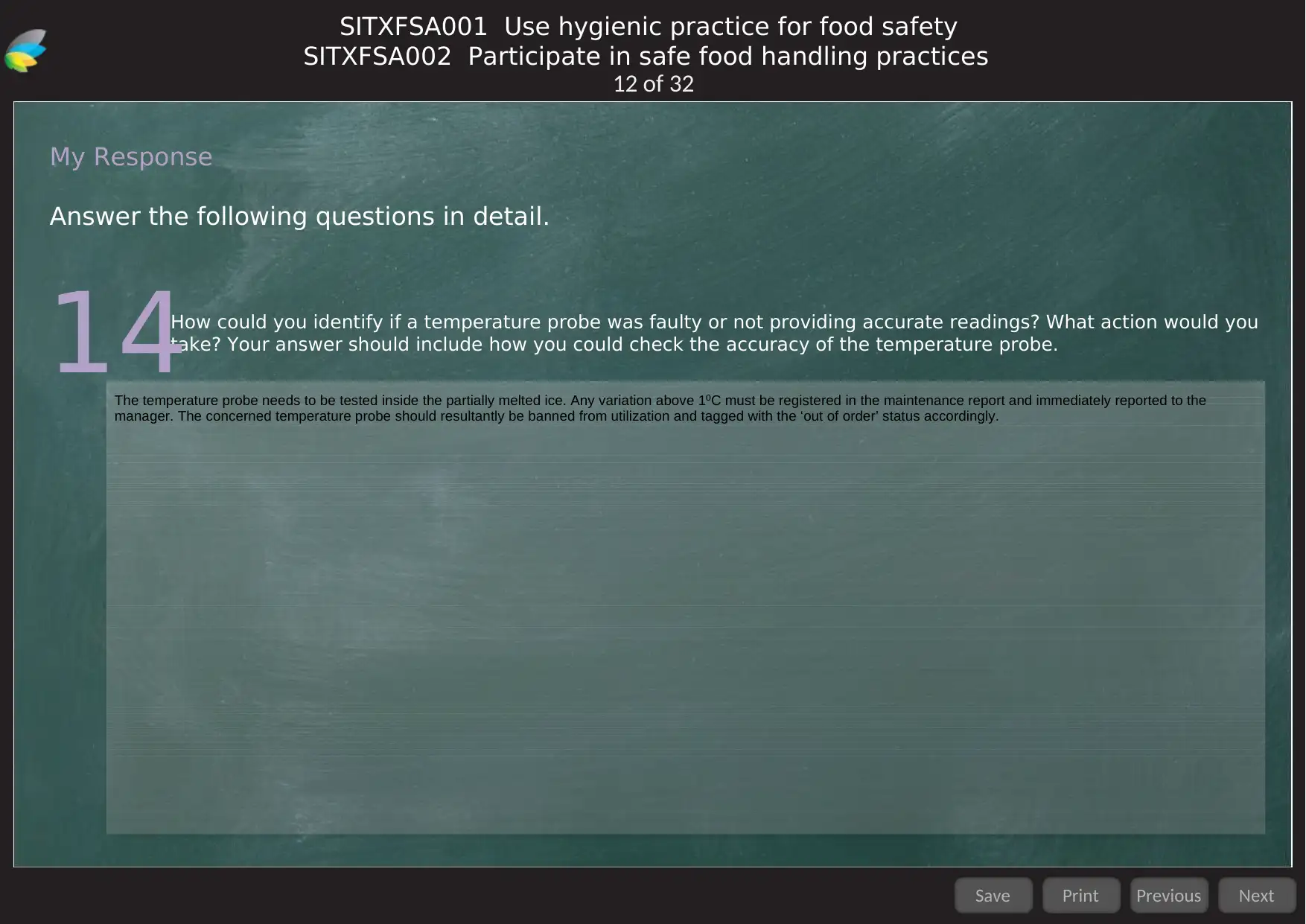
14The temperature probe needs to be tested inside the partially melted ice. Any variation above 1⁰C must be registered in the maintenance report and immediately reported to the
manager. The concerned temperature probe should resultantly be banned from utilization and tagged with the ‘out of order’ status accordingly.
NextPreviousPrintSave
SITXFSA001 Use hygienic practice for food safety
SITXFSA002 Participate in safe food handling practices
My Response
Answer the following questions in detail.
How could you identify if a temperature probe was faulty or not providing accurate readings? What action would you
take? Your answer should include how you could check the accuracy of the temperature probe.
14The temperature probe needs to be tested inside the partially melted ice. Any variation above 1⁰C must be registered in the maintenance report and immediately reported to the
manager. The concerned temperature probe should resultantly be banned from utilization and tagged with the ‘out of order’ status accordingly.
⊘ This is a preview!⊘
Do you want full access?
Subscribe today to unlock all pages.
Trusted by 1+ million students worldwide

1 out of 32


Your All-in-One AI-Powered Toolkit for Academic Success.
+13062052269
info@desklib.com
Available 24*7 on WhatsApp / Email
![[object Object]](/_next/static/media/star-bottom.7253800d.svg)
Unlock your academic potential
Copyright © 2020–2025 A2Z Services. All Rights Reserved. Developed and managed by ZUCOL.