SITXINV004 Control Stock: Short Answer Assessment - Complete Solution
VerifiedAdded on 2021/09/27
|17
|3396
|523
Homework Assignment
AI Summary
This document provides a comprehensive solution to the SITXINV004 Control Stock short answer assessment. The assessment covers a range of topics including maintaining stock levels and records, processing stock orders, and minimizing stock losses. It includes answers to questions on computerised stock control systems, imprest systems, bin card systems, monitoring and maintaining stock levels, stock information for new staff, maintaining stock records, stock usage reports, identifying fast and slow-moving items, stock reorder cycles, and delegating ordering responsibilities. The document also addresses documents containing information on negotiated costs, order forms, computerised ordering systems, ordering methods (PAR, JIT), reorder points, purchasing steps, processing deliveries, recording discrepancies, security systems, electronic article surveillance, inspecting stock in storage, avoidable stock losses, recording and reporting stock losses, reasons for stock losses, and solutions to prevent future losses. The document is a valuable resource for students studying stock control and management.
SITXINV004 CONTROL STOCK– Short answer
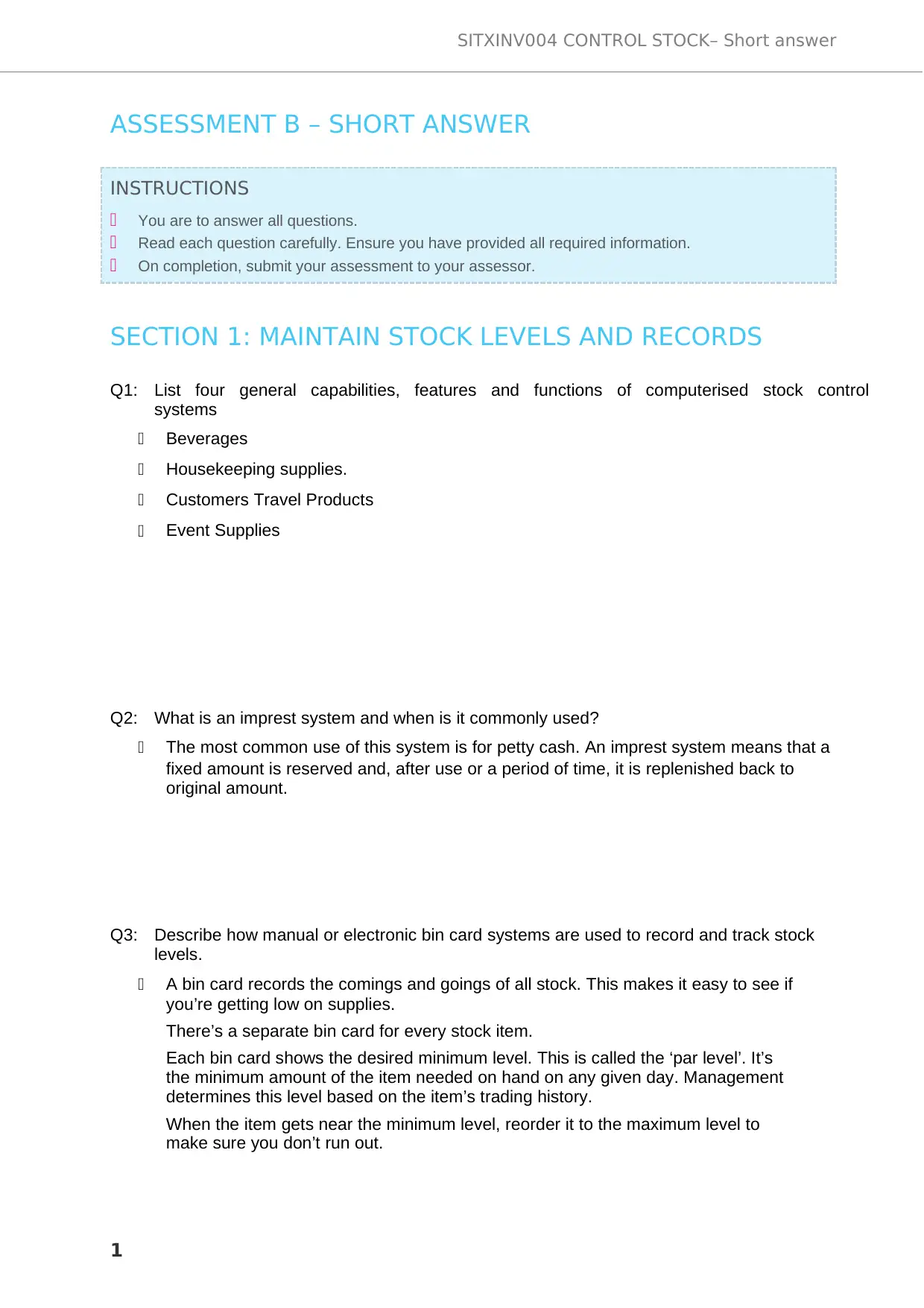
ASSESSMENT B – SHORT ANSWER
INSTRUCTIONS
You are to answer all questions.
Read each question carefully. Ensure you have provided all required information.
On completion, submit your assessment to your assessor.
SECTION 1: MAINTAIN STOCK LEVELS AND RECORDS
Q1: List four general capabilities, features and functions of computerised stock control
systems
Beverages
Housekeeping supplies.
Customers Travel Products
Event Supplies
Q2: What is an imprest system and when is it commonly used?
The most common use of this system is for petty cash. An imprest system means that a
fixed amount is reserved and, after use or a period of time, it is replenished back to
original amount.
Q3: Describe how manual or electronic bin card systems are used to record and track stock
levels.
A bin card records the comings and goings of all stock. This makes it easy to see if
you’re getting low on supplies.
There’s a separate bin card for every stock item.
Each bin card shows the desired minimum level. This is called the ‘par level’. It’s
the minimum amount of the item needed on hand on any given day. Management
determines this level based on the item’s trading history.
When the item gets near the minimum level, reorder it to the maximum level to
make sure you don’t run out.
1
ASSESSMENT B – SHORT ANSWER
INSTRUCTIONS
You are to answer all questions.
Read each question carefully. Ensure you have provided all required information.
On completion, submit your assessment to your assessor.
SECTION 1: MAINTAIN STOCK LEVELS AND RECORDS
Q1: List four general capabilities, features and functions of computerised stock control
systems
Beverages
Housekeeping supplies.
Customers Travel Products
Event Supplies
Q2: What is an imprest system and when is it commonly used?
The most common use of this system is for petty cash. An imprest system means that a
fixed amount is reserved and, after use or a period of time, it is replenished back to
original amount.
Q3: Describe how manual or electronic bin card systems are used to record and track stock
levels.
A bin card records the comings and goings of all stock. This makes it easy to see if
you’re getting low on supplies.
There’s a separate bin card for every stock item.
Each bin card shows the desired minimum level. This is called the ‘par level’. It’s
the minimum amount of the item needed on hand on any given day. Management
determines this level based on the item’s trading history.
When the item gets near the minimum level, reorder it to the maximum level to
make sure you don’t run out.
1
Paraphrase This Document
Need a fresh take? Get an instant paraphrase of this document with our AI Paraphraser

SITXINV004 CONTROL STOCK– Short answer
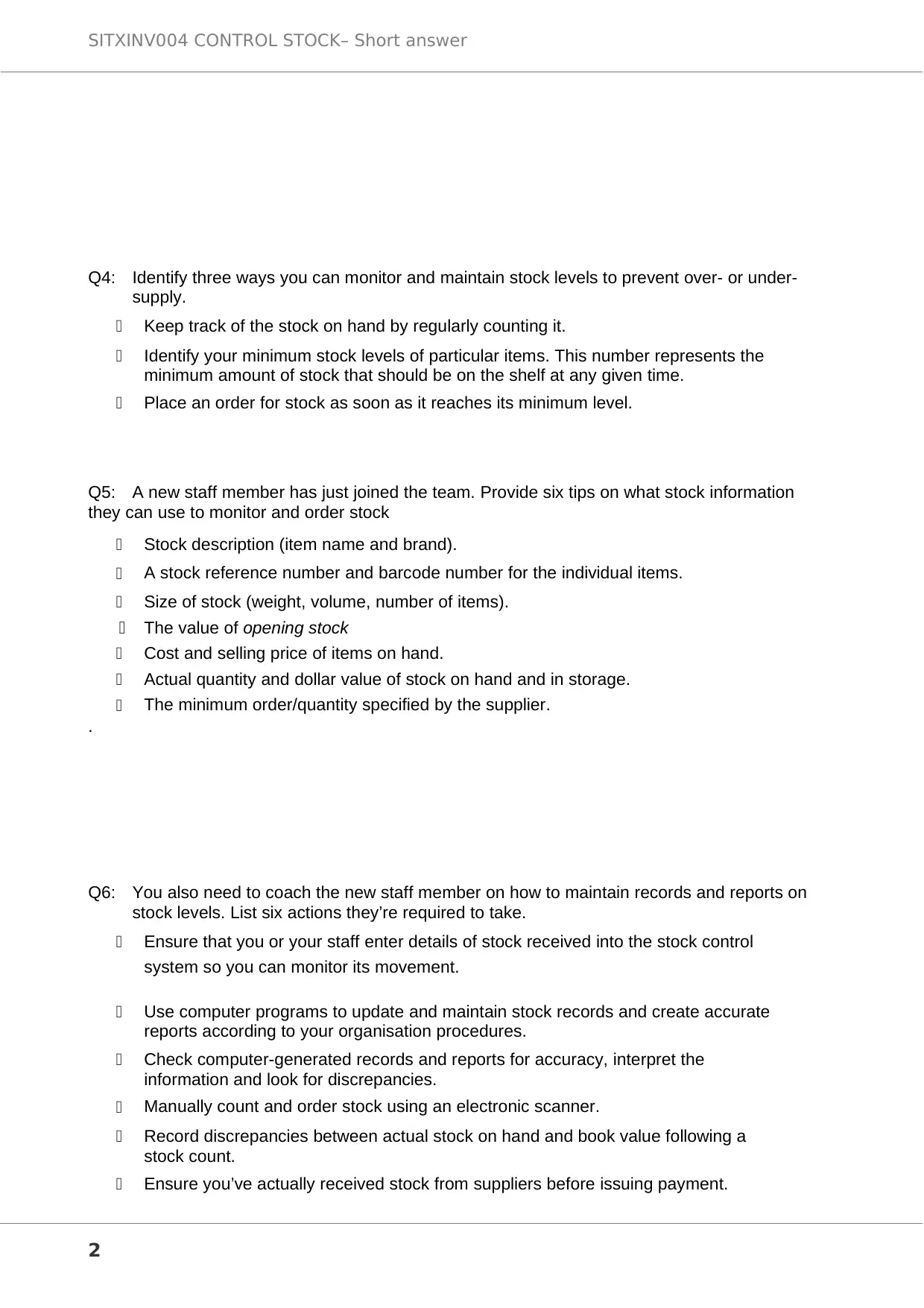
Q4: Identify three ways you can monitor and maintain stock levels to prevent over- or under-
supply.
Keep track of the stock on hand by regularly counting it.
Identify your minimum stock levels of particular items. This number represents the
minimum amount of stock that should be on the shelf at any given time.
Place an order for stock as soon as it reaches its minimum level.
Q5: A new staff member has just joined the team. Provide six tips on what stock information
they can use to monitor and order stock
Stock description (item name and brand).
A stock reference number and barcode number for the individual items.
Size of stock (weight, volume, number of items).
The value of opening stock
Cost and selling price of items on hand.
Actual quantity and dollar value of stock on hand and in storage.
The minimum order/quantity specified by the supplier.
.
Q6: You also need to coach the new staff member on how to maintain records and reports on
stock levels. List six actions they’re required to take.
Ensure that you or your staff enter details of stock received into the stock control
system so you can monitor its movement.
Use computer programs to update and maintain stock records and create accurate
reports according to your organisation procedures.
Check computer-generated records and reports for accuracy, interpret the
information and look for discrepancies.
Manually count and order stock using an electronic scanner.
Record discrepancies between actual stock on hand and book value following a
stock count.
Ensure you’ve actually received stock from suppliers before issuing payment.
2
Q4: Identify three ways you can monitor and maintain stock levels to prevent over- or under-
supply.
Keep track of the stock on hand by regularly counting it.
Identify your minimum stock levels of particular items. This number represents the
minimum amount of stock that should be on the shelf at any given time.
Place an order for stock as soon as it reaches its minimum level.
Q5: A new staff member has just joined the team. Provide six tips on what stock information
they can use to monitor and order stock
Stock description (item name and brand).
A stock reference number and barcode number for the individual items.
Size of stock (weight, volume, number of items).
The value of opening stock
Cost and selling price of items on hand.
Actual quantity and dollar value of stock on hand and in storage.
The minimum order/quantity specified by the supplier.
.
Q6: You also need to coach the new staff member on how to maintain records and reports on
stock levels. List six actions they’re required to take.
Ensure that you or your staff enter details of stock received into the stock control
system so you can monitor its movement.
Use computer programs to update and maintain stock records and create accurate
reports according to your organisation procedures.
Check computer-generated records and reports for accuracy, interpret the
information and look for discrepancies.
Manually count and order stock using an electronic scanner.
Record discrepancies between actual stock on hand and book value following a
stock count.
Ensure you’ve actually received stock from suppliers before issuing payment.
2

SITXINV004 CONTROL STOCK– Short answer
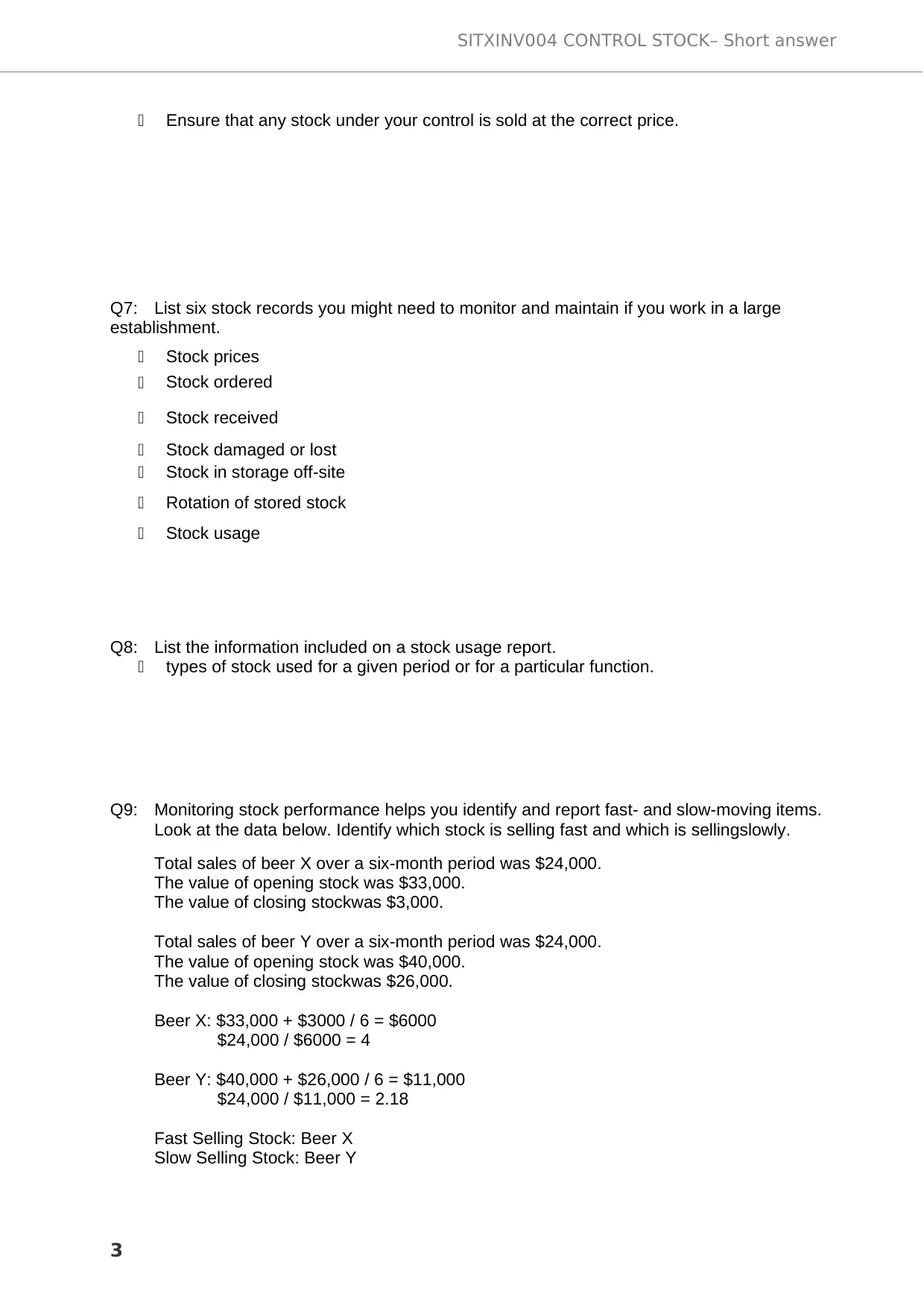
Ensure that any stock under your control is sold at the correct price.
Q7: List six stock records you might need to monitor and maintain if you work in a large
establishment.
Stock prices
Stock ordered
Stock received
Stock damaged or lost
Stock in storage off-site
Rotation of stored stock
Stock usage
Q8: List the information included on a stock usage report.
types of stock used for a given period or for a particular function.
Q9: Monitoring stock performance helps you identify and report fast- and slow-moving items.
Look at the data below. Identify which stock is selling fast and which is sellingslowly.
Total sales of beer X over a six-month period was $24,000.
The value of opening stock was $33,000.
The value of closing stockwas $3,000.
Total sales of beer Y over a six-month period was $24,000.
The value of opening stock was $40,000.
The value of closing stockwas $26,000.
Beer X: $33,000 + $3000 / 6 = $6000
$24,000 / $6000 = 4
Beer Y: $40,000 + $26,000 / 6 = $11,000
$24,000 / $11,000 = 2.18
Fast Selling Stock: Beer X
Slow Selling Stock: Beer Y
3
Ensure that any stock under your control is sold at the correct price.
Q7: List six stock records you might need to monitor and maintain if you work in a large
establishment.
Stock prices
Stock ordered
Stock received
Stock damaged or lost
Stock in storage off-site
Rotation of stored stock
Stock usage
Q8: List the information included on a stock usage report.
types of stock used for a given period or for a particular function.
Q9: Monitoring stock performance helps you identify and report fast- and slow-moving items.
Look at the data below. Identify which stock is selling fast and which is sellingslowly.
Total sales of beer X over a six-month period was $24,000.
The value of opening stock was $33,000.
The value of closing stockwas $3,000.
Total sales of beer Y over a six-month period was $24,000.
The value of opening stock was $40,000.
The value of closing stockwas $26,000.
Beer X: $33,000 + $3000 / 6 = $6000
$24,000 / $6000 = 4
Beer Y: $40,000 + $26,000 / 6 = $11,000
$24,000 / $11,000 = 2.18
Fast Selling Stock: Beer X
Slow Selling Stock: Beer Y
3
⊘ This is a preview!⊘
Do you want full access?
Subscribe today to unlock all pages.

Trusted by 1+ million students worldwide

SITXINV004 CONTROL STOCK– Short answer
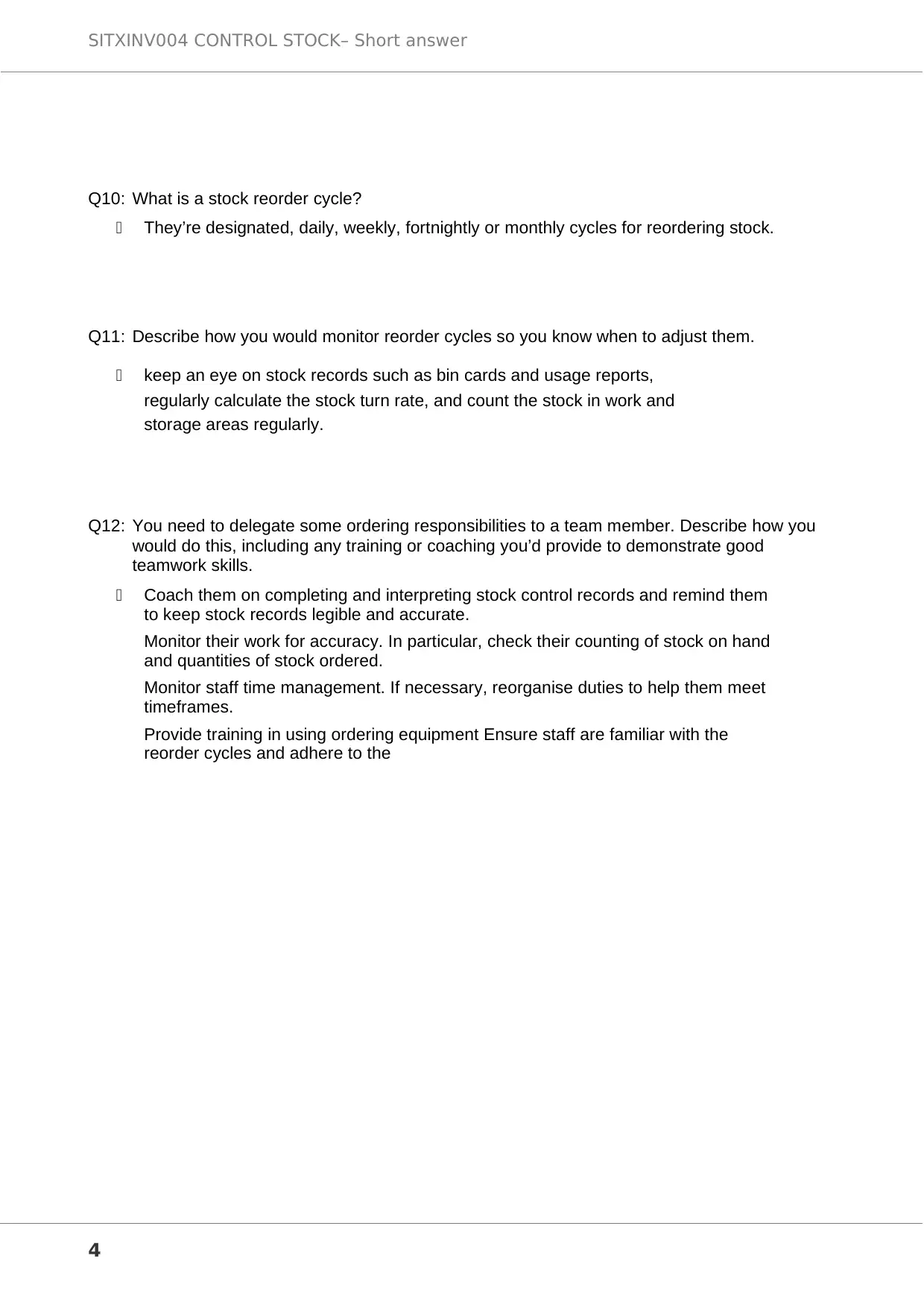
Q10: What is a stock reorder cycle?
They’re designated, daily, weekly, fortnightly or monthly cycles for reordering stock.
Q11: Describe how you would monitor reorder cycles so you know when to adjust them.
keep an eye on stock records such as bin cards and usage reports,
regularly calculate the stock turn rate, and count the stock in work and
storage areas regularly.
Q12: You need to delegate some ordering responsibilities to a team member. Describe how you
would do this, including any training or coaching you’d provide to demonstrate good
teamwork skills.
Coach them on completing and interpreting stock control records and remind them
to keep stock records legible and accurate.
Monitor their work for accuracy. In particular, check their counting of stock on hand
and quantities of stock ordered.
Monitor staff time management. If necessary, reorganise duties to help them meet
timeframes.
Provide training in using ordering equipment Ensure staff are familiar with the
reorder cycles and adhere to the
4
Q10: What is a stock reorder cycle?
They’re designated, daily, weekly, fortnightly or monthly cycles for reordering stock.
Q11: Describe how you would monitor reorder cycles so you know when to adjust them.
keep an eye on stock records such as bin cards and usage reports,
regularly calculate the stock turn rate, and count the stock in work and
storage areas regularly.
Q12: You need to delegate some ordering responsibilities to a team member. Describe how you
would do this, including any training or coaching you’d provide to demonstrate good
teamwork skills.
Coach them on completing and interpreting stock control records and remind them
to keep stock records legible and accurate.
Monitor their work for accuracy. In particular, check their counting of stock on hand
and quantities of stock ordered.
Monitor staff time management. If necessary, reorganise duties to help them meet
timeframes.
Provide training in using ordering equipment Ensure staff are familiar with the
reorder cycles and adhere to the
4
Paraphrase This Document
Need a fresh take? Get an instant paraphrase of this document with our AI Paraphraser

SITXINV004 CONTROL STOCK– Short answer
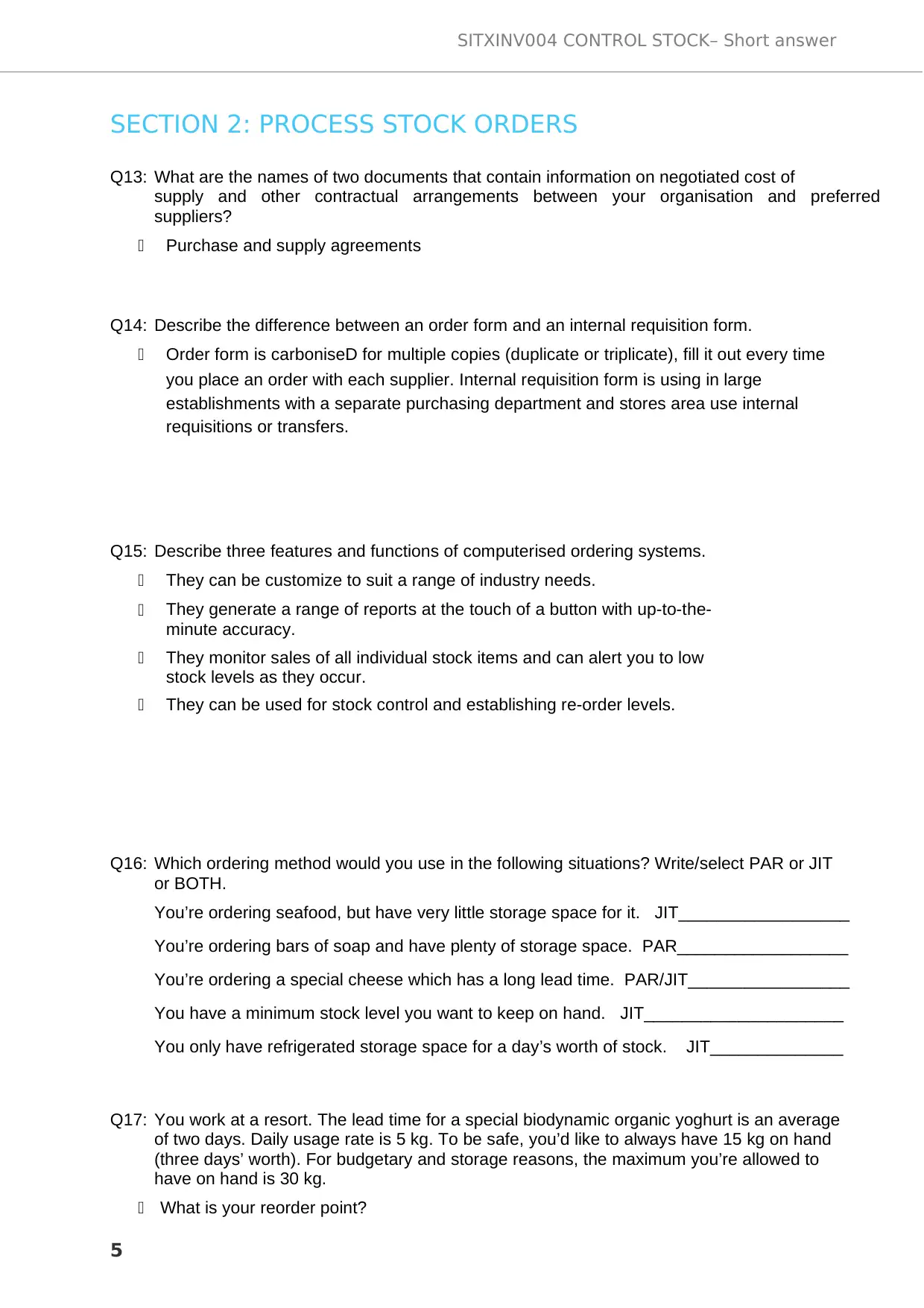
SECTION 2: PROCESS STOCK ORDERS
Q13: What are the names of two documents that contain information on negotiated cost of
supply and other contractual arrangements between your organisation and preferred
suppliers?
Purchase and supply agreements
Q14: Describe the difference between an order form and an internal requisition form.
Order form is carboniseD for multiple copies (duplicate or triplicate), fill it out every time
you place an order with each supplier. Internal requisition form is using in large
establishments with a separate purchasing department and stores area use internal
requisitions or transfers.
Q15: Describe three features and functions of computerised ordering systems.
They can be customize to suit a range of industry needs.
They generate a range of reports at the touch of a button with up-to-the-
minute accuracy.
They monitor sales of all individual stock items and can alert you to low
stock levels as they occur.
They can be used for stock control and establishing re-order levels.
Q16: Which ordering method would you use in the following situations? Write/select PAR or JIT
or BOTH.
You’re ordering seafood, but have very little storage space for it. JIT__________________
You’re ordering bars of soap and have plenty of storage space. PAR__________________
You’re ordering a special cheese which has a long lead time. PAR/JIT_________________
You have a minimum stock level you want to keep on hand. JIT_____________________
You only have refrigerated storage space for a day’s worth of stock. JIT______________
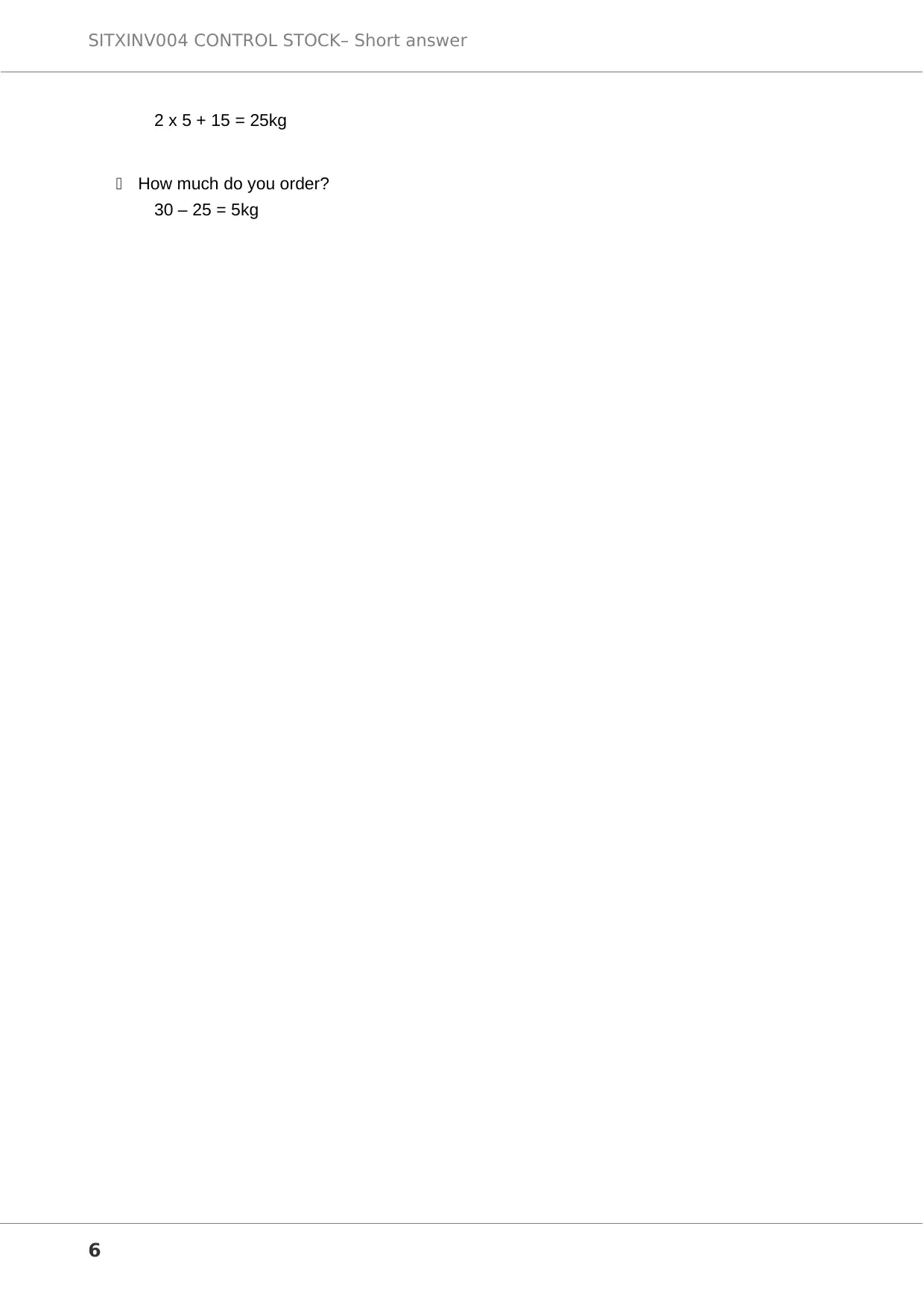
Q17: You work at a resort. The lead time for a special biodynamic organic yoghurt is an average
of two days. Daily usage rate is 5 kg. To be safe, you’d like to always have 15 kg on hand
(three days’ worth). For budgetary and storage reasons, the maximum you’re allowed to
have on hand is 30 kg.
What is your reorder point?
5
SECTION 2: PROCESS STOCK ORDERS
Q13: What are the names of two documents that contain information on negotiated cost of
supply and other contractual arrangements between your organisation and preferred
suppliers?
Purchase and supply agreements
Q14: Describe the difference between an order form and an internal requisition form.
Order form is carboniseD for multiple copies (duplicate or triplicate), fill it out every time
you place an order with each supplier. Internal requisition form is using in large
establishments with a separate purchasing department and stores area use internal
requisitions or transfers.
Q15: Describe three features and functions of computerised ordering systems.
They can be customize to suit a range of industry needs.
They generate a range of reports at the touch of a button with up-to-the-
minute accuracy.
They monitor sales of all individual stock items and can alert you to low
stock levels as they occur.
They can be used for stock control and establishing re-order levels.
Q16: Which ordering method would you use in the following situations? Write/select PAR or JIT
or BOTH.
You’re ordering seafood, but have very little storage space for it. JIT__________________
You’re ordering bars of soap and have plenty of storage space. PAR__________________
You’re ordering a special cheese which has a long lead time. PAR/JIT_________________
You have a minimum stock level you want to keep on hand. JIT_____________________
You only have refrigerated storage space for a day’s worth of stock. JIT______________
Q17: You work at a resort. The lead time for a special biodynamic organic yoghurt is an average
of two days. Daily usage rate is 5 kg. To be safe, you’d like to always have 15 kg on hand
(three days’ worth). For budgetary and storage reasons, the maximum you’re allowed to
have on hand is 30 kg.
What is your reorder point?
5

SITXINV004 CONTROL STOCK– Short answer
2 x 5 + 15 = 25kg
How much do you order?
30 – 25 = 5kg
6
2 x 5 + 15 = 25kg
How much do you order?
30 – 25 = 5kg
6
⊘ This is a preview!⊘
Do you want full access?
Subscribe today to unlock all pages.

Trusted by 1+ million students worldwide

SITXINV004 CONTROL STOCK– Short answer
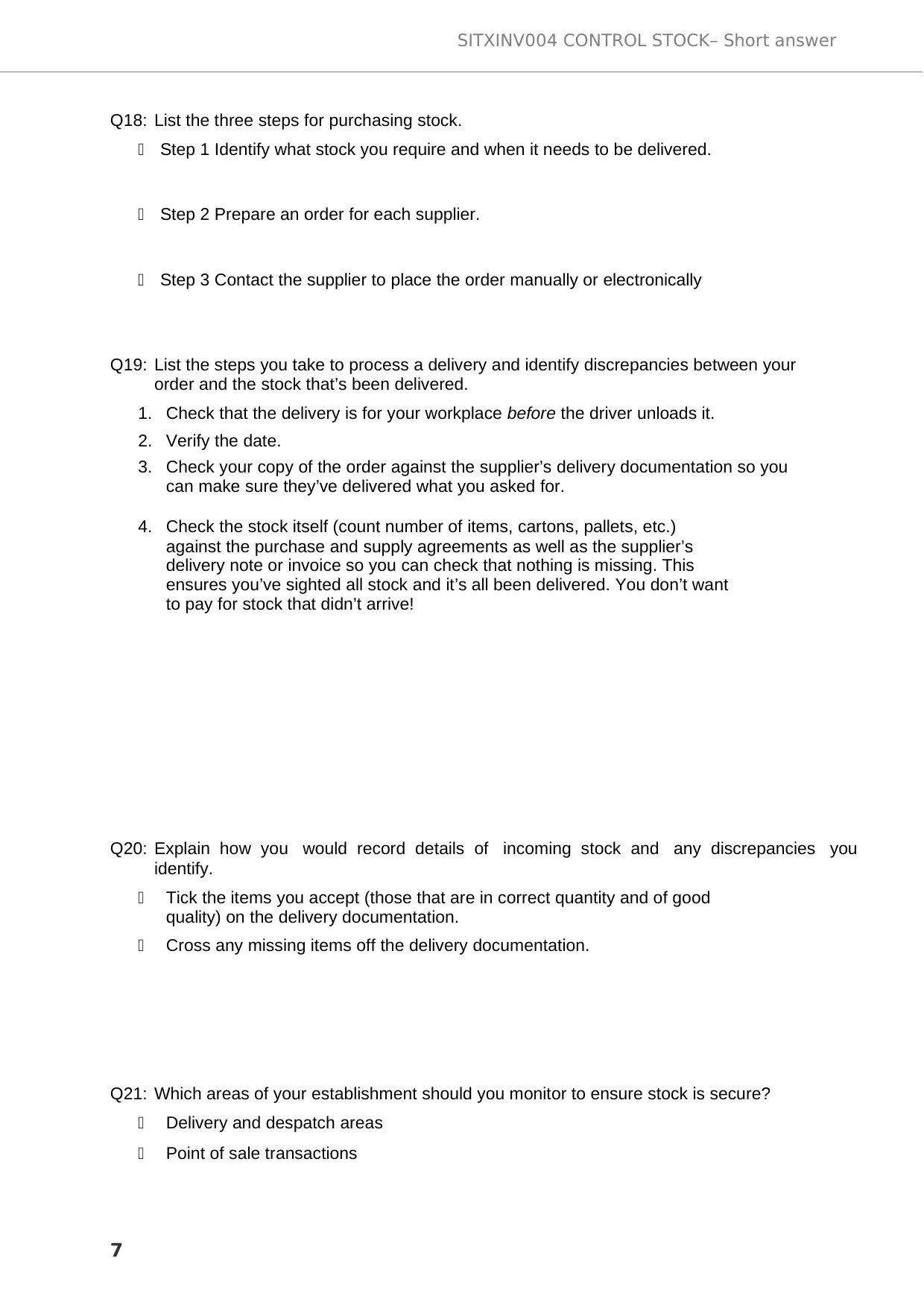
Q18: List the three steps for purchasing stock.
Step 1 Identify what stock you require and when it needs to be delivered.
Step 2 Prepare an order for each supplier.
Step 3 Contact the supplier to place the order manually or electronically
Q19: List the steps you take to process a delivery and identify discrepancies between your
order and the stock that’s been delivered.
1. Check that the delivery is for your workplace before the driver unloads it.
2. Verify the date.
3. Check your copy of the order against the supplier’s delivery documentation so you
can make sure they’ve delivered what you asked for.
4. Check the stock itself (count number of items, cartons, pallets, etc.)
against the purchase and supply agreements as well as the supplier’s
delivery note or invoice so you can check that nothing is missing. This
ensures you’ve sighted all stock and it’s all been delivered. You don’t want
to pay for stock that didn’t arrive!
Q20: Explain how you would record details of incoming stock and any discrepancies you
identify.
Tick the items you accept (those that are in correct quantity and of good
quality) on the delivery documentation.
Cross any missing items off the delivery documentation.
Q21: Which areas of your establishment should you monitor to ensure stock is secure?
Delivery and despatch areas
Point of sale transactions
7
Q18: List the three steps for purchasing stock.
Step 1 Identify what stock you require and when it needs to be delivered.
Step 2 Prepare an order for each supplier.
Step 3 Contact the supplier to place the order manually or electronically
Q19: List the steps you take to process a delivery and identify discrepancies between your
order and the stock that’s been delivered.
1. Check that the delivery is for your workplace before the driver unloads it.
2. Verify the date.
3. Check your copy of the order against the supplier’s delivery documentation so you
can make sure they’ve delivered what you asked for.
4. Check the stock itself (count number of items, cartons, pallets, etc.)
against the purchase and supply agreements as well as the supplier’s
delivery note or invoice so you can check that nothing is missing. This
ensures you’ve sighted all stock and it’s all been delivered. You don’t want
to pay for stock that didn’t arrive!
Q20: Explain how you would record details of incoming stock and any discrepancies you
identify.
Tick the items you accept (those that are in correct quantity and of good
quality) on the delivery documentation.
Cross any missing items off the delivery documentation.
Q21: Which areas of your establishment should you monitor to ensure stock is secure?
Delivery and despatch areas
Point of sale transactions
7
Paraphrase This Document
Need a fresh take? Get an instant paraphrase of this document with our AI Paraphraser

SITXINV004 CONTROL STOCK– Short answer
8
8

SITXINV004 CONTROL STOCK– Short answer
SECTION 3: MINIMISE STOCK LOSSES
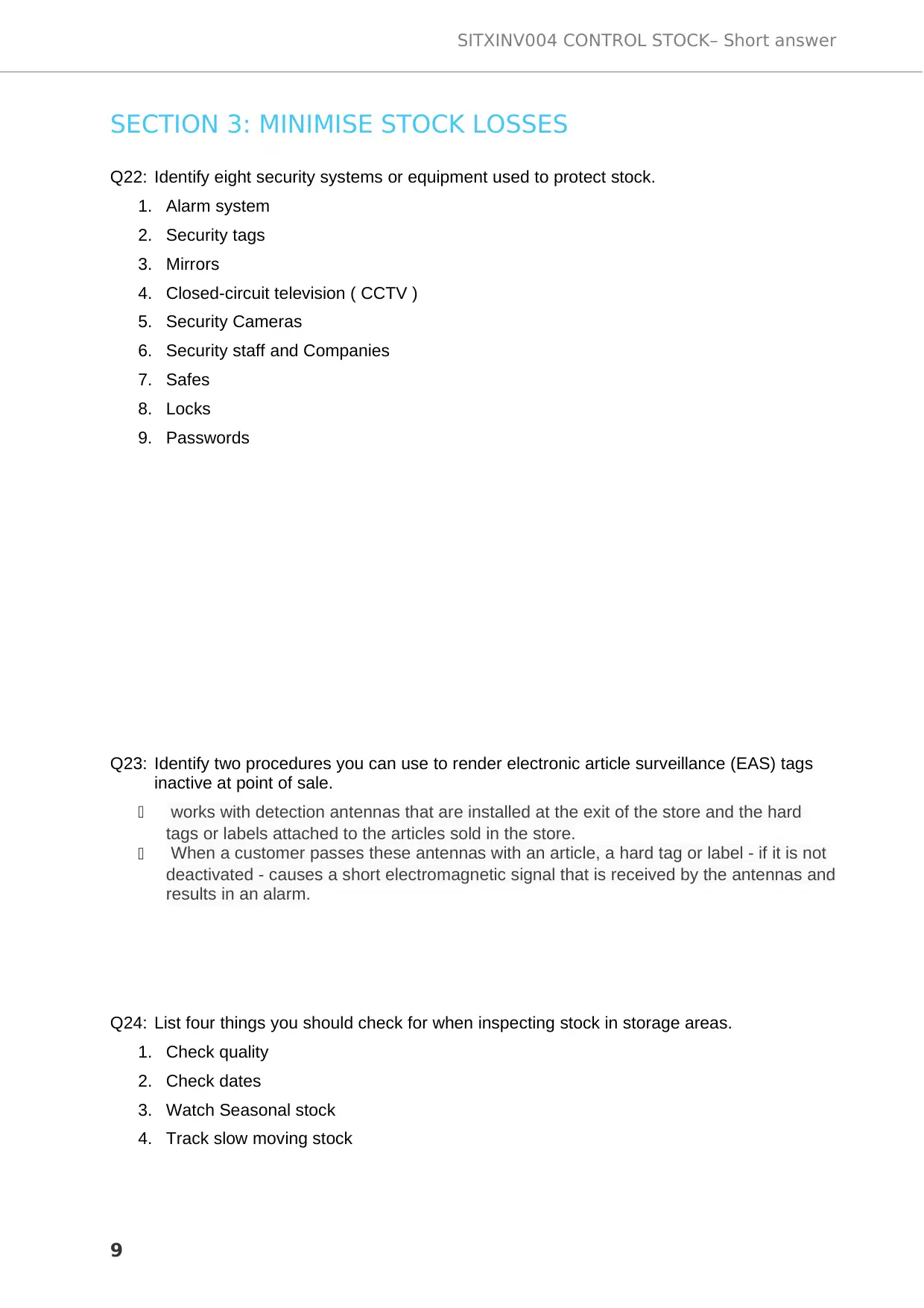
Q22: Identify eight security systems or equipment used to protect stock.
1. Alarm system
2. Security tags
3. Mirrors
4. Closed-circuit television ( CCTV )
5. Security Cameras
6. Security staff and Companies
7. Safes
8. Locks
9. Passwords
Q23: Identify two procedures you can use to render electronic article surveillance (EAS) tags
inactive at point of sale.
works with detection antennas that are installed at the exit of the store and the hard
tags or labels attached to the articles sold in the store.
When a customer passes these antennas with an article, a hard tag or label - if it is not
deactivated - causes a short electromagnetic signal that is received by the antennas and
results in an alarm.
Q24: List four things you should check for when inspecting stock in storage areas.
1. Check quality
2. Check dates
3. Watch Seasonal stock
4. Track slow moving stock
9
SECTION 3: MINIMISE STOCK LOSSES
Q22: Identify eight security systems or equipment used to protect stock.
1. Alarm system
2. Security tags
3. Mirrors
4. Closed-circuit television ( CCTV )
5. Security Cameras
6. Security staff and Companies
7. Safes
8. Locks
9. Passwords
Q23: Identify two procedures you can use to render electronic article surveillance (EAS) tags
inactive at point of sale.
works with detection antennas that are installed at the exit of the store and the hard
tags or labels attached to the articles sold in the store.
When a customer passes these antennas with an article, a hard tag or label - if it is not
deactivated - causes a short electromagnetic signal that is received by the antennas and
results in an alarm.
Q24: List four things you should check for when inspecting stock in storage areas.
1. Check quality
2. Check dates
3. Watch Seasonal stock
4. Track slow moving stock
9
⊘ This is a preview!⊘
Do you want full access?
Subscribe today to unlock all pages.

Trusted by 1+ million students worldwide

SITXINV004 CONTROL STOCK– Short answer
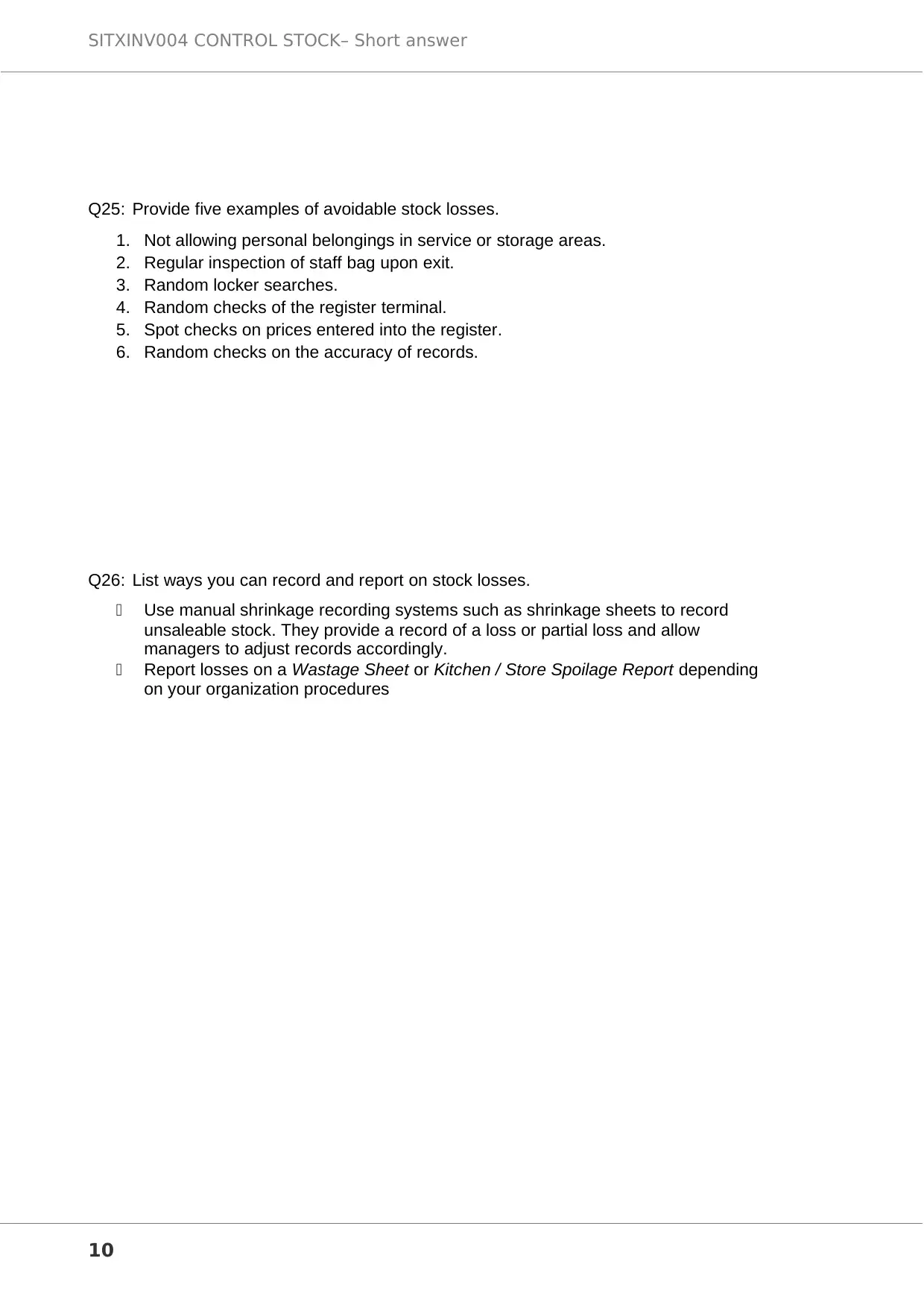
Q25: Provide five examples of avoidable stock losses.
1. Not allowing personal belongings in service or storage areas.
2. Regular inspection of staff bag upon exit.
3. Random locker searches.
4. Random checks of the register terminal.
5. Spot checks on prices entered into the register.
6. Random checks on the accuracy of records.
Q26: List ways you can record and report on stock losses.
Use manual shrinkage recording systems such as shrinkage sheets to record
unsaleable stock. They provide a record of a loss or partial loss and allow
managers to adjust records accordingly.
Report losses on a Wastage Sheet or Kitchen / Store Spoilage Report depending
on your organization procedures
10
Q25: Provide five examples of avoidable stock losses.
1. Not allowing personal belongings in service or storage areas.
2. Regular inspection of staff bag upon exit.
3. Random locker searches.
4. Random checks of the register terminal.
5. Spot checks on prices entered into the register.
6. Random checks on the accuracy of records.
Q26: List ways you can record and report on stock losses.
Use manual shrinkage recording systems such as shrinkage sheets to record
unsaleable stock. They provide a record of a loss or partial loss and allow
managers to adjust records accordingly.
Report losses on a Wastage Sheet or Kitchen / Store Spoilage Report depending
on your organization procedures
10
Paraphrase This Document
Need a fresh take? Get an instant paraphrase of this document with our AI Paraphraser

SITXINV004 CONTROL STOCK– Short answer
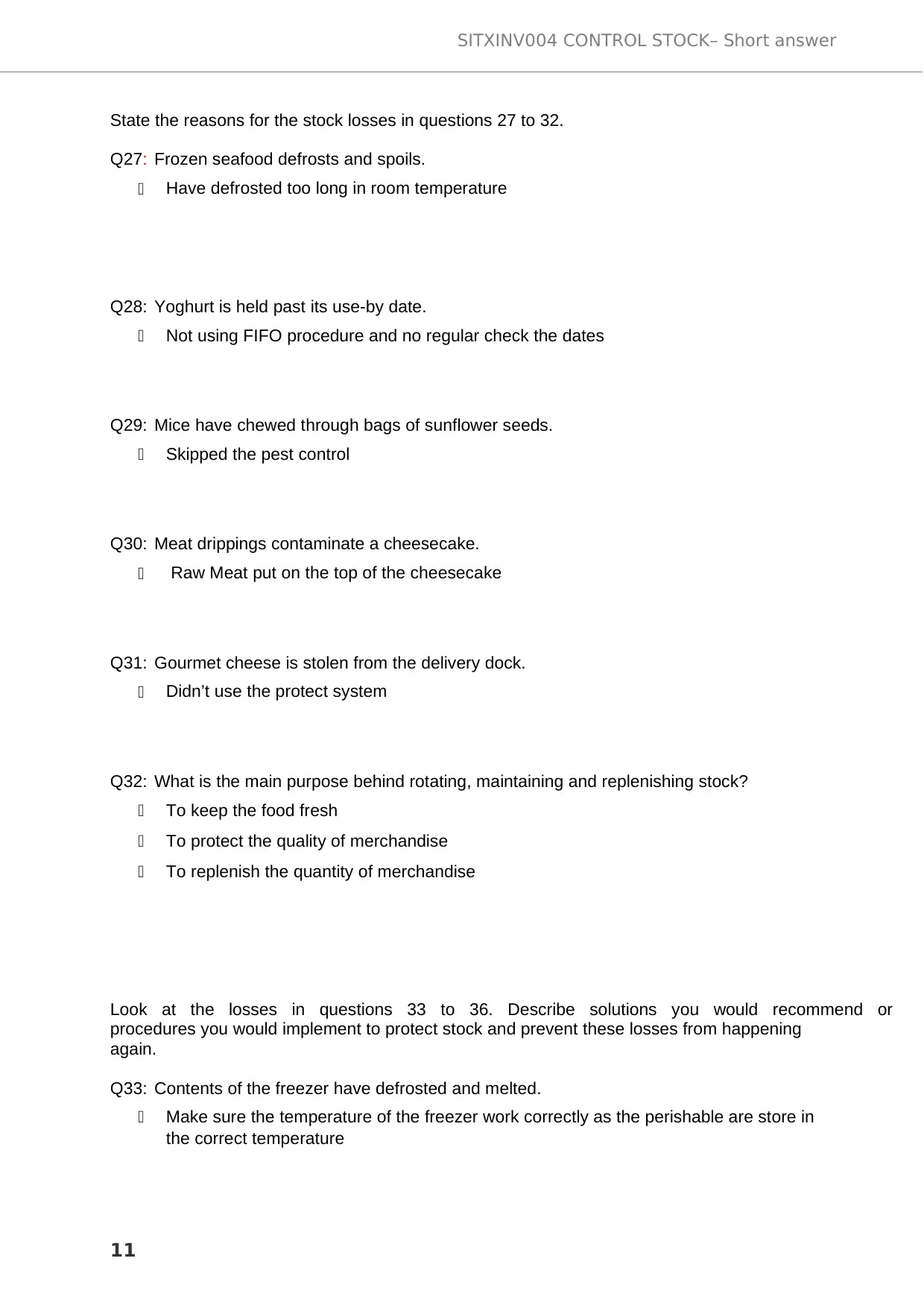
State the reasons for the stock losses in questions 27 to 32.
Q27: Frozen seafood defrosts and spoils.
Have defrosted too long in room temperature
Q28: Yoghurt is held past its use-by date.
Not using FIFO procedure and no regular check the dates
Q29: Mice have chewed through bags of sunflower seeds.
Skipped the pest control
Q30: Meat drippings contaminate a cheesecake.
Raw Meat put on the top of the cheesecake
Q31: Gourmet cheese is stolen from the delivery dock.
Didn’t use the protect system
Q32: What is the main purpose behind rotating, maintaining and replenishing stock?
To keep the food fresh
To protect the quality of merchandise
To replenish the quantity of merchandise
Look at the losses in questions 33 to 36. Describe solutions you would recommend or
procedures you would implement to protect stock and prevent these losses from happening
again.
Q33: Contents of the freezer have defrosted and melted.
Make sure the temperature of the freezer work correctly as the perishable are store in
the correct temperature
11
State the reasons for the stock losses in questions 27 to 32.
Q27: Frozen seafood defrosts and spoils.
Have defrosted too long in room temperature
Q28: Yoghurt is held past its use-by date.
Not using FIFO procedure and no regular check the dates
Q29: Mice have chewed through bags of sunflower seeds.
Skipped the pest control
Q30: Meat drippings contaminate a cheesecake.
Raw Meat put on the top of the cheesecake
Q31: Gourmet cheese is stolen from the delivery dock.
Didn’t use the protect system
Q32: What is the main purpose behind rotating, maintaining and replenishing stock?
To keep the food fresh
To protect the quality of merchandise
To replenish the quantity of merchandise
Look at the losses in questions 33 to 36. Describe solutions you would recommend or
procedures you would implement to protect stock and prevent these losses from happening
again.
Q33: Contents of the freezer have defrosted and melted.
Make sure the temperature of the freezer work correctly as the perishable are store in
the correct temperature
11

SITXINV004 CONTROL STOCK– Short answer
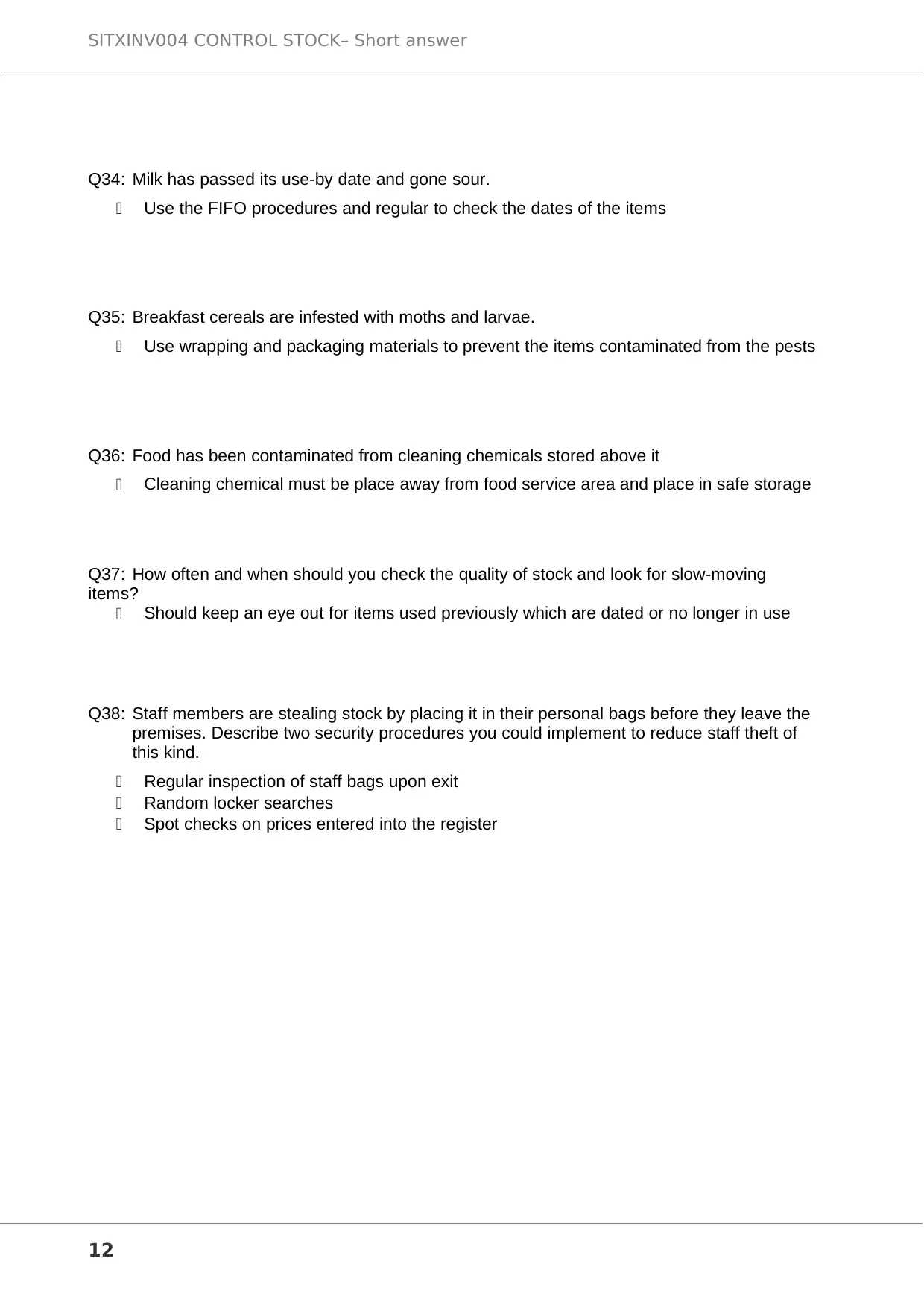
Q34: Milk has passed its use-by date and gone sour.
Use the FIFO procedures and regular to check the dates of the items
Q35: Breakfast cereals are infested with moths and larvae.
Use wrapping and packaging materials to prevent the items contaminated from the pests
Q36: Food has been contaminated from cleaning chemicals stored above it
Cleaning chemical must be place away from food service area and place in safe storage
Q37: How often and when should you check the quality of stock and look for slow-moving
items?
Should keep an eye out for items used previously which are dated or no longer in use
Q38: Staff members are stealing stock by placing it in their personal bags before they leave the
premises. Describe two security procedures you could implement to reduce staff theft of
this kind.
Regular inspection of staff bags upon exit
Random locker searches
Spot checks on prices entered into the register
12
Q34: Milk has passed its use-by date and gone sour.
Use the FIFO procedures and regular to check the dates of the items
Q35: Breakfast cereals are infested with moths and larvae.
Use wrapping and packaging materials to prevent the items contaminated from the pests
Q36: Food has been contaminated from cleaning chemicals stored above it
Cleaning chemical must be place away from food service area and place in safe storage
Q37: How often and when should you check the quality of stock and look for slow-moving
items?
Should keep an eye out for items used previously which are dated or no longer in use
Q38: Staff members are stealing stock by placing it in their personal bags before they leave the
premises. Describe two security procedures you could implement to reduce staff theft of
this kind.
Regular inspection of staff bags upon exit
Random locker searches
Spot checks on prices entered into the register
12
⊘ This is a preview!⊘
Do you want full access?
Subscribe today to unlock all pages.

Trusted by 1+ million students worldwide
1 out of 17
Related Documents
Your All-in-One AI-Powered Toolkit for Academic Success.
+13062052269
info@desklib.com
Available 24*7 on WhatsApp / Email
Unlock your academic potential
Copyright © 2020–2025 A2Z Services. All Rights Reserved. Developed and managed by ZUCOL.