BUS300: Six Sigma Methodology and Failure Modes Analysis Report
VerifiedAdded on 2022/05/12
|9
|2218
|25
Report
AI Summary
This report delves into the Six Sigma methodology, a data-driven approach used to reduce defects and improve product quality, contrasting it with the process-driven Total Quality Management (TQM) approach. The report begins with an introduction to Six Sigma, its origins, and its evolution, highlighting its core principles and steps. Task 1 focuses on the main purpose of Six Sigma, which is to improve the overall quality of manufacturing and reduce customer complaints. Task 2 applies Six Sigma to a hypothetical detergent business facing declining customer satisfaction, comparing its effectiveness with TQM. Task 3 examines critical-to-quality parameters for a project, such as simplifying design and providing more durable products, and includes a Potential Failure Mode and Effects Analysis (PFMEA). The conclusion emphasizes Six Sigma's advantages in terms of accuracy, cost reduction, and its ability to facilitate communication, making it a superior choice for projects focused on product design and customer satisfaction.
1
ASSIGNMENT 02:
SIX SIGMA METHODOLOGY AND FAILURE MODES
ANALYSIS
ASSIGNMENT 02:
SIX SIGMA METHODOLOGY AND FAILURE MODES
ANALYSIS

Paraphrase This Document
Need a fresh take? Get an instant paraphrase of this document with our AI Paraphraser
2
Contents
1.0 Introduction..........................................................................................................................3
2.0 Task 1...................................................................................................................................3
3.0 Task 2...................................................................................................................................3
4.0 Task 3...................................................................................................................................5
5.0 Conclusion............................................................................................................................5
Reference....................................................................................................................................7
Contents
1.0 Introduction..........................................................................................................................3
2.0 Task 1...................................................................................................................................3
3.0 Task 2...................................................................................................................................3
4.0 Task 3...................................................................................................................................5
5.0 Conclusion............................................................................................................................5
Reference....................................................................................................................................7
3
1.0 Introduction
Six-sigma is a data-driven and digital approach to eliminate and reduce the number of faulty
products. Most of the large companies use this in order to improve the overall quality of the
production. The objective of this paper is to present a discussion pertaining to the working of
Six- Sigma.
2.0 Task 1
The main purpose of the six sigma methodology is to improve the overall quality of
manufacturing. Emekli et al. (2016) stated that, while some companies use this methodology
for improving the quality and the efficiency of the product, there are companies that use this
to reduce the complaints from the customers. One of the biggest functions of the six-sigma
methodology is to determine the overall quality of the production. Apart from that, it helps in
eliminating the defective products as well.
The roots and the basic principles of six-sigma can be traced back to Carl Friedrich who
developed a measurement system to understand the quality of a project in general. After that
a number of measurements tool came in the scene, however, the term “Six- Sigma” was
coined by Bill Smith an engineer of Motorola. Since its, inception in the 1980s, it has evolved
a lot. In the year 1993, Motorola further developed the Six-Sigma methodology so that it can
be used in identifying the quality of different projects (Chugani et al. 2017). Based on these,
the new methodology could categorise different projects such as champion, master black belt,
black belt and many more.
Define Measure Analyse Improve Control
1.0 Introduction
Six-sigma is a data-driven and digital approach to eliminate and reduce the number of faulty
products. Most of the large companies use this in order to improve the overall quality of the
production. The objective of this paper is to present a discussion pertaining to the working of
Six- Sigma.
2.0 Task 1
The main purpose of the six sigma methodology is to improve the overall quality of
manufacturing. Emekli et al. (2016) stated that, while some companies use this methodology
for improving the quality and the efficiency of the product, there are companies that use this
to reduce the complaints from the customers. One of the biggest functions of the six-sigma
methodology is to determine the overall quality of the production. Apart from that, it helps in
eliminating the defective products as well.
The roots and the basic principles of six-sigma can be traced back to Carl Friedrich who
developed a measurement system to understand the quality of a project in general. After that
a number of measurements tool came in the scene, however, the term “Six- Sigma” was
coined by Bill Smith an engineer of Motorola. Since its, inception in the 1980s, it has evolved
a lot. In the year 1993, Motorola further developed the Six-Sigma methodology so that it can
be used in identifying the quality of different projects (Chugani et al. 2017). Based on these,
the new methodology could categorise different projects such as champion, master black belt,
black belt and many more.
Define Measure Analyse Improve Control
⊘ This is a preview!⊘
Do you want full access?
Subscribe today to unlock all pages.

Trusted by 1+ million students worldwide
4
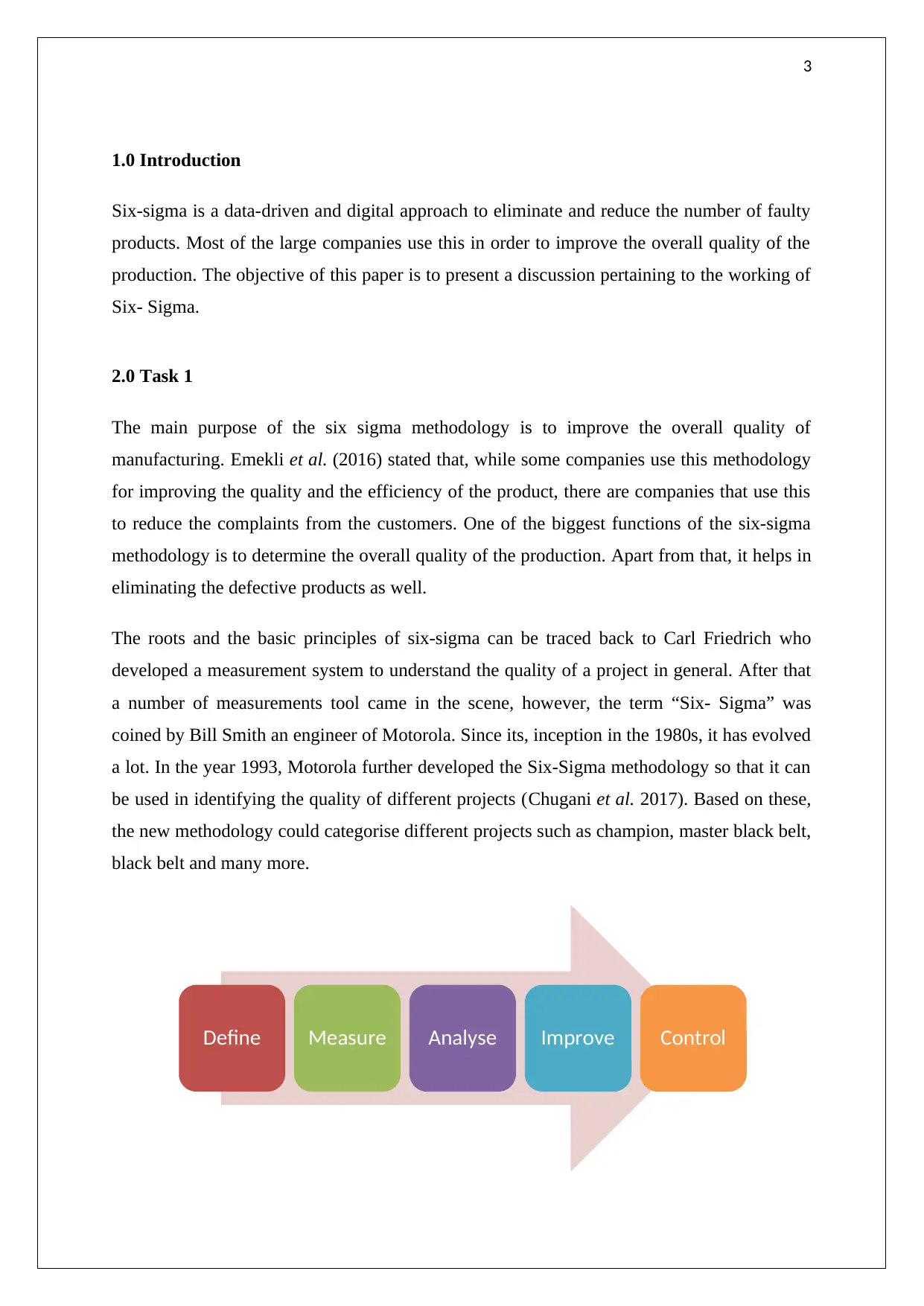
Figure 1: The different steps of Six-Sigma methodology
(Source: Sayeed et al. 2018)
There are a number of steps and analysis which are required for the correct use of Six-Sigma.
The first step of the process is to define a problem in the existing system. After that, the
second step collects data from the system regarding the faults. The next step then goes on to
analyse the faults so that it can be improved in the next step. The last step of the process
monitors the implementation and controls the overall project. However, Six-Sigma should
normally be used where the intervention of human is less. In the case of a manufacturing
system which is labour intensive methods like TQM is more useful (Trzeciak et al. 2018).
The timescale for any general six sigma project is around 2-6 months. There is also a shorter
variation of this known as lean which takes 1 week to 2 months to get completed.
3.0 Task 2
A recent potential six-sigma project that I have been involved with is a detergent business
which is facing a deteriorating satisfaction of the customers. Sales have gone down in the last
6 months and packaging of the product has been below par compared to the other rivals of the
market. The project charter was to provide a cost-effective alternative product in the market.
Now, the main aim of the company is to improve the quality of the product so that, it can gain
a competitive advantage over the rivals in the market.
Implementation of Six-Sigma and other methodologies like TQM gives different outcome to
the projects. In a potential Six-Sigma project, if TQM is implemented, the overall quality
would improve, but the reduction in the faulty products will not be as impressive as it would
be if Six-Sigma was implemented. Sayeed et al. (2018) stated that, compared to TQM, Six-
Sigma provides a sharper product feature of the company. Apart from that, outcomes with
different methodologies would just maintain consistency in terms of production. Six-Sigma
helps the organisation to make a huge number of small changes that eventually improve the
quality of the units produced by the company. Roberts, Wilson, and Quezado, (2017)
highlighted that TQM reaches a saturation level after a certain period of time and hence the
scope for improvement would be less if other methodologies such as TQM is used in a
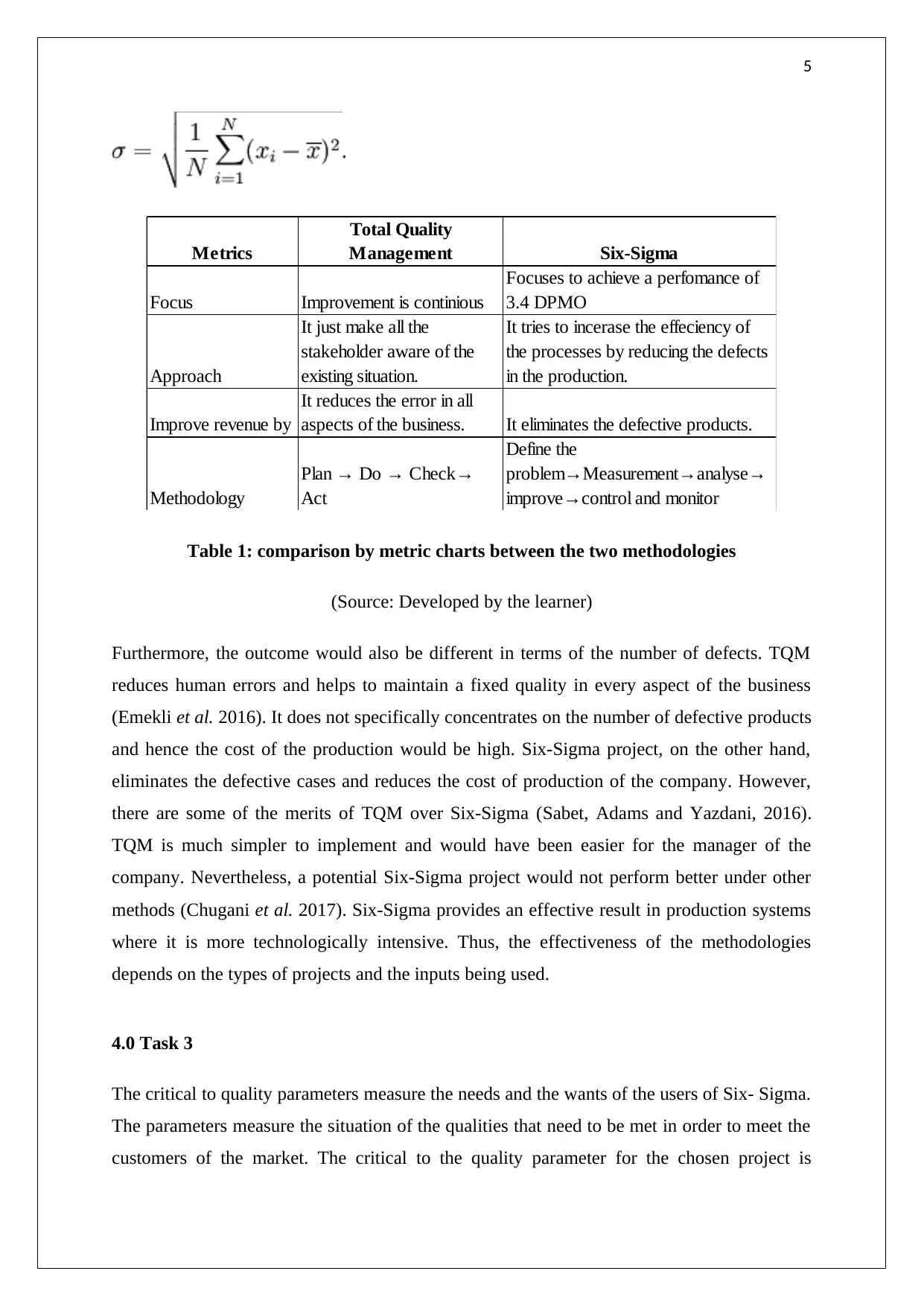
potential Six-Sigma project. Standard deviation is used as a tool to find out the deviation in
the quality scores of each of the units. The following formula of standard deviation is used,
Figure 1: The different steps of Six-Sigma methodology
(Source: Sayeed et al. 2018)
There are a number of steps and analysis which are required for the correct use of Six-Sigma.
The first step of the process is to define a problem in the existing system. After that, the
second step collects data from the system regarding the faults. The next step then goes on to
analyse the faults so that it can be improved in the next step. The last step of the process
monitors the implementation and controls the overall project. However, Six-Sigma should
normally be used where the intervention of human is less. In the case of a manufacturing
system which is labour intensive methods like TQM is more useful (Trzeciak et al. 2018).
The timescale for any general six sigma project is around 2-6 months. There is also a shorter
variation of this known as lean which takes 1 week to 2 months to get completed.
3.0 Task 2
A recent potential six-sigma project that I have been involved with is a detergent business
which is facing a deteriorating satisfaction of the customers. Sales have gone down in the last
6 months and packaging of the product has been below par compared to the other rivals of the
market. The project charter was to provide a cost-effective alternative product in the market.
Now, the main aim of the company is to improve the quality of the product so that, it can gain
a competitive advantage over the rivals in the market.
Implementation of Six-Sigma and other methodologies like TQM gives different outcome to
the projects. In a potential Six-Sigma project, if TQM is implemented, the overall quality
would improve, but the reduction in the faulty products will not be as impressive as it would
be if Six-Sigma was implemented. Sayeed et al. (2018) stated that, compared to TQM, Six-
Sigma provides a sharper product feature of the company. Apart from that, outcomes with
different methodologies would just maintain consistency in terms of production. Six-Sigma
helps the organisation to make a huge number of small changes that eventually improve the
quality of the units produced by the company. Roberts, Wilson, and Quezado, (2017)
highlighted that TQM reaches a saturation level after a certain period of time and hence the
scope for improvement would be less if other methodologies such as TQM is used in a
potential Six-Sigma project. Standard deviation is used as a tool to find out the deviation in
the quality scores of each of the units. The following formula of standard deviation is used,
Paraphrase This Document
Need a fresh take? Get an instant paraphrase of this document with our AI Paraphraser
5
Metrics
Total Quality
Management Six-Sigma
Focus Improvement is continious
Focuses to achieve a perfomance of
3.4 DPMO
Approach
It just make all the
stakeholder aware of the
existing situation.
It tries to incerase the effeciency of
the processes by reducing the defects
in the production.
Improve revenue by
It reduces the error in all
aspects of the business. It eliminates the defective products.
Methodology
Plan → Do → Check→
Act
Define the
problem→Measurement→analyse→
improve→control and monitor
Table 1: comparison by metric charts between the two methodologies
(Source: Developed by the learner)
Furthermore, the outcome would also be different in terms of the number of defects. TQM
reduces human errors and helps to maintain a fixed quality in every aspect of the business
(Emekli et al. 2016). It does not specifically concentrates on the number of defective products
and hence the cost of the production would be high. Six-Sigma project, on the other hand,
eliminates the defective cases and reduces the cost of production of the company. However,
there are some of the merits of TQM over Six-Sigma (Sabet, Adams and Yazdani, 2016).
TQM is much simpler to implement and would have been easier for the manager of the
company. Nevertheless, a potential Six-Sigma project would not perform better under other
methods (Chugani et al. 2017). Six-Sigma provides an effective result in production systems
where it is more technologically intensive. Thus, the effectiveness of the methodologies
depends on the types of projects and the inputs being used.
4.0 Task 3
The critical to quality parameters measure the needs and the wants of the users of Six- Sigma.
The parameters measure the situation of the qualities that need to be met in order to meet the
customers of the market. The critical to the quality parameter for the chosen project is
Metrics
Total Quality
Management Six-Sigma
Focus Improvement is continious
Focuses to achieve a perfomance of
3.4 DPMO
Approach
It just make all the
stakeholder aware of the
existing situation.
It tries to incerase the effeciency of
the processes by reducing the defects
in the production.
Improve revenue by
It reduces the error in all
aspects of the business. It eliminates the defective products.
Methodology
Plan → Do → Check→
Act
Define the
problem→Measurement→analyse→
improve→control and monitor
Table 1: comparison by metric charts between the two methodologies
(Source: Developed by the learner)
Furthermore, the outcome would also be different in terms of the number of defects. TQM
reduces human errors and helps to maintain a fixed quality in every aspect of the business
(Emekli et al. 2016). It does not specifically concentrates on the number of defective products
and hence the cost of the production would be high. Six-Sigma project, on the other hand,
eliminates the defective cases and reduces the cost of production of the company. However,
there are some of the merits of TQM over Six-Sigma (Sabet, Adams and Yazdani, 2016).
TQM is much simpler to implement and would have been easier for the manager of the
company. Nevertheless, a potential Six-Sigma project would not perform better under other
methods (Chugani et al. 2017). Six-Sigma provides an effective result in production systems
where it is more technologically intensive. Thus, the effectiveness of the methodologies
depends on the types of projects and the inputs being used.
4.0 Task 3
The critical to quality parameters measure the needs and the wants of the users of Six- Sigma.
The parameters measure the situation of the qualities that need to be met in order to meet the
customers of the market. The critical to the quality parameter for the chosen project is
6
simplifying the design, meeting the current marketplace quality level and providing products
that are more durable. These parameters have been chosen as there were gaps in these aspects
of the production of the project. The potential failure mode analysis is presented below.
PFMEA analysis:
process step
Potential Failure
mode
Potential failure
effects
Actions
recommendations Action taken
Design simplifying
May become less
attractive
Does not attract
the customers
Take feedback after
the first launch
Flexible production
process
Change in packaging
May become
expensive Incerase the cost
produce different
variations
Lowered the quality of
packaging
Potential failure mode analysis of the project
Table 2: The potential failure mode and effects analysis for the project
(Source: Developed by the learner)
These activities or the process steps have been chosen as per the charter of the project.
According to the requirement, the products needed to be simpler in line with the other rival
products of the market. In addition to that packaging has been selected as it influences the
attractiveness of the product which is important to boost the sales of the product.
5.0 Conclusion
Therefore, for this particular project where product designing is the main focus, a statistical
approach is a better option compared to a process driven methodology. A process-driven
approach such as TQM focuses on the maintenance of all the aspects of the business. On the
other hand, statistical approach such as Six-Sigma methodology intends to eliminate the
defective products so that overall quality is improved and customer satisfaction is achieved.
Six-sigma has several advantages over the process driven methods. That includes the time
cost and the accuracy that helps organisations to cut down on the cost of operation. Apart
from that there are a number of limitations such as complicated labour management that
reduces the effectiveness of the TQM methodology. TQM also fails to provide a quick
solution in case of emergency. Given the project charter and the risks of the selected project,
Six-Sigma methodology is a better option than the other alternative available for the
company.
simplifying the design, meeting the current marketplace quality level and providing products
that are more durable. These parameters have been chosen as there were gaps in these aspects
of the production of the project. The potential failure mode analysis is presented below.
PFMEA analysis:
process step
Potential Failure
mode
Potential failure
effects
Actions
recommendations Action taken
Design simplifying
May become less
attractive
Does not attract
the customers
Take feedback after
the first launch
Flexible production
process
Change in packaging
May become
expensive Incerase the cost
produce different
variations
Lowered the quality of
packaging
Potential failure mode analysis of the project
Table 2: The potential failure mode and effects analysis for the project
(Source: Developed by the learner)
These activities or the process steps have been chosen as per the charter of the project.
According to the requirement, the products needed to be simpler in line with the other rival
products of the market. In addition to that packaging has been selected as it influences the
attractiveness of the product which is important to boost the sales of the product.
5.0 Conclusion
Therefore, for this particular project where product designing is the main focus, a statistical
approach is a better option compared to a process driven methodology. A process-driven
approach such as TQM focuses on the maintenance of all the aspects of the business. On the
other hand, statistical approach such as Six-Sigma methodology intends to eliminate the
defective products so that overall quality is improved and customer satisfaction is achieved.
Six-sigma has several advantages over the process driven methods. That includes the time
cost and the accuracy that helps organisations to cut down on the cost of operation. Apart
from that there are a number of limitations such as complicated labour management that
reduces the effectiveness of the TQM methodology. TQM also fails to provide a quick
solution in case of emergency. Given the project charter and the risks of the selected project,
Six-Sigma methodology is a better option than the other alternative available for the
company.
⊘ This is a preview!⊘
Do you want full access?
Subscribe today to unlock all pages.
Trusted by 1+ million students worldwide
7
Six-Sigma is a data driven process that finds out the gaps in the operational process of an
organisations. It collects data and information from different stages of operation and matches
it with the planned structure. This process is not only used to correct the business processes
but it can also reduce the number of faulty productions as well. As the company reduces the
number of faulty products, its cost of operation reduces which can further contribute to lower
prices for the goods and services. Most of the big companies of the world currently use six
sigma methodologies in order to improve the quality of the products and reduce the cost of
operation. As discussed above, the methodology used in this process is data driven and hence
the level of accuracy is more than any other methodologies. One of the biggest advantages of
this process is that human error can be minimised using this process.
In addition to that, six-sigma allows a better communication among different processes of the
business. Compared to the TQM process which is a process based method does not have
much impact on the communication among the different processes of the business.
Communication is an important part of business operation that increases the speed of the
production of the organisation. TQM is mainly used in the product based companies where
the main the aim is to reduce the number of faulty products. It does not improve the quality of
the products in any way. ExxonMobil is a company that has been using TQM as a
methodology to correct the quality of the products and the services. Apart from that, they also
use it reduce the cost of operation that can also be seen from the reduction in the price of the
oil they provide.
Another advantage of the TQM process is that it is easier to use and hence better for the
companies new in the business. The cost of usage of TQM is lesser than that of Six Sigma
and hence it is often proffered by many companies. However, one of the drawbacks of this
process is that accuracy is not as great as that of Six Sigma. TQM also does not provide a
good communication among different processes of a business as well. Therefore, Six Sigma
is a better and updated methodology than that of TQM.
However, given the specific case of the project in the question, it is preferable to use the six
sigma methodology. In this project the main aim is to improve the quality of the product by
changing the designs. Six-sigma would allow the project to monitor the changing process at
each of the stages of production. Apart from that, this project also requires a lot of
communication among different processes of the business. Changing the design requires a
healthy communication among the manufacturing and designing processes of the business.
Six-Sigma is a data driven process that finds out the gaps in the operational process of an
organisations. It collects data and information from different stages of operation and matches
it with the planned structure. This process is not only used to correct the business processes
but it can also reduce the number of faulty productions as well. As the company reduces the
number of faulty products, its cost of operation reduces which can further contribute to lower
prices for the goods and services. Most of the big companies of the world currently use six
sigma methodologies in order to improve the quality of the products and reduce the cost of
operation. As discussed above, the methodology used in this process is data driven and hence
the level of accuracy is more than any other methodologies. One of the biggest advantages of
this process is that human error can be minimised using this process.
In addition to that, six-sigma allows a better communication among different processes of the
business. Compared to the TQM process which is a process based method does not have
much impact on the communication among the different processes of the business.
Communication is an important part of business operation that increases the speed of the
production of the organisation. TQM is mainly used in the product based companies where
the main the aim is to reduce the number of faulty products. It does not improve the quality of
the products in any way. ExxonMobil is a company that has been using TQM as a
methodology to correct the quality of the products and the services. Apart from that, they also
use it reduce the cost of operation that can also be seen from the reduction in the price of the
oil they provide.
Another advantage of the TQM process is that it is easier to use and hence better for the
companies new in the business. The cost of usage of TQM is lesser than that of Six Sigma
and hence it is often proffered by many companies. However, one of the drawbacks of this
process is that accuracy is not as great as that of Six Sigma. TQM also does not provide a
good communication among different processes of a business as well. Therefore, Six Sigma
is a better and updated methodology than that of TQM.
However, given the specific case of the project in the question, it is preferable to use the six
sigma methodology. In this project the main aim is to improve the quality of the product by
changing the designs. Six-sigma would allow the project to monitor the changing process at
each of the stages of production. Apart from that, this project also requires a lot of
communication among different processes of the business. Changing the design requires a
healthy communication among the manufacturing and designing processes of the business.
Paraphrase This Document
Need a fresh take? Get an instant paraphrase of this document with our AI Paraphraser

8
Apart from that, it also reduces the cost of operation of the company as well. Therefore, given
the type and the nature of this project six-sigma is a better option in terms of methodology.
Apart from that, it also reduces the cost of operation of the company as well. Therefore, given
the type and the nature of this project six-sigma is a better option in terms of methodology.
9
Reference
Chugani, N., Kumar, V., Garza-Reyes, J.A., Rocha-Lona, L. and Upadhyay, A., 2017.
Investigating the green impact of Lean, Six Sigma and Lean Six Sigma: A systematic
literature review. International Journal of Lean Six Sigma, 8(1), pp.7-32.
Emekli, D.İ., Güçlü, K., Turna, G., İlanbey, B., Nar, R. and Çiçek, E.A., 2016. Evaluation of
Analytical Process in Clinical Laboratories: Six Sigma Methodology. Türk Klinik Biyokimya
Derg, 14(2), pp.79-86.
Roberts, R.J., Wilson, A.E. and Quezado, Z., 2017. Using Lean Six Sigma methodology to
improve quality of the anesthesia supply chain in a pediatric hospital. Anesthesia &
Analgesia, 124(3), pp.922-924.
Sabet, E., Adams, E. and Yazdani, B., 2016. Quality management in heavy duty
manufacturing industry: TQM vs. Six Sigma. Total Quality Management & Business
Excellence, 27(1-2), pp.215-225.
Sayeed, Z., Anoushiravani, A., El-Othmani, M., Barinaga, G., Sayeed, Y., Cagle Jr, P. and
Saleh, K.J., 2018. Implementation of a Hip Fracture Care Pathway Using Lean Six Sigma
Methodology in a Level I Trauma Center. JAAOS-Journal of the American Academy of
Orthopaedic Surgeons, 26(24), pp.881-893.
Trzeciak, S., Mercincavage, M., Angelini, C., Cogliano, W., Damuth, E., Roberts, B.W.,
Zanotti, S. and Mazzarelli, A.J., 2018. Lean Six Sigma to Reduce Intensive Care Unit Length
of Stay and Costs in Prolonged Mechanical Ventilation. Journal for Healthcare
Quality, 40(1), pp.36-43.
Reference
Chugani, N., Kumar, V., Garza-Reyes, J.A., Rocha-Lona, L. and Upadhyay, A., 2017.
Investigating the green impact of Lean, Six Sigma and Lean Six Sigma: A systematic
literature review. International Journal of Lean Six Sigma, 8(1), pp.7-32.
Emekli, D.İ., Güçlü, K., Turna, G., İlanbey, B., Nar, R. and Çiçek, E.A., 2016. Evaluation of
Analytical Process in Clinical Laboratories: Six Sigma Methodology. Türk Klinik Biyokimya
Derg, 14(2), pp.79-86.
Roberts, R.J., Wilson, A.E. and Quezado, Z., 2017. Using Lean Six Sigma methodology to
improve quality of the anesthesia supply chain in a pediatric hospital. Anesthesia &
Analgesia, 124(3), pp.922-924.
Sabet, E., Adams, E. and Yazdani, B., 2016. Quality management in heavy duty
manufacturing industry: TQM vs. Six Sigma. Total Quality Management & Business
Excellence, 27(1-2), pp.215-225.
Sayeed, Z., Anoushiravani, A., El-Othmani, M., Barinaga, G., Sayeed, Y., Cagle Jr, P. and
Saleh, K.J., 2018. Implementation of a Hip Fracture Care Pathway Using Lean Six Sigma
Methodology in a Level I Trauma Center. JAAOS-Journal of the American Academy of
Orthopaedic Surgeons, 26(24), pp.881-893.
Trzeciak, S., Mercincavage, M., Angelini, C., Cogliano, W., Damuth, E., Roberts, B.W.,
Zanotti, S. and Mazzarelli, A.J., 2018. Lean Six Sigma to Reduce Intensive Care Unit Length
of Stay and Costs in Prolonged Mechanical Ventilation. Journal for Healthcare
Quality, 40(1), pp.36-43.
⊘ This is a preview!⊘
Do you want full access?
Subscribe today to unlock all pages.
Trusted by 1+ million students worldwide

1 out of 9


Related Documents


Your All-in-One AI-Powered Toolkit for Academic Success.
+13062052269
info@desklib.com
Available 24*7 on WhatsApp / Email
![[object Object]](/_next/static/media/star-bottom.7253800d.svg)
Unlock your academic potential
Copyright © 2020–2026 A2Z Services. All Rights Reserved. Developed and managed by ZUCOL.