Research Proposal: Skills and Development for Management Accountants

Verified

Added on  2023/06/05

|9
|1832
|82
Report
AI Summary
This research proposal investigates the skills and training required for managerial accountants to meet current market demands and enhance competitiveness. It addresses the evolving role of managerial accountants from data entry to strategic decision-making, highlighting the importance of skills such as variance analysis, price modeling, and strategic planning. The proposal outlines research objectives to determine necessary skills and evaluate training programs, using qualitative research methods, including interviews and questionnaires, to gather data from managerial accountants. The research aims to provide insights into industry trends and inform training and development initiatives, ultimately improving job market readiness for aspiring management accountants. Desklib offers a platform to explore similar research proposals and solved assignments for further study.
Document Page
Research Proposal 1
RESEARCH PROPOSAL
Name
Course
Tutor
University
Date
tabler-icon-diamond-filled.svg

Paraphrase This Document

Need a fresh take? Get an instant paraphrase of this document with our AI Paraphraser
Document Page
Research Proposal 2
Introduction
Understanding ones job description plays a crucial role whenever an individual is
applying for a particular position. The main aim is to ensure that one is able to comprehend the
tasks and duties which as are expected in order to add value to a company as well as earning
income. Besides, understanding the job description plays into the ability to recognize various
limitations that might hinder one from achieving their potential (Maas, Schaltegger and Crutzen
2016).
Job description and tasks are significant in assisting an employee to understand various
parameters within which they are supposed to function. Also, an employee is able to understand
an organization standards which facilitates effective execution of tasks. More so, there are many
benefits that an employee can get from understanding their job description such as performance
management, training and employee development, compensation plans, recognition and rewards,
code of conduct required, return to work programs as well as essential analysis of the job
function (Chenhall and Moers 2015).
Management Problem
Managerial accountant is a demanding field that requires professionals to have skills and
abilities that aid in carrying out tasks required. These skills are vital for helping managers to
make decisions in order to enable companies become competitive and dominant in the market.
Among the skills managerial accountants must have include variance analysis where the
managers are expected to explain difference between the budget and actual amount incurred.
Besides, the managers are required to determine rates and volumes of both goods and services in
an institution (Jermias 2017). Further, they are expected to understand various measurements that
Document Page
Research Proposal 3
relates to the performance of a company. Another significant skill that managerial accountants
are required to have is price modelling which focuses on various aspects if price, competition,
consumers and market segments. Moreover, management accountants are required to be experts
in product profitability, analyzing the effectiveness of sales of a products, perform cost analysis
among other skills relating to strategic planning, financial forecasting, annual budget and
resource allocation.
Management Research Problem
Managerial accountant not only focuses on numbers but a set of skills that involve
gathering accounting information that can be used in the decision making process. As a result,
managerial accountants are required to use creativity, leadership skills which are significant in
the identification of areas of strength as well as weaknesses in order to provide informed
solutions (Gilchrist 2018). For this purpose, managerial accountants are required to have
analytical skills which are significant in the development of budget as well as minimizing costs
and maximizing profits. Besides, aptitude of technical process is significant in assisting the
accountants to come up with accurate estimates. Further, management accountants are required
to have knowledge in business fundamentals which can assist an organization to achieve long-
term goals.
Research Objectives
Objective A:
This research is aimed at determining the skills that a managerial accountant should be
equipped with in order to be able to meet the requirements with respect to tasks and duties
required by managerial accountants.
Document Page
Research Proposal 4
Objective B:
The objective of this research is to determine the training and development programs that
are structured to meet the needs of managerial accountants in preparation to meeting market
demands.
Research Questions
Research Question 1:
What is involved in the main functions of management accounting?
Research Question 2:
How has the field of management accounting changed when comparing past and present
managerial accountant practices?
Research Question 1:
Which factors in managerial accounting are responsible increased competitiveness?
Research Question 2:
Other than common skills and abilities that managerial accountant are expected to have,
what other requirements are necessary to increase ones success in the job market?
Literature Review
There are various functions that are involved in management accounting such as
preparation, organizing and providing of financial data that can be used for decision making.
These functions are primarily performed by directors in various organizations. As a result,
managerial accountant comprises two aspect which include management aspect as well as
tabler-icon-diamond-filled.svg

Paraphrase This Document

Need a fresh take? Get an instant paraphrase of this document with our AI Paraphraser
Document Page
Research Proposal 5
accounting aspect. In essence, managerial accountant is a field that evolves with time (Maas,
Schaltegger and Crutzen 2016). In the past, management accountants were mainly concerned
with data entry using spreadsheets and were considered to lack personality since they did not
require skills such as communication.
It was until the 21st century when managerial accountants began to evolve from data entry
into decision making through analysis form financial reporting, offering advice as well as
assisting business development. Increase in competition is attributed to the change in dynamics
with how managerial accountants conduct themselves. Today, managerial accountants are
characterized with systematic, planning and use of technology to help businesses succeed. As a
result of competitive nature of the field, various institutions have begun incorporating applied
skills of managerial as well as those of accounting to equip students with the right skills that are
demanded by the job market (Chenhall and Moers 2015). Therefore, various skills such as
relational, knowledge and communication skills are considered by most employees.
Research Design
Research design refers to techniques that are used in collection and analysis of
parameters that are determined by the research question. The primary goal of a research design is
to find answers sought by the research questions.
Rationale
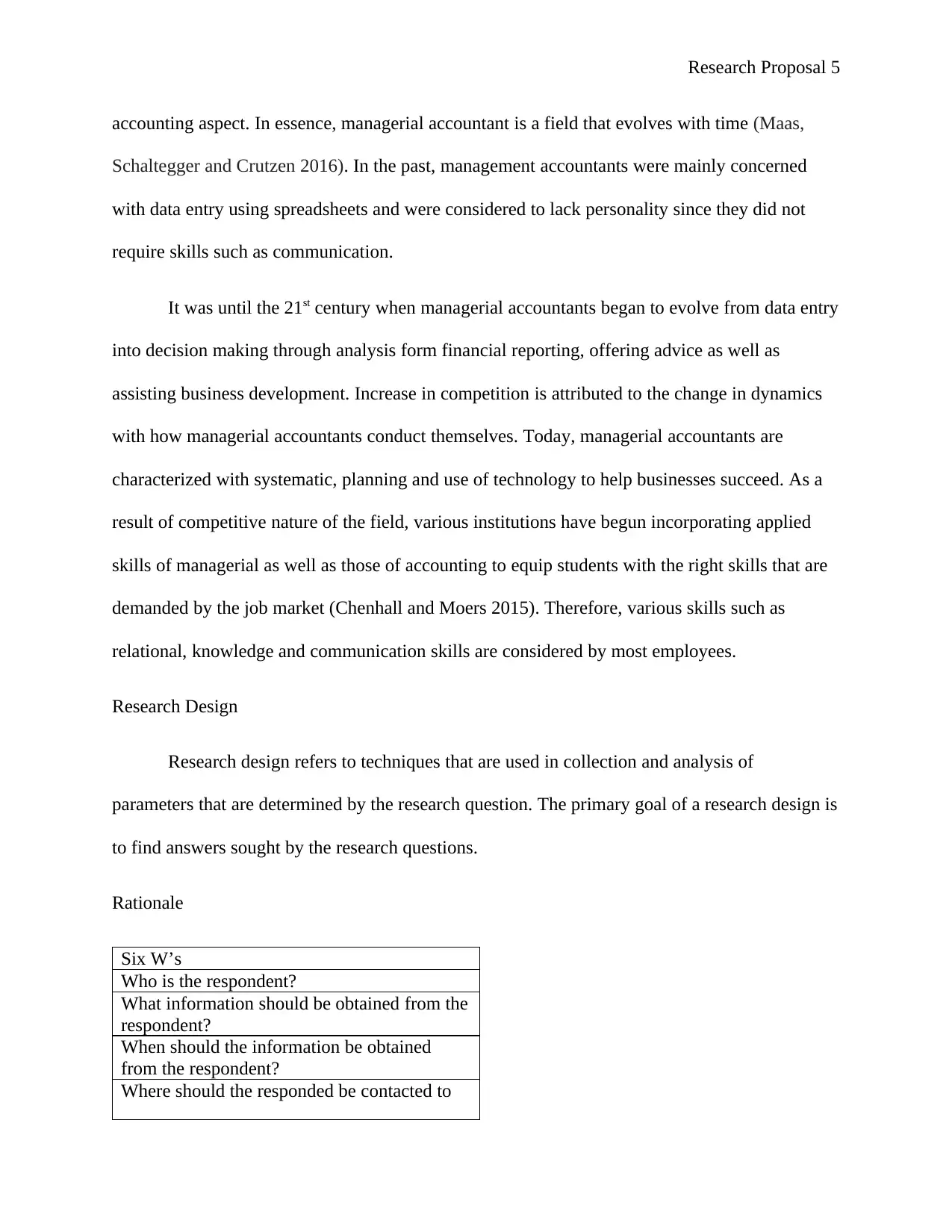
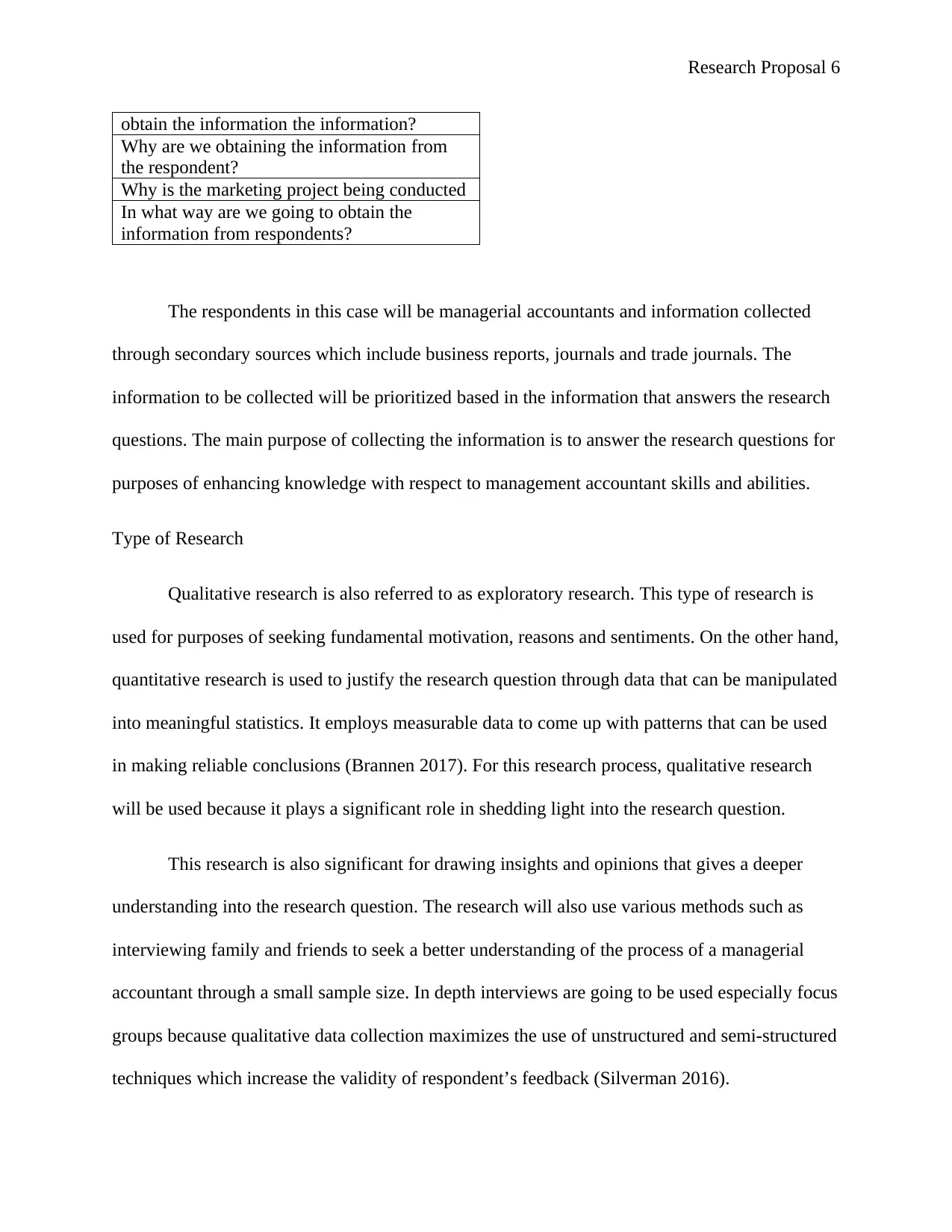
Six W’s
Who is the respondent?
What information should be obtained from the
respondent?
When should the information be obtained
from the respondent?
Where should the responded be contacted to
Document Page
Research Proposal 6
obtain the information the information?
Why are we obtaining the information from
the respondent?
Why is the marketing project being conducted
In what way are we going to obtain the
information from respondents?
The respondents in this case will be managerial accountants and information collected
through secondary sources which include business reports, journals and trade journals. The
information to be collected will be prioritized based in the information that answers the research
questions. The main purpose of collecting the information is to answer the research questions for
purposes of enhancing knowledge with respect to management accountant skills and abilities.
Type of Research
Qualitative research is also referred to as exploratory research. This type of research is
used for purposes of seeking fundamental motivation, reasons and sentiments. On the other hand,
quantitative research is used to justify the research question through data that can be manipulated
into meaningful statistics. It employs measurable data to come up with patterns that can be used
in making reliable conclusions (Brannen 2017). For this research process, qualitative research
will be used because it plays a significant role in shedding light into the research question.
This research is also significant for drawing insights and opinions that gives a deeper
understanding into the research question. The research will also use various methods such as
interviewing family and friends to seek a better understanding of the process of a managerial
accountant through a small sample size. In depth interviews are going to be used especially focus
groups because qualitative data collection maximizes the use of unstructured and semi-structured
techniques which increase the validity of respondent’s feedback (Silverman 2016).
Document Page
Research Proposal 7
Among the specific questions that the research will aim at investigating include what are
the requirements of a managerial accountant in the modern world? Are these skills and abilities
cut across different businesses or organizations? What is nature of training and development that
is required to enable managerial accountants meet the needs of their job requirement?
The people to be included in this research are appropriate because they have been in the
field of managerial accountants and have witnessed first-hand the trends that have been
happening in the job market. Besides, these people are knowledgeable and have experience in the
fields and their families depend on them for various aspects of life.
Sampling
Convenience sampling will be used for this research because it is expensive to conduct
the research far from the researcher’s proximity (Etikan, Musa, and Alkassim 2016).
How data will be collected
The data will be collected through a questionnaire which will be given to the respondents.
Data Analysis
The data analysis for this research will employ the use of collected information to
determine difference and similarities by arranging and sorting the feedback from questionnaire
and secondary sources in order to increasing understanding of the research question. Besides,
coding will be used in categorizing the data to reduce the volume of data and identify important
patterns (Silverman 2016).
Value of the research
tabler-icon-diamond-filled.svg

Paraphrase This Document

Need a fresh take? Get an instant paraphrase of this document with our AI Paraphraser
Document Page
Research Proposal 8
The results of this research will play a significant role in providing substantial
information relating to the current filed of managerial accountant as well as provide detailed
information regarding trends in the industry. Also, the information will be used as a basis for
training and development to increase the chances of getting a position as a management
accountant in the job market.
Document Page
Research Proposal 9
Reference List
Brannen, J., (2017). Mixing methods: Qualitative and quantitative research. London, Routledge.
Chenhall, R.H. and Moers, F., (2015). The role of innovation in the evolution of management
accounting and its integration into management control. Accounting, Organizations and Society,
47, pp.1-13.
Etikan, I., Musa, S.A. and Alkassim, R.S., (2016). Comparison of convenience sampling and
purposive sampling. American Journal of Theoretical and Applied Statistics, 5(1), pp.1-4.
Gilchrist, R.R., (2018). Managing for profit: the added value concept. London, Routledge.
Jermias, J., (2017). Development of management accounting practices in Indonesia. In The
Routledge Handbook of Accounting in Asia (pp. 126-136). London, Routledge.
Maas, K., Schaltegger, S. and Crutzen, N., (2016). Integrating corporate sustainability
assessment, management accounting, control, and reporting. Journal of Cleaner Production, 136,
pp.237-248.
Silverman, D. ed., (2016). Qualitative research. London. Sage.
chevron_up_icon
1 out of 9
circle_padding
hide_on_mobile
zoom_out_icon
[object Object]