Research Proposal Plan: Skin Cancer Prevention, University Study

Verified

Added on  2023/03/20

|2
|473
|83
Report
AI Summary
This report presents a research proposal plan focusing on skin cancer prevention among international students at the University of Sunshine Coast. The study aims to investigate the attitudes and behaviors related to skin cancer prevention. The research employs a qualitative approach, utilizing a constructivist epistemology and a social cognitive theory framework. The methodology involves open-ended questionnaires and thematic analysis to understand student perspectives. The study considers ethical considerations such as informed consent and confidentiality. The report also discusses the limitations of the research and the strategies for ensuring the reliability, validity, and transferability of the findings. The research addresses a gap in the current literature concerning international students and their understanding of skin cancer prevention, aiming to contribute valuable insights into this critical health issue.
Document Page
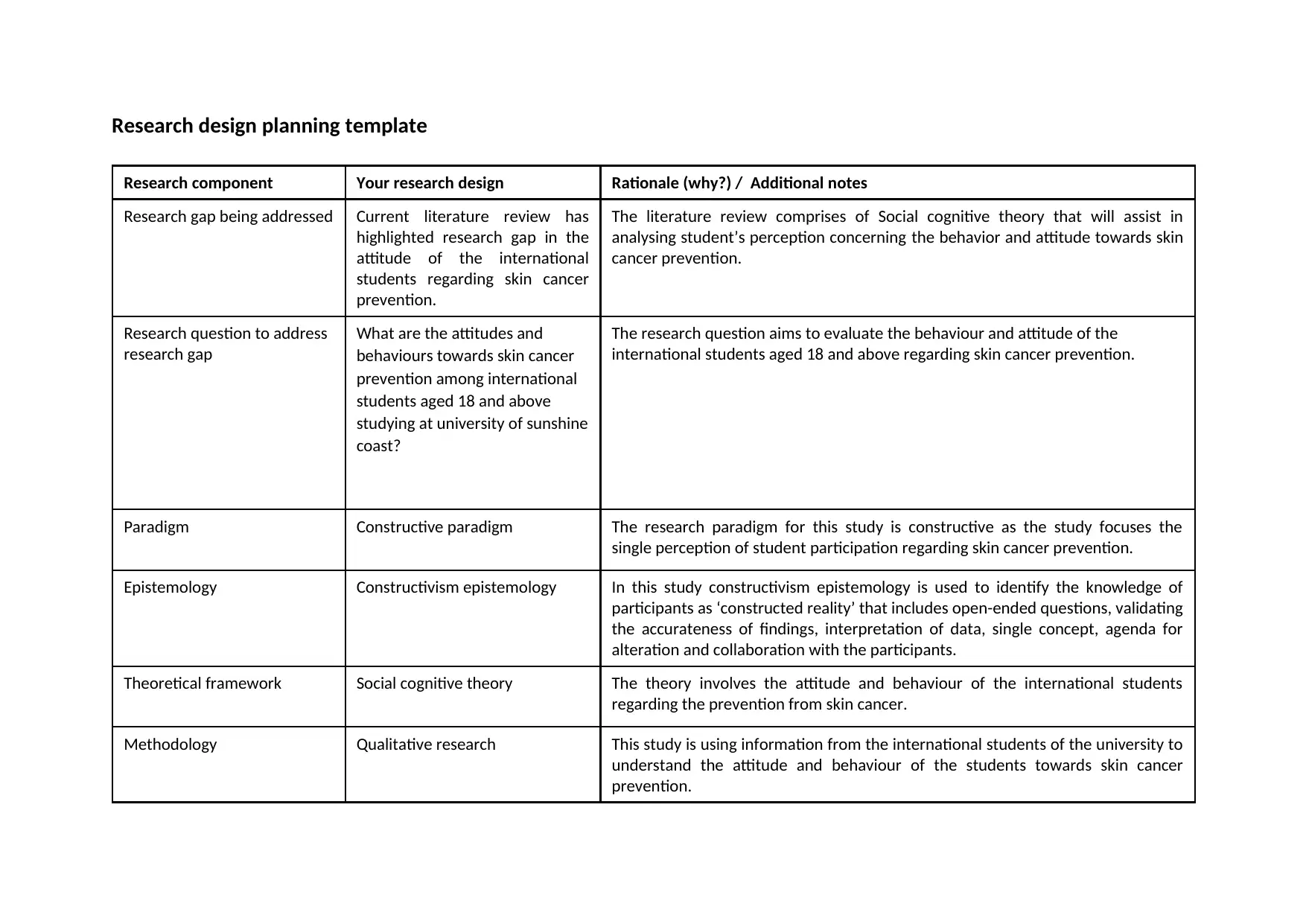
Research design planning template
Research component Your research design Rationale (why?) / Additional notes
Research gap being addressed Current literature review has
highlighted research gap in the
attitude of the international
students regarding skin cancer
prevention.
The literature review comprises of Social cognitive theory that will assist in
analysing student’s perception concerning the behavior and attitude towards skin
cancer prevention.
Research question to address
research gap
What are the attitudes and
behaviours towards skin cancer
prevention among international
students aged 18 and above
studying at university of sunshine
coast?
The research question aims to evaluate the behaviour and attitude of the
international students aged 18 and above regarding skin cancer prevention.
Paradigm Constructive paradigm The research paradigm for this study is constructive as the study focuses the
single perception of student participation regarding skin cancer prevention.
Epistemology Constructivism epistemology In this study constructivism epistemology is used to identify the knowledge of
participants as ‘constructed reality’ that includes open-ended questions, validating
the accurateness of findings, interpretation of data, single concept, agenda for
alteration and collaboration with the participants.
Theoretical framework Social cognitive theory The theory involves the attitude and behaviour of the international students
regarding the prevention from skin cancer.
Methodology Qualitative research This study is using information from the international students of the university to
understand the attitude and behaviour of the students towards skin cancer
prevention.
tabler-icon-diamond-filled.svg

Paraphrase This Document

Need a fresh take? Get an instant paraphrase of this document with our AI Paraphraser
Document Page
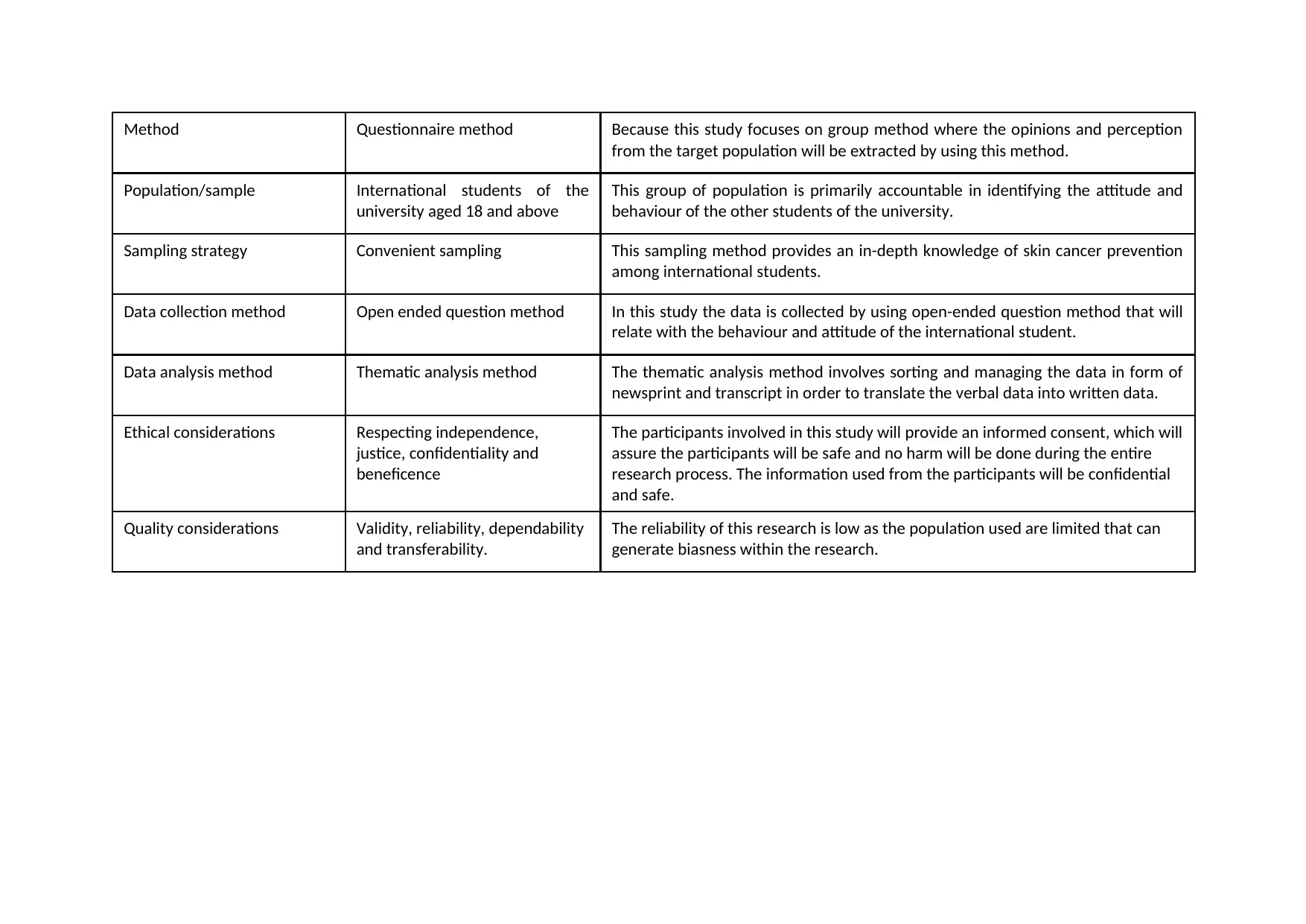
Method Questionnaire method Because this study focuses on group method where the opinions and perception
from the target population will be extracted by using this method.
Population/sample International students of the
university aged 18 and above
This group of population is primarily accountable in identifying the attitude and
behaviour of the other students of the university.
Sampling strategy Convenient sampling This sampling method provides an in-depth knowledge of skin cancer prevention
among international students.
Data collection method Open ended question method In this study the data is collected by using open-ended question method that will
relate with the behaviour and attitude of the international student.
Data analysis method Thematic analysis method The thematic analysis method involves sorting and managing the data in form of
newsprint and transcript in order to translate the verbal data into written data.
Ethical considerations Respecting independence,
justice, confidentiality and
beneficence
The participants involved in this study will provide an informed consent, which will
assure the participants will be safe and no harm will be done during the entire
research process. The information used from the participants will be confidential
and safe.
Quality considerations Validity, reliability, dependability
and transferability.
The reliability of this research is low as the population used are limited that can
generate biasness within the research.
chevron_up_icon
1 out of 2
circle_padding
hide_on_mobile
zoom_out_icon
[object Object]