Civil Engineering: Slope Stability Analysis Homework Solution

Verified

Added on  2022/09/02

|5
|798
|15
Homework Assignment
AI Summary
This document presents a solution to a civil engineering homework assignment focusing on slope stability analysis. The solution begins with calculations for the depth factor and stability number, referencing Taylor's chart to determine the type of critical slip circle. The core of the solution involves data extracted from GeoStudio software, specifically a SLOPE/W analysis report. This report details the project settings, including the unit system, analysis method (Bishop), material properties (SILTSTONE, SILTY CLAY, and GRAVELLY SAND), and slip surface parameters. The report also outlines the entry and exit points for slip surfaces, piezometric lines, seismic coefficients, and design factor settings. The document concludes with a reference to the source material, Scott's Principles of soil mechanics, providing a comprehensive overview of the slope stability analysis process.
Document Page
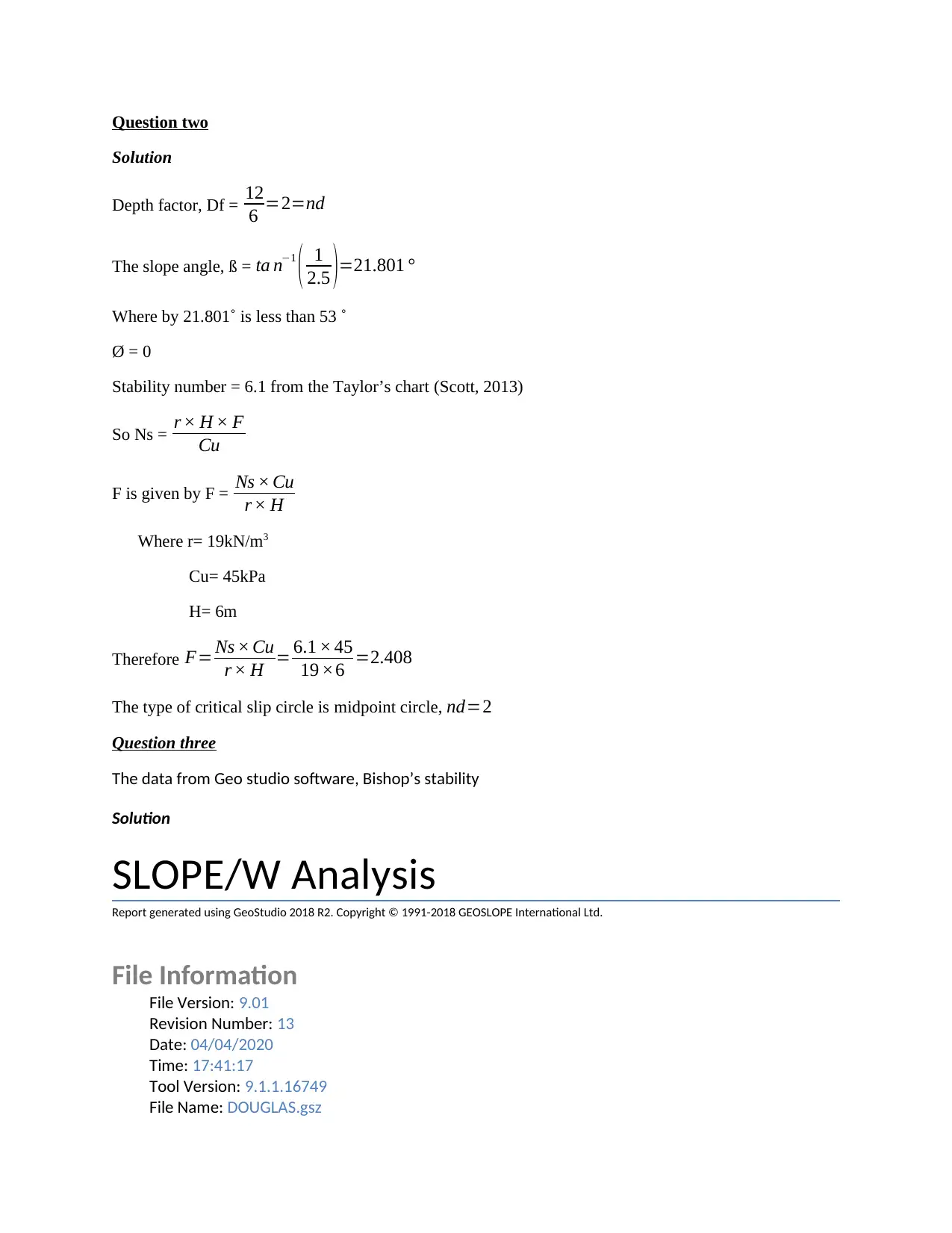
Question two
Solution
Depth factor, Df = 12
6 =2=nd
The slope angle, ß = ta n1
( 1
2.5 )=21.801 °
Where by 21.801˚ is less than 53 ˚
Ø = 0
Stability number = 6.1 from the Taylor’s chart (Scott, 2013)
So Ns = r × H × F
Cu
F is given by F = Ns × Cu
r × H
Where r= 19kN/m3
Cu= 45kPa
H= 6m
Therefore F= Ns × Cu
r × H = 6.1 × 45
19 ×6 =2.408
The type of critical slip circle is midpoint circle, nd=2
Question three
The data from Geo studio software, Bishop’s stability
Solution
SLOPE/W Analysis
Report generated using GeoStudio 2018 R2. Copyright © 1991-2018 GEOSLOPE International Ltd.
File Information
File Version: 9.01
Revision Number: 13
Date: 04/04/2020
Time: 17:41:17
Tool Version: 9.1.1.16749
File Name: DOUGLAS.gsz
tabler-icon-diamond-filled.svg

Paraphrase This Document

Need a fresh take? Get an instant paraphrase of this document with our AI Paraphraser
Document Page
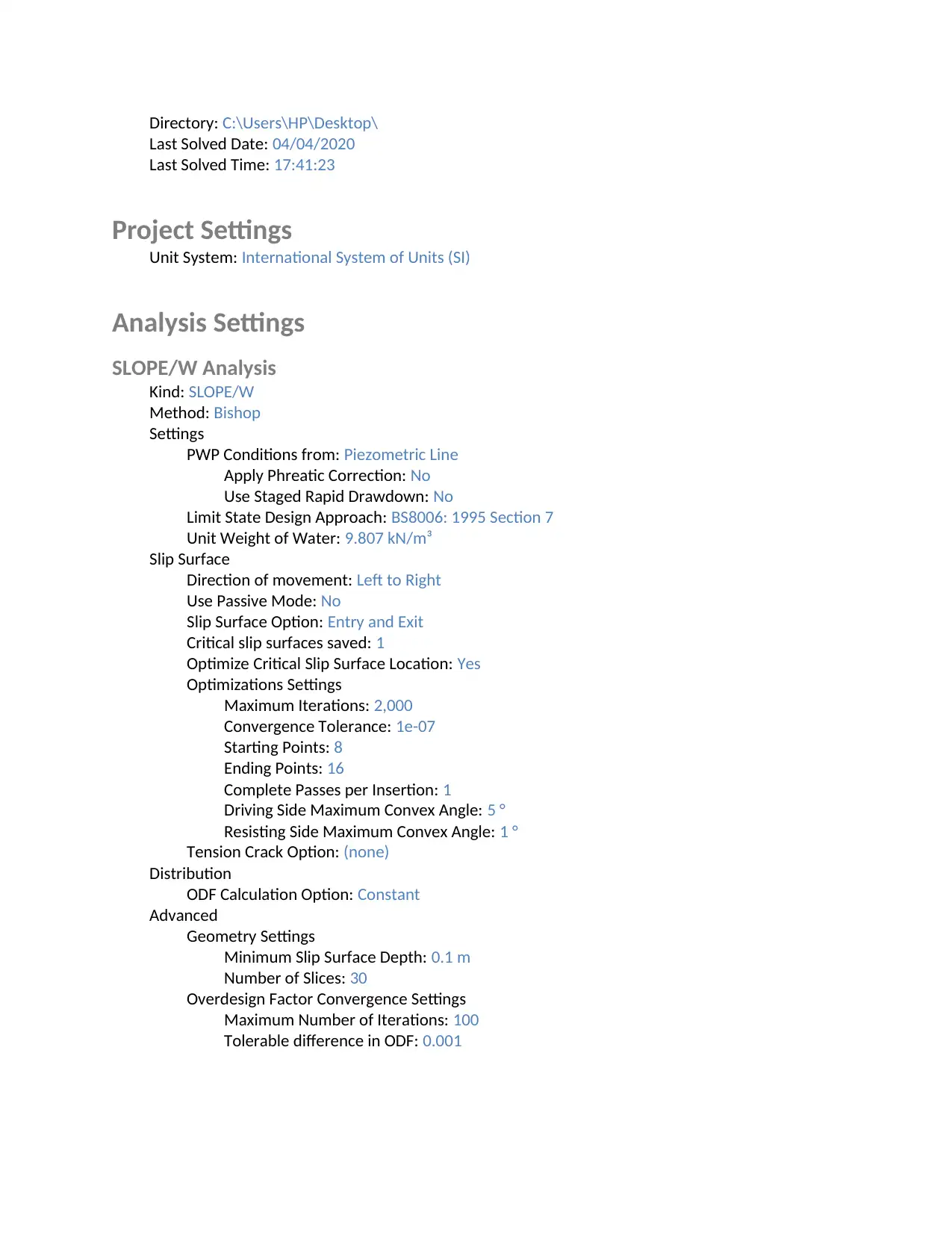
Directory: C:\Users\HP\Desktop\
Last Solved Date: 04/04/2020
Last Solved Time: 17:41:23
Project Settings
Unit System: International System of Units (SI)
Analysis Settings
SLOPE/W Analysis
Kind: SLOPE/W
Method: Bishop
Settings
PWP Conditions from: Piezometric Line
Apply Phreatic Correction: No
Use Staged Rapid Drawdown: No
Limit State Design Approach: BS8006: 1995 Section 7
Unit Weight of Water: 9.807 kN/m³
Slip Surface
Direction of movement: Left to Right
Use Passive Mode: No
Slip Surface Option: Entry and Exit
Critical slip surfaces saved: 1
Optimize Critical Slip Surface Location: Yes
Optimizations Settings
Maximum Iterations: 2,000
Convergence Tolerance: 1e-07
Starting Points: 8
Ending Points: 16
Complete Passes per Insertion: 1
Driving Side Maximum Convex Angle: 5 °
Resisting Side Maximum Convex Angle: 1 °
Tension Crack Option: (none)
Distribution
ODF Calculation Option: Constant
Advanced
Geometry Settings
Minimum Slip Surface Depth: 0.1 m
Number of Slices: 30
Overdesign Factor Convergence Settings
Maximum Number of Iterations: 100
Tolerable difference in ODF: 0.001
Document Page
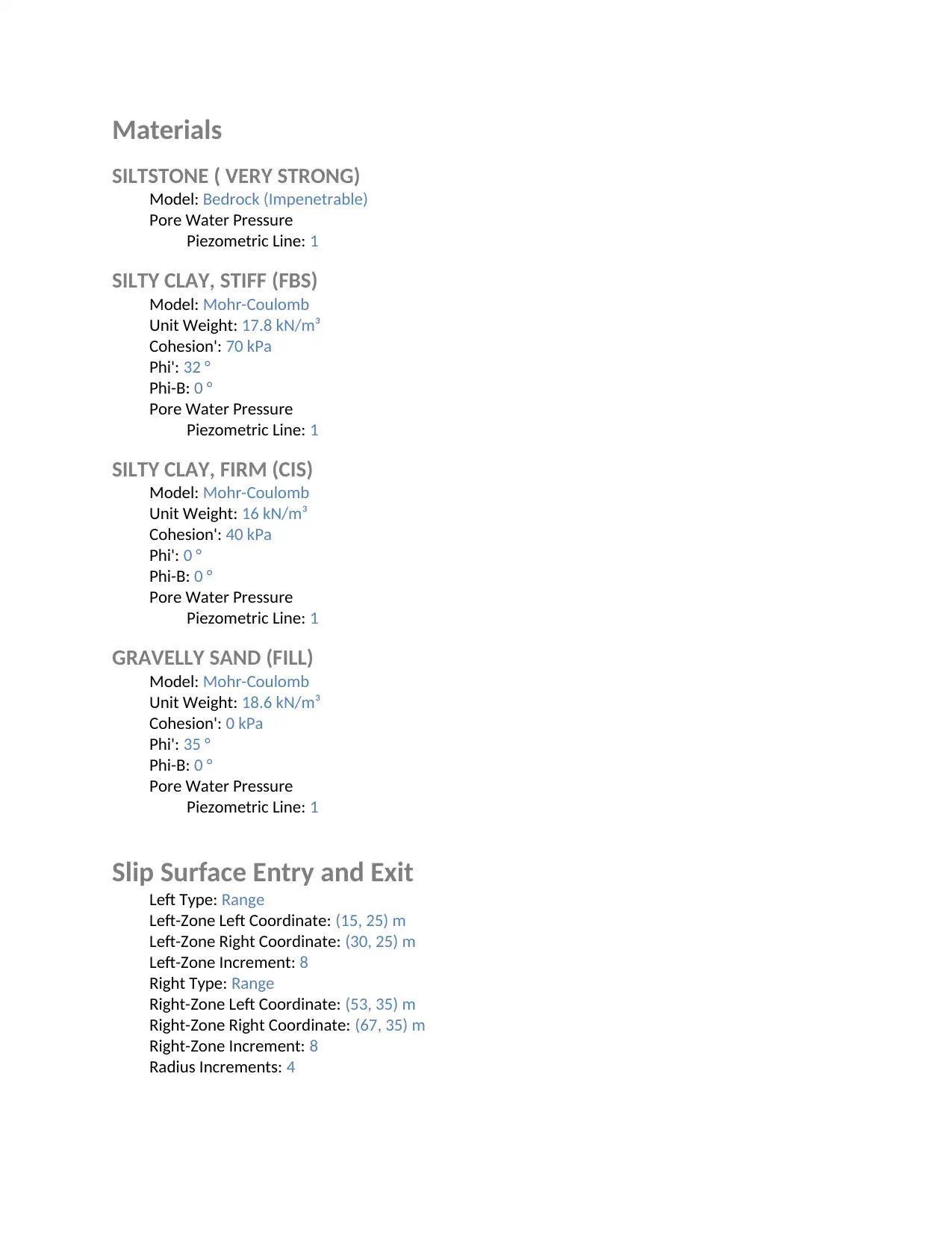
Materials
SILTSTONE ( VERY STRONG)
Model: Bedrock (Impenetrable)
Pore Water Pressure
Piezometric Line: 1
SILTY CLAY, STIFF (FBS)
Model: Mohr-Coulomb
Unit Weight: 17.8 kN/m³
Cohesion': 70 kPa
Phi': 32 °
Phi-B: 0 °
Pore Water Pressure
Piezometric Line: 1
SILTY CLAY, FIRM (CIS)
Model: Mohr-Coulomb
Unit Weight: 16 kN/m³
Cohesion': 40 kPa
Phi': 0 °
Phi-B: 0 °
Pore Water Pressure
Piezometric Line: 1
GRAVELLY SAND (FILL)
Model: Mohr-Coulomb
Unit Weight: 18.6 kN/m³
Cohesion': 0 kPa
Phi': 35 °
Phi-B: 0 °
Pore Water Pressure
Piezometric Line: 1
Slip Surface Entry and Exit
Left Type: Range
Left-Zone Left Coordinate: (15, 25) m
Left-Zone Right Coordinate: (30, 25) m
Left-Zone Increment: 8
Right Type: Range
Right-Zone Left Coordinate: (53, 35) m
Right-Zone Right Coordinate: (67, 35) m
Right-Zone Increment: 8
Radius Increments: 4
Document Page
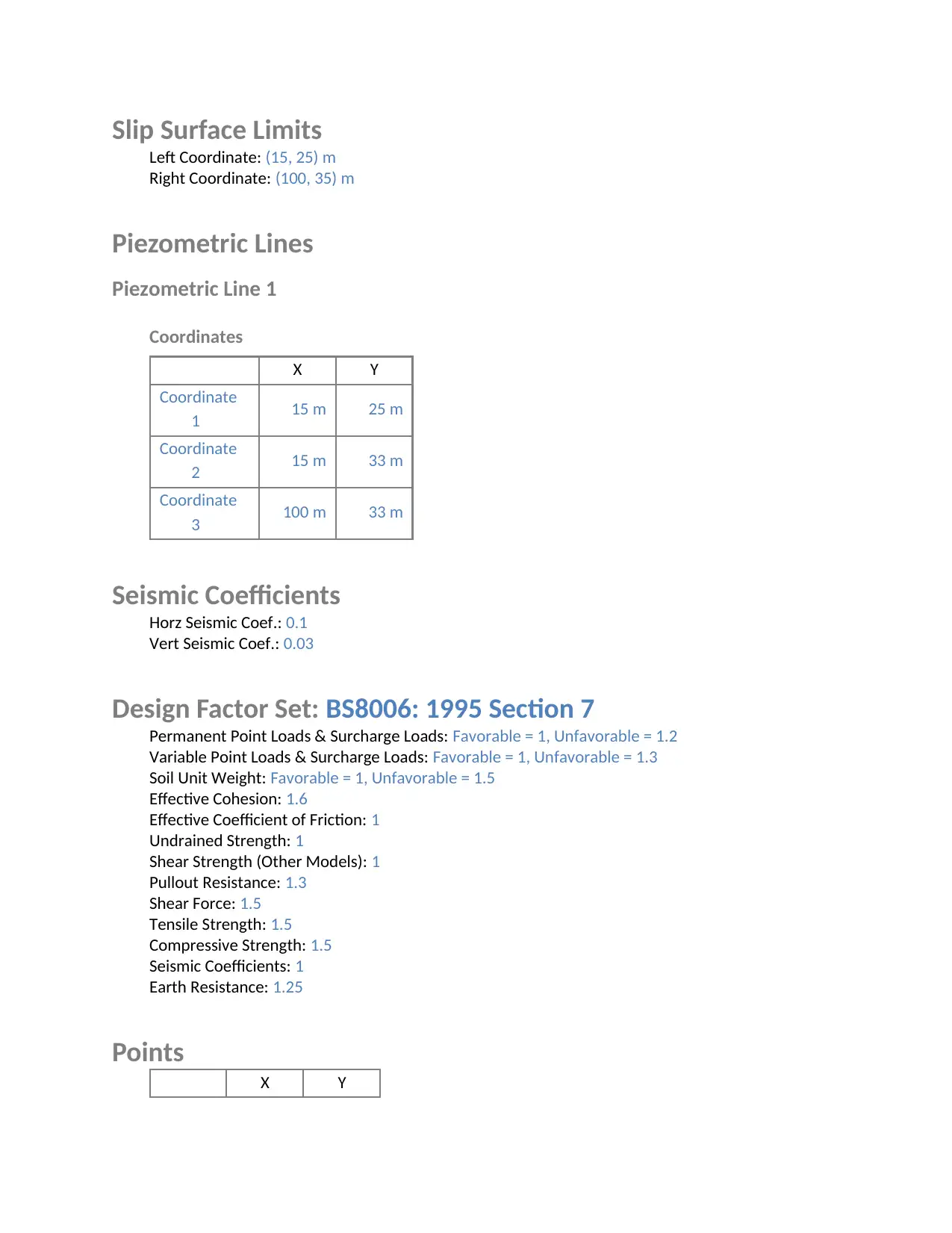
Slip Surface Limits
Left Coordinate: (15, 25) m
Right Coordinate: (100, 35) m
Piezometric Lines
Piezometric Line 1
Coordinates
X Y
Coordinate
1 15 m 25 m
Coordinate
2 15 m 33 m
Coordinate
3 100 m 33 m
Seismic Coefficients
Horz Seismic Coef.: 0.1
Vert Seismic Coef.: 0.03
Design Factor Set: BS8006: 1995 Section 7
Permanent Point Loads & Surcharge Loads: Favorable = 1, Unfavorable = 1.2
Variable Point Loads & Surcharge Loads: Favorable = 1, Unfavorable = 1.3
Soil Unit Weight: Favorable = 1, Unfavorable = 1.5
Effective Cohesion: 1.6
Effective Coefficient of Friction: 1
Undrained Strength: 1
Shear Strength (Other Models): 1
Pullout Resistance: 1.3
Shear Force: 1.5
Tensile Strength: 1.5
Compressive Strength: 1.5
Seismic Coefficients: 1
Earth Resistance: 1.25
Points X Y
tabler-icon-diamond-filled.svg

Paraphrase This Document

Need a fresh take? Get an instant paraphrase of this document with our AI Paraphraser
Document Page
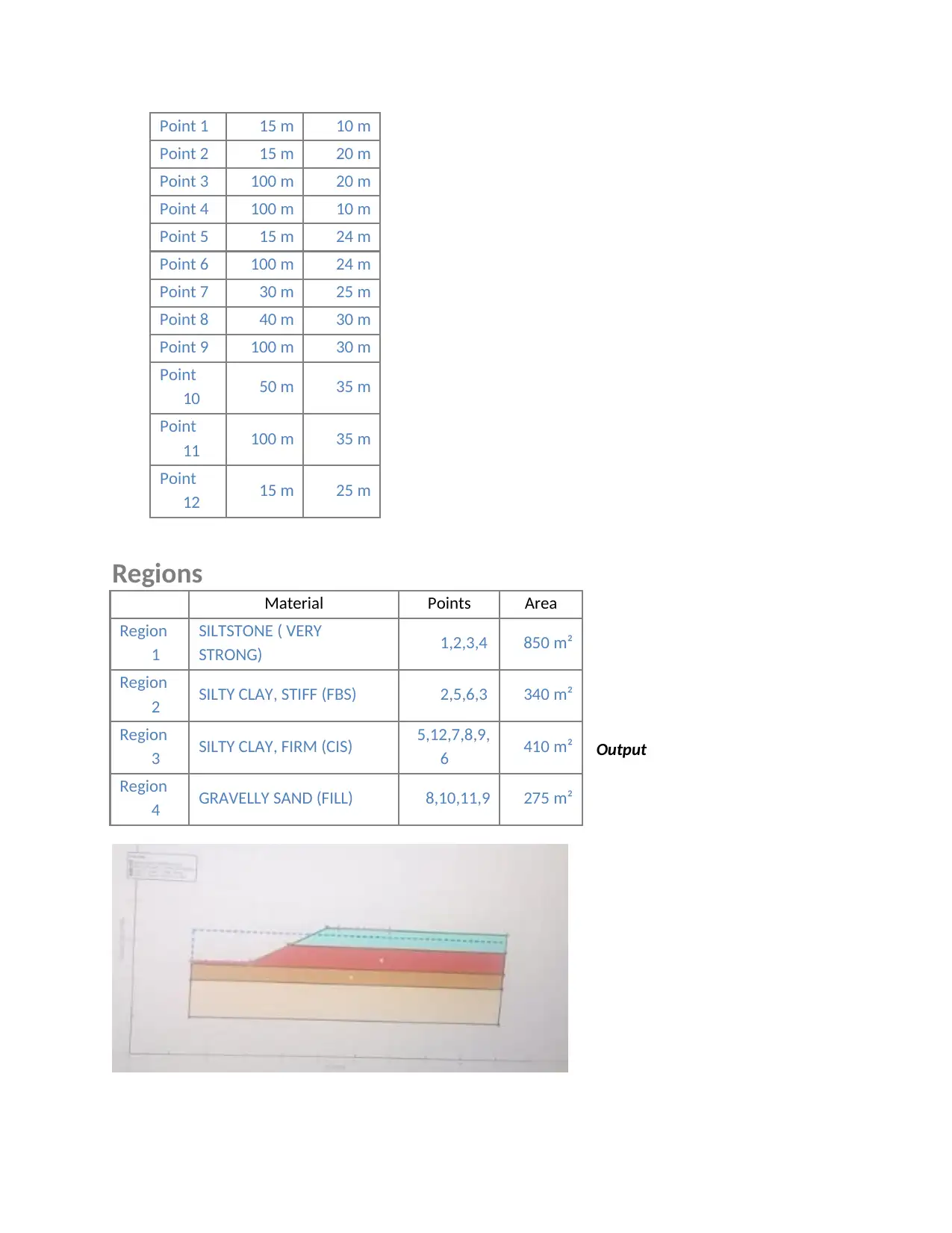
Point 1 15 m 10 m
Point 2 15 m 20 m
Point 3 100 m 20 m
Point 4 100 m 10 m
Point 5 15 m 24 m
Point 6 100 m 24 m
Point 7 30 m 25 m
Point 8 40 m 30 m
Point 9 100 m 30 m
Point
10 50 m 35 m
Point
11 100 m 35 m
Point
12 15 m 25 m
Regions
Output
Material Points Area
Region
1
SILTSTONE ( VERY
STRONG) 1,2,3,4 850
Region
2 SILTY CLAY, STIFF (FBS) 2,5,6,3 340
Region
3 SILTY CLAY, FIRM (CIS) 5,12,7,8,9,
6 410
Region
4 GRAVELLY SAND (FILL) 8,10,11,9 275
chevron_up_icon
1 out of 5
circle_padding
hide_on_mobile
zoom_out_icon
[object Object]