Comprehensive Report on Entrepreneurship and Small Business Dynamics
VerifiedAdded on 2021/02/20
|12
|3527
|165
Report
AI Summary
This report provides a comprehensive analysis of entrepreneurship and small business management. It explores different types of entrepreneurial ventures, their similarities and differences, and their impact on the UK economy. The report assesses the importance of small businesses and start-ups to the growth of the social economy, highlighting employment opportunities, social and economic evolution, and fund flow. It also examines the characteristic traits and skills of successful entrepreneurs, differentiating them from other business managers by considering entrepreneurs like Bill Gates, Peter Jones and James Dyson. Furthermore, it discusses how background and experience can influence entrepreneurship. The report uses data and information to support its findings and offers insights into the dynamics of small business growth and its contribution to the UK's social and economic landscape.
Entrepreneurship and Small Business
Management
Management

Paraphrase This Document
Need a fresh take? Get an instant paraphrase of this document with our AI Paraphraser
Table of Contents
INTRODUCTION...........................................................................................................................3
TASK 1............................................................................................................................................3
P2 Similarities and differences between entrepreneurial ventures.............................................4
TASK 2............................................................................................................................................5
P3 Interpret and assess data and information on how micro and small businesses impact on the
economy......................................................................................................................................5
P4 Explain the importance of small businesses and business start-ups to the growth of the
social economy............................................................................................................................7
TASK 3............................................................................................................................................8
P5 Characteristic traits and skills of successful entrepreneurs that differentiate them from
other business managers..............................................................................................................8
P6 Assess how aspects of the entrepreneurial personality reflect entrepreneurial motivation
and mindset.................................................................................................................................9
TASK 4..........................................................................................................................................10
P7 How background and experience can hinder or foster entrepreneurship.............................10
CONCLUSION..............................................................................................................................11
REFERENCES..............................................................................................................................12
INTRODUCTION...........................................................................................................................3
TASK 1............................................................................................................................................3
P2 Similarities and differences between entrepreneurial ventures.............................................4
TASK 2............................................................................................................................................5
P3 Interpret and assess data and information on how micro and small businesses impact on the
economy......................................................................................................................................5
P4 Explain the importance of small businesses and business start-ups to the growth of the
social economy............................................................................................................................7
TASK 3............................................................................................................................................8
P5 Characteristic traits and skills of successful entrepreneurs that differentiate them from
other business managers..............................................................................................................8
P6 Assess how aspects of the entrepreneurial personality reflect entrepreneurial motivation
and mindset.................................................................................................................................9
TASK 4..........................................................................................................................................10
P7 How background and experience can hinder or foster entrepreneurship.............................10
CONCLUSION..............................................................................................................................11
REFERENCES..............................................................................................................................12
INTRODUCTION
Entrepreneurship is the process of the designing, launching and running any new entity,
who is officially declared small business. The people who creates its own business are called as
an entrepreneurs. In the current period, small business and starts-up are two things at one point,
in which intention to start the business is common (Winkel, 2013). In this context, report will
consists of analysis around this given purpose of discussing on a small businesses. This report
will makes their own talk over two different entrepreneurs named as Bill Gates and Peter Jones
and also traits, skills and characteristics. Also, report will also put its focus on different types of
an entrepreneurial ventures and typology, similarities and differences between entrepreneurial
ventures, importance of small business & start-ups firm in long term growth of a business
process, characteristics and traits of the successful entrepreneurs and discussion on the
personality of an entity.
TASK 1
P1 Different types of entrepreneurial ventures and relation to the typology of entrepreneurship
Entrepreneur are those who generally starts own business, ventures & business operation
to welfare or develops any defined goods or services to satisfy customer needs. These people
majorly starts any business ventures in order to fulfil employment requirements for others and
also delivers the commitment in a long run. Small business starts with the micro structure and its
continues to become bigger one. These ventures have their own vision & mission, defined
structures, methodology and strategic action plan. Entrepreneurial ventures are classified into
four different categories such as large business, scalable ventures, small business and social
ventures. For UK, entrepreneurial ventures has been classified are as follows:
Small business ventures: Small ventures are those starts with small units of a business
such as grocery store, medicine outlets, food meal cafes etc., as well as slowly and steadily rises
to large scale, if possibles. In this ventures, amount of an investment is low, as because of high
range & unlimited resources to be acquired at the given cost (Sullivan and Meek, 2012). These
ventures have potential to led at a productive level or stage of time. These ventures are meant to
earn profit instead of surviving in a market.
Large business ventures: Large business firms are focused on increasing developing the
products or services at a large scale and earning huge profit out of a defined mission or action
Entrepreneurship is the process of the designing, launching and running any new entity,
who is officially declared small business. The people who creates its own business are called as
an entrepreneurs. In the current period, small business and starts-up are two things at one point,
in which intention to start the business is common (Winkel, 2013). In this context, report will
consists of analysis around this given purpose of discussing on a small businesses. This report
will makes their own talk over two different entrepreneurs named as Bill Gates and Peter Jones
and also traits, skills and characteristics. Also, report will also put its focus on different types of
an entrepreneurial ventures and typology, similarities and differences between entrepreneurial
ventures, importance of small business & start-ups firm in long term growth of a business
process, characteristics and traits of the successful entrepreneurs and discussion on the
personality of an entity.
TASK 1
P1 Different types of entrepreneurial ventures and relation to the typology of entrepreneurship
Entrepreneur are those who generally starts own business, ventures & business operation
to welfare or develops any defined goods or services to satisfy customer needs. These people
majorly starts any business ventures in order to fulfil employment requirements for others and
also delivers the commitment in a long run. Small business starts with the micro structure and its
continues to become bigger one. These ventures have their own vision & mission, defined
structures, methodology and strategic action plan. Entrepreneurial ventures are classified into
four different categories such as large business, scalable ventures, small business and social
ventures. For UK, entrepreneurial ventures has been classified are as follows:
Small business ventures: Small ventures are those starts with small units of a business
such as grocery store, medicine outlets, food meal cafes etc., as well as slowly and steadily rises
to large scale, if possibles. In this ventures, amount of an investment is low, as because of high
range & unlimited resources to be acquired at the given cost (Sullivan and Meek, 2012). These
ventures have potential to led at a productive level or stage of time. These ventures are meant to
earn profit instead of surviving in a market.
Large business ventures: Large business firms are focused on increasing developing the
products or services at a large scale and earning huge profit out of a defined mission or action
⊘ This is a preview!⊘
Do you want full access?
Subscribe today to unlock all pages.

Trusted by 1+ million students worldwide
plan. These are basically big corporate firm, companies or entity who are meant to earn millions
of the turnover. In UK, this is necessary for people to gather investment to start business firm
and be registered with the recognised authorities or bodies. Hence, this can be necessary for firm
to obtain an approval from recognised authorities to start upon business operation in the defined
manner.
Social venture: This kind of the business with an aim to give society a major
consideration for welfare or social development of the people. Social ventures includes NGO,
business ventures for solution of a health crisis, social or cultural issues (Sánchez, 2013). An
entrepreneur is this ventures are mainly visionary, mission oriented and also have different of an
ideologies or level of thoughts. Profit earning, social development or environmental protections
matters are their big concern.
Typology of an entrepreneurship: In the entrepreneurial, typology is comprises of three
types such as: male, female and copycat entrepreneurs.
Male entrepreneur: In this, business ventures are used to be started by male individual
who are innovative or compulsive in nature. Male are high entrepreneur and also responsible to
carry out business operations.
Female entrepreneur: In this, business are started by female, who is creative, identified
and well disciplined to accomplish given targets of goals.
Copy cat entrepreneurs: In this, any individual generally copies other idea or thoughts to
generates own business process as well as gather the major profits at the bigger stage of time.
P2 Similarities and differences between entrepreneurial ventures
In the current time, where business entities are becoming large in size, structure and the
potentials to gather profits. In that case, how defined business varies matters a lot and how they
used to continue their functions and suitability at the defined period of time (Ribeiro-Navarrete,
2015). Every business is not similar in every context, this will be prominent in this assessment to
do analysis of different types of entrepreneurial ventures are as follows:
Particular Large scale ventures Social ventures
Similarities
Large ventures are started to produces
the valuable goods and services for the
development and satisfaction of the
Social venture is initiated with major
purpose to work for people welfare
and satisfaction of the human being.
of the turnover. In UK, this is necessary for people to gather investment to start business firm
and be registered with the recognised authorities or bodies. Hence, this can be necessary for firm
to obtain an approval from recognised authorities to start upon business operation in the defined
manner.
Social venture: This kind of the business with an aim to give society a major
consideration for welfare or social development of the people. Social ventures includes NGO,
business ventures for solution of a health crisis, social or cultural issues (Sánchez, 2013). An
entrepreneur is this ventures are mainly visionary, mission oriented and also have different of an
ideologies or level of thoughts. Profit earning, social development or environmental protections
matters are their big concern.
Typology of an entrepreneurship: In the entrepreneurial, typology is comprises of three
types such as: male, female and copycat entrepreneurs.
Male entrepreneur: In this, business ventures are used to be started by male individual
who are innovative or compulsive in nature. Male are high entrepreneur and also responsible to
carry out business operations.
Female entrepreneur: In this, business are started by female, who is creative, identified
and well disciplined to accomplish given targets of goals.
Copy cat entrepreneurs: In this, any individual generally copies other idea or thoughts to
generates own business process as well as gather the major profits at the bigger stage of time.
P2 Similarities and differences between entrepreneurial ventures
In the current time, where business entities are becoming large in size, structure and the
potentials to gather profits. In that case, how defined business varies matters a lot and how they
used to continue their functions and suitability at the defined period of time (Ribeiro-Navarrete,
2015). Every business is not similar in every context, this will be prominent in this assessment to
do analysis of different types of entrepreneurial ventures are as follows:
Particular Large scale ventures Social ventures
Similarities
Large ventures are started to produces
the valuable goods and services for the
development and satisfaction of the
Social venture is initiated with major
purpose to work for people welfare
and satisfaction of the human being.
Paraphrase This Document
Need a fresh take? Get an instant paraphrase of this document with our AI Paraphraser
common customer, in this word
satisfaction is same.
Also, these ventures have support of
the government bodies, agency etc., to
raise funds or money.
Differences Large scale business are started to earn
business turnover, product revenues
and creating brand images.
The story is different here, where
social ventures is not to earn profits, to
the welfare of the people or service
welfare to them.
Particular Small ventures Scalable ventures
Similarities
Small business are majorly with small
units and provisioned for generating
process of the business at a major
circumstances. Here, growth or
increasing scale of the business
operations at the major concern.
These types of ventures are meant to
increasing scale of the business, rise
its profitability and expands it to major
area to gather business outcomes. In
this, scalability of the business matter.
Differences Small ventures are consists of grocery
stores, retail stores, medical stores etc.
In this, retail outlets, scaled grocery
stores, consultancy firm, who have
capability or accessibility to gather
one stage up into the business.
TASK 2
P3 Interpret and assess data and information on how micro and small businesses impact on the
economy
Micro and small business are highly growing structures, in which firm of the UK are
operating and also existence to gather the business objectives with increased productivity and
profit capability. From last 5 year's, number of the micro and small business ventures have been
increased and that entities are operating at domestic level such as the Unicorn grocery, Greggs
etc., are some of the business operations, which where started at the micro level and grown at the
domestic level of time (Alcazar, 2016). These entities has tried to gives out the positive message
satisfaction is same.
Also, these ventures have support of
the government bodies, agency etc., to
raise funds or money.
Differences Large scale business are started to earn
business turnover, product revenues
and creating brand images.
The story is different here, where
social ventures is not to earn profits, to
the welfare of the people or service
welfare to them.
Particular Small ventures Scalable ventures
Similarities
Small business are majorly with small
units and provisioned for generating
process of the business at a major
circumstances. Here, growth or
increasing scale of the business
operations at the major concern.
These types of ventures are meant to
increasing scale of the business, rise
its profitability and expands it to major
area to gather business outcomes. In
this, scalability of the business matter.
Differences Small ventures are consists of grocery
stores, retail stores, medical stores etc.
In this, retail outlets, scaled grocery
stores, consultancy firm, who have
capability or accessibility to gather
one stage up into the business.
TASK 2
P3 Interpret and assess data and information on how micro and small businesses impact on the
economy
Micro and small business are highly growing structures, in which firm of the UK are
operating and also existence to gather the business objectives with increased productivity and
profit capability. From last 5 year's, number of the micro and small business ventures have been
increased and that entities are operating at domestic level such as the Unicorn grocery, Greggs
etc., are some of the business operations, which where started at the micro level and grown at the
domestic level of time (Alcazar, 2016). These entities has tried to gives out the positive message
in social level of co-operation that, business with the vision, defined aim or perfect cannot be
stop to grow and also accomplish its own defined purpose of the business operations. Thus, small
and micro firms have put positives in the UK economy and also brings job opportunities for the
youth of the UK.
When UK was eliminated out of an European Union, this has been forecasted that small
businesses were effected and got stoppage in the accessibility in resources from nation of the
Europe nation to carry production of the goods or services (Gray, 2013). This is like a threat for
business such as the Unicorn grocery, Greggs who have less access to gather resources in the
UK. Simply, this has led negative effects on business structures of the UK and make entities to
struggle more to survive business operations at a major instances.
In context of the UK, this will be necessary to make do analysis of the impact of what
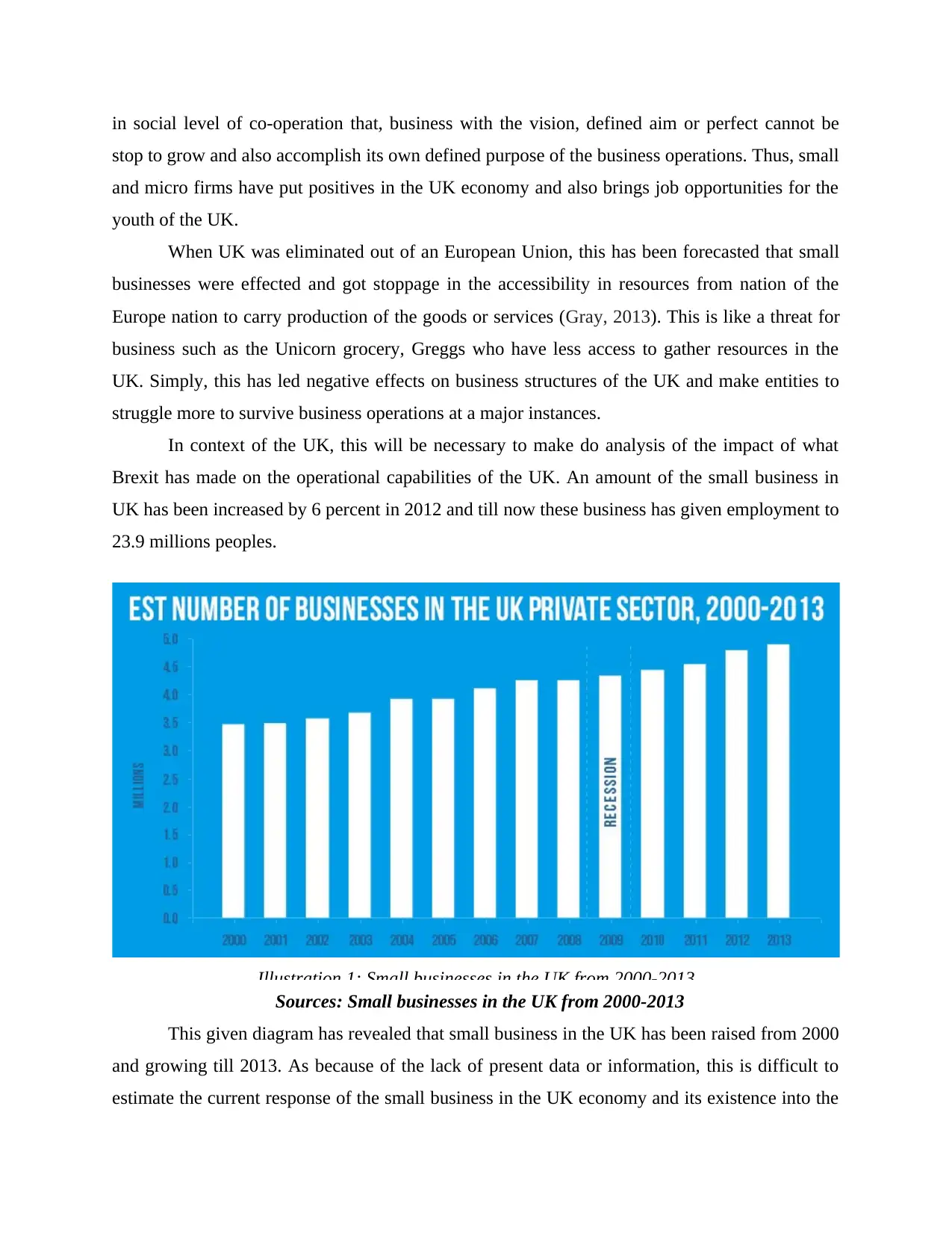
Brexit has made on the operational capabilities of the UK. An amount of the small business in
UK has been increased by 6 percent in 2012 and till now these business has given employment to
23.9 millions peoples.
Sources: Small businesses in the UK from 2000-2013
This given diagram has revealed that small business in the UK has been raised from 2000
and growing till 2013. As because of the lack of present data or information, this is difficult to
estimate the current response of the small business in the UK economy and its existence into the
Illustration 1: Small businesses in the UK from 2000-2013
stop to grow and also accomplish its own defined purpose of the business operations. Thus, small
and micro firms have put positives in the UK economy and also brings job opportunities for the
youth of the UK.
When UK was eliminated out of an European Union, this has been forecasted that small
businesses were effected and got stoppage in the accessibility in resources from nation of the
Europe nation to carry production of the goods or services (Gray, 2013). This is like a threat for
business such as the Unicorn grocery, Greggs who have less access to gather resources in the
UK. Simply, this has led negative effects on business structures of the UK and make entities to
struggle more to survive business operations at a major instances.
In context of the UK, this will be necessary to make do analysis of the impact of what
Brexit has made on the operational capabilities of the UK. An amount of the small business in
UK has been increased by 6 percent in 2012 and till now these business has given employment to
23.9 millions peoples.
Sources: Small businesses in the UK from 2000-2013
This given diagram has revealed that small business in the UK has been raised from 2000
and growing till 2013. As because of the lack of present data or information, this is difficult to
estimate the current response of the small business in the UK economy and its existence into the
Illustration 1: Small businesses in the UK from 2000-2013
⊘ This is a preview!⊘
Do you want full access?
Subscribe today to unlock all pages.
Trusted by 1+ million students worldwide
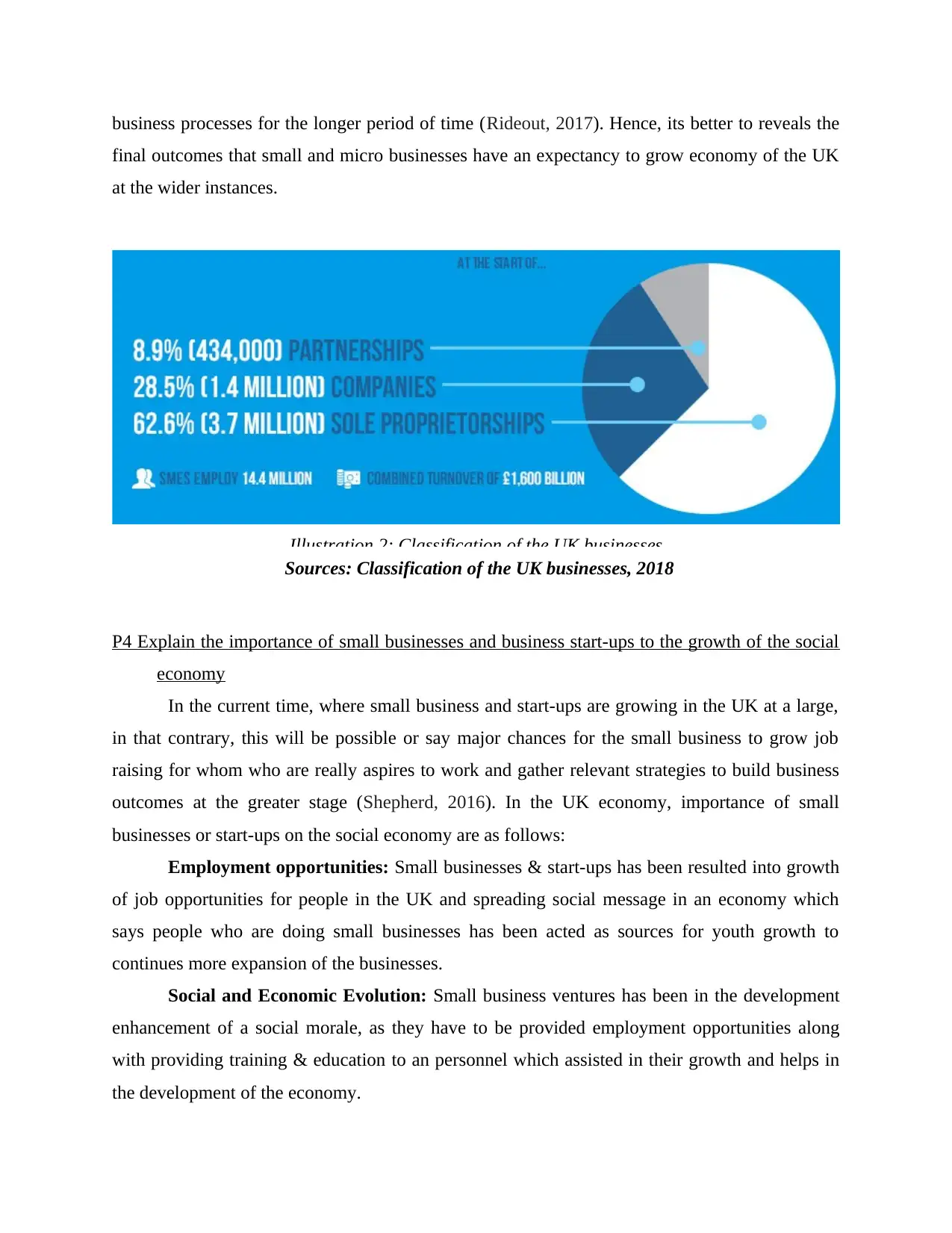
business processes for the longer period of time (Rideout, 2017). Hence, its better to reveals the
final outcomes that small and micro businesses have an expectancy to grow economy of the UK
at the wider instances.
Sources: Classification of the UK businesses, 2018
P4 Explain the importance of small businesses and business start-ups to the growth of the social
economy
In the current time, where small business and start-ups are growing in the UK at a large,
in that contrary, this will be possible or say major chances for the small business to grow job
raising for whom who are really aspires to work and gather relevant strategies to build business
outcomes at the greater stage (Shepherd, 2016). In the UK economy, importance of small
businesses or start-ups on the social economy are as follows:
Employment opportunities: Small businesses & start-ups has been resulted into growth
of job opportunities for people in the UK and spreading social message in an economy which
says people who are doing small businesses has been acted as sources for youth growth to
continues more expansion of the businesses.
Social and Economic Evolution: Small business ventures has been in the development
enhancement of a social morale, as they have to be provided employment opportunities along
with providing training & education to an personnel which assisted in their growth and helps in
the development of the economy.
Illustration 2: Classification of the UK businesses
final outcomes that small and micro businesses have an expectancy to grow economy of the UK
at the wider instances.
Sources: Classification of the UK businesses, 2018
P4 Explain the importance of small businesses and business start-ups to the growth of the social
economy
In the current time, where small business and start-ups are growing in the UK at a large,
in that contrary, this will be possible or say major chances for the small business to grow job
raising for whom who are really aspires to work and gather relevant strategies to build business
outcomes at the greater stage (Shepherd, 2016). In the UK economy, importance of small
businesses or start-ups on the social economy are as follows:
Employment opportunities: Small businesses & start-ups has been resulted into growth
of job opportunities for people in the UK and spreading social message in an economy which
says people who are doing small businesses has been acted as sources for youth growth to
continues more expansion of the businesses.
Social and Economic Evolution: Small business ventures has been in the development
enhancement of a social morale, as they have to be provided employment opportunities along
with providing training & education to an personnel which assisted in their growth and helps in
the development of the economy.
Illustration 2: Classification of the UK businesses
Paraphrase This Document
Need a fresh take? Get an instant paraphrase of this document with our AI Paraphraser
Flow of the funds: Small businesses now a days attracting FDI, funds from angel person
and money from other entities or nation which can be considered as inflow for the UK gov.
bodies. Also, some of the outside business firms are expected to spreads out social message for
people and for which they are investing funds in an accordance to that. Thus, it is helpful to
social development or welfare.
Small businesses has been impact on different level of an economy, in which different
levels of an economy comes under the existence such as local, domestic and national. On these
given level, small enterprises have increased an expansion of the national business processes and
creates the ranking of the UK in business fortune lists (Drucker, 2014). This is why, because
start-ups into the UK has attracted almost 1 billion dollar of an overall investment in the UK
economy and it is growth opportunities in an entire UK. Thus, it will be prominent to examine
both positive and negative aspects of small businesses into the UK.
TASK 3
P5 Characteristic traits and skills of successful entrepreneurs that differentiate them from other
business managers
In the present time, every entrepreneur is the manager in itself with helps of its insight,
vision, mission or strategic objectives and also they have that skills to act as the manager. In this
assessment, two renowned entrepreneurs named as James Dyson and Peter Jones has taken into
the consideration to know what makes an entrepreneur being different from manager and skills
contrast and competencies level (Dennis Jr, 2011) The above discussion is as follows:
Characteristics:
Peter Jones:
Innovative person: Peter Jones is well-known for its efforts to implement perfect goods
or services along with utilising the skills or talents to deliver own promise in a perfect manner.
Along with innovative, he is enthusiastic for work also.
James Dyson:
Creative psycho person: James Dyson was know for its own creative thinking in which
he uses his own idea or vision to deliver own thought and words creatively.
Traits:
and money from other entities or nation which can be considered as inflow for the UK gov.
bodies. Also, some of the outside business firms are expected to spreads out social message for
people and for which they are investing funds in an accordance to that. Thus, it is helpful to
social development or welfare.
Small businesses has been impact on different level of an economy, in which different
levels of an economy comes under the existence such as local, domestic and national. On these
given level, small enterprises have increased an expansion of the national business processes and
creates the ranking of the UK in business fortune lists (Drucker, 2014). This is why, because
start-ups into the UK has attracted almost 1 billion dollar of an overall investment in the UK
economy and it is growth opportunities in an entire UK. Thus, it will be prominent to examine
both positive and negative aspects of small businesses into the UK.
TASK 3
P5 Characteristic traits and skills of successful entrepreneurs that differentiate them from other
business managers
In the present time, every entrepreneur is the manager in itself with helps of its insight,
vision, mission or strategic objectives and also they have that skills to act as the manager. In this
assessment, two renowned entrepreneurs named as James Dyson and Peter Jones has taken into
the consideration to know what makes an entrepreneur being different from manager and skills
contrast and competencies level (Dennis Jr, 2011) The above discussion is as follows:
Characteristics:
Peter Jones:
Innovative person: Peter Jones is well-known for its efforts to implement perfect goods
or services along with utilising the skills or talents to deliver own promise in a perfect manner.
Along with innovative, he is enthusiastic for work also.
James Dyson:
Creative psycho person: James Dyson was know for its own creative thinking in which
he uses his own idea or vision to deliver own thought and words creatively.
Traits:
Peter Jones:
Personality: Strongest point of the Peter Jones is its personality which appeals people to
interact with him and get some kind of the positive inspiration in own work or goals.
James Dyson:
Attitude: James Dyson is well know for its attitude, which predicts his personality and an
entire credentials in an effective manner and also led people react on it accordingly.
Skills:
Peter Jones:
Communication: This is a most competent skills of the Peter Jones in which, he pursues
the potential to gather large audiences to them to interact with them. Also, his ability to interact
is appealing or sounds good.
James Dyson:
Management skills: James Dyson strong point is its the management skills such as the
planning, organising, co-ordination and controlling, in which he is matter and competent enough.
P6 Assess how aspects of the entrepreneurial personality reflect entrepreneurial motivation and
mindset
In this assessment, OCEAN model will be consists of personality discussion of a given
entrepreneur's named as Peter Jones and James Dyson (Chrisman and et. al., 2012). This model
will be taken into care to led proper and clear understanding of how the personalities of an
entrepreneur behave in a manner to make working more effective. The major discussion on the
OCEAN model is as follows:
Openness to experience: This personality trait explains that entrepreneur should be open
minded to grab all the opportunities in the ever changing environment. It should introduce
innovative products to become a successful entrepreneur.
Conscientiousness: This personality trait desires the individual to work in a disciplined
manner and work with more efficiency. In context to Peter Jones it effectively develops a
framework and organises and manages business process in an effective way.
Extraversion: This personality trait shows that entrepreneurs who are highly energetic
and enthusiastic in nature and tries to explore new things. They have a more social nature and
highly interacts with the individual.
Personality: Strongest point of the Peter Jones is its personality which appeals people to
interact with him and get some kind of the positive inspiration in own work or goals.
James Dyson:
Attitude: James Dyson is well know for its attitude, which predicts his personality and an
entire credentials in an effective manner and also led people react on it accordingly.
Skills:
Peter Jones:
Communication: This is a most competent skills of the Peter Jones in which, he pursues
the potential to gather large audiences to them to interact with them. Also, his ability to interact
is appealing or sounds good.
James Dyson:
Management skills: James Dyson strong point is its the management skills such as the
planning, organising, co-ordination and controlling, in which he is matter and competent enough.
P6 Assess how aspects of the entrepreneurial personality reflect entrepreneurial motivation and
mindset
In this assessment, OCEAN model will be consists of personality discussion of a given
entrepreneur's named as Peter Jones and James Dyson (Chrisman and et. al., 2012). This model
will be taken into care to led proper and clear understanding of how the personalities of an
entrepreneur behave in a manner to make working more effective. The major discussion on the
OCEAN model is as follows:
Openness to experience: This personality trait explains that entrepreneur should be open
minded to grab all the opportunities in the ever changing environment. It should introduce
innovative products to become a successful entrepreneur.
Conscientiousness: This personality trait desires the individual to work in a disciplined
manner and work with more efficiency. In context to Peter Jones it effectively develops a
framework and organises and manages business process in an effective way.
Extraversion: This personality trait shows that entrepreneurs who are highly energetic
and enthusiastic in nature and tries to explore new things. They have a more social nature and
highly interacts with the individual.
⊘ This is a preview!⊘
Do you want full access?
Subscribe today to unlock all pages.
Trusted by 1+ million students worldwide

Agreeableness: This trait specifies that individuals are sympathetic, cooperative and
compassionate towards others (Franchitti and et. al., 2011) This understands others problems and
issues and effectively coordinate with others.
Neuroticism: This characteristic allows the entrepreneur to be neutral in any situation
and to remain positive or negative and remains clam and remain free from anger, tensions and
sadness in every situation.
TASK 4
P7 How background and experience can hinder or foster entrepreneurship
Peter Jones is the renowned and well known person in the field of businesses and sports
both. He was born in the UK and grown up into the family of 3 members. In the initial time, he
was passionate about playing sports or other games and then in further time, his interest for the
reading of the books or magazines rise from that he decided to pursue entrepreneurial working.
Experiences: His experiences is full of good and morale learning, in which he learnt on
how business can be regulated & also what he learnt from hi practices. His experiences with the
BBC television and American news was skills centric.
Positive: This has helps him to gather motivation & sources of the confidences at a major
sector.
Negative: This has led his passion for soccer unfulfilled, but he is still plays the sport on
regular basis.
compassionate towards others (Franchitti and et. al., 2011) This understands others problems and
issues and effectively coordinate with others.
Neuroticism: This characteristic allows the entrepreneur to be neutral in any situation
and to remain positive or negative and remains clam and remain free from anger, tensions and
sadness in every situation.
TASK 4
P7 How background and experience can hinder or foster entrepreneurship
Peter Jones is the renowned and well known person in the field of businesses and sports
both. He was born in the UK and grown up into the family of 3 members. In the initial time, he
was passionate about playing sports or other games and then in further time, his interest for the
reading of the books or magazines rise from that he decided to pursue entrepreneurial working.
Experiences: His experiences is full of good and morale learning, in which he learnt on
how business can be regulated & also what he learnt from hi practices. His experiences with the
BBC television and American news was skills centric.
Positive: This has helps him to gather motivation & sources of the confidences at a major
sector.
Negative: This has led his passion for soccer unfulfilled, but he is still plays the sport on
regular basis.
Paraphrase This Document
Need a fresh take? Get an instant paraphrase of this document with our AI Paraphraser
CONCLUSION
From the above report, this is concluded that entrepreneurship and small business is the
back bone of the UK economy which has helped them to grow the opportunities in regards of the
job or creation of the valuable products or services. This was realised that UK market is highly
influenced by small and start-ups which are simply responsible for an effective development and
increasing of more products in the economy along with measuring growth and flow of the funds
in this big economy at a prominent level or working.
From the above report, this is concluded that entrepreneurship and small business is the
back bone of the UK economy which has helped them to grow the opportunities in regards of the
job or creation of the valuable products or services. This was realised that UK market is highly
influenced by small and start-ups which are simply responsible for an effective development and
increasing of more products in the economy along with measuring growth and flow of the funds
in this big economy at a prominent level or working.
REFERENCES
Books & Journals
Blackburn, R. A., Hart, M. and Wainwright, T., 2013. Small business performance: business,
strategy and owner-manager characteristics. Journal of small business and enterprise
development. 20(1). pp.8-27.
Bridge, S. and O'Neill, K., 2012. Understanding enterprise: entrepreneurship and small
business. Palgrave Macmillan.
Carsrud, A. and Brännback, M., 2011. Entrepreneurial motivations: what do we still need to
know?. Journal of Small Business Management. 49(1). pp.9-26.
Chittithaworn, C. and et. al., 2011. Factors affecting business success of small & medium
enterprises (SMEs) in Thailand. Asian Social Science. 7(5). p.180.
Chrisman, J. J. and et. al., 2012. Family involvement, family influence, and family‐centered non‐
economic goals in small firms. Entrepreneurship theory and practice. 36(2). pp.267-
293.
Dennis Jr, W. J., 2011. Entrepreneurship, small business and public policy levers. Journal of
Small Business Management. 49(1). pp.92-106.
Drucker, P., 2014. Innovation and entrepreneurship. Routledge.
Schaltegger, S., Lüdeke-Freund, F. and Hansen, E.G., 2016. Business models for sustainability:
A co-evolutionary analysis of sustainable entrepreneurship, innovation, and
transformation. Organization & Environment. 29(3). pp.264-289.
Shepherd, D.A., 2016. An emotions perspective for advancing the fields of family business and
entrepreneurship: Stocks, flows, reactions, and responses.
Priem, R. L., Li, S. and Carr, J. C., 2012. Insights and new directions from demand-side
approaches to technology innovation, entrepreneurship, and strategic management
research. Journal of management. 38(1). pp.346-374.
Rideout, E. C. and Gray, D. O., 2013. Does entrepreneurship education really work? A review
and methodological critique of the empirical literature on the effects of university‐based
entrepreneurship education. Journal of Small Business Management. 51(3). pp.329-351.
Roig-Tierno, N., Alcazar, J. and Ribeiro-Navarrete, S., 2015. Use of infrastructures to support
innovative entrepreneurship and business growth. Journal of Business Research. 68(11).
pp.2290-2294.
Sánchez, J. C., 2013. The impact of an entrepreneurship education program on entrepreneurial
competencies and intention. Journal of Small Business Management. 51(3). pp.447-465.
Sullivan, D. M. and Meek, W. R., 2012. Gender and entrepreneurship: a review and process
model. Journal of Managerial Psychology. 27(5). pp.428-458.
Winkel, D., 2013. The changing face of entrepreneurship education. Journal of Small Business
Management. 51(3). pp.313-314.
Online
Brexit’s impact on small businesses: the experts may be spot on after all 2019.
[Online].Available through:<https://theconversation.com/brexits-impact-on-small-
businesses-the-experts-may-be-spot-on-after-all-90561>.
Books & Journals
Blackburn, R. A., Hart, M. and Wainwright, T., 2013. Small business performance: business,
strategy and owner-manager characteristics. Journal of small business and enterprise
development. 20(1). pp.8-27.
Bridge, S. and O'Neill, K., 2012. Understanding enterprise: entrepreneurship and small
business. Palgrave Macmillan.
Carsrud, A. and Brännback, M., 2011. Entrepreneurial motivations: what do we still need to
know?. Journal of Small Business Management. 49(1). pp.9-26.
Chittithaworn, C. and et. al., 2011. Factors affecting business success of small & medium
enterprises (SMEs) in Thailand. Asian Social Science. 7(5). p.180.
Chrisman, J. J. and et. al., 2012. Family involvement, family influence, and family‐centered non‐
economic goals in small firms. Entrepreneurship theory and practice. 36(2). pp.267-
293.
Dennis Jr, W. J., 2011. Entrepreneurship, small business and public policy levers. Journal of
Small Business Management. 49(1). pp.92-106.
Drucker, P., 2014. Innovation and entrepreneurship. Routledge.
Schaltegger, S., Lüdeke-Freund, F. and Hansen, E.G., 2016. Business models for sustainability:
A co-evolutionary analysis of sustainable entrepreneurship, innovation, and
transformation. Organization & Environment. 29(3). pp.264-289.
Shepherd, D.A., 2016. An emotions perspective for advancing the fields of family business and
entrepreneurship: Stocks, flows, reactions, and responses.
Priem, R. L., Li, S. and Carr, J. C., 2012. Insights and new directions from demand-side
approaches to technology innovation, entrepreneurship, and strategic management
research. Journal of management. 38(1). pp.346-374.
Rideout, E. C. and Gray, D. O., 2013. Does entrepreneurship education really work? A review
and methodological critique of the empirical literature on the effects of university‐based
entrepreneurship education. Journal of Small Business Management. 51(3). pp.329-351.
Roig-Tierno, N., Alcazar, J. and Ribeiro-Navarrete, S., 2015. Use of infrastructures to support
innovative entrepreneurship and business growth. Journal of Business Research. 68(11).
pp.2290-2294.
Sánchez, J. C., 2013. The impact of an entrepreneurship education program on entrepreneurial
competencies and intention. Journal of Small Business Management. 51(3). pp.447-465.
Sullivan, D. M. and Meek, W. R., 2012. Gender and entrepreneurship: a review and process
model. Journal of Managerial Psychology. 27(5). pp.428-458.
Winkel, D., 2013. The changing face of entrepreneurship education. Journal of Small Business
Management. 51(3). pp.313-314.
Online
Brexit’s impact on small businesses: the experts may be spot on after all 2019.
[Online].Available through:<https://theconversation.com/brexits-impact-on-small-
businesses-the-experts-may-be-spot-on-after-all-90561>.
⊘ This is a preview!⊘
Do you want full access?
Subscribe today to unlock all pages.
Trusted by 1+ million students worldwide

1 out of 12


Related Documents


Your All-in-One AI-Powered Toolkit for Academic Success.
+13062052269
info@desklib.com
Available 24*7 on WhatsApp / Email
![[object Object]](/_next/static/media/star-bottom.7253800d.svg)
Unlock your academic potential
Copyright © 2020–2026 A2Z Services. All Rights Reserved. Developed and managed by ZUCOL.