Entrepreneurship and Small Business: Impact on the UK Economy
VerifiedAdded on 2023/01/13
|18
|5158
|25
Report
AI Summary
This report explores the landscape of entrepreneurship and small business management, focusing on different types of entrepreneurial ventures and their typologies. It highlights the distinctions between small businesses, large ventures, social enterprises, and scalable ventures, examining their similarities and differences in terms of risk, innovation, sustainability, size, number of employees, and structure. The report also presents relevant data and statistics illustrating the significant impact of small and micro businesses on the UK economy, including their contribution to employment, tax revenue, and innovation. Furthermore, it emphasizes the importance of small businesses and start-ups in fostering the growth of the social economy, outlining the roles of mutuals, foundations, and charities. Finally, the report identifies key skills that differentiate successful entrepreneurs from business managers, such as risk-taking, innovation, leadership, and adaptability. The document is available on Desklib, a platform offering a wide array of study tools and resources for students.
Entrepreneurship and
Small Business
Management
1
Small Business
Management
1

Paraphrase This Document
Need a fresh take? Get an instant paraphrase of this document with our AI Paraphraser
Table of Contents
INTRODUCTION...........................................................................................................................3
MAIN BODY...................................................................................................................................3
P1 Different types of entrepreneurial ventures and their relation with typologies......................3
P2 Similarities and differences between entrepreneurial ventures..............................................4
P3 Relevant data and statistics which shows how small and micro businesses impact on the
economy.......................................................................................................................................6
P4 Importance of small businesses and start-ups to the growth of the social economy..............8
P5 Skills of a successful entrepreneur which differentiate them from business manager...........9
CONCLUSION..............................................................................................................................12
REFERENCES..............................................................................................................................13
2
INTRODUCTION...........................................................................................................................3
MAIN BODY...................................................................................................................................3
P1 Different types of entrepreneurial ventures and their relation with typologies......................3
P2 Similarities and differences between entrepreneurial ventures..............................................4
P3 Relevant data and statistics which shows how small and micro businesses impact on the
economy.......................................................................................................................................6
P4 Importance of small businesses and start-ups to the growth of the social economy..............8
P5 Skills of a successful entrepreneur which differentiate them from business manager...........9
CONCLUSION..............................................................................................................................12
REFERENCES..............................................................................................................................13
2
INTRODUCTION
Entrepreneurship termed out as process that aids to create new enterprise. They also has
capacity and willingness to develop, organise and manage risk to business venture to make
profit. Therefore, an individual who undertakes the risk to start up business venture is called out
as entrepreneur.
The present report will be based on topic of Entrepreneurship and small business
management. Furthermore, study will cover the activities as to cover differ kind of
entrepreneurial venture and typologies. Thus, Relevant data and statistics has been used to reflect
on small and micro businesses impact on the economy. Lastly, background and experience will
be defined that hinders or foster entrepreneurship.
MAIN BODY
P1 Different types of entrepreneurial ventures and their relation with typologies
Entrepreneurship is the process of developing a new business. There are various kinds of
ventures that can be developed by entrepreneur. These are described as below:
Small business: These are such business venture that covers large market share. These
firms are generating limited profit and get funds from family or friends. The objective of
these small ventures are to generate certain amount of profit that may help in recovering
the operational cost so that firm can sustain in market for longer duration. In addition, it
can be said that it may be sole traders, partnership and corporation, privately owned
whose main aim is to make profit and take competitive advantages. For example:
plumbers, electricians, grocery stores are the great example of small ventures (The Four
Types of Entrepreneurship, 2020). These firms can get micro loan facilities from private
financial institutes. Owner has to pay tax as personal tax because there is no need to pay
company tax in such small business ventures. Legal structure of these firms are very
simple as owner takes all decisions by own.
Large venture: These are the big firms that have huge capital and have capability to bear
huge risk. These firms always implement innovative ideas so that it can gain attention of
large audience and can sustain in the competitive market for longer duration. These large
organization offers wide range of products and services and charge accordingly. These
firms ensure to fulfil needs of consumers so that they can make consumers loyal towards
the brand. In addition, it can be said that all those companies whose main aim is to make
3
Entrepreneurship termed out as process that aids to create new enterprise. They also has
capacity and willingness to develop, organise and manage risk to business venture to make
profit. Therefore, an individual who undertakes the risk to start up business venture is called out
as entrepreneur.
The present report will be based on topic of Entrepreneurship and small business
management. Furthermore, study will cover the activities as to cover differ kind of
entrepreneurial venture and typologies. Thus, Relevant data and statistics has been used to reflect
on small and micro businesses impact on the economy. Lastly, background and experience will
be defined that hinders or foster entrepreneurship.
MAIN BODY
P1 Different types of entrepreneurial ventures and their relation with typologies
Entrepreneurship is the process of developing a new business. There are various kinds of
ventures that can be developed by entrepreneur. These are described as below:
Small business: These are such business venture that covers large market share. These
firms are generating limited profit and get funds from family or friends. The objective of
these small ventures are to generate certain amount of profit that may help in recovering
the operational cost so that firm can sustain in market for longer duration. In addition, it
can be said that it may be sole traders, partnership and corporation, privately owned
whose main aim is to make profit and take competitive advantages. For example:
plumbers, electricians, grocery stores are the great example of small ventures (The Four
Types of Entrepreneurship, 2020). These firms can get micro loan facilities from private
financial institutes. Owner has to pay tax as personal tax because there is no need to pay
company tax in such small business ventures. Legal structure of these firms are very
simple as owner takes all decisions by own.
Large venture: These are the big firms that have huge capital and have capability to bear
huge risk. These firms always implement innovative ideas so that it can gain attention of
large audience and can sustain in the competitive market for longer duration. These large
organization offers wide range of products and services and charge accordingly. These
firms ensure to fulfil needs of consumers so that they can make consumers loyal towards
the brand. In addition, it can be said that all those companies whose main aim is to make
3
⊘ This is a preview!⊘
Do you want full access?
Subscribe today to unlock all pages.

Trusted by 1+ million students worldwide
profit and grow their business and also reach global customers are known as large
organization. They invest highly in order to run business at a large scale. For example:
Google is the great example of large ventures.
Social enterprise: These are the kinds of ventures that focuses on creating such kinds of
products that may help in meeting needs of society members and resolving their
problems. Their main agenda is to improve wealth of consumers by serving them best.
For example: Safepoint trust, Red cross are working as social ventures those which are
continuously working to improve wellbeing of people.
Scalable venture: This is the kind of venture which have faith on the aspect that new
vision can change entire world. Venture capitalist invest funds in these kinds of startups
and company hires talented employees those who can help in meeting that vision greatly.
Facebook, Instagram are the example of scalable ventures. These scalable firms have
ability to raise profit and generate more employment.
So, it can be said that those businesses who mainly focus on business to business
activities are known as scalable. They act for growing larger. Amazon is the great
example of scalable firm that is having capability to provide job opportunities to many
people and generate more revenues.
Typologies
Life style typology is implemented by small ventures that works to generate reasonable
amount of profit. Founder of business show their skills to set up business successfully. Gazelles
are another kind of typology which is implemented by large organization. These are such kinds
of firm that works to generate huge profit and have capability to dominate the market by
becoming market leader. Goal of such kinds of typology is to expand business and make the firm
successful in such competitive market (The Four Types of Entrepreneurship, 2020). Companies
that are generating revenue between 2-10 million can implement Gzaelles typologies. Hence
large organization adopt this typology and raise 20% revenue every year. These high growth
firms can gain opportunities in market.
P2 Similarities and differences between entrepreneurial ventures
There are some similarities as well as differences between entrepreneurial ventures which
are discussed below.
4
organization. They invest highly in order to run business at a large scale. For example:
Google is the great example of large ventures.
Social enterprise: These are the kinds of ventures that focuses on creating such kinds of
products that may help in meeting needs of society members and resolving their
problems. Their main agenda is to improve wealth of consumers by serving them best.
For example: Safepoint trust, Red cross are working as social ventures those which are
continuously working to improve wellbeing of people.
Scalable venture: This is the kind of venture which have faith on the aspect that new
vision can change entire world. Venture capitalist invest funds in these kinds of startups
and company hires talented employees those who can help in meeting that vision greatly.
Facebook, Instagram are the example of scalable ventures. These scalable firms have
ability to raise profit and generate more employment.
So, it can be said that those businesses who mainly focus on business to business
activities are known as scalable. They act for growing larger. Amazon is the great
example of scalable firm that is having capability to provide job opportunities to many
people and generate more revenues.
Typologies
Life style typology is implemented by small ventures that works to generate reasonable
amount of profit. Founder of business show their skills to set up business successfully. Gazelles
are another kind of typology which is implemented by large organization. These are such kinds
of firm that works to generate huge profit and have capability to dominate the market by
becoming market leader. Goal of such kinds of typology is to expand business and make the firm
successful in such competitive market (The Four Types of Entrepreneurship, 2020). Companies
that are generating revenue between 2-10 million can implement Gzaelles typologies. Hence
large organization adopt this typology and raise 20% revenue every year. These high growth
firms can gain opportunities in market.
P2 Similarities and differences between entrepreneurial ventures
There are some similarities as well as differences between entrepreneurial ventures which
are discussed below.
4
Paraphrase This Document
Need a fresh take? Get an instant paraphrase of this document with our AI Paraphraser
Similarities between entrepreneurial ventures
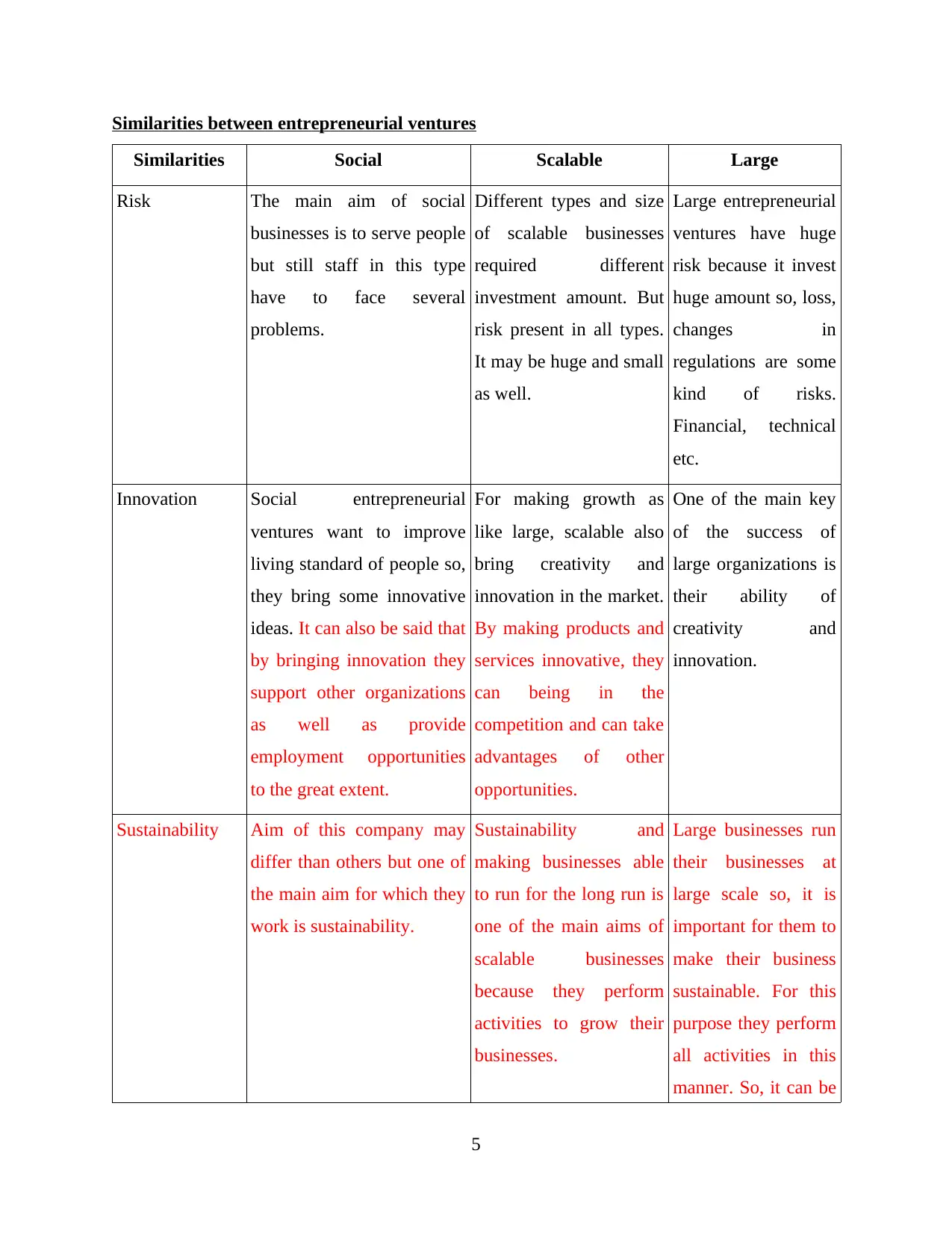
Similarities Social Scalable Large
Risk The main aim of social
businesses is to serve people
but still staff in this type
have to face several
problems.
Different types and size
of scalable businesses
required different
investment amount. But
risk present in all types.
It may be huge and small
as well.
Large entrepreneurial
ventures have huge
risk because it invest
huge amount so, loss,
changes in
regulations are some
kind of risks.
Financial, technical
etc.
Innovation Social entrepreneurial
ventures want to improve
living standard of people so,
they bring some innovative
ideas. It can also be said that
by bringing innovation they
support other organizations
as well as provide
employment opportunities
to the great extent.
For making growth as
like large, scalable also
bring creativity and
innovation in the market.
By making products and
services innovative, they
can being in the
competition and can take
advantages of other
opportunities.
One of the main key
of the success of
large organizations is
their ability of
creativity and
innovation.
Sustainability Aim of this company may
differ than others but one of
the main aim for which they
work is sustainability.
Sustainability and
making businesses able
to run for the long run is
one of the main aims of
scalable businesses
because they perform
activities to grow their
businesses.
Large businesses run
their businesses at
large scale so, it is
important for them to
make their business
sustainable. For this
purpose they perform
all activities in this
manner. So, it can be
5
Similarities Social Scalable Large
Risk The main aim of social
businesses is to serve people
but still staff in this type
have to face several
problems.
Different types and size
of scalable businesses
required different
investment amount. But
risk present in all types.
It may be huge and small
as well.
Large entrepreneurial
ventures have huge
risk because it invest
huge amount so, loss,
changes in
regulations are some
kind of risks.
Financial, technical
etc.
Innovation Social entrepreneurial
ventures want to improve
living standard of people so,
they bring some innovative
ideas. It can also be said that
by bringing innovation they
support other organizations
as well as provide
employment opportunities
to the great extent.
For making growth as
like large, scalable also
bring creativity and
innovation in the market.
By making products and
services innovative, they
can being in the
competition and can take
advantages of other
opportunities.
One of the main key
of the success of
large organizations is
their ability of
creativity and
innovation.
Sustainability Aim of this company may
differ than others but one of
the main aim for which they
work is sustainability.
Sustainability and
making businesses able
to run for the long run is
one of the main aims of
scalable businesses
because they perform
activities to grow their
businesses.
Large businesses run
their businesses at
large scale so, it is
important for them to
make their business
sustainable. For this
purpose they perform
all activities in this
manner. So, it can be
5
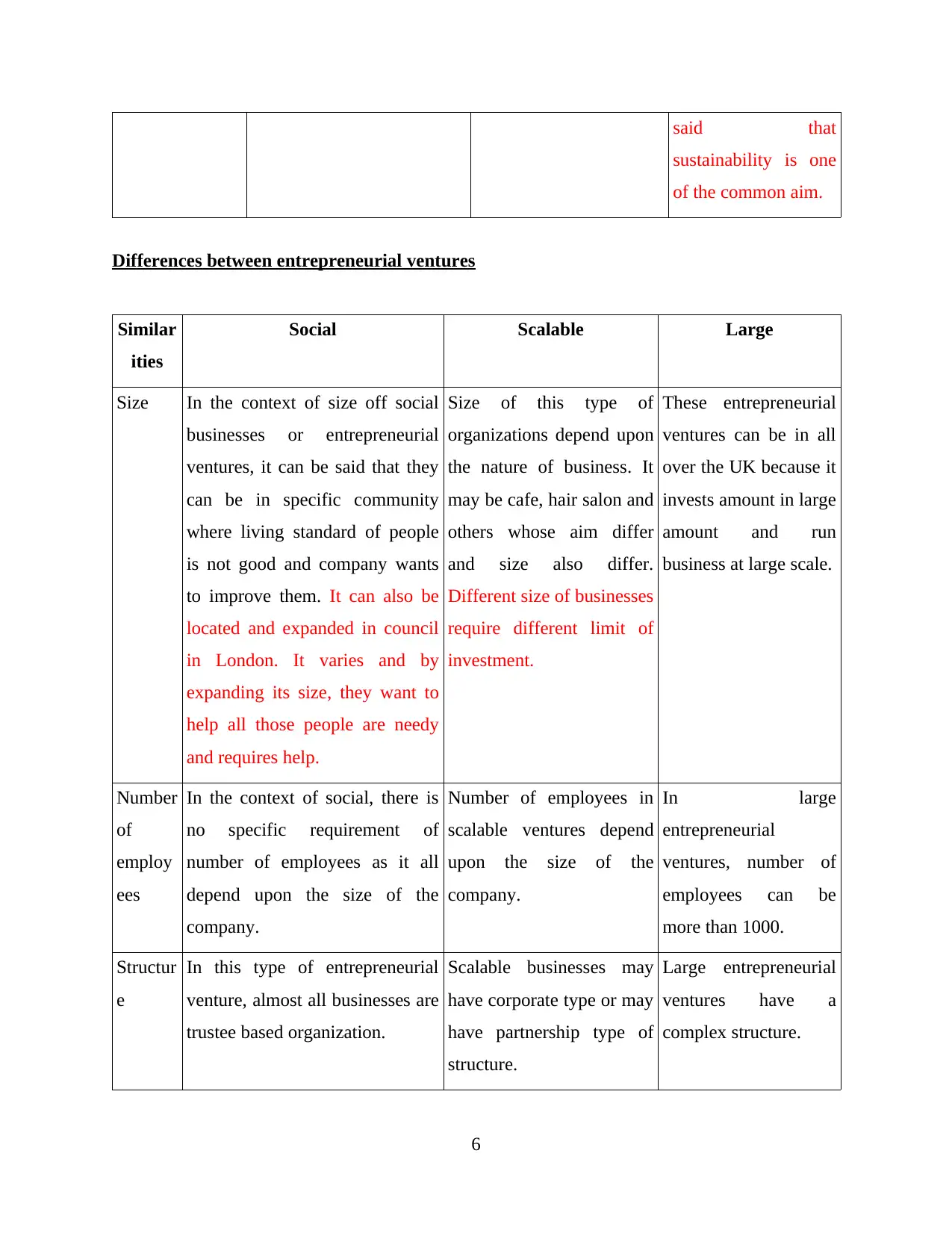
said that
sustainability is one
of the common aim.
Differences between entrepreneurial ventures
Similar
ities
Social Scalable Large
Size In the context of size off social
businesses or entrepreneurial
ventures, it can be said that they
can be in specific community
where living standard of people
is not good and company wants
to improve them. It can also be
located and expanded in council
in London. It varies and by
expanding its size, they want to
help all those people are needy
and requires help.
Size of this type of
organizations depend upon
the nature of business. It
may be cafe, hair salon and
others whose aim differ
and size also differ.
Different size of businesses
require different limit of
investment.
These entrepreneurial
ventures can be in all
over the UK because it
invests amount in large
amount and run
business at large scale.
Number
of
employ
ees
In the context of social, there is
no specific requirement of
number of employees as it all
depend upon the size of the
company.
Number of employees in
scalable ventures depend
upon the size of the
company.
In large
entrepreneurial
ventures, number of
employees can be
more than 1000.
Structur
e
In this type of entrepreneurial
venture, almost all businesses are
trustee based organization.
Scalable businesses may
have corporate type or may
have partnership type of
structure.
Large entrepreneurial
ventures have a
complex structure.
6
sustainability is one
of the common aim.
Differences between entrepreneurial ventures
Similar
ities
Social Scalable Large
Size In the context of size off social
businesses or entrepreneurial
ventures, it can be said that they
can be in specific community
where living standard of people
is not good and company wants
to improve them. It can also be
located and expanded in council
in London. It varies and by
expanding its size, they want to
help all those people are needy
and requires help.
Size of this type of
organizations depend upon
the nature of business. It
may be cafe, hair salon and
others whose aim differ
and size also differ.
Different size of businesses
require different limit of
investment.
These entrepreneurial
ventures can be in all
over the UK because it
invests amount in large
amount and run
business at large scale.
Number
of
employ
ees
In the context of social, there is
no specific requirement of
number of employees as it all
depend upon the size of the
company.
Number of employees in
scalable ventures depend
upon the size of the
company.
In large
entrepreneurial
ventures, number of
employees can be
more than 1000.
Structur
e
In this type of entrepreneurial
venture, almost all businesses are
trustee based organization.
Scalable businesses may
have corporate type or may
have partnership type of
structure.
Large entrepreneurial
ventures have a
complex structure.
6
⊘ This is a preview!⊘
Do you want full access?
Subscribe today to unlock all pages.
Trusted by 1+ million students worldwide
P3 Relevant data and statistics which shows how small and micro businesses impact on the
economy
Micro business: Micro businesses refers those businesses who run at small scale or it can be
said that those businesses who operate with fewer than 10 people and also require small amount
of capital (Macasaet and et.al., 2019).
Small business: Small businesses are those who has turnover of up to the approximate £6.5
Million and does not have more than 50 employees. It can be said that they are limited in the size
as well as revenue (Burns and Dewhurst, 2016).
Contribution of small businesses in UK economy
As per the data, it is analysed that approximate 99% of private businesses of UK among
5.9 million were small and medium size in the year of 2019. Small businesses are known as
important businesses or crucial to the UK's economy. Their contribution in improving economy
is not stable as it is increasing.
7
economy
Micro business: Micro businesses refers those businesses who run at small scale or it can be
said that those businesses who operate with fewer than 10 people and also require small amount
of capital (Macasaet and et.al., 2019).
Small business: Small businesses are those who has turnover of up to the approximate £6.5
Million and does not have more than 50 employees. It can be said that they are limited in the size
as well as revenue (Burns and Dewhurst, 2016).
Contribution of small businesses in UK economy
As per the data, it is analysed that approximate 99% of private businesses of UK among
5.9 million were small and medium size in the year of 2019. Small businesses are known as
important businesses or crucial to the UK's economy. Their contribution in improving economy
is not stable as it is increasing.
7
Paraphrase This Document
Need a fresh take? Get an instant paraphrase of this document with our AI Paraphraser
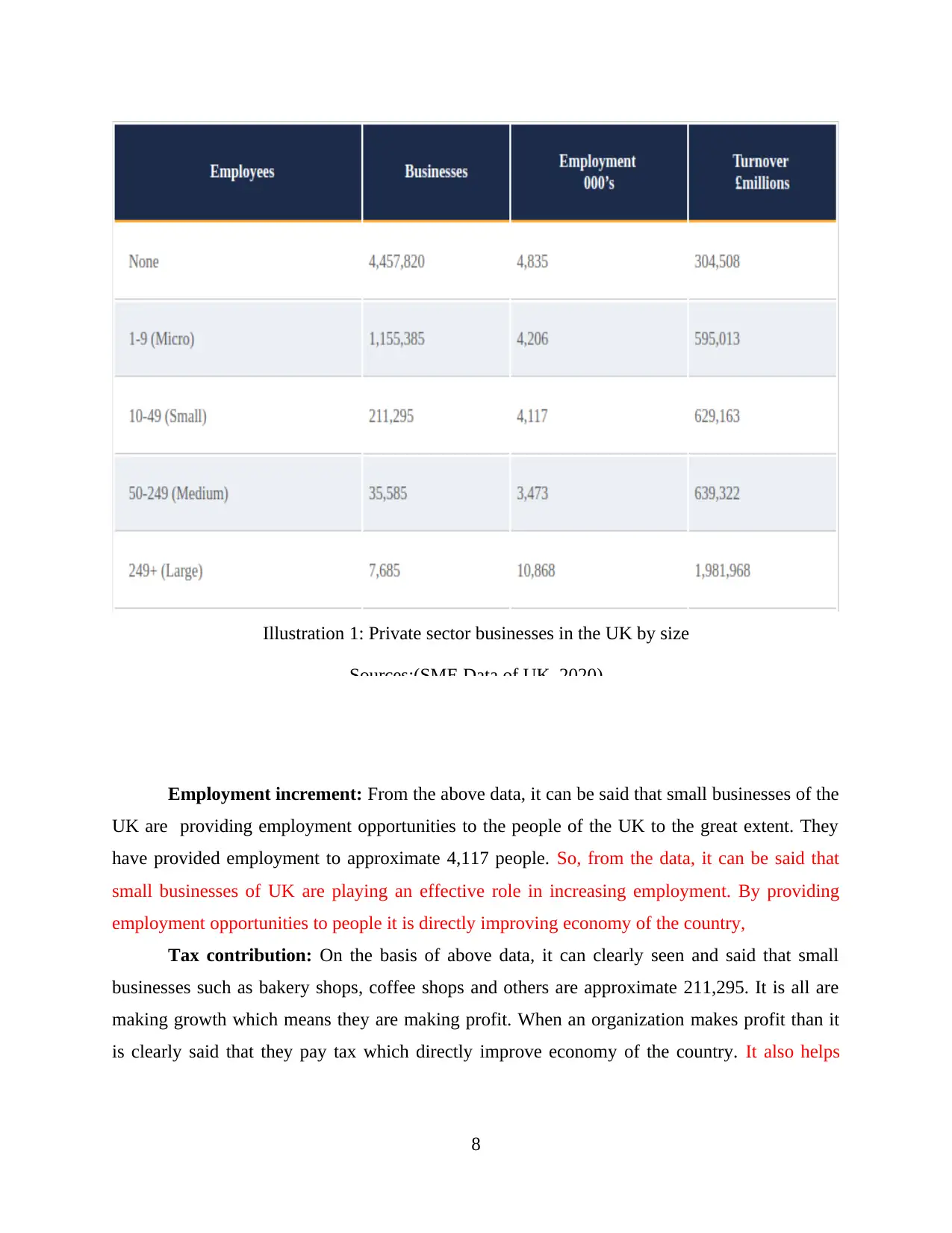
Employment increment: From the above data, it can be said that small businesses of the
UK are providing employment opportunities to the people of the UK to the great extent. They
have provided employment to approximate 4,117 people. So, from the data, it can be said that
small businesses of UK are playing an effective role in increasing employment. By providing
employment opportunities to people it is directly improving economy of the country,
Tax contribution: On the basis of above data, it can clearly seen and said that small
businesses such as bakery shops, coffee shops and others are approximate 211,295. It is all are
making growth which means they are making profit. When an organization makes profit than it
is clearly said that they pay tax which directly improve economy of the country. It also helps
8
Illustration 1: Private sector businesses in the UK by size
Sources:(SME Data of UK. 2020)
UK are providing employment opportunities to the people of the UK to the great extent. They
have provided employment to approximate 4,117 people. So, from the data, it can be said that
small businesses of UK are playing an effective role in increasing employment. By providing
employment opportunities to people it is directly improving economy of the country,
Tax contribution: On the basis of above data, it can clearly seen and said that small
businesses such as bakery shops, coffee shops and others are approximate 211,295. It is all are
making growth which means they are making profit. When an organization makes profit than it
is clearly said that they pay tax which directly improve economy of the country. It also helps
8
Illustration 1: Private sector businesses in the UK by size
Sources:(SME Data of UK. 2020)
vulnerable people directly because this tax is being used for emergency uses and other main
important function which help all people of the country.
Contribution of micro businesses in UK economy
Innovation: In the context of micro businesses it can be said that they are mainly known
for their contribution in improving UK economy. In addition, it is stated that micro businesses of
the UK provide the economy with a healthy supply of new skills, creativity and ideas as well as
make marketplace dynamic. It is one of the main roles of micro businesses for which they are
known. By bringing innovation in the market they are not only improving their productivity but
also helping other companies in solving problems and making their product innovative.
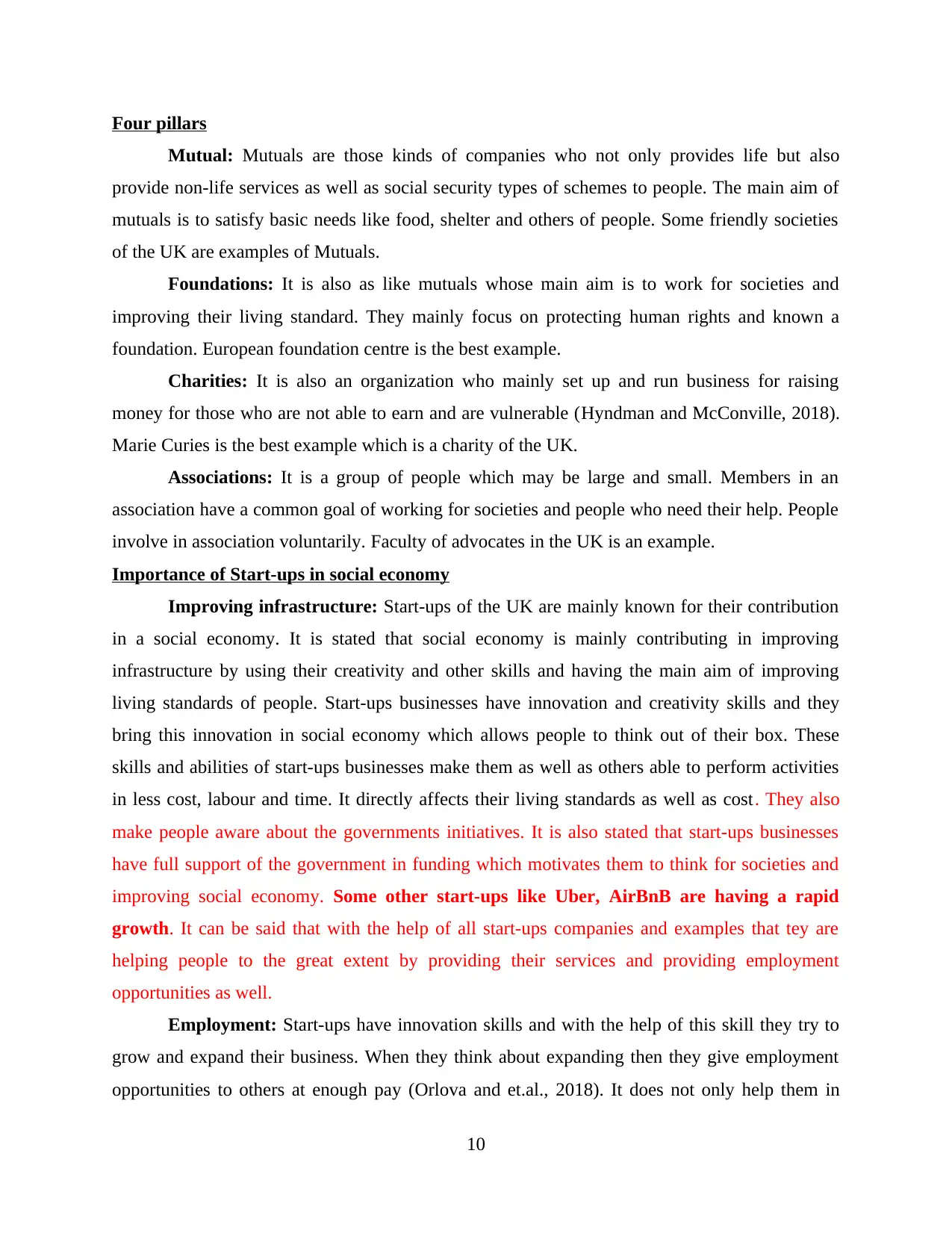
Revenue Generation: From the above data, it can be said that in the UK total micro
businesses are 5,613 which are providing employment to approximate 9,041 people. Al these
micro businesses of the UK are generating approximate £900 Billion turnover. It can be said that
it is generating total 22% revenue. From this data it can clearly be said that this increasing
number of micro businesses are having great positive impact on the UK economy.
P4 Importance of small businesses and start-ups to the growth of the social economy
Social economy: Social economy is a branch of economy whose focus and responsibility
is to improve relationship between economy and social behaviour. It shares common values as
like democratic governance (Waters-Lynch and Potts, 2017). This type of economy
organizations are being divided into several parts as per their size.
9
Illustration 2: Contribution of Micro businesses
Sources: (Businesses of the UK Statistics. 2019)
important function which help all people of the country.
Contribution of micro businesses in UK economy
Innovation: In the context of micro businesses it can be said that they are mainly known
for their contribution in improving UK economy. In addition, it is stated that micro businesses of
the UK provide the economy with a healthy supply of new skills, creativity and ideas as well as
make marketplace dynamic. It is one of the main roles of micro businesses for which they are
known. By bringing innovation in the market they are not only improving their productivity but
also helping other companies in solving problems and making their product innovative.
Revenue Generation: From the above data, it can be said that in the UK total micro
businesses are 5,613 which are providing employment to approximate 9,041 people. Al these
micro businesses of the UK are generating approximate £900 Billion turnover. It can be said that
it is generating total 22% revenue. From this data it can clearly be said that this increasing
number of micro businesses are having great positive impact on the UK economy.
P4 Importance of small businesses and start-ups to the growth of the social economy
Social economy: Social economy is a branch of economy whose focus and responsibility
is to improve relationship between economy and social behaviour. It shares common values as
like democratic governance (Waters-Lynch and Potts, 2017). This type of economy
organizations are being divided into several parts as per their size.
9
Illustration 2: Contribution of Micro businesses
Sources: (Businesses of the UK Statistics. 2019)
⊘ This is a preview!⊘
Do you want full access?
Subscribe today to unlock all pages.
Trusted by 1+ million students worldwide
Four pillars
Mutual: Mutuals are those kinds of companies who not only provides life but also
provide non-life services as well as social security types of schemes to people. The main aim of
mutuals is to satisfy basic needs like food, shelter and others of people. Some friendly societies
of the UK are examples of Mutuals.
Foundations: It is also as like mutuals whose main aim is to work for societies and
improving their living standard. They mainly focus on protecting human rights and known a
foundation. European foundation centre is the best example.
Charities: It is also an organization who mainly set up and run business for raising
money for those who are not able to earn and are vulnerable (Hyndman and McConville, 2018).
Marie Curies is the best example which is a charity of the UK.
Associations: It is a group of people which may be large and small. Members in an
association have a common goal of working for societies and people who need their help. People
involve in association voluntarily. Faculty of advocates in the UK is an example.
Importance of Start-ups in social economy
Improving infrastructure: Start-ups of the UK are mainly known for their contribution
in a social economy. It is stated that social economy is mainly contributing in improving
infrastructure by using their creativity and other skills and having the main aim of improving
living standards of people. Start-ups businesses have innovation and creativity skills and they
bring this innovation in social economy which allows people to think out of their box. These
skills and abilities of start-ups businesses make them as well as others able to perform activities
in less cost, labour and time. It directly affects their living standards as well as cost. They also
make people aware about the governments initiatives. It is also stated that start-ups businesses
have full support of the government in funding which motivates them to think for societies and
improving social economy. Some other start-ups like Uber, AirBnB are having a rapid
growth. It can be said that with the help of all start-ups companies and examples that tey are
helping people to the great extent by providing their services and providing employment
opportunities as well.
Employment: Start-ups have innovation skills and with the help of this skill they try to
grow and expand their business. When they think about expanding then they give employment
opportunities to others at enough pay (Orlova and et.al., 2018). It does not only help them in
10
Mutual: Mutuals are those kinds of companies who not only provides life but also
provide non-life services as well as social security types of schemes to people. The main aim of
mutuals is to satisfy basic needs like food, shelter and others of people. Some friendly societies
of the UK are examples of Mutuals.
Foundations: It is also as like mutuals whose main aim is to work for societies and
improving their living standard. They mainly focus on protecting human rights and known a
foundation. European foundation centre is the best example.
Charities: It is also an organization who mainly set up and run business for raising
money for those who are not able to earn and are vulnerable (Hyndman and McConville, 2018).
Marie Curies is the best example which is a charity of the UK.
Associations: It is a group of people which may be large and small. Members in an
association have a common goal of working for societies and people who need their help. People
involve in association voluntarily. Faculty of advocates in the UK is an example.
Importance of Start-ups in social economy
Improving infrastructure: Start-ups of the UK are mainly known for their contribution
in a social economy. It is stated that social economy is mainly contributing in improving
infrastructure by using their creativity and other skills and having the main aim of improving
living standards of people. Start-ups businesses have innovation and creativity skills and they
bring this innovation in social economy which allows people to think out of their box. These
skills and abilities of start-ups businesses make them as well as others able to perform activities
in less cost, labour and time. It directly affects their living standards as well as cost. They also
make people aware about the governments initiatives. It is also stated that start-ups businesses
have full support of the government in funding which motivates them to think for societies and
improving social economy. Some other start-ups like Uber, AirBnB are having a rapid
growth. It can be said that with the help of all start-ups companies and examples that tey are
helping people to the great extent by providing their services and providing employment
opportunities as well.
Employment: Start-ups have innovation skills and with the help of this skill they try to
grow and expand their business. When they think about expanding then they give employment
opportunities to others at enough pay (Orlova and et.al., 2018). It does not only help them in
10
Paraphrase This Document
Need a fresh take? Get an instant paraphrase of this document with our AI Paraphraser
growing and developing their businesses but also help in improving social economy by
increasing income of people. There are some examples of companies who are runnig their
businesses at large scale, but they have started their business at small level initially as a start-ups
such as Microsoft, Apple. So, it can be said that start-ups are mainly known for its contribution
and providing employment opportunities.
Importance of Small business in social economy
As like start-ups, small companies are also playing a big role in improving social
economy such as:
Improving lifestyles: One of the main aim of social businesses of the UK is to satisfy
needs of people and improving their living standards. Small businesses are famous and are
increasing because it brings new ideas in the market which allows people to improve their living
standards by using unique ways of performing activities. For example: There are some data
which shows that small businesses have contributed in improving living standards of farmers by
bringing out new ideas and innovation. It is also stated that pesticides, irrigation facilities and
other ways by which farmers can improve their ways of performance are contributions of small
businesses (Role of Small Businesses In the Agricultural Sector, 2014.) Improved life style of
people increase their confidence and motivate them to work something unique than others and it
brings innovation in the market.
Protection of environment: It is stated that small businesses are protecting environment
to the great extent. As with the help of their creativity and innovative skills they started to use
paper shipping bags instead of using plastic bags. Plastic bags can harm to the environment to
the great extent and this initiative has made several changes (Ribeiro-Soriano, 2017).
P5 Skills of a successful entrepreneur which differentiate them from business manager
Entrepreneur is an individual who sets up and run a business as like other business
manager, but they have some skills and characteristic traits which makes them differ than
business manager. Some skills which a successful entrepreneur have and which differ them from
other business manager include:
Willingness to learn:: Willingness to learn all the time whenever they need it is one of
the main skill of a successful entrepreneur. A successful entrepreneur and an individual who has
willingness to learn not only from their seniors but also from their employees and juniors if
11
increasing income of people. There are some examples of companies who are runnig their
businesses at large scale, but they have started their business at small level initially as a start-ups
such as Microsoft, Apple. So, it can be said that start-ups are mainly known for its contribution
and providing employment opportunities.
Importance of Small business in social economy
As like start-ups, small companies are also playing a big role in improving social
economy such as:
Improving lifestyles: One of the main aim of social businesses of the UK is to satisfy
needs of people and improving their living standards. Small businesses are famous and are
increasing because it brings new ideas in the market which allows people to improve their living
standards by using unique ways of performing activities. For example: There are some data
which shows that small businesses have contributed in improving living standards of farmers by
bringing out new ideas and innovation. It is also stated that pesticides, irrigation facilities and
other ways by which farmers can improve their ways of performance are contributions of small
businesses (Role of Small Businesses In the Agricultural Sector, 2014.) Improved life style of
people increase their confidence and motivate them to work something unique than others and it
brings innovation in the market.
Protection of environment: It is stated that small businesses are protecting environment
to the great extent. As with the help of their creativity and innovative skills they started to use
paper shipping bags instead of using plastic bags. Plastic bags can harm to the environment to
the great extent and this initiative has made several changes (Ribeiro-Soriano, 2017).
P5 Skills of a successful entrepreneur which differentiate them from business manager
Entrepreneur is an individual who sets up and run a business as like other business
manager, but they have some skills and characteristic traits which makes them differ than
business manager. Some skills which a successful entrepreneur have and which differ them from
other business manager include:
Willingness to learn:: Willingness to learn all the time whenever they need it is one of
the main skill of a successful entrepreneur. A successful entrepreneur and an individual who has
willingness to learn not only from their seniors but also from their employees and juniors if
11
required, makes them able to perform activities in a better way and it also increases their
knowledge (Odewale and et.al., 2019).
Leadership: Leadership refers an ability and skill to work with employees and others by
guiding them in an efficient manner. A successful entrepreneur is not one who always focus on
developing their skills but it is one who think about others with whom they work. So, an ability
to guide others and willingness to develop others differ a successful entrepreneur than a business
manager.
Motivation: Motivation means an ability which elicit a desired behaviour. Motivation is
an important factor which pushes people to do something. A successful entrepreneur have
motivation skills which not only pushed him but also they try to push all members with whom
they work in order to accomplish goals. Self motivation makes an individual able to perform any
kind of work in a very effective manner.
Independence: Independence or having an ability to work and perform activities at their
own or by taking help of anyone. A successful entrepreneur is one who has skill and ability to
solve any type of problem and ways to perform activities without making themselves dependent
on others.
Communication: An effective communication skill is not limited to interact with others
but it also includes an active listening and having skills of influencing others by using such kind
of effective words in communication. An effective communication and the way of talking makes
an entrepreneur successful as well as differ than other business manager (Liang, 2019).
Creativity: Creativity is also considered one of the main skill and ability of doing
something new and different from others. An individual who has a creative mind and skills of
making something unique whether they are products and services and way of performing
activities. This is the main skill which makes an entrepreneur success as they have ability to
perform activities in a different and unique ways which can save their time, cost as well as
labour. In less time, cost and labour they can perform activities more effectively.
So, from the above discussed skills, it can be said that why a successful entrepreneur is
differed than other business manager. For more understanding this, it can be understood with
some differences such as:
Skills Entrepreneur Business manager
12
knowledge (Odewale and et.al., 2019).
Leadership: Leadership refers an ability and skill to work with employees and others by
guiding them in an efficient manner. A successful entrepreneur is not one who always focus on
developing their skills but it is one who think about others with whom they work. So, an ability
to guide others and willingness to develop others differ a successful entrepreneur than a business
manager.
Motivation: Motivation means an ability which elicit a desired behaviour. Motivation is
an important factor which pushes people to do something. A successful entrepreneur have
motivation skills which not only pushed him but also they try to push all members with whom
they work in order to accomplish goals. Self motivation makes an individual able to perform any
kind of work in a very effective manner.
Independence: Independence or having an ability to work and perform activities at their
own or by taking help of anyone. A successful entrepreneur is one who has skill and ability to
solve any type of problem and ways to perform activities without making themselves dependent
on others.
Communication: An effective communication skill is not limited to interact with others
but it also includes an active listening and having skills of influencing others by using such kind
of effective words in communication. An effective communication and the way of talking makes
an entrepreneur successful as well as differ than other business manager (Liang, 2019).
Creativity: Creativity is also considered one of the main skill and ability of doing
something new and different from others. An individual who has a creative mind and skills of
making something unique whether they are products and services and way of performing
activities. This is the main skill which makes an entrepreneur success as they have ability to
perform activities in a different and unique ways which can save their time, cost as well as
labour. In less time, cost and labour they can perform activities more effectively.
So, from the above discussed skills, it can be said that why a successful entrepreneur is
differed than other business manager. For more understanding this, it can be understood with
some differences such as:
Skills Entrepreneur Business manager
12
⊘ This is a preview!⊘
Do you want full access?
Subscribe today to unlock all pages.
Trusted by 1+ million students worldwide

1 out of 18


Related Documents


Your All-in-One AI-Powered Toolkit for Academic Success.
+13062052269
info@desklib.com
Available 24*7 on WhatsApp / Email
![[object Object]](/_next/static/media/star-bottom.7253800d.svg)
Unlock your academic potential
Copyright © 2020–2026 A2Z Services. All Rights Reserved. Developed and managed by ZUCOL.