Detailed Risk Management Analysis Report for Smar Tech Simulation
VerifiedAdded on 2023/01/04
|20
|3669
|46
Report
AI Summary
This report presents a comprehensive analysis of risk management procedures, specifically within the context of a Smar Tech simulation. The introduction establishes the framework for analyzing risk management standards, their importance, and key components. The report then delves into a stakeholder analysis, industry analysis, and the strengths and weaknesses of existing arrangements. It identifies critical success factors and develops a communication plan. The core of the report focuses on the Smar Tech simulation, including a risk scope statement, the identification of potential risks, and the application of tools and techniques for risk generation. The report assesses the likelihood, impact, and consequences of identified risks, prioritizing them for treatment. It culminates in a detailed risk treatment and action plan, including implementation strategies and communication protocols. The report also monitors and evaluates the outcomes of the risk management process. The report provides a complete picture of the risk management process in the Smar Tech simulation, highlighting key elements of the process.
Manage Risk

Paraphrase This Document
Need a fresh take? Get an instant paraphrase of this document with our AI Paraphraser
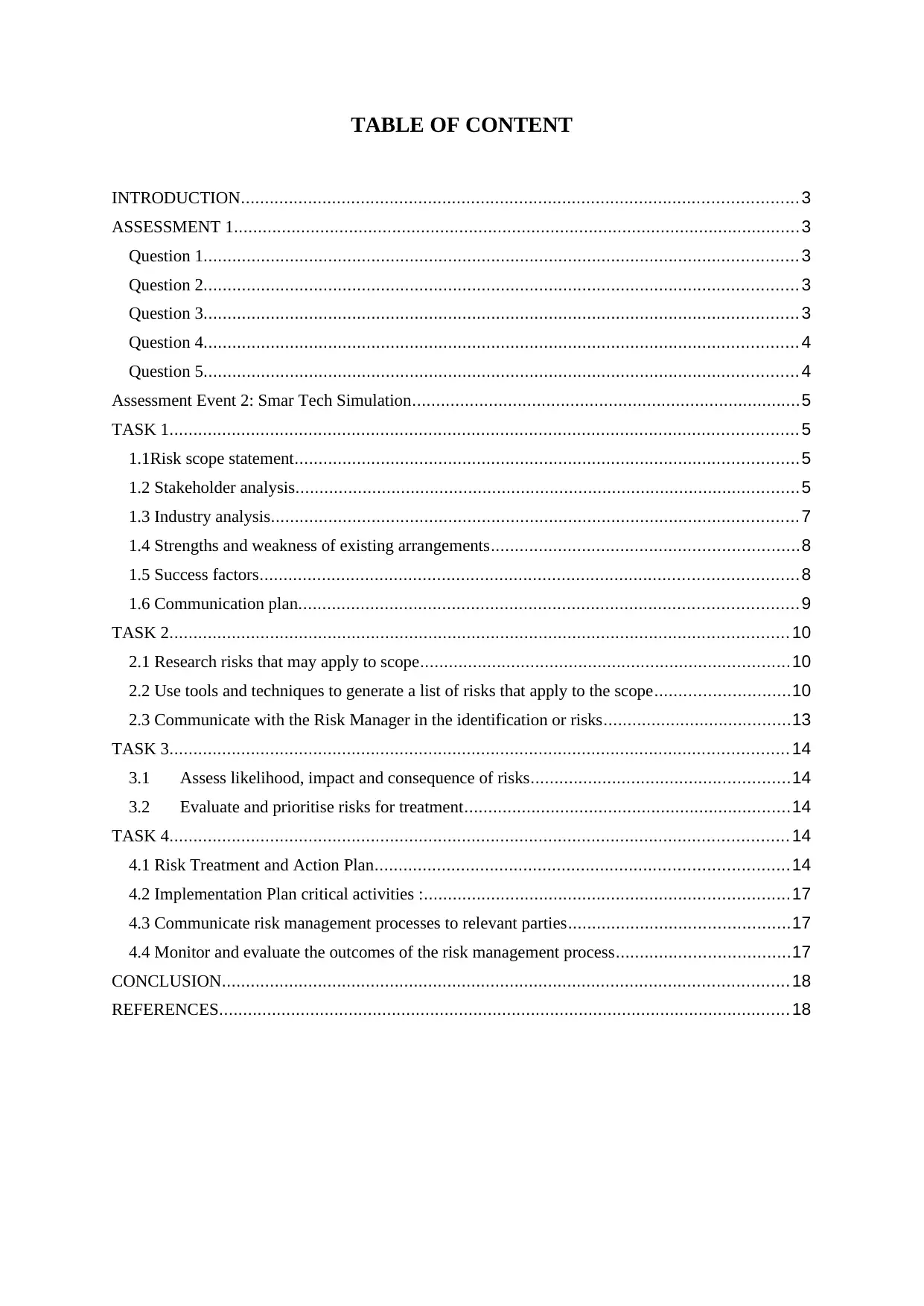
TABLE OF CONTENT
INTRODUCTION.................................................................................................................... 3
ASSESSMENT 1......................................................................................................................3
Question 1............................................................................................................................ 3
Question 2............................................................................................................................ 3
Question 3............................................................................................................................ 3
Question 4............................................................................................................................ 4
Question 5............................................................................................................................ 4
Assessment Event 2: Smar Tech Simulation.................................................................................5
TASK 1................................................................................................................................... 5
1.1Risk scope statement.........................................................................................................5
1.2 Stakeholder analysis.........................................................................................................5
1.3 Industry analysis.............................................................................................................. 7
1.4 Strengths and weakness of existing arrangements................................................................8
1.5 Success factors................................................................................................................8
1.6 Communication plan........................................................................................................9
TASK 2................................................................................................................................. 10
2.1 Research risks that may apply to scope.............................................................................10
2.2 Use tools and techniques to generate a list of risks that apply to the scope............................10
2.3 Communicate with the Risk Manager in the identification or risks.......................................13
TASK 3................................................................................................................................. 14
3.1 Assess likelihood, impact and consequence of risks......................................................14
3.2 Evaluate and prioritise risks for treatment....................................................................14
TASK 4................................................................................................................................. 14
4.1 Risk Treatment and Action Plan......................................................................................14
4.2 Implementation Plan critical activities :............................................................................17
4.3 Communicate risk management processes to relevant parties..............................................17
4.4 Monitor and evaluate the outcomes of the risk management process....................................17
CONCLUSION...................................................................................................................... 18
REFERENCES....................................................................................................................... 18
INTRODUCTION.................................................................................................................... 3
ASSESSMENT 1......................................................................................................................3
Question 1............................................................................................................................ 3
Question 2............................................................................................................................ 3
Question 3............................................................................................................................ 3
Question 4............................................................................................................................ 4
Question 5............................................................................................................................ 4
Assessment Event 2: Smar Tech Simulation.................................................................................5
TASK 1................................................................................................................................... 5
1.1Risk scope statement.........................................................................................................5
1.2 Stakeholder analysis.........................................................................................................5
1.3 Industry analysis.............................................................................................................. 7
1.4 Strengths and weakness of existing arrangements................................................................8
1.5 Success factors................................................................................................................8
1.6 Communication plan........................................................................................................9
TASK 2................................................................................................................................. 10
2.1 Research risks that may apply to scope.............................................................................10
2.2 Use tools and techniques to generate a list of risks that apply to the scope............................10
2.3 Communicate with the Risk Manager in the identification or risks.......................................13
TASK 3................................................................................................................................. 14
3.1 Assess likelihood, impact and consequence of risks......................................................14
3.2 Evaluate and prioritise risks for treatment....................................................................14
TASK 4................................................................................................................................. 14
4.1 Risk Treatment and Action Plan......................................................................................14
4.2 Implementation Plan critical activities :............................................................................17
4.3 Communicate risk management processes to relevant parties..............................................17
4.4 Monitor and evaluate the outcomes of the risk management process....................................17
CONCLUSION...................................................................................................................... 18
REFERENCES....................................................................................................................... 18
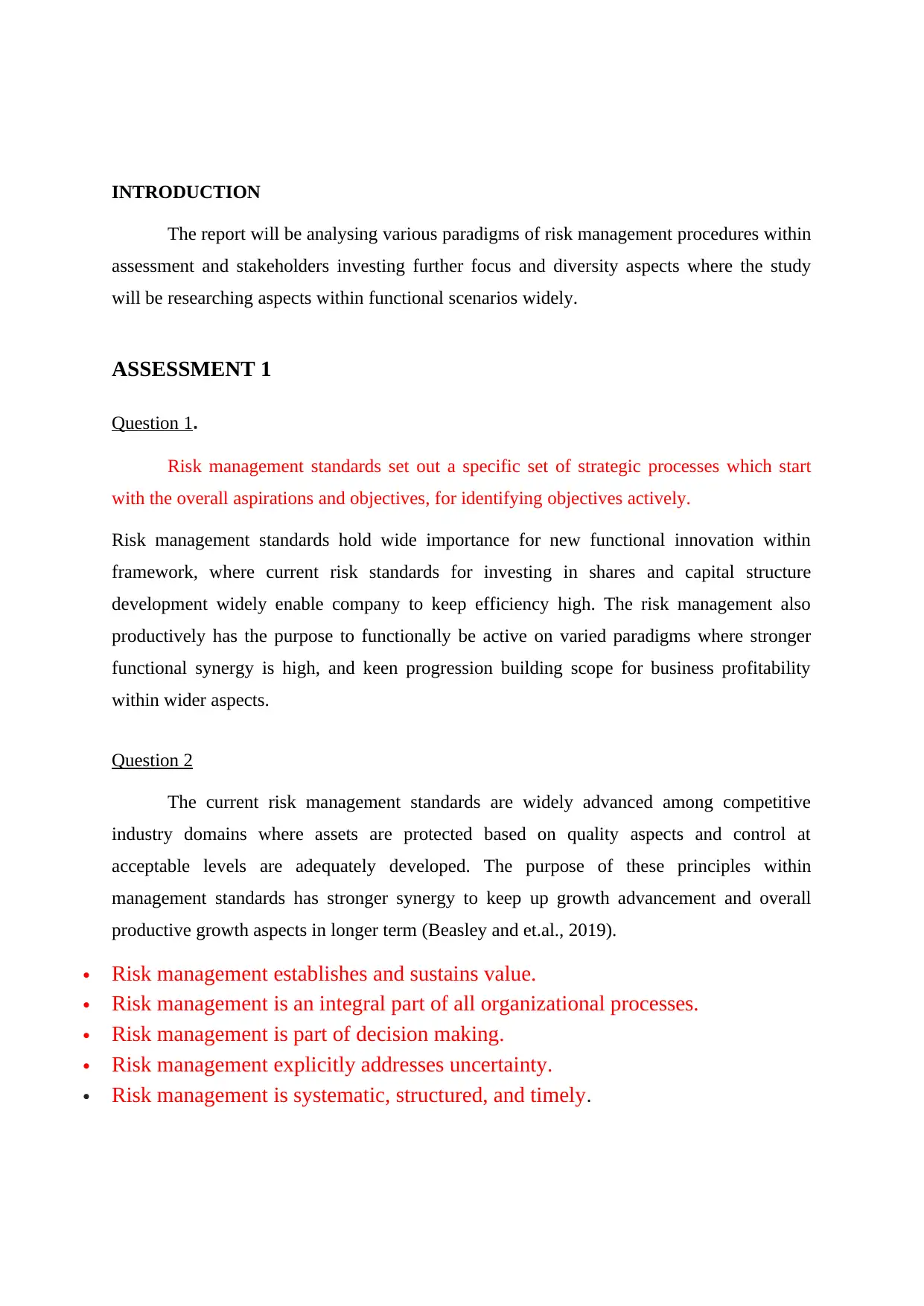
INTRODUCTION
The report will be analysing various paradigms of risk management procedures within
assessment and stakeholders investing further focus and diversity aspects where the study
will be researching aspects within functional scenarios widely.
ASSESSMENT 1
Question 1.
Risk management standards set out a specific set of strategic processes which start
with the overall aspirations and objectives, for identifying objectives actively.
Risk management standards hold wide importance for new functional innovation within
framework, where current risk standards for investing in shares and capital structure
development widely enable company to keep efficiency high. The risk management also
productively has the purpose to functionally be active on varied paradigms where stronger
functional synergy is high, and keen progression building scope for business profitability
within wider aspects.
Question 2
The current risk management standards are widely advanced among competitive
industry domains where assets are protected based on quality aspects and control at
acceptable levels are adequately developed. The purpose of these principles within
management standards has stronger synergy to keep up growth advancement and overall
productive growth aspects in longer term (Beasley and et.al., 2019).
Risk management establishes and sustains value.
Risk management is an integral part of all organizational processes.
Risk management is part of decision making.
Risk management explicitly addresses uncertainty.
Risk management is systematic, structured, and timely.
The report will be analysing various paradigms of risk management procedures within
assessment and stakeholders investing further focus and diversity aspects where the study
will be researching aspects within functional scenarios widely.
ASSESSMENT 1
Question 1.
Risk management standards set out a specific set of strategic processes which start
with the overall aspirations and objectives, for identifying objectives actively.
Risk management standards hold wide importance for new functional innovation within
framework, where current risk standards for investing in shares and capital structure
development widely enable company to keep efficiency high. The risk management also
productively has the purpose to functionally be active on varied paradigms where stronger
functional synergy is high, and keen progression building scope for business profitability
within wider aspects.
Question 2
The current risk management standards are widely advanced among competitive
industry domains where assets are protected based on quality aspects and control at
acceptable levels are adequately developed. The purpose of these principles within
management standards has stronger synergy to keep up growth advancement and overall
productive growth aspects in longer term (Beasley and et.al., 2019).
Risk management establishes and sustains value.
Risk management is an integral part of all organizational processes.
Risk management is part of decision making.
Risk management explicitly addresses uncertainty.
Risk management is systematic, structured, and timely.
⊘ This is a preview!⊘
Do you want full access?
Subscribe today to unlock all pages.

Trusted by 1+ million students worldwide
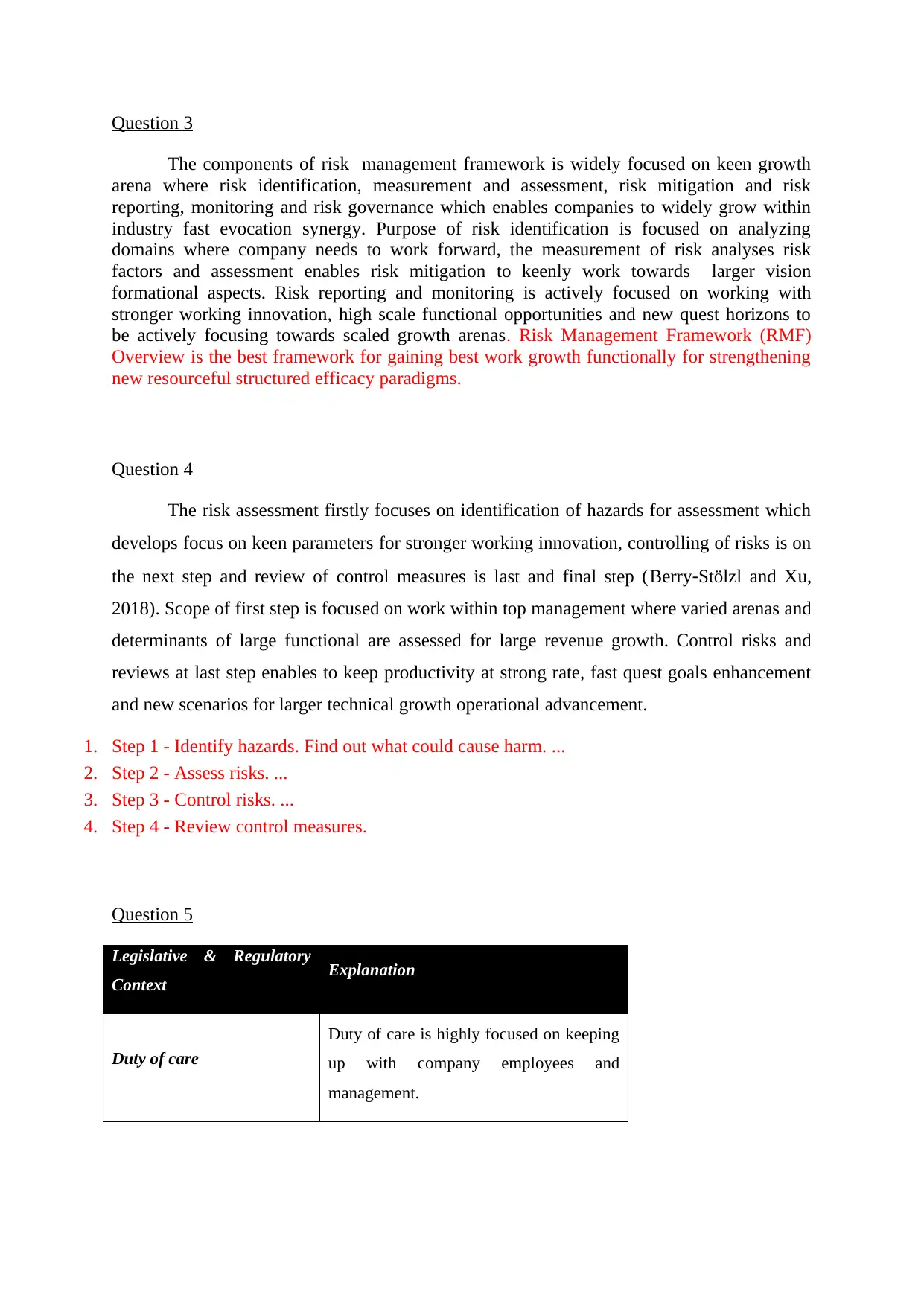
Question 3
The components of risk management framework is widely focused on keen growth
arena where risk identification, measurement and assessment, risk mitigation and risk
reporting, monitoring and risk governance which enables companies to widely grow within
industry fast evocation synergy. Purpose of risk identification is focused on analyzing
domains where company needs to work forward, the measurement of risk analyses risk
factors and assessment enables risk mitigation to keenly work towards larger vision
formational aspects. Risk reporting and monitoring is actively focused on working with
stronger working innovation, high scale functional opportunities and new quest horizons to
be actively focusing towards scaled growth arenas. Risk Management Framework (RMF)
Overview is the best framework for gaining best work growth functionally for strengthening
new resourceful structured efficacy paradigms.
Question 4
The risk assessment firstly focuses on identification of hazards for assessment which
develops focus on keen parameters for stronger working innovation, controlling of risks is on
the next step and review of control measures is last and final step (Berry‐Stölzl and Xu,
2018). Scope of first step is focused on work within top management where varied arenas and
determinants of large functional are assessed for large revenue growth. Control risks and
reviews at last step enables to keep productivity at strong rate, fast quest goals enhancement
and new scenarios for larger technical growth operational advancement.
1. Step 1 - Identify hazards. Find out what could cause harm. ...
2. Step 2 - Assess risks. ...
3. Step 3 - Control risks. ...
4. Step 4 - Review control measures.
Question 5
Legislative & Regulatory
Context Explanation
Duty of care
Duty of care is highly focused on keeping
up with company employees and
management.
The components of risk management framework is widely focused on keen growth
arena where risk identification, measurement and assessment, risk mitigation and risk
reporting, monitoring and risk governance which enables companies to widely grow within
industry fast evocation synergy. Purpose of risk identification is focused on analyzing
domains where company needs to work forward, the measurement of risk analyses risk
factors and assessment enables risk mitigation to keenly work towards larger vision
formational aspects. Risk reporting and monitoring is actively focused on working with
stronger working innovation, high scale functional opportunities and new quest horizons to
be actively focusing towards scaled growth arenas. Risk Management Framework (RMF)
Overview is the best framework for gaining best work growth functionally for strengthening
new resourceful structured efficacy paradigms.
Question 4
The risk assessment firstly focuses on identification of hazards for assessment which
develops focus on keen parameters for stronger working innovation, controlling of risks is on
the next step and review of control measures is last and final step (Berry‐Stölzl and Xu,
2018). Scope of first step is focused on work within top management where varied arenas and
determinants of large functional are assessed for large revenue growth. Control risks and
reviews at last step enables to keep productivity at strong rate, fast quest goals enhancement
and new scenarios for larger technical growth operational advancement.
1. Step 1 - Identify hazards. Find out what could cause harm. ...
2. Step 2 - Assess risks. ...
3. Step 3 - Control risks. ...
4. Step 4 - Review control measures.
Question 5
Legislative & Regulatory
Context Explanation
Duty of care
Duty of care is highly focused on keeping
up with company employees and
management.
Paraphrase This Document
Need a fresh take? Get an instant paraphrase of this document with our AI Paraphraser
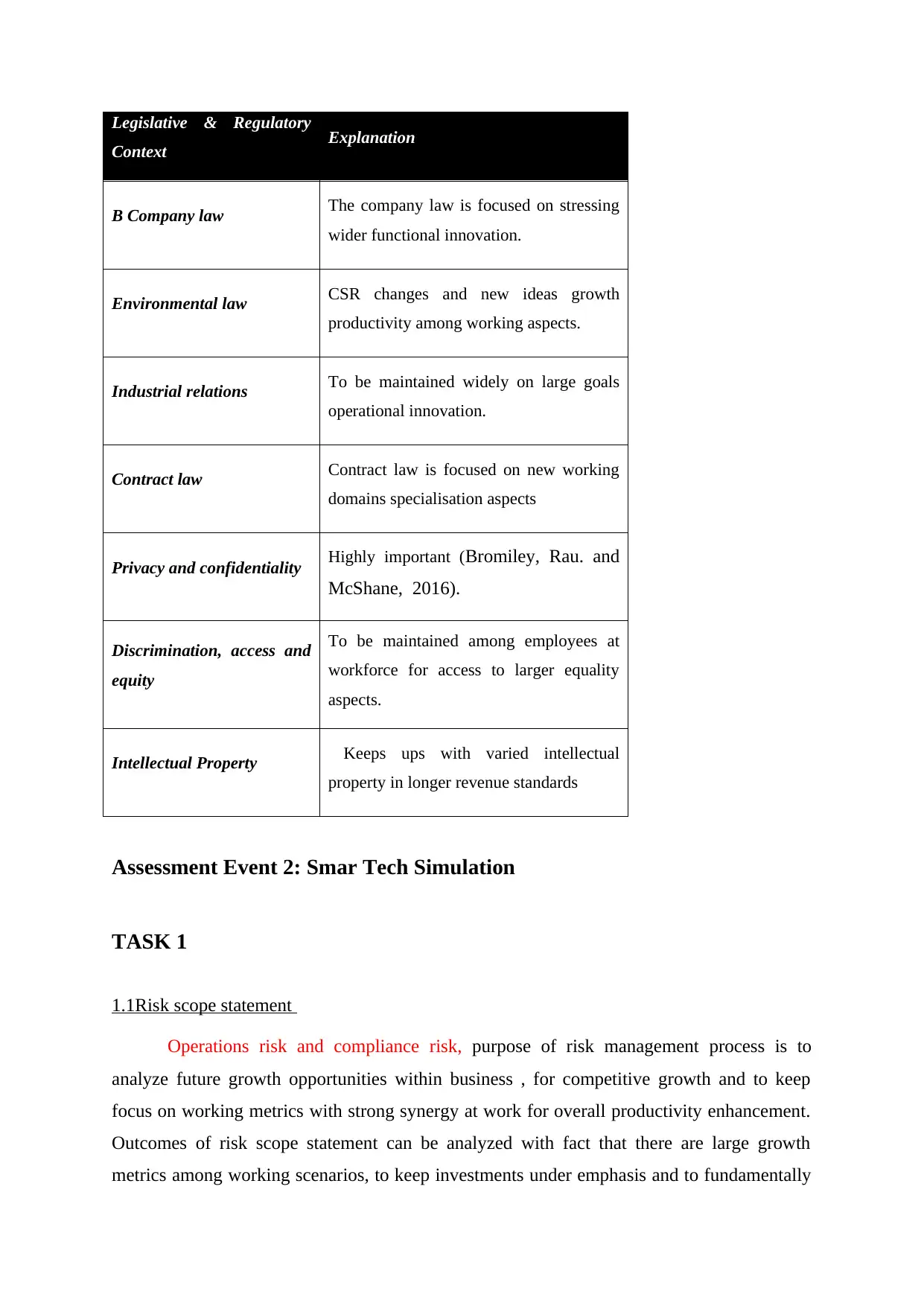
Legislative & Regulatory
Context Explanation
B Company law The company law is focused on stressing
wider functional innovation.
Environmental law CSR changes and new ideas growth
productivity among working aspects.
Industrial relations To be maintained widely on large goals
operational innovation.
Contract law Contract law is focused on new working
domains specialisation aspects
Privacy and confidentiality Highly important (Bromiley, Rau. and
McShane, 2016).
Discrimination, access and
equity
To be maintained among employees at
workforce for access to larger equality
aspects.
Intellectual Property Keeps ups with varied intellectual
property in longer revenue standards
Assessment Event 2: Smar Tech Simulation
TASK 1
1.1Risk scope statement
Operations risk and compliance risk, purpose of risk management process is to
analyze future growth opportunities within business , for competitive growth and to keep
focus on working metrics with strong synergy at work for overall productivity enhancement.
Outcomes of risk scope statement can be analyzed with fact that there are large growth
metrics among working scenarios, to keep investments under emphasis and to fundamentally
Context Explanation
B Company law The company law is focused on stressing
wider functional innovation.
Environmental law CSR changes and new ideas growth
productivity among working aspects.
Industrial relations To be maintained widely on large goals
operational innovation.
Contract law Contract law is focused on new working
domains specialisation aspects
Privacy and confidentiality Highly important (Bromiley, Rau. and
McShane, 2016).
Discrimination, access and
equity
To be maintained among employees at
workforce for access to larger equality
aspects.
Intellectual Property Keeps ups with varied intellectual
property in longer revenue standards
Assessment Event 2: Smar Tech Simulation
TASK 1
1.1Risk scope statement
Operations risk and compliance risk, purpose of risk management process is to
analyze future growth opportunities within business , for competitive growth and to keep
focus on working metrics with strong synergy at work for overall productivity enhancement.
Outcomes of risk scope statement can be analyzed with fact that there are large growth
metrics among working scenarios, to keep investments under emphasis and to fundamentally
grow on larger technical paradigms widely. The Technology research and development
department, HR department and new operations department have specific role to play widely
among working scenarios where the impact will be analyzed by focusing towards their active
role (Brustbauer, 2016).
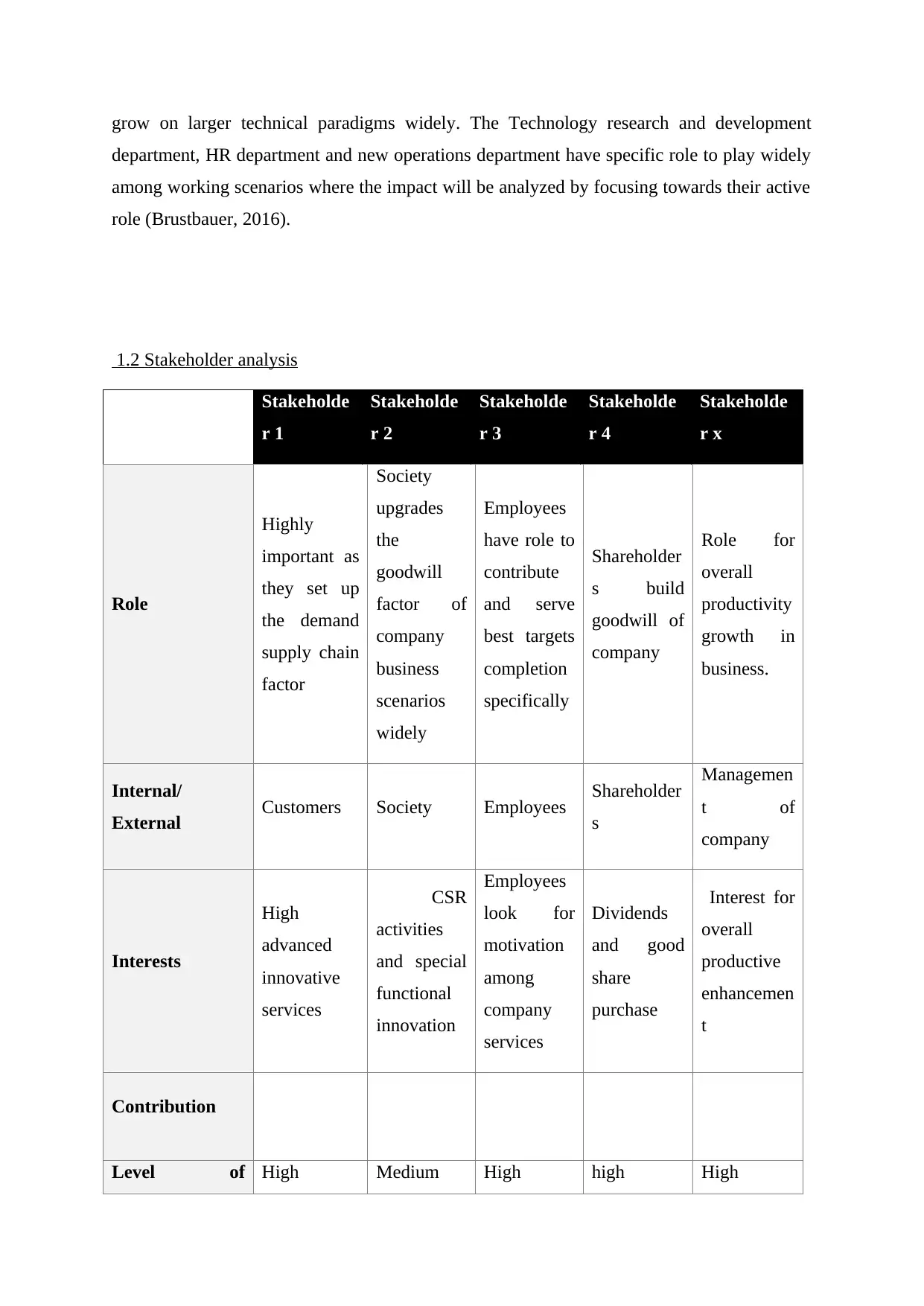
1.2 Stakeholder analysis
Stakeholde
r 1
Stakeholde
r 2
Stakeholde
r 3
Stakeholde
r 4
Stakeholde
r x
Role
Highly
important as
they set up
the demand
supply chain
factor
Society
upgrades
the
goodwill
factor of
company
business
scenarios
widely
Employees
have role to
contribute
and serve
best targets
completion
specifically
Shareholder
s build
goodwill of
company
Role for
overall
productivity
growth in
business.
Internal/
External Customers Society Employees Shareholder
s
Managemen
t of
company
Interests
High
advanced
innovative
services
CSR
activities
and special
functional
innovation
Employees
look for
motivation
among
company
services
Dividends
and good
share
purchase
Interest for
overall
productive
enhancemen
t
Contribution
Level of High Medium High high High
department, HR department and new operations department have specific role to play widely
among working scenarios where the impact will be analyzed by focusing towards their active
role (Brustbauer, 2016).
1.2 Stakeholder analysis
Stakeholde
r 1
Stakeholde
r 2
Stakeholde
r 3
Stakeholde
r 4
Stakeholde
r x
Role
Highly
important as
they set up
the demand
supply chain
factor
Society
upgrades
the
goodwill
factor of
company
business
scenarios
widely
Employees
have role to
contribute
and serve
best targets
completion
specifically
Shareholder
s build
goodwill of
company
Role for
overall
productivity
growth in
business.
Internal/
External Customers Society Employees Shareholder
s
Managemen
t of
company
Interests
High
advanced
innovative
services
CSR
activities
and special
functional
innovation
Employees
look for
motivation
among
company
services
Dividends
and good
share
purchase
Interest for
overall
productive
enhancemen
t
Contribution
Level of High Medium High high High
⊘ This is a preview!⊘
Do you want full access?
Subscribe today to unlock all pages.
Trusted by 1+ million students worldwide
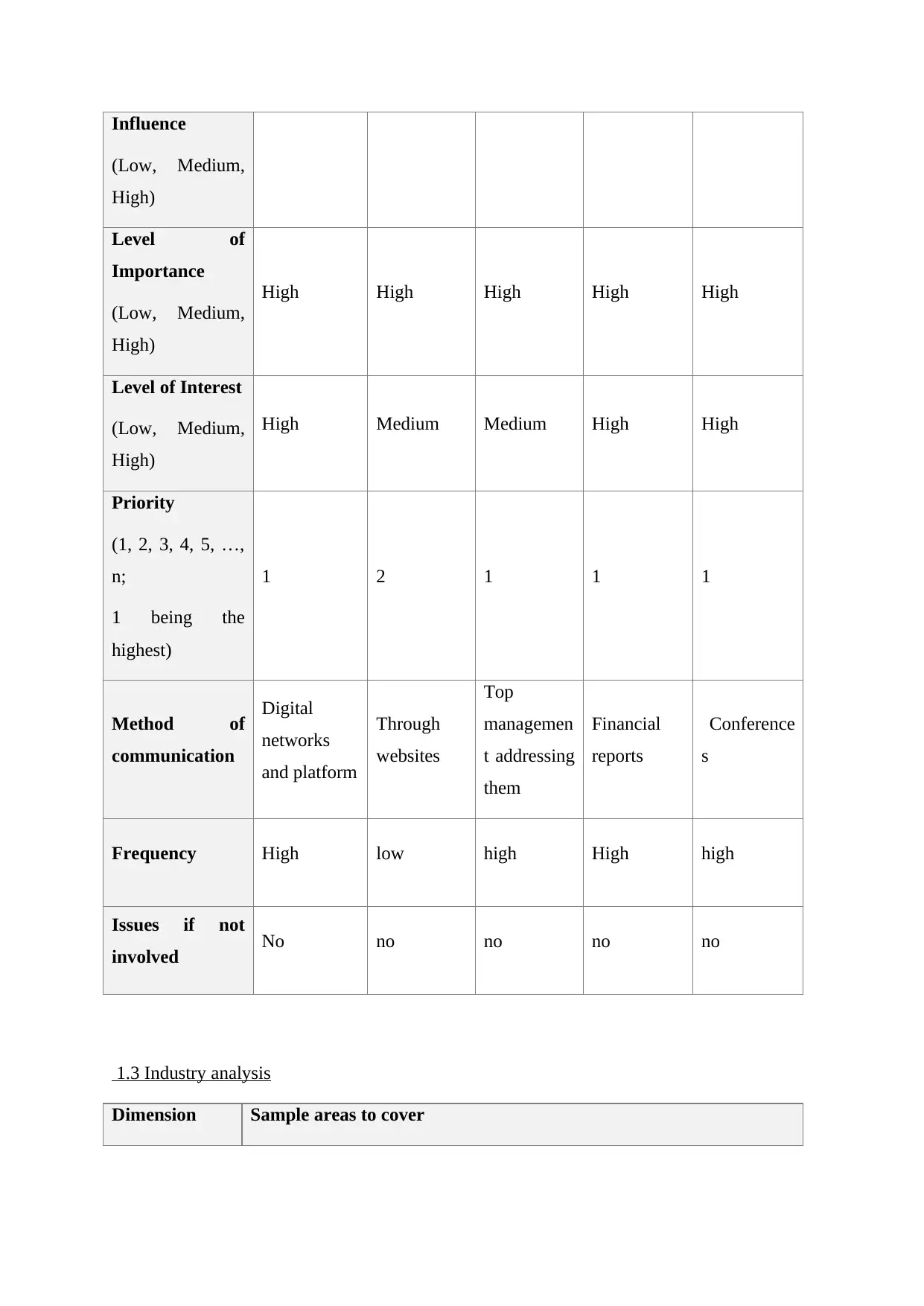
Influence
(Low, Medium,
High)
Level of
Importance
(Low, Medium,
High)
High High High High High
Level of Interest
(Low, Medium,
High)
High Medium Medium High High
Priority
(1, 2, 3, 4, 5, …,
n;
1 being the
highest)
1 2 1 1 1
Method of
communication
Digital
networks
and platform
Through
websites
Top
managemen
t addressing
them
Financial
reports
Conference
s
Frequency High low high High high
Issues if not
involved No no no no no
1.3 Industry analysis
Dimension Sample areas to cover
(Low, Medium,
High)
Level of
Importance
(Low, Medium,
High)
High High High High High
Level of Interest
(Low, Medium,
High)
High Medium Medium High High
Priority
(1, 2, 3, 4, 5, …,
n;
1 being the
highest)
1 2 1 1 1
Method of
communication
Digital
networks
and platform
Through
websites
Top
managemen
t addressing
them
Financial
reports
Conference
s
Frequency High low high High high
Issues if not
involved No no no no no
1.3 Industry analysis
Dimension Sample areas to cover
Paraphrase This Document
Need a fresh take? Get an instant paraphrase of this document with our AI Paraphraser
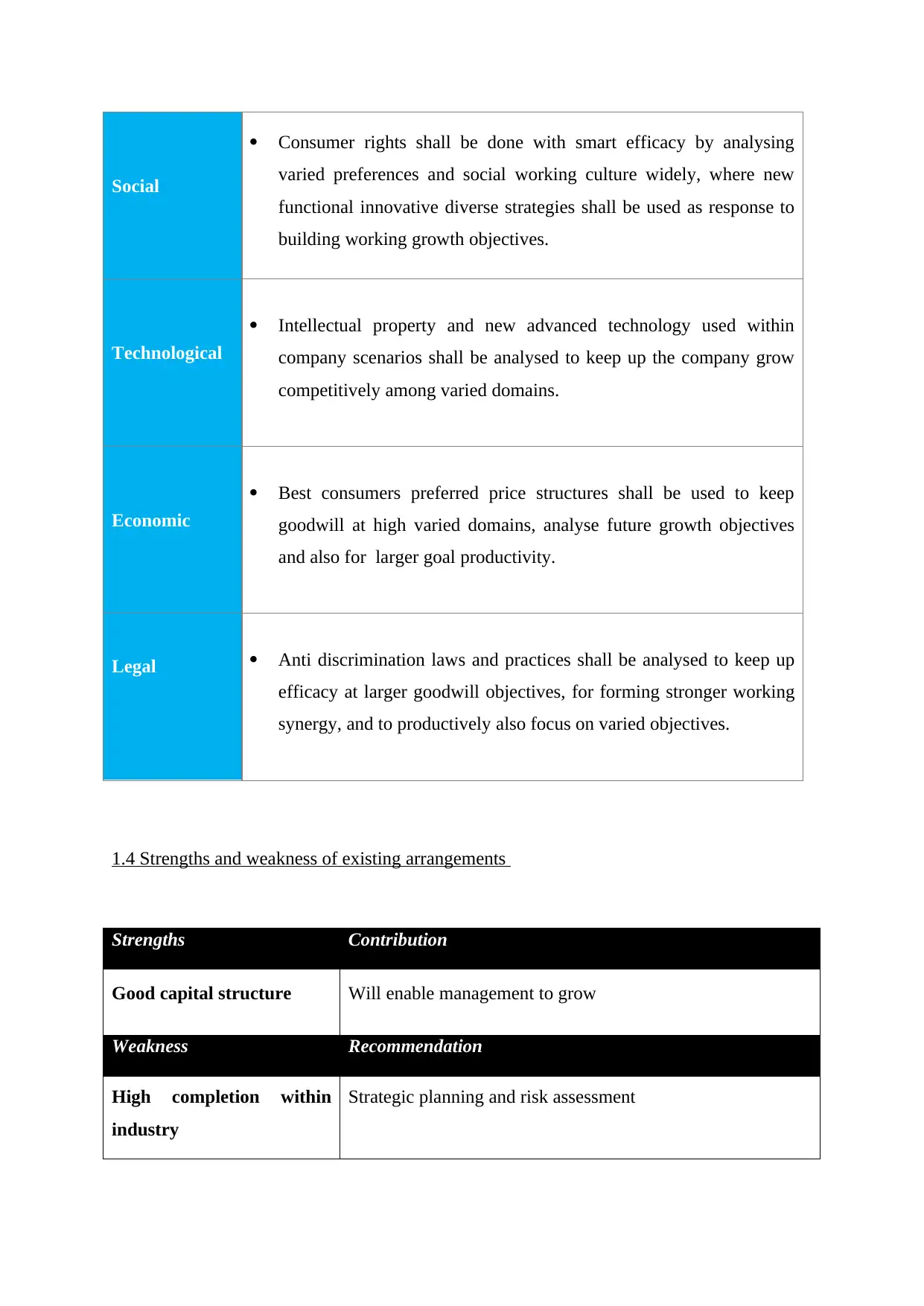
Social
Consumer rights shall be done with smart efficacy by analysing
varied preferences and social working culture widely, where new
functional innovative diverse strategies shall be used as response to
building working growth objectives.
Technological
Intellectual property and new advanced technology used within
company scenarios shall be analysed to keep up the company grow
competitively among varied domains.
Economic
Best consumers preferred price structures shall be used to keep
goodwill at high varied domains, analyse future growth objectives
and also for larger goal productivity.
Legal Anti discrimination laws and practices shall be analysed to keep up
efficacy at larger goodwill objectives, for forming stronger working
synergy, and to productively also focus on varied objectives.
1.4 Strengths and weakness of existing arrangements
Strengths Contribution
Good capital structure Will enable management to grow
Weakness Recommendation
High completion within
industry
Strategic planning and risk assessment
Consumer rights shall be done with smart efficacy by analysing
varied preferences and social working culture widely, where new
functional innovative diverse strategies shall be used as response to
building working growth objectives.
Technological
Intellectual property and new advanced technology used within
company scenarios shall be analysed to keep up the company grow
competitively among varied domains.
Economic
Best consumers preferred price structures shall be used to keep
goodwill at high varied domains, analyse future growth objectives
and also for larger goal productivity.
Legal Anti discrimination laws and practices shall be analysed to keep up
efficacy at larger goodwill objectives, for forming stronger working
synergy, and to productively also focus on varied objectives.
1.4 Strengths and weakness of existing arrangements
Strengths Contribution
Good capital structure Will enable management to grow
Weakness Recommendation
High completion within
industry
Strategic planning and risk assessment
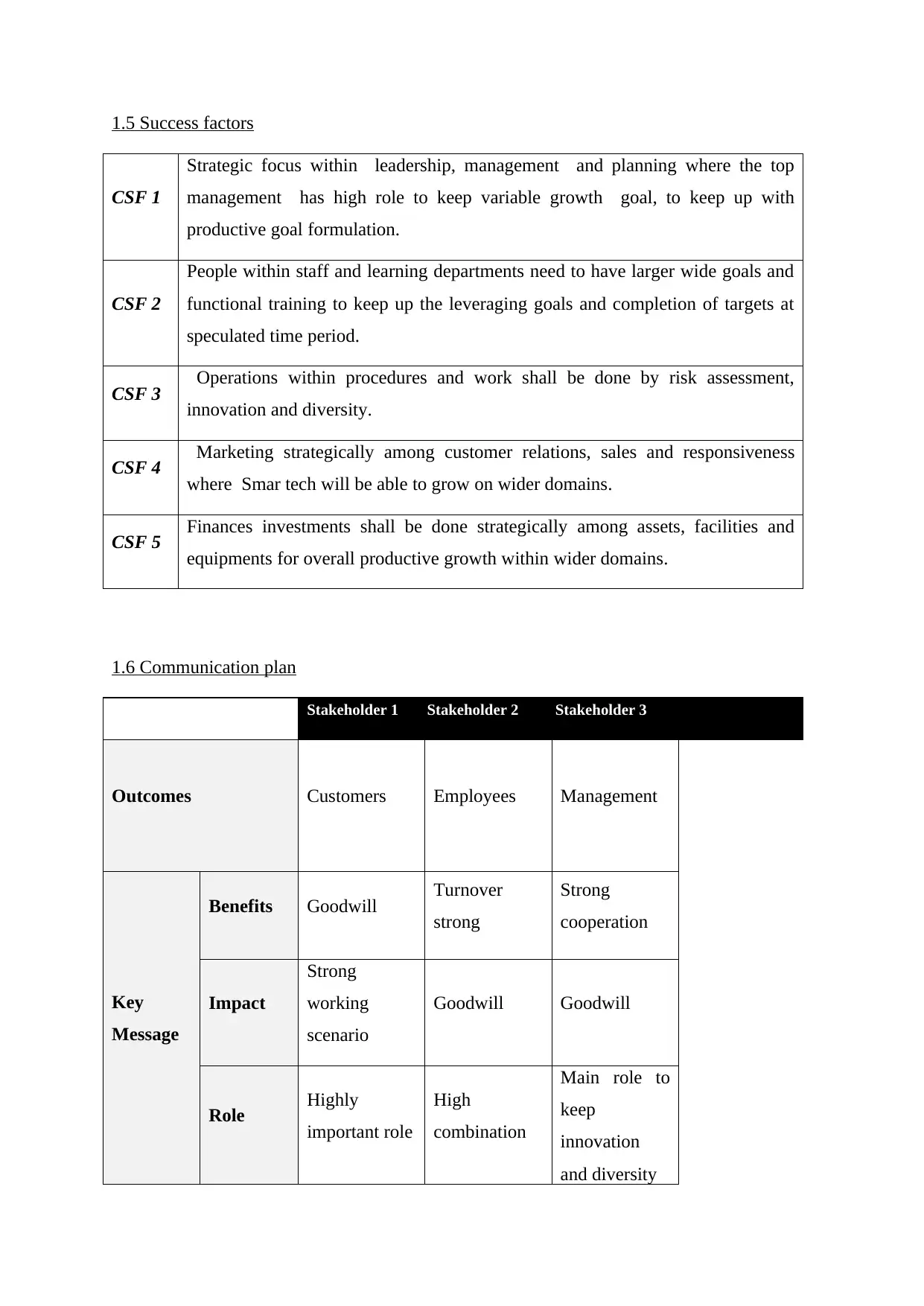
1.5 Success factors
CSF 1
Strategic focus within leadership, management and planning where the top
management has high role to keep variable growth goal, to keep up with
productive goal formulation.
CSF 2
People within staff and learning departments need to have larger wide goals and
functional training to keep up the leveraging goals and completion of targets at
speculated time period.
CSF 3 Operations within procedures and work shall be done by risk assessment,
innovation and diversity.
CSF 4 Marketing strategically among customer relations, sales and responsiveness
where Smar tech will be able to grow on wider domains.
CSF 5 Finances investments shall be done strategically among assets, facilities and
equipments for overall productive growth within wider domains.
1.6 Communication plan
Stakeholder 1 Stakeholder 2 Stakeholder 3
Outcomes Customers Employees Management
Key
Message
Benefits Goodwill Turnover
strong
Strong
cooperation
Impact
Strong
working
scenario
Goodwill Goodwill
Role Highly
important role
High
combination
Main role to
keep
innovation
and diversity
CSF 1
Strategic focus within leadership, management and planning where the top
management has high role to keep variable growth goal, to keep up with
productive goal formulation.
CSF 2
People within staff and learning departments need to have larger wide goals and
functional training to keep up the leveraging goals and completion of targets at
speculated time period.
CSF 3 Operations within procedures and work shall be done by risk assessment,
innovation and diversity.
CSF 4 Marketing strategically among customer relations, sales and responsiveness
where Smar tech will be able to grow on wider domains.
CSF 5 Finances investments shall be done strategically among assets, facilities and
equipments for overall productive growth within wider domains.
1.6 Communication plan
Stakeholder 1 Stakeholder 2 Stakeholder 3
Outcomes Customers Employees Management
Key
Message
Benefits Goodwill Turnover
strong
Strong
cooperation
Impact
Strong
working
scenario
Goodwill Goodwill
Role Highly
important role
High
combination
Main role to
keep
innovation
and diversity
⊘ This is a preview!⊘
Do you want full access?
Subscribe today to unlock all pages.
Trusted by 1+ million students worldwide
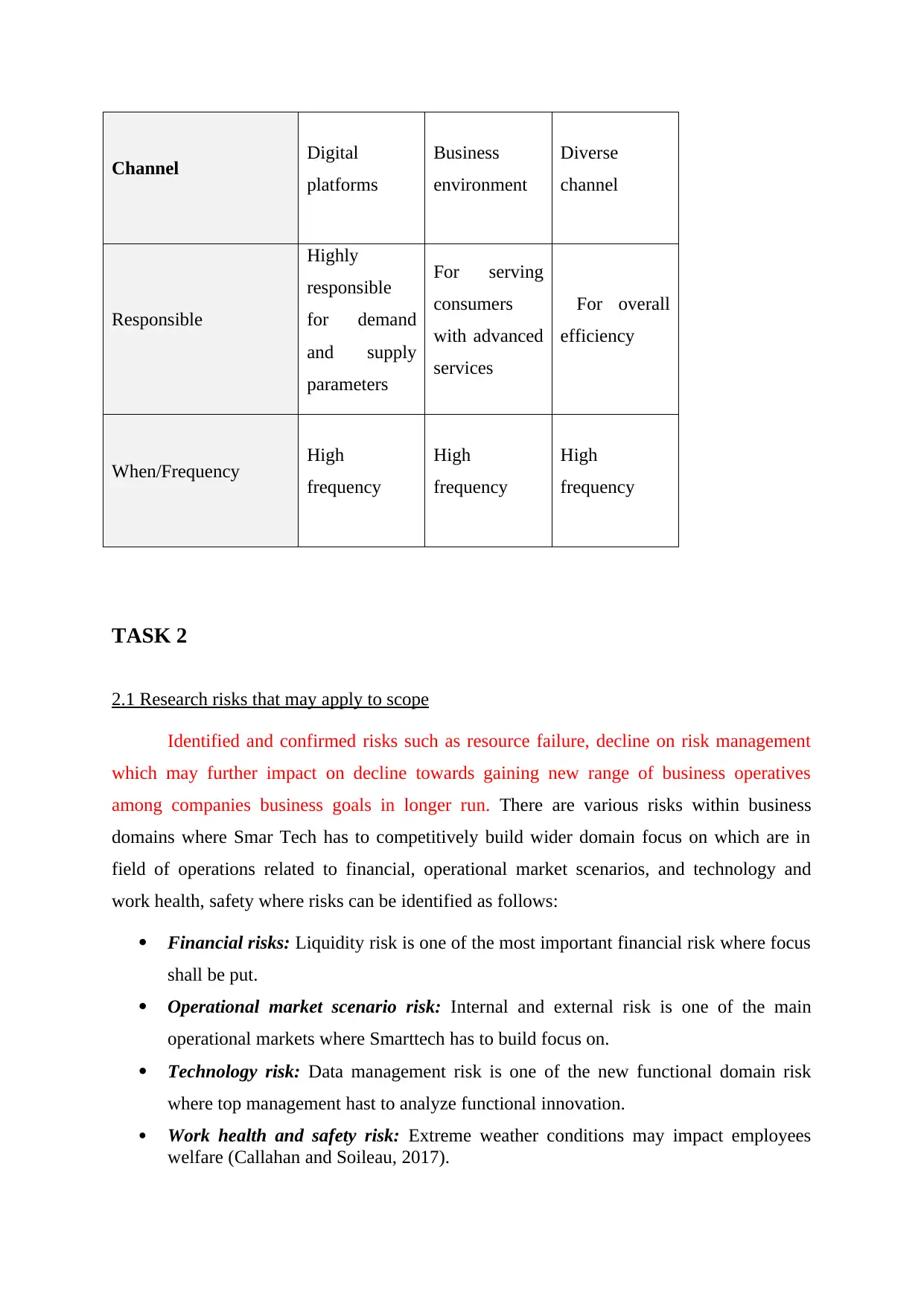
Channel Digital
platforms
Business
environment
Diverse
channel
Responsible
Highly
responsible
for demand
and supply
parameters
For serving
consumers
with advanced
services
For overall
efficiency
When/Frequency High
frequency
High
frequency
High
frequency
TASK 2
2.1 Research risks that may apply to scope
Identified and confirmed risks such as resource failure, decline on risk management
which may further impact on decline towards gaining new range of business operatives
among companies business goals in longer run. There are various risks within business
domains where Smar Tech has to competitively build wider domain focus on which are in
field of operations related to financial, operational market scenarios, and technology and
work health, safety where risks can be identified as follows:
Financial risks: Liquidity risk is one of the most important financial risk where focus
shall be put.
Operational market scenario risk: Internal and external risk is one of the main
operational markets where Smarttech has to build focus on.
Technology risk: Data management risk is one of the new functional domain risk
where top management hast to analyze functional innovation.
Work health and safety risk: Extreme weather conditions may impact employees
welfare (Callahan and Soileau, 2017).
platforms
Business
environment
Diverse
channel
Responsible
Highly
responsible
for demand
and supply
parameters
For serving
consumers
with advanced
services
For overall
efficiency
When/Frequency High
frequency
High
frequency
High
frequency
TASK 2
2.1 Research risks that may apply to scope
Identified and confirmed risks such as resource failure, decline on risk management
which may further impact on decline towards gaining new range of business operatives
among companies business goals in longer run. There are various risks within business
domains where Smar Tech has to competitively build wider domain focus on which are in
field of operations related to financial, operational market scenarios, and technology and
work health, safety where risks can be identified as follows:
Financial risks: Liquidity risk is one of the most important financial risk where focus
shall be put.
Operational market scenario risk: Internal and external risk is one of the main
operational markets where Smarttech has to build focus on.
Technology risk: Data management risk is one of the new functional domain risk
where top management hast to analyze functional innovation.
Work health and safety risk: Extreme weather conditions may impact employees
welfare (Callahan and Soileau, 2017).
Paraphrase This Document
Need a fresh take? Get an instant paraphrase of this document with our AI Paraphraser
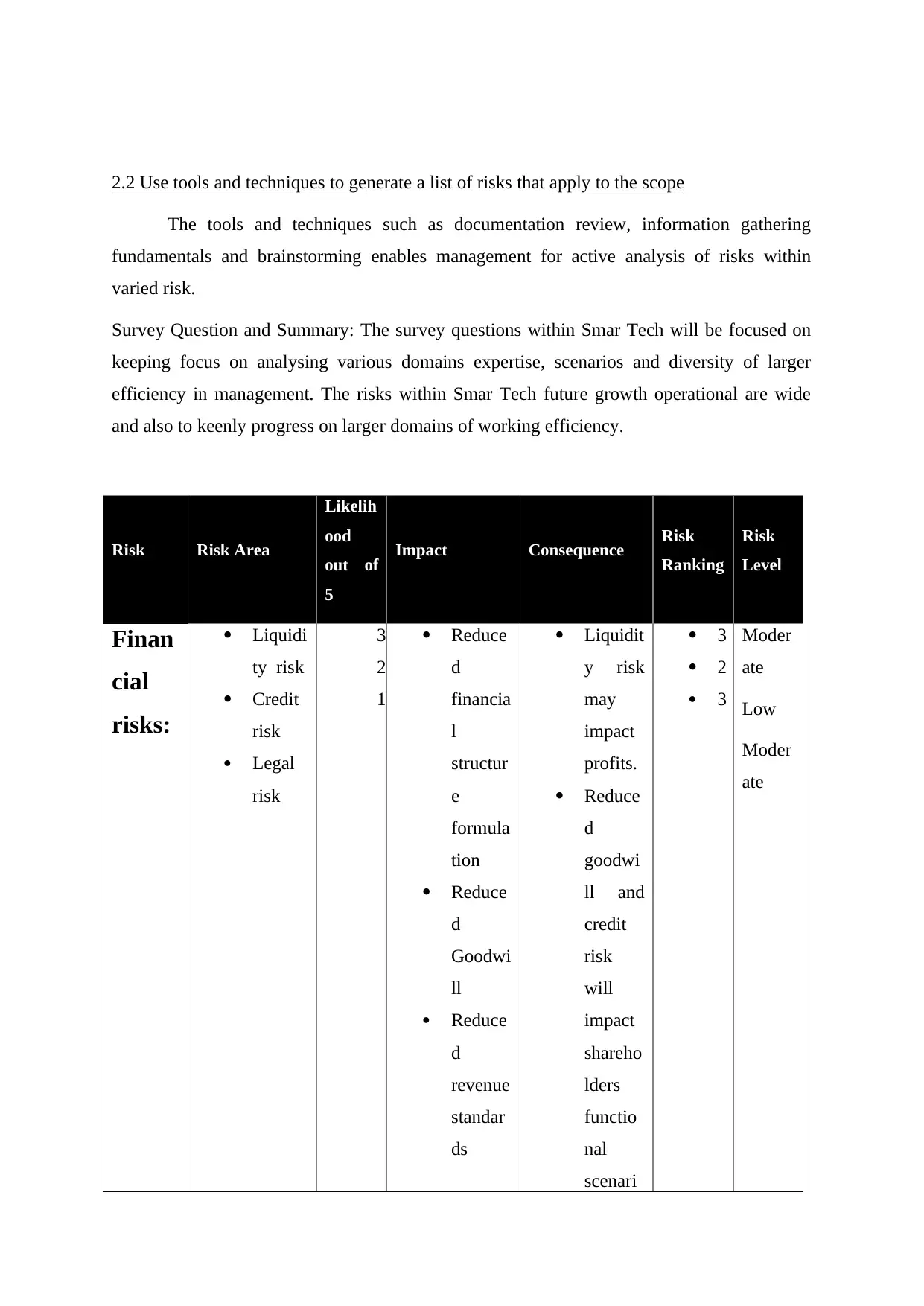
2.2 Use tools and techniques to generate a list of risks that apply to the scope
The tools and techniques such as documentation review, information gathering
fundamentals and brainstorming enables management for active analysis of risks within
varied risk.
Survey Question and Summary: The survey questions within Smar Tech will be focused on
keeping focus on analysing various domains expertise, scenarios and diversity of larger
efficiency in management. The risks within Smar Tech future growth operational are wide
and also to keenly progress on larger domains of working efficiency.
Risk Risk Area
Likelih
ood
out of
5
Impact Consequence Risk
Ranking
Risk
Level
Finan
cial
risks:
Liquidi
ty risk
Credit
risk
Legal
risk
3
2
1
Reduce
d
financia
l
structur
e
formula
tion
Reduce
d
Goodwi
ll
Reduce
d
revenue
standar
ds
Liquidit
y risk
may
impact
profits.
Reduce
d
goodwi
ll and
credit
risk
will
impact
shareho
lders
functio
nal
scenari
3
2
3
Moder
ate
Low
Moder
ate
The tools and techniques such as documentation review, information gathering
fundamentals and brainstorming enables management for active analysis of risks within
varied risk.
Survey Question and Summary: The survey questions within Smar Tech will be focused on
keeping focus on analysing various domains expertise, scenarios and diversity of larger
efficiency in management. The risks within Smar Tech future growth operational are wide
and also to keenly progress on larger domains of working efficiency.
Risk Risk Area
Likelih
ood
out of
5
Impact Consequence Risk
Ranking
Risk
Level
Finan
cial
risks:
Liquidi
ty risk
Credit
risk
Legal
risk
3
2
1
Reduce
d
financia
l
structur
e
formula
tion
Reduce
d
Goodwi
ll
Reduce
d
revenue
standar
ds
Liquidit
y risk
may
impact
profits.
Reduce
d
goodwi
ll and
credit
risk
will
impact
shareho
lders
functio
nal
scenari
3
2
3
Moder
ate
Low
Moder
ate
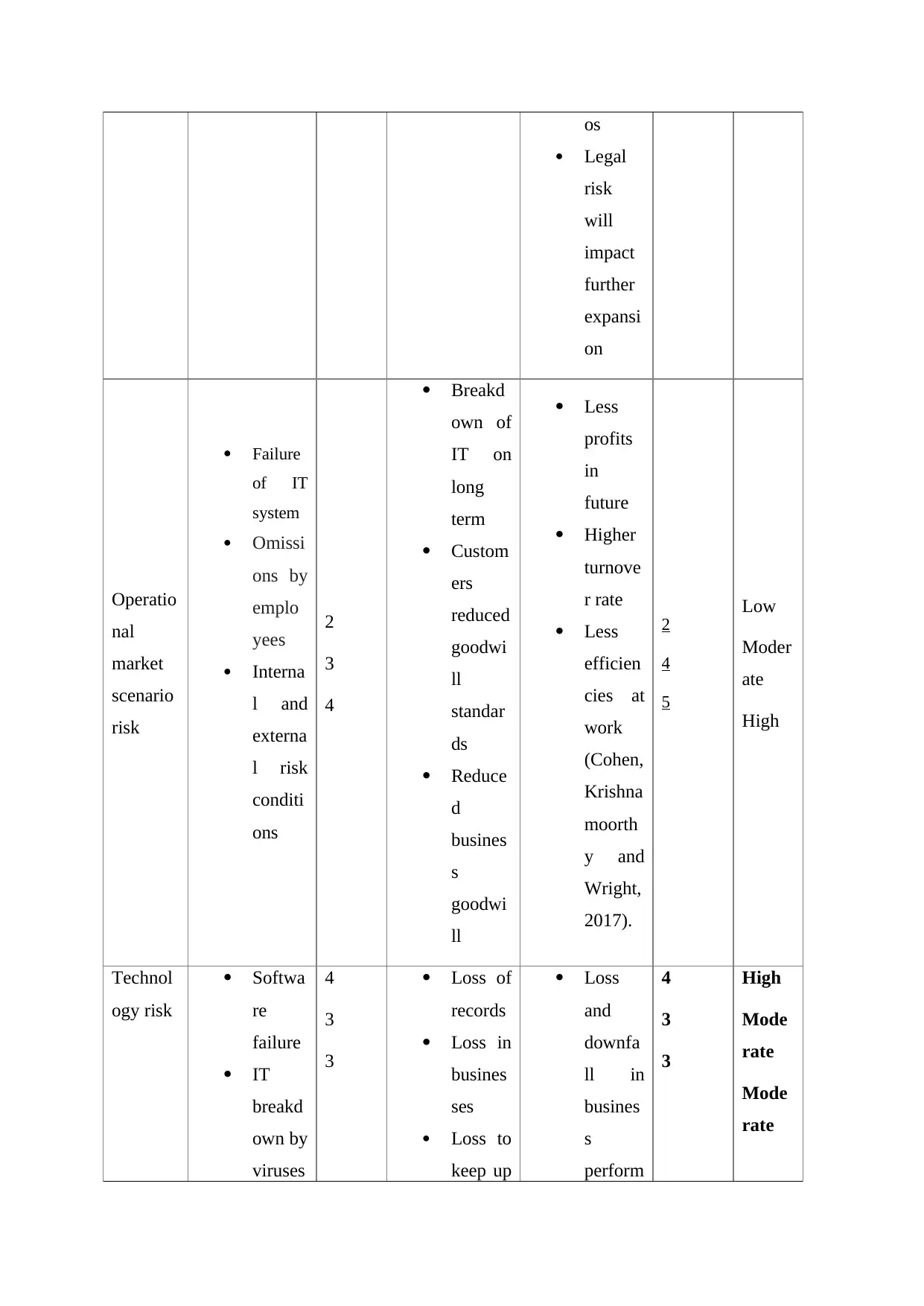
os
Legal
risk
will
impact
further
expansi
on
Operatio
nal
market
scenario
risk
Failure
of IT
system
Omissi
ons by
emplo
yees
Interna
l and
externa
l risk
conditi
ons
2
3
4
Breakd
own of
IT on
long
term
Custom
ers
reduced
goodwi
ll
standar
ds
Reduce
d
busines
s
goodwi
ll
Less
profits
in
future
Higher
turnove
r rate
Less
efficien
cies at
work
(Cohen,
Krishna
moorth
y and
Wright,
2017).
2
4
5
Low
Moder
ate
High
Technol
ogy risk
Softwa
re
failure
IT
breakd
own by
viruses
4
3
3
Loss of
records
Loss in
busines
ses
Loss to
keep up
Loss
and
downfa
ll in
busines
s
perform
4
3
3
High
Mode
rate
Mode
rate
Legal
risk
will
impact
further
expansi
on
Operatio
nal
market
scenario
risk
Failure
of IT
system
Omissi
ons by
emplo
yees
Interna
l and
externa
l risk
conditi
ons
2
3
4
Breakd
own of
IT on
long
term
Custom
ers
reduced
goodwi
ll
standar
ds
Reduce
d
busines
s
goodwi
ll
Less
profits
in
future
Higher
turnove
r rate
Less
efficien
cies at
work
(Cohen,
Krishna
moorth
y and
Wright,
2017).
2
4
5
Low
Moder
ate
High
Technol
ogy risk
Softwa
re
failure
IT
breakd
own by
viruses
4
3
3
Loss of
records
Loss in
busines
ses
Loss to
keep up
Loss
and
downfa
ll in
busines
s
perform
4
3
3
High
Mode
rate
Mode
rate
⊘ This is a preview!⊘
Do you want full access?
Subscribe today to unlock all pages.
Trusted by 1+ million students worldwide

1 out of 20


Related Documents


Your All-in-One AI-Powered Toolkit for Academic Success.
+13062052269
info@desklib.com
Available 24*7 on WhatsApp / Email
![[object Object]](/_next/static/media/star-bottom.7253800d.svg)
Unlock your academic potential
Copyright © 2020–2026 A2Z Services. All Rights Reserved. Developed and managed by ZUCOL.