Comprehensive Network Plan for Smart Digital Networks Company Project
VerifiedAdded on 2022/10/01
|12
|2878
|5
Project
AI Summary
This project presents a detailed network plan for the Smart Digital Networks (SDN) Company, a retail company with multiple branches. The plan addresses the company's need for a scalable network capable of supporting a 100% expansion within five years. The project encompasses various aspects of network design, including media selection (UTP CAT 6 and wireless), subnetting using VLSM for efficient IP address allocation, and dual-stack integration for IPv4 and IPv6 compatibility. The network topology is based on a star configuration, and the project details the necessary networking and communication hardware such as routers, switches, and firewalls. The plan also addresses the company's technical requirements, including availability, scalability, maintainability, and adaptability. The project provides detailed IPv4 and IPv6 addressing schemes, along with the rationale behind the chosen network design and technologies.

Course Title:
Course Code:
Student Name:
Student Code:
Lecture Name:
Course Code:
Student Name:
Student Code:
Lecture Name:

Paraphrase This Document
Need a fresh take? Get an instant paraphrase of this document with our AI Paraphraser
Executive summary
Information Technology has seen fast growth in the recent past. Each day, there is new technology that
is invented. This has come as a result of increased human demands in the area of IT. In response to this,
IT specialists ranging from software to hardware have been working around the clock to ensure that the
needs of their clients are satisfied without a fail. This zeal and unwavering efforts by the developers and
the hardware designers has seen powerful devices brought to the market for use by the clients. Business
enterprises are implementing the super powerful devices invented during the upgrade of their
networks.
Information Technology has seen fast growth in the recent past. Each day, there is new technology that
is invented. This has come as a result of increased human demands in the area of IT. In response to this,
IT specialists ranging from software to hardware have been working around the clock to ensure that the
needs of their clients are satisfied without a fail. This zeal and unwavering efforts by the developers and
the hardware designers has seen powerful devices brought to the market for use by the clients. Business
enterprises are implementing the super powerful devices invented during the upgrade of their
networks.
Table of Contents
Executive summary.....................................................................................................................................1
Introduction.................................................................................................................................................2
Project scope...............................................................................................................................................2
Statement of requirements.........................................................................................................................2
Type of media..............................................................................................................................................3
Subnetting...................................................................................................................................................3
Dual stack integration..................................................................................................................................5
Networking and communication hardware.................................................................................................6
Network topology........................................................................................................................................6
Type of internet...........................................................................................................................................7
References...................................................................................................................................................8
Executive summary.....................................................................................................................................1
Introduction.................................................................................................................................................2
Project scope...............................................................................................................................................2
Statement of requirements.........................................................................................................................2
Type of media..............................................................................................................................................3
Subnetting...................................................................................................................................................3
Dual stack integration..................................................................................................................................5
Networking and communication hardware.................................................................................................6
Network topology........................................................................................................................................6
Type of internet...........................................................................................................................................7
References...................................................................................................................................................8
⊘ This is a preview!⊘
Do you want full access?
Subscribe today to unlock all pages.

Trusted by 1+ million students worldwide

Figure 1: Topology Diagram.........................................................................................................................8
Table 1: Number of Network hosts..............................................................................................................5
Table 2: IPv4 Address Table.........................................................................................................................6
Table 3: IPv6 addressing..............................................................................................................................7
Table 4: Networking and communication hardware...................................................................................7
Table 1: Number of Network hosts..............................................................................................................5
Table 2: IPv4 Address Table.........................................................................................................................6
Table 3: IPv6 addressing..............................................................................................................................7
Table 4: Networking and communication hardware...................................................................................7
Paraphrase This Document
Need a fresh take? Get an instant paraphrase of this document with our AI Paraphraser
Introduction
Smart Digital Networks abbreviated as SDN denotes to a retail company whose headquarter is in the
city. The company has branches in Hornsby, Parramatta and Sutherland. Furthermore, the company has
two more small offices in Epping and Bankstown. The company is a retail company dealing with
computing devices. Due to the expected growth in the next five years, the company management has
taken an action plan in response to the growth. The growth is expected to be 100%. A network has to be
constructed which meets the requirements.
Project scope
The scope of this task is to come up with a network plan which upgrades the current situation of the
network. The network is expected to be 100% scalable. The network design will include deciding on the
network media to be used in cabling of network. Wireless media will also be used. Subnetting will be
done using the VLSM technique allowing each location or department has allowance of 100% growth. In
addition, dual-stack will be implemented so that IPv6 addressing is used in preparation of IPv6 full
deployment. Networking and hardware communication devices will also be discussed in detail. Other
areas which will require our attention network topology and the type of internet to be used in this
network design (Aristarkus, et al., 2016).
Statement of requirements
Each business enterprise which has deployed IT infrastructure services ensures that the implement
services conform to certain technical requirements. For our SDN Company, below are the technical
requirements about the network to be constructed.
Availability: Availability specifies the uptime of the system. It actually measured as a percentage of the
time that the system is available to the network users. The system can be unavailable to users due to
the failure of the hardware component, loss of power, failure of a software, failure of the network or
other factors which may cause the unavailability of the system to the users. It should be noted that the
scheduled service time for upgraded and maintenance is not considered as a down time. Our proposed
network will always be avaiible for users and in case of unavailability measures will be taken quickly to
restore the network (Cascio & Montealegre, 2017).
Scalability: scalability of a computing system describes the capability of relocating of networking end
nodes and addition of users to the network without interfering with business activities. The requirement
quests for addition of resources without redesigning the network (Bee, 2017).
Maintainability: no matter how huge or good the initial design of a network is, the staff present staff
must have the capability to maintain and manage the network. A difficult and complex network cannot
function effectively and efficiently. Our proposed network will be efficient to maintain and manage
(Ciampa, 2014).
Adaptability: network adaptability defines the ability of the network to cope with the unanticipated
system turbulence in the environment. Our proposed network design will be adaptable and be open to
retrofit with respect to the changes will occur in the environment of operation (Coltman & Sharma,
2019).
Smart Digital Networks abbreviated as SDN denotes to a retail company whose headquarter is in the
city. The company has branches in Hornsby, Parramatta and Sutherland. Furthermore, the company has
two more small offices in Epping and Bankstown. The company is a retail company dealing with
computing devices. Due to the expected growth in the next five years, the company management has
taken an action plan in response to the growth. The growth is expected to be 100%. A network has to be
constructed which meets the requirements.
Project scope
The scope of this task is to come up with a network plan which upgrades the current situation of the
network. The network is expected to be 100% scalable. The network design will include deciding on the
network media to be used in cabling of network. Wireless media will also be used. Subnetting will be
done using the VLSM technique allowing each location or department has allowance of 100% growth. In
addition, dual-stack will be implemented so that IPv6 addressing is used in preparation of IPv6 full
deployment. Networking and hardware communication devices will also be discussed in detail. Other
areas which will require our attention network topology and the type of internet to be used in this
network design (Aristarkus, et al., 2016).
Statement of requirements
Each business enterprise which has deployed IT infrastructure services ensures that the implement
services conform to certain technical requirements. For our SDN Company, below are the technical
requirements about the network to be constructed.
Availability: Availability specifies the uptime of the system. It actually measured as a percentage of the
time that the system is available to the network users. The system can be unavailable to users due to
the failure of the hardware component, loss of power, failure of a software, failure of the network or
other factors which may cause the unavailability of the system to the users. It should be noted that the
scheduled service time for upgraded and maintenance is not considered as a down time. Our proposed
network will always be avaiible for users and in case of unavailability measures will be taken quickly to
restore the network (Cascio & Montealegre, 2017).
Scalability: scalability of a computing system describes the capability of relocating of networking end
nodes and addition of users to the network without interfering with business activities. The requirement
quests for addition of resources without redesigning the network (Bee, 2017).
Maintainability: no matter how huge or good the initial design of a network is, the staff present staff
must have the capability to maintain and manage the network. A difficult and complex network cannot
function effectively and efficiently. Our proposed network will be efficient to maintain and manage
(Ciampa, 2014).
Adaptability: network adaptability defines the ability of the network to cope with the unanticipated
system turbulence in the environment. Our proposed network design will be adaptable and be open to
retrofit with respect to the changes will occur in the environment of operation (Coltman & Sharma,
2019).
Type of media
Communication can be defined as the sending of information from sender to recipient through a media.
Therefore, this implies that communication will be incomplete when media of transmission is taken
away from the equation. Transmission media is required to develop a network system since they are the
physical transmission routes between the sender of a message and receiver of a message.
Before we select the correct media to be used for our network design, let us look at sample transmission
media available;
- Twisted pair cable: twisted pair cables have been around for years performing the task of voice
transmission. This kind of media is widely used for small and medium networking since it is
cheaper, lighter, easy to install, and more flexible. The two types of twisted cables are UTP and
STP (unshielded twisted pair and shielded twisted pair respectively).
- Coaxial cable: the coaxial cables a defined with a central copper conductor. The copper
conductor is surrounded with an insulation layer, conducting sheath and outer plastic covering.
This cable is deployed in long distance communication. The 3 layer coating enables high
resistance to crosstalk as compared to twisted pair cable.
- Optical fiber cable: as the name suggests this kind of cable use light waves for data transmission.
This kind of cable does not experience attenuation, EMI and crosstalk. The cables are well suited
for data, video and voice transmission. This kind of cable is the most secure type of information
transmission and it spans to very long distances. However, it is the most cost full of all the
network transmission media.
- Unguided or wireless Transmission media: for unguided media of transmission, the signals are
broadcast without guiding medium via the air. This kind of medium of transmission is the least
secure (Andrews, 2016).
In our network design for SDN Company, we are going to use two types of media of transmission. That
is, wireless and twisted pair cable. We use UTP CAT 6 cable which is cheaper and easier to implement.
This kind of cable has more twisting which reduce the interference effect.
Wireless media is a must implement in the present technology of micro-computers. These kind of
devices do not have network cards to accommodate wired media lest you have a-USB network adapter.
This will require you incur another cost.
The cost of one meter of a UTP CAT 6 cable is approximately $ 0.2.
Subnetting
Subnetting is the process of dividing ISP provided IP address into divisions which are allocated to
departments of an organization. Subnetting is done for the purpose of ease of management of the
network and improved security. One may wonder how security is improved by subnetting. Security
aspect is improved by allowing users of a certain department to have authorizations on access of
defined resources on the network. Furthermore, it is easier to manage and troubleshoot a small division
of the network than the whole chunk of the network (Empson, 2013).
Communication can be defined as the sending of information from sender to recipient through a media.
Therefore, this implies that communication will be incomplete when media of transmission is taken
away from the equation. Transmission media is required to develop a network system since they are the
physical transmission routes between the sender of a message and receiver of a message.
Before we select the correct media to be used for our network design, let us look at sample transmission
media available;
- Twisted pair cable: twisted pair cables have been around for years performing the task of voice
transmission. This kind of media is widely used for small and medium networking since it is
cheaper, lighter, easy to install, and more flexible. The two types of twisted cables are UTP and
STP (unshielded twisted pair and shielded twisted pair respectively).
- Coaxial cable: the coaxial cables a defined with a central copper conductor. The copper
conductor is surrounded with an insulation layer, conducting sheath and outer plastic covering.
This cable is deployed in long distance communication. The 3 layer coating enables high
resistance to crosstalk as compared to twisted pair cable.
- Optical fiber cable: as the name suggests this kind of cable use light waves for data transmission.
This kind of cable does not experience attenuation, EMI and crosstalk. The cables are well suited
for data, video and voice transmission. This kind of cable is the most secure type of information
transmission and it spans to very long distances. However, it is the most cost full of all the
network transmission media.
- Unguided or wireless Transmission media: for unguided media of transmission, the signals are
broadcast without guiding medium via the air. This kind of medium of transmission is the least
secure (Andrews, 2016).
In our network design for SDN Company, we are going to use two types of media of transmission. That
is, wireless and twisted pair cable. We use UTP CAT 6 cable which is cheaper and easier to implement.
This kind of cable has more twisting which reduce the interference effect.
Wireless media is a must implement in the present technology of micro-computers. These kind of
devices do not have network cards to accommodate wired media lest you have a-USB network adapter.
This will require you incur another cost.
The cost of one meter of a UTP CAT 6 cable is approximately $ 0.2.
Subnetting
Subnetting is the process of dividing ISP provided IP address into divisions which are allocated to
departments of an organization. Subnetting is done for the purpose of ease of management of the
network and improved security. One may wonder how security is improved by subnetting. Security
aspect is improved by allowing users of a certain department to have authorizations on access of
defined resources on the network. Furthermore, it is easier to manage and troubleshoot a small division
of the network than the whole chunk of the network (Empson, 2013).
⊘ This is a preview!⊘
Do you want full access?
Subscribe today to unlock all pages.
Trusted by 1+ million students worldwide
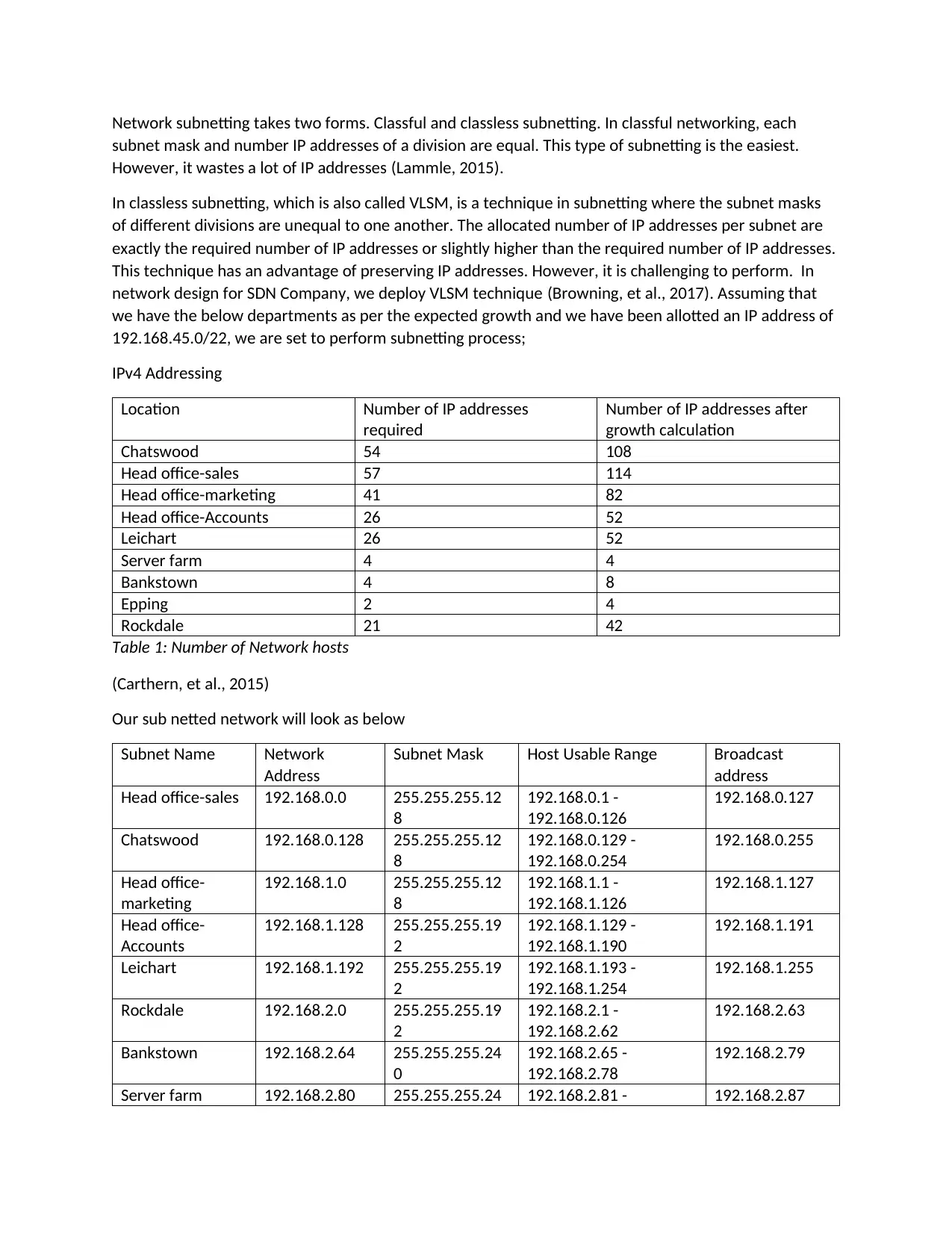
Network subnetting takes two forms. Classful and classless subnetting. In classful networking, each
subnet mask and number IP addresses of a division are equal. This type of subnetting is the easiest.
However, it wastes a lot of IP addresses (Lammle, 2015).
In classless subnetting, which is also called VLSM, is a technique in subnetting where the subnet masks
of different divisions are unequal to one another. The allocated number of IP addresses per subnet are
exactly the required number of IP addresses or slightly higher than the required number of IP addresses.
This technique has an advantage of preserving IP addresses. However, it is challenging to perform. In
network design for SDN Company, we deploy VLSM technique (Browning, et al., 2017). Assuming that
we have the below departments as per the expected growth and we have been allotted an IP address of
192.168.45.0/22, we are set to perform subnetting process;
IPv4 Addressing
Location Number of IP addresses
required
Number of IP addresses after
growth calculation
Chatswood 54 108
Head office-sales 57 114
Head office-marketing 41 82
Head office-Accounts 26 52
Leichart 26 52
Server farm 4 4
Bankstown 4 8
Epping 2 4
Rockdale 21 42
Table 1: Number of Network hosts
(Carthern, et al., 2015)
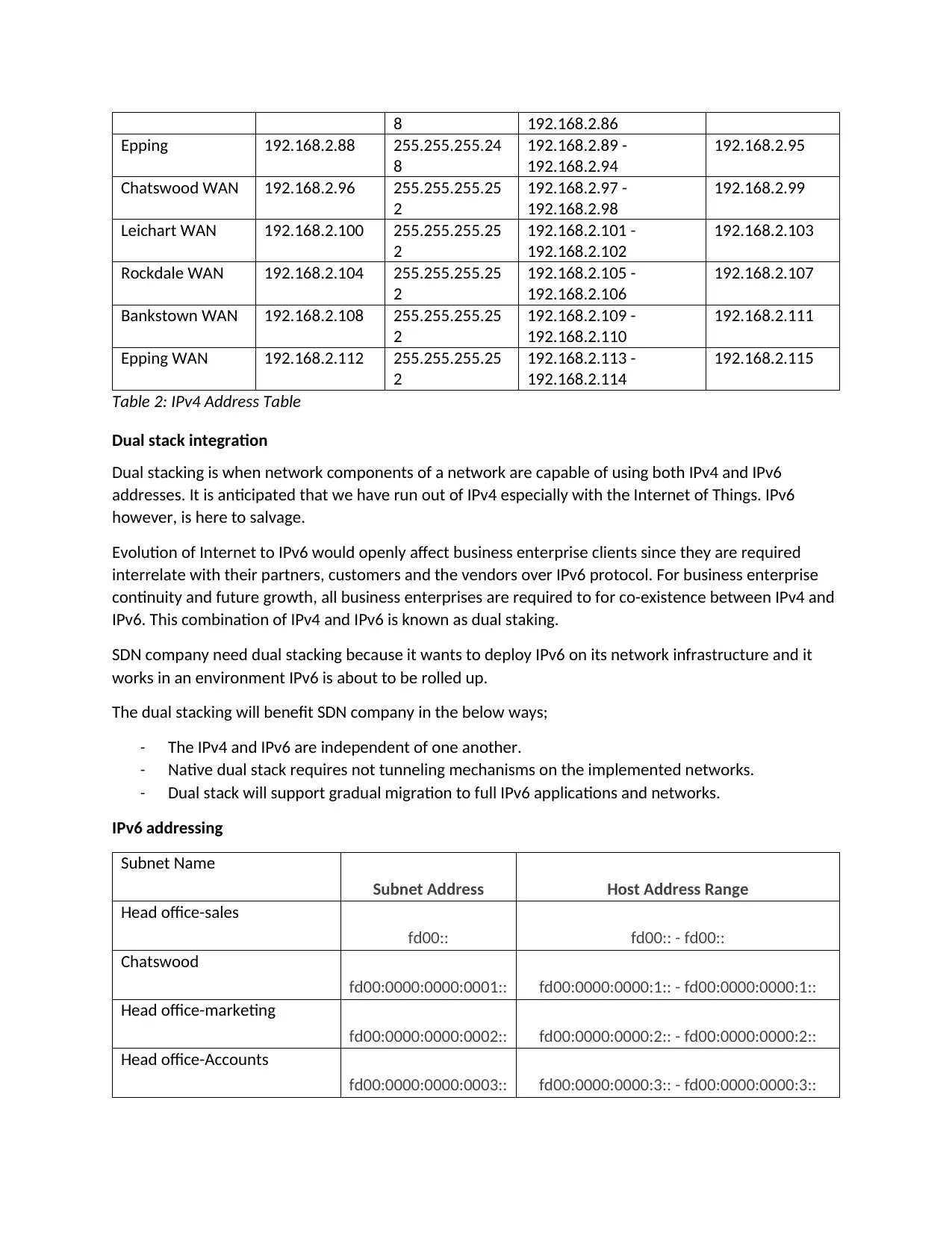
Our sub netted network will look as below
Subnet Name Network
Address
Subnet Mask Host Usable Range Broadcast
address
Head office-sales 192.168.0.0 255.255.255.12
8
192.168.0.1 -
192.168.0.126
192.168.0.127
Chatswood 192.168.0.128 255.255.255.12
8
192.168.0.129 -
192.168.0.254
192.168.0.255
Head office-
marketing
192.168.1.0 255.255.255.12
8
192.168.1.1 -
192.168.1.126
192.168.1.127
Head office-
Accounts
192.168.1.128 255.255.255.19
2
192.168.1.129 -
192.168.1.190
192.168.1.191
Leichart 192.168.1.192 255.255.255.19
2
192.168.1.193 -
192.168.1.254
192.168.1.255
Rockdale 192.168.2.0 255.255.255.19
2
192.168.2.1 -
192.168.2.62
192.168.2.63
Bankstown 192.168.2.64 255.255.255.24
0
192.168.2.65 -
192.168.2.78
192.168.2.79
Server farm 192.168.2.80 255.255.255.24 192.168.2.81 - 192.168.2.87
subnet mask and number IP addresses of a division are equal. This type of subnetting is the easiest.
However, it wastes a lot of IP addresses (Lammle, 2015).
In classless subnetting, which is also called VLSM, is a technique in subnetting where the subnet masks
of different divisions are unequal to one another. The allocated number of IP addresses per subnet are
exactly the required number of IP addresses or slightly higher than the required number of IP addresses.
This technique has an advantage of preserving IP addresses. However, it is challenging to perform. In
network design for SDN Company, we deploy VLSM technique (Browning, et al., 2017). Assuming that
we have the below departments as per the expected growth and we have been allotted an IP address of
192.168.45.0/22, we are set to perform subnetting process;
IPv4 Addressing
Location Number of IP addresses
required
Number of IP addresses after
growth calculation
Chatswood 54 108
Head office-sales 57 114
Head office-marketing 41 82
Head office-Accounts 26 52
Leichart 26 52
Server farm 4 4
Bankstown 4 8
Epping 2 4
Rockdale 21 42
Table 1: Number of Network hosts
(Carthern, et al., 2015)
Our sub netted network will look as below
Subnet Name Network
Address
Subnet Mask Host Usable Range Broadcast
address
Head office-sales 192.168.0.0 255.255.255.12
8
192.168.0.1 -
192.168.0.126
192.168.0.127
Chatswood 192.168.0.128 255.255.255.12
8
192.168.0.129 -
192.168.0.254
192.168.0.255
Head office-
marketing
192.168.1.0 255.255.255.12
8
192.168.1.1 -
192.168.1.126
192.168.1.127
Head office-
Accounts
192.168.1.128 255.255.255.19
2
192.168.1.129 -
192.168.1.190
192.168.1.191
Leichart 192.168.1.192 255.255.255.19
2
192.168.1.193 -
192.168.1.254
192.168.1.255
Rockdale 192.168.2.0 255.255.255.19
2
192.168.2.1 -
192.168.2.62
192.168.2.63
Bankstown 192.168.2.64 255.255.255.24
0
192.168.2.65 -
192.168.2.78
192.168.2.79
Server farm 192.168.2.80 255.255.255.24 192.168.2.81 - 192.168.2.87
Paraphrase This Document
Need a fresh take? Get an instant paraphrase of this document with our AI Paraphraser
8 192.168.2.86
Epping 192.168.2.88 255.255.255.24
8
192.168.2.89 -
192.168.2.94
192.168.2.95
Chatswood WAN 192.168.2.96 255.255.255.25
2
192.168.2.97 -
192.168.2.98
192.168.2.99
Leichart WAN 192.168.2.100 255.255.255.25
2
192.168.2.101 -
192.168.2.102
192.168.2.103
Rockdale WAN 192.168.2.104 255.255.255.25
2
192.168.2.105 -
192.168.2.106
192.168.2.107
Bankstown WAN 192.168.2.108 255.255.255.25
2
192.168.2.109 -
192.168.2.110
192.168.2.111
Epping WAN 192.168.2.112 255.255.255.25
2
192.168.2.113 -
192.168.2.114
192.168.2.115
Table 2: IPv4 Address Table
Dual stack integration
Dual stacking is when network components of a network are capable of using both IPv4 and IPv6
addresses. It is anticipated that we have run out of IPv4 especially with the Internet of Things. IPv6
however, is here to salvage.
Evolution of Internet to IPv6 would openly affect business enterprise clients since they are required
interrelate with their partners, customers and the vendors over IPv6 protocol. For business enterprise
continuity and future growth, all business enterprises are required to for co-existence between IPv4 and
IPv6. This combination of IPv4 and IPv6 is known as dual staking.
SDN company need dual stacking because it wants to deploy IPv6 on its network infrastructure and it
works in an environment IPv6 is about to be rolled up.
The dual stacking will benefit SDN company in the below ways;
- The IPv4 and IPv6 are independent of one another.
- Native dual stack requires not tunneling mechanisms on the implemented networks.
- Dual stack will support gradual migration to full IPv6 applications and networks.
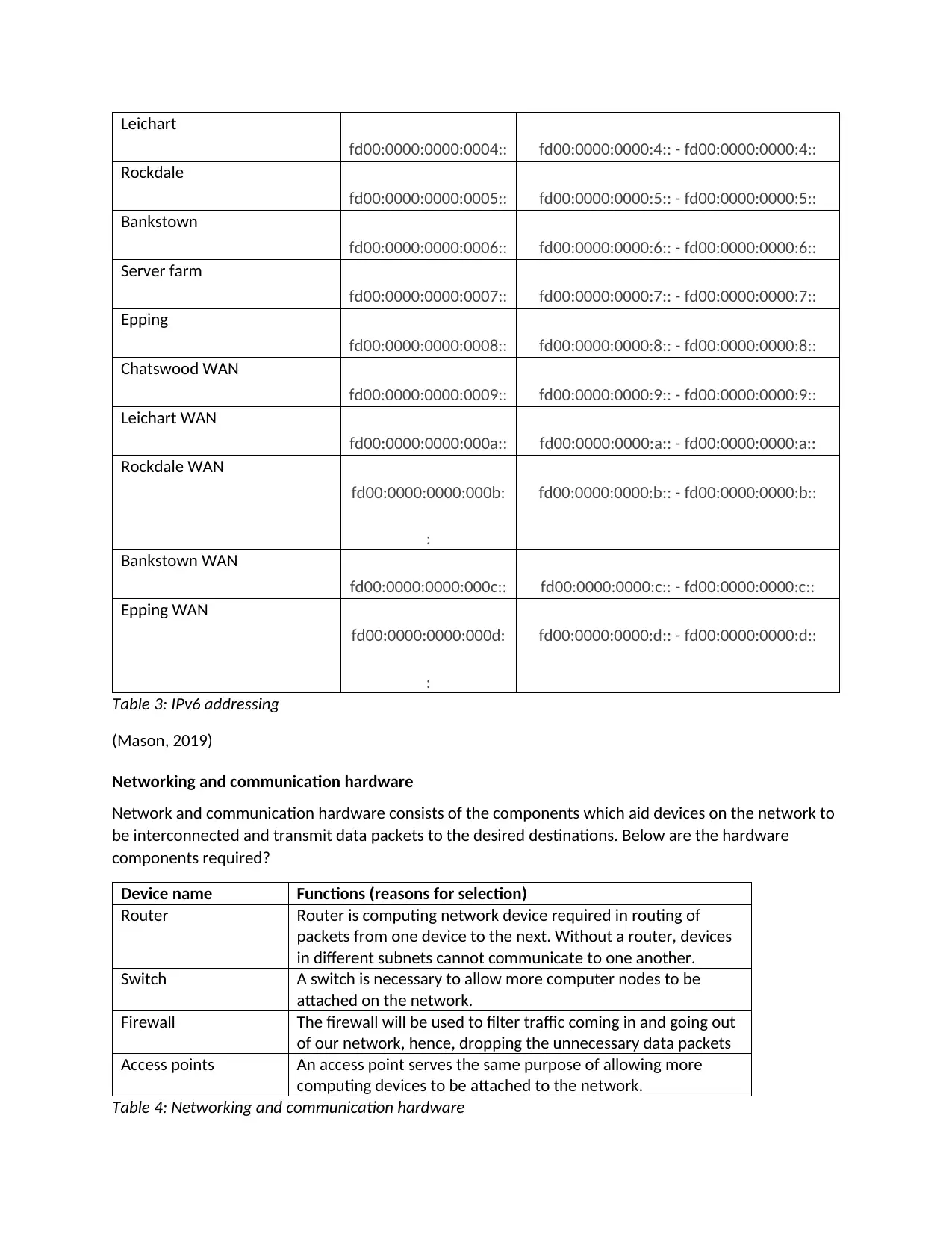
IPv6 addressing
Subnet Name
Subnet Address Host Address Range
Head office-sales
fd00:: fd00:: - fd00::
Chatswood
fd00:0000:0000:0001:: fd00:0000:0000:1:: - fd00:0000:0000:1::
Head office-marketing
fd00:0000:0000:0002:: fd00:0000:0000:2:: - fd00:0000:0000:2::
Head office-Accounts
fd00:0000:0000:0003:: fd00:0000:0000:3:: - fd00:0000:0000:3::
Epping 192.168.2.88 255.255.255.24
8
192.168.2.89 -
192.168.2.94
192.168.2.95
Chatswood WAN 192.168.2.96 255.255.255.25
2
192.168.2.97 -
192.168.2.98
192.168.2.99
Leichart WAN 192.168.2.100 255.255.255.25
2
192.168.2.101 -
192.168.2.102
192.168.2.103
Rockdale WAN 192.168.2.104 255.255.255.25
2
192.168.2.105 -
192.168.2.106
192.168.2.107
Bankstown WAN 192.168.2.108 255.255.255.25
2
192.168.2.109 -
192.168.2.110
192.168.2.111
Epping WAN 192.168.2.112 255.255.255.25
2
192.168.2.113 -
192.168.2.114
192.168.2.115
Table 2: IPv4 Address Table
Dual stack integration
Dual stacking is when network components of a network are capable of using both IPv4 and IPv6
addresses. It is anticipated that we have run out of IPv4 especially with the Internet of Things. IPv6
however, is here to salvage.
Evolution of Internet to IPv6 would openly affect business enterprise clients since they are required
interrelate with their partners, customers and the vendors over IPv6 protocol. For business enterprise
continuity and future growth, all business enterprises are required to for co-existence between IPv4 and
IPv6. This combination of IPv4 and IPv6 is known as dual staking.
SDN company need dual stacking because it wants to deploy IPv6 on its network infrastructure and it
works in an environment IPv6 is about to be rolled up.
The dual stacking will benefit SDN company in the below ways;
- The IPv4 and IPv6 are independent of one another.
- Native dual stack requires not tunneling mechanisms on the implemented networks.
- Dual stack will support gradual migration to full IPv6 applications and networks.
IPv6 addressing
Subnet Name
Subnet Address Host Address Range
Head office-sales
fd00:: fd00:: - fd00::
Chatswood
fd00:0000:0000:0001:: fd00:0000:0000:1:: - fd00:0000:0000:1::
Head office-marketing
fd00:0000:0000:0002:: fd00:0000:0000:2:: - fd00:0000:0000:2::
Head office-Accounts
fd00:0000:0000:0003:: fd00:0000:0000:3:: - fd00:0000:0000:3::
Leichart
fd00:0000:0000:0004:: fd00:0000:0000:4:: - fd00:0000:0000:4::
Rockdale
fd00:0000:0000:0005:: fd00:0000:0000:5:: - fd00:0000:0000:5::
Bankstown
fd00:0000:0000:0006:: fd00:0000:0000:6:: - fd00:0000:0000:6::
Server farm
fd00:0000:0000:0007:: fd00:0000:0000:7:: - fd00:0000:0000:7::
Epping
fd00:0000:0000:0008:: fd00:0000:0000:8:: - fd00:0000:0000:8::
Chatswood WAN
fd00:0000:0000:0009:: fd00:0000:0000:9:: - fd00:0000:0000:9::
Leichart WAN
fd00:0000:0000:000a:: fd00:0000:0000:a:: - fd00:0000:0000:a::
Rockdale WAN
fd00:0000:0000:000b:
:
fd00:0000:0000:b:: - fd00:0000:0000:b::
Bankstown WAN
fd00:0000:0000:000c:: fd00:0000:0000:c:: - fd00:0000:0000:c::
Epping WAN
fd00:0000:0000:000d:
:
fd00:0000:0000:d:: - fd00:0000:0000:d::
Table 3: IPv6 addressing
(Mason, 2019)
Networking and communication hardware
Network and communication hardware consists of the components which aid devices on the network to
be interconnected and transmit data packets to the desired destinations. Below are the hardware
components required?
Device name Functions (reasons for selection)
Router Router is computing network device required in routing of
packets from one device to the next. Without a router, devices
in different subnets cannot communicate to one another.
Switch A switch is necessary to allow more computer nodes to be
attached on the network.
Firewall The firewall will be used to filter traffic coming in and going out
of our network, hence, dropping the unnecessary data packets
Access points An access point serves the same purpose of allowing more
computing devices to be attached to the network.
Table 4: Networking and communication hardware
fd00:0000:0000:0004:: fd00:0000:0000:4:: - fd00:0000:0000:4::
Rockdale
fd00:0000:0000:0005:: fd00:0000:0000:5:: - fd00:0000:0000:5::
Bankstown
fd00:0000:0000:0006:: fd00:0000:0000:6:: - fd00:0000:0000:6::
Server farm
fd00:0000:0000:0007:: fd00:0000:0000:7:: - fd00:0000:0000:7::
Epping
fd00:0000:0000:0008:: fd00:0000:0000:8:: - fd00:0000:0000:8::
Chatswood WAN
fd00:0000:0000:0009:: fd00:0000:0000:9:: - fd00:0000:0000:9::
Leichart WAN
fd00:0000:0000:000a:: fd00:0000:0000:a:: - fd00:0000:0000:a::
Rockdale WAN
fd00:0000:0000:000b:
:
fd00:0000:0000:b:: - fd00:0000:0000:b::
Bankstown WAN
fd00:0000:0000:000c:: fd00:0000:0000:c:: - fd00:0000:0000:c::
Epping WAN
fd00:0000:0000:000d:
:
fd00:0000:0000:d:: - fd00:0000:0000:d::
Table 3: IPv6 addressing
(Mason, 2019)
Networking and communication hardware
Network and communication hardware consists of the components which aid devices on the network to
be interconnected and transmit data packets to the desired destinations. Below are the hardware
components required?
Device name Functions (reasons for selection)
Router Router is computing network device required in routing of
packets from one device to the next. Without a router, devices
in different subnets cannot communicate to one another.
Switch A switch is necessary to allow more computer nodes to be
attached on the network.
Firewall The firewall will be used to filter traffic coming in and going out
of our network, hence, dropping the unnecessary data packets
Access points An access point serves the same purpose of allowing more
computing devices to be attached to the network.
Table 4: Networking and communication hardware
⊘ This is a preview!⊘
Do you want full access?
Subscribe today to unlock all pages.
Trusted by 1+ million students worldwide
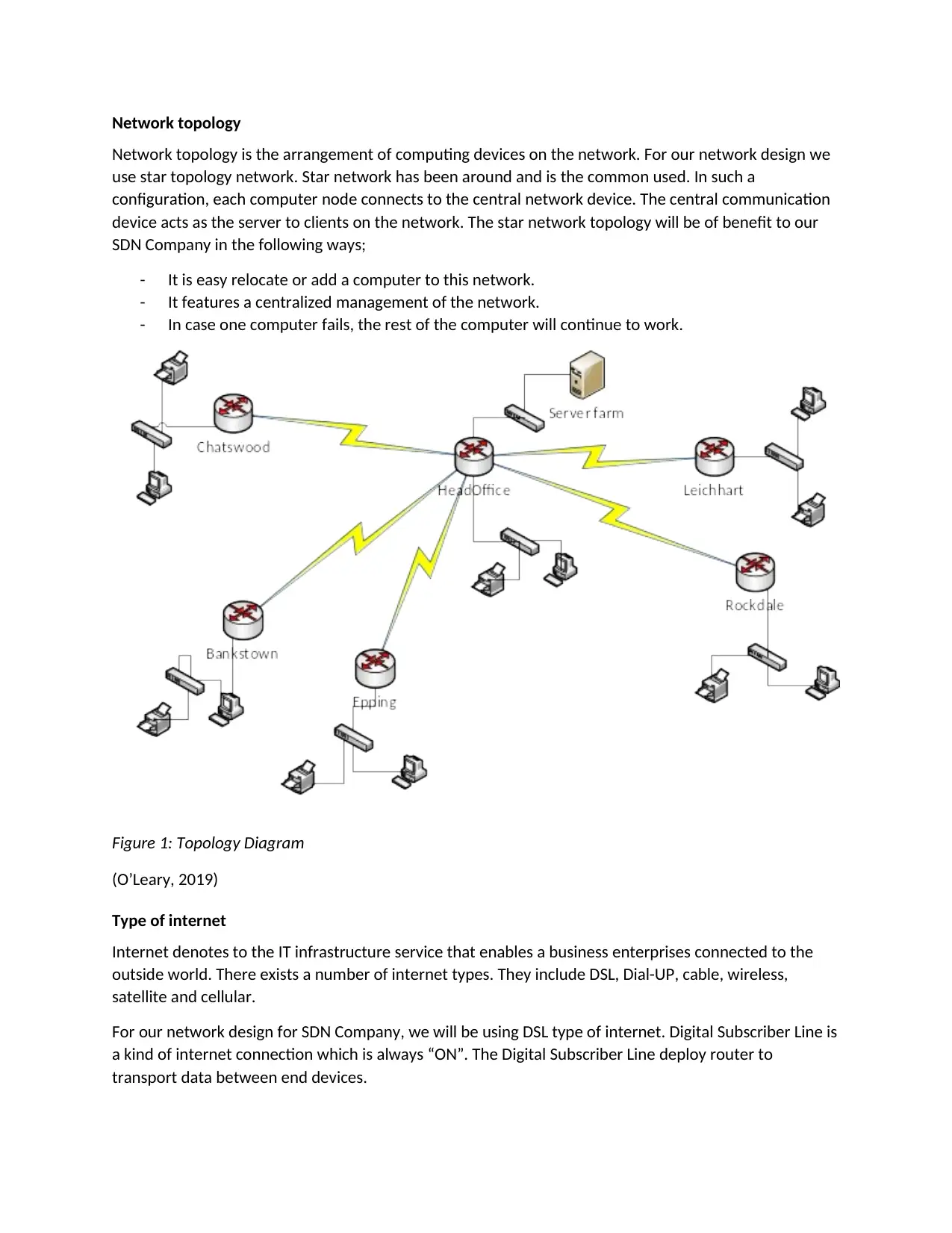
Network topology
Network topology is the arrangement of computing devices on the network. For our network design we
use star topology network. Star network has been around and is the common used. In such a
configuration, each computer node connects to the central network device. The central communication
device acts as the server to clients on the network. The star network topology will be of benefit to our
SDN Company in the following ways;
- It is easy relocate or add a computer to this network.
- It features a centralized management of the network.
- In case one computer fails, the rest of the computer will continue to work.
Figure 1: Topology Diagram
(O’Leary, 2019)
Type of internet
Internet denotes to the IT infrastructure service that enables a business enterprises connected to the
outside world. There exists a number of internet types. They include DSL, Dial-UP, cable, wireless,
satellite and cellular.
For our network design for SDN Company, we will be using DSL type of internet. Digital Subscriber Line is
a kind of internet connection which is always “ON”. The Digital Subscriber Line deploy router to
transport data between end devices.
Network topology is the arrangement of computing devices on the network. For our network design we
use star topology network. Star network has been around and is the common used. In such a
configuration, each computer node connects to the central network device. The central communication
device acts as the server to clients on the network. The star network topology will be of benefit to our
SDN Company in the following ways;
- It is easy relocate or add a computer to this network.
- It features a centralized management of the network.
- In case one computer fails, the rest of the computer will continue to work.
Figure 1: Topology Diagram
(O’Leary, 2019)
Type of internet
Internet denotes to the IT infrastructure service that enables a business enterprises connected to the
outside world. There exists a number of internet types. They include DSL, Dial-UP, cable, wireless,
satellite and cellular.
For our network design for SDN Company, we will be using DSL type of internet. Digital Subscriber Line is
a kind of internet connection which is always “ON”. The Digital Subscriber Line deploy router to
transport data between end devices.
Paraphrase This Document
Need a fresh take? Get an instant paraphrase of this document with our AI Paraphraser
Conclusion
Conclusively, it is important for each organization to have IT Infrastructure services incorporated in their
operations. IT services which are critical and need to be integrated include the Internet, web service,
mail service, print service, file sharing and storage, DHCP, security and DNS service. For a network to be
complete, some hardware components such as communication media, routers, switches, firewalls and
the communicating end nodes.
Conclusively, it is important for each organization to have IT Infrastructure services incorporated in their
operations. IT services which are critical and need to be integrated include the Internet, web service,
mail service, print service, file sharing and storage, DHCP, security and DNS service. For a network to be
complete, some hardware components such as communication media, routers, switches, firewalls and
the communicating end nodes.

References
Andrews, J., 2016. A+ Guide to Hardware. 4th ed. Boston: Cengage Learning.
Aristarkus, D. K., Palaniappan, S. & Purnshatman, T., 2016. Towards proposing network topology for
improving performance. International Journal of Computer Networks and Communications Security, 4(9),
pp. 1-6.
Bee, Y. H., 2017. Routing Technologies. 2nd ed. Kuala Lumpur: Open University Malaysia.
Browning, P. W., Tafa, F., Gheorghe, D. & Barinic, D., 2017. Cisco CCNA Simplified: Your Complete Guide
to Passing the Cisco CCNA Routing and Switching Exam. 4th ed. Indianapolis: Cisco Press.
Carthern, C., Wilson, . & Rivera, ., 2015. Cisco Networks: Engineers' Handbook of Routing, Switching, and
Security. 5th ed. New York City: Apress.
Cascio, W. F. & Montealegre, R., 2017. How Technology Is Changing Work and Organizations. Annual
Review of Organizational Psychology and Organizational Behavior, 3(6), pp. 349-375.
Ciampa, M., 2014. CompTIA Security+ Guide to Network Security Fundamentals. 3rd ed. Boston: Cengage
Learning.
Coltman, T. & Sharma, R., 2019. Information Technology and the Search for Organizational Agility: A
Systematic Review with Future Research Possibilities. The Journal of Strategic Information Systems,
28(13), pp. 218-237.
Empson, S., 2013. CCNA Routing and Switching Portable Command Guide (ICND1 100-105, ICND2 200-
105, and CCNA 200-125). 2nd ed. Indianapolis: Cisco Press.
Lammle, T., 2015. CompTIA Network+ Study Guide: Exam N10-006. Hoboken: John Wiley & Sons.
Mason, D., 2019. Computer Networking; A Top-Down Approach. Los Angeles: Rico Publications.
O’Leary, M., 2019. Cyber Operations: Building, Defending, and Attacking Modern Computer Networks.
4th ed. New York City: Apress.
Andrews, J., 2016. A+ Guide to Hardware. 4th ed. Boston: Cengage Learning.
Aristarkus, D. K., Palaniappan, S. & Purnshatman, T., 2016. Towards proposing network topology for
improving performance. International Journal of Computer Networks and Communications Security, 4(9),
pp. 1-6.
Bee, Y. H., 2017. Routing Technologies. 2nd ed. Kuala Lumpur: Open University Malaysia.
Browning, P. W., Tafa, F., Gheorghe, D. & Barinic, D., 2017. Cisco CCNA Simplified: Your Complete Guide
to Passing the Cisco CCNA Routing and Switching Exam. 4th ed. Indianapolis: Cisco Press.
Carthern, C., Wilson, . & Rivera, ., 2015. Cisco Networks: Engineers' Handbook of Routing, Switching, and
Security. 5th ed. New York City: Apress.
Cascio, W. F. & Montealegre, R., 2017. How Technology Is Changing Work and Organizations. Annual
Review of Organizational Psychology and Organizational Behavior, 3(6), pp. 349-375.
Ciampa, M., 2014. CompTIA Security+ Guide to Network Security Fundamentals. 3rd ed. Boston: Cengage
Learning.
Coltman, T. & Sharma, R., 2019. Information Technology and the Search for Organizational Agility: A
Systematic Review with Future Research Possibilities. The Journal of Strategic Information Systems,
28(13), pp. 218-237.
Empson, S., 2013. CCNA Routing and Switching Portable Command Guide (ICND1 100-105, ICND2 200-
105, and CCNA 200-125). 2nd ed. Indianapolis: Cisco Press.
Lammle, T., 2015. CompTIA Network+ Study Guide: Exam N10-006. Hoboken: John Wiley & Sons.
Mason, D., 2019. Computer Networking; A Top-Down Approach. Los Angeles: Rico Publications.
O’Leary, M., 2019. Cyber Operations: Building, Defending, and Attacking Modern Computer Networks.
4th ed. New York City: Apress.
⊘ This is a preview!⊘
Do you want full access?
Subscribe today to unlock all pages.
Trusted by 1+ million students worldwide

1 out of 12


Related Documents


Your All-in-One AI-Powered Toolkit for Academic Success.
+13062052269
info@desklib.com
Available 24*7 on WhatsApp / Email
![[object Object]](/_next/static/media/star-bottom.7253800d.svg)
Unlock your academic potential
Copyright © 2020–2026 A2Z Services. All Rights Reserved. Developed and managed by ZUCOL.