Analyzing Smart Home Technologies for Disabled and Elderly in UK
VerifiedAdded on 2019/12/04
|44
|12385
|205
Report
AI Summary
This report investigates the effects of smart home technologies on the disabled and elderly populations in the UK. It begins with an acknowledgment and abstract, highlighting the benefits of smart home features like automation and safety. The study aims to analyze the impact of these technologies on the well-being of elderly and disabled individuals, examining factors contributing to the growth of smart homes, and addressing challenges in implementation. The research includes a literature review covering smart home concepts, technologies, advantages, and their impact on the target population, along with factors influencing growth and implementation challenges. The methodology outlines the research approach, philosophy, design, data collection, sampling, and analysis techniques. Data analysis, including questionnaire and interview results, provides insights into the acceptance and challenges of smart home technologies. The conclusion summarizes the findings and offers recommendations for government and companies to improve services, emphasizing the importance of cost-effective and customized solutions. The report also includes research aims, objectives, and questions, along with an appendix with disability information.
THE EFFECT OF SMART HOME
TECHNOLOGIES TO SUPPORT DISABLED AND
ELDERLY PEOPLE IN THE UK
TECHNOLOGIES TO SUPPORT DISABLED AND
ELDERLY PEOPLE IN THE UK

Paraphrase This Document
Need a fresh take? Get an instant paraphrase of this document with our AI Paraphraser
ACKNOWLEDGMENT
The present report is the significant reflection of the efforts made by various individuals
and this is my responsibility to pay a humble gratitude for their time and efforts they have given
to me. Firstly, I would like to express my sincere gratitude to my advisor, Dr. .............. for the
continuous support, his patience, motivation, and immense knowledge. His guidance helped me
in all the time of research and writing of thankful to all the people who have given me support
and guidance for completing the dissertation. Finally, I must express my very profound gratitude
to my family, especially to my mother, brothers and to my husband for providing me with
unfailing support and continuous encouragement throughout my years of study and through the
process of researching and writing this dissertation. This accomplishment would not have been
possible without them.
The present report is the significant reflection of the efforts made by various individuals
and this is my responsibility to pay a humble gratitude for their time and efforts they have given
to me. Firstly, I would like to express my sincere gratitude to my advisor, Dr. .............. for the
continuous support, his patience, motivation, and immense knowledge. His guidance helped me
in all the time of research and writing of thankful to all the people who have given me support
and guidance for completing the dissertation. Finally, I must express my very profound gratitude
to my family, especially to my mother, brothers and to my husband for providing me with
unfailing support and continuous encouragement throughout my years of study and through the
process of researching and writing this dissertation. This accomplishment would not have been
possible without them.
ABSTRACT
Smart homes are homes with technologically advanced systems to enable domestic task
automation, easier communication, and higher security. This concept has widely helped in
contributing towards the well being of older people and also people with special needs. The aim
of the present study is to analyse the effect of smart home technologies to support disabled and
elderly people in the UK. The study has focused on determining the impact of smart home
technologies of well being of elder and disabled people. It will also address the issue regarding
factors contributing is the growth of smart home technologies. It will determine the effect of
ageing and disability on the country and the level to which the new technologies will help in
creating a positive impact for smart care home.
The overall research analysed that smart home technologies is an emerging and well
accepted concept for the population of the country. People are widely accepting the services in
order to ensure safe and supportive living conditions. The smart home featured such as
automation, safety and support has helped in providing a convenient support to people. The
analysis helped in analysing that there are many challenges faced by the industry to create a
definite market position for smart services. One of the managers considered analysed that
acceptance is reluctant within old age and disabled population. Hence, training them to use the
services in an effective manner is a challenging task for the companies. Psychological barriers
among people are is also a crucial challenge which may create a social impact on the acceptance
of the concept. This reveals that older people’s acceptance of assertive home-based technology is
dependent on the complex relationships between cognitive, affective and emotional components.
Hence, the companies must focus on providing cost effective and customised needs of the people
in order to effectively help in attaining their requirements.
Smart homes are homes with technologically advanced systems to enable domestic task
automation, easier communication, and higher security. This concept has widely helped in
contributing towards the well being of older people and also people with special needs. The aim
of the present study is to analyse the effect of smart home technologies to support disabled and
elderly people in the UK. The study has focused on determining the impact of smart home
technologies of well being of elder and disabled people. It will also address the issue regarding
factors contributing is the growth of smart home technologies. It will determine the effect of
ageing and disability on the country and the level to which the new technologies will help in
creating a positive impact for smart care home.
The overall research analysed that smart home technologies is an emerging and well
accepted concept for the population of the country. People are widely accepting the services in
order to ensure safe and supportive living conditions. The smart home featured such as
automation, safety and support has helped in providing a convenient support to people. The
analysis helped in analysing that there are many challenges faced by the industry to create a
definite market position for smart services. One of the managers considered analysed that
acceptance is reluctant within old age and disabled population. Hence, training them to use the
services in an effective manner is a challenging task for the companies. Psychological barriers
among people are is also a crucial challenge which may create a social impact on the acceptance
of the concept. This reveals that older people’s acceptance of assertive home-based technology is
dependent on the complex relationships between cognitive, affective and emotional components.
Hence, the companies must focus on providing cost effective and customised needs of the people
in order to effectively help in attaining their requirements.
⊘ This is a preview!⊘
Do you want full access?
Subscribe today to unlock all pages.

Trusted by 1+ million students worldwide

TABLE OF CONTENTS
RESEACH AIMS AND OBJECTIVES..........................................................................................1
CHAPTER 1: INTRODUCTION....................................................................................................2
1.1 Background of the study...................................................................................................2
1.2 Rationale of the study.......................................................................................................6
CHAPTER 2 LITERATURE REVIEW .........................................................................................7
2.1 Introduction......................................................................................................................7
2.2 Smart home concept.........................................................................................................7
2.3 Smart home Technologies................................................................................................9
2.4 Advantages associated with smart home concepts.........................................................12
2.5 Impact of smart home technology on older and disabled population.............................14
2.6 Factors contribution towards the growth of Smart homes in UK...................................15
2.7 Challenges in implementing smart home technologies for elderly people of UK. .......16
CHAPTER 3: RESEARCH METHODOLOGY...........................................................................18
3.1 Introduction....................................................................................................................18
3.2 Research Approach ........................................................................................................18
3.3 Research Philosophy......................................................................................................18
3.4 Research Design.............................................................................................................18
3.5 Data collection ...............................................................................................................19
3.6 Sampling ........................................................................................................................19
3.7 Data analysis...................................................................................................................20
3.8 Reliability and Validity..................................................................................................20
CHAPTER 4: DATA ANALYSIS ...............................................................................................21
4.1 Introduction....................................................................................................................21
4.2 Data analysis Questionnaire...........................................................................................21
4.3 Data analysis Interview..................................................................................................25
CHAPTER 5 CONCLUSION AND RECOMMENDATION......................................................30
5.1 Introduction....................................................................................................................30
5.2 Conclusion......................................................................................................................30
5.3 Recommendation to government and companies providing smart home services.........31
RESEACH AIMS AND OBJECTIVES..........................................................................................1
CHAPTER 1: INTRODUCTION....................................................................................................2
1.1 Background of the study...................................................................................................2
1.2 Rationale of the study.......................................................................................................6
CHAPTER 2 LITERATURE REVIEW .........................................................................................7
2.1 Introduction......................................................................................................................7
2.2 Smart home concept.........................................................................................................7
2.3 Smart home Technologies................................................................................................9
2.4 Advantages associated with smart home concepts.........................................................12
2.5 Impact of smart home technology on older and disabled population.............................14
2.6 Factors contribution towards the growth of Smart homes in UK...................................15
2.7 Challenges in implementing smart home technologies for elderly people of UK. .......16
CHAPTER 3: RESEARCH METHODOLOGY...........................................................................18
3.1 Introduction....................................................................................................................18
3.2 Research Approach ........................................................................................................18
3.3 Research Philosophy......................................................................................................18
3.4 Research Design.............................................................................................................18
3.5 Data collection ...............................................................................................................19
3.6 Sampling ........................................................................................................................19
3.7 Data analysis...................................................................................................................20
3.8 Reliability and Validity..................................................................................................20
CHAPTER 4: DATA ANALYSIS ...............................................................................................21
4.1 Introduction....................................................................................................................21
4.2 Data analysis Questionnaire...........................................................................................21
4.3 Data analysis Interview..................................................................................................25
CHAPTER 5 CONCLUSION AND RECOMMENDATION......................................................30
5.1 Introduction....................................................................................................................30
5.2 Conclusion......................................................................................................................30
5.3 Recommendation to government and companies providing smart home services.........31
Paraphrase This Document
Need a fresh take? Get an instant paraphrase of this document with our AI Paraphraser
REFERENCES..............................................................................................................................32
APPENDIX....................................................................................................................................36
A1. Disability information....................................................................................................36
APPENDIX....................................................................................................................................36
A1. Disability information....................................................................................................36

RESEACH AIMS AND OBJECTIVES
The aim of the present study is to analyse the effect of smart home technologies to
support disabled and elderly people in UK. In order to effectively attain the stated aim of the
research following objectives will be addressed closely by the researcher:
To review the theoretical perspective and concept of smart home technologies in the UK.
To examine the impact of smart home technology on elder and disabled people.
To evaluate the factors contributing the growth of smart home technologies in the UK To analyse challenges faced by the UK country in implementing smart home
technologies for the elderly people of the UK.
RESEARCH QUESTIONS
What are smart home technologies?
What is the impact of smart home technologies of well being or elder and disabled
people?
What factors are contributing in the growth of smart home technologies?
What are the challenges faced by country in implementing smart home technologies?
1
The aim of the present study is to analyse the effect of smart home technologies to
support disabled and elderly people in UK. In order to effectively attain the stated aim of the
research following objectives will be addressed closely by the researcher:
To review the theoretical perspective and concept of smart home technologies in the UK.
To examine the impact of smart home technology on elder and disabled people.
To evaluate the factors contributing the growth of smart home technologies in the UK To analyse challenges faced by the UK country in implementing smart home
technologies for the elderly people of the UK.
RESEARCH QUESTIONS
What are smart home technologies?
What is the impact of smart home technologies of well being or elder and disabled
people?
What factors are contributing in the growth of smart home technologies?
What are the challenges faced by country in implementing smart home technologies?
1
⊘ This is a preview!⊘
Do you want full access?
Subscribe today to unlock all pages.
Trusted by 1+ million students worldwide
CHAPTER 1: INTRODUCTION
1.1 Background of the study
An elderly person according to legal terms is defined as someone with an age of 65 years
or above (Hofmann, 2013). Medical development has effectively influenced human lives by
prolonging life expectancy, thus creating an impact on the population level. The Age
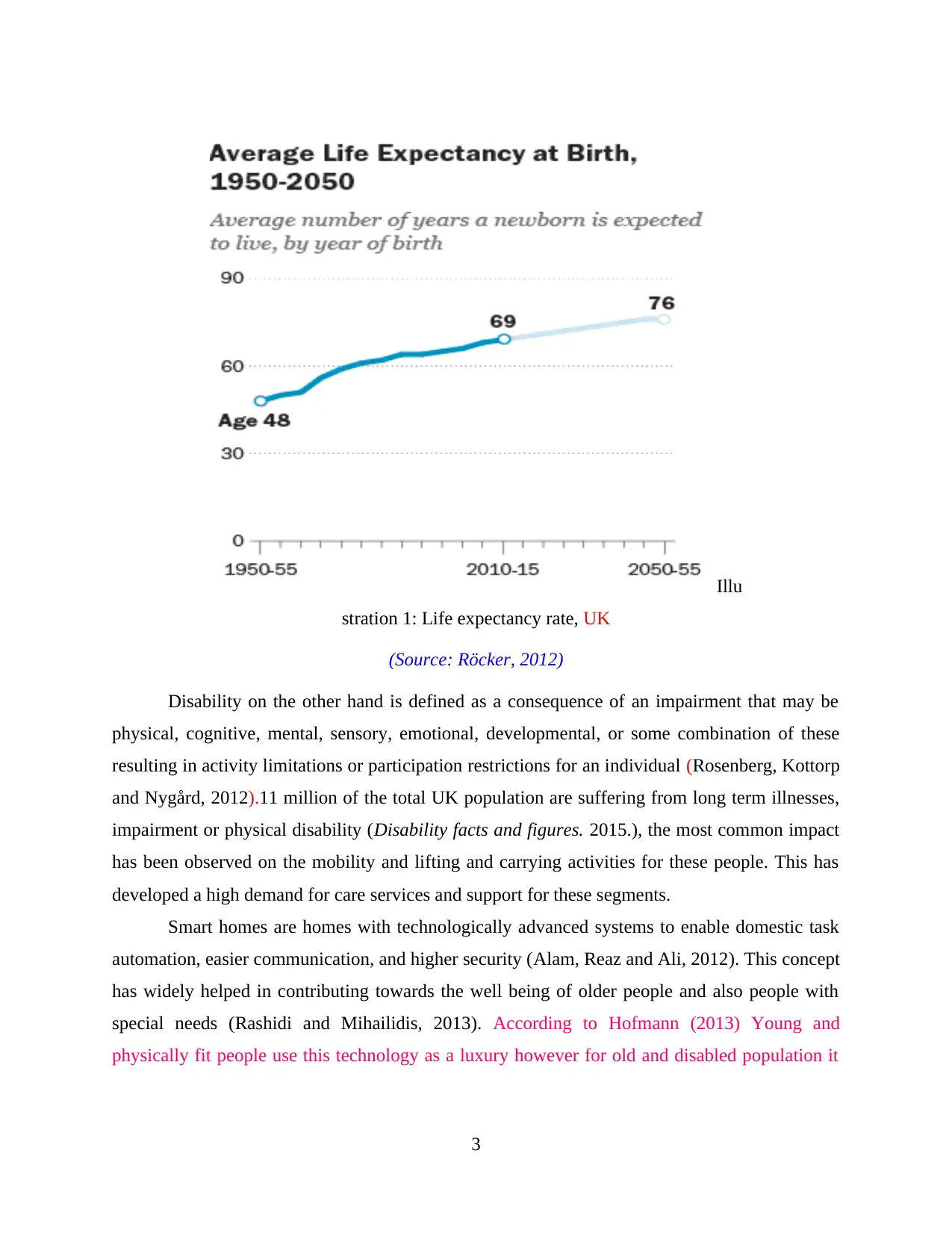
demographic has dramatically changed over 50 years time frame. In 1950s the life expectancy
rate of a person was 48 which have now increased to 69 years. The aged population of the world
is continuously increasing and creating an impact on the economies (Suryadevara and et.al.,
2012). Facts and findings in the field has shown that the ageing population has dramatically
increased in the last 30 years and is expected to grow by 50% by the year 2050 (Lotfi and et.al.,
2012).
2
1.1 Background of the study
An elderly person according to legal terms is defined as someone with an age of 65 years
or above (Hofmann, 2013). Medical development has effectively influenced human lives by
prolonging life expectancy, thus creating an impact on the population level. The Age
demographic has dramatically changed over 50 years time frame. In 1950s the life expectancy
rate of a person was 48 which have now increased to 69 years. The aged population of the world
is continuously increasing and creating an impact on the economies (Suryadevara and et.al.,
2012). Facts and findings in the field has shown that the ageing population has dramatically
increased in the last 30 years and is expected to grow by 50% by the year 2050 (Lotfi and et.al.,
2012).
2
Paraphrase This Document
Need a fresh take? Get an instant paraphrase of this document with our AI Paraphraser
Disability on the other hand is defined as a consequence of an impairment that may be
physical, cognitive, mental, sensory, emotional, developmental, or some combination of these
resulting in activity limitations or participation restrictions for an individual (Rosenberg, Kottorp
and Nygård, 2012).11 million of the total UK population are suffering from long term illnesses,
impairment or physical disability (Disability facts and figures. 2015.), the most common impact
has been observed on the mobility and lifting and carrying activities for these people. This has
developed a high demand for care services and support for these segments.
Smart homes are homes with technologically advanced systems to enable domestic task
automation, easier communication, and higher security (Alam, Reaz and Ali, 2012). This concept
has widely helped in contributing towards the well being of older people and also people with
special needs (Rashidi and Mihailidis, 2013). According to Hofmann (2013) Young and
physically fit people use this technology as a luxury however for old and disabled population it
3
Illu
stration 1: Life expectancy rate, UK
(Source: Röcker, 2012)
physical, cognitive, mental, sensory, emotional, developmental, or some combination of these
resulting in activity limitations or participation restrictions for an individual (Rosenberg, Kottorp
and Nygård, 2012).11 million of the total UK population are suffering from long term illnesses,
impairment or physical disability (Disability facts and figures. 2015.), the most common impact
has been observed on the mobility and lifting and carrying activities for these people. This has
developed a high demand for care services and support for these segments.
Smart homes are homes with technologically advanced systems to enable domestic task
automation, easier communication, and higher security (Alam, Reaz and Ali, 2012). This concept
has widely helped in contributing towards the well being of older people and also people with
special needs (Rashidi and Mihailidis, 2013). According to Hofmann (2013) Young and
physically fit people use this technology as a luxury however for old and disabled population it
3
Illu
stration 1: Life expectancy rate, UK
(Source: Röcker, 2012)
acts as a source of necessity. Thus, technology has an individual role for different people
residing in the economy.
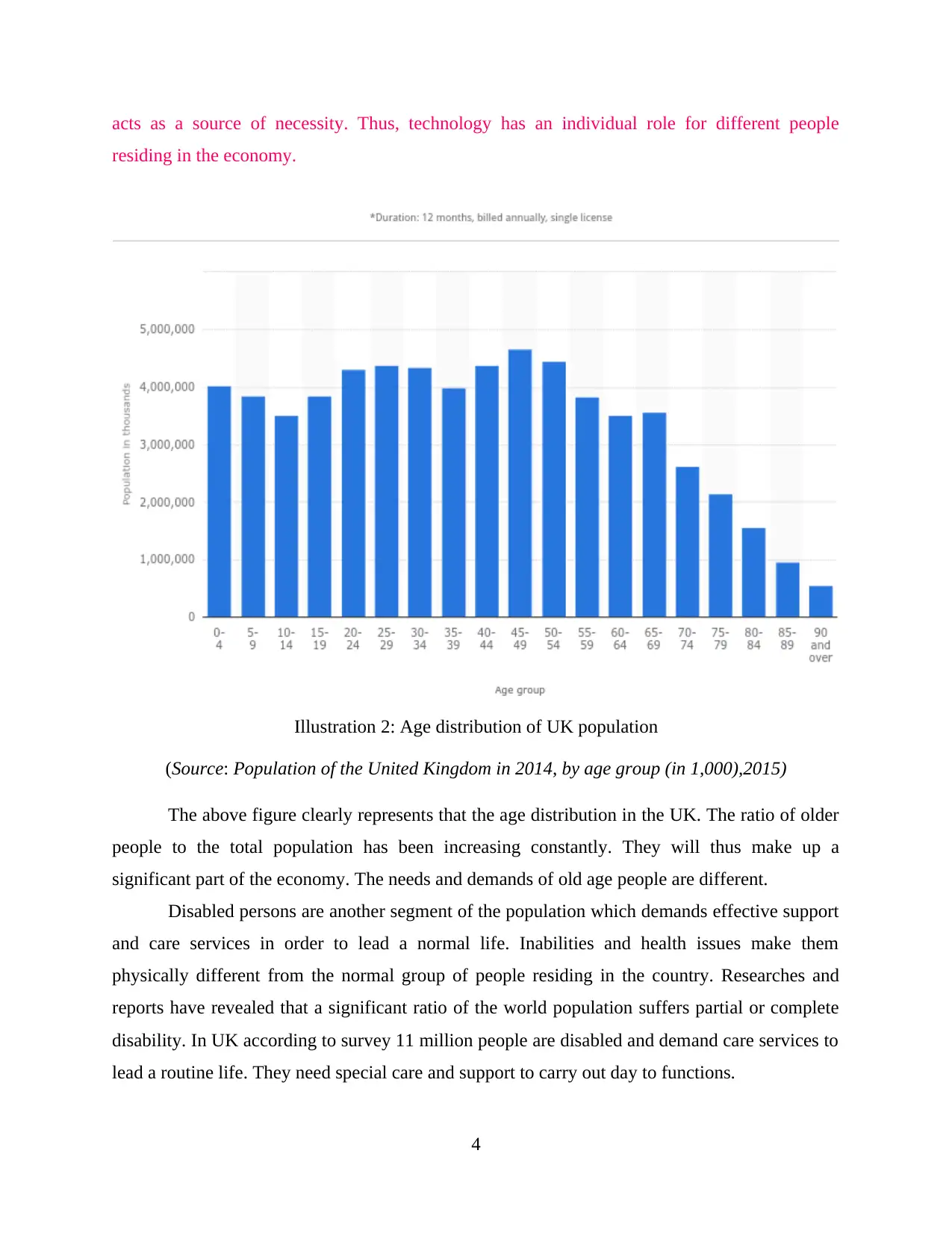
The above figure clearly represents that the age distribution in the UK. The ratio of older
people to the total population has been increasing constantly. They will thus make up a
significant part of the economy. The needs and demands of old age people are different.
Disabled persons are another segment of the population which demands effective support
and care services in order to lead a normal life. Inabilities and health issues make them
physically different from the normal group of people residing in the country. Researches and
reports have revealed that a significant ratio of the world population suffers partial or complete
disability. In UK according to survey 11 million people are disabled and demand care services to
lead a routine life. They need special care and support to carry out day to functions.
4
Illustration 2: Age distribution of UK population
(Source: Population of the United Kingdom in 2014, by age group (in 1,000),2015)
residing in the economy.
The above figure clearly represents that the age distribution in the UK. The ratio of older
people to the total population has been increasing constantly. They will thus make up a
significant part of the economy. The needs and demands of old age people are different.
Disabled persons are another segment of the population which demands effective support
and care services in order to lead a normal life. Inabilities and health issues make them
physically different from the normal group of people residing in the country. Researches and
reports have revealed that a significant ratio of the world population suffers partial or complete
disability. In UK according to survey 11 million people are disabled and demand care services to
lead a routine life. They need special care and support to carry out day to functions.
4
Illustration 2: Age distribution of UK population
(Source: Population of the United Kingdom in 2014, by age group (in 1,000),2015)
⊘ This is a preview!⊘
Do you want full access?
Subscribe today to unlock all pages.
Trusted by 1+ million students worldwide

The above figure clearly represents that large part of the UK population has different
needs and demands from rest of the population. 11.85 million People at present are above the age
of 65 years who are mostly retired or have minimum access to earning. While 11 million people,
suffer from some or other kind of disability (Refer appendix A1.) (Facts and statistics, 2015).
They demand special care services to carry out their routine lives because due to their special
needs they are dependent on other to live a usual life (Chen, Nugent and Wang, 2012). It
increases dependency and thus demands proper and regular care for a person. Developing
technologies and change lifestyles of people has created a direct impact on issues related to
support and independent living for elder and disabled people. Health issue and increasing level
of dependency will demand the need of higher care services such as residential care, medical
care, independent living etc. Adopting technologies for care taking services will help in
supporting the segment definitely for elder or disabled people (Analysis of UK long term care
market, 2016).
The framework of smart homes focuses on providing the five basic features to service
users which include automation, multi functionality, adaptability, interactivity and efficiency
(Baig and Gholamhosseini, 2013). Advanced technologies such as alarms, sensitive detector,
automatic lightings, smart and easily accessible media etc. are the key support of these care
5
Illustration 3: Elderly and Disabled population of UK (2015)
(Source: Self attempted)
needs and demands from rest of the population. 11.85 million People at present are above the age
of 65 years who are mostly retired or have minimum access to earning. While 11 million people,
suffer from some or other kind of disability (Refer appendix A1.) (Facts and statistics, 2015).
They demand special care services to carry out their routine lives because due to their special
needs they are dependent on other to live a usual life (Chen, Nugent and Wang, 2012). It
increases dependency and thus demands proper and regular care for a person. Developing
technologies and change lifestyles of people has created a direct impact on issues related to
support and independent living for elder and disabled people. Health issue and increasing level
of dependency will demand the need of higher care services such as residential care, medical
care, independent living etc. Adopting technologies for care taking services will help in
supporting the segment definitely for elder or disabled people (Analysis of UK long term care
market, 2016).
The framework of smart homes focuses on providing the five basic features to service
users which include automation, multi functionality, adaptability, interactivity and efficiency
(Baig and Gholamhosseini, 2013). Advanced technologies such as alarms, sensitive detector,
automatic lightings, smart and easily accessible media etc. are the key support of these care
5
Illustration 3: Elderly and Disabled population of UK (2015)
(Source: Self attempted)
Paraphrase This Document
Need a fresh take? Get an instant paraphrase of this document with our AI Paraphraser
homes. The UK has adopted the concept in order to create an effective impact on the growth and
development of the economy. The present report will focus on analysing the effect of smart
home technologies to support disabled and elderly people in the UK. It will help the researcher in
determining the impact of smart home technologies of well being of elder and disabled people. It
will also address the issue regarding factors contributing is the growth of smart home
technologies. It will determine the effect of ageing and disability on the country and the level to
which the new technologies will help in creating a positive impact for the same.
1.2 Rationale of the study
The concept of smart homes is developing in the world. People are demanding effective
use of technologies to support elder and disabled people in order to make their lives easy and
independent. The proposed subject has started developing its base in the UK market as well.
Statistics reveal that the ratio of older and disabled people is consistently rising in the world’s
population. In order to provide them with an effective and independent life technologies are
widely being used to create supportive measures for them. Smart homes have created a
revolutionary impact on the development phase of the world. It has helped in rising
independence level of older people and elderly and disabled segment. Presently economies are
focusing on developing their growth rate by empowering individuals and developing nation
through high standards of living. The medical services are developing smart home technologies
to provide advanced services to the patients. NHS has developed its first community based smart
home in Aliquippa (NHS ALLEGHENY VALLEY SCHOOL OPENS FIRST SMART HOME,
2016). The residents represent greater independence and effective living conditions. UK may
focus on providing similar services to its residents in order to enhance effective living for elders
and disabled. It will help the researcher in determining the impact of smart home technologies of
well being of elder and disabled people. It will also address the issue regarding factors
contributing is the growth of smart home technologies. It will determine the effect of ageing and
disability on the country and the level to which the new technologies will help in creating a
positive impact for the same.
6
development of the economy. The present report will focus on analysing the effect of smart
home technologies to support disabled and elderly people in the UK. It will help the researcher in
determining the impact of smart home technologies of well being of elder and disabled people. It
will also address the issue regarding factors contributing is the growth of smart home
technologies. It will determine the effect of ageing and disability on the country and the level to
which the new technologies will help in creating a positive impact for the same.
1.2 Rationale of the study
The concept of smart homes is developing in the world. People are demanding effective
use of technologies to support elder and disabled people in order to make their lives easy and
independent. The proposed subject has started developing its base in the UK market as well.
Statistics reveal that the ratio of older and disabled people is consistently rising in the world’s
population. In order to provide them with an effective and independent life technologies are
widely being used to create supportive measures for them. Smart homes have created a
revolutionary impact on the development phase of the world. It has helped in rising
independence level of older people and elderly and disabled segment. Presently economies are
focusing on developing their growth rate by empowering individuals and developing nation
through high standards of living. The medical services are developing smart home technologies
to provide advanced services to the patients. NHS has developed its first community based smart
home in Aliquippa (NHS ALLEGHENY VALLEY SCHOOL OPENS FIRST SMART HOME,
2016). The residents represent greater independence and effective living conditions. UK may
focus on providing similar services to its residents in order to enhance effective living for elders
and disabled. It will help the researcher in determining the impact of smart home technologies of
well being of elder and disabled people. It will also address the issue regarding factors
contributing is the growth of smart home technologies. It will determine the effect of ageing and
disability on the country and the level to which the new technologies will help in creating a
positive impact for the same.
6
CHAPTER 2 LITERATURE REVIEW
2.1 Introduction
Smart home is a new and emerging concept for the economy of UK. The need of aged
and disabled people within the economy is high. The projected statistical data clearly reveals that
the population of the elderly is going to rise in future which will create a significant demand for
care services for the same. Smart home is an effective solution for managing the health
conditions and independent living for elder people. Technological support and aid will raise the
level of independence for this population segments. This part of the study will focus on
developing intensive secondary research on the topic in order to attain the facts, figures and
analysis of the market. It will carry out an extensive research for analysing and understanding the
theoretical aspects of smart home concept, technologies involves and factors contribution in its
growth. This will help in developing a clear and in-depth analysis of the topic and discussion. It
will help the researcher in understanding the concept and contribution of past researchers on
similar topic. Herein, the literatures which are related with the health and social care sector as
well as smart home technologies will be reviewed. This is done in order to get detailed
knowledge about the selected topic under study in an effective manner.
2.2 Smart home concept
According to Chen and et.al., (2012) twenty-first century is the conceptual age where
technology and digitalization has developed deep roots in daily routines such as day to day
communication using phones, internet, automation of tasks using appliances such as coffee
maker, microwave; security needs etc. small to big needs of the individuals who are individuals.
The concept is developing and emerging in the economy as companies are commercializing
smart home technologies according to customized needs of individuals. Chen, Nugent and Wang
(2012) states that the major factors which contributes as turning points for smart home concepts
includes introduction to domestic technology in day to day living measures, education
entertainment etc. and integration of information technology in modern families which they look
for (fast paced lives, demand for high security, individual living, moving for better opportunities
etc) . This helped people in adopting effective and modern gadgets to carry out day to activities.
The concept emerged and is still developing to provide a comfortable and supportive
environment to live to individuals. Scientists and researchers are trying to develop technology to
7
2.1 Introduction
Smart home is a new and emerging concept for the economy of UK. The need of aged
and disabled people within the economy is high. The projected statistical data clearly reveals that
the population of the elderly is going to rise in future which will create a significant demand for
care services for the same. Smart home is an effective solution for managing the health
conditions and independent living for elder people. Technological support and aid will raise the
level of independence for this population segments. This part of the study will focus on
developing intensive secondary research on the topic in order to attain the facts, figures and
analysis of the market. It will carry out an extensive research for analysing and understanding the
theoretical aspects of smart home concept, technologies involves and factors contribution in its
growth. This will help in developing a clear and in-depth analysis of the topic and discussion. It
will help the researcher in understanding the concept and contribution of past researchers on
similar topic. Herein, the literatures which are related with the health and social care sector as
well as smart home technologies will be reviewed. This is done in order to get detailed
knowledge about the selected topic under study in an effective manner.
2.2 Smart home concept
According to Chen and et.al., (2012) twenty-first century is the conceptual age where
technology and digitalization has developed deep roots in daily routines such as day to day
communication using phones, internet, automation of tasks using appliances such as coffee
maker, microwave; security needs etc. small to big needs of the individuals who are individuals.
The concept is developing and emerging in the economy as companies are commercializing
smart home technologies according to customized needs of individuals. Chen, Nugent and Wang
(2012) states that the major factors which contributes as turning points for smart home concepts
includes introduction to domestic technology in day to day living measures, education
entertainment etc. and integration of information technology in modern families which they look
for (fast paced lives, demand for high security, individual living, moving for better opportunities
etc) . This helped people in adopting effective and modern gadgets to carry out day to activities.
The concept emerged and is still developing to provide a comfortable and supportive
environment to live to individuals. Scientists and researchers are trying to develop technology to
7
⊘ This is a preview!⊘
Do you want full access?
Subscribe today to unlock all pages.
Trusted by 1+ million students worldwide

1 out of 44


Related Documents


Your All-in-One AI-Powered Toolkit for Academic Success.
+13062052269
info@desklib.com
Available 24*7 on WhatsApp / Email
![[object Object]](/_next/static/media/star-bottom.7253800d.svg)
Unlock your academic potential
Copyright © 2020–2026 A2Z Services. All Rights Reserved. Developed and managed by ZUCOL.