Misbehaving Public Transport Drivers Reporting System Using Smartphone
VerifiedAdded on 2021/08/19
|67
|16702
|228
Project
AI Summary
This project paper, submitted to the Department of Computer Science at Addis Ababa University in partial fulfillment of a Master of Science degree, presents a smartphone-based reporting system designed to address the issue of misbehaving public transport drivers in Addis Ababa. The system allows passengers and other users to report drivers' bad behavior, such as speeding and drunk driving, to the traffic police using their smartphones. The project utilizes GPS to track locations and aims to reduce traffic accidents by providing an easy and efficient way to report dangerous driving. The paper includes an introduction, literature review, system analysis, design, implementation details, and conclusions, along with relevant diagrams, tables, and source code snippets. The system was tested in Addis Ababa, demonstrating its functionality and potential to improve road safety. This project contributes to the development of a practical solution for reporting dangerous driving behaviors and enhancing public transport safety.
ADDIS ABABA UNIVERSITY
COLLEGE OF NATURAL SCIENCES
DEPARTMENT OF COMPUTER SCIENCE
Misbehaving Public Transport Drivers Reporting System Using
Smart Phone
Shimels Bizuneh
A Project Paper Submitted to Department of Computer Science in Partial
Fulfillment of the Requirements for the Degree of Master of Science in Computer
Science
Addis Ababa, Ethiopia
October 30, 2019
COLLEGE OF NATURAL SCIENCES
DEPARTMENT OF COMPUTER SCIENCE
Misbehaving Public Transport Drivers Reporting System Using
Smart Phone
Shimels Bizuneh
A Project Paper Submitted to Department of Computer Science in Partial
Fulfillment of the Requirements for the Degree of Master of Science in Computer
Science
Addis Ababa, Ethiopia
October 30, 2019

Paraphrase This Document
Need a fresh take? Get an instant paraphrase of this document with our AI Paraphraser
ADDIS ABABA UNIVERSITY
COLLEGE OF NATURAL SCIENCE
Misbehaving Public Transport Drivers Reporting System Using
Smart Phone
Advisor: Dida Midekso(PHD)
This is to certify that the project prepared by Shimels Bizuneh, titled: Misbehaving public
transport drivers reporting system using smart phone and submitted in partial fulfillment of the
requirements for the Degree of Master of Science in Computer Science complies with the
regulations of the University and meets the accepted standards with respect to originality and
quality.
Signed by the Examining Committee:
Name Signature Date
Advisor: ______________________ _______________ ____________
Examiner_____________________ _______________ ____________
Examiner: ____________________ _______________ ____________
COLLEGE OF NATURAL SCIENCE
Misbehaving Public Transport Drivers Reporting System Using
Smart Phone
Advisor: Dida Midekso(PHD)
This is to certify that the project prepared by Shimels Bizuneh, titled: Misbehaving public
transport drivers reporting system using smart phone and submitted in partial fulfillment of the
requirements for the Degree of Master of Science in Computer Science complies with the
regulations of the University and meets the accepted standards with respect to originality and
quality.
Signed by the Examining Committee:
Name Signature Date
Advisor: ______________________ _______________ ____________
Examiner_____________________ _______________ ____________
Examiner: ____________________ _______________ ____________
Abstract
People use different transportation methods to move from one place to another for different
reasons. Public transportation, taxi and bus, is widely used for moving many people from one
place to another. Many people live in Addis Ababa use these public transportations for their day
to day activities. As public transportation has many benefits, it has problems that affect the
passenger and sometime the reason to injure, disable and kill many people.
Most of the problems are caused by drivers, some of them are, over speed, overload, drunk and
other. People face these problems every day and they don’t have easy way to report these
problems to the right authority.
This project is done to reduce the problems and accidents mentioned above on public transport
cars, taxis and bus, by providing an easy way to passengers and others to report on the drivers’
bad behavior and actions during driving to the traffic polices using smart phone.
The system has been tested on sample data in some area of Addis Ababa. It found that the system
is working as expected and help the passengers to report the problems that they face while they
use public transport cars.
Keywords:
Public transport, Misbehave drivers, Bad behavior drivers, Traffic accidents, Passengers,
Reporting system.
People use different transportation methods to move from one place to another for different
reasons. Public transportation, taxi and bus, is widely used for moving many people from one
place to another. Many people live in Addis Ababa use these public transportations for their day
to day activities. As public transportation has many benefits, it has problems that affect the
passenger and sometime the reason to injure, disable and kill many people.
Most of the problems are caused by drivers, some of them are, over speed, overload, drunk and
other. People face these problems every day and they don’t have easy way to report these
problems to the right authority.
This project is done to reduce the problems and accidents mentioned above on public transport
cars, taxis and bus, by providing an easy way to passengers and others to report on the drivers’
bad behavior and actions during driving to the traffic polices using smart phone.
The system has been tested on sample data in some area of Addis Ababa. It found that the system
is working as expected and help the passengers to report the problems that they face while they
use public transport cars.
Keywords:
Public transport, Misbehave drivers, Bad behavior drivers, Traffic accidents, Passengers,
Reporting system.
⊘ This is a preview!⊘
Do you want full access?
Subscribe today to unlock all pages.

Trusted by 1+ million students worldwide

Acknowledgment
First and foremost, I would like to thank the almighty God who blessed me in every step of my
life.
A big thank to my advisor Dr. Dida Midekso. This project would not be successfully completed
without the guidance, supervision and advice of you. You have supported me throughout my
project with your valuable insights, knowledge and patience. I have learned a lot from you; thank
you very much again.
My special heartily thanks and love to my wife, Birtukan Belayneh, whose encouragement and
unreserved support helped me to complete my work successfully. It is my great pleasure to have
you in my life.
First and foremost, I would like to thank the almighty God who blessed me in every step of my
life.
A big thank to my advisor Dr. Dida Midekso. This project would not be successfully completed
without the guidance, supervision and advice of you. You have supported me throughout my
project with your valuable insights, knowledge and patience. I have learned a lot from you; thank
you very much again.
My special heartily thanks and love to my wife, Birtukan Belayneh, whose encouragement and
unreserved support helped me to complete my work successfully. It is my great pleasure to have
you in my life.
Paraphrase This Document
Need a fresh take? Get an instant paraphrase of this document with our AI Paraphraser
i
Contents
List of Tables ..................................................................................................................................... iii
List of Figures .................................................................................................................................... iv
Abbreviations .................................................................................................................................... v
Chapter One: Introduction .................................................................................................................1
1.1 Background ................................................................................................................................... 1
1.2 Motivation ..................................................................................................................................... 2
1.3 Statement of the Problem ............................................................................................................ 2
1.4 Objectives...................................................................................................................................... 3
1.5 Methodology ................................................................................................................................. 3
1.6 Scope and Limitations ................................................................................................................... 4
1.7 Application Results ........................................................................................................................ 4
1.8 Organization of the Document ..................................................................................................... 5
Chapter Two: Literature Review .........................................................................................................6
2.1 Public Transport ............................................................................................................................ 6
2.2 Misbehaving Derivers ................................................................................................................... 6
2.3 Reporting system .......................................................................................................................... 7
2.4 Global Positioning System(GPS) .................................................................................................... 7
2.5 Mobile Internet ............................................................................................................................. 8
2.6 Short Message Service (SMS) ........................................................................................................ 8
2.7 ODK Collect ................................................................................................................................... 9
2.8 OpenStreetMap(OSM) .................................................................................................................. 9
Chapter Three: Related Work ........................................................................................................... 10
3.1 Detecting Aggressive Deriving using smart phone ..................................................................... 10
Chapter Four: System Analysis ......................................................................................................... 13
3.1 Overview ..................................................................................................................................... 13
3.2 Functional Requirement ............................................................................................................. 13
3.3 Non Functional Requirement ...................................................................................................... 13
3.4 System Model ............................................................................................................................. 14
3.4.1 Use Case Diagram ................................................................................................................... 14
3.4.2 Class Diagram .......................................................................................................................... 23
Contents
List of Tables ..................................................................................................................................... iii
List of Figures .................................................................................................................................... iv
Abbreviations .................................................................................................................................... v
Chapter One: Introduction .................................................................................................................1
1.1 Background ................................................................................................................................... 1
1.2 Motivation ..................................................................................................................................... 2
1.3 Statement of the Problem ............................................................................................................ 2
1.4 Objectives...................................................................................................................................... 3
1.5 Methodology ................................................................................................................................. 3
1.6 Scope and Limitations ................................................................................................................... 4
1.7 Application Results ........................................................................................................................ 4
1.8 Organization of the Document ..................................................................................................... 5
Chapter Two: Literature Review .........................................................................................................6
2.1 Public Transport ............................................................................................................................ 6
2.2 Misbehaving Derivers ................................................................................................................... 6
2.3 Reporting system .......................................................................................................................... 7
2.4 Global Positioning System(GPS) .................................................................................................... 7
2.5 Mobile Internet ............................................................................................................................. 8
2.6 Short Message Service (SMS) ........................................................................................................ 8
2.7 ODK Collect ................................................................................................................................... 9
2.8 OpenStreetMap(OSM) .................................................................................................................. 9
Chapter Three: Related Work ........................................................................................................... 10
3.1 Detecting Aggressive Deriving using smart phone ..................................................................... 10
Chapter Four: System Analysis ......................................................................................................... 13
3.1 Overview ..................................................................................................................................... 13
3.2 Functional Requirement ............................................................................................................. 13
3.3 Non Functional Requirement ...................................................................................................... 13
3.4 System Model ............................................................................................................................. 14
3.4.1 Use Case Diagram ................................................................................................................... 14
3.4.2 Class Diagram .......................................................................................................................... 23
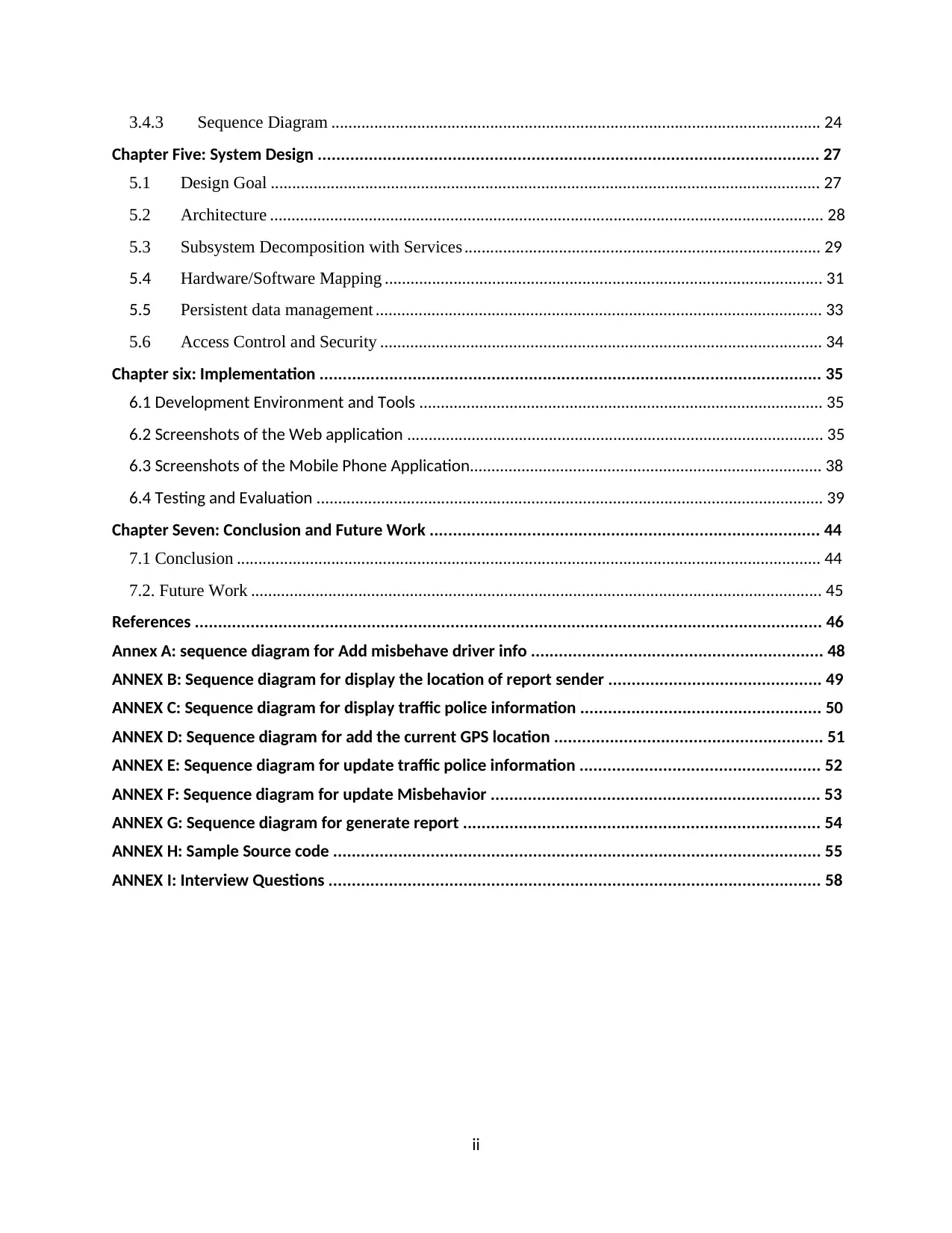
ii
3.4.3 Sequence Diagram .................................................................................................................. 24
Chapter Five: System Design ............................................................................................................ 27
5.1 Design Goal ................................................................................................................................ 27
5.2 Architecture ................................................................................................................................. 28
5.3 Subsystem Decomposition with Services ................................................................................... 29
5.4 Hardware/Software Mapping ...................................................................................................... 31
5.5 Persistent data management ........................................................................................................ 33
5.6 Access Control and Security ....................................................................................................... 34
Chapter six: Implementation ............................................................................................................ 35
6.1 Development Environment and Tools .............................................................................................. 35
6.2 Screenshots of the Web application ................................................................................................. 35
6.3 Screenshots of the Mobile Phone Application.................................................................................. 38
6.4 Testing and Evaluation ...................................................................................................................... 39
Chapter Seven: Conclusion and Future Work .................................................................................... 44
7.1 Conclusion ........................................................................................................................................ 44
7.2. Future Work ..................................................................................................................................... 45
References ....................................................................................................................................... 46
Annex A: sequence diagram for Add misbehave driver info ............................................................... 48
ANNEX B: Sequence diagram for display the location of report sender .............................................. 49
ANNEX C: Sequence diagram for display traffic police information .................................................... 50
ANNEX D: Sequence diagram for add the current GPS location .......................................................... 51
ANNEX E: Sequence diagram for update traffic police information .................................................... 52
ANNEX F: Sequence diagram for update Misbehavior ....................................................................... 53
ANNEX G: Sequence diagram for generate report ............................................................................. 54
ANNEX H: Sample Source code ......................................................................................................... 55
ANNEX I: Interview Questions .......................................................................................................... 58
3.4.3 Sequence Diagram .................................................................................................................. 24
Chapter Five: System Design ............................................................................................................ 27
5.1 Design Goal ................................................................................................................................ 27
5.2 Architecture ................................................................................................................................. 28
5.3 Subsystem Decomposition with Services ................................................................................... 29
5.4 Hardware/Software Mapping ...................................................................................................... 31
5.5 Persistent data management ........................................................................................................ 33
5.6 Access Control and Security ....................................................................................................... 34
Chapter six: Implementation ............................................................................................................ 35
6.1 Development Environment and Tools .............................................................................................. 35
6.2 Screenshots of the Web application ................................................................................................. 35
6.3 Screenshots of the Mobile Phone Application.................................................................................. 38
6.4 Testing and Evaluation ...................................................................................................................... 39
Chapter Seven: Conclusion and Future Work .................................................................................... 44
7.1 Conclusion ........................................................................................................................................ 44
7.2. Future Work ..................................................................................................................................... 45
References ....................................................................................................................................... 46
Annex A: sequence diagram for Add misbehave driver info ............................................................... 48
ANNEX B: Sequence diagram for display the location of report sender .............................................. 49
ANNEX C: Sequence diagram for display traffic police information .................................................... 50
ANNEX D: Sequence diagram for add the current GPS location .......................................................... 51
ANNEX E: Sequence diagram for update traffic police information .................................................... 52
ANNEX F: Sequence diagram for update Misbehavior ....................................................................... 53
ANNEX G: Sequence diagram for generate report ............................................................................. 54
ANNEX H: Sample Source code ......................................................................................................... 55
ANNEX I: Interview Questions .......................................................................................................... 58
⊘ This is a preview!⊘
Do you want full access?
Subscribe today to unlock all pages.
Trusted by 1+ million students worldwide
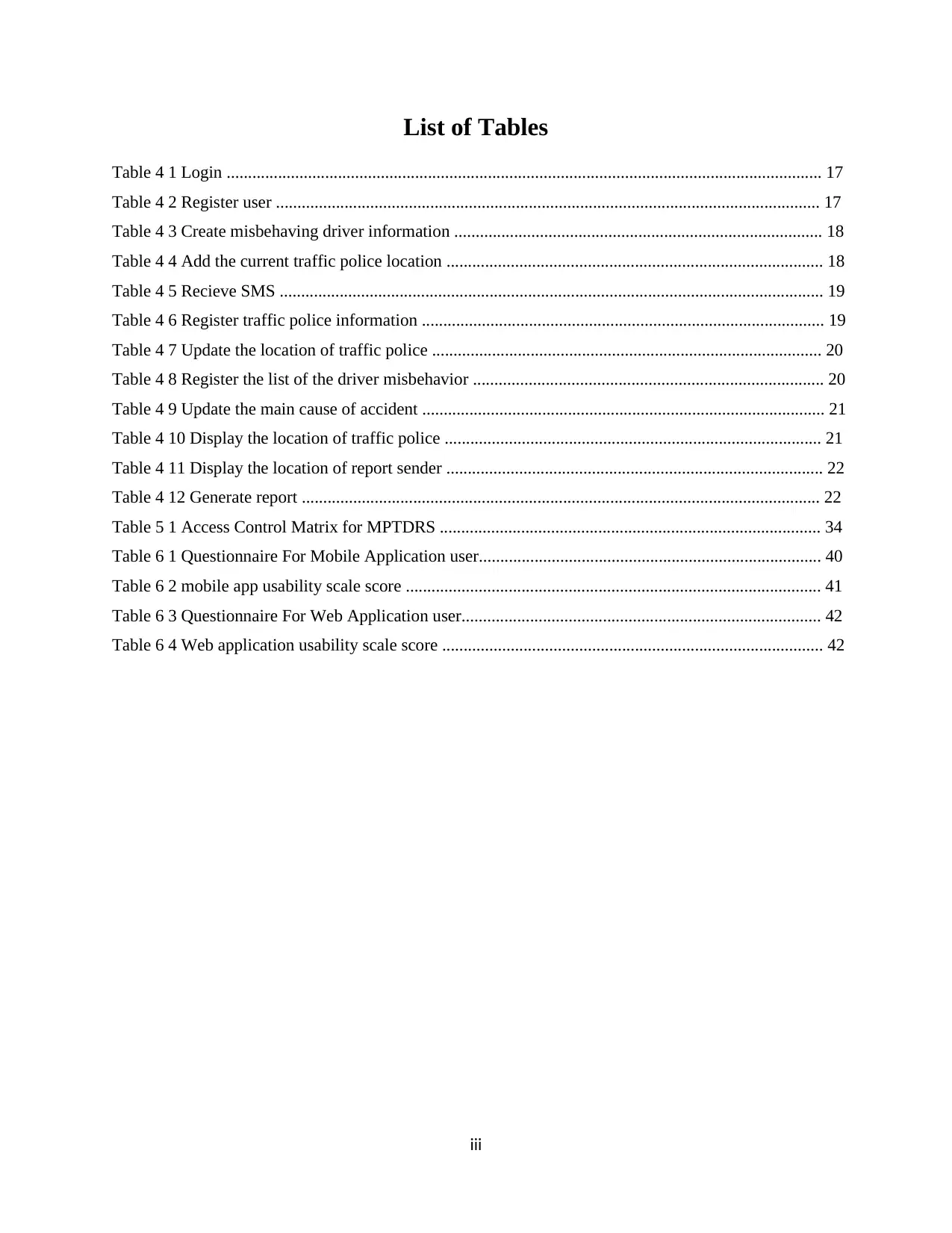
iii
List of Tables
Table 4 1 Login ........................................................................................................................................... 17
Table 4 2 Register user ............................................................................................................................... 17
Table 4 3 Create misbehaving driver information ...................................................................................... 18
Table 4 4 Add the current traffic police location ........................................................................................ 18
Table 4 5 Recieve SMS ............................................................................................................................... 19
Table 4 6 Register traffic police information .............................................................................................. 19
Table 4 7 Update the location of traffic police ........................................................................................... 20
Table 4 8 Register the list of the driver misbehavior .................................................................................. 20
Table 4 9 Update the main cause of accident .............................................................................................. 21
Table 4 10 Display the location of traffic police ........................................................................................ 21
Table 4 11 Display the location of report sender ........................................................................................ 22
Table 4 12 Generate report ......................................................................................................................... 22
Table 5 1 Access Control Matrix for MPTDRS ......................................................................................... 34
Table 6 1 Questionnaire For Mobile Application user................................................................................ 40
Table 6 2 mobile app usability scale score ................................................................................................. 41
Table 6 3 Questionnaire For Web Application user.................................................................................... 42
Table 6 4 Web application usability scale score ......................................................................................... 42
List of Tables
Table 4 1 Login ........................................................................................................................................... 17
Table 4 2 Register user ............................................................................................................................... 17
Table 4 3 Create misbehaving driver information ...................................................................................... 18
Table 4 4 Add the current traffic police location ........................................................................................ 18
Table 4 5 Recieve SMS ............................................................................................................................... 19
Table 4 6 Register traffic police information .............................................................................................. 19
Table 4 7 Update the location of traffic police ........................................................................................... 20
Table 4 8 Register the list of the driver misbehavior .................................................................................. 20
Table 4 9 Update the main cause of accident .............................................................................................. 21
Table 4 10 Display the location of traffic police ........................................................................................ 21
Table 4 11 Display the location of report sender ........................................................................................ 22
Table 4 12 Generate report ......................................................................................................................... 22
Table 5 1 Access Control Matrix for MPTDRS ......................................................................................... 34
Table 6 1 Questionnaire For Mobile Application user................................................................................ 40
Table 6 2 mobile app usability scale score ................................................................................................. 41
Table 6 3 Questionnaire For Web Application user.................................................................................... 42
Table 6 4 Web application usability scale score ......................................................................................... 42
Paraphrase This Document
Need a fresh take? Get an instant paraphrase of this document with our AI Paraphraser
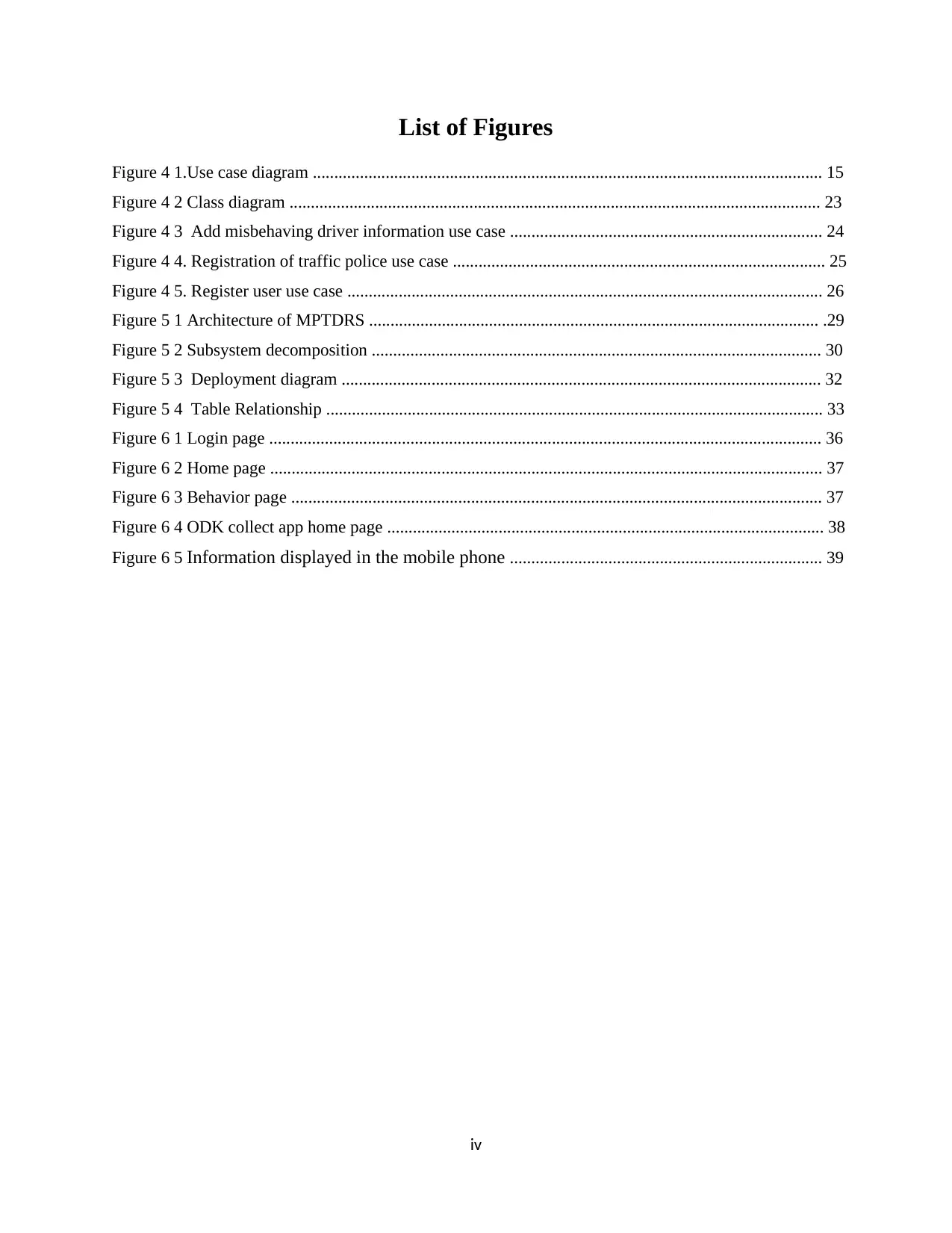
iv
List of Figures
Figure 4 1.Use case diagram ....................................................................................................................... 15
Figure 4 2 Class diagram ............................................................................................................................ 23
Figure 4 3 Add misbehaving driver information use case ......................................................................... 24
Figure 4 4. Registration of traffic police use case ....................................................................................... 25
Figure 4 5. Register user use case ............................................................................................................... 26
Figure 5 1 Architecture of MPTDRS ......................................................................................................... .29
Figure 5 2 Subsystem decomposition ......................................................................................................... 30
Figure 5 3 Deployment diagram ................................................................................................................ 32
Figure 5 4 Table Relationship .................................................................................................................... 33
Figure 6 1 Login page ................................................................................................................................. 36
Figure 6 2 Home page ................................................................................................................................. 37
Figure 6 3 Behavior page ............................................................................................................................ 37
Figure 6 4 ODK collect app home page ...................................................................................................... 38
Figure 6 5 Information displayed in the mobile phone ......................................................................... 39
List of Figures
Figure 4 1.Use case diagram ....................................................................................................................... 15
Figure 4 2 Class diagram ............................................................................................................................ 23
Figure 4 3 Add misbehaving driver information use case ......................................................................... 24
Figure 4 4. Registration of traffic police use case ....................................................................................... 25
Figure 4 5. Register user use case ............................................................................................................... 26
Figure 5 1 Architecture of MPTDRS ......................................................................................................... .29
Figure 5 2 Subsystem decomposition ......................................................................................................... 30
Figure 5 3 Deployment diagram ................................................................................................................ 32
Figure 5 4 Table Relationship .................................................................................................................... 33
Figure 6 1 Login page ................................................................................................................................. 36
Figure 6 2 Home page ................................................................................................................................. 37
Figure 6 3 Behavior page ............................................................................................................................ 37
Figure 6 4 ODK collect app home page ...................................................................................................... 38
Figure 6 5 Information displayed in the mobile phone ......................................................................... 39
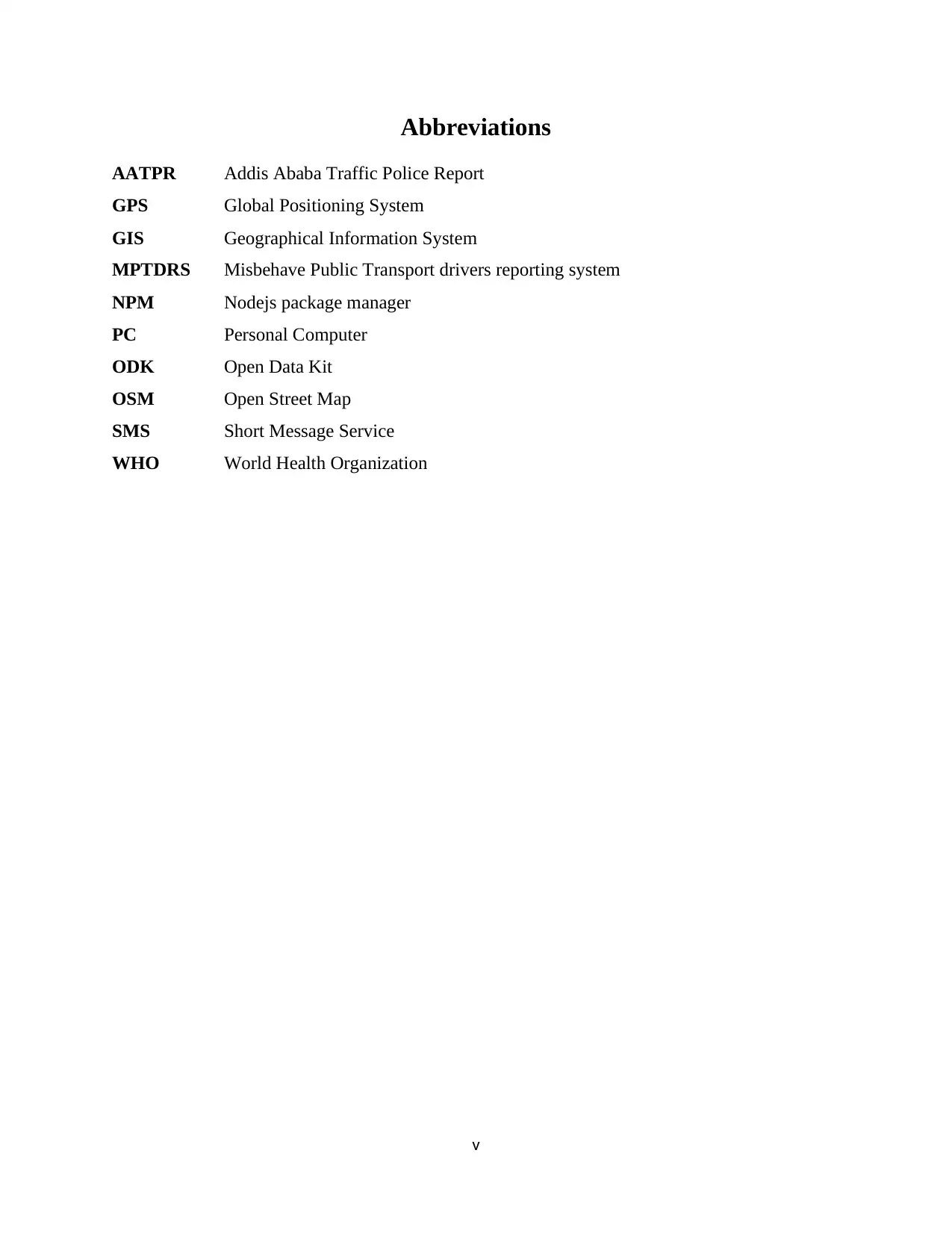
v
Abbreviations
AATPR Addis Ababa Traffic Police Report
GPS Global Positioning System
GIS Geographical Information System
MPTDRS Misbehave Public Transport drivers reporting system
NPM Nodejs package manager
PC Personal Computer
ODK Open Data Kit
OSM Open Street Map
SMS Short Message Service
WHO World Health Organization
Abbreviations
AATPR Addis Ababa Traffic Police Report
GPS Global Positioning System
GIS Geographical Information System
MPTDRS Misbehave Public Transport drivers reporting system
NPM Nodejs package manager
PC Personal Computer
ODK Open Data Kit
OSM Open Street Map
SMS Short Message Service
WHO World Health Organization
⊘ This is a preview!⊘
Do you want full access?
Subscribe today to unlock all pages.
Trusted by 1+ million students worldwide
1
Chapter One: Introduction
1.1 Background
People use different transportation methods to move from one place to another for different
reasons. Public transportation, taxi and bus, is widely used for moving many people from one
place to another. As public transportation has many benefits, it is also the reason to injure,
disable and kill many people.
In Ethiopia, the number of deaths due to traffic accidents is reported to be amongst the highest in
the world. According to the WHO, in 2013 the road crash fatality rate in Ethiopia was 4984.3
deaths per 100,000 vehicles per year, compared to 574 across sub-Saharan African countries. In
general, the scale and the severity of the problem are increasing from time to time and adversely
affecting the economy of the country in general and the livelihood of individuals in particular
[1].
It is a daily trend for us to hear lot of accident in media happen mainly because of over speeding
of vehicle i.e. rash driving, not following sign board and fatigue states of driver like drowsy,
drunken state [2].
Drivers are the major cause of most accidents according to traffic police report. Trucks and
minibus taxis were involved in the majority of crashes, while automobiles (small vehicles) were
less involved in crashes relative to other vehicle types [3].
It is important to decrease the rate of traffic accidents to reduce not only human casualties but
also medical expenses, damages of vehicles and road facilities, congestion due to accidents, and
other economic losses (such as losses of production) [4].
Controlling each driver is difficult because of the limited number traffic police in the country.
Drivers follow the rule when there is traffic police around so this is what makes it difficult to
reduce the accident.
Currently, Smart phones are widely used for different purpose. These smart phones have built-in
GPS (Global positioning system) device which use to determine the current position and can
download and use different applications [5]. This project will help passengers and other to
submit dangerous drivers’ information including their location to the nearest traffic police using
smart phone.
Chapter One: Introduction
1.1 Background
People use different transportation methods to move from one place to another for different
reasons. Public transportation, taxi and bus, is widely used for moving many people from one
place to another. As public transportation has many benefits, it is also the reason to injure,
disable and kill many people.
In Ethiopia, the number of deaths due to traffic accidents is reported to be amongst the highest in
the world. According to the WHO, in 2013 the road crash fatality rate in Ethiopia was 4984.3
deaths per 100,000 vehicles per year, compared to 574 across sub-Saharan African countries. In
general, the scale and the severity of the problem are increasing from time to time and adversely
affecting the economy of the country in general and the livelihood of individuals in particular
[1].
It is a daily trend for us to hear lot of accident in media happen mainly because of over speeding
of vehicle i.e. rash driving, not following sign board and fatigue states of driver like drowsy,
drunken state [2].
Drivers are the major cause of most accidents according to traffic police report. Trucks and
minibus taxis were involved in the majority of crashes, while automobiles (small vehicles) were
less involved in crashes relative to other vehicle types [3].
It is important to decrease the rate of traffic accidents to reduce not only human casualties but
also medical expenses, damages of vehicles and road facilities, congestion due to accidents, and
other economic losses (such as losses of production) [4].
Controlling each driver is difficult because of the limited number traffic police in the country.
Drivers follow the rule when there is traffic police around so this is what makes it difficult to
reduce the accident.
Currently, Smart phones are widely used for different purpose. These smart phones have built-in
GPS (Global positioning system) device which use to determine the current position and can
download and use different applications [5]. This project will help passengers and other to
submit dangerous drivers’ information including their location to the nearest traffic police using
smart phone.
Paraphrase This Document
Need a fresh take? Get an instant paraphrase of this document with our AI Paraphraser
2
The aim of this project is to reduce car accident that will occur on taxis and bus by making
passengers and others to report on the drivers’ illegal action during driving to the nearest traffic
police using smart phone.
1.2 Motivation
Car accidents became critical issue in Ethiopia which takes much human life and people are
getting worry while they travel to other places using public transportation. Because of drivers
fault many parents lost their children, children are forced to live without their parents, and many
people became disabled and stay at home without work. If a technology that controls the drivers
and penalize them implemented such accidents will be reduced. This motivates us to conduct this
project.
1.3 Statement of the Problem
According to Addis Ababa Traffic Police Report (AATPR), nearly 75% of the accident was
attributable to the driver [6]. Some of the attributes are speed, drunk driving, using mobile device
and alike. Generally, most public transportation drivers’ problem is not willing to follow the
traffic law [2].
Passengers usually argue with drivers about their illegal action while they travel to some place
but most drivers do not accept what the passenger say.
In many countries different authorities have set up a call center where motorists and public
transport users are able to report dangerous driving behavior and make a complaint. Traditional
dangerous driving report system is usually carried out by telephone calls in order to report or
make a complaint regarding bad driving behavior [17]. Reporting the drivers action by calling to
call center (991) takes more time to reach the traffic polices so it cannot help to prevent accidents
before happing and calling direct to traffic polices is also difficult because they are not staying
permanently in one place and new comers don’t get the telephone address of traffic officers.
Therefore, it is difficult to report illegal drivers through telephone for accident prevention.
Currently, traffic police randomly use radar guns to control over speed vehicles in different
places which are important to reduce accident cause by over speed but they only use it in specific
area and time because of limited resource. This kind of mobile device cannot be used all over the
country for 24 hours.
The aim of this project is to reduce car accident that will occur on taxis and bus by making
passengers and others to report on the drivers’ illegal action during driving to the nearest traffic
police using smart phone.
1.2 Motivation
Car accidents became critical issue in Ethiopia which takes much human life and people are
getting worry while they travel to other places using public transportation. Because of drivers
fault many parents lost their children, children are forced to live without their parents, and many
people became disabled and stay at home without work. If a technology that controls the drivers
and penalize them implemented such accidents will be reduced. This motivates us to conduct this
project.
1.3 Statement of the Problem
According to Addis Ababa Traffic Police Report (AATPR), nearly 75% of the accident was
attributable to the driver [6]. Some of the attributes are speed, drunk driving, using mobile device
and alike. Generally, most public transportation drivers’ problem is not willing to follow the
traffic law [2].
Passengers usually argue with drivers about their illegal action while they travel to some place
but most drivers do not accept what the passenger say.
In many countries different authorities have set up a call center where motorists and public
transport users are able to report dangerous driving behavior and make a complaint. Traditional
dangerous driving report system is usually carried out by telephone calls in order to report or
make a complaint regarding bad driving behavior [17]. Reporting the drivers action by calling to
call center (991) takes more time to reach the traffic polices so it cannot help to prevent accidents
before happing and calling direct to traffic polices is also difficult because they are not staying
permanently in one place and new comers don’t get the telephone address of traffic officers.
Therefore, it is difficult to report illegal drivers through telephone for accident prevention.
Currently, traffic police randomly use radar guns to control over speed vehicles in different
places which are important to reduce accident cause by over speed but they only use it in specific
area and time because of limited resource. This kind of mobile device cannot be used all over the
country for 24 hours.
3
Alcohol testing device is also used to control drunk driver. This device is also useful to reduce
accident caused by drunk drivers but as radar guns it is not used frequently in all places.
There are research works try to solve this problem by using different technology. According to
research work by Chalermpol and Wasan [17], by collecting a stream of data through built-in
GPS receiver in smart phone, a time series of speed profile can be obtained for a given journey.
The above research work is trying to report over speed using smart phone to passenger but in the
case of Ethiopia, there are different reasons other than the above attribute. Some of them are over
speed, on boarding over the vehicle capacity, using mobile phone and others.
Implementing the technology to control this kind of driver behaviors is also challenging. That is
why we try to solve this problem by allowing passengers of public transportation and others who
see the driver’s behavior to report the situation to the right authority using their smart phone.
1.4 Objectives
General Objective
The general objective of the project is to develop a system which makes people able to report
misbehaving public transport driver to the nearest traffic police.
Specific Objective
The specific objectives that will help us to meet the general objectives are listed below.
- Study the bad driving behavior of public transport drivers while they drive
- Analyze the bad driving behavior of the public transport drivers
- Design the architecture of the solution domain based on the problem
- Develop a prototype application that can solve the problem using smart phone
- User acceptance test
- Use manual preparation
1.5 Methodology
1.5.1 Literature Review
Extensive literature review will be made on different related works to obtain an in-depth
understanding of the area and to identify the actual problem. Moreover, to find useful approaches
that can efficiently solve the problem.
Alcohol testing device is also used to control drunk driver. This device is also useful to reduce
accident caused by drunk drivers but as radar guns it is not used frequently in all places.
There are research works try to solve this problem by using different technology. According to
research work by Chalermpol and Wasan [17], by collecting a stream of data through built-in
GPS receiver in smart phone, a time series of speed profile can be obtained for a given journey.
The above research work is trying to report over speed using smart phone to passenger but in the
case of Ethiopia, there are different reasons other than the above attribute. Some of them are over
speed, on boarding over the vehicle capacity, using mobile phone and others.
Implementing the technology to control this kind of driver behaviors is also challenging. That is
why we try to solve this problem by allowing passengers of public transportation and others who
see the driver’s behavior to report the situation to the right authority using their smart phone.
1.4 Objectives
General Objective
The general objective of the project is to develop a system which makes people able to report
misbehaving public transport driver to the nearest traffic police.
Specific Objective
The specific objectives that will help us to meet the general objectives are listed below.
- Study the bad driving behavior of public transport drivers while they drive
- Analyze the bad driving behavior of the public transport drivers
- Design the architecture of the solution domain based on the problem
- Develop a prototype application that can solve the problem using smart phone
- User acceptance test
- Use manual preparation
1.5 Methodology
1.5.1 Literature Review
Extensive literature review will be made on different related works to obtain an in-depth
understanding of the area and to identify the actual problem. Moreover, to find useful approaches
that can efficiently solve the problem.
⊘ This is a preview!⊘
Do you want full access?
Subscribe today to unlock all pages.
Trusted by 1+ million students worldwide

1 out of 67


Your All-in-One AI-Powered Toolkit for Academic Success.
+13062052269
info@desklib.com
Available 24*7 on WhatsApp / Email
![[object Object]](/_next/static/media/star-bottom.7253800d.svg)
Unlock your academic potential
Copyright © 2020–2026 A2Z Services. All Rights Reserved. Developed and managed by ZUCOL.