Entrepreneurship and Small Business Management: SMEs in UK Economy
VerifiedAdded on 2021/02/21
|16
|4571
|32
Report
AI Summary
This report provides an overview of entrepreneurship and small business management in the UK, emphasizing the significant impact of small, medium, and micro enterprises (SMEs) on the UK economy. It distinguishes between entrepreneurial ventures, highlighting the similarities and differences among micro, medium, and large enterprises in terms of growth rate, managerial focus, time horizon, and innovation. The report also assesses the importance of SMEs in the growth of the social economy, focusing on their role in job creation and contribution to the GDP. Furthermore, it explores the characteristics, traits, and skills of entrepreneurs, examining how their personalities reflect entrepreneurial motivation and mindset, and how background and experience can either hinder or foster entrepreneurship. The report concludes by underscoring the vital role of SMEs in driving economic growth and enhancing the overall well-being of the UK.
Entrepreneurship and Small
Business Management
Business Management

Paraphrase This Document
Need a fresh take? Get an instant paraphrase of this document with our AI Paraphraser
EXECUTIVE SUMMARY
Small, medium and micro enterprises have put huge impact on the UK economy. It has provided
job opportunities to people and also been engaged in enhancing the lifestyle of people living over
there. There are various skills and traits of entrepreneurs that has differentiated them from
business managers. Traits such as honesty and integrity, communication and decision making
have foster the growth of entrepreneurs.
Small, medium and micro enterprises have put huge impact on the UK economy. It has provided
job opportunities to people and also been engaged in enhancing the lifestyle of people living over
there. There are various skills and traits of entrepreneurs that has differentiated them from
business managers. Traits such as honesty and integrity, communication and decision making
have foster the growth of entrepreneurs.
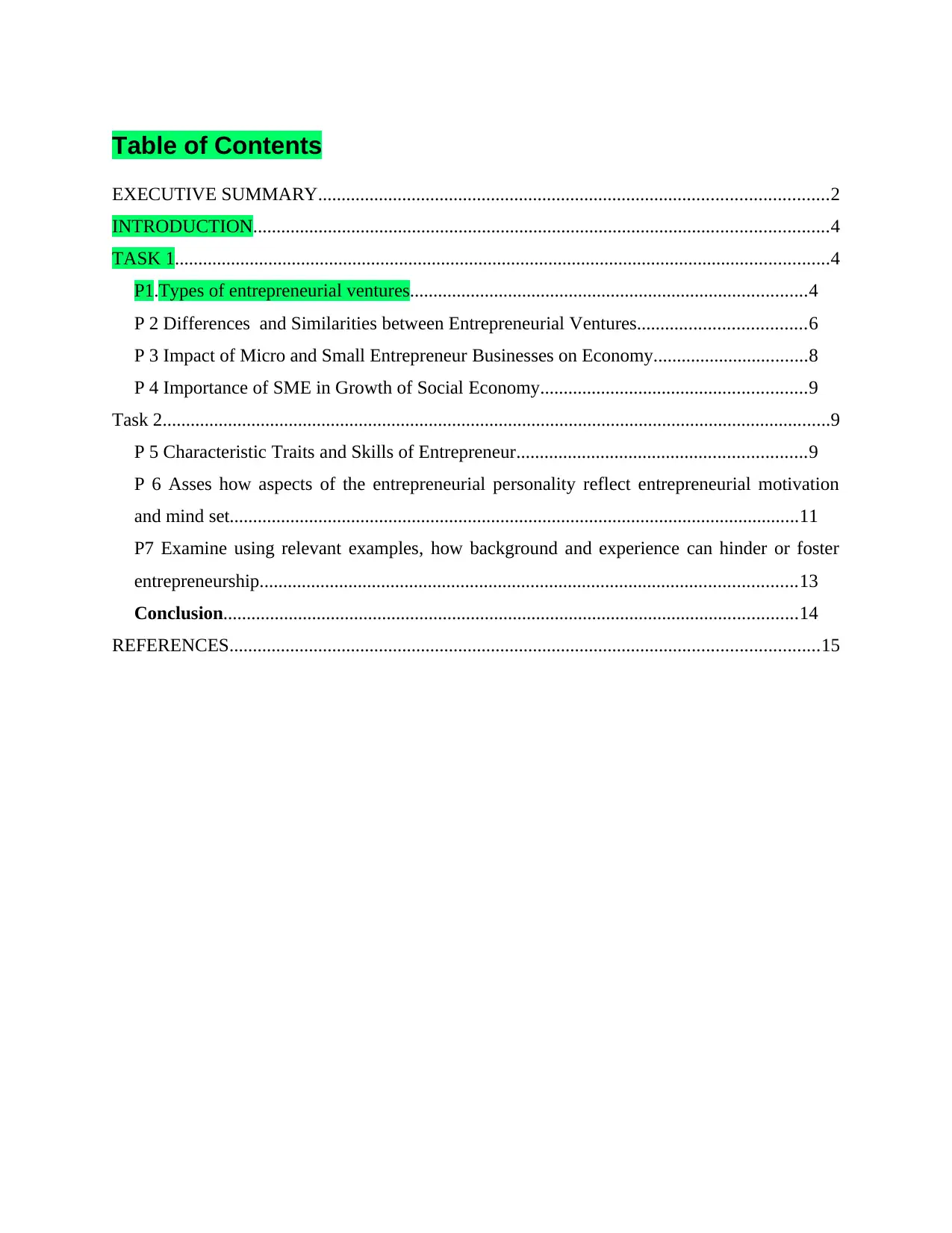
Table of Contents
EXECUTIVE SUMMARY.............................................................................................................2
INTRODUCTION...........................................................................................................................4
TASK 1............................................................................................................................................4
P1.Types of entrepreneurial ventures.....................................................................................4
P 2 Differences and Similarities between Entrepreneurial Ventures....................................6
P 3 Impact of Micro and Small Entrepreneur Businesses on Economy.................................8
P 4 Importance of SME in Growth of Social Economy.........................................................9
Task 2...............................................................................................................................................9
P 5 Characteristic Traits and Skills of Entrepreneur..............................................................9
P 6 Asses how aspects of the entrepreneurial personality reflect entrepreneurial motivation
and mind set..........................................................................................................................11
P7 Examine using relevant examples, how background and experience can hinder or foster
entrepreneurship...................................................................................................................13
Conclusion...........................................................................................................................14
REFERENCES..............................................................................................................................15
EXECUTIVE SUMMARY.............................................................................................................2
INTRODUCTION...........................................................................................................................4
TASK 1............................................................................................................................................4
P1.Types of entrepreneurial ventures.....................................................................................4
P 2 Differences and Similarities between Entrepreneurial Ventures....................................6
P 3 Impact of Micro and Small Entrepreneur Businesses on Economy.................................8
P 4 Importance of SME in Growth of Social Economy.........................................................9
Task 2...............................................................................................................................................9
P 5 Characteristic Traits and Skills of Entrepreneur..............................................................9
P 6 Asses how aspects of the entrepreneurial personality reflect entrepreneurial motivation
and mind set..........................................................................................................................11
P7 Examine using relevant examples, how background and experience can hinder or foster
entrepreneurship...................................................................................................................13
Conclusion...........................................................................................................................14
REFERENCES..............................................................................................................................15
⊘ This is a preview!⊘
Do you want full access?
Subscribe today to unlock all pages.

Trusted by 1+ million students worldwide
INTRODUCTION
Entrepreneurship is action which creates a new business where group of peoples and
individuals stay and work together and take step into making the world better place. To build a
better world where everyone feel good. Entrepreneurship is setting business on your own and
starts a business where there is no other boss and they work instead of working for someone else.
Under this entrepreneurship there is new term which introduce entrepreneur is an individual who
Is the one started the enterprise and one who had creative idea to do something new, innovative
and who is always willing to take risk. There are various Enterprise includes small business,
medium business and large business. Entrepreneurship always focuses on the goals of achieving
profits in the competitive markets beyond the emotions of the entrepreneur. Entrepreneur is the
individual who is always ready to take risk and generates creative ideas and innovation which
leads them towards the bright future.
A small size businesses are not always focused on profit generation they work as small business.
This report also the brief study about the roles and responsibility of entrepreneur and nature and
techniques of small business and what are the tools and techniques they follow for surviving
there enterprises in the market. Report will highlight the various types of entrepreneurial venture
TASK 1
P1.Types of entrepreneurial ventures
There are few types of entrepreneurship which are Small, medium and large
entrepreneurship plays an important role in the contribution of the economy in different levels of
the economy like local, regional and national it will increase the growth of economy and help the
country to increase gross rate on domestic product in these levels.
Large company entrepreneurship: large-scale entrepreneurship always give special
importance on the success and the growth which helps them to earn more revenue and
profitability as long term in the business environment(Volery and Mazzarol 2015). the
developing the new ideas, techniques, innovation for achieving the profits of the company, due
the entrance of globalization and digitalisation faces lots of problems for large scale
entrepreneurship.
Social Entrepreneurship: for the social, culture and environmental issues which is taken by the
start-up companies and entrepreneurs . Social entrepreneurship is a approach which help the
Entrepreneurship is action which creates a new business where group of peoples and
individuals stay and work together and take step into making the world better place. To build a
better world where everyone feel good. Entrepreneurship is setting business on your own and
starts a business where there is no other boss and they work instead of working for someone else.
Under this entrepreneurship there is new term which introduce entrepreneur is an individual who
Is the one started the enterprise and one who had creative idea to do something new, innovative
and who is always willing to take risk. There are various Enterprise includes small business,
medium business and large business. Entrepreneurship always focuses on the goals of achieving
profits in the competitive markets beyond the emotions of the entrepreneur. Entrepreneur is the
individual who is always ready to take risk and generates creative ideas and innovation which
leads them towards the bright future.
A small size businesses are not always focused on profit generation they work as small business.
This report also the brief study about the roles and responsibility of entrepreneur and nature and
techniques of small business and what are the tools and techniques they follow for surviving
there enterprises in the market. Report will highlight the various types of entrepreneurial venture
TASK 1
P1.Types of entrepreneurial ventures
There are few types of entrepreneurship which are Small, medium and large
entrepreneurship plays an important role in the contribution of the economy in different levels of
the economy like local, regional and national it will increase the growth of economy and help the
country to increase gross rate on domestic product in these levels.
Large company entrepreneurship: large-scale entrepreneurship always give special
importance on the success and the growth which helps them to earn more revenue and
profitability as long term in the business environment(Volery and Mazzarol 2015). the
developing the new ideas, techniques, innovation for achieving the profits of the company, due
the entrance of globalization and digitalisation faces lots of problems for large scale
entrepreneurship.
Social Entrepreneurship: for the social, culture and environmental issues which is taken by the
start-up companies and entrepreneurs . Social entrepreneurship is a approach which help the
Paraphrase This Document
Need a fresh take? Get an instant paraphrase of this document with our AI Paraphraser
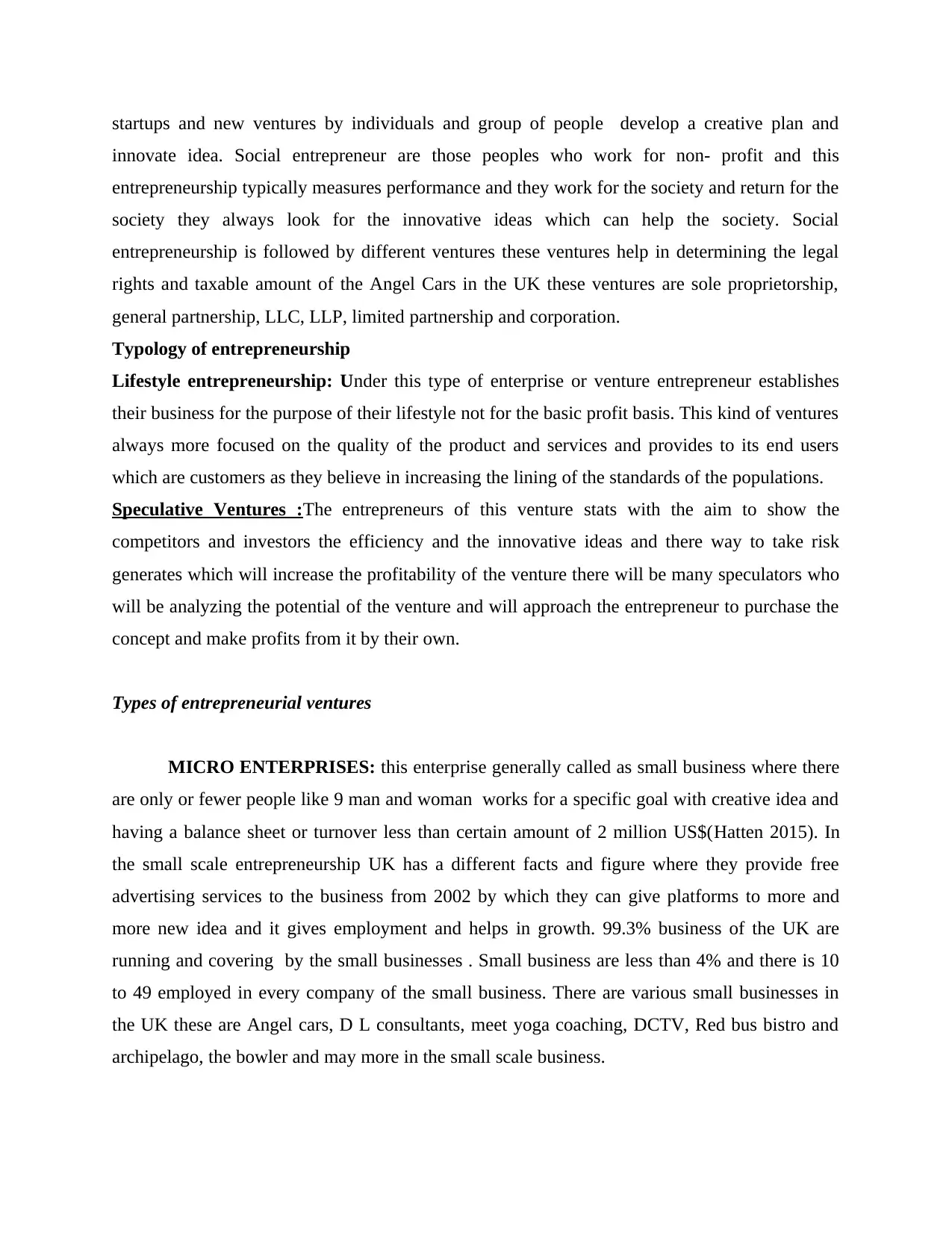
startups and new ventures by individuals and group of people develop a creative plan and
innovate idea. Social entrepreneur are those peoples who work for non- profit and this
entrepreneurship typically measures performance and they work for the society and return for the
society they always look for the innovative ideas which can help the society. Social
entrepreneurship is followed by different ventures these ventures help in determining the legal
rights and taxable amount of the Angel Cars in the UK these ventures are sole proprietorship,
general partnership, LLC, LLP, limited partnership and corporation.
Typology of entrepreneurship
Lifestyle entrepreneurship: Under this type of enterprise or venture entrepreneur establishes
their business for the purpose of their lifestyle not for the basic profit basis. This kind of ventures
always more focused on the quality of the product and services and provides to its end users
which are customers as they believe in increasing the lining of the standards of the populations.
Speculative Ventures :The entrepreneurs of this venture stats with the aim to show the
competitors and investors the efficiency and the innovative ideas and there way to take risk
generates which will increase the profitability of the venture there will be many speculators who
will be analyzing the potential of the venture and will approach the entrepreneur to purchase the
concept and make profits from it by their own.
Types of entrepreneurial ventures
MICRO ENTERPRISES: this enterprise generally called as small business where there
are only or fewer people like 9 man and woman works for a specific goal with creative idea and
having a balance sheet or turnover less than certain amount of 2 million US$(Hatten 2015). In
the small scale entrepreneurship UK has a different facts and figure where they provide free
advertising services to the business from 2002 by which they can give platforms to more and
more new idea and it gives employment and helps in growth. 99.3% business of the UK are
running and covering by the small businesses . Small business are less than 4% and there is 10
to 49 employed in every company of the small business. There are various small businesses in
the UK these are Angel cars, D L consultants, meet yoga coaching, DCTV, Red bus bistro and
archipelago, the bowler and may more in the small scale business.
innovate idea. Social entrepreneur are those peoples who work for non- profit and this
entrepreneurship typically measures performance and they work for the society and return for the
society they always look for the innovative ideas which can help the society. Social
entrepreneurship is followed by different ventures these ventures help in determining the legal
rights and taxable amount of the Angel Cars in the UK these ventures are sole proprietorship,
general partnership, LLC, LLP, limited partnership and corporation.
Typology of entrepreneurship
Lifestyle entrepreneurship: Under this type of enterprise or venture entrepreneur establishes
their business for the purpose of their lifestyle not for the basic profit basis. This kind of ventures
always more focused on the quality of the product and services and provides to its end users
which are customers as they believe in increasing the lining of the standards of the populations.
Speculative Ventures :The entrepreneurs of this venture stats with the aim to show the
competitors and investors the efficiency and the innovative ideas and there way to take risk
generates which will increase the profitability of the venture there will be many speculators who
will be analyzing the potential of the venture and will approach the entrepreneur to purchase the
concept and make profits from it by their own.
Types of entrepreneurial ventures
MICRO ENTERPRISES: this enterprise generally called as small business where there
are only or fewer people like 9 man and woman works for a specific goal with creative idea and
having a balance sheet or turnover less than certain amount of 2 million US$(Hatten 2015). In
the small scale entrepreneurship UK has a different facts and figure where they provide free
advertising services to the business from 2002 by which they can give platforms to more and
more new idea and it gives employment and helps in growth. 99.3% business of the UK are
running and covering by the small businesses . Small business are less than 4% and there is 10
to 49 employed in every company of the small business. There are various small businesses in
the UK these are Angel cars, D L consultants, meet yoga coaching, DCTV, Red bus bistro and
archipelago, the bowler and may more in the small scale business.
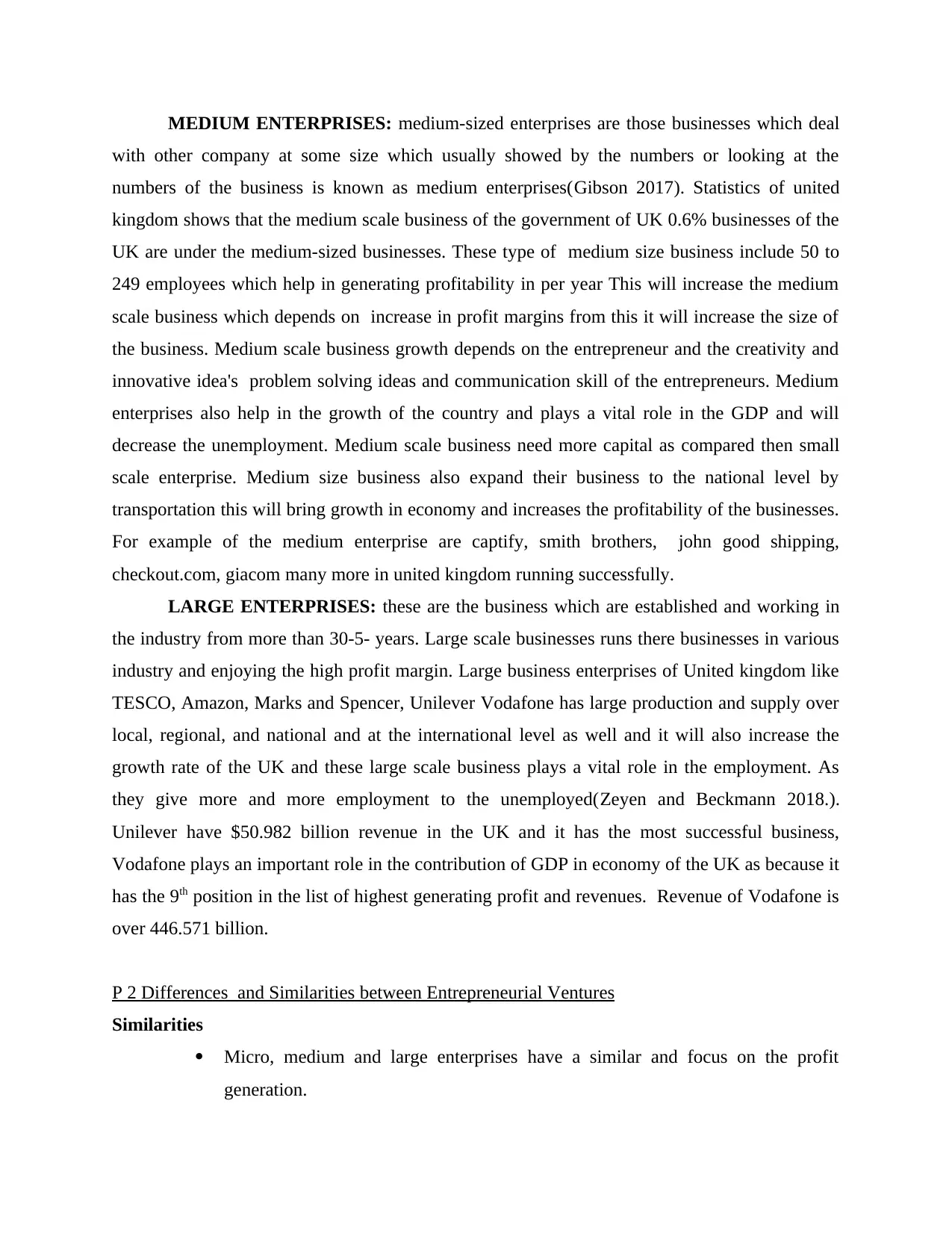
MEDIUM ENTERPRISES: medium-sized enterprises are those businesses which deal
with other company at some size which usually showed by the numbers or looking at the
numbers of the business is known as medium enterprises(Gibson 2017). Statistics of united
kingdom shows that the medium scale business of the government of UK 0.6% businesses of the
UK are under the medium-sized businesses. These type of medium size business include 50 to
249 employees which help in generating profitability in per year This will increase the medium
scale business which depends on increase in profit margins from this it will increase the size of
the business. Medium scale business growth depends on the entrepreneur and the creativity and
innovative idea's problem solving ideas and communication skill of the entrepreneurs. Medium
enterprises also help in the growth of the country and plays a vital role in the GDP and will
decrease the unemployment. Medium scale business need more capital as compared then small
scale enterprise. Medium size business also expand their business to the national level by
transportation this will bring growth in economy and increases the profitability of the businesses.
For example of the medium enterprise are captify, smith brothers, john good shipping,
checkout.com, giacom many more in united kingdom running successfully.
LARGE ENTERPRISES: these are the business which are established and working in
the industry from more than 30-5- years. Large scale businesses runs there businesses in various
industry and enjoying the high profit margin. Large business enterprises of United kingdom like
TESCO, Amazon, Marks and Spencer, Unilever Vodafone has large production and supply over
local, regional, and national and at the international level as well and it will also increase the
growth rate of the UK and these large scale business plays a vital role in the employment. As
they give more and more employment to the unemployed(Zeyen and Beckmann 2018.).
Unilever have $50.982 billion revenue in the UK and it has the most successful business,
Vodafone plays an important role in the contribution of GDP in economy of the UK as because it
has the 9th position in the list of highest generating profit and revenues. Revenue of Vodafone is
over 446.571 billion.
P 2 Differences and Similarities between Entrepreneurial Ventures
Similarities
Micro, medium and large enterprises have a similar and focus on the profit
generation.
with other company at some size which usually showed by the numbers or looking at the
numbers of the business is known as medium enterprises(Gibson 2017). Statistics of united
kingdom shows that the medium scale business of the government of UK 0.6% businesses of the
UK are under the medium-sized businesses. These type of medium size business include 50 to
249 employees which help in generating profitability in per year This will increase the medium
scale business which depends on increase in profit margins from this it will increase the size of
the business. Medium scale business growth depends on the entrepreneur and the creativity and
innovative idea's problem solving ideas and communication skill of the entrepreneurs. Medium
enterprises also help in the growth of the country and plays a vital role in the GDP and will
decrease the unemployment. Medium scale business need more capital as compared then small
scale enterprise. Medium size business also expand their business to the national level by
transportation this will bring growth in economy and increases the profitability of the businesses.
For example of the medium enterprise are captify, smith brothers, john good shipping,
checkout.com, giacom many more in united kingdom running successfully.
LARGE ENTERPRISES: these are the business which are established and working in
the industry from more than 30-5- years. Large scale businesses runs there businesses in various
industry and enjoying the high profit margin. Large business enterprises of United kingdom like
TESCO, Amazon, Marks and Spencer, Unilever Vodafone has large production and supply over
local, regional, and national and at the international level as well and it will also increase the
growth rate of the UK and these large scale business plays a vital role in the employment. As
they give more and more employment to the unemployed(Zeyen and Beckmann 2018.).
Unilever have $50.982 billion revenue in the UK and it has the most successful business,
Vodafone plays an important role in the contribution of GDP in economy of the UK as because it
has the 9th position in the list of highest generating profit and revenues. Revenue of Vodafone is
over 446.571 billion.
P 2 Differences and Similarities between Entrepreneurial Ventures
Similarities
Micro, medium and large enterprises have a similar and focus on the profit
generation.
⊘ This is a preview!⊘
Do you want full access?
Subscribe today to unlock all pages.
Trusted by 1+ million students worldwide
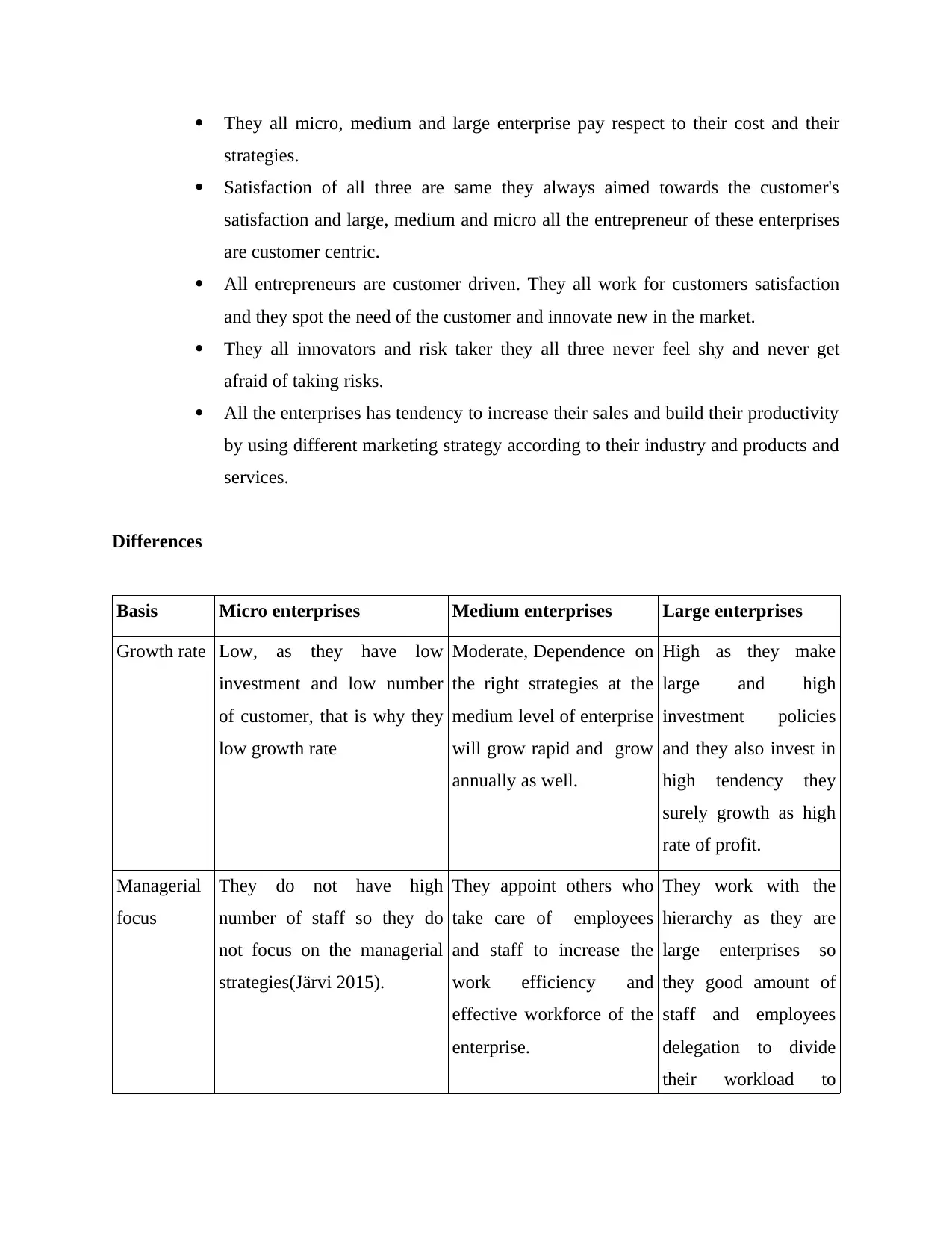
They all micro, medium and large enterprise pay respect to their cost and their
strategies.
Satisfaction of all three are same they always aimed towards the customer's
satisfaction and large, medium and micro all the entrepreneur of these enterprises
are customer centric.
All entrepreneurs are customer driven. They all work for customers satisfaction
and they spot the need of the customer and innovate new in the market.
They all innovators and risk taker they all three never feel shy and never get
afraid of taking risks.
All the enterprises has tendency to increase their sales and build their productivity
by using different marketing strategy according to their industry and products and
services.
Differences
Basis Micro enterprises Medium enterprises Large enterprises
Growth rate Low, as they have low
investment and low number
of customer, that is why they
low growth rate
Moderate, Dependence on
the right strategies at the
medium level of enterprise
will grow rapid and grow
annually as well.
High as they make
large and high
investment policies
and they also invest in
high tendency they
surely growth as high
rate of profit.
Managerial
focus
They do not have high
number of staff so they do
not focus on the managerial
strategies(Järvi 2015).
They appoint others who
take care of employees
and staff to increase the
work efficiency and
effective workforce of the
enterprise.
They work with the
hierarchy as they are
large enterprises so
they good amount of
staff and employees
delegation to divide
their workload to
strategies.
Satisfaction of all three are same they always aimed towards the customer's
satisfaction and large, medium and micro all the entrepreneur of these enterprises
are customer centric.
All entrepreneurs are customer driven. They all work for customers satisfaction
and they spot the need of the customer and innovate new in the market.
They all innovators and risk taker they all three never feel shy and never get
afraid of taking risks.
All the enterprises has tendency to increase their sales and build their productivity
by using different marketing strategy according to their industry and products and
services.
Differences
Basis Micro enterprises Medium enterprises Large enterprises
Growth rate Low, as they have low
investment and low number
of customer, that is why they
low growth rate
Moderate, Dependence on
the right strategies at the
medium level of enterprise
will grow rapid and grow
annually as well.
High as they make
large and high
investment policies
and they also invest in
high tendency they
surely growth as high
rate of profit.
Managerial
focus
They do not have high
number of staff so they do
not focus on the managerial
strategies(Järvi 2015).
They appoint others who
take care of employees
and staff to increase the
work efficiency and
effective workforce of the
enterprise.
They work with the
hierarchy as they are
large enterprises so
they good amount of
staff and employees
delegation to divide
their workload to
Paraphrase This Document
Need a fresh take? Get an instant paraphrase of this document with our AI Paraphraser
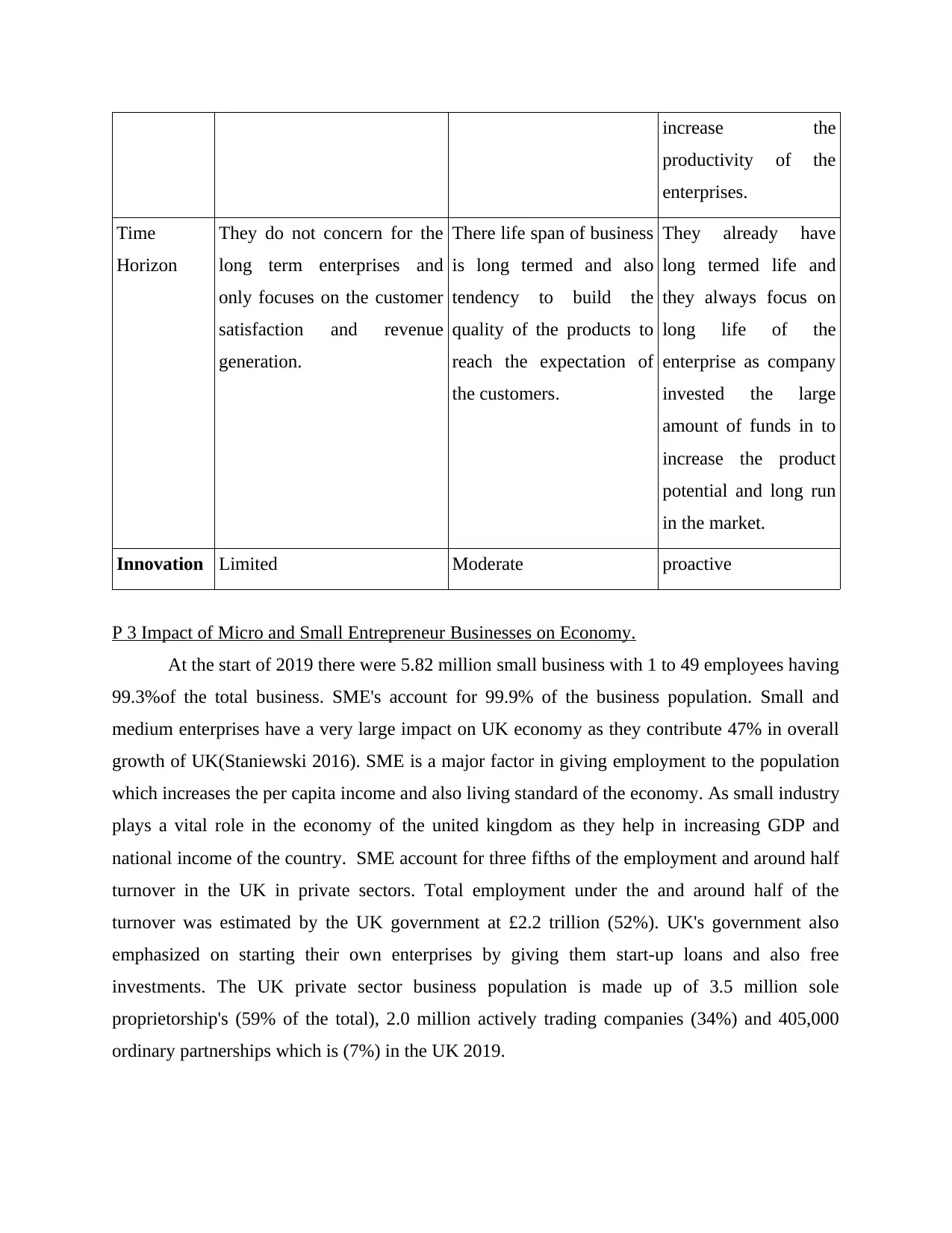
increase the
productivity of the
enterprises.
Time
Horizon
They do not concern for the
long term enterprises and
only focuses on the customer
satisfaction and revenue
generation.
There life span of business
is long termed and also
tendency to build the
quality of the products to
reach the expectation of
the customers.
They already have
long termed life and
they always focus on
long life of the
enterprise as company
invested the large
amount of funds in to
increase the product
potential and long run
in the market.
Innovation Limited Moderate proactive
P 3 Impact of Micro and Small Entrepreneur Businesses on Economy.
At the start of 2019 there were 5.82 million small business with 1 to 49 employees having
99.3%of the total business. SME's account for 99.9% of the business population. Small and
medium enterprises have a very large impact on UK economy as they contribute 47% in overall
growth of UK(Staniewski 2016). SME is a major factor in giving employment to the population
which increases the per capita income and also living standard of the economy. As small industry
plays a vital role in the economy of the united kingdom as they help in increasing GDP and
national income of the country. SME account for three fifths of the employment and around half
turnover in the UK in private sectors. Total employment under the and around half of the
turnover was estimated by the UK government at £2.2 trillion (52%). UK's government also
emphasized on starting their own enterprises by giving them start-up loans and also free
investments. The UK private sector business population is made up of 3.5 million sole
proprietorship's (59% of the total), 2.0 million actively trading companies (34%) and 405,000
ordinary partnerships which is (7%) in the UK 2019.
productivity of the
enterprises.
Time
Horizon
They do not concern for the
long term enterprises and
only focuses on the customer
satisfaction and revenue
generation.
There life span of business
is long termed and also
tendency to build the
quality of the products to
reach the expectation of
the customers.
They already have
long termed life and
they always focus on
long life of the
enterprise as company
invested the large
amount of funds in to
increase the product
potential and long run
in the market.
Innovation Limited Moderate proactive
P 3 Impact of Micro and Small Entrepreneur Businesses on Economy.
At the start of 2019 there were 5.82 million small business with 1 to 49 employees having
99.3%of the total business. SME's account for 99.9% of the business population. Small and
medium enterprises have a very large impact on UK economy as they contribute 47% in overall
growth of UK(Staniewski 2016). SME is a major factor in giving employment to the population
which increases the per capita income and also living standard of the economy. As small industry
plays a vital role in the economy of the united kingdom as they help in increasing GDP and
national income of the country. SME account for three fifths of the employment and around half
turnover in the UK in private sectors. Total employment under the and around half of the
turnover was estimated by the UK government at £2.2 trillion (52%). UK's government also
emphasized on starting their own enterprises by giving them start-up loans and also free
investments. The UK private sector business population is made up of 3.5 million sole
proprietorship's (59% of the total), 2.0 million actively trading companies (34%) and 405,000
ordinary partnerships which is (7%) in the UK 2019.
P 4 Importance of SME in Growth of Social Economy
SMEs has recognized as an important means of economic growth. SMEs evolves around
the united kingdom's boundaries and now plays an important role for the UK government by
creating jobs in the market and by economic growth of any nation by giving contribution in gross
domestic product and in national income. SMEs sector reduce poverty and generate income for
the public. It also facilitates nation's wealth thus resulting in national development. Small and
medium enterprise have very major role in contributing the economy of UK as it helped the
economy in growing rapidly in past few years this help to increase the efficiency of the country
and also created many employment opportunities.The SME are the backbone the economy it
helps the population to gain the living standards and also help them to spend their income
according to them because SME provide a large market with variety of products with different
price range according to the suitability of the individual(Mugler 2017). SME business is very
close to customers as they reach directly to the customer, they're closer to their customers.
They're more flexible and get more into business. SME business are able to detect better and take
the advantage in the right time of small niches. SME have easy to link the staff to the company
as they have small area and small premises to deal with employees. SME provide links between
other business that they know everyone knows each other better. SME's are now becoming more
and more present in the united kingdom economies. SME have also contributed in converting the
competition in positive manner which will help the in contributing in the economy as SME is
absent in the market then there will be monopoly of large enterprises which will exploit the
customers and will maximize their profits which will not increase the growth of the economy.
Task 2
P 5 Characteristic Traits and Skills of Entrepreneur
Entrepreneur is an individual who works for the society first and who have an idea, an
innovative idea to create something different which no one ever except that thing or thought off.
Entrepreneur refers to an individual who establish and operates a business taking higher financial
risk any type of risk for his or her idea(Schaper 2016.). A successful entrepreneur should keep
different characteristic traits like given below.
Entrepreneur is a person who is innovative the first and foremost characteristic of an
entrepreneur is innovative, entrepreneur thinks beyond the box and made his innovations into an
SMEs has recognized as an important means of economic growth. SMEs evolves around
the united kingdom's boundaries and now plays an important role for the UK government by
creating jobs in the market and by economic growth of any nation by giving contribution in gross
domestic product and in national income. SMEs sector reduce poverty and generate income for
the public. It also facilitates nation's wealth thus resulting in national development. Small and
medium enterprise have very major role in contributing the economy of UK as it helped the
economy in growing rapidly in past few years this help to increase the efficiency of the country
and also created many employment opportunities.The SME are the backbone the economy it
helps the population to gain the living standards and also help them to spend their income
according to them because SME provide a large market with variety of products with different
price range according to the suitability of the individual(Mugler 2017). SME business is very
close to customers as they reach directly to the customer, they're closer to their customers.
They're more flexible and get more into business. SME business are able to detect better and take
the advantage in the right time of small niches. SME have easy to link the staff to the company
as they have small area and small premises to deal with employees. SME provide links between
other business that they know everyone knows each other better. SME's are now becoming more
and more present in the united kingdom economies. SME have also contributed in converting the
competition in positive manner which will help the in contributing in the economy as SME is
absent in the market then there will be monopoly of large enterprises which will exploit the
customers and will maximize their profits which will not increase the growth of the economy.
Task 2
P 5 Characteristic Traits and Skills of Entrepreneur
Entrepreneur is an individual who works for the society first and who have an idea, an
innovative idea to create something different which no one ever except that thing or thought off.
Entrepreneur refers to an individual who establish and operates a business taking higher financial
risk any type of risk for his or her idea(Schaper 2016.). A successful entrepreneur should keep
different characteristic traits like given below.
Entrepreneur is a person who is innovative the first and foremost characteristic of an
entrepreneur is innovative, entrepreneur thinks beyond the box and made his innovations into an
⊘ This is a preview!⊘
Do you want full access?
Subscribe today to unlock all pages.
Trusted by 1+ million students worldwide
idea. Entrepreneur is always an open minded guy who realize every event, action and situation in
a business opportunity. Workflows and efficiency creates ideas with different mind alertness.
Entrepreneur is risk: taker entrepreneur always ready to take any type of risk which gives
entrepreneur ideas to new platform or built his skills and potential to the new business.
Entrepreneur is a creative person who bring all creativeness in his or her idea and with his
innovative idea entrepreneur can do something big. Strategic orientation: entrepreneur creates
ideas and convert into strategy accordingly to perceptive of opportunity and refers to growth in
market. While manager utilizes current resources and obtains strategy for business development.
Entrepreneur strong work ethic and communication skills to sell product and services with good
communicative skills. A successful entrepreneur will often be the first person to arrive at the
office and last one to leave. That's should be his passion and that much an entrepreneur is
passionate to achieve his goals
Skills differentiation between entrepreneur and business manager:
Strategic orientation: An entrepreneur creates innovative ideas and convert those ideas
into strategy according to there vision for the opportunity and that vision of opportunity brings
the growth in the market. While manager utilizes current resources and obtains strategy for
business development manager only implement plans which are given to him by his or her
subordinates..
Management structure: entrepreneur follows flat structure with multiple informal network. In this
structure employees can direct communicate to owner and can give innovative ideas regrading
business development(Ramadani Ratten and Palalić 2018). This structure establishes good
relationship between employees and owner while manager follows formalized hierarchy where
employees can't communicate directly to owner. Manager only follow whatsoever he or she s
been guided to do.
Responsibilities: entrepreneur has lot of responsibility regarding the business as entrepreneur is
the main person who created all the plan and policies accomplished by him to set up business or
industry in business market while manager has less responsibility because manager function is to
apply policies which is formulated by entrepreneur for business envelopment.
a business opportunity. Workflows and efficiency creates ideas with different mind alertness.
Entrepreneur is risk: taker entrepreneur always ready to take any type of risk which gives
entrepreneur ideas to new platform or built his skills and potential to the new business.
Entrepreneur is a creative person who bring all creativeness in his or her idea and with his
innovative idea entrepreneur can do something big. Strategic orientation: entrepreneur creates
ideas and convert into strategy accordingly to perceptive of opportunity and refers to growth in
market. While manager utilizes current resources and obtains strategy for business development.
Entrepreneur strong work ethic and communication skills to sell product and services with good
communicative skills. A successful entrepreneur will often be the first person to arrive at the
office and last one to leave. That's should be his passion and that much an entrepreneur is
passionate to achieve his goals
Skills differentiation between entrepreneur and business manager:
Strategic orientation: An entrepreneur creates innovative ideas and convert those ideas
into strategy according to there vision for the opportunity and that vision of opportunity brings
the growth in the market. While manager utilizes current resources and obtains strategy for
business development manager only implement plans which are given to him by his or her
subordinates..
Management structure: entrepreneur follows flat structure with multiple informal network. In this
structure employees can direct communicate to owner and can give innovative ideas regrading
business development(Ramadani Ratten and Palalić 2018). This structure establishes good
relationship between employees and owner while manager follows formalized hierarchy where
employees can't communicate directly to owner. Manager only follow whatsoever he or she s
been guided to do.
Responsibilities: entrepreneur has lot of responsibility regarding the business as entrepreneur is
the main person who created all the plan and policies accomplished by him to set up business or
industry in business market while manager has less responsibility because manager function is to
apply policies which is formulated by entrepreneur for business envelopment.
Paraphrase This Document
Need a fresh take? Get an instant paraphrase of this document with our AI Paraphraser
P 6 Asses how aspects of the entrepreneurial personality reflect entrepreneurial motivation and
mind set.
The five broad personality traits described by the theory are extraversion (also often spelled
extroversion), agreeableness, openness, conscientiousness, and neuroticism.
The Big five OCEAN are
Openness to experience Openness to experience has been described as the depth and complexity
of an individual mental life and experiences. It is also sometimes called intellect or imagination.
Openness to experience concerns people willingness to try new things, their ability to be
vulnerable and their capability of think out of the box.
The common traits to openness to experience includes
• Imagination
• Complexity
• Insightfulness
• Originality
• Cleverness
• Varied Interest
2. Conscientiousness – it is a personality trait where one person want to do others work.
Conscientiousness is a trait that can be described as the tendency to control impulses and act in
socially acceptable ways, behaviours that facilitate goal directed behaviour.
The common traits to Conscientiousness to experience includes
• Planning
• Self Discipline
• Ambition
• Control
• Energy
• Hard Work
3. Extroversion – Is a personality factor which characterised by the direction of individual
and interest outside of all, Which is a fun loving personalty.
The common traits to Extroversion to experience includes
• Fun Loving nature
mind set.
The five broad personality traits described by the theory are extraversion (also often spelled
extroversion), agreeableness, openness, conscientiousness, and neuroticism.
The Big five OCEAN are
Openness to experience Openness to experience has been described as the depth and complexity
of an individual mental life and experiences. It is also sometimes called intellect or imagination.
Openness to experience concerns people willingness to try new things, their ability to be
vulnerable and their capability of think out of the box.
The common traits to openness to experience includes
• Imagination
• Complexity
• Insightfulness
• Originality
• Cleverness
• Varied Interest
2. Conscientiousness – it is a personality trait where one person want to do others work.
Conscientiousness is a trait that can be described as the tendency to control impulses and act in
socially acceptable ways, behaviours that facilitate goal directed behaviour.
The common traits to Conscientiousness to experience includes
• Planning
• Self Discipline
• Ambition
• Control
• Energy
• Hard Work
3. Extroversion – Is a personality factor which characterised by the direction of individual
and interest outside of all, Which is a fun loving personalty.
The common traits to Extroversion to experience includes
• Fun Loving nature
• Friendliness
• Talkativeness
• Outgoing nature
4. AgreeableneMugler 2017ss is a personality trait that it is a grouping of personality(Burns
and Dewhurst 2016). it is a construct that rests on how an individual generally interacts with
others.
The common traits to Agreeableness to experience includes
• Trust
• Tact
• Politeness
• Cheerfulness
5. Neuroticism – one of the super traits in the big five models of personality It
encompasses one's emotional stability and general temper.
The common traits to Neuroticism to experience includes
• Lack of confidence
• Tininess
• Self criticism
A perfect personality can reflects motivation and give motivation to others an
entrepreneur is the person who have different and attractive personality which reflects the
mindset and vision which inspires others to do more. Personality is an easy concept for most of
us to grasp. However, you define personality, its an important part of who you are. In fact
personality shows a positive correlation with life satisfaction. With personality having such a
large impact on our lives. (Rey-Martí, Porcar and Mas-Tur, 2015)
The most prevalent personality framework is a big five, also known as five factors of personality
Sir Richard Branson born in July 1950, he is an s a British business magnate, investor, author
and philanthropist. He founded the Virgin group in the 1970s, which controls more than 400
companies in various fields. He became an entrepreneur at a very young age. At his young age
he opened a chain of records sore, “virgin records” later known as “virgin megastores”.
J.K. Rowling british $1 billion most famous for authority the immensely popular harry potter
series books, which later became as a most successful and popular movies
• Talkativeness
• Outgoing nature
4. AgreeableneMugler 2017ss is a personality trait that it is a grouping of personality(Burns
and Dewhurst 2016). it is a construct that rests on how an individual generally interacts with
others.
The common traits to Agreeableness to experience includes
• Trust
• Tact
• Politeness
• Cheerfulness
5. Neuroticism – one of the super traits in the big five models of personality It
encompasses one's emotional stability and general temper.
The common traits to Neuroticism to experience includes
• Lack of confidence
• Tininess
• Self criticism
A perfect personality can reflects motivation and give motivation to others an
entrepreneur is the person who have different and attractive personality which reflects the
mindset and vision which inspires others to do more. Personality is an easy concept for most of
us to grasp. However, you define personality, its an important part of who you are. In fact
personality shows a positive correlation with life satisfaction. With personality having such a
large impact on our lives. (Rey-Martí, Porcar and Mas-Tur, 2015)
The most prevalent personality framework is a big five, also known as five factors of personality
Sir Richard Branson born in July 1950, he is an s a British business magnate, investor, author
and philanthropist. He founded the Virgin group in the 1970s, which controls more than 400
companies in various fields. He became an entrepreneur at a very young age. At his young age
he opened a chain of records sore, “virgin records” later known as “virgin megastores”.
J.K. Rowling british $1 billion most famous for authority the immensely popular harry potter
series books, which later became as a most successful and popular movies
⊘ This is a preview!⊘
Do you want full access?
Subscribe today to unlock all pages.
Trusted by 1+ million students worldwide

1 out of 16


Related Documents


Your All-in-One AI-Powered Toolkit for Academic Success.
+13062052269
info@desklib.com
Available 24*7 on WhatsApp / Email
![[object Object]](/_next/static/media/star-bottom.7253800d.svg)
Unlock your academic potential
Copyright © 2020–2026 A2Z Services. All Rights Reserved. Developed and managed by ZUCOL.