Entrepreneurial Marketing Practices Comparison: SMEs and Large Firms
VerifiedAdded on 2023/01/12
|8
|2213
|23
Report
AI Summary
This report delves into the realm of entrepreneurial marketing, presenting a comparative analysis of marketing practices employed by Small and Medium Enterprises (SMEs) and large organizations. The introduction establishes entrepreneurial marketing as a distinct field, highlighting its focus on identifying opportunities and leveraging innovation. The main body provides a detailed comparison across various aspects of marketing, including product, price, place, promotion, packaging, distribution channels, people, and research & development. The report also explores entrepreneurship theories, particularly Schumpeter's innovation theory, and its relevance to marketing strategies. It examines how SMEs can utilize innovation in promotional activities, distribution channels, and supply chain management. The report concludes by emphasizing the significance of entrepreneurial marketing for SMEs, stressing the need to adapt marketing strategies to the specific characteristics of the small business environment. The references include books, journals, and online resources related to the topic.

Entrepreneurial
Marketing
Marketing

Paraphrase This Document
Need a fresh take? Get an instant paraphrase of this document with our AI Paraphraser
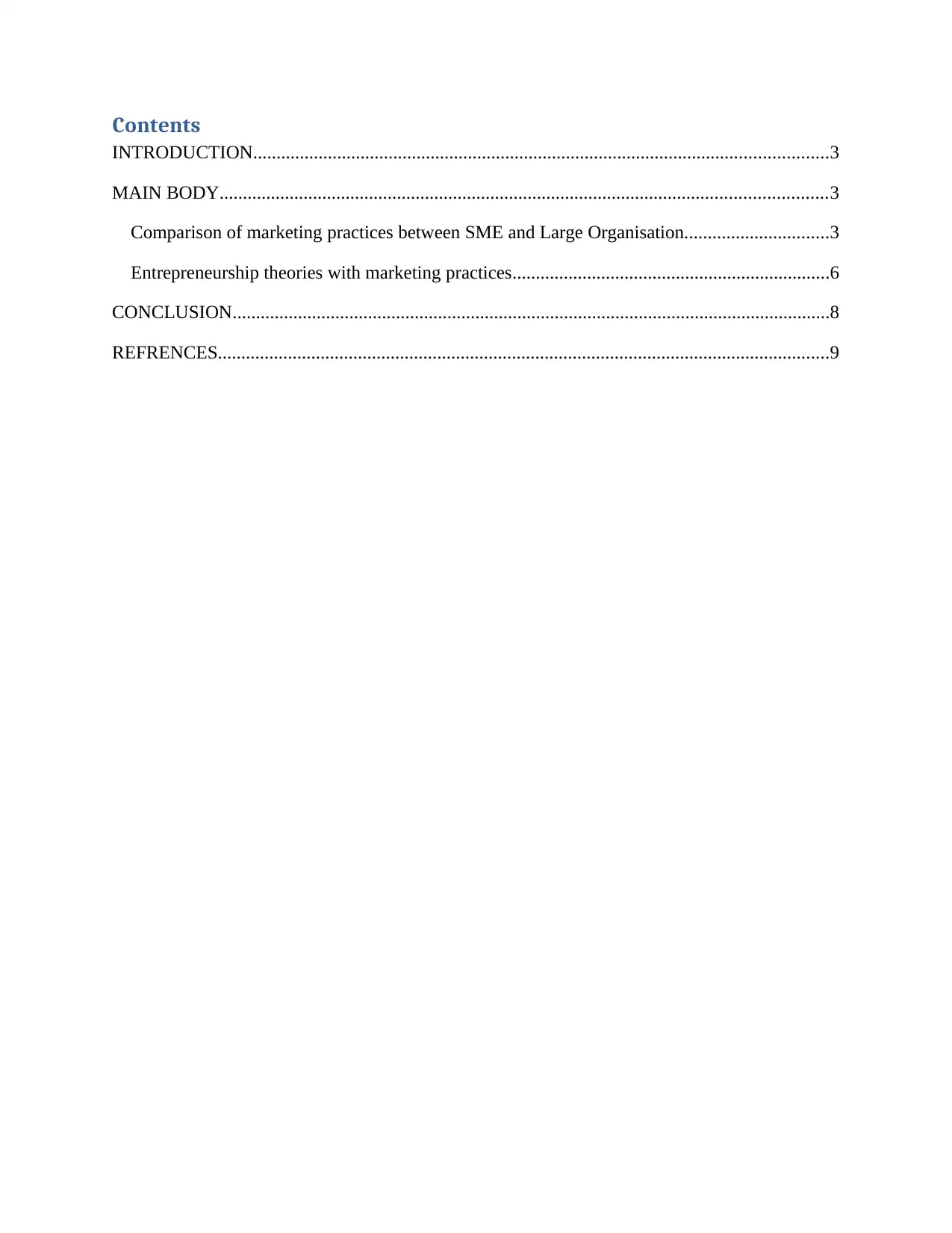
Contents
INTRODUCTION...........................................................................................................................3
MAIN BODY..................................................................................................................................3
Comparison of marketing practices between SME and Large Organisation...............................3
Entrepreneurship theories with marketing practices....................................................................6
CONCLUSION................................................................................................................................8
REFRENCES...................................................................................................................................9
INTRODUCTION...........................................................................................................................3
MAIN BODY..................................................................................................................................3
Comparison of marketing practices between SME and Large Organisation...............................3
Entrepreneurship theories with marketing practices....................................................................6
CONCLUSION................................................................................................................................8
REFRENCES...................................................................................................................................9
INTRODUCTION
Entrepreneurial marketing comprises of separate management area or field that is
entrepreneurship and marketing. It is a process of identifying and exploit unique opportunities
for attracting and holding potential customers with help of innovative approaches for purpose of
risk management, resource leveraging, creation of value (Entrepreneurial Marketing, 2020).This
particular marketing strategy are emerged to implement those fundamental principles that are
deliberately avoided by small firms as they are formulated for large organisations.
Entrepreneurial marketing encompasses various new and uncommon marketing practices that are
undertaken by SME’s to gain competitive advantage in crowded market. This report contains
information regarding how marketing efforts of small and medium enterprises are different from
marketing efforts of large and well establish organisations. It exhibits various marketing
practices which are helpful in promoting products and services to target market. Moreover, it
explains different entrepreneurial theory and how it is interrelated marketing practices.
MAIN BODY
Comparison of marketing practices between SME and Large Organisation.
Marketing practices refers to various ways through which organisation can promote their
exclusive products and services to target market. These are methods by which company can
communicate and interact with its target audience and make them aware about features and
benefits of their wide variety of product range (Barrett and Weinstein, 2015). Also, with help of
marketing practices company can able to understand requirement and demand of customers
according to which they can modify or manufacture their products. It refers to a procedure
through which marketers can identify, address and fulfil customer’s needs and wants. These
practices helps them to how to sell out their products in better way as compare to other
organisations. Marketing practices are always differ from company to company. As small
enterprisers make use of different methods as compare to large organisations. This can
understood by given comparison.
Comparison of Marketing practices in Small and Medium Enterprises and large organisation
PRODUCT: small and medium enterprises produce and serves limited number of products and
services as compare to large and well establish organisations (Miles and et. al., 2015). Small
enterprises manufacture low grade products in order to serve lower target market of customers
Entrepreneurial marketing comprises of separate management area or field that is
entrepreneurship and marketing. It is a process of identifying and exploit unique opportunities
for attracting and holding potential customers with help of innovative approaches for purpose of
risk management, resource leveraging, creation of value (Entrepreneurial Marketing, 2020).This
particular marketing strategy are emerged to implement those fundamental principles that are
deliberately avoided by small firms as they are formulated for large organisations.
Entrepreneurial marketing encompasses various new and uncommon marketing practices that are
undertaken by SME’s to gain competitive advantage in crowded market. This report contains
information regarding how marketing efforts of small and medium enterprises are different from
marketing efforts of large and well establish organisations. It exhibits various marketing
practices which are helpful in promoting products and services to target market. Moreover, it
explains different entrepreneurial theory and how it is interrelated marketing practices.
MAIN BODY
Comparison of marketing practices between SME and Large Organisation.
Marketing practices refers to various ways through which organisation can promote their
exclusive products and services to target market. These are methods by which company can
communicate and interact with its target audience and make them aware about features and
benefits of their wide variety of product range (Barrett and Weinstein, 2015). Also, with help of
marketing practices company can able to understand requirement and demand of customers
according to which they can modify or manufacture their products. It refers to a procedure
through which marketers can identify, address and fulfil customer’s needs and wants. These
practices helps them to how to sell out their products in better way as compare to other
organisations. Marketing practices are always differ from company to company. As small
enterprisers make use of different methods as compare to large organisations. This can
understood by given comparison.
Comparison of Marketing practices in Small and Medium Enterprises and large organisation
PRODUCT: small and medium enterprises produce and serves limited number of products and
services as compare to large and well establish organisations (Miles and et. al., 2015). Small
enterprises manufacture low grade products in order to serve lower target market of customers
⊘ This is a preview!⊘
Do you want full access?
Subscribe today to unlock all pages.

Trusted by 1+ million students worldwide
and satisfy their few requirements. On contrary, large organisation provide and offer wide range
of products in different shapes, colour, sizes to cater different demand of customers. Small
business do not offer variants as compare to well established organisation. As they only produce
few identical items in only to limited number of customer base due to which they have less
market share as compare to large organisation. Generally, small traders or enterprisers
manufacture low quality products in order to save cost while large organisation focuses on
producing high quality of goods and services (O'Cass and Morrish, 2016).
PRICE: small enterprises set relatively low prices associated with their products because of they
have small customer and client base. Whereas, large organisation charges high prices for their
product offering as they have large customer base. Small enterpriser make use of penetration
pricing strategy where they charge very low rates in order to grab large market share whereas
large organisation optimise price skimming strategy in order to earn higher revenue from their
products.
PLACE: small enterprises generally target few areas in to sell out its products and services as
they make use their personal stores or few outlets to display their product range. Whereas large
organisation display their products and services through supermarkets, malls, online stores etc.
Due to number of stores small enterprises are able to attract few customers where as large
organisations attracts and retain huge number of customers as they placed their products in
different areas or locations.
PROMOTION: Small and medium enterprises make use of traditional and non paid promotional
activities in order to promote and communicate regarding products and service to target
audience. They make use of bill boards, Hoardings, pamphlets, posters, newspaper, word of
mouth, personal selling as small trader has less budget. On other hand, large organisation utilise
paid promotional activities with purpose of reaching out large target audience. Marketer of large
corporations make use of television commercial which is paid sponsorships. In addition to this,
they make use sale promotion by providing lucrative offers and discounts in order to increase its
sales (Ratten and Ferreira, 2017). Moreover, these organisations conduct various campaigns on
digital platform, make use of publicity to gain loyalty and sustain its potential customers.
of products in different shapes, colour, sizes to cater different demand of customers. Small
business do not offer variants as compare to well established organisation. As they only produce
few identical items in only to limited number of customer base due to which they have less
market share as compare to large organisation. Generally, small traders or enterprisers
manufacture low quality products in order to save cost while large organisation focuses on
producing high quality of goods and services (O'Cass and Morrish, 2016).
PRICE: small enterprises set relatively low prices associated with their products because of they
have small customer and client base. Whereas, large organisation charges high prices for their
product offering as they have large customer base. Small enterpriser make use of penetration
pricing strategy where they charge very low rates in order to grab large market share whereas
large organisation optimise price skimming strategy in order to earn higher revenue from their
products.
PLACE: small enterprises generally target few areas in to sell out its products and services as
they make use their personal stores or few outlets to display their product range. Whereas large
organisation display their products and services through supermarkets, malls, online stores etc.
Due to number of stores small enterprises are able to attract few customers where as large
organisations attracts and retain huge number of customers as they placed their products in
different areas or locations.
PROMOTION: Small and medium enterprises make use of traditional and non paid promotional
activities in order to promote and communicate regarding products and service to target
audience. They make use of bill boards, Hoardings, pamphlets, posters, newspaper, word of
mouth, personal selling as small trader has less budget. On other hand, large organisation utilise
paid promotional activities with purpose of reaching out large target audience. Marketer of large
corporations make use of television commercial which is paid sponsorships. In addition to this,
they make use sale promotion by providing lucrative offers and discounts in order to increase its
sales (Ratten and Ferreira, 2017). Moreover, these organisations conduct various campaigns on
digital platform, make use of publicity to gain loyalty and sustain its potential customers.
Paraphrase This Document
Need a fresh take? Get an instant paraphrase of this document with our AI Paraphraser
Moreover, small business owner do not utilise social media or digital marketing strategies as
compare to large organisation.
PACKAGING AND LABELLING: small and medium enterprises do not make use attractive
packaging due to which they are not able to attract large customer base. As they make use of
simple packaging for their products. On contrary, large business organisation invest in producing
attractive design of product packaging. In such they focuses on providing right information to
their customer regarding product feature, ingredients and so on. Small business do not highly
focuses on showing brand whereas big corporation utilise their brand name so that it products
reach out and attract huge target audience (Ratten, 2017).
DISTRIBUTION CHANNELS: small enterprises has vulnerable network of supply chain and
distribution channels as they produce their product in fewer areas through few stores. Whereas
large organisation has a strong distribution channel through which they ensure that their product
are available at right time and right place. Large organisation make use of digital platform to
deliver its products to end user. Whereas small enterprises focuses on traditional distribution
method. Small enterprises have few suppliers who supply their products and make them
accessible in market. Whereas large organisation have strong chain of suppliers.
PEOPLE: small enterprises have few number of employees and workers in order to attend
customers. Small enterprises employs minimum two or maximum ten individuals at workplace.
Whereas large organisation have minimum 200 to no limit. Small enterprises majorly have semi-
skilled workers as compare to large as they have experienced and skilled employees to cater the
requirements of customers. Small traders do not provide after sales services whereas large
corporation has a separate staff to attend customers issue and provide pre as well as post sell
services.
RESEARCH AND DEVELOPMENT: large organisation highly invest in research and
development programs in order to identify and meet out requirements of customers. Whereas
small enterprises do not much emphasis on designing or modification of existing or new product
(Sulistyo, 2016).
compare to large organisation.
PACKAGING AND LABELLING: small and medium enterprises do not make use attractive
packaging due to which they are not able to attract large customer base. As they make use of
simple packaging for their products. On contrary, large business organisation invest in producing
attractive design of product packaging. In such they focuses on providing right information to
their customer regarding product feature, ingredients and so on. Small business do not highly
focuses on showing brand whereas big corporation utilise their brand name so that it products
reach out and attract huge target audience (Ratten, 2017).
DISTRIBUTION CHANNELS: small enterprises has vulnerable network of supply chain and
distribution channels as they produce their product in fewer areas through few stores. Whereas
large organisation has a strong distribution channel through which they ensure that their product
are available at right time and right place. Large organisation make use of digital platform to
deliver its products to end user. Whereas small enterprises focuses on traditional distribution
method. Small enterprises have few suppliers who supply their products and make them
accessible in market. Whereas large organisation have strong chain of suppliers.
PEOPLE: small enterprises have few number of employees and workers in order to attend
customers. Small enterprises employs minimum two or maximum ten individuals at workplace.
Whereas large organisation have minimum 200 to no limit. Small enterprises majorly have semi-
skilled workers as compare to large as they have experienced and skilled employees to cater the
requirements of customers. Small traders do not provide after sales services whereas large
corporation has a separate staff to attend customers issue and provide pre as well as post sell
services.
RESEARCH AND DEVELOPMENT: large organisation highly invest in research and
development programs in order to identify and meet out requirements of customers. Whereas
small enterprises do not much emphasis on designing or modification of existing or new product
(Sulistyo, 2016).
Entrepreneurship theories with marketing practices
Entrepreneurship is an essential aspect or factor in economic development. An
entrepreneur is that individual who bears risk and regulate its business under uncertainty. There
are various theories and concepts related to entrepreneurship which are to be consider by every
small business enterpriser or entrepreneur in order to get successful and survive for longer period
of time. These frameworks helps small firm in formulating and implementing best marketing
strategies in order to develop and design innovative as well as unique product in market (O'Cass
and Morrish, 2016).
INNOVATION THEORY OF ENTREPRENURESHIP
This particular theory was proposed by J.A. Schumpeter which state that an entrepreneur
is generally known as innovator for target market as they launch or introduces something new or
better featured product which differs from other products. This theory is based on such
assumption that an individual can earn higher profits and revenue through introducing exclusive
and successful innovations in market. In simple terms, it justify that profit act as a reward for
entrepreneur if he or she launches something new. Innovation is component through which small
enterpriser can reduce its overall cost of production and able to raise demand for its products and
services. This categorised into two section: first section associated with those activities which
helps in reduce cost of production by introducing new techniques of production, new equipment
and mechanism for organizing functions effectively within organisation. Second section include
those activities which are perform to raise demand for product. An entrepreneur can earn higher
profits for long period of time if they secured their innovation by under law. In this theory there
are majorly five functions such as introduction of new product, introduction of new
manufacturing method, entering or opening up new market, identify new source of input supply,
establishing new organisation of any industry. Moreover, this theory include important element
associated with risk taking, superintendence and coordination (Burns and Dewhurst, 2016).
Innovation theory is highly useful in marketing practices or strategies that can be undertaken by
small business enterprises in order to promote its business effectively and efficiently. Small
organisations can make use of this innovation theory in its promotional activities as they can
utilise innovative ideas to promote their products in markets such it can make use digital
catalogue sales system in order to increase their online customer base. Small entrepreneurs can
make use of innovative tag lines and logos so that their products can be easily recognizable by
Entrepreneurship is an essential aspect or factor in economic development. An
entrepreneur is that individual who bears risk and regulate its business under uncertainty. There
are various theories and concepts related to entrepreneurship which are to be consider by every
small business enterpriser or entrepreneur in order to get successful and survive for longer period
of time. These frameworks helps small firm in formulating and implementing best marketing
strategies in order to develop and design innovative as well as unique product in market (O'Cass
and Morrish, 2016).
INNOVATION THEORY OF ENTREPRENURESHIP
This particular theory was proposed by J.A. Schumpeter which state that an entrepreneur
is generally known as innovator for target market as they launch or introduces something new or
better featured product which differs from other products. This theory is based on such
assumption that an individual can earn higher profits and revenue through introducing exclusive
and successful innovations in market. In simple terms, it justify that profit act as a reward for
entrepreneur if he or she launches something new. Innovation is component through which small
enterpriser can reduce its overall cost of production and able to raise demand for its products and
services. This categorised into two section: first section associated with those activities which
helps in reduce cost of production by introducing new techniques of production, new equipment
and mechanism for organizing functions effectively within organisation. Second section include
those activities which are perform to raise demand for product. An entrepreneur can earn higher
profits for long period of time if they secured their innovation by under law. In this theory there
are majorly five functions such as introduction of new product, introduction of new
manufacturing method, entering or opening up new market, identify new source of input supply,
establishing new organisation of any industry. Moreover, this theory include important element
associated with risk taking, superintendence and coordination (Burns and Dewhurst, 2016).
Innovation theory is highly useful in marketing practices or strategies that can be undertaken by
small business enterprises in order to promote its business effectively and efficiently. Small
organisations can make use of this innovation theory in its promotional activities as they can
utilise innovative ideas to promote their products in markets such it can make use digital
catalogue sales system in order to increase their online customer base. Small entrepreneurs can
make use of innovative tag lines and logos so that their products can be easily recognizable by
⊘ This is a preview!⊘
Do you want full access?
Subscribe today to unlock all pages.
Trusted by 1+ million students worldwide
target audience. Small organisation can adopt this theory in establishing effective distribution
channel in order to deliver its product to large market. Also, they can bring innovation in their
supply chain management by acquiring best and fine raw material which will enhance quality of
their products (Ratten and Ferreira, 2017).
Distinguish features of small business marketing environment
Small business enterprisers faces difficulty in conducting or organising marketing
program because of fierce and stiff competition and improper financial capital budget
that influence growth of venture. Rivalry for attracting higher customers and sustaining
large market share are generated from larger and well known established firms existing in
industry. Here, small enterprisers are required to identify and formulate such marketing
strategies that are must be suitable for their resources instead of aggressive competition.
Small and medium business required to adopt brand management that enables them to
diversified and differentiate their specific products from well known outlets and large
organisation. Through this company can able to offer high quality products at affordable
price.
Small business required to invest in research and development programs so that they
can able to determine needs and expectations in order to develop and design products that
are suitable to preference and taste of customers (Sulistyo, 2016)..
CONCLUSION
From above research report, it can be concluded that entrepreneurial marketing is an
essential and crucial element for running small business enterprises. There are various marketing
practices that needs to be consider by small and medium firm in order to sustain competitive
advantage and attract large customer for its products. This is wide area of management which
include various entrepreneurship theories which guide small marketer regarding how to penetrate
large market for its products and services. Moreover, these particular enterprises must assess
various features of small business marketing environment in order to determine opportunities and
threats so that they can formulate strategies accordingly.
channel in order to deliver its product to large market. Also, they can bring innovation in their
supply chain management by acquiring best and fine raw material which will enhance quality of
their products (Ratten and Ferreira, 2017).
Distinguish features of small business marketing environment
Small business enterprisers faces difficulty in conducting or organising marketing
program because of fierce and stiff competition and improper financial capital budget
that influence growth of venture. Rivalry for attracting higher customers and sustaining
large market share are generated from larger and well known established firms existing in
industry. Here, small enterprisers are required to identify and formulate such marketing
strategies that are must be suitable for their resources instead of aggressive competition.
Small and medium business required to adopt brand management that enables them to
diversified and differentiate their specific products from well known outlets and large
organisation. Through this company can able to offer high quality products at affordable
price.
Small business required to invest in research and development programs so that they
can able to determine needs and expectations in order to develop and design products that
are suitable to preference and taste of customers (Sulistyo, 2016)..
CONCLUSION
From above research report, it can be concluded that entrepreneurial marketing is an
essential and crucial element for running small business enterprises. There are various marketing
practices that needs to be consider by small and medium firm in order to sustain competitive
advantage and attract large customer for its products. This is wide area of management which
include various entrepreneurship theories which guide small marketer regarding how to penetrate
large market for its products and services. Moreover, these particular enterprises must assess
various features of small business marketing environment in order to determine opportunities and
threats so that they can formulate strategies accordingly.
Paraphrase This Document
Need a fresh take? Get an instant paraphrase of this document with our AI Paraphraser
REFRENCES
Books and Journals
Barrett, H. and Weinstein, A., 2015. Corporate entrepreneurship, the marketing mix, and
business performance. In Proceedings of the 1997 Academy of Marketing Science
(AMS) Annual Conference (pp. 144-150). Springer, Cham.
Burns, P. and Dewhurst, J. eds., 2016. Small business and entrepreneurship. Macmillan
International Higher Education.
Miles, M. and et. al., 2015. Exploring entrepreneurial marketing. Journal of Strategic
Marketing, 23(2), pp.94-111.
O'Cass, A. and Morrish, S., 2016. Anatomy of entrepreneurial marketing. Journal of Strategic
Marketing, 24(1), pp.2-4.
Ratten, V. and Ferreira, J.J., 2017. Future research directions for cultural entrepreneurship and
regional development. International Journal of Entrepreneurship and Innovation
Management, 21(3), pp.163-169.
Ratten, V., 2017. Gender entrepreneurship and global marketing. Journal of global
marketing, 30(3), pp.114-121.
Sulistyo, H., 2016. Innovation capability of SMEs through entrepreneurship, marketing
capability, relational capital and empowerment. Asia Pacific Management
Review, 21(4), pp.196-203.
Online
Entrepreneurial Marketing. 2020 [Online]Available
through<https://www.entrepreneurship.org/learning-paths/entrepreneurial-marketing>./
Books and Journals
Barrett, H. and Weinstein, A., 2015. Corporate entrepreneurship, the marketing mix, and
business performance. In Proceedings of the 1997 Academy of Marketing Science
(AMS) Annual Conference (pp. 144-150). Springer, Cham.
Burns, P. and Dewhurst, J. eds., 2016. Small business and entrepreneurship. Macmillan
International Higher Education.
Miles, M. and et. al., 2015. Exploring entrepreneurial marketing. Journal of Strategic
Marketing, 23(2), pp.94-111.
O'Cass, A. and Morrish, S., 2016. Anatomy of entrepreneurial marketing. Journal of Strategic
Marketing, 24(1), pp.2-4.
Ratten, V. and Ferreira, J.J., 2017. Future research directions for cultural entrepreneurship and
regional development. International Journal of Entrepreneurship and Innovation
Management, 21(3), pp.163-169.
Ratten, V., 2017. Gender entrepreneurship and global marketing. Journal of global
marketing, 30(3), pp.114-121.
Sulistyo, H., 2016. Innovation capability of SMEs through entrepreneurship, marketing
capability, relational capital and empowerment. Asia Pacific Management
Review, 21(4), pp.196-203.
Online
Entrepreneurial Marketing. 2020 [Online]Available
through<https://www.entrepreneurship.org/learning-paths/entrepreneurial-marketing>./

1 out of 8


Related Documents


Your All-in-One AI-Powered Toolkit for Academic Success.
+13062052269
info@desklib.com
Available 24*7 on WhatsApp / Email
![[object Object]](/_next/static/media/star-bottom.7253800d.svg)
Unlock your academic potential
Copyright © 2020–2026 A2Z Services. All Rights Reserved. Developed and managed by ZUCOL.