Reflective Journal: Social Networking Sites Impact on Education

Verified

Added on  2023/04/26

|9
|1056
|334
Journal and Reflective Writing
AI Summary
This reflective journal examines the impact of social networking sites (SNS) on the academic performance of university students, focusing on Victoria University. The author reflects on a research project investigating the relationship between SNS use and student attention during study, as well as its effects on academic outcomes. The journal discusses the dual nature of SNS, acknowledging its role in communication and information sharing while also highlighting potential distractions. A survey of postgraduate students is presented, revealing insights into their SNS usage habits, including frequency of use, preferred platforms, and perceptions of its impact on their studies. The author concludes that while SNS offers educational benefits, excessive use can negatively affect academic performance and suggests that future research should focus on helping educators manage the use of SNS in the classroom.
Document Page
Reflective Journal
Student’s Name:
Student’s ID:
tabler-icon-diamond-filled.svg

Paraphrase This Document

Need a fresh take? Get an instant paraphrase of this document with our AI Paraphraser
Document Page
1
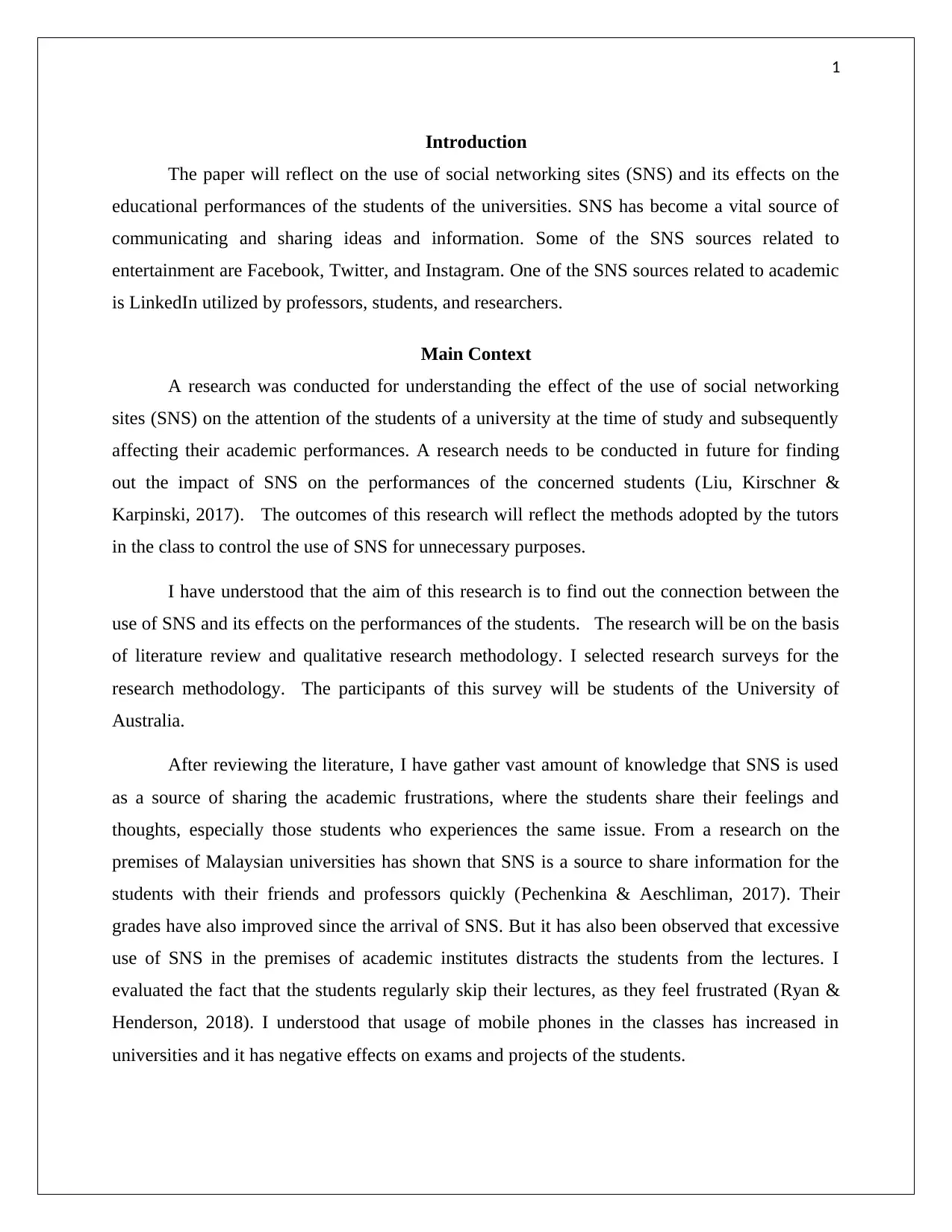
Introduction
The paper will reflect on the use of social networking sites (SNS) and its effects on the
educational performances of the students of the universities. SNS has become a vital source of
communicating and sharing ideas and information. Some of the SNS sources related to
entertainment are Facebook, Twitter, and Instagram. One of the SNS sources related to academic
is LinkedIn utilized by professors, students, and researchers.
Main Context
A research was conducted for understanding the effect of the use of social networking
sites (SNS) on the attention of the students of a university at the time of study and subsequently
affecting their academic performances. A research needs to be conducted in future for finding
out the impact of SNS on the performances of the concerned students (Liu, Kirschner &
Karpinski, 2017). The outcomes of this research will reflect the methods adopted by the tutors
in the class to control the use of SNS for unnecessary purposes.
I have understood that the aim of this research is to find out the connection between the
use of SNS and its effects on the performances of the students. The research will be on the basis
of literature review and qualitative research methodology. I selected research surveys for the
research methodology. The participants of this survey will be students of the University of
Australia.
After reviewing the literature, I have gather vast amount of knowledge that SNS is used
as a source of sharing the academic frustrations, where the students share their feelings and
thoughts, especially those students who experiences the same issue. From a research on the
premises of Malaysian universities has shown that SNS is a source to share information for the
students with their friends and professors quickly (Pechenkina & Aeschliman, 2017). Their
grades have also improved since the arrival of SNS. But it has also been observed that excessive
use of SNS in the premises of academic institutes distracts the students from the lectures. I
evaluated the fact that the students regularly skip their lectures, as they feel frustrated (Ryan &
Henderson, 2018). I understood that usage of mobile phones in the classes has increased in
universities and it has negative effects on exams and projects of the students.
Document Page
2
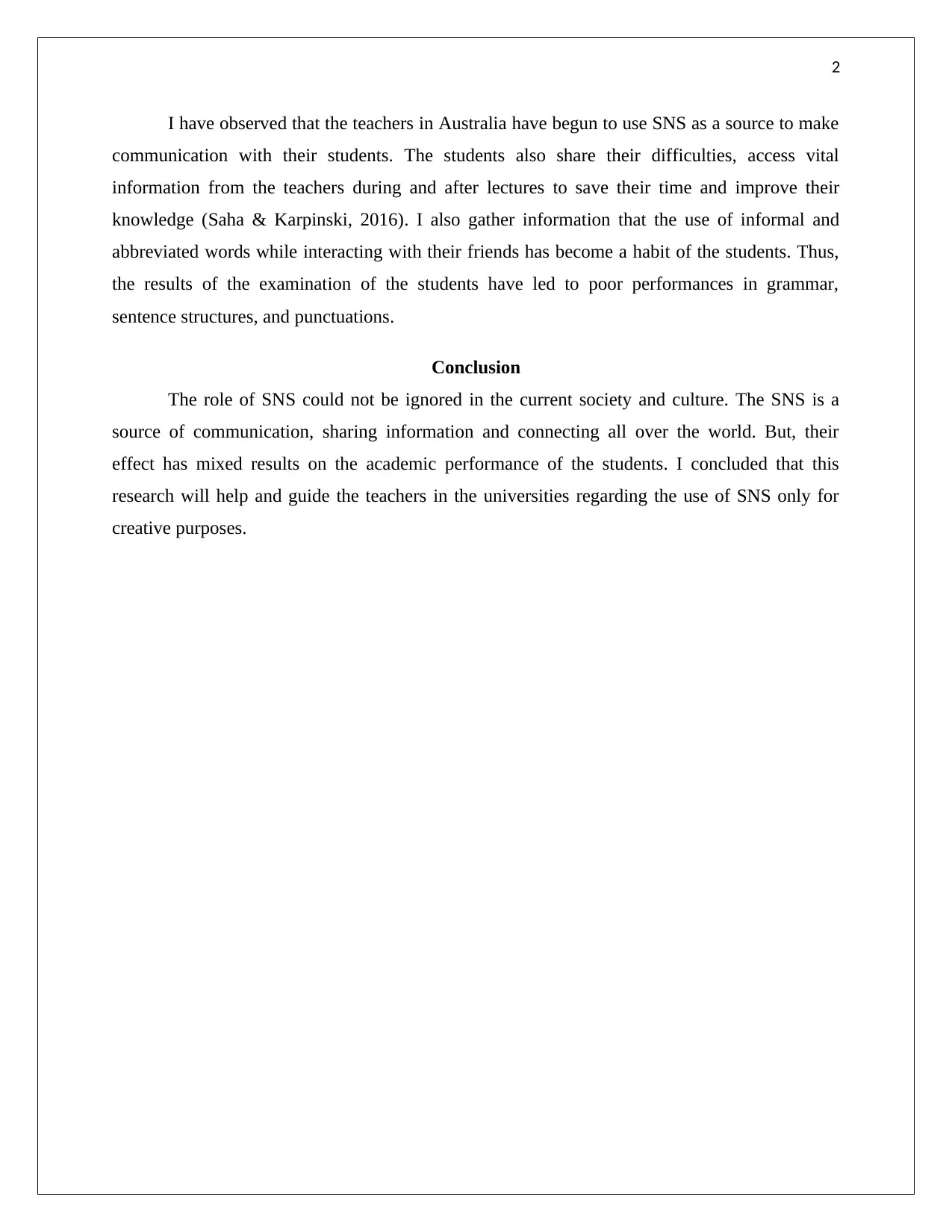
I have observed that the teachers in Australia have begun to use SNS as a source to make
communication with their students. The students also share their difficulties, access vital
information from the teachers during and after lectures to save their time and improve their
knowledge (Saha & Karpinski, 2016). I also gather information that the use of informal and
abbreviated words while interacting with their friends has become a habit of the students. Thus,
the results of the examination of the students have led to poor performances in grammar,
sentence structures, and punctuations.
Conclusion
The role of SNS could not be ignored in the current society and culture. The SNS is a
source of communication, sharing information and connecting all over the world. But, their
effect has mixed results on the academic performance of the students. I concluded that this
research will help and guide the teachers in the universities regarding the use of SNS only for
creative purposes.
Document Page
3
References
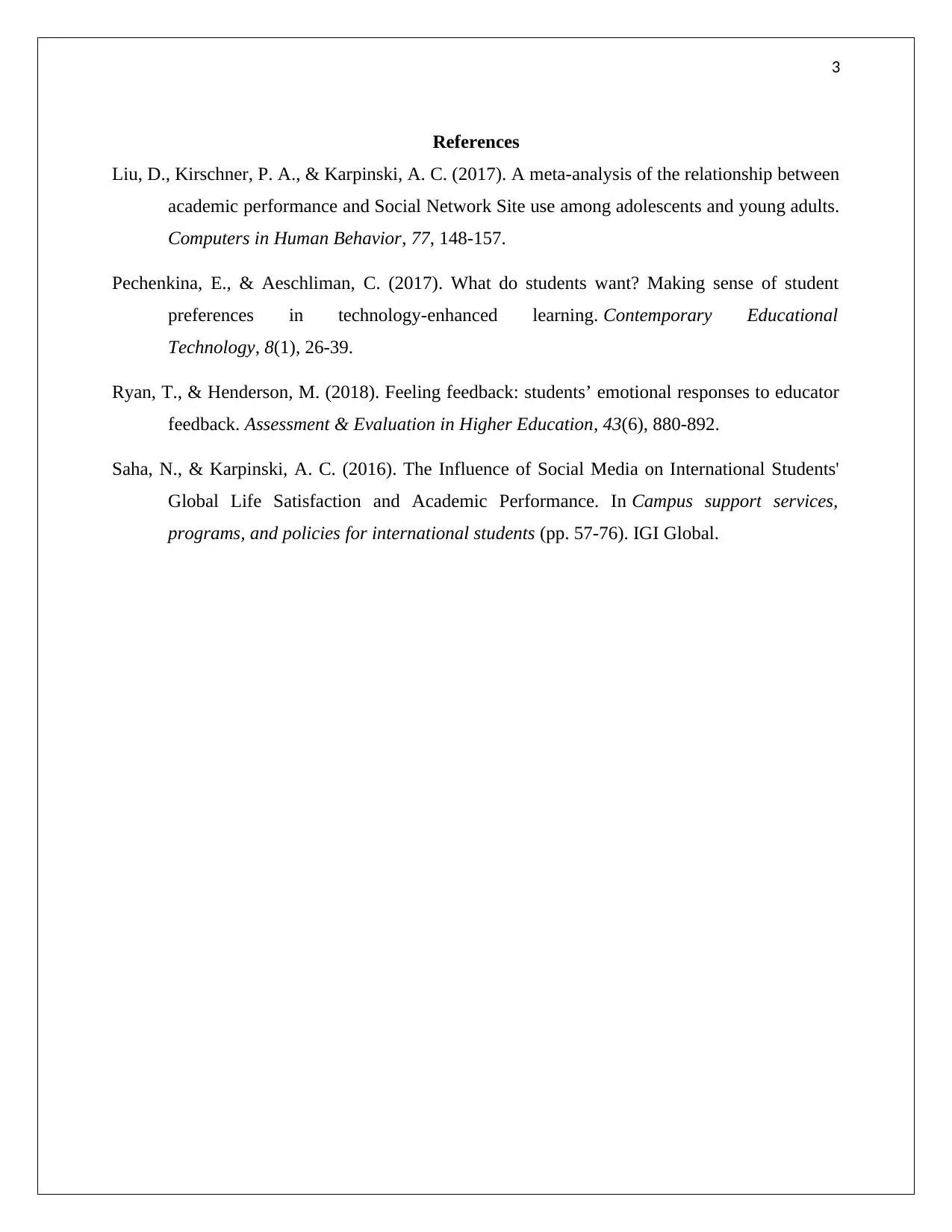
Liu, D., Kirschner, P. A., & Karpinski, A. C. (2017). A meta-analysis of the relationship between
academic performance and Social Network Site use among adolescents and young adults.
Computers in Human Behavior, 77, 148-157.
Pechenkina, E., & Aeschliman, C. (2017). What do students want? Making sense of student
preferences in technology-enhanced learning. Contemporary Educational
Technology, 8(1), 26-39.
Ryan, T., & Henderson, M. (2018). Feeling feedback: students’ emotional responses to educator
feedback. Assessment & Evaluation in Higher Education, 43(6), 880-892.
Saha, N., & Karpinski, A. C. (2016). The Influence of Social Media on International Students'
Global Life Satisfaction and Academic Performance. In Campus support services,
programs, and policies for international students (pp. 57-76). IGI Global.
tabler-icon-diamond-filled.svg

Paraphrase This Document

Need a fresh take? Get an instant paraphrase of this document with our AI Paraphraser
Document Page
4
Appendices
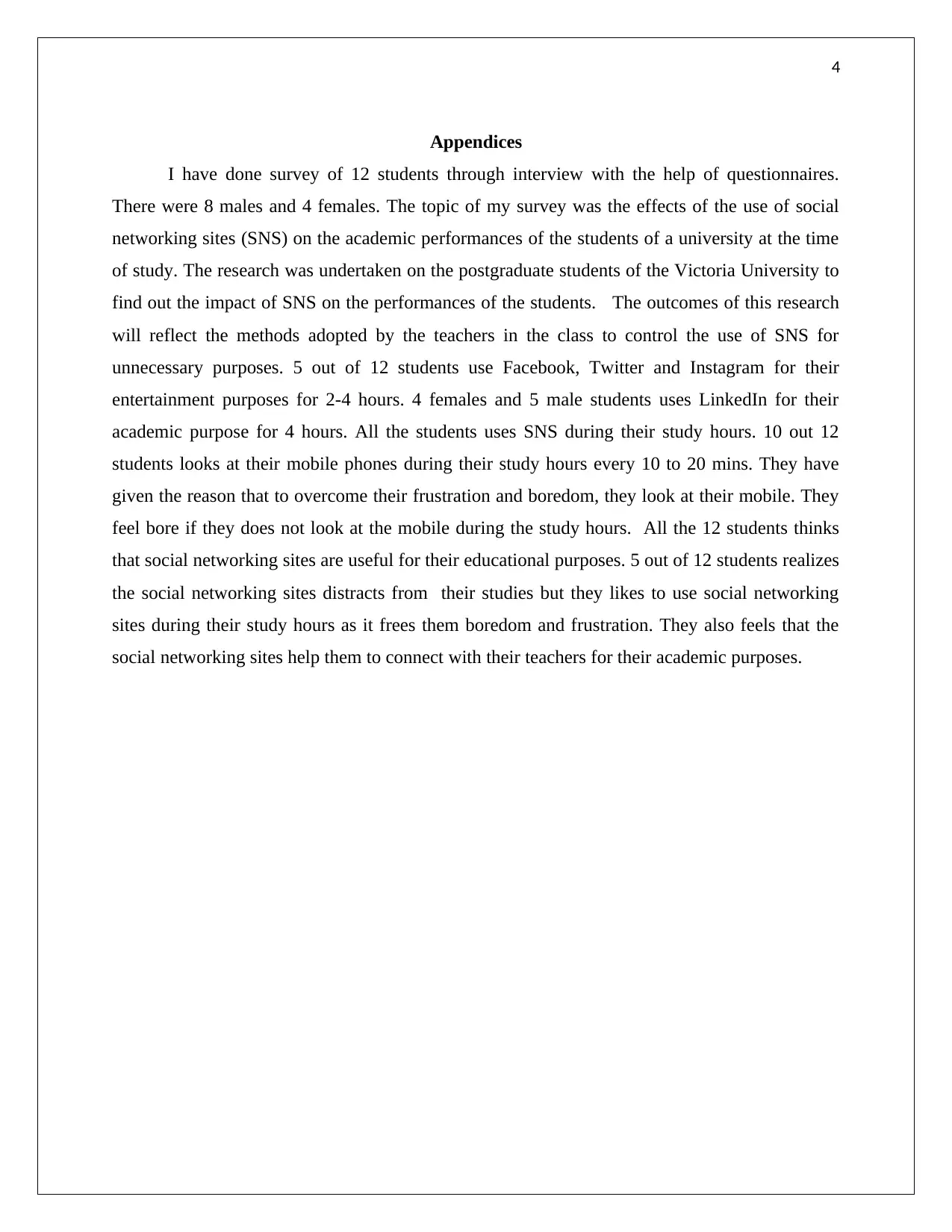
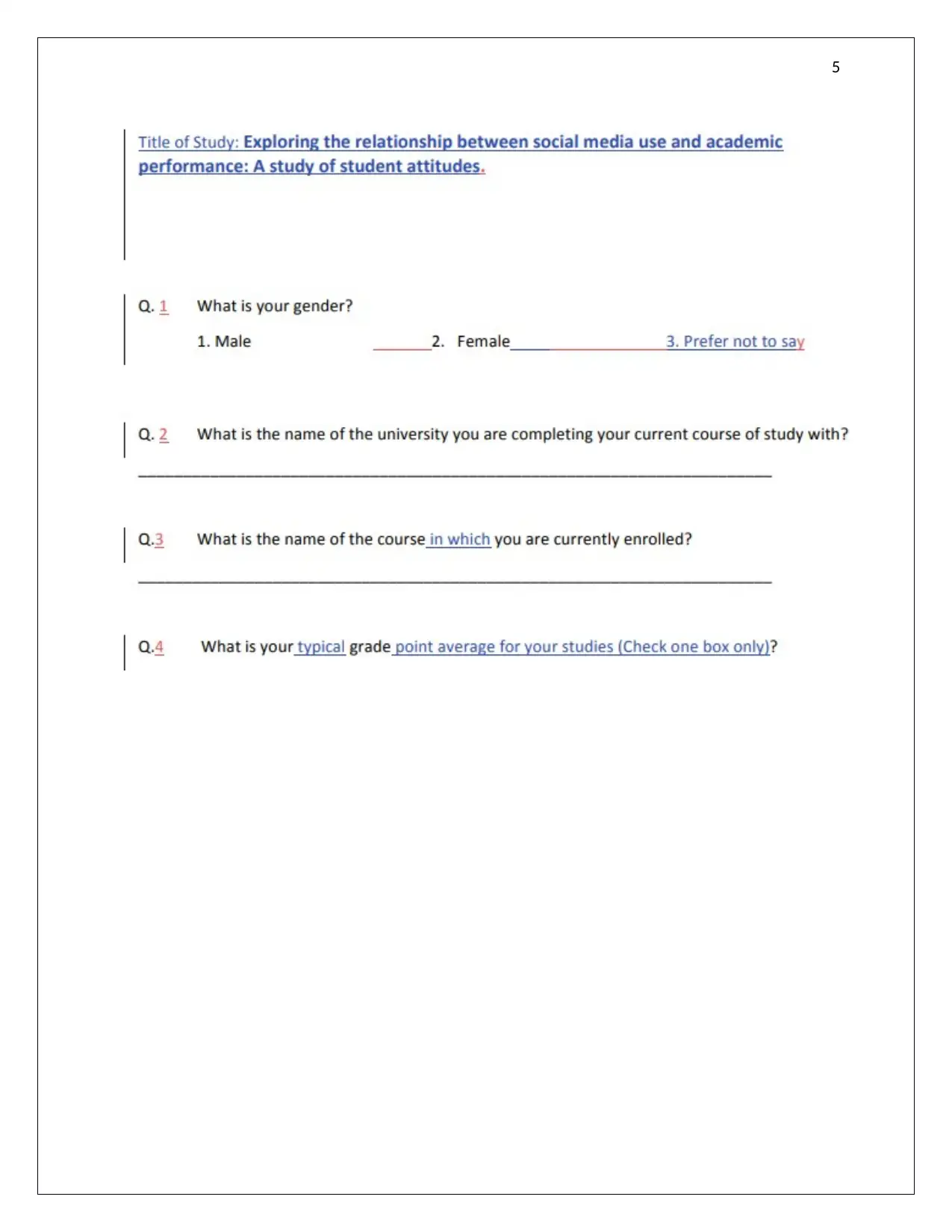
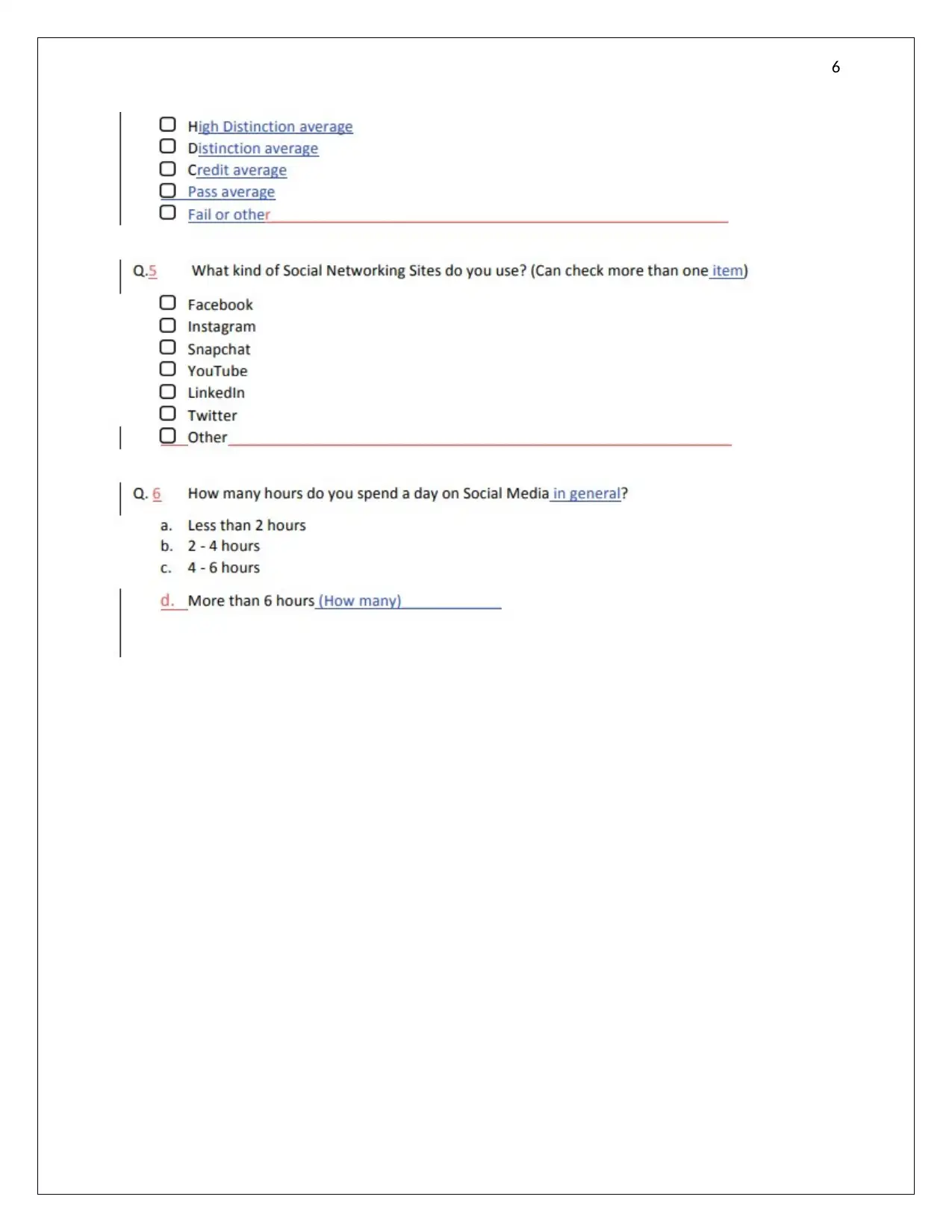
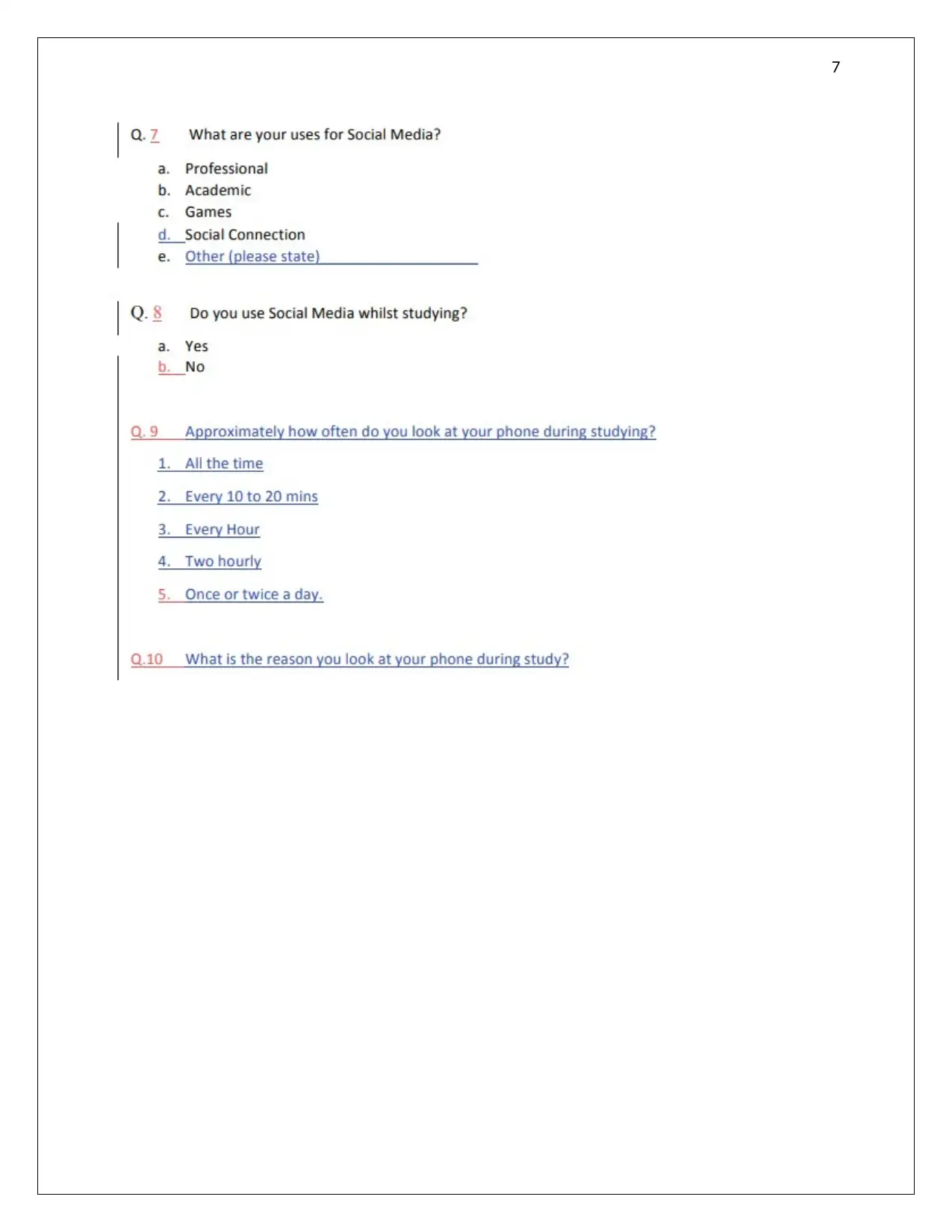
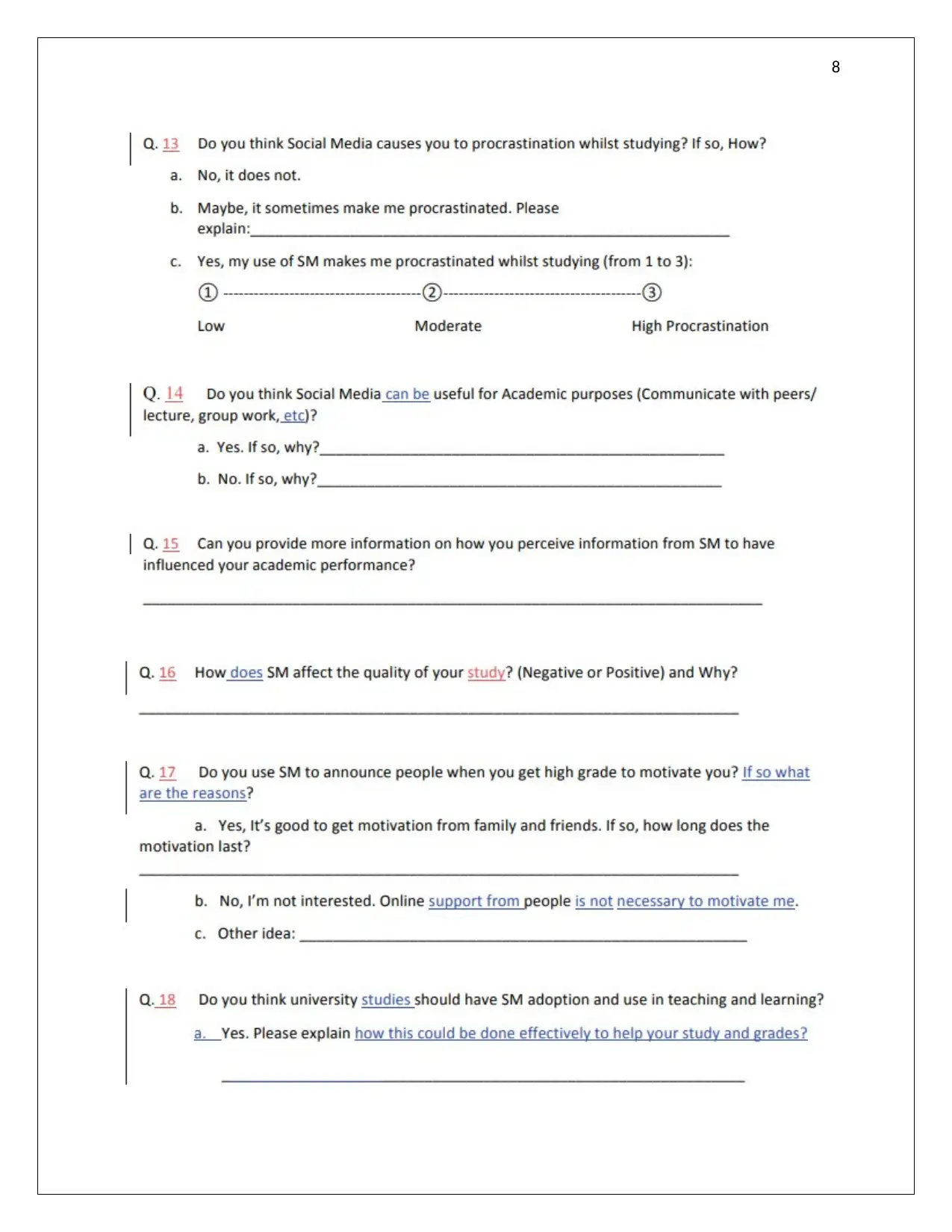
I have done survey of 12 students through interview with the help of questionnaires.
There were 8 males and 4 females. The topic of my survey was the effects of the use of social
networking sites (SNS) on the academic performances of the students of a university at the time
of study. The research was undertaken on the postgraduate students of the Victoria University to
find out the impact of SNS on the performances of the students. The outcomes of this research
will reflect the methods adopted by the teachers in the class to control the use of SNS for
unnecessary purposes. 5 out of 12 students use Facebook, Twitter and Instagram for their
entertainment purposes for 2-4 hours. 4 females and 5 male students uses LinkedIn for their
academic purpose for 4 hours. All the students uses SNS during their study hours. 10 out 12
students looks at their mobile phones during their study hours every 10 to 20 mins. They have
given the reason that to overcome their frustration and boredom, they look at their mobile. They
feel bore if they does not look at the mobile during the study hours. All the 12 students thinks
that social networking sites are useful for their educational purposes. 5 out of 12 students realizes
the social networking sites distracts from their studies but they likes to use social networking
sites during their study hours as it frees them boredom and frustration. They also feels that the
social networking sites help them to connect with their teachers for their academic purposes.
Document Page
5
Document Page
6
tabler-icon-diamond-filled.svg

Paraphrase This Document

Need a fresh take? Get an instant paraphrase of this document with our AI Paraphraser
Document Page
7
Document Page
8
chevron_up_icon
1 out of 9
circle_padding
hide_on_mobile
zoom_out_icon
[object Object]