The Impact of Social Capital on Modern Citizenship Affairs

Verified

Added on  2022/09/08

|6
|1404
|12
Report
AI Summary
This report, focused on Economics 2, delves into the multifaceted concept of social capital and its profound influence on modern citizenship within the global order. The analysis explores the structural allocation of resources, emphasizing relationships, networks, and the accessibility of governance institutions. It examines how social capital, characterized by trust, civil engagement, and mutual cooperation, underpins effective social services. The report investigates the correlation between social capital and citizenship, evaluating its impact on service delivery, citizen rights, and government-citizen relationships. It highlights the importance of social context in promoting humanity and common goals, while also addressing potential negative aspects like corruption and injustice. The study further discusses the role of education, economic status, and leadership in shaping social capital, and suggests strategies to enhance accessibility and promote inclusivity. Finally, the report suggests that collective participation in decision-making is crucial for enhancing accountability and government responsibilities.

Document Page
Economics 1
STATE IN THE GLOBAL ORDER
Name
Course
Date
tabler-icon-diamond-filled.svg

Paraphrase This Document

Need a fresh take? Get an instant paraphrase of this document with our AI Paraphraser
Document Page
Economics 2
Introduction
Social capital is the structural resource allocation in terms of relationship, networks, and
accessibility of governance institutions in the society. It is regarded to act as the foundation for
the effective social service offered by the citizens (Aldrich and Meyer, 2015). Societies that are
strongly operational are well stocked with a strong social capital. However, the presence of
social capital depends on how elaborative the research about its merits and demerits affects the
whole community. For instance, the concept of social capital appears to be more relevant when
citizens demonstrates the good will to trust in the service, civil engagements and morals, mutual
cooperation, and networking. As a result, this paper will ascertain the extent on ways to which
depth research works on the social capital has modified the current citizenship affairs
(Ljungholm, 2016).
Social Capital and its importance to Modern Approaches to Citizen
According to Ponzetto and Troiano (2018), researchers have regarded the social capital
and trust as an asset in inducing the citizenship services. These include citizenship commitments
and responsibilities, together with their awareness of their rights to act appropriately. Since early
17th centuries, citizenship has been a major concept in the public policy and global governance
with many scholars finding the correlation between the social capital and the citizenship in terms
of service delivery. According to Turner (2016), there are two dimensions that are considered to
be important in the citizenship culture in terms of social capital responsibilities. These include
the citizen’s rights and the relationship between the government and the citizens. As a result,
research on social capital thus depends on how the citizens observe the rights of other people in
Document Page
Economics 3
performing their duties. What is considered essential in the research between social and modern
citizen approaches is the social context that promotes the culture that embraces humanity.
Citizenship approaches emphasizes on the basis of commitments and concepts of a
common goal of global orders. It is therefore argued that comparison with the social capital,
citizenship is a service that calls for commitments and priority. In general, citizenship involves
the respect for one another’s respects and a responsibility for sense of closeness (Ljungholm,
2016). This is measured in social capital index which takes in to consideration economic
resources and job opportunities. In a society, there are numerous cases where social capital is
more liable to the society than its importance. For example, when linking the social capital to the
nepotism, corruption, and judgmental injustices; it can be used to control the society in a wrong
way.
Research on social capital proves that both economic and political classes in the society
with regard to education level are primarily the main causes of social capital. As a result, the
more wealthy and educated the society, the higher the level of its social capital accessibility
(Dower and Williams, 2016). At the same time, the poor in the society will be bound to lack of
primary access to the social capital in large because they lack economic power to participate in
the decision makings in the society. As a result, the research to collate importance of the social
capital in the modern society should be used to impact the less privileged people in the society.
This can be done through promoting the modern structures for the justice and human rights in the
communities and neighborhoods with little social capital accessibilities (Ponzetto and Troiano,
2018).
Document Page
Economics 4
The elements of social capital which includes trust can be used to increase the citizen
participation in the groups thus helps to identify the common precedence and effective way to air
out the voice of the demands. For instance, Bendix (2017) argued that when citizens are able to
completely articulate their priorities, they become better off to work on their targets thus
increases monitoring and evaluation services in the society. As a result, this demand, known as
the trust will precipitate the supply side of the transparency and accountability from the
government agencies (Aldrich and Meyer, 2015).
Research has also suggested that through social capital, citizens are able to develop a
leadership capacity to help promote change. As a result, it is important to harness the positive
benefits of the social capital that helps to improve the governance and accountability (Ratten,
2015). Through the change agents, the possibility of citizen representation will be achieved when
key government and community decisions are made in line with the economic order priorities.
According to Bendix (2017), specialized knowledge and competency in advocating for a fair
political change requires a sober mind that promotes the unity of the community. To achieve this,
researchers have suggested that new leaders including women and youths mostly posses the
relevant characteristics for the better economic developments. This is because through their
social capital including knowledge and competency, these groups have advanced skills in
negotiating for the interest of citizens. For instance, according to Chilenski and Summers (2016),
using a seven year longitudinal study, in the rural areas of India the social capital was most
productive in areas with young leaders who helped the communities act collectively in
formulating a fair economic goals.
Lastly, there is a hypothesis that suggests that when political elites and bureaucrats are
included in the society decision makings for a social capital formation, they are able to
tabler-icon-diamond-filled.svg

Paraphrase This Document

Need a fresh take? Get an instant paraphrase of this document with our AI Paraphraser
Document Page
Economics 5
compromise with one another and come to an agreement on an effective working environment
(Aldrich and Meyer, 2015). This is because through the bureaucrats’ involvement, there is an
effective internal cooperation on governance in the society. As a result, the government is able to
respond to citizens’ demand that goes beyond social capital but within the organizational
incentives. Therefore, although social capital can be used to positively contribute to effective and
inclusive governance; it should not be the only option to help promote inclusivity in the society.
Conclusion
Through social capital, the availability of a lens that can be used to promote good
governance, through normalizing society trust and reciprocity is fostered. It is therefore
important for the citizens to embark on embracing different cultures that helps to build skills,
opportunities, and confidence of the citizens. As a result, this paper recommends that an act of
collective social capital participation in decision making should be advocated for in order to
enhance accountability and government responsibilities.
Document Page
Economics 6
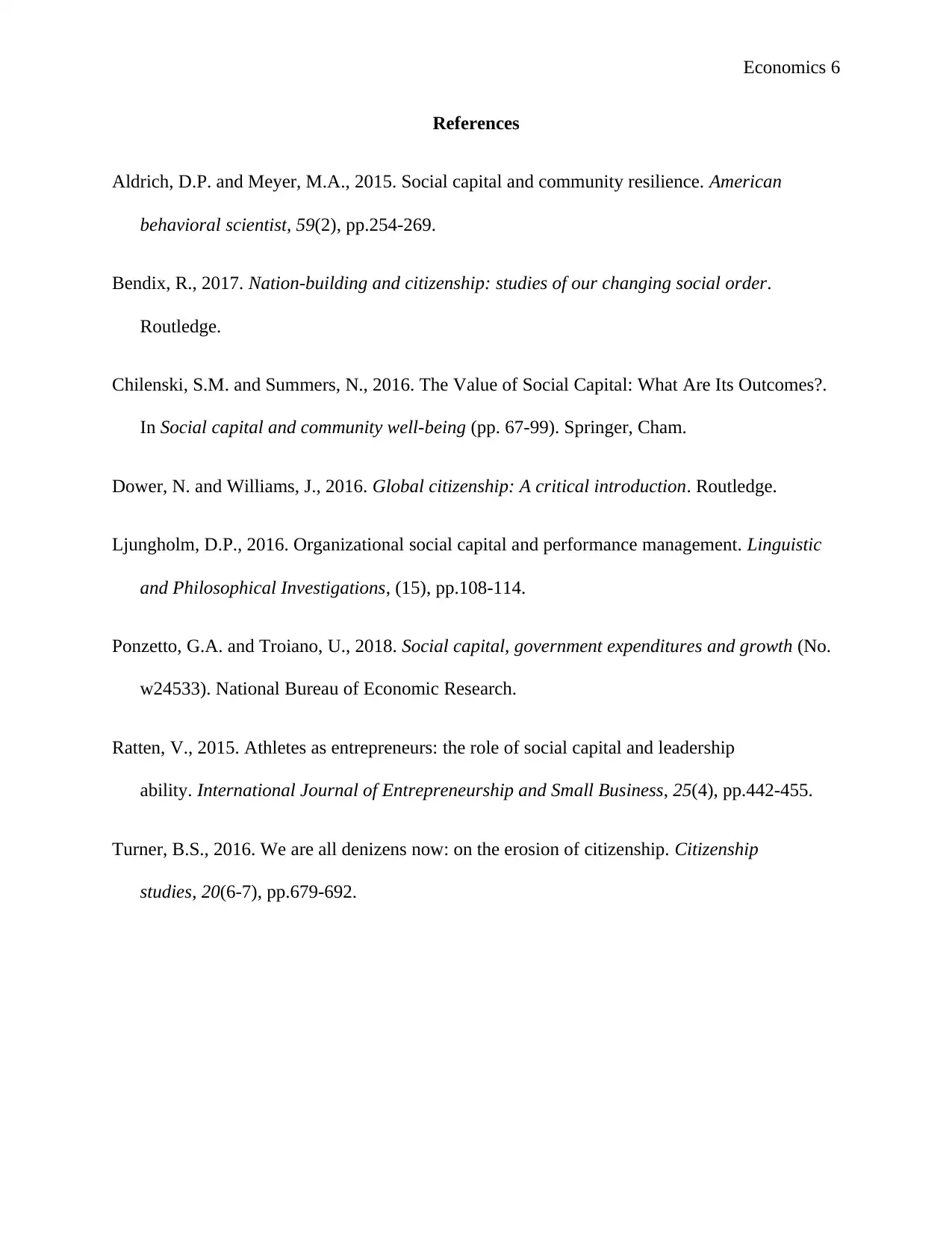
References
Aldrich, D.P. and Meyer, M.A., 2015. Social capital and community resilience. American
behavioral scientist, 59(2), pp.254-269.
Bendix, R., 2017. Nation-building and citizenship: studies of our changing social order.
Routledge.
Chilenski, S.M. and Summers, N., 2016. The Value of Social Capital: What Are Its Outcomes?.
In Social capital and community well-being (pp. 67-99). Springer, Cham.
Dower, N. and Williams, J., 2016. Global citizenship: A critical introduction. Routledge.
Ljungholm, D.P., 2016. Organizational social capital and performance management. Linguistic
and Philosophical Investigations, (15), pp.108-114.
Ponzetto, G.A. and Troiano, U., 2018. Social capital, government expenditures and growth (No.
w24533). National Bureau of Economic Research.
Ratten, V., 2015. Athletes as entrepreneurs: the role of social capital and leadership
ability. International Journal of Entrepreneurship and Small Business, 25(4), pp.442-455.
Turner, B.S., 2016. We are all denizens now: on the erosion of citizenship. Citizenship
studies, 20(6-7), pp.679-692.
chevron_up_icon
1 out of 6
circle_padding
hide_on_mobile
zoom_out_icon
[object Object]