Social Successful Relationships: Workplace and Communication
VerifiedAdded on 2023/06/10
|9
|1326
|166
Report
AI Summary
This report examines the dynamics of social successful relationships in a professional context. It begins by exploring Maslow's Hierarchy of Needs and its relevance to workplace motivation and individual fulfillment. The report then delves into the significance of communication climate, outlining strategies to foster a supportive and respectful environment, and explores the concept of 'face' within politeness theory, illustrating how language and behavior impact social interactions. The core of the report focuses on an essay analyzing cultural conflict in the workplace, emphasizing the importance of cultural diversity, effective communication, and conflict management strategies. The essay discusses the impact of cultural differences on employee relationships, creativity, and productivity, along with strategies to mitigate negative impacts and promote a positive and inclusive work environment. The report concludes by highlighting the importance of understanding individual needs, maintaining politeness, and fostering a good communication climate to build successful and harmonious workplace relationships.
Running head: SOCIAL SUCCESSFUL RELATIONSHIP
Social Successful Relationship
Name of the Student
Name of the University
Author Note
Social Successful Relationship
Name of the Student
Name of the University
Author Note
Paraphrase This Document
Need a fresh take? Get an instant paraphrase of this document with our AI Paraphraser

1SOCIAL SUCCESSFUL RELATIONSHIP
Table of Contents
SECTION A: SHORT QUESTION-ANSWER..............................................................................2
Maslow’s Need Hierarchy...........................................................................................................2
Communication Climate..............................................................................................................4
Concept of Face in Politeness Theory.........................................................................................4
SECTION B: ESSAY......................................................................................................................6
Cultural conflict at workplace.....................................................................................................6
Table of Contents
SECTION A: SHORT QUESTION-ANSWER..............................................................................2
Maslow’s Need Hierarchy...........................................................................................................2
Communication Climate..............................................................................................................4
Concept of Face in Politeness Theory.........................................................................................4
SECTION B: ESSAY......................................................................................................................6
Cultural conflict at workplace.....................................................................................................6

2SOCIAL SUCCESSFUL RELATIONSHIP
SECTION A: SHORT QUESTION-ANSWER
Maslow’s Need Hierarchy
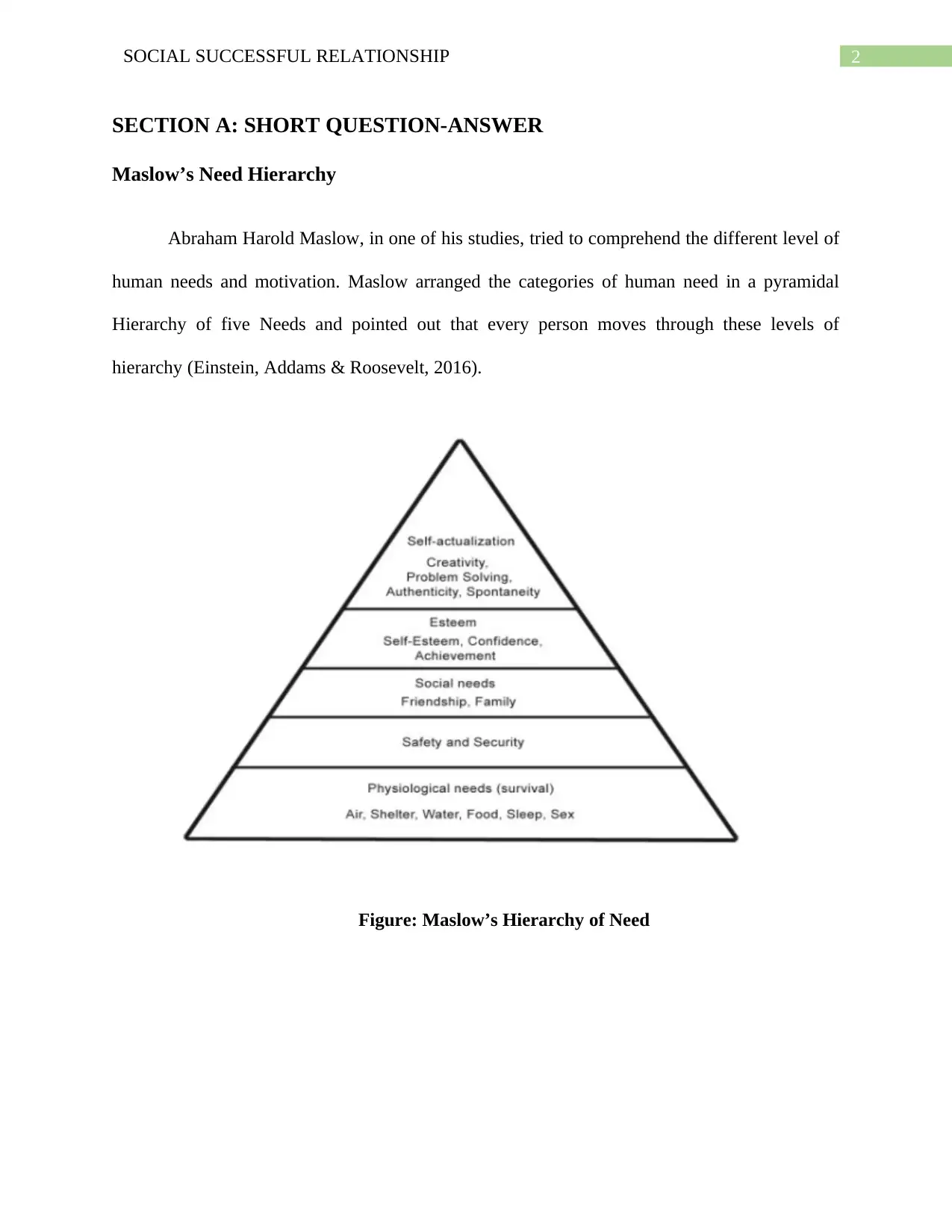
Abraham Harold Maslow, in one of his studies, tried to comprehend the different level of
human needs and motivation. Maslow arranged the categories of human need in a pyramidal
Hierarchy of five Needs and pointed out that every person moves through these levels of
hierarchy (Einstein, Addams & Roosevelt, 2016).
Figure: Maslow’s Hierarchy of Need
SECTION A: SHORT QUESTION-ANSWER
Maslow’s Need Hierarchy
Abraham Harold Maslow, in one of his studies, tried to comprehend the different level of
human needs and motivation. Maslow arranged the categories of human need in a pyramidal
Hierarchy of five Needs and pointed out that every person moves through these levels of
hierarchy (Einstein, Addams & Roosevelt, 2016).
Figure: Maslow’s Hierarchy of Need
⊘ This is a preview!⊘
Do you want full access?
Subscribe today to unlock all pages.

Trusted by 1+ million students worldwide

3SOCIAL SUCCESSFUL RELATIONSHIP
Role of Communication
Communication with people living in the same society is necessary to enjoy the basics
physiological needs stated in the first level.
Safety and security like health, money, and asset can be achieved by keeping a cordial
relationship with people around.
Human attachments like family and friendship should be maintained with regular
communication.
Human esteems like respect, confidence can be achieved through good performance and
quality conversations.
Participation in the societal gatherings is must for acquiring Self-actualizations factors
(Kang & Jung, 2014).
Communication Climate
Communication climate means the tone and accent of two or more person who live or
work together and interact with each other regularly. Good and supportive communication
climate is what everyone desire as it is easier to live and work with people with whom it is more
convenient to strike a conversation and exchange mutual respect (Mirivel, 2014). To make a
communication climate good and positive, there are certain aspects, which are to be followed.
Offer respect to each other: Respect is the most important positive aspect for
any relationship, be it at home or at work.
Role of Communication
Communication with people living in the same society is necessary to enjoy the basics
physiological needs stated in the first level.
Safety and security like health, money, and asset can be achieved by keeping a cordial
relationship with people around.
Human attachments like family and friendship should be maintained with regular
communication.
Human esteems like respect, confidence can be achieved through good performance and
quality conversations.
Participation in the societal gatherings is must for acquiring Self-actualizations factors
(Kang & Jung, 2014).
Communication Climate
Communication climate means the tone and accent of two or more person who live or
work together and interact with each other regularly. Good and supportive communication
climate is what everyone desire as it is easier to live and work with people with whom it is more
convenient to strike a conversation and exchange mutual respect (Mirivel, 2014). To make a
communication climate good and positive, there are certain aspects, which are to be followed.
Offer respect to each other: Respect is the most important positive aspect for
any relationship, be it at home or at work.
Paraphrase This Document
Need a fresh take? Get an instant paraphrase of this document with our AI Paraphraser

4SOCIAL SUCCESSFUL RELATIONSHIP
Disapprove negative actions: Negative actions should be checked as negativity
pollutes a positive environment. However, it should be conveyed politely to
maintain calm and peaceful atmosphere and to retain a good communication
climate.
Acknowledgment of effort: one should be praised and congratulated right away
for a good deed. This spreads an atmosphere of confidence in and around. It
creates a positive communication climate.
Concept of Face in Politeness Theory
The concept of politeness theory depends upon the concept of face, propounded by
Erving Goffman, a social psychologist. He led down that Face is the image that one projects in
the social arena to establish a contact with everyone else. The face of a person is the first feature
that is recognized and remembered throughout (O’Driscoll, 2017).
Examples of face in politeness theory:
1. Throw of words like “shut up” and “keep quiet” can sound extremely rude. Instead, it
would be suggested to use “would you mind keeping quiet as it is a library and others are
trying to study”.
2. “I don’t need your help” can be restated as “thank you so much for your kindness,
however I do not need the help at the moment” is more appropriate.
Disapprove negative actions: Negative actions should be checked as negativity
pollutes a positive environment. However, it should be conveyed politely to
maintain calm and peaceful atmosphere and to retain a good communication
climate.
Acknowledgment of effort: one should be praised and congratulated right away
for a good deed. This spreads an atmosphere of confidence in and around. It
creates a positive communication climate.
Concept of Face in Politeness Theory
The concept of politeness theory depends upon the concept of face, propounded by
Erving Goffman, a social psychologist. He led down that Face is the image that one projects in
the social arena to establish a contact with everyone else. The face of a person is the first feature
that is recognized and remembered throughout (O’Driscoll, 2017).
Examples of face in politeness theory:
1. Throw of words like “shut up” and “keep quiet” can sound extremely rude. Instead, it
would be suggested to use “would you mind keeping quiet as it is a library and others are
trying to study”.
2. “I don’t need your help” can be restated as “thank you so much for your kindness,
however I do not need the help at the moment” is more appropriate.

5SOCIAL SUCCESSFUL RELATIONSHIP
3. Giving a compliment to promote a positive face is essential. “I really appreciate the hard
work you do every day sincerely” is a great face value compliment that boosts the
confidence of the other person and creates a sense of positivity.
3. Giving a compliment to promote a positive face is essential. “I really appreciate the hard
work you do every day sincerely” is a great face value compliment that boosts the
confidence of the other person and creates a sense of positivity.
⊘ This is a preview!⊘
Do you want full access?
Subscribe today to unlock all pages.

Trusted by 1+ million students worldwide

6SOCIAL SUCCESSFUL RELATIONSHIP
SECTION B: ESSAY
Cultural conflict at workplace
In today’s world every organization needs cultural diversity as it nurtures creativity and
gives scope for different point of view. This results in better understanding of the problems and
even smoother delivery of solution, given the fact that all the members of a tem are pulling in the
same direction. Cultural difference may affect cordialness between employees, creativity and
productiveness; and may result in unwillingness to work, depression and anxiety.
However, there are higher possibilities to face cross-cultural difference in the workplace
but they can be avoided with appropriate approach. It is inevitable to experience conflict and
harsh situation in workplace when there are people coming from different cultural background.
Nonetheless, there are several strategies and theories to tackle the conflicting situation. It is
important to be aware of one’s own cultural drawback to safeguard himself from further
criticism. To avoid or handle negative workplace situation, one should follow certain strategies
like creating a good communication climate, maintaining politeness and understanding his own
priorities in life (Prause & Mujtaba, 2015). A good and positive communication climate is a must
at a workplace. Paying respect to each other is a positive aspect to maintain a healthy
relationship with co-workers even though they are from different cultural background as
respecting one another should not vary as per cultural background. Although it is important to
acknowledge negative actions, however to avoid negativity one can suppress his personal
judgment about someone else’s personal life. A polite approach is another essential to maintain
positivity around oneself when working in an organization. Selection of words when speaking is
vital and should be taken care of most importantly when it is about one’s culture. Keeping a
SECTION B: ESSAY
Cultural conflict at workplace
In today’s world every organization needs cultural diversity as it nurtures creativity and
gives scope for different point of view. This results in better understanding of the problems and
even smoother delivery of solution, given the fact that all the members of a tem are pulling in the
same direction. Cultural difference may affect cordialness between employees, creativity and
productiveness; and may result in unwillingness to work, depression and anxiety.
However, there are higher possibilities to face cross-cultural difference in the workplace
but they can be avoided with appropriate approach. It is inevitable to experience conflict and
harsh situation in workplace when there are people coming from different cultural background.
Nonetheless, there are several strategies and theories to tackle the conflicting situation. It is
important to be aware of one’s own cultural drawback to safeguard himself from further
criticism. To avoid or handle negative workplace situation, one should follow certain strategies
like creating a good communication climate, maintaining politeness and understanding his own
priorities in life (Prause & Mujtaba, 2015). A good and positive communication climate is a must
at a workplace. Paying respect to each other is a positive aspect to maintain a healthy
relationship with co-workers even though they are from different cultural background as
respecting one another should not vary as per cultural background. Although it is important to
acknowledge negative actions, however to avoid negativity one can suppress his personal
judgment about someone else’s personal life. A polite approach is another essential to maintain
positivity around oneself when working in an organization. Selection of words when speaking is
vital and should be taken care of most importantly when it is about one’s culture. Keeping a
Paraphrase This Document
Need a fresh take? Get an instant paraphrase of this document with our AI Paraphraser

7SOCIAL SUCCESSFUL RELATIONSHIP
polite facial expression is important when dealing with cultural diversity. Putting a negative or
regressive face for a particular culture or passing lewd comments attacking a person’s personal
space or background would only add to an adverse situation. Politeness is the key to handle any
ugly situation that might affect the work culture and ethics of an organization. A person needs to
understand his needs and wants from an organization and must deliver keeping such needs in
mind as per the Maslow’s Hierarchy of Need. Cultural differences like language barrier, food
choices, family rituals are imperative needs of every individual. One tends to feel threatened and
vulnerable if he finds a lack of familiar things around. Such gaps give birth to dissatisfaction and
unwillingness to work leading to a negative atmosphere in the workplace (Gunkel, Schlaegel &
Taras, 2016).
Therefore, to curtail such discomfort one must address and communicate his issues with
the effective authority in the workplace.
polite facial expression is important when dealing with cultural diversity. Putting a negative or
regressive face for a particular culture or passing lewd comments attacking a person’s personal
space or background would only add to an adverse situation. Politeness is the key to handle any
ugly situation that might affect the work culture and ethics of an organization. A person needs to
understand his needs and wants from an organization and must deliver keeping such needs in
mind as per the Maslow’s Hierarchy of Need. Cultural differences like language barrier, food
choices, family rituals are imperative needs of every individual. One tends to feel threatened and
vulnerable if he finds a lack of familiar things around. Such gaps give birth to dissatisfaction and
unwillingness to work leading to a negative atmosphere in the workplace (Gunkel, Schlaegel &
Taras, 2016).
Therefore, to curtail such discomfort one must address and communicate his issues with
the effective authority in the workplace.

8SOCIAL SUCCESSFUL RELATIONSHIP
References:
Einstein, A., Addams, J., & Roosevelt, E. (2016). Maslow's hierarchy of needs.
Gunkel, M., Schlaegel, C., & Taras, V. (2016). Cultural values, emotional intelligence, and
conflict handling styles: A global study. Journal of World Business, 51(4), 568-585.
Mirivel, J. C. (2014). The art of positive communication: Theory and practice. New York, NY:
Peter Lang.
O’Driscoll, J. (2017). Face and (Im) politeness. In The Palgrave Handbook of Linguistic (Im)
politeness (pp. 89-118). Palgrave Macmillan, London.
Prause, D., & Mujtaba, B. G. (2015). Conflict management practices for diverse
workplaces. Journal of Business Studies Quarterly, 6(3), 13.
References:
Einstein, A., Addams, J., & Roosevelt, E. (2016). Maslow's hierarchy of needs.
Gunkel, M., Schlaegel, C., & Taras, V. (2016). Cultural values, emotional intelligence, and
conflict handling styles: A global study. Journal of World Business, 51(4), 568-585.
Mirivel, J. C. (2014). The art of positive communication: Theory and practice. New York, NY:
Peter Lang.
O’Driscoll, J. (2017). Face and (Im) politeness. In The Palgrave Handbook of Linguistic (Im)
politeness (pp. 89-118). Palgrave Macmillan, London.
Prause, D., & Mujtaba, B. G. (2015). Conflict management practices for diverse
workplaces. Journal of Business Studies Quarterly, 6(3), 13.
⊘ This is a preview!⊘
Do you want full access?
Subscribe today to unlock all pages.

Trusted by 1+ million students worldwide
1 out of 9
Related Documents
Your All-in-One AI-Powered Toolkit for Academic Success.
+13062052269
info@desklib.com
Available 24*7 on WhatsApp / Email
Unlock your academic potential
Copyright © 2020–2025 A2Z Services. All Rights Reserved. Developed and managed by ZUCOL.