Major Project: UK Social Housing Scenario and Improvement
VerifiedAdded on 2022/12/23
|23
|5894
|95
Project
AI Summary
This major project investigates the scenario of social housing improvement in the United Kingdom, exploring the historical context and present-day challenges of prefabrication and standardization within the construction industry. The research examines the factors influencing prefabrication, including cost, quality, and time analysis, as well as the performance of prefabricated buildings. It delves into the advantages of prefabrication and addresses limitations in the context of UK social housing. The project analyzes the evolution of prefabrication and standardization, particularly after World War II, and discusses the skepticism surrounding these concepts. The study aims to evaluate the application of prefabrication in both developed and developing countries, focusing on the current scenario in the UK, improvement strategies, and identified risks. The objectives include exploring time, cost, and quality requirements, analyzing prefabrication factors, and evaluating the performance of prefabricated structures and the challenges of prefabrication technology in UK social housing. The project also considers the potential of standardization and prefabrication to meet current housing demands and improve efficiency in the construction industry, while addressing issues related to design, quality, and life cycle considerations.
MAJOR PROJECT: THE SCENARIO OF
SOCIAL HOUSING IMPROVEMENT IN THE
UNITED KINGDOM
By Name
Course
Instructor
Institution
Location
Date
SOCIAL HOUSING IMPROVEMENT IN THE
UNITED KINGDOM
By Name
Course
Instructor
Institution
Location
Date

Paraphrase This Document
Need a fresh take? Get an instant paraphrase of this document with our AI Paraphraser
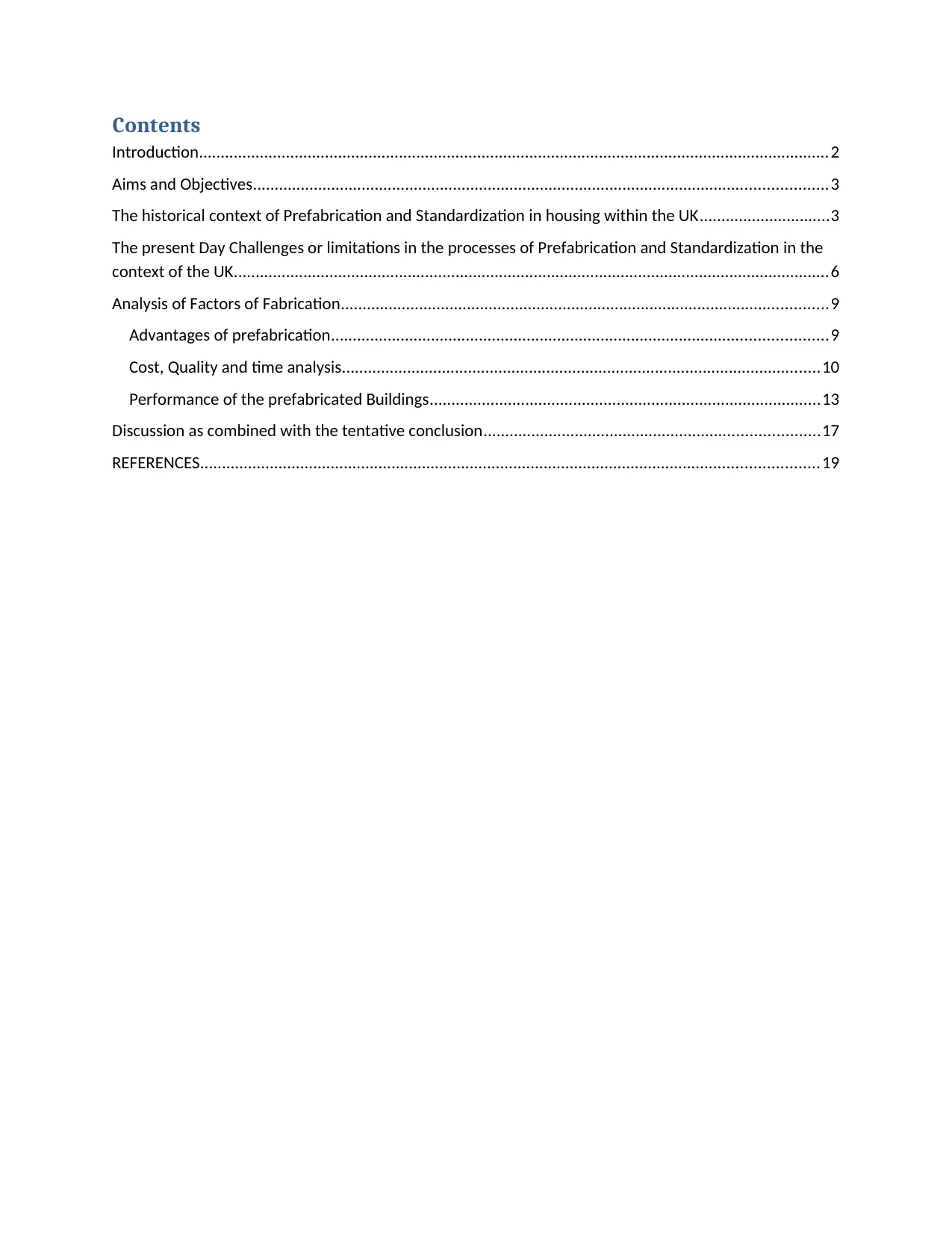
Contents
Introduction.................................................................................................................................................2
Aims and Objectives....................................................................................................................................3
The historical context of Prefabrication and Standardization in housing within the UK..............................3
The present Day Challenges or limitations in the processes of Prefabrication and Standardization in the
context of the UK.........................................................................................................................................6
Analysis of Factors of Fabrication................................................................................................................9
Advantages of prefabrication..................................................................................................................9
Cost, Quality and time analysis..............................................................................................................10
Performance of the prefabricated Buildings..........................................................................................13
Discussion as combined with the tentative conclusion.............................................................................17
REFERENCES..............................................................................................................................................19
Introduction.................................................................................................................................................2
Aims and Objectives....................................................................................................................................3
The historical context of Prefabrication and Standardization in housing within the UK..............................3
The present Day Challenges or limitations in the processes of Prefabrication and Standardization in the
context of the UK.........................................................................................................................................6
Analysis of Factors of Fabrication................................................................................................................9
Advantages of prefabrication..................................................................................................................9
Cost, Quality and time analysis..............................................................................................................10
Performance of the prefabricated Buildings..........................................................................................13
Discussion as combined with the tentative conclusion.............................................................................17
REFERENCES..............................................................................................................................................19

⊘ This is a preview!⊘
Do you want full access?
Subscribe today to unlock all pages.

Trusted by 1+ million students worldwide
Introduction
Different images, opinions, and perception will spring the mind of any concerned individual in
the popular imagination when consideration is given to the prefabrication as well as
standardization in housing. The paper focuses on the clarification of some of the above-
mentioned issues. The subject is ground within the context of housing in the UK today. To
expand on the understanding of the literature, the paper has focused on the outline of the
background to the project which is ongoing preferably called "Overcoming the Market and
Client Resistance to Standardization and Pre-fabrication in Housing (Gorgolewski 2008).
It is from this approach that the discussion extends to some of the barriers which are socio-
cultural such as innovative methods of the construction in the market of the UK housing. In the
first instance, there is a discussion on the historical context of the prefabrication. This is done in
attempts to establish the connection that exists between the mistakes and experiences of the past.
The nature of the standardization and prefabrication in today's context is outlined before it is set
within the context of the resurgence of the drive which increases house building efficiency in the
present date.
The past constructs and experiences of standardizations and prefabrication are believed to have
made very many people skeptical about the principles of the same subject. It is, however,
important to note that the evidence over the same is largely anecdotal in the present day. The
arguments presented are the possible issues that are likely to be thought by people about the
housing prefabrication as for the near future. When the discussion considers the nature of homes
and houses in the present society, there is additional profit on the potential of the prefabrication
to the buyers of the house as had been outlined previously. The conclusion is tentatively reached
which becomes the basis of having proposed methodology for the developed research.
Different images, opinions, and perception will spring the mind of any concerned individual in
the popular imagination when consideration is given to the prefabrication as well as
standardization in housing. The paper focuses on the clarification of some of the above-
mentioned issues. The subject is ground within the context of housing in the UK today. To
expand on the understanding of the literature, the paper has focused on the outline of the
background to the project which is ongoing preferably called "Overcoming the Market and
Client Resistance to Standardization and Pre-fabrication in Housing (Gorgolewski 2008).
It is from this approach that the discussion extends to some of the barriers which are socio-
cultural such as innovative methods of the construction in the market of the UK housing. In the
first instance, there is a discussion on the historical context of the prefabrication. This is done in
attempts to establish the connection that exists between the mistakes and experiences of the past.
The nature of the standardization and prefabrication in today's context is outlined before it is set
within the context of the resurgence of the drive which increases house building efficiency in the
present date.
The past constructs and experiences of standardizations and prefabrication are believed to have
made very many people skeptical about the principles of the same subject. It is, however,
important to note that the evidence over the same is largely anecdotal in the present day. The
arguments presented are the possible issues that are likely to be thought by people about the
housing prefabrication as for the near future. When the discussion considers the nature of homes
and houses in the present society, there is additional profit on the potential of the prefabrication
to the buyers of the house as had been outlined previously. The conclusion is tentatively reached
which becomes the basis of having proposed methodology for the developed research.
Paraphrase This Document
Need a fresh take? Get an instant paraphrase of this document with our AI Paraphraser
Aims and Objectives
The main aim of the research was to study the application of the prefabrication in te industry of
the construction in both developing and developed countries, facilitate implementation as finally
evaluate adoption of the processes of pre-fabrication in the UK as a result of shortage in
housing. The study therefore focuses on the evaluation of the current scenario in the construction
industry within the context of the UK while putting much focus on the determination of the
improvement as well as effect of the identified risk. In order to meets this main aim, the
objectives of the study are highlighted as:
Exploration of the time, cost and quality requirements in the structural prefabrication as
far as the construction industry is concerned.
Prefabrication factors analysis
Evaluation of the prefabrication performance of the structures in certain countries
Evaluation of the prefabrication technology challenges or limitation in the context of the
social housing within the UK.
The historical context of Prefabrication and Standardization in housing
within the UK
There have been very many supporters of the standardization and prefabrication concepts
historically in the context of housing. Some of the scholars once argued that the aim of
producing houses should be as efficient as the production of bicycles which has been identified
in the past as one of the efficient objects. Other similar comparisons have been made by others
like airplanes, ships, automobiles, etc. which are more advanced that the bicycle itself.
Subsequent projects have aimed at reduction of the tension between the idea of industrial
The main aim of the research was to study the application of the prefabrication in te industry of
the construction in both developing and developed countries, facilitate implementation as finally
evaluate adoption of the processes of pre-fabrication in the UK as a result of shortage in
housing. The study therefore focuses on the evaluation of the current scenario in the construction
industry within the context of the UK while putting much focus on the determination of the
improvement as well as effect of the identified risk. In order to meets this main aim, the
objectives of the study are highlighted as:
Exploration of the time, cost and quality requirements in the structural prefabrication as
far as the construction industry is concerned.
Prefabrication factors analysis
Evaluation of the prefabrication performance of the structures in certain countries
Evaluation of the prefabrication technology challenges or limitation in the context of the
social housing within the UK.
The historical context of Prefabrication and Standardization in housing
within the UK
There have been very many supporters of the standardization and prefabrication concepts
historically in the context of housing. Some of the scholars once argued that the aim of
producing houses should be as efficient as the production of bicycles which has been identified
in the past as one of the efficient objects. Other similar comparisons have been made by others
like airplanes, ships, automobiles, etc. which are more advanced that the bicycle itself.
Subsequent projects have aimed at reduction of the tension between the idea of industrial
manufacturing processes as well as sustainability concept through optimization of the ecological,
economic and finally social issues which surround the process of the house construction.
It is very crucial to have the recognition criteria for the prefabrication and standardization which
relates primarily with the processes and not the products. The prefabrication of the elements,
components or even the whole structure which are not produced within the site is considered as
alternatives to working in situ which has been applied extensively in the past. In any building
and construction process, the requirement is that construction stages are broken down into
different phases regardless of the degree of the employed prefabrication. The finished product
quality will thus depend on the given attention on the construction method and material selection
procedure on the same.
It is from this procedure or criteria that several buildings which were constructed in the previous
years based on the concept of prefabrication were considered to be of lower quality. Following
World War II, there was a state-led drive provision of housing which was massively done in a
very organized manner in the UK. This led to the undertaking of the vast and open-ended
program of the construction of housing which was sustained by the decades of steady economic
growth. This particular program was so popular in Scotland than anywhere in Europe
(Eversmann et al.2015).
In the concept of the prefab, there was the growth of homes in prominence and they were
referred in the two major kinds of the construction. Some of these concepts included the
complexly prefabricated aluminum bungalow and other types of houses which incorporated
various levels of the off-site construction of the company. All these themes on the concept of the
fabrication have impacted the views of society on the appropriateness of applying the same
economic and finally social issues which surround the process of the house construction.
It is very crucial to have the recognition criteria for the prefabrication and standardization which
relates primarily with the processes and not the products. The prefabrication of the elements,
components or even the whole structure which are not produced within the site is considered as
alternatives to working in situ which has been applied extensively in the past. In any building
and construction process, the requirement is that construction stages are broken down into
different phases regardless of the degree of the employed prefabrication. The finished product
quality will thus depend on the given attention on the construction method and material selection
procedure on the same.
It is from this procedure or criteria that several buildings which were constructed in the previous
years based on the concept of prefabrication were considered to be of lower quality. Following
World War II, there was a state-led drive provision of housing which was massively done in a
very organized manner in the UK. This led to the undertaking of the vast and open-ended
program of the construction of housing which was sustained by the decades of steady economic
growth. This particular program was so popular in Scotland than anywhere in Europe
(Eversmann et al.2015).
In the concept of the prefab, there was the growth of homes in prominence and they were
referred in the two major kinds of the construction. Some of these concepts included the
complexly prefabricated aluminum bungalow and other types of houses which incorporated
various levels of the off-site construction of the company. All these themes on the concept of the
fabrication have impacted the views of society on the appropriateness of applying the same
⊘ This is a preview!⊘
Do you want full access?
Subscribe today to unlock all pages.
Trusted by 1+ million students worldwide
technologies. Even though this kind of the prominence on the “prefab” in terms of the output of
the construction dwindled in the late 1960s, the connection between the processes considered to
be conceptual had been established and realized products.
In the last two decades which was the period between 1960 and 1970s, a program of mass-
produced and standardized social hosing followed the previously known prefab in the entire
homes of the UK. With consideration being given to the high rise system which was popular in
the 1960s, there was the establishment of the connection between very specific types of the
building as well as the building standardization following the application of the standardized
approach to the state-owned housing.
There has been forged new connection which is very powerful despite the existence of several
examples of standardized construction or the standardized design in the UK before the above-
mentioned dates. The social acceptability of the mass program built houses in the UK in the
previous years preferably (50 years) has significantly varied with the present reaction to the
technology focusing heavily on the influence by past errors in the construction and the design.
In all the two concepts that are standardization and prefabrication in the industry of the
construction, it is important to remember that the lifespan of the constructed housing between
1946 and 1975 is generally considered to be less. This is in comparison with the ancient houses
built to meet the demands during the same period. Most of the construction in the modern world
that employed the technology of non-masonry even in the material selection tends to have
predicated lifespan which was less than the expected lifespan of the masonry built structures.
Any link which is perceptual between the ideas of standardization, prefabrication, and non-
the construction dwindled in the late 1960s, the connection between the processes considered to
be conceptual had been established and realized products.
In the last two decades which was the period between 1960 and 1970s, a program of mass-
produced and standardized social hosing followed the previously known prefab in the entire
homes of the UK. With consideration being given to the high rise system which was popular in
the 1960s, there was the establishment of the connection between very specific types of the
building as well as the building standardization following the application of the standardized
approach to the state-owned housing.
There has been forged new connection which is very powerful despite the existence of several
examples of standardized construction or the standardized design in the UK before the above-
mentioned dates. The social acceptability of the mass program built houses in the UK in the
previous years preferably (50 years) has significantly varied with the present reaction to the
technology focusing heavily on the influence by past errors in the construction and the design.
In all the two concepts that are standardization and prefabrication in the industry of the
construction, it is important to remember that the lifespan of the constructed housing between
1946 and 1975 is generally considered to be less. This is in comparison with the ancient houses
built to meet the demands during the same period. Most of the construction in the modern world
that employed the technology of non-masonry even in the material selection tends to have
predicated lifespan which was less than the expected lifespan of the masonry built structures.
Any link which is perceptual between the ideas of standardization, prefabrication, and non-
Paraphrase This Document
Need a fresh take? Get an instant paraphrase of this document with our AI Paraphraser
permanence may, therefore, prove very crucial in acceptance of the latest approaches to the
structural building and construction.
The present Day Challenges or limitations in the processes of
Prefabrication and Standardization in the context of the UK.
Considering some of the complex problems which are associated with the standardized and
fabricated structures in the past, it is also very important to identify the strengths which emerged
from the same work and are found to be relevant in the present date. Presumably, standardization
has been very successful within the construction industry especially in most of the prominent
buildings such as the airport of Hong Kong, the Sven Bridge Crossing as well as other
constructions of the hotel. The improvements in the efforts are also gaining importance with the
applications of the new range of the materials (Damas, Li, and Liu 2019).
From the perspective of the occupants, standardization of the process of construction can
effectively define several numbers of values concerning the perceived value. For instance, the
consideration can be given to the balance of optimum cost, lower time as well as higher quality.
This goes alongside giving due attention to the whole assessment of life. The resultant
completion in the early life, ease of maintenance and satisfaction of the user are some of the clear
indicators that standardization and prefabrication have greater future potential. The demands of
housing which is currently large are pointers to the requirements of the same applied approach.
This implies that the standardization can be very generic, supplier led, client-specific or even
being project-specific. Components and systems which are already available tend to9 incorporate
readily available materials like steel, timber, concrete as well as their combinations in the
provision of the potential solutions in the manufacture and the design of housing. In the post –
Fordist world, the process of standardization need not be used in the overlooked since it will be
structural building and construction.
The present Day Challenges or limitations in the processes of
Prefabrication and Standardization in the context of the UK.
Considering some of the complex problems which are associated with the standardized and
fabricated structures in the past, it is also very important to identify the strengths which emerged
from the same work and are found to be relevant in the present date. Presumably, standardization
has been very successful within the construction industry especially in most of the prominent
buildings such as the airport of Hong Kong, the Sven Bridge Crossing as well as other
constructions of the hotel. The improvements in the efforts are also gaining importance with the
applications of the new range of the materials (Damas, Li, and Liu 2019).
From the perspective of the occupants, standardization of the process of construction can
effectively define several numbers of values concerning the perceived value. For instance, the
consideration can be given to the balance of optimum cost, lower time as well as higher quality.
This goes alongside giving due attention to the whole assessment of life. The resultant
completion in the early life, ease of maintenance and satisfaction of the user are some of the clear
indicators that standardization and prefabrication have greater future potential. The demands of
housing which is currently large are pointers to the requirements of the same applied approach.
This implies that the standardization can be very generic, supplier led, client-specific or even
being project-specific. Components and systems which are already available tend to9 incorporate
readily available materials like steel, timber, concrete as well as their combinations in the
provision of the potential solutions in the manufacture and the design of housing. In the post –
Fordist world, the process of standardization need not be used in the overlooked since it will be
relevant to the product standardization. In this manner, the focus will be on the prediction of
economic production.
Similarly, it is possible for the standardization to take various forms and therefore the term can
be used while refereeing to the subassemblies, components, modular buildings, and volumetric
pre-assembly. The selection of the appropriate level of the standardizations and fabrication will
depend on the case which is yet to be handled. They should, therefore, be driven by the value
needs as stated for any specific project. The components and the system which is already made
to consider the distinction between the product and the process. All the two concepts of
prefabrication and standardization suggest not necessarily aesthetically or functionally distinct
products from a construction process which is more conventional but rather more routes towards
the attainment of the identified objectives.
In the case of the housing programs, the same approaches may not be viewed as innovative
barriers which affect design satisfaction, the aim or the primary objective of every project are
stated clearly. This makes it possible to have all the activities directed toward maximizing the
values of the concerned variables. The current thinking towards efficiency improvement in the
industry of construction has been moved by the demands set in the UK the government-
sponsored Egan. It has shown interest in the quality as well as greater values of the product.
Similarly, given the general importance of societal and environmental values, sustainability is
considered for long term goals. This will go alongside consideration of the long term view while
addressing eventual disposal, maintenance, flexibility among others at the stage of the design.
Different levels of standardization can be used in addressing a wide range of short term goals.
Also, the use of the modular building types or the components of the prefabrication can
economic production.
Similarly, it is possible for the standardization to take various forms and therefore the term can
be used while refereeing to the subassemblies, components, modular buildings, and volumetric
pre-assembly. The selection of the appropriate level of the standardizations and fabrication will
depend on the case which is yet to be handled. They should, therefore, be driven by the value
needs as stated for any specific project. The components and the system which is already made
to consider the distinction between the product and the process. All the two concepts of
prefabrication and standardization suggest not necessarily aesthetically or functionally distinct
products from a construction process which is more conventional but rather more routes towards
the attainment of the identified objectives.
In the case of the housing programs, the same approaches may not be viewed as innovative
barriers which affect design satisfaction, the aim or the primary objective of every project are
stated clearly. This makes it possible to have all the activities directed toward maximizing the
values of the concerned variables. The current thinking towards efficiency improvement in the
industry of construction has been moved by the demands set in the UK the government-
sponsored Egan. It has shown interest in the quality as well as greater values of the product.
Similarly, given the general importance of societal and environmental values, sustainability is
considered for long term goals. This will go alongside consideration of the long term view while
addressing eventual disposal, maintenance, flexibility among others at the stage of the design.
Different levels of standardization can be used in addressing a wide range of short term goals.
Also, the use of the modular building types or the components of the prefabrication can
⊘ This is a preview!⊘
Do you want full access?
Subscribe today to unlock all pages.
Trusted by 1+ million students worldwide
effectively provide the user with the personalized and flexible space of living (Gunawardena et
al.2016).
Important mistakes in the past which are related to the lack of attention to the detailed design,
quality, and consideration to the life cycle must be given significant recognition. This goes
alongside recognition by the design team the places of large volume construction. The
recognition is that a duty is owed to ensure that consequent needs for maintenance, flexibility,
processes of maintaining and finally disposal through different stages. The process thus allows
for the adequate address of various standardization as well as prefabrication of the components
for various demands of the householders. This is done in connection in connection with
emotional satisfaction as well as economic performance. The methods of the prefabrication and
standardization provide tested, reliable as well as flexible tools that are important for the use by
the team of the design so that they can satisfy their specific demands. Advances in the new
organizational structures and technology allow concepts like standardization as well as
prefabrication to address the specific problems which face the industry of the house building
potentially.
Some of the problems which can be addressed include a shortage of labor skills and the needs for
greater involvement of the client. It is, however, important to note that there are other barriers to
the change in this respect some of which include pessimism about the mistakes which had been
made in the past. It seems that rather than culminating in the standardized types of housing in the
previous past experiences, the trend in the thinking will remain to be focused on the mass-
customization as well as agile production. This increases the number of choices which are
available to the customers while at the same time retaining the efficiencies in the philosophy of
the production (Dsouza et al 2018).
al.2016).
Important mistakes in the past which are related to the lack of attention to the detailed design,
quality, and consideration to the life cycle must be given significant recognition. This goes
alongside recognition by the design team the places of large volume construction. The
recognition is that a duty is owed to ensure that consequent needs for maintenance, flexibility,
processes of maintaining and finally disposal through different stages. The process thus allows
for the adequate address of various standardization as well as prefabrication of the components
for various demands of the householders. This is done in connection in connection with
emotional satisfaction as well as economic performance. The methods of the prefabrication and
standardization provide tested, reliable as well as flexible tools that are important for the use by
the team of the design so that they can satisfy their specific demands. Advances in the new
organizational structures and technology allow concepts like standardization as well as
prefabrication to address the specific problems which face the industry of the house building
potentially.
Some of the problems which can be addressed include a shortage of labor skills and the needs for
greater involvement of the client. It is, however, important to note that there are other barriers to
the change in this respect some of which include pessimism about the mistakes which had been
made in the past. It seems that rather than culminating in the standardized types of housing in the
previous past experiences, the trend in the thinking will remain to be focused on the mass-
customization as well as agile production. This increases the number of choices which are
available to the customers while at the same time retaining the efficiencies in the philosophy of
the production (Dsouza et al 2018).
Paraphrase This Document
Need a fresh take? Get an instant paraphrase of this document with our AI Paraphraser
Analysis of Factors of Fabrication
Advantages of prefabrication
Prefabrication always saves programme be because of its ability of the progress work due to it
parallel operation within the industry as well as in the site of construction
Prefabrication facilitate factory tolerance as well as workmanship that is considered to be of a
very high quality thus making the site consistency more achievable.
It provides less waste
Prefabrication does not depend on adverse weather and even on winter working.
Prefabrication is being used as an alternative way of production if the shortage of the local
skilled is experience.
Help in accessing the cheapest labour market. In many cases about two hundred timbers
prefabricated lodge being used for short holiday lets of Pembroke shire as sourced from the
Eastern Europe.
Gives a greater certainty of programme.
An environment factory may allow the best safety as compared by the site of the construction
Disadvantages of prefabrication.
The use of road as a means of transport has a maximum width.
The police are required for escorts.
It has a restricted height when dealing with the bridge
Advantages of prefabrication
Prefabrication always saves programme be because of its ability of the progress work due to it
parallel operation within the industry as well as in the site of construction
Prefabrication facilitate factory tolerance as well as workmanship that is considered to be of a
very high quality thus making the site consistency more achievable.
It provides less waste
Prefabrication does not depend on adverse weather and even on winter working.
Prefabrication is being used as an alternative way of production if the shortage of the local
skilled is experience.
Help in accessing the cheapest labour market. In many cases about two hundred timbers
prefabricated lodge being used for short holiday lets of Pembroke shire as sourced from the
Eastern Europe.
Gives a greater certainty of programme.
An environment factory may allow the best safety as compared by the site of the construction
Disadvantages of prefabrication.
The use of road as a means of transport has a maximum width.
The police are required for escorts.
It has a restricted height when dealing with the bridge
Include daytime traffic especially in within the city centres
Have a maximum load site capacity craneage with some temporary gantries.
Include an additional temporary bracing cost for transportation as well lifting or permanent
framing in order to provide a support to prefabricated assemblies.
The pre-assembly additional cost within the factory prior in order to dismantle transport as well
as delivery.
A higher degree of the institutional work abutting prefabricated assemblies’ accuracy is required
than that which is associated the onsite building work in order to control interface problems.
Sustainability is considered to be the greatest problem in consideration the material
transportation to the site of construction.
A customer-focused strategy of house building is regarded useful in this context since it is useful
to have the preference of the market understanding. There has been documentation of the issue of
the market preference in various palaces. Similar documentations have not however been
considered in this particular literature review. It should not be confused with the brief statement
on the preference which is directed at the “second hand-market” for the housing. It is therefore
perceived by the buyers of the house to be offerings less flexibility and choice (Eck, and
Lichtinger 2018).
Cost, Quality and time analysis
Reduction of the cost and time are some of the main anxieties for both manufacturers and
consumers in the industry of building and construction industry. When compared to the
conventional methods of the construction, the prefabricated systems are responsible for the
Have a maximum load site capacity craneage with some temporary gantries.
Include an additional temporary bracing cost for transportation as well lifting or permanent
framing in order to provide a support to prefabricated assemblies.
The pre-assembly additional cost within the factory prior in order to dismantle transport as well
as delivery.
A higher degree of the institutional work abutting prefabricated assemblies’ accuracy is required
than that which is associated the onsite building work in order to control interface problems.
Sustainability is considered to be the greatest problem in consideration the material
transportation to the site of construction.
A customer-focused strategy of house building is regarded useful in this context since it is useful
to have the preference of the market understanding. There has been documentation of the issue of
the market preference in various palaces. Similar documentations have not however been
considered in this particular literature review. It should not be confused with the brief statement
on the preference which is directed at the “second hand-market” for the housing. It is therefore
perceived by the buyers of the house to be offerings less flexibility and choice (Eck, and
Lichtinger 2018).
Cost, Quality and time analysis
Reduction of the cost and time are some of the main anxieties for both manufacturers and
consumers in the industry of building and construction industry. When compared to the
conventional methods of the construction, the prefabricated systems are responsible for the
⊘ This is a preview!⊘
Do you want full access?
Subscribe today to unlock all pages.
Trusted by 1+ million students worldwide

1 out of 23


Your All-in-One AI-Powered Toolkit for Academic Success.
+13062052269
info@desklib.com
Available 24*7 on WhatsApp / Email
![[object Object]](/_next/static/media/star-bottom.7253800d.svg)
Unlock your academic potential
Copyright © 2020–2026 A2Z Services. All Rights Reserved. Developed and managed by ZUCOL.