Comprehensive Report on Social Innovation and Community Engagement
VerifiedAdded on 2023/06/05
|12
|2694
|231
Report
AI Summary
This report provides a comprehensive overview of social innovation, focusing on its theoretical and practical applications in community development. It begins by defining social innovation, highlighting its various aspects and principles of community engagement, particularly in relation to business and marginalized communities. The report then presents a social innovation proposal aimed at improving the economic conditions of marginalized communities, detailing methods for addressing economic issues and contributing to the common good. Furthermore, it includes a SWOT and PESTLE analysis to assess the innovation's potential implications, alongside a discussion of potential implementation challenges. The report emphasizes the importance of ethical and social responsibility in social innovation, advocating for a balanced approach that considers environmental sustainability and community welfare. Ultimately, the report underscores the transformative potential of social innovation in fostering economic empowerment, growth, and improved living standards within marginalized communities, while acknowledging the challenges and necessary conditions for successful implementation. Desklib provides access to similar reports and study tools for students.
Running Head: SOCIAL INNOVATION REPORT 1
SOCIAL INNOVATION REPORT
Student’s Name
Professors Name
Institution
Course
Date
SOCIAL INNOVATION REPORT
Student’s Name
Professors Name
Institution
Course
Date

Paraphrase This Document
Need a fresh take? Get an instant paraphrase of this document with our AI Paraphraser
SOCIAL INNOVATION REPORT 2
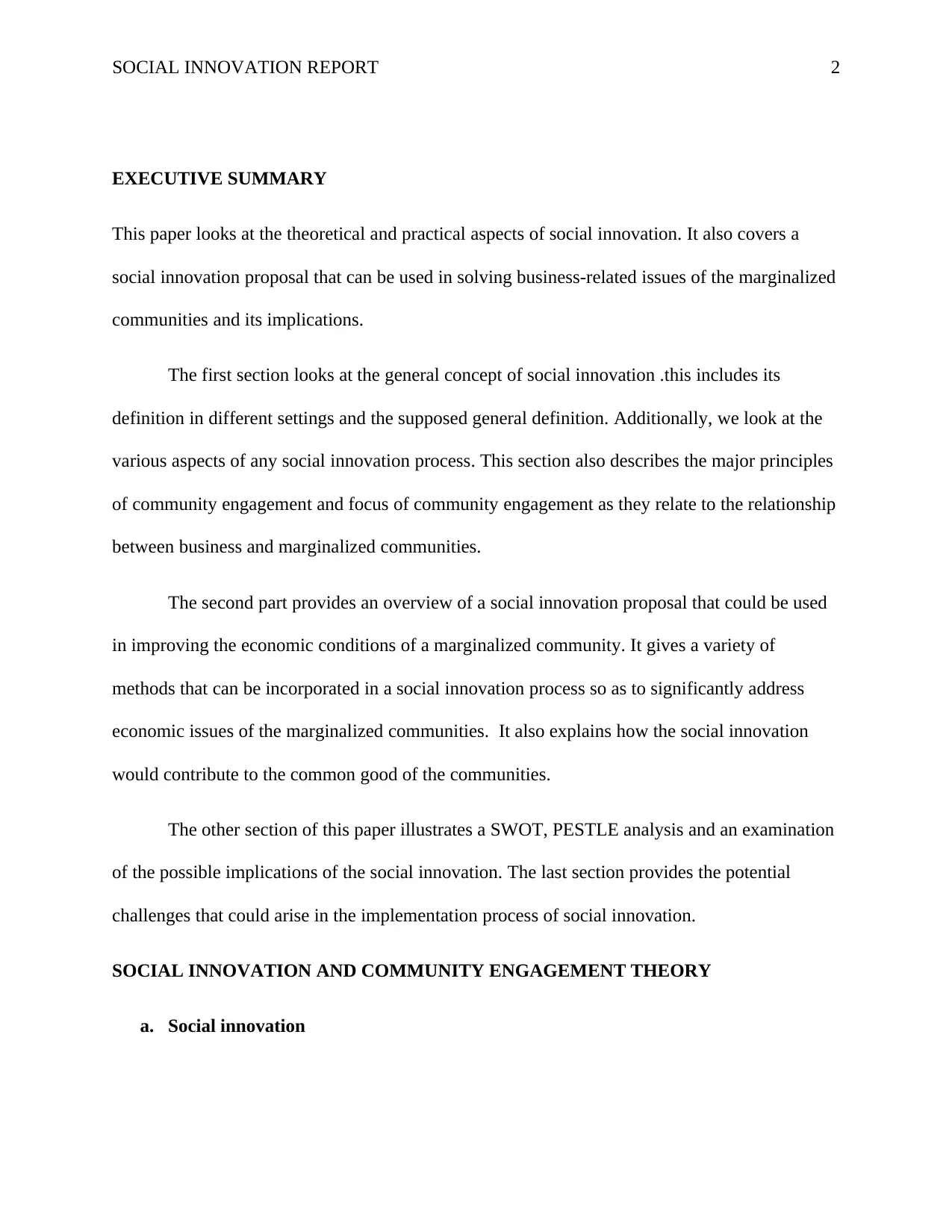
EXECUTIVE SUMMARY
This paper looks at the theoretical and practical aspects of social innovation. It also covers a
social innovation proposal that can be used in solving business-related issues of the marginalized
communities and its implications.
The first section looks at the general concept of social innovation .this includes its
definition in different settings and the supposed general definition. Additionally, we look at the
various aspects of any social innovation process. This section also describes the major principles
of community engagement and focus of community engagement as they relate to the relationship
between business and marginalized communities.
The second part provides an overview of a social innovation proposal that could be used
in improving the economic conditions of a marginalized community. It gives a variety of
methods that can be incorporated in a social innovation process so as to significantly address
economic issues of the marginalized communities. It also explains how the social innovation
would contribute to the common good of the communities.
The other section of this paper illustrates a SWOT, PESTLE analysis and an examination
of the possible implications of the social innovation. The last section provides the potential
challenges that could arise in the implementation process of social innovation.
SOCIAL INNOVATION AND COMMUNITY ENGAGEMENT THEORY
a. Social innovation
EXECUTIVE SUMMARY
This paper looks at the theoretical and practical aspects of social innovation. It also covers a
social innovation proposal that can be used in solving business-related issues of the marginalized
communities and its implications.
The first section looks at the general concept of social innovation .this includes its
definition in different settings and the supposed general definition. Additionally, we look at the
various aspects of any social innovation process. This section also describes the major principles
of community engagement and focus of community engagement as they relate to the relationship
between business and marginalized communities.
The second part provides an overview of a social innovation proposal that could be used
in improving the economic conditions of a marginalized community. It gives a variety of
methods that can be incorporated in a social innovation process so as to significantly address
economic issues of the marginalized communities. It also explains how the social innovation
would contribute to the common good of the communities.
The other section of this paper illustrates a SWOT, PESTLE analysis and an examination
of the possible implications of the social innovation. The last section provides the potential
challenges that could arise in the implementation process of social innovation.
SOCIAL INNOVATION AND COMMUNITY ENGAGEMENT THEORY
a. Social innovation
SOCIAL INNOVATION REPORT 3
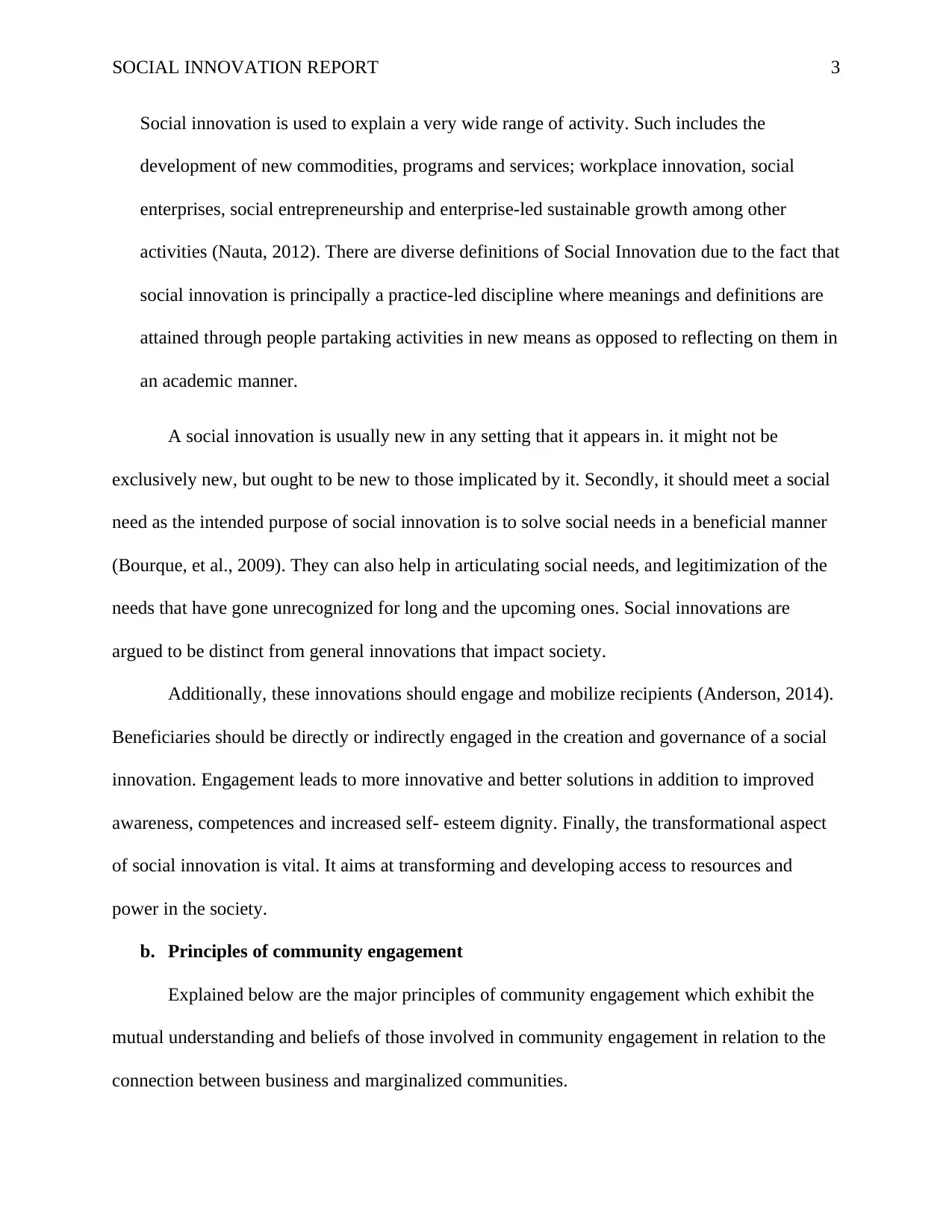
Social innovation is used to explain a very wide range of activity. Such includes the
development of new commodities, programs and services; workplace innovation, social
enterprises, social entrepreneurship and enterprise-led sustainable growth among other
activities (Nauta, 2012). There are diverse definitions of Social Innovation due to the fact that
social innovation is principally a practice-led discipline where meanings and definitions are
attained through people partaking activities in new means as opposed to reflecting on them in
an academic manner.
A social innovation is usually new in any setting that it appears in. it might not be
exclusively new, but ought to be new to those implicated by it. Secondly, it should meet a social
need as the intended purpose of social innovation is to solve social needs in a beneficial manner
(Bourque, et al., 2009). They can also help in articulating social needs, and legitimization of the
needs that have gone unrecognized for long and the upcoming ones. Social innovations are
argued to be distinct from general innovations that impact society.
Additionally, these innovations should engage and mobilize recipients (Anderson, 2014).
Beneficiaries should be directly or indirectly engaged in the creation and governance of a social
innovation. Engagement leads to more innovative and better solutions in addition to improved
awareness, competences and increased self- esteem dignity. Finally, the transformational aspect
of social innovation is vital. It aims at transforming and developing access to resources and
power in the society.
b. Principles of community engagement
Explained below are the major principles of community engagement which exhibit the
mutual understanding and beliefs of those involved in community engagement in relation to the
connection between business and marginalized communities.
Social innovation is used to explain a very wide range of activity. Such includes the
development of new commodities, programs and services; workplace innovation, social
enterprises, social entrepreneurship and enterprise-led sustainable growth among other
activities (Nauta, 2012). There are diverse definitions of Social Innovation due to the fact that
social innovation is principally a practice-led discipline where meanings and definitions are
attained through people partaking activities in new means as opposed to reflecting on them in
an academic manner.
A social innovation is usually new in any setting that it appears in. it might not be
exclusively new, but ought to be new to those implicated by it. Secondly, it should meet a social
need as the intended purpose of social innovation is to solve social needs in a beneficial manner
(Bourque, et al., 2009). They can also help in articulating social needs, and legitimization of the
needs that have gone unrecognized for long and the upcoming ones. Social innovations are
argued to be distinct from general innovations that impact society.
Additionally, these innovations should engage and mobilize recipients (Anderson, 2014).
Beneficiaries should be directly or indirectly engaged in the creation and governance of a social
innovation. Engagement leads to more innovative and better solutions in addition to improved
awareness, competences and increased self- esteem dignity. Finally, the transformational aspect
of social innovation is vital. It aims at transforming and developing access to resources and
power in the society.
b. Principles of community engagement
Explained below are the major principles of community engagement which exhibit the
mutual understanding and beliefs of those involved in community engagement in relation to the
connection between business and marginalized communities.
⊘ This is a preview!⊘
Do you want full access?
Subscribe today to unlock all pages.

Trusted by 1+ million students worldwide
SOCIAL INNOVATION REPORT 4
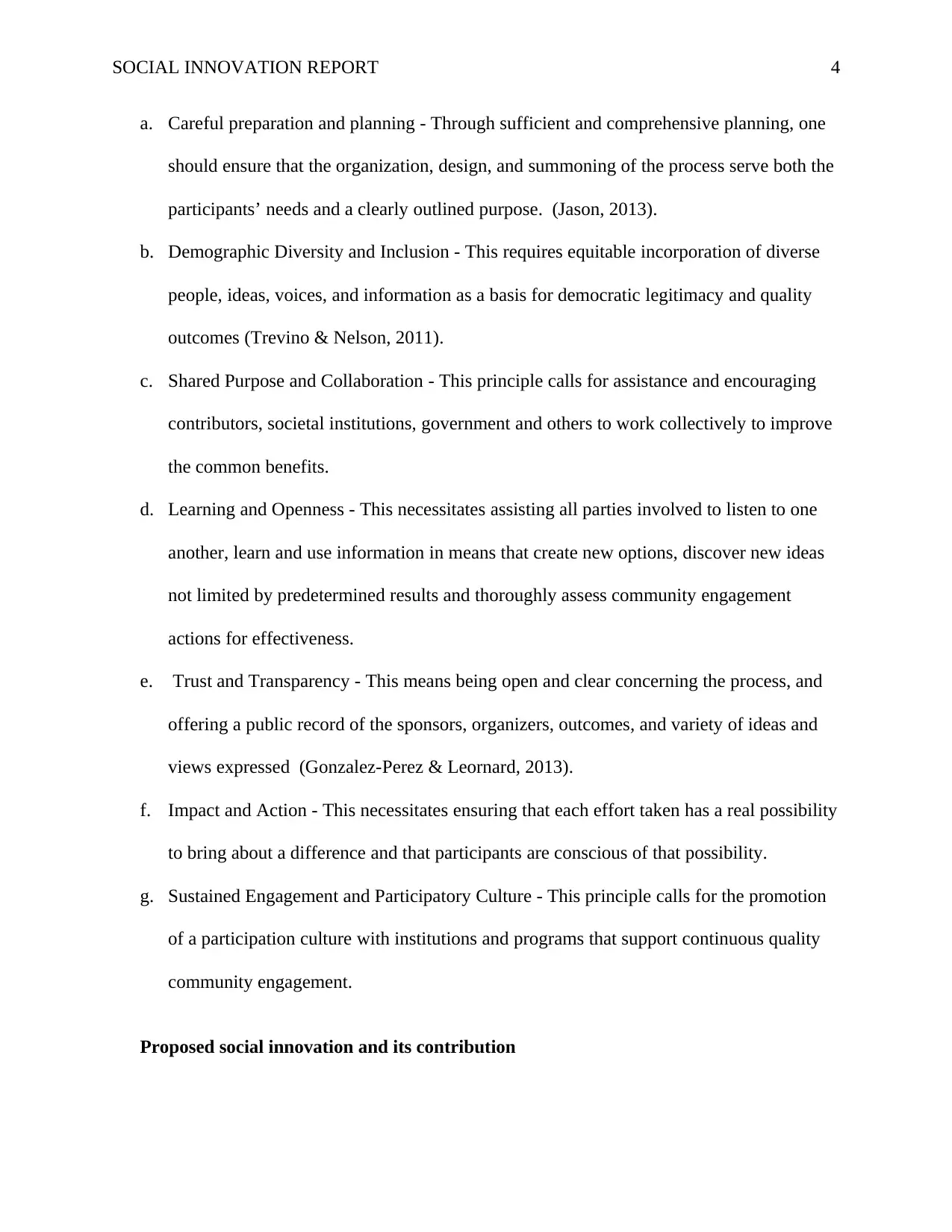
a. Careful preparation and planning - Through sufficient and comprehensive planning, one
should ensure that the organization, design, and summoning of the process serve both the
participants’ needs and a clearly outlined purpose. (Jason, 2013).
b. Demographic Diversity and Inclusion - This requires equitable incorporation of diverse
people, ideas, voices, and information as a basis for democratic legitimacy and quality
outcomes (Trevino & Nelson, 2011).
c. Shared Purpose and Collaboration - This principle calls for assistance and encouraging
contributors, societal institutions, government and others to work collectively to improve
the common benefits.
d. Learning and Openness - This necessitates assisting all parties involved to listen to one
another, learn and use information in means that create new options, discover new ideas
not limited by predetermined results and thoroughly assess community engagement
actions for effectiveness.
e. Trust and Transparency - This means being open and clear concerning the process, and
offering a public record of the sponsors, organizers, outcomes, and variety of ideas and
views expressed (Gonzalez-Perez & Leornard, 2013).
f. Impact and Action - This necessitates ensuring that each effort taken has a real possibility
to bring about a difference and that participants are conscious of that possibility.
g. Sustained Engagement and Participatory Culture - This principle calls for the promotion
of a participation culture with institutions and programs that support continuous quality
community engagement.
Proposed social innovation and its contribution
a. Careful preparation and planning - Through sufficient and comprehensive planning, one
should ensure that the organization, design, and summoning of the process serve both the
participants’ needs and a clearly outlined purpose. (Jason, 2013).
b. Demographic Diversity and Inclusion - This requires equitable incorporation of diverse
people, ideas, voices, and information as a basis for democratic legitimacy and quality
outcomes (Trevino & Nelson, 2011).
c. Shared Purpose and Collaboration - This principle calls for assistance and encouraging
contributors, societal institutions, government and others to work collectively to improve
the common benefits.
d. Learning and Openness - This necessitates assisting all parties involved to listen to one
another, learn and use information in means that create new options, discover new ideas
not limited by predetermined results and thoroughly assess community engagement
actions for effectiveness.
e. Trust and Transparency - This means being open and clear concerning the process, and
offering a public record of the sponsors, organizers, outcomes, and variety of ideas and
views expressed (Gonzalez-Perez & Leornard, 2013).
f. Impact and Action - This necessitates ensuring that each effort taken has a real possibility
to bring about a difference and that participants are conscious of that possibility.
g. Sustained Engagement and Participatory Culture - This principle calls for the promotion
of a participation culture with institutions and programs that support continuous quality
community engagement.
Proposed social innovation and its contribution
Paraphrase This Document
Need a fresh take? Get an instant paraphrase of this document with our AI Paraphraser
SOCIAL INNOVATION REPORT 5
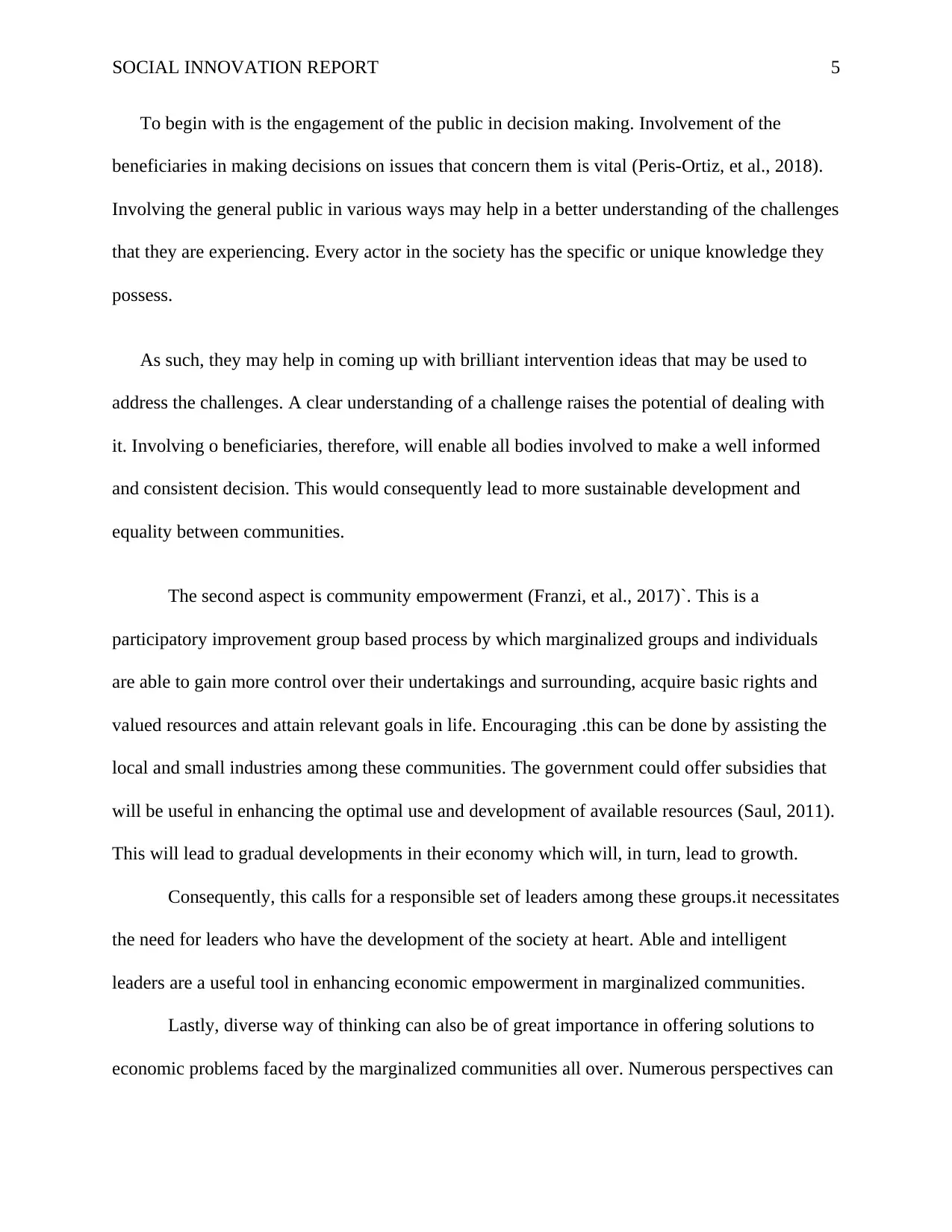
To begin with is the engagement of the public in decision making. Involvement of the
beneficiaries in making decisions on issues that concern them is vital (Peris-Ortiz, et al., 2018).
Involving the general public in various ways may help in a better understanding of the challenges
that they are experiencing. Every actor in the society has the specific or unique knowledge they
possess.
As such, they may help in coming up with brilliant intervention ideas that may be used to
address the challenges. A clear understanding of a challenge raises the potential of dealing with
it. Involving o beneficiaries, therefore, will enable all bodies involved to make a well informed
and consistent decision. This would consequently lead to more sustainable development and
equality between communities.
The second aspect is community empowerment (Franzi, et al., 2017)`. This is a
participatory improvement group based process by which marginalized groups and individuals
are able to gain more control over their undertakings and surrounding, acquire basic rights and
valued resources and attain relevant goals in life. Encouraging .this can be done by assisting the
local and small industries among these communities. The government could offer subsidies that
will be useful in enhancing the optimal use and development of available resources (Saul, 2011).
This will lead to gradual developments in their economy which will, in turn, lead to growth.
Consequently, this calls for a responsible set of leaders among these groups.it necessitates
the need for leaders who have the development of the society at heart. Able and intelligent
leaders are a useful tool in enhancing economic empowerment in marginalized communities.
Lastly, diverse way of thinking can also be of great importance in offering solutions to
economic problems faced by the marginalized communities all over. Numerous perspectives can
To begin with is the engagement of the public in decision making. Involvement of the
beneficiaries in making decisions on issues that concern them is vital (Peris-Ortiz, et al., 2018).
Involving the general public in various ways may help in a better understanding of the challenges
that they are experiencing. Every actor in the society has the specific or unique knowledge they
possess.
As such, they may help in coming up with brilliant intervention ideas that may be used to
address the challenges. A clear understanding of a challenge raises the potential of dealing with
it. Involving o beneficiaries, therefore, will enable all bodies involved to make a well informed
and consistent decision. This would consequently lead to more sustainable development and
equality between communities.
The second aspect is community empowerment (Franzi, et al., 2017)`. This is a
participatory improvement group based process by which marginalized groups and individuals
are able to gain more control over their undertakings and surrounding, acquire basic rights and
valued resources and attain relevant goals in life. Encouraging .this can be done by assisting the
local and small industries among these communities. The government could offer subsidies that
will be useful in enhancing the optimal use and development of available resources (Saul, 2011).
This will lead to gradual developments in their economy which will, in turn, lead to growth.
Consequently, this calls for a responsible set of leaders among these groups.it necessitates
the need for leaders who have the development of the society at heart. Able and intelligent
leaders are a useful tool in enhancing economic empowerment in marginalized communities.
Lastly, diverse way of thinking can also be of great importance in offering solutions to
economic problems faced by the marginalized communities all over. Numerous perspectives can
SOCIAL INNOVATION REPORT 6
add value when trying to solve these challenges (Moulaert, 2013). This is because it provides
various methods of arriving at the solution.
If the society relies wholly on experts they are likely to be faced by lots of challenges
when dealing with such issues. This can be curbed by incorporating several organs in solving the
problems. Other problem solvers may have expertise in different disciplines are not restricted by
established rules and therefore the incorporation will enable them to deal with the issues
substantially, fostering development and growth among the marginalized communities. This will
also lead to better living standards among such communities in the long run.
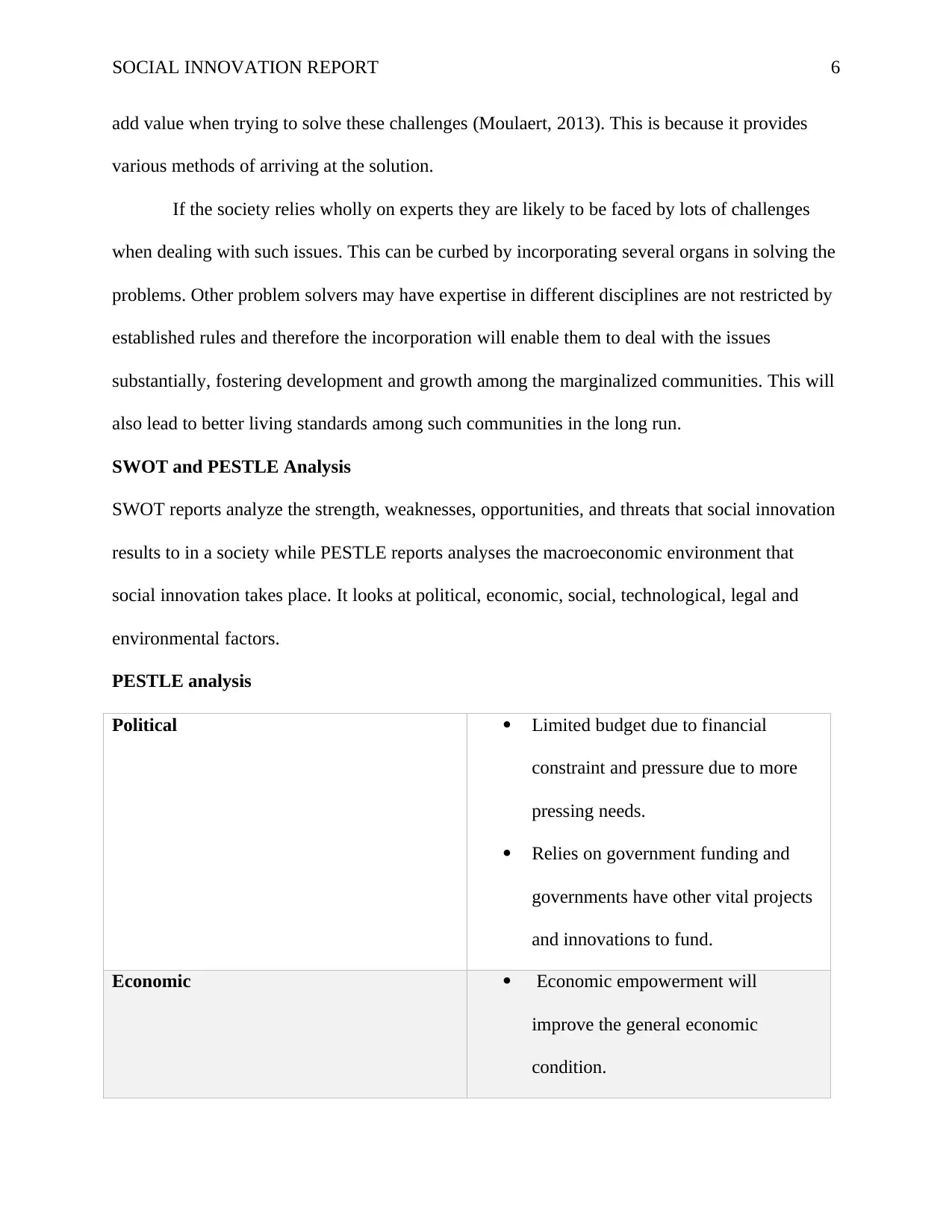
SWOT and PESTLE Analysis
SWOT reports analyze the strength, weaknesses, opportunities, and threats that social innovation
results to in a society while PESTLE reports analyses the macroeconomic environment that
social innovation takes place. It looks at political, economic, social, technological, legal and
environmental factors.
PESTLE analysis
Political Limited budget due to financial
constraint and pressure due to more
pressing needs.
Relies on government funding and
governments have other vital projects
and innovations to fund.
Economic Economic empowerment will
improve the general economic
condition.
add value when trying to solve these challenges (Moulaert, 2013). This is because it provides
various methods of arriving at the solution.
If the society relies wholly on experts they are likely to be faced by lots of challenges
when dealing with such issues. This can be curbed by incorporating several organs in solving the
problems. Other problem solvers may have expertise in different disciplines are not restricted by
established rules and therefore the incorporation will enable them to deal with the issues
substantially, fostering development and growth among the marginalized communities. This will
also lead to better living standards among such communities in the long run.
SWOT and PESTLE Analysis
SWOT reports analyze the strength, weaknesses, opportunities, and threats that social innovation
results to in a society while PESTLE reports analyses the macroeconomic environment that
social innovation takes place. It looks at political, economic, social, technological, legal and
environmental factors.
PESTLE analysis
Political Limited budget due to financial
constraint and pressure due to more
pressing needs.
Relies on government funding and
governments have other vital projects
and innovations to fund.
Economic Economic empowerment will
improve the general economic
condition.
⊘ This is a preview!⊘
Do you want full access?
Subscribe today to unlock all pages.
Trusted by 1+ million students worldwide
SOCIAL INNOVATION REPORT 7
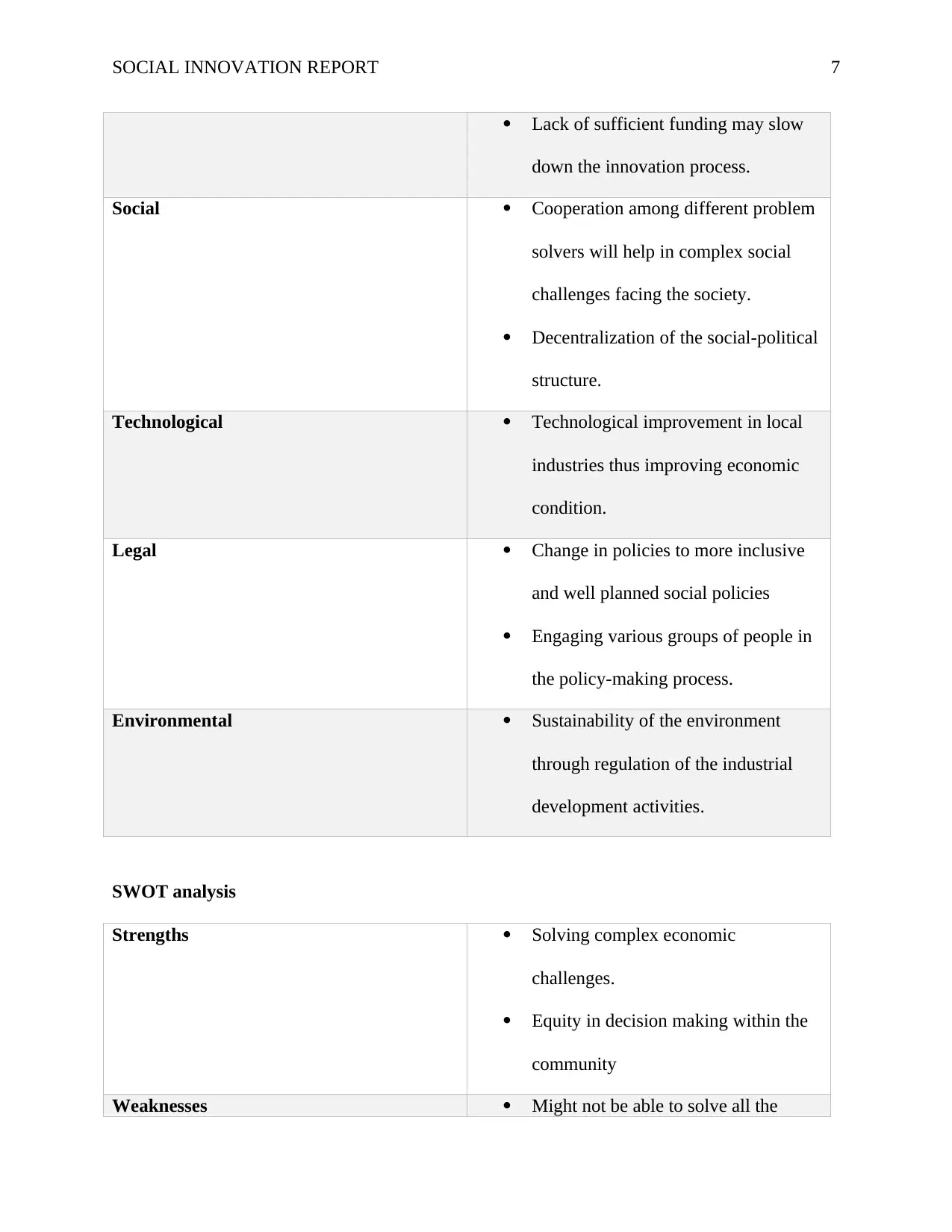
Lack of sufficient funding may slow
down the innovation process.
Social Cooperation among different problem
solvers will help in complex social
challenges facing the society.
Decentralization of the social-political
structure.
Technological Technological improvement in local
industries thus improving economic
condition.
Legal Change in policies to more inclusive
and well planned social policies
Engaging various groups of people in
the policy-making process.
Environmental Sustainability of the environment
through regulation of the industrial
development activities.
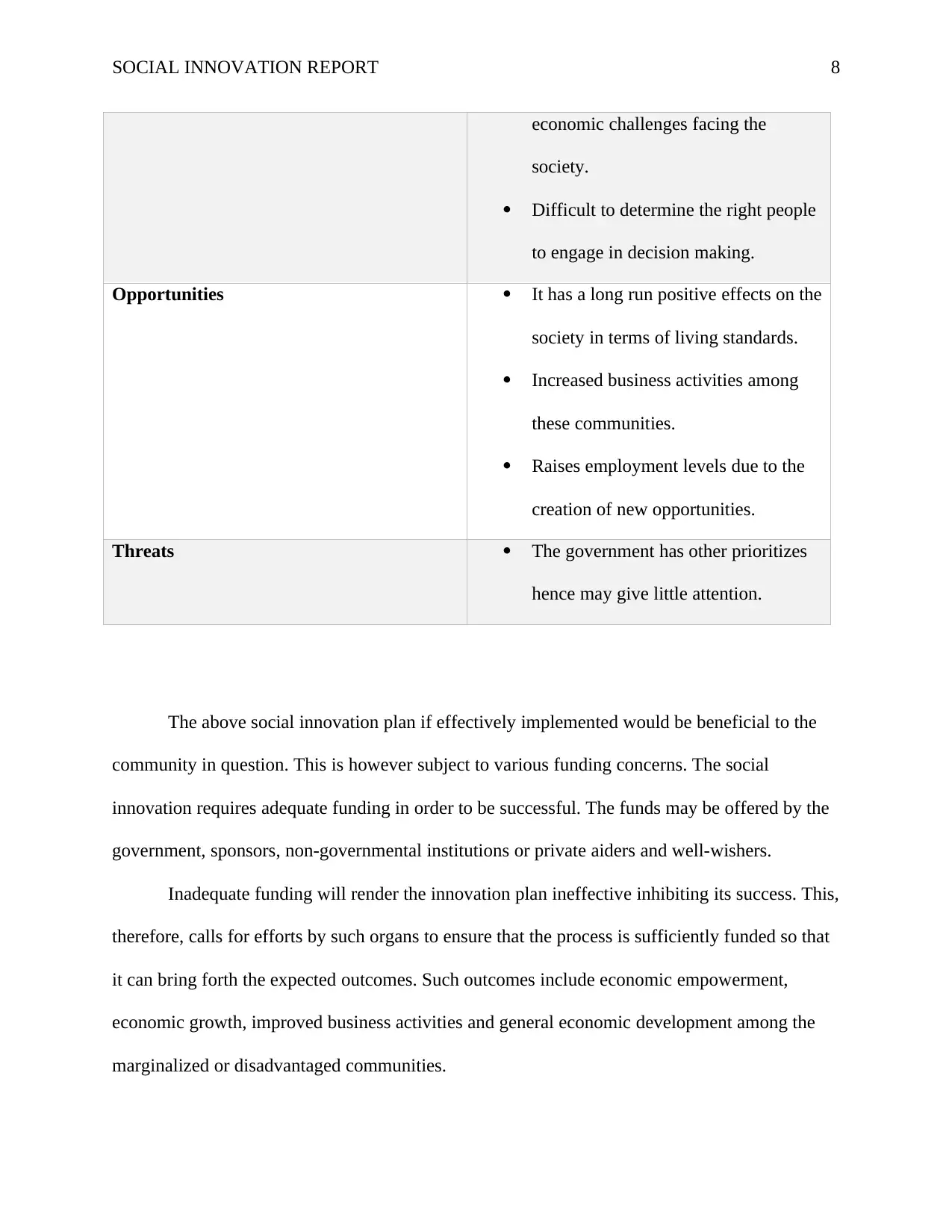
SWOT analysis
Strengths Solving complex economic
challenges.
Equity in decision making within the
community
Weaknesses Might not be able to solve all the
Lack of sufficient funding may slow
down the innovation process.
Social Cooperation among different problem
solvers will help in complex social
challenges facing the society.
Decentralization of the social-political
structure.
Technological Technological improvement in local
industries thus improving economic
condition.
Legal Change in policies to more inclusive
and well planned social policies
Engaging various groups of people in
the policy-making process.
Environmental Sustainability of the environment
through regulation of the industrial
development activities.
SWOT analysis
Strengths Solving complex economic
challenges.
Equity in decision making within the
community
Weaknesses Might not be able to solve all the
Paraphrase This Document
Need a fresh take? Get an instant paraphrase of this document with our AI Paraphraser
SOCIAL INNOVATION REPORT 8
economic challenges facing the
society.
Difficult to determine the right people
to engage in decision making.
Opportunities It has a long run positive effects on the
society in terms of living standards.
Increased business activities among
these communities.
Raises employment levels due to the
creation of new opportunities.
Threats The government has other prioritizes
hence may give little attention.
The above social innovation plan if effectively implemented would be beneficial to the
community in question. This is however subject to various funding concerns. The social
innovation requires adequate funding in order to be successful. The funds may be offered by the
government, sponsors, non-governmental institutions or private aiders and well-wishers.
Inadequate funding will render the innovation plan ineffective inhibiting its success. This,
therefore, calls for efforts by such organs to ensure that the process is sufficiently funded so that
it can bring forth the expected outcomes. Such outcomes include economic empowerment,
economic growth, improved business activities and general economic development among the
marginalized or disadvantaged communities.
economic challenges facing the
society.
Difficult to determine the right people
to engage in decision making.
Opportunities It has a long run positive effects on the
society in terms of living standards.
Increased business activities among
these communities.
Raises employment levels due to the
creation of new opportunities.
Threats The government has other prioritizes
hence may give little attention.
The above social innovation plan if effectively implemented would be beneficial to the
community in question. This is however subject to various funding concerns. The social
innovation requires adequate funding in order to be successful. The funds may be offered by the
government, sponsors, non-governmental institutions or private aiders and well-wishers.
Inadequate funding will render the innovation plan ineffective inhibiting its success. This,
therefore, calls for efforts by such organs to ensure that the process is sufficiently funded so that
it can bring forth the expected outcomes. Such outcomes include economic empowerment,
economic growth, improved business activities and general economic development among the
marginalized or disadvantaged communities.
SOCIAL INNOVATION REPORT 9
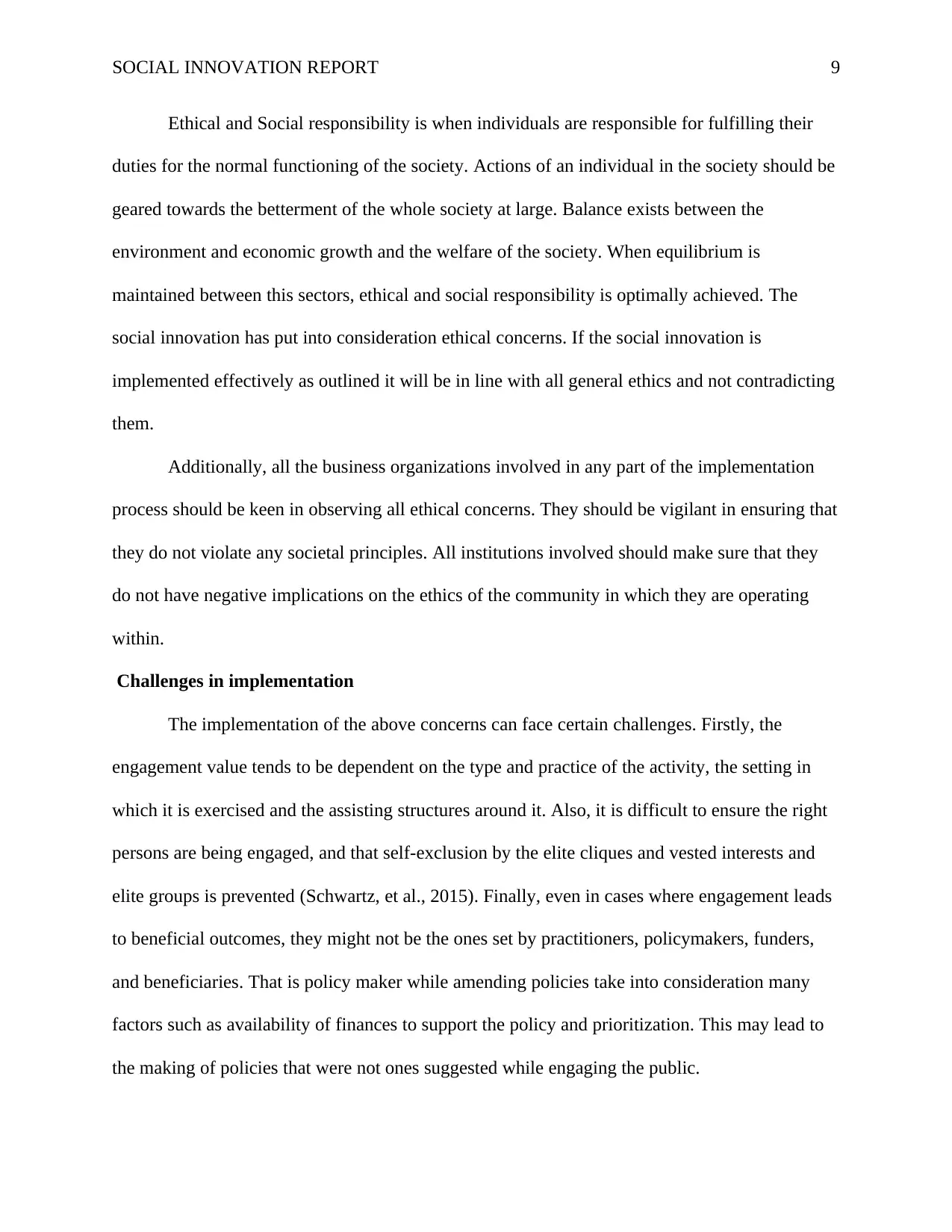
Ethical and Social responsibility is when individuals are responsible for fulfilling their
duties for the normal functioning of the society. Actions of an individual in the society should be
geared towards the betterment of the whole society at large. Balance exists between the
environment and economic growth and the welfare of the society. When equilibrium is
maintained between this sectors, ethical and social responsibility is optimally achieved. The
social innovation has put into consideration ethical concerns. If the social innovation is
implemented effectively as outlined it will be in line with all general ethics and not contradicting
them.
Additionally, all the business organizations involved in any part of the implementation
process should be keen in observing all ethical concerns. They should be vigilant in ensuring that
they do not violate any societal principles. All institutions involved should make sure that they
do not have negative implications on the ethics of the community in which they are operating
within.
Challenges in implementation
The implementation of the above concerns can face certain challenges. Firstly, the
engagement value tends to be dependent on the type and practice of the activity, the setting in
which it is exercised and the assisting structures around it. Also, it is difficult to ensure the right
persons are being engaged, and that self-exclusion by the elite cliques and vested interests and
elite groups is prevented (Schwartz, et al., 2015). Finally, even in cases where engagement leads
to beneficial outcomes, they might not be the ones set by practitioners, policymakers, funders,
and beneficiaries. That is policy maker while amending policies take into consideration many
factors such as availability of finances to support the policy and prioritization. This may lead to
the making of policies that were not ones suggested while engaging the public.
Ethical and Social responsibility is when individuals are responsible for fulfilling their
duties for the normal functioning of the society. Actions of an individual in the society should be
geared towards the betterment of the whole society at large. Balance exists between the
environment and economic growth and the welfare of the society. When equilibrium is
maintained between this sectors, ethical and social responsibility is optimally achieved. The
social innovation has put into consideration ethical concerns. If the social innovation is
implemented effectively as outlined it will be in line with all general ethics and not contradicting
them.
Additionally, all the business organizations involved in any part of the implementation
process should be keen in observing all ethical concerns. They should be vigilant in ensuring that
they do not violate any societal principles. All institutions involved should make sure that they
do not have negative implications on the ethics of the community in which they are operating
within.
Challenges in implementation
The implementation of the above concerns can face certain challenges. Firstly, the
engagement value tends to be dependent on the type and practice of the activity, the setting in
which it is exercised and the assisting structures around it. Also, it is difficult to ensure the right
persons are being engaged, and that self-exclusion by the elite cliques and vested interests and
elite groups is prevented (Schwartz, et al., 2015). Finally, even in cases where engagement leads
to beneficial outcomes, they might not be the ones set by practitioners, policymakers, funders,
and beneficiaries. That is policy maker while amending policies take into consideration many
factors such as availability of finances to support the policy and prioritization. This may lead to
the making of policies that were not ones suggested while engaging the public.
⊘ This is a preview!⊘
Do you want full access?
Subscribe today to unlock all pages.
Trusted by 1+ million students worldwide
SOCIAL INNOVATION REPORT 10
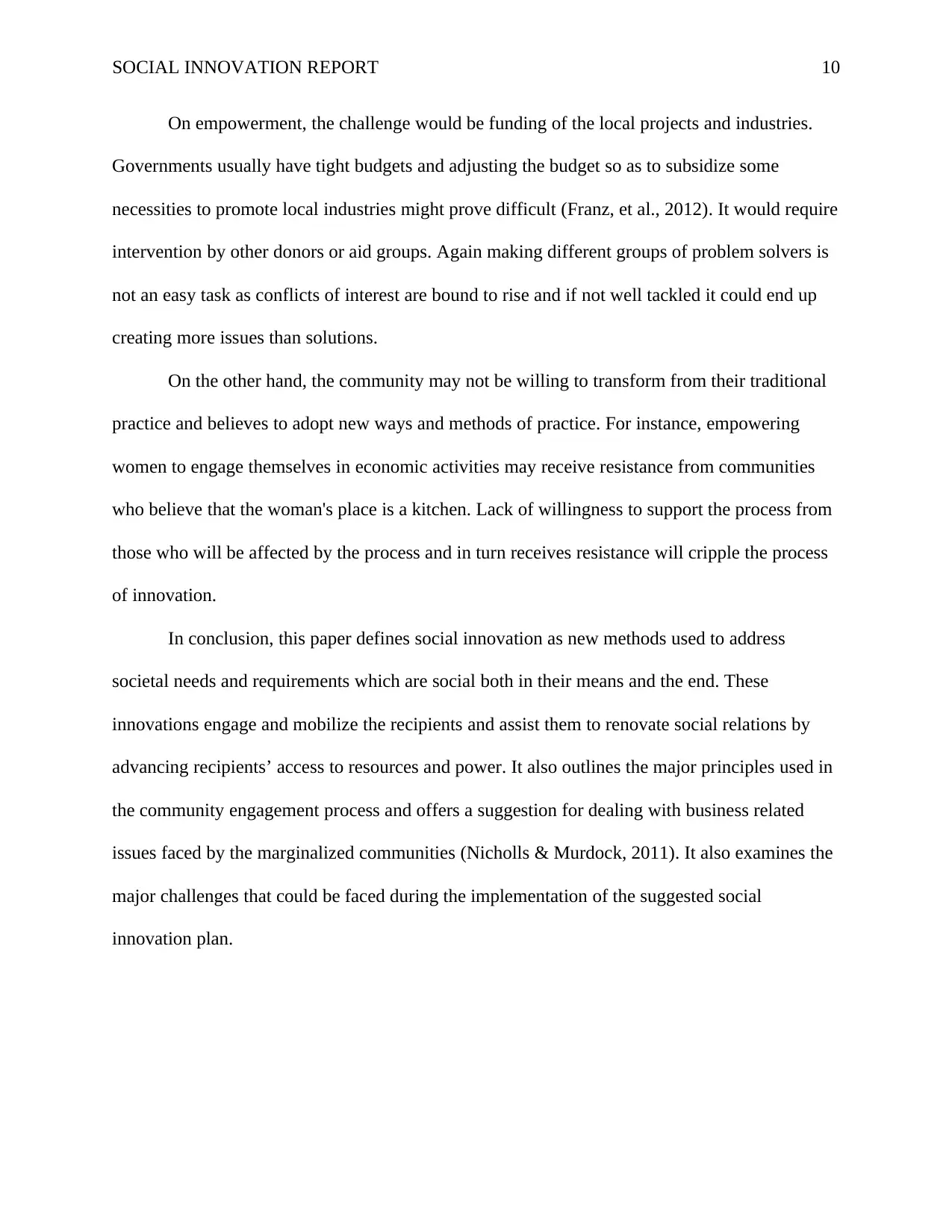
On empowerment, the challenge would be funding of the local projects and industries.
Governments usually have tight budgets and adjusting the budget so as to subsidize some
necessities to promote local industries might prove difficult (Franz, et al., 2012). It would require
intervention by other donors or aid groups. Again making different groups of problem solvers is
not an easy task as conflicts of interest are bound to rise and if not well tackled it could end up
creating more issues than solutions.
On the other hand, the community may not be willing to transform from their traditional
practice and believes to adopt new ways and methods of practice. For instance, empowering
women to engage themselves in economic activities may receive resistance from communities
who believe that the woman's place is a kitchen. Lack of willingness to support the process from
those who will be affected by the process and in turn receives resistance will cripple the process
of innovation.
In conclusion, this paper defines social innovation as new methods used to address
societal needs and requirements which are social both in their means and the end. These
innovations engage and mobilize the recipients and assist them to renovate social relations by
advancing recipients’ access to resources and power. It also outlines the major principles used in
the community engagement process and offers a suggestion for dealing with business related
issues faced by the marginalized communities (Nicholls & Murdock, 2011). It also examines the
major challenges that could be faced during the implementation of the suggested social
innovation plan.
On empowerment, the challenge would be funding of the local projects and industries.
Governments usually have tight budgets and adjusting the budget so as to subsidize some
necessities to promote local industries might prove difficult (Franz, et al., 2012). It would require
intervention by other donors or aid groups. Again making different groups of problem solvers is
not an easy task as conflicts of interest are bound to rise and if not well tackled it could end up
creating more issues than solutions.
On the other hand, the community may not be willing to transform from their traditional
practice and believes to adopt new ways and methods of practice. For instance, empowering
women to engage themselves in economic activities may receive resistance from communities
who believe that the woman's place is a kitchen. Lack of willingness to support the process from
those who will be affected by the process and in turn receives resistance will cripple the process
of innovation.
In conclusion, this paper defines social innovation as new methods used to address
societal needs and requirements which are social both in their means and the end. These
innovations engage and mobilize the recipients and assist them to renovate social relations by
advancing recipients’ access to resources and power. It also outlines the major principles used in
the community engagement process and offers a suggestion for dealing with business related
issues faced by the marginalized communities (Nicholls & Murdock, 2011). It also examines the
major challenges that could be faced during the implementation of the suggested social
innovation plan.
Paraphrase This Document
Need a fresh take? Get an instant paraphrase of this document with our AI Paraphraser
SOCIAL INNOVATION REPORT 11
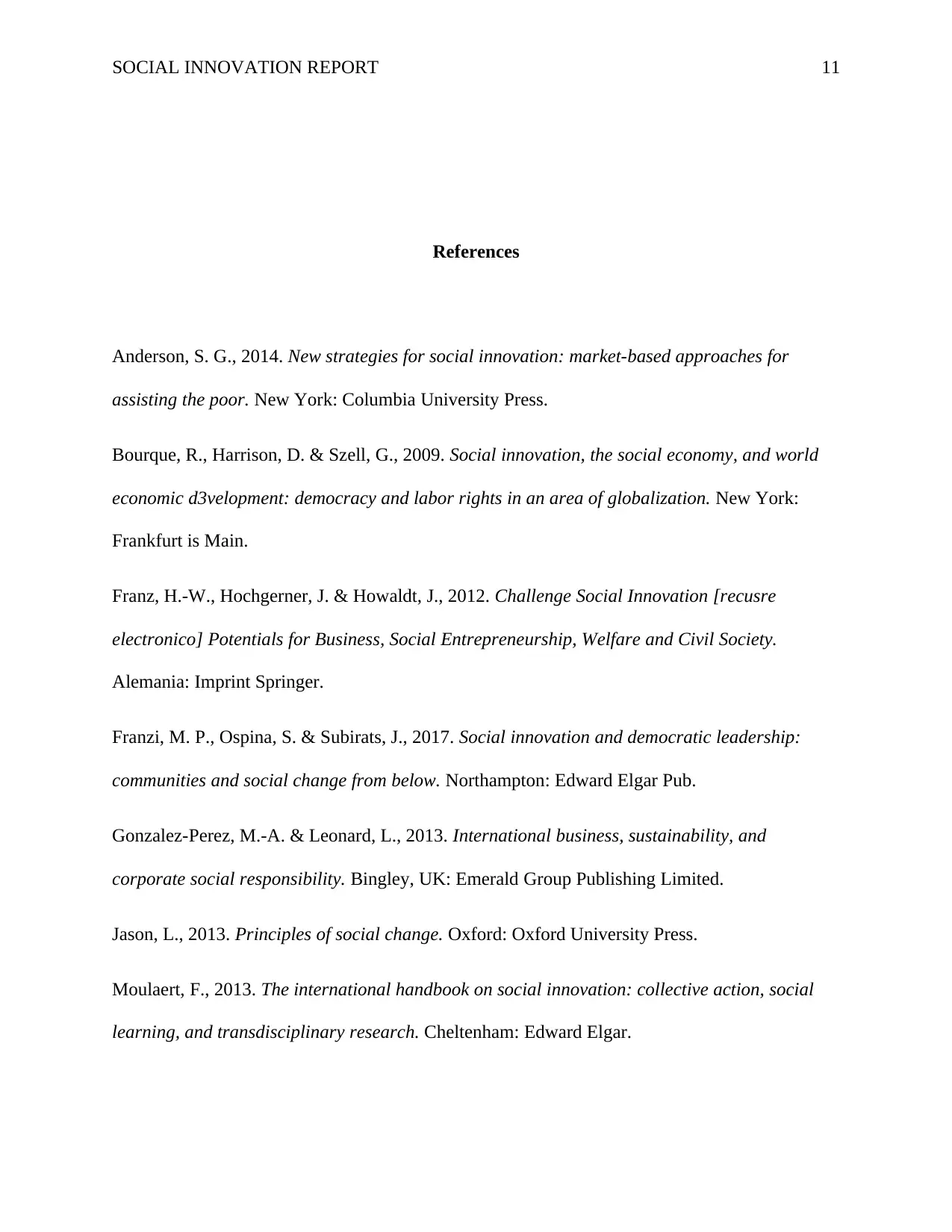
References
Anderson, S. G., 2014. New strategies for social innovation: market-based approaches for
assisting the poor. New York: Columbia University Press.
Bourque, R., Harrison, D. & Szell, G., 2009. Social innovation, the social economy, and world
economic d3velopment: democracy and labor rights in an area of globalization. New York:
Frankfurt is Main.
Franz, H.-W., Hochgerner, J. & Howaldt, J., 2012. Challenge Social Innovation [recusre
electronico] Potentials for Business, Social Entrepreneurship, Welfare and Civil Society.
Alemania: Imprint Springer.
Franzi, M. P., Ospina, S. & Subirats, J., 2017. Social innovation and democratic leadership:
communities and social change from below. Northampton: Edward Elgar Pub.
Gonzalez-Perez, M.-A. & Leonard, L., 2013. International business, sustainability, and
corporate social responsibility. Bingley, UK: Emerald Group Publishing Limited.
Jason, L., 2013. Principles of social change. Oxford: Oxford University Press.
Moulaert, F., 2013. The international handbook on social innovation: collective action, social
learning, and transdisciplinary research. Cheltenham: Edward Elgar.
References
Anderson, S. G., 2014. New strategies for social innovation: market-based approaches for
assisting the poor. New York: Columbia University Press.
Bourque, R., Harrison, D. & Szell, G., 2009. Social innovation, the social economy, and world
economic d3velopment: democracy and labor rights in an area of globalization. New York:
Frankfurt is Main.
Franz, H.-W., Hochgerner, J. & Howaldt, J., 2012. Challenge Social Innovation [recusre
electronico] Potentials for Business, Social Entrepreneurship, Welfare and Civil Society.
Alemania: Imprint Springer.
Franzi, M. P., Ospina, S. & Subirats, J., 2017. Social innovation and democratic leadership:
communities and social change from below. Northampton: Edward Elgar Pub.
Gonzalez-Perez, M.-A. & Leonard, L., 2013. International business, sustainability, and
corporate social responsibility. Bingley, UK: Emerald Group Publishing Limited.
Jason, L., 2013. Principles of social change. Oxford: Oxford University Press.
Moulaert, F., 2013. The international handbook on social innovation: collective action, social
learning, and transdisciplinary research. Cheltenham: Edward Elgar.
SOCIAL INNOVATION REPORT 12
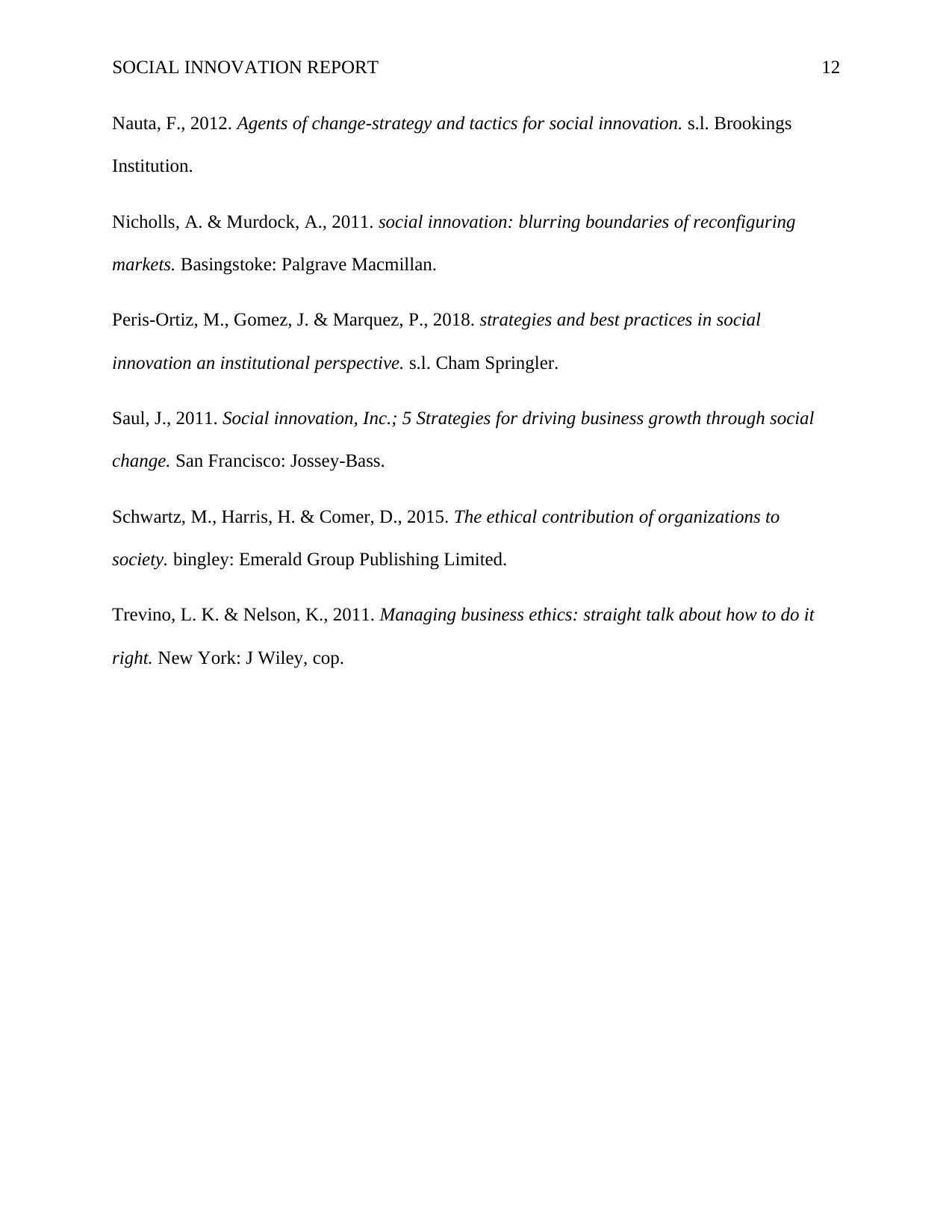
Nauta, F., 2012. Agents of change-strategy and tactics for social innovation. s.l. Brookings
Institution.
Nicholls, A. & Murdock, A., 2011. social innovation: blurring boundaries of reconfiguring
markets. Basingstoke: Palgrave Macmillan.
Peris-Ortiz, M., Gomez, J. & Marquez, P., 2018. strategies and best practices in social
innovation an institutional perspective. s.l. Cham Springler.
Saul, J., 2011. Social innovation, Inc.; 5 Strategies for driving business growth through social
change. San Francisco: Jossey-Bass.
Schwartz, M., Harris, H. & Comer, D., 2015. The ethical contribution of organizations to
society. bingley: Emerald Group Publishing Limited.
Trevino, L. K. & Nelson, K., 2011. Managing business ethics: straight talk about how to do it
right. New York: J Wiley, cop.
Nauta, F., 2012. Agents of change-strategy and tactics for social innovation. s.l. Brookings
Institution.
Nicholls, A. & Murdock, A., 2011. social innovation: blurring boundaries of reconfiguring
markets. Basingstoke: Palgrave Macmillan.
Peris-Ortiz, M., Gomez, J. & Marquez, P., 2018. strategies and best practices in social
innovation an institutional perspective. s.l. Cham Springler.
Saul, J., 2011. Social innovation, Inc.; 5 Strategies for driving business growth through social
change. San Francisco: Jossey-Bass.
Schwartz, M., Harris, H. & Comer, D., 2015. The ethical contribution of organizations to
society. bingley: Emerald Group Publishing Limited.
Trevino, L. K. & Nelson, K., 2011. Managing business ethics: straight talk about how to do it
right. New York: J Wiley, cop.
⊘ This is a preview!⊘
Do you want full access?
Subscribe today to unlock all pages.
Trusted by 1+ million students worldwide

1 out of 12


Related Documents


Your All-in-One AI-Powered Toolkit for Academic Success.
+13062052269
info@desklib.com
Available 24*7 on WhatsApp / Email
![[object Object]](/_next/static/media/star-bottom.7253800d.svg)
Unlock your academic potential
Copyright © 2020–2026 A2Z Services. All Rights Reserved. Developed and managed by ZUCOL.