Report on Social Marketing and Behavioral Intervention Strategies
VerifiedAdded on 2023/01/11
|9
|3437
|44
Report
AI Summary
This report delves into the application of social marketing and behavioral intervention strategies to promote sustainable mobility, specifically focusing on encouraging tourists to utilize public transport. It examines various measures, such as the SEEMORE initiative, aimed at improving public transport infrastructure and awareness. The report highlights government efforts, including increased clarity about transport routes, online ticket systems, technological advancements, promotional activities, and collaborations with airlines. It analyzes the effective implications of these strategies, such as increased awareness, greater public transport usage, and the building of a positive reputation for public transport, ultimately contributing to sustainable mobility goals. The report also touches upon the importance of sustainable practices and the positive outcomes of these interventions on the environment and tourist behavior.
Social Marketing and
Behavioral
Intervention
Behavioral
Intervention

Paraphrase This Document
Need a fresh take? Get an instant paraphrase of this document with our AI Paraphraser
Contents
INTRODUCTION.......................................................................................................................................3
TASK..........................................................................................................................................................3
Measures which are taken........................................................................................................................3
Effective implications..............................................................................................................................5
Problems with establishing this concept..................................................................................................7
CONCLUSION...........................................................................................................................................8
REFERENCES............................................................................................................................................9
INTRODUCTION.......................................................................................................................................3
TASK..........................................................................................................................................................3
Measures which are taken........................................................................................................................3
Effective implications..............................................................................................................................5
Problems with establishing this concept..................................................................................................7
CONCLUSION...........................................................................................................................................8
REFERENCES............................................................................................................................................9
INTRODUCTION
Marketing refers to educating the people or the target group about some idea, product,
service or any kind of message. Marketing is done through advertising and promoting the same.
Whereas social marketing are refers to performing and advertising some social idea or message
to the targeted audience. Social marketing can be about any topic which may concern to the
society. From that social marketing the advertiser wants to educate and aware the sociality about
the idea or any social goals. The message which is aim to deliver is usually upon sustainability
development. This report discuss about how the social marketing and behavioral intervention can
help or influence the society into the direction towards the aim of that social marketing. This
report has taken a social message of sustainability mobility where encouraging tourist use of
public and active transport in tourism destinations (Gordon, 2012). Here the motive of the
message is to request the tourist people to not hire any private car or bus but try to take public
transport when to travel around the cities.
TASK
There are a huge rise among the government and the general public with regard to sustainable
development. Likely the same as arise for opting for public transport for tourist people and also
for general public. Encouraging both the general public and tourist to take public transport to
roam around the cities is a matter of sustainability development. There are many campaigns and
strategies adopted by the government to encourage the people to do so. Apart from this there
many measures also were taken to increase in the sustainability development into this area.
Measures which are taken
There is a step which is being taken up the Europe government which is being called as
SEEMORE. SEEMORE is an abbreviation for sustainable and energy efficient mobility options
in tourist region in Europe. SEEMORE is an initiative which aims to provide an increase in
cooperation between the tourism sector and mobility sector, in order to encourage the people to
use more public transport to roam around the cities. First there was a study which was conducted
about the tourist experiences of how they have expected the city to be and how actually it
actually is with regard with transports. After a proper study the research team came up with few
point or drawbacks which resist the tourist for taking the public transport. The major changes
include pre specified for the routes which that particular transport would going to take. Taking a
public transport in urban area is quite easy and preferable by the tourist but it is not so easy and
preferable when it comes to take a public transport in rural area (Gordon and et. al.,2013). Rural
area does not have much technology and proper arrangements for taking the public transport.
First the government makes the necessity arrangements which would improve the
qualities for public transport. These need for improvements recognized from the survey which
were conducted by the government. In that survey, the researcher prepares the questionnaires and
asks the public which includes the tourist also as a participant into that survey whom opinions
Marketing refers to educating the people or the target group about some idea, product,
service or any kind of message. Marketing is done through advertising and promoting the same.
Whereas social marketing are refers to performing and advertising some social idea or message
to the targeted audience. Social marketing can be about any topic which may concern to the
society. From that social marketing the advertiser wants to educate and aware the sociality about
the idea or any social goals. The message which is aim to deliver is usually upon sustainability
development. This report discuss about how the social marketing and behavioral intervention can
help or influence the society into the direction towards the aim of that social marketing. This
report has taken a social message of sustainability mobility where encouraging tourist use of
public and active transport in tourism destinations (Gordon, 2012). Here the motive of the
message is to request the tourist people to not hire any private car or bus but try to take public
transport when to travel around the cities.
TASK
There are a huge rise among the government and the general public with regard to sustainable
development. Likely the same as arise for opting for public transport for tourist people and also
for general public. Encouraging both the general public and tourist to take public transport to
roam around the cities is a matter of sustainability development. There are many campaigns and
strategies adopted by the government to encourage the people to do so. Apart from this there
many measures also were taken to increase in the sustainability development into this area.
Measures which are taken
There is a step which is being taken up the Europe government which is being called as
SEEMORE. SEEMORE is an abbreviation for sustainable and energy efficient mobility options
in tourist region in Europe. SEEMORE is an initiative which aims to provide an increase in
cooperation between the tourism sector and mobility sector, in order to encourage the people to
use more public transport to roam around the cities. First there was a study which was conducted
about the tourist experiences of how they have expected the city to be and how actually it
actually is with regard with transports. After a proper study the research team came up with few
point or drawbacks which resist the tourist for taking the public transport. The major changes
include pre specified for the routes which that particular transport would going to take. Taking a
public transport in urban area is quite easy and preferable by the tourist but it is not so easy and
preferable when it comes to take a public transport in rural area (Gordon and et. al.,2013). Rural
area does not have much technology and proper arrangements for taking the public transport.
First the government makes the necessity arrangements which would improve the
qualities for public transport. These need for improvements recognized from the survey which
were conducted by the government. In that survey, the researcher prepares the questionnaires and
asks the public which includes the tourist also as a participant into that survey whom opinions
⊘ This is a preview!⊘
Do you want full access?
Subscribe today to unlock all pages.

Trusted by 1+ million students worldwide
and answers were taken under account. After conducting the survey the government releases of
the drawbacks and the areas at which they were lacking behind. Then detecting of these areas
they have tried to bridge it. There were many initiatives taken by the government to bridge this
gap, some of these are as follows:
Increase clarity about transports: First and the foremost, the government makes proper clarity
about the transports which were available as a public transport along with the routes at follows.
The government tries to cover up all the routes and area so that larger part of the country can get
covered (Kennedy & Parsons,2012). Clarity of transport includes the buses routes along with
their number were clarified and also shown at the bus stops so that the public would get aware
about the route or the right bus which a person needs to take. Making totally clear maps helps
any person or layman a lot as he gets educated about the actual roads and bus number which
would take him to his actual destinations. Along with the buses, the proper routes of train were
also specified by the government so that they can know about the train details and the stations
were they will stop.
Tickets: Tourist does face many problems in regard with the tickets as they do not know the
procedure about buying for tickets. So to make this system very much convenient for the tourist,
the government came up with online idea where they made the tickets available to purchase. This
activity made the tourist people very much comfortable about taking the public transport. Same
were the case with buses, tickets system get easy and transparent for the people so that they face
no issues and problems in regarding this. That the online system, the routes were also available
which that public transport would going to take. From stating the routes properly the tourist
would be totally educated about the routes which that transport would opt. Apart from this the
online sites would also show the current location about that public transport which helps the
tourist to know about the transport’s current location so that they can make their arrangements
properly.
Technological advancements: The technological advancements include making all the things
online for taking a transport. The government had make online sites along with the apps where
the people can visit or download to see the route of transports and for book the tickets. The
technological advancements had brought more development into transport area. When the tourist
are fully aware about the transports available to them. This would delete all the doubts in a
tourist which he has about public transports and would prefer to take one as they are
comparatively cheap when compared with private transports.
Advertisements and promotional activities: There were many promotional and advertisements
conducted by the government, social marketing as we say, that educate the people more about
the taking the public transport for the sake of sustainable mobility. These social marketing would
help in spreading the awareness about sustainable mobility and development.
the drawbacks and the areas at which they were lacking behind. Then detecting of these areas
they have tried to bridge it. There were many initiatives taken by the government to bridge this
gap, some of these are as follows:
Increase clarity about transports: First and the foremost, the government makes proper clarity
about the transports which were available as a public transport along with the routes at follows.
The government tries to cover up all the routes and area so that larger part of the country can get
covered (Kennedy & Parsons,2012). Clarity of transport includes the buses routes along with
their number were clarified and also shown at the bus stops so that the public would get aware
about the route or the right bus which a person needs to take. Making totally clear maps helps
any person or layman a lot as he gets educated about the actual roads and bus number which
would take him to his actual destinations. Along with the buses, the proper routes of train were
also specified by the government so that they can know about the train details and the stations
were they will stop.
Tickets: Tourist does face many problems in regard with the tickets as they do not know the
procedure about buying for tickets. So to make this system very much convenient for the tourist,
the government came up with online idea where they made the tickets available to purchase. This
activity made the tourist people very much comfortable about taking the public transport. Same
were the case with buses, tickets system get easy and transparent for the people so that they face
no issues and problems in regarding this. That the online system, the routes were also available
which that public transport would going to take. From stating the routes properly the tourist
would be totally educated about the routes which that transport would opt. Apart from this the
online sites would also show the current location about that public transport which helps the
tourist to know about the transport’s current location so that they can make their arrangements
properly.
Technological advancements: The technological advancements include making all the things
online for taking a transport. The government had make online sites along with the apps where
the people can visit or download to see the route of transports and for book the tickets. The
technological advancements had brought more development into transport area. When the tourist
are fully aware about the transports available to them. This would delete all the doubts in a
tourist which he has about public transports and would prefer to take one as they are
comparatively cheap when compared with private transports.
Advertisements and promotional activities: There were many promotional and advertisements
conducted by the government, social marketing as we say, that educate the people more about
the taking the public transport for the sake of sustainable mobility. These social marketing would
help in spreading the awareness about sustainable mobility and development.
Paraphrase This Document
Need a fresh take? Get an instant paraphrase of this document with our AI Paraphraser
Commercial protocols with airline companies: The government made it all necessary for the
airline companies to advertise the use of public transport so that more and more tourist would get
attracted and prefer to take public transports (Kubacki and et. al,2015). Collaborations were
made with the airlines across the borders which have helped much in this campaign.
Training to tourism professionals: The trainings were given to the hotels and tourism agencies
about how they can make the tourist more educated and comfortable about taking the public
transport. These companies later made contact with the local transport people or services for
providing the transport services to these tourist people.
Viral videos: Proper videos were made of motivational which emphasis on encouraging the
tourist or the associated people to take up the public transport for sustainable mobility. The
videos were uploaded at you tube and made viral to the public to make them aware about the
cause.
These were some measures which were taken by the country’s government to educate the tourist
for taking the public transport when they travel to in the city. These measures help in changing
the behavioral interventions of the people that they earlier prefer to take the private transports for
roaming around the cities but for the sustainable mobility they now prefer to take public
transport. These measures really help the government in increase in the positive behavior of
tourist for taking this transport. The government also brought up the advantages to take public
transport for tourist, some of them were, cheap or low prices, covers almost all the parts of
country, easy to take, and all.
Effective implications
From the social marketing, there were some change into the behavior of tourist and this did show
some effectively. Some of the effective implications were:
Awareness among the people: Through all these campaigns and promotional activities,
awareness was generated among the people about public transport. For sustainable mobility
people did take the public transport which was beneficial for the people and government. Now
the tourist people themselves consider to take public transport as the campaigns gets so famous
and popular among the people that it educated the general public. Now the tourist people are
aware about the transport available along with the required information they need to grab. The
systems are so transparent that it provides all sort of information to an individual in regard with
any transport, so that they don’t need to get worry (Lee & Kotler, 2015).
The use of public transport: With these campaigns the tourist people start using the public
transport which counted as a major success in sustainable mobility. The tourist people are now
more prefer to take public transport until and unless they don’t have the urgency to take private
one. Through the regular campaigns and social marketing the message which the government
wants to convey to the public has now been reached successfully. There were seen an increase in
the rides of public transport among the tourist people. These Champaign also emphasis about
airline companies to advertise the use of public transport so that more and more tourist would get
attracted and prefer to take public transports (Kubacki and et. al,2015). Collaborations were
made with the airlines across the borders which have helped much in this campaign.
Training to tourism professionals: The trainings were given to the hotels and tourism agencies
about how they can make the tourist more educated and comfortable about taking the public
transport. These companies later made contact with the local transport people or services for
providing the transport services to these tourist people.
Viral videos: Proper videos were made of motivational which emphasis on encouraging the
tourist or the associated people to take up the public transport for sustainable mobility. The
videos were uploaded at you tube and made viral to the public to make them aware about the
cause.
These were some measures which were taken by the country’s government to educate the tourist
for taking the public transport when they travel to in the city. These measures help in changing
the behavioral interventions of the people that they earlier prefer to take the private transports for
roaming around the cities but for the sustainable mobility they now prefer to take public
transport. These measures really help the government in increase in the positive behavior of
tourist for taking this transport. The government also brought up the advantages to take public
transport for tourist, some of them were, cheap or low prices, covers almost all the parts of
country, easy to take, and all.
Effective implications
From the social marketing, there were some change into the behavior of tourist and this did show
some effectively. Some of the effective implications were:
Awareness among the people: Through all these campaigns and promotional activities,
awareness was generated among the people about public transport. For sustainable mobility
people did take the public transport which was beneficial for the people and government. Now
the tourist people themselves consider to take public transport as the campaigns gets so famous
and popular among the people that it educated the general public. Now the tourist people are
aware about the transport available along with the required information they need to grab. The
systems are so transparent that it provides all sort of information to an individual in regard with
any transport, so that they don’t need to get worry (Lee & Kotler, 2015).
The use of public transport: With these campaigns the tourist people start using the public
transport which counted as a major success in sustainable mobility. The tourist people are now
more prefer to take public transport until and unless they don’t have the urgency to take private
one. Through the regular campaigns and social marketing the message which the government
wants to convey to the public has now been reached successfully. There were seen an increase in
the rides of public transport among the tourist people. These Champaign also emphasis about
how this public transport are safe to them and the merits of taking one. This shows a positive
results of the huge social marketing which were performed by the government in promoting this
idea.
Sustainable mobility: The Champaign’s were aim at sustainable mobility so that they private
transports were used as minimum as possible. More use of private transport would create more
pollution into the environment more consumption of petrol and diesel and more traffic on the
roads. Therefore to overcome these problems the government had put major focus on the use of
public transport facilities. Apart from this the public transport facilities were made advanced,
safe and effective so that more and more people would prefer to take these. The sustainable
mobility was very much essential for the development and improvement of environment and its
factors. Sustainability refers to the use of a resource such that the next or coming generations
would also experience it or can use it (Lefebvre, 2013). It is basically refers to the savings of the
resources as much as possible especially the natural resources. Through the promotion of public
transport, the usage of petrol and the diesel would be less as compared with before.
Building reputation of public transports: From the above mentioned measures a positive
reputation has been build among the people to take public transports. Now along with the general
public, the tourist people also prefers to take the public transport to roam around the cities.
Through the continuous efforts and campaigns the government clearly gets success in spreading
out their motive and objective for encouraging the tourist people to take public transports. A
good reputation would encourage the new tourist also to take the public transport as they would
feel no discomfort in taking so.
As of late, larger part of PT associations have been enhanced. The working occasions were
acclimated to compare with starting and end times of schools, opening times of workplaces,
organizations and administrations in the city, appearances and flights of trains and working hours
in industrial facilities. Interims of individual associations were set to all the more likely relate
with one another. A few lines were dropped or supplanted. Chosen lines were ensured to work by
low-floor trolleybuses to empower transportation of incapacitated travelers.
Review of consumer loyalty uncovered, that greater part of respondents require upgrades of the
current administrations as opposed to setting up new ones. They favor acquisition of new and
present day low-floor transports and trolleybuses, better upkeep of vehicles and stations and
improved conveyance of data. Occupants additionally favor quieting the downtown area, barring
the traffic and setting up walker zones (92%). All in all, occupants are happy with open
transportation however request enhancements in nature of administrations equivalent to the cost
of the ticket.
In light of consequences of the client review, the advancement battle was held planned for giving
data to travelers (both existing and potential) in an intelligible and alluring structure (Luca &
Suggs, 2013). It was grounded on the way that travelers see open transportation in an
results of the huge social marketing which were performed by the government in promoting this
idea.
Sustainable mobility: The Champaign’s were aim at sustainable mobility so that they private
transports were used as minimum as possible. More use of private transport would create more
pollution into the environment more consumption of petrol and diesel and more traffic on the
roads. Therefore to overcome these problems the government had put major focus on the use of
public transport facilities. Apart from this the public transport facilities were made advanced,
safe and effective so that more and more people would prefer to take these. The sustainable
mobility was very much essential for the development and improvement of environment and its
factors. Sustainability refers to the use of a resource such that the next or coming generations
would also experience it or can use it (Lefebvre, 2013). It is basically refers to the savings of the
resources as much as possible especially the natural resources. Through the promotion of public
transport, the usage of petrol and the diesel would be less as compared with before.
Building reputation of public transports: From the above mentioned measures a positive
reputation has been build among the people to take public transports. Now along with the general
public, the tourist people also prefers to take the public transport to roam around the cities.
Through the continuous efforts and campaigns the government clearly gets success in spreading
out their motive and objective for encouraging the tourist people to take public transports. A
good reputation would encourage the new tourist also to take the public transport as they would
feel no discomfort in taking so.
As of late, larger part of PT associations have been enhanced. The working occasions were
acclimated to compare with starting and end times of schools, opening times of workplaces,
organizations and administrations in the city, appearances and flights of trains and working hours
in industrial facilities. Interims of individual associations were set to all the more likely relate
with one another. A few lines were dropped or supplanted. Chosen lines were ensured to work by
low-floor trolleybuses to empower transportation of incapacitated travelers.
Review of consumer loyalty uncovered, that greater part of respondents require upgrades of the
current administrations as opposed to setting up new ones. They favor acquisition of new and
present day low-floor transports and trolleybuses, better upkeep of vehicles and stations and
improved conveyance of data. Occupants additionally favor quieting the downtown area, barring
the traffic and setting up walker zones (92%). All in all, occupants are happy with open
transportation however request enhancements in nature of administrations equivalent to the cost
of the ticket.
In light of consequences of the client review, the advancement battle was held planned for giving
data to travelers (both existing and potential) in an intelligible and alluring structure (Luca &
Suggs, 2013). It was grounded on the way that travelers see open transportation in an
⊘ This is a preview!⊘
Do you want full access?
Subscribe today to unlock all pages.
Trusted by 1+ million students worldwide
unpredictable manner, thinking about solace of transport, accommodation of timetables, nature
of gave data and administrations, and so forth.
Necessities of individual objective gatherings were studied and tended to in the battle. City
inhabitants invited the push to make city open transportation increasingly appealing, regardless
of whether by giving fundamental enhancements (data pamphlets and different wellsprings of
thorough information about PT administrations) or additional administrations (free Wi-Fi
association in vehicles or rivalries for PT clients).
The battle included moderately numerous members, which was considered as a triumph.
Information from members were used for measure assessment (pointers of acknowledgment and
mindfulness level) and will be additionally misused for future exercises of the city and the PT
Company. Ústí nad Labem plans to compose comparative occasions later on, in light of
understanding and best practice from CIVITAS battles.
Problems with establishing this concept
There were many drawbacks which had forced the tourist people to opt for the private transport
in place for public transport. Some of these problems were as follows:
Poor services: The public transports offered the improper and poor services which had forced
the tourist people as well sometimes the general people also to opt for private transports (Smith
& O'Sullivan, 2012). The services which were offered by the public transport were not in system,
no transparent and full information were provided the passengers, there were so confusion
among the passenger about the transport number and the routes which it would going to take. All
these created a huge mess into the minds of people which was a major drawback for the public
transport.
Lack of technology: they say that more the technology into that country or region more would
be the advancement into that place. There were very poor technological development when it
comes to transport services. There were no place or site where the people can visit to see the
information about the available public transports with the full and required information. Lack in
technology created a gap between the public transportations and the passengers. To bridge the
gap the advancement of technology was very much essential which later on was brought into the
system. Due to lack of technology the tourists people were unaware about the transportations
available and the places to get those transports were also unknown to them.
Attitude and behavior of tourist for public transport: Apart from all these above stated
points, the attitude ad behavior of the tourist towards the public transport was also not good.
They considered at not equal to their level. The attitude they carried for public transport was not
as positive as it should be. They considered that the public transport is full of people who are
of gave data and administrations, and so forth.
Necessities of individual objective gatherings were studied and tended to in the battle. City
inhabitants invited the push to make city open transportation increasingly appealing, regardless
of whether by giving fundamental enhancements (data pamphlets and different wellsprings of
thorough information about PT administrations) or additional administrations (free Wi-Fi
association in vehicles or rivalries for PT clients).
The battle included moderately numerous members, which was considered as a triumph.
Information from members were used for measure assessment (pointers of acknowledgment and
mindfulness level) and will be additionally misused for future exercises of the city and the PT
Company. Ústí nad Labem plans to compose comparative occasions later on, in light of
understanding and best practice from CIVITAS battles.
Problems with establishing this concept
There were many drawbacks which had forced the tourist people to opt for the private transport
in place for public transport. Some of these problems were as follows:
Poor services: The public transports offered the improper and poor services which had forced
the tourist people as well sometimes the general people also to opt for private transports (Smith
& O'Sullivan, 2012). The services which were offered by the public transport were not in system,
no transparent and full information were provided the passengers, there were so confusion
among the passenger about the transport number and the routes which it would going to take. All
these created a huge mess into the minds of people which was a major drawback for the public
transport.
Lack of technology: they say that more the technology into that country or region more would
be the advancement into that place. There were very poor technological development when it
comes to transport services. There were no place or site where the people can visit to see the
information about the available public transports with the full and required information. Lack in
technology created a gap between the public transportations and the passengers. To bridge the
gap the advancement of technology was very much essential which later on was brought into the
system. Due to lack of technology the tourists people were unaware about the transportations
available and the places to get those transports were also unknown to them.
Attitude and behavior of tourist for public transport: Apart from all these above stated
points, the attitude ad behavior of the tourist towards the public transport was also not good.
They considered at not equal to their level. The attitude they carried for public transport was not
as positive as it should be. They considered that the public transport is full of people who are
Paraphrase This Document
Need a fresh take? Get an instant paraphrase of this document with our AI Paraphraser
really to mob the tourist and is not consider safe for them. Changing the attitude of a person and
its perspective towards a thing is very much a hard task to perform.
Unsafe transports: The tourist people were always afraid in taking the public transport as they
considered them as unsafe. And it was also a fact that these transport earlier had no securities to
watch out for the people. If was considered as a major drawback for the tourist people in opting
for public transports (Spotswood, French, Tapp & Stead, 2012).
The tourist was very much afraid to take it. To eliminate these drawbacks the government had
increased much safety and security at these public transport areas so that it can monitor all the
activities of the people. And if any mischief activity gets detect then at that moment only strict
actions are taken by the security people.
Past experiences: the past experiences of the people many a times become a lesson for the other
people. There were also chances that the tourist might not had a good experience with the public
transport for which he had broad casted the problem at social media. And at this era of
moderniasation where no time is needed in spreading the information from one people to the
group, these experiences also got viral among other tourist people which had restrain them in
taking the public transport and opting for private one (Truong & Hall, 2013).
CONCLUSION
This report has discussed about the strategies and measures which were taken by the
government in encouraging the tourist for taking the public transport while travelling. There
were several measures which were taken by the government to establish this among which some
includes, increase in clarity about transportation, increase in technology use, promotional and
advertisement activities, collaborations with airlines companies, training programs to hotels and
transportation services and the so forth. The problems were also discus in this report which
includes, lack of technology, attitude and behavior of tourist people, poor services qualities and
the so forth.
its perspective towards a thing is very much a hard task to perform.
Unsafe transports: The tourist people were always afraid in taking the public transport as they
considered them as unsafe. And it was also a fact that these transport earlier had no securities to
watch out for the people. If was considered as a major drawback for the tourist people in opting
for public transports (Spotswood, French, Tapp & Stead, 2012).
The tourist was very much afraid to take it. To eliminate these drawbacks the government had
increased much safety and security at these public transport areas so that it can monitor all the
activities of the people. And if any mischief activity gets detect then at that moment only strict
actions are taken by the security people.
Past experiences: the past experiences of the people many a times become a lesson for the other
people. There were also chances that the tourist might not had a good experience with the public
transport for which he had broad casted the problem at social media. And at this era of
moderniasation where no time is needed in spreading the information from one people to the
group, these experiences also got viral among other tourist people which had restrain them in
taking the public transport and opting for private one (Truong & Hall, 2013).
CONCLUSION
This report has discussed about the strategies and measures which were taken by the
government in encouraging the tourist for taking the public transport while travelling. There
were several measures which were taken by the government to establish this among which some
includes, increase in clarity about transportation, increase in technology use, promotional and
advertisement activities, collaborations with airlines companies, training programs to hotels and
transportation services and the so forth. The problems were also discus in this report which
includes, lack of technology, attitude and behavior of tourist people, poor services qualities and
the so forth.
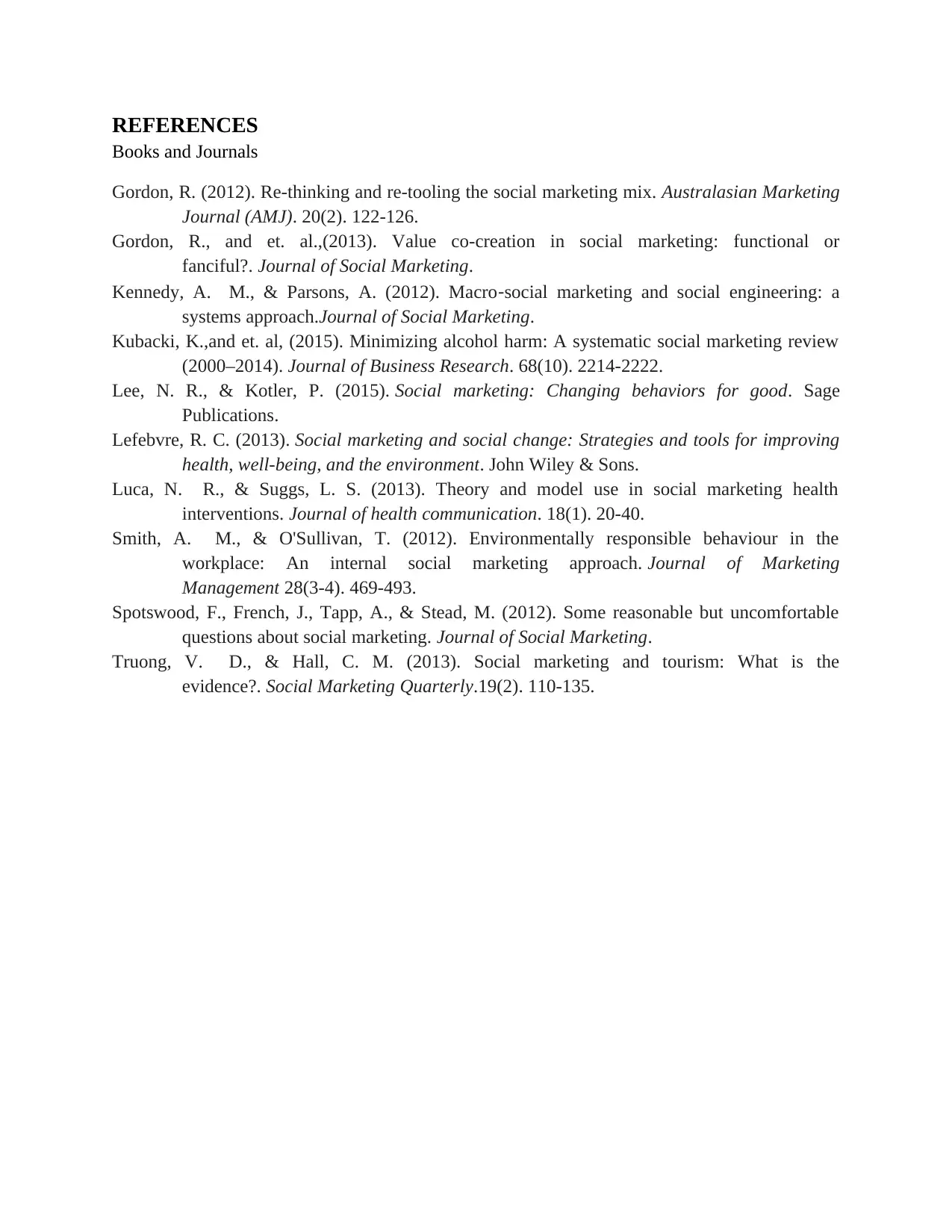
REFERENCES
Books and Journals
Gordon, R. (2012). Re-thinking and re-tooling the social marketing mix. Australasian Marketing
Journal (AMJ). 20(2). 122-126.
Gordon, R., and et. al.,(2013). Value co-creation in social marketing: functional or
fanciful?. Journal of Social Marketing.
Kennedy, A. M., & Parsons, A. (2012). Macro‐social marketing and social engineering: a
systems approach.Journal of Social Marketing.
Kubacki, K.,and et. al, (2015). Minimizing alcohol harm: A systematic social marketing review
(2000–2014). Journal of Business Research. 68(10). 2214-2222.
Lee, N. R., & Kotler, P. (2015). Social marketing: Changing behaviors for good. Sage
Publications.
Lefebvre, R. C. (2013). Social marketing and social change: Strategies and tools for improving
health, well-being, and the environment. John Wiley & Sons.
Luca, N. R., & Suggs, L. S. (2013). Theory and model use in social marketing health
interventions. Journal of health communication. 18(1). 20-40.
Smith, A. M., & O'Sullivan, T. (2012). Environmentally responsible behaviour in the
workplace: An internal social marketing approach. Journal of Marketing
Management 28(3-4). 469-493.
Spotswood, F., French, J., Tapp, A., & Stead, M. (2012). Some reasonable but uncomfortable
questions about social marketing. Journal of Social Marketing.
Truong, V. D., & Hall, C. M. (2013). Social marketing and tourism: What is the
evidence?. Social Marketing Quarterly.19(2). 110-135.
Books and Journals
Gordon, R. (2012). Re-thinking and re-tooling the social marketing mix. Australasian Marketing
Journal (AMJ). 20(2). 122-126.
Gordon, R., and et. al.,(2013). Value co-creation in social marketing: functional or
fanciful?. Journal of Social Marketing.
Kennedy, A. M., & Parsons, A. (2012). Macro‐social marketing and social engineering: a
systems approach.Journal of Social Marketing.
Kubacki, K.,and et. al, (2015). Minimizing alcohol harm: A systematic social marketing review
(2000–2014). Journal of Business Research. 68(10). 2214-2222.
Lee, N. R., & Kotler, P. (2015). Social marketing: Changing behaviors for good. Sage
Publications.
Lefebvre, R. C. (2013). Social marketing and social change: Strategies and tools for improving
health, well-being, and the environment. John Wiley & Sons.
Luca, N. R., & Suggs, L. S. (2013). Theory and model use in social marketing health
interventions. Journal of health communication. 18(1). 20-40.
Smith, A. M., & O'Sullivan, T. (2012). Environmentally responsible behaviour in the
workplace: An internal social marketing approach. Journal of Marketing
Management 28(3-4). 469-493.
Spotswood, F., French, J., Tapp, A., & Stead, M. (2012). Some reasonable but uncomfortable
questions about social marketing. Journal of Social Marketing.
Truong, V. D., & Hall, C. M. (2013). Social marketing and tourism: What is the
evidence?. Social Marketing Quarterly.19(2). 110-135.
⊘ This is a preview!⊘
Do you want full access?
Subscribe today to unlock all pages.
Trusted by 1+ million students worldwide

1 out of 9


Related Documents


Your All-in-One AI-Powered Toolkit for Academic Success.
+13062052269
info@desklib.com
Available 24*7 on WhatsApp / Email
![[object Object]](/_next/static/media/star-bottom.7253800d.svg)
Unlock your academic potential
Copyright © 2020–2026 A2Z Services. All Rights Reserved. Developed and managed by ZUCOL.