Structured Abstract: Social Media's Impact on Business and Users

Verified

Added on  2021/06/15

|6
|1413
|46
Report
AI Summary
This structured abstract examines the multifaceted influence of social media, drawing from research by Gangi & Wasko, Malhotra & Gopal, Audree et al., and Murhat et al. The abstract explores how businesses leverage social media to gauge user perceptions and facilitate engagement, highlighting the role of social engagement theory. It discusses common themes such as the impact of social networking sites on social interactions, psychological effects on users, and the benefits of social media in information access, particularly in areas like nutrition. The abstract also addresses study limitations, such as the challenges of qualitative research and barriers to platform access, as well as future research directions, including further investigation of social media's impact on communication, health services, and user experiences. The report provides a comprehensive overview of social media's role in modern society, emphasizing its impact on business operations, user behavior, and future research avenues.
Document Page
Surname 1
STRUCTURED ABSTRACT: SOCIAL MEDIA
Student’s Name
Professor’s Name
Course Name
Institution
City
Date
tabler-icon-diamond-filled.svg

Paraphrase This Document

Need a fresh take? Get an instant paraphrase of this document with our AI Paraphraser
Document Page
Surname 2
STRUCTURED ABSTRACT
This structured abstract will focus on the topic of social media through research of Murat et al.,
Malhotra & Gopal, Audree et al. and Gengi & Wasko.
CONCEPTUAL
Gangi & Wasko (2016) present an analysis based on the extent to which business are hooked to
social media and user-generated content. The author builds all relevant information based on user
experiences from social interactions and operationalized information sharing aspects from social
media. In the modern world, businesses rely on social media to gauge user perceptions based on
different brands in the market (Gangi & Wasko, 2016). Survey responses are also used, and this
has a significant impact on user engagement and risks to the business. The theory in
consideration is the social engagement theory which accounts for the role that technology plays
in facilitating social interactions, as well as uses that are globally distributed. The theory has
since evolved based on dynamic concepts in business and technology. In the modern business
platform, organisation’s are keen to support the creation of user experience, to meet their
diversified needs, and to ensure that high user engagement is facilitated in business operations
(Gangi & Wasko, 2016).
Common themes/findings across the four articles.
Malhotra & Gopal emphasizes the concept of social networking sites, which are commonly used
trends that have a significant influence on the social interactions and the wellbeing of
individuals. The findings in this article are linked to the fact that most individuals, especially
youngsters, have a likelihood of using social media and social networking sites at a very young
age, which has an impact on gender and family interactions. According to the authors, Facebook
is the most preferred social networking site for most participants. Most teenagers or adolescents
Document Page
Surname 3
also, tend to hide most of their tasks from others and feel frustrated in the absence of access to
social networks. The authors focus on the theme of social acceptance which reveals itself in the
journal and is related to the other articles as well. The concept of career growth and adjustment is
as a tool influencing most experiences around the era of social networking. Based on the Audrey
et al. (2018), the use of social media platforms continues to increase. The article also focuses on
the aspect of ease in information access, as well as interactions, which are essential in the
modern day. The concept of social media in business is focused on in the article focusing on
social media engagement theory (Gangi & Wasko, 2016). This brings out a very distinct
approach to the use of social media towards positive interactions and social relations for business
and social growth. A common theme presented by Murhat et al. (2015) is the relationship
between internet technology and social networks in the modern day. Social networking and
related concepts have been discussed by the author, together with the revelation of the level of
social media addiction. The author, however, focuses on Turkey in this research. The study
results apply to the world as a whole, where teenagers are the most affected by the different
impacts of the use of social media in the modern day.
Different themes/findings across the four articles.
A unique theme presenting itself in the works of Malhotra & Gopal (2017) is related to
psychological and emotional problems which face social media users. According to the study,
cultural and gender stereotypes in the society are evident, and this aspect continues to be
significant based on social media freedom. The degree of freedom and autonomy in social
networking sites is high. In some cases, women are meant to be preserved from influences to the
outer world. The concept of autonomy and freedom on social media is the central issue of
consideration in the article. Audree et al. (2018) emphasize on the nutritional benefits of social
Document Page
Surname 4
media. The authors outline the importance of information access, specifically weight loss issues
and information exchange, which has played a significant role, helping individuals suffering
from nutritional problems such as obesity (Audree et al. 2018). The social media platforms have
been applauded by the author for the positive aspects, and the help which has been of
significance to most individuals in the world. The theme of technology has been presented,
which helps in business growth (Gangi & Wasko, 2016). In the long run, social media will
always affect business operations despite the drawbacks faced in trying to regulate social
platforms in the world. Murhat et al. (2015) are more specific on the virtual environment,
through the use of web-based networks. The author is keen to separate social media from
traditional content, through text, audio, video and pictures, which make life and communication
easy.
Study limitations and how these differ from the various study designs
Malhotra and Gopal (2017) acknowledge the effects of using qualitative design in research,
which is not accurate enough especially in measuring different populations. Personality measures
cannot be easily depicted, and smaller sample sizes have to be considered, which may produce
inaccurate results in the long run. Audree et al. (2018) present a fundamental limitation which
involves identification of barriers to blog, and the challenges involved in obtaining platforms for
discussion forums. Such barriers have been related to the perceptions of users towards specific
social networking sites that are also a challenge to research. These barriers make the entire
process more complicated, as well as aspects such as lack of time on the part of respondents.
Future research directions proposed in the articles.
Malhotra and Gopal (2017) propose the need to look into more ways through which social
networking sites are altering communication in the modern society. According to the authors, the
tabler-icon-diamond-filled.svg

Paraphrase This Document

Need a fresh take? Get an instant paraphrase of this document with our AI Paraphraser
Document Page
Surname 5
environment allows individuals to make friends, colleagues and share ideas and personal views
with other people. The impact of work schedules on the use of social media should be
accommodated in future research (Audree et al. 2018). Participants have different life
experiences and priorities, which are bound to affect their interest in networking sites and social
media platforms, which need to be investigated at length. Murhat et al. (2015) encourage further
research in how social media aids health services and the treatment of different infections,
together with the level of participant interest and participation in the same.
Document Page
Surname 6
List of References
Conceptual Theory
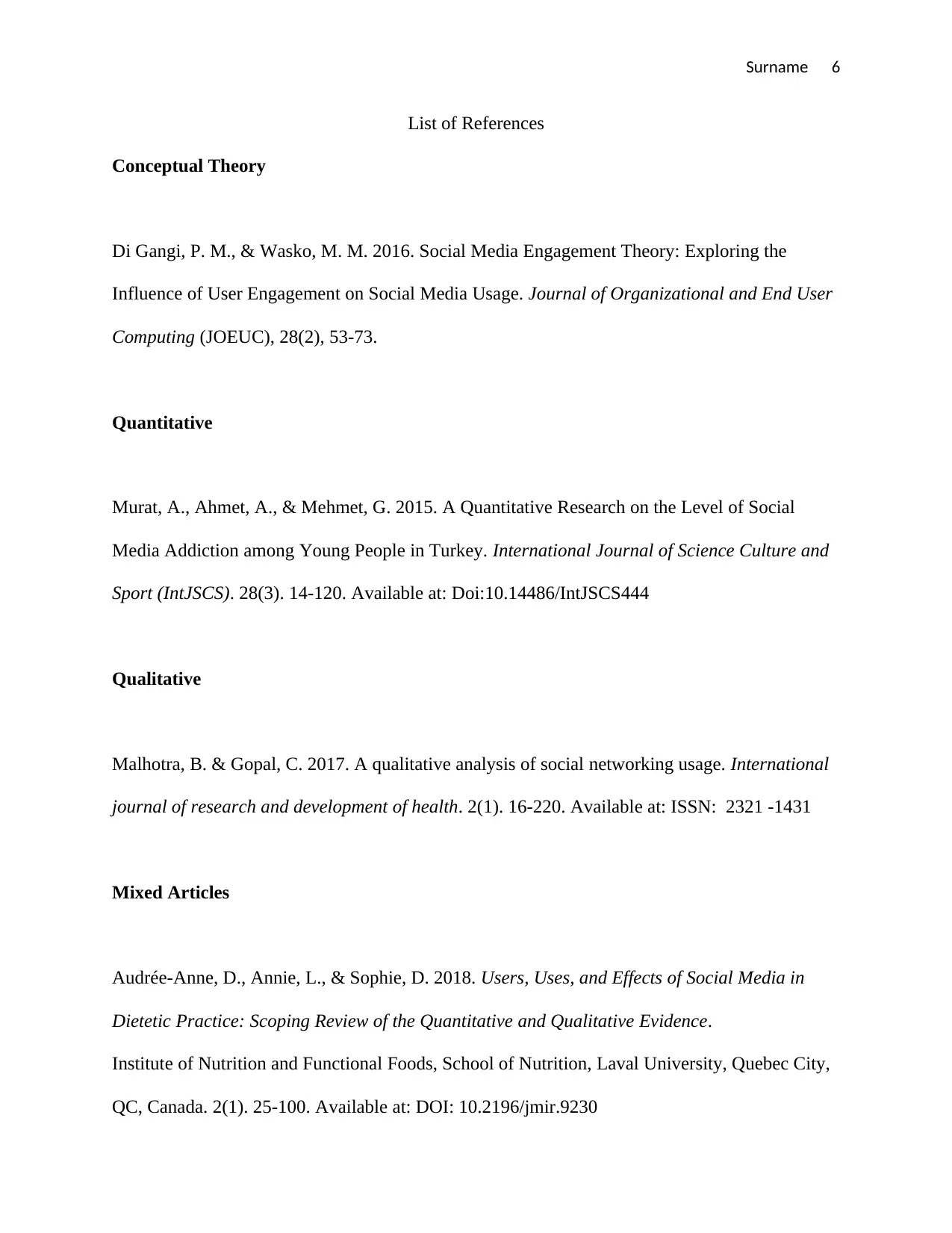
Di Gangi, P. M., & Wasko, M. M. 2016. Social Media Engagement Theory: Exploring the
Influence of User Engagement on Social Media Usage. Journal of Organizational and End User
Computing (JOEUC), 28(2), 53-73.
Quantitative
Murat, A., Ahmet, A., & Mehmet, G. 2015. A Quantitative Research on the Level of Social
Media Addiction among Young People in Turkey. International Journal of Science Culture and
Sport (IntJSCS). 28(3). 14-120. Available at: Doi:10.14486/IntJSCS444
Qualitative
Malhotra, B. & Gopal, C. 2017. A qualitative analysis of social networking usage. International
journal of research and development of health. 2(1). 16-220. Available at: ISSN: 2321 -1431
Mixed Articles
Audrée-Anne, D., Annie, L., & Sophie, D. 2018. Users, Uses, and Effects of Social Media in
Dietetic Practice: Scoping Review of the Quantitative and Qualitative Evidence.
Institute of Nutrition and Functional Foods, School of Nutrition, Laval University, Quebec City,
QC, Canada. 2(1). 25-100. Available at: DOI: 10.2196/jmir.9230
chevron_up_icon
1 out of 6
circle_padding
hide_on_mobile
zoom_out_icon
[object Object]