Social Media Usage, Academic Engagement, and Emotional Stability
VerifiedAdded on 2020/01/28
|21
|3376
|158
Report
AI Summary
This report presents a survey-based analysis of social media usage among students at Griffith University. The study investigated the impact of social networking sites (SNS) on academic engagement, SNS dependency, and emotional stability. A sample of 784 students (419 females and 365 males) was surveyed. The methods included item generation to assess the variables, and a simple random sampling technique was used to gather data. Measures included the Utrecht Work Engagement Scale-Student version (UWES-S) for academic engagement, a 6-item scale for SNS dependency, and the Ten Item Personality Inventory (TIPI) for emotional stability. The results, analyzed using regression models, revealed a significant relationship between academic engagement and the use of Facebook pages for university courses, as well as a correlation between SNS dependency and anxiousness. The findings highlight the complex relationship between social media and student life, emphasizing the importance of understanding its effects on academic performance and psychological well-being.

Survey Design and Analysis

Paraphrase This Document
Need a fresh take? Get an instant paraphrase of this document with our AI Paraphraser
Table of Contents
OVERVIEW OF PROJECT............................................................................................................4
METHODS......................................................................................................................................5
Item Generation...........................................................................................................................5
Sample.........................................................................................................................................5
Measures......................................................................................................................................6
Procedure.....................................................................................................................................7
RESULTS........................................................................................................................................7
DISCUSSION................................................................................................................................18
REFERENCES..............................................................................................................................20
Books and Journals....................................................................................................................20
OVERVIEW OF PROJECT............................................................................................................4
METHODS......................................................................................................................................5
Item Generation...........................................................................................................................5
Sample.........................................................................................................................................5
Measures......................................................................................................................................6
Procedure.....................................................................................................................................7
RESULTS........................................................................................................................................7
DISCUSSION................................................................................................................................18
REFERENCES..............................................................................................................................20
Books and Journals....................................................................................................................20
Abstract
Social networking sites are enjoying high level of popularity due to having high level of
usage. Moreover, now each individual has smart phone which in turn enables them to access
internet at any time. For this research study or investigation Griffith University has been
selection which has attained leading position in Australia. In this, report has presented the
manner or frequency in which students of concerned University has used social networking sites.
For the present investigation, 784 respondents have been selected in which 419 (females) and
365 were males. From investigation it has been found that students place high level of emphasis
on sharing their views with others rather than searching concepts. It has been identified that
cheerfulness aspect and social networking usage moderately correlated with each other.
Moreover, social networking sites enable people to make new friends and share their views and
ideas with others
Social networking sites are enjoying high level of popularity due to having high level of
usage. Moreover, now each individual has smart phone which in turn enables them to access
internet at any time. For this research study or investigation Griffith University has been
selection which has attained leading position in Australia. In this, report has presented the
manner or frequency in which students of concerned University has used social networking sites.
For the present investigation, 784 respondents have been selected in which 419 (females) and
365 were males. From investigation it has been found that students place high level of emphasis
on sharing their views with others rather than searching concepts. It has been identified that
cheerfulness aspect and social networking usage moderately correlated with each other.
Moreover, social networking sites enable people to make new friends and share their views and
ideas with others
⊘ This is a preview!⊘
Do you want full access?
Subscribe today to unlock all pages.

Trusted by 1+ million students worldwide
To analyze the academic engagement, SNS dependency and emotional stability of Griffith
University of Australia.
OVERVIEW OF PROJECT
In the recent, use of social networking sites among every group of people increased
significantly. From students to young as well as old people each segment lays emphasis on using
social networking sites. The main reasons behind the increasing use of social sites are that now
each individual has smart phones (Appel, Gerlach & Crusius, 2016). Along with this, social
networking sites enable people to share their views, ideas and suggestions with the large group of
people. On social sites, students can fulfill their needs in relation to both educational and non-
educational aspects (Best, Manktelow & Taylor, 2014). The present report is based on Griffith
University which has 5000 students pertaining to the five campuses. It is one of the top or
leading University of Australia. In this, report will describe the extent to which use of social
networking sites have an impact on social life and mental being of students. By making
assessment of such issue researcher would become able to assess the mindset of students and
their attitude towards social sites.
According to the views of BlomfieldNeira & Barber (2014) now students do internet
surfing with the motive to assess relevant study material. The rationale behind this, internet
contains huge data or information which in turn assist students in presenting the suitable or fair
view of issue. Besides this, Dunlap & et.al., (2016) depicted that social sites more information
regarding academic assignmemnts which make vital contribuion in the learning and growth
aspect. Further, Flick (2015) found in their study that level of emotional stability of students are
highly based on the use of social networking sites. Now, people share their views and
suggestions on social sites with the motive to become emotional stable. However, on the critical
note, Junco (2012) stated that social sites are only the medium through which individuals can
share their feelings. Nevertheless, it does not provide high level of emotional and mental
satisfaction. Moreover, sometimes individuals do negative comments on social sites. Lup, Trub
& Rosenthal (2015) depicted in their study that now dependency level of individuals on social
networking sites increased signifiacntly. Moreover, individuals share their memories with other
University of Australia.
OVERVIEW OF PROJECT
In the recent, use of social networking sites among every group of people increased
significantly. From students to young as well as old people each segment lays emphasis on using
social networking sites. The main reasons behind the increasing use of social sites are that now
each individual has smart phones (Appel, Gerlach & Crusius, 2016). Along with this, social
networking sites enable people to share their views, ideas and suggestions with the large group of
people. On social sites, students can fulfill their needs in relation to both educational and non-
educational aspects (Best, Manktelow & Taylor, 2014). The present report is based on Griffith
University which has 5000 students pertaining to the five campuses. It is one of the top or
leading University of Australia. In this, report will describe the extent to which use of social
networking sites have an impact on social life and mental being of students. By making
assessment of such issue researcher would become able to assess the mindset of students and
their attitude towards social sites.
According to the views of BlomfieldNeira & Barber (2014) now students do internet
surfing with the motive to assess relevant study material. The rationale behind this, internet
contains huge data or information which in turn assist students in presenting the suitable or fair
view of issue. Besides this, Dunlap & et.al., (2016) depicted that social sites more information
regarding academic assignmemnts which make vital contribuion in the learning and growth
aspect. Further, Flick (2015) found in their study that level of emotional stability of students are
highly based on the use of social networking sites. Now, people share their views and
suggestions on social sites with the motive to become emotional stable. However, on the critical
note, Junco (2012) stated that social sites are only the medium through which individuals can
share their feelings. Nevertheless, it does not provide high level of emotional and mental
satisfaction. Moreover, sometimes individuals do negative comments on social sites. Lup, Trub
& Rosenthal (2015) depicted in their study that now dependency level of individuals on social
networking sites increased signifiacntly. Moreover, individuals share their memories with other
Paraphrase This Document
Need a fresh take? Get an instant paraphrase of this document with our AI Paraphraser
by uploading the images and status on social sites. Students make use of social sites more
frequently now a days.
METHODS
Item Generation
In the present study, scale has been developed by the researcher with the motive to
analyze the academic enagagement, SNS dependency and emotional stability. For the
development of scale researcher must have understanding regarding secondary data findings.
Hence, with the motive to determine suitable solution of research issue scholar has included
questions regarding the level of academic engagement, SNS dependency and emotional stability
(Mackey and Gass, 2015). Hence, to get suitable information from respondents short and simple
questions have been included by the researcher in plan. Hence, to avoid confusuion from the
mind of respondents questiionnaire has been designed by the researcher in an easiest format.
Hence, to evaluate the use of social networking sites and its impact on psychological well-being
several themes have been prepared by the researcher (Woods & Scott, 2016). By considering the
brief thesis prepared from literature review section statement for evaluation has been devised.
Sample
Researcher is required to select suitable sample for doing primary data investigation
more effectively and efficiently. Moreover, limited time frame and monetary resources are the
main constraints due to which it is not possible for the scholar to conduct study on whole
population. Hence, mainly two types of sampling techniques are available to the researcher
namely probabilistic and non-probabilistic (Mackey and Gass, 2015). Thus, with the motive to
conduct investigation in the best possible way simple random sampling technique has been
employed by the researcher. Hence, by using such technique researcher has selected 784 students
of Griffith University, Australia. Out of such 784 students, 419 were female and remaining
(365) were mal who have presented their views regarding the aspects of academic enagement,
dependency on social networking sites and level of emotional stability.
frequently now a days.
METHODS
Item Generation
In the present study, scale has been developed by the researcher with the motive to
analyze the academic enagagement, SNS dependency and emotional stability. For the
development of scale researcher must have understanding regarding secondary data findings.
Hence, with the motive to determine suitable solution of research issue scholar has included
questions regarding the level of academic engagement, SNS dependency and emotional stability
(Mackey and Gass, 2015). Hence, to get suitable information from respondents short and simple
questions have been included by the researcher in plan. Hence, to avoid confusuion from the
mind of respondents questiionnaire has been designed by the researcher in an easiest format.
Hence, to evaluate the use of social networking sites and its impact on psychological well-being
several themes have been prepared by the researcher (Woods & Scott, 2016). By considering the
brief thesis prepared from literature review section statement for evaluation has been devised.
Sample
Researcher is required to select suitable sample for doing primary data investigation
more effectively and efficiently. Moreover, limited time frame and monetary resources are the
main constraints due to which it is not possible for the scholar to conduct study on whole
population. Hence, mainly two types of sampling techniques are available to the researcher
namely probabilistic and non-probabilistic (Mackey and Gass, 2015). Thus, with the motive to
conduct investigation in the best possible way simple random sampling technique has been
employed by the researcher. Hence, by using such technique researcher has selected 784 students
of Griffith University, Australia. Out of such 784 students, 419 were female and remaining
(365) were mal who have presented their views regarding the aspects of academic enagement,
dependency on social networking sites and level of emotional stability.
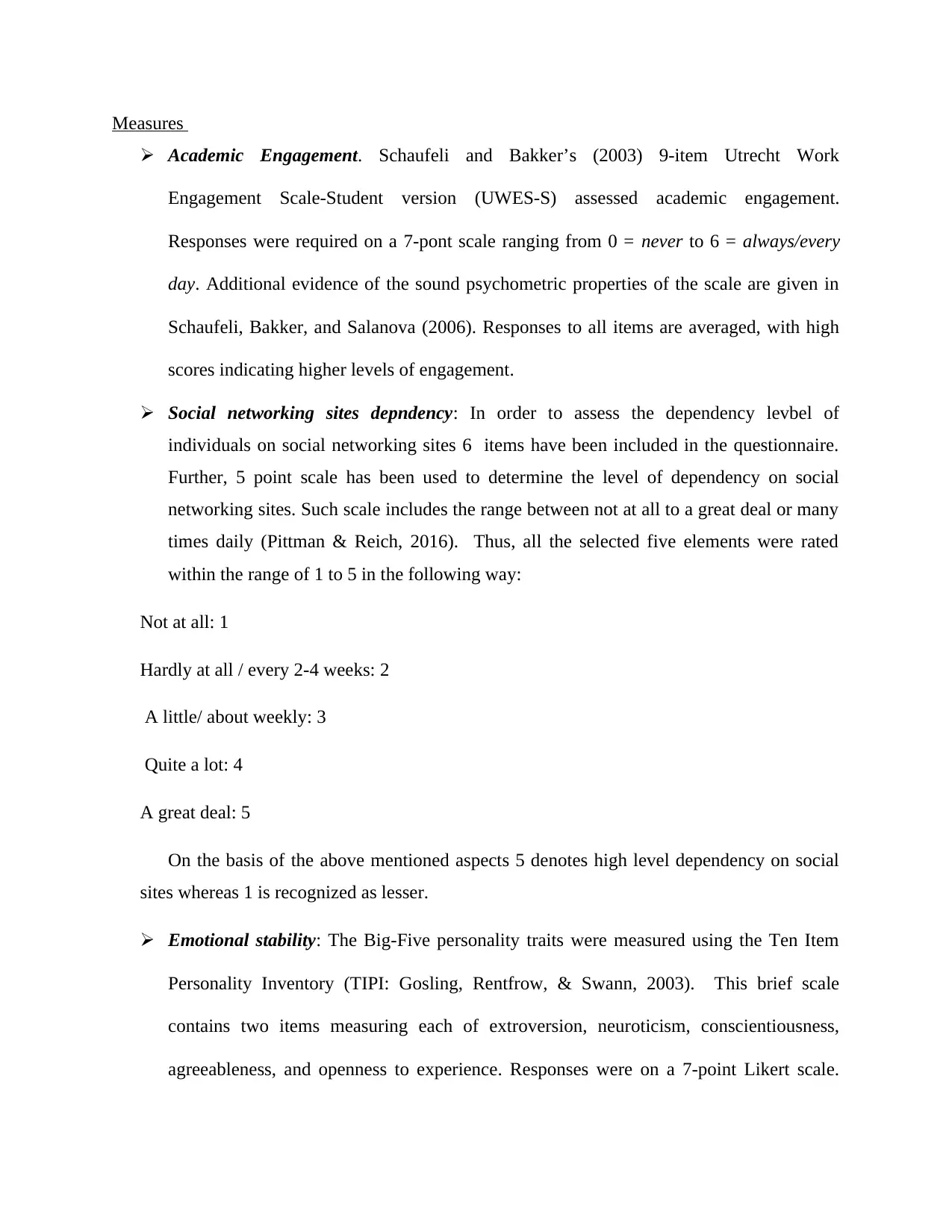
Measures
Academic Engagement. Schaufeli and Bakker’s (2003) 9-item Utrecht Work
Engagement Scale-Student version (UWES-S) assessed academic engagement.
Responses were required on a 7-pont scale ranging from 0 = never to 6 = always/every
day. Additional evidence of the sound psychometric properties of the scale are given in
Schaufeli, Bakker, and Salanova (2006). Responses to all items are averaged, with high
scores indicating higher levels of engagement.
Social networking sites depndency: In order to assess the dependency levbel of
individuals on social networking sites 6 items have been included in the questionnaire.
Further, 5 point scale has been used to determine the level of dependency on social
networking sites. Such scale includes the range between not at all to a great deal or many
times daily (Pittman & Reich, 2016). Thus, all the selected five elements were rated
within the range of 1 to 5 in the following way:
Not at all: 1
Hardly at all / every 2-4 weeks: 2
A little/ about weekly: 3
Quite a lot: 4
A great deal: 5
On the basis of the above mentioned aspects 5 denotes high level dependency on social
sites whereas 1 is recognized as lesser.
Emotional stability: The Big-Five personality traits were measured using the Ten Item
Personality Inventory (TIPI: Gosling, Rentfrow, & Swann, 2003). This brief scale
contains two items measuring each of extroversion, neuroticism, conscientiousness,
agreeableness, and openness to experience. Responses were on a 7-point Likert scale.
Academic Engagement. Schaufeli and Bakker’s (2003) 9-item Utrecht Work
Engagement Scale-Student version (UWES-S) assessed academic engagement.
Responses were required on a 7-pont scale ranging from 0 = never to 6 = always/every
day. Additional evidence of the sound psychometric properties of the scale are given in
Schaufeli, Bakker, and Salanova (2006). Responses to all items are averaged, with high
scores indicating higher levels of engagement.
Social networking sites depndency: In order to assess the dependency levbel of
individuals on social networking sites 6 items have been included in the questionnaire.
Further, 5 point scale has been used to determine the level of dependency on social
networking sites. Such scale includes the range between not at all to a great deal or many
times daily (Pittman & Reich, 2016). Thus, all the selected five elements were rated
within the range of 1 to 5 in the following way:
Not at all: 1
Hardly at all / every 2-4 weeks: 2
A little/ about weekly: 3
Quite a lot: 4
A great deal: 5
On the basis of the above mentioned aspects 5 denotes high level dependency on social
sites whereas 1 is recognized as lesser.
Emotional stability: The Big-Five personality traits were measured using the Ten Item
Personality Inventory (TIPI: Gosling, Rentfrow, & Swann, 2003). This brief scale
contains two items measuring each of extroversion, neuroticism, conscientiousness,
agreeableness, and openness to experience. Responses were on a 7-point Likert scale.
⊘ This is a preview!⊘
Do you want full access?
Subscribe today to unlock all pages.
Trusted by 1+ million students worldwide
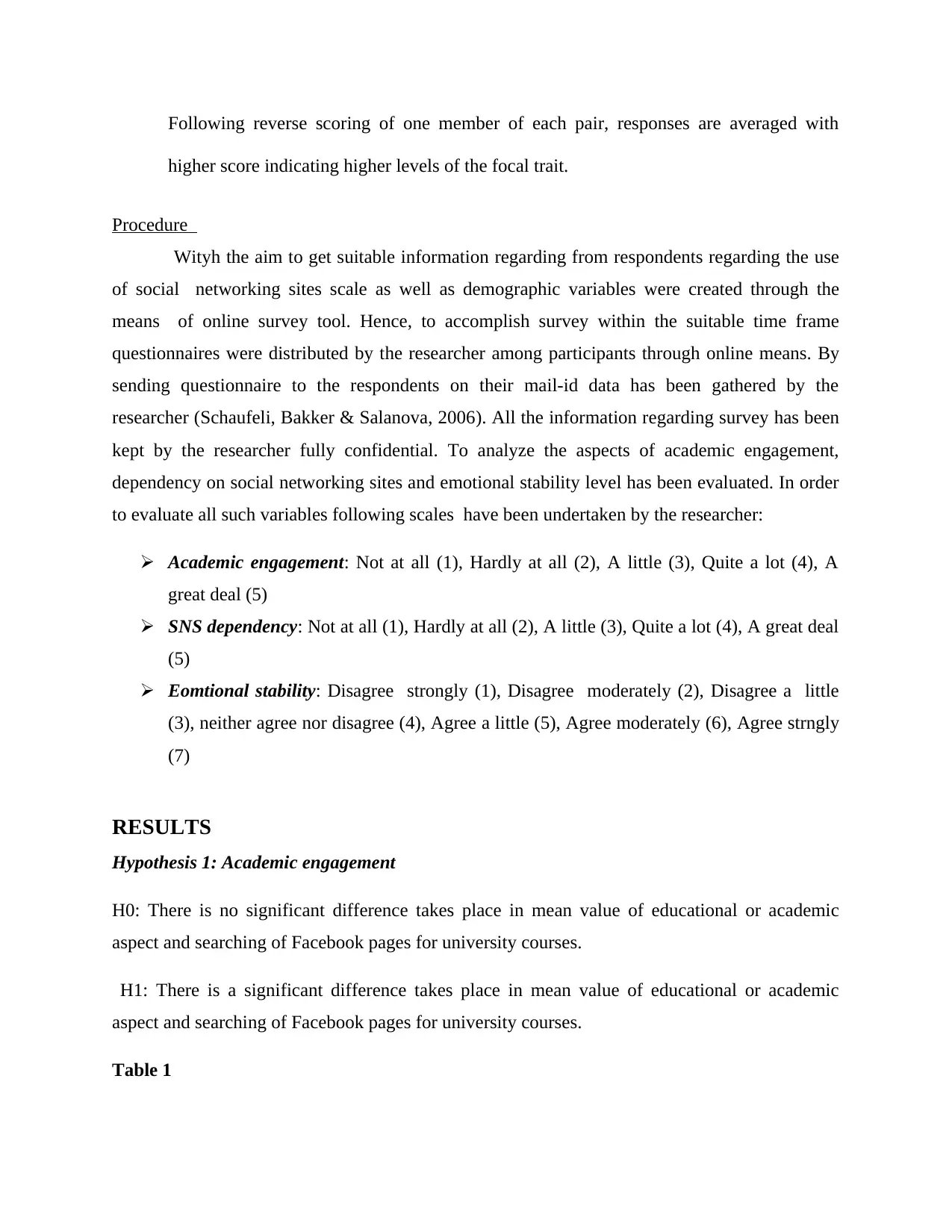
Following reverse scoring of one member of each pair, responses are averaged with
higher score indicating higher levels of the focal trait.
Procedure
Wityh the aim to get suitable information regarding from respondents regarding the use
of social networking sites scale as well as demographic variables were created through the
means of online survey tool. Hence, to accomplish survey within the suitable time frame
questionnaires were distributed by the researcher among participants through online means. By
sending questionnaire to the respondents on their mail-id data has been gathered by the
researcher (Schaufeli, Bakker & Salanova, 2006). All the information regarding survey has been
kept by the researcher fully confidential. To analyze the aspects of academic engagement,
dependency on social networking sites and emotional stability level has been evaluated. In order
to evaluate all such variables following scales have been undertaken by the researcher:
Academic engagement: Not at all (1), Hardly at all (2), A little (3), Quite a lot (4), A
great deal (5)
SNS dependency: Not at all (1), Hardly at all (2), A little (3), Quite a lot (4), A great deal
(5)
Eomtional stability: Disagree strongly (1), Disagree moderately (2), Disagree a little
(3), neither agree nor disagree (4), Agree a little (5), Agree moderately (6), Agree strngly
(7)
RESULTS
Hypothesis 1: Academic engagement
H0: There is no significant difference takes place in mean value of educational or academic
aspect and searching of Facebook pages for university courses.
H1: There is a significant difference takes place in mean value of educational or academic
aspect and searching of Facebook pages for university courses.
Table 1
higher score indicating higher levels of the focal trait.
Procedure
Wityh the aim to get suitable information regarding from respondents regarding the use
of social networking sites scale as well as demographic variables were created through the
means of online survey tool. Hence, to accomplish survey within the suitable time frame
questionnaires were distributed by the researcher among participants through online means. By
sending questionnaire to the respondents on their mail-id data has been gathered by the
researcher (Schaufeli, Bakker & Salanova, 2006). All the information regarding survey has been
kept by the researcher fully confidential. To analyze the aspects of academic engagement,
dependency on social networking sites and emotional stability level has been evaluated. In order
to evaluate all such variables following scales have been undertaken by the researcher:
Academic engagement: Not at all (1), Hardly at all (2), A little (3), Quite a lot (4), A
great deal (5)
SNS dependency: Not at all (1), Hardly at all (2), A little (3), Quite a lot (4), A great deal
(5)
Eomtional stability: Disagree strongly (1), Disagree moderately (2), Disagree a little
(3), neither agree nor disagree (4), Agree a little (5), Agree moderately (6), Agree strngly
(7)
RESULTS
Hypothesis 1: Academic engagement
H0: There is no significant difference takes place in mean value of educational or academic
aspect and searching of Facebook pages for university courses.
H1: There is a significant difference takes place in mean value of educational or academic
aspect and searching of Facebook pages for university courses.
Table 1
Paraphrase This Document
Need a fresh take? Get an instant paraphrase of this document with our AI Paraphraser
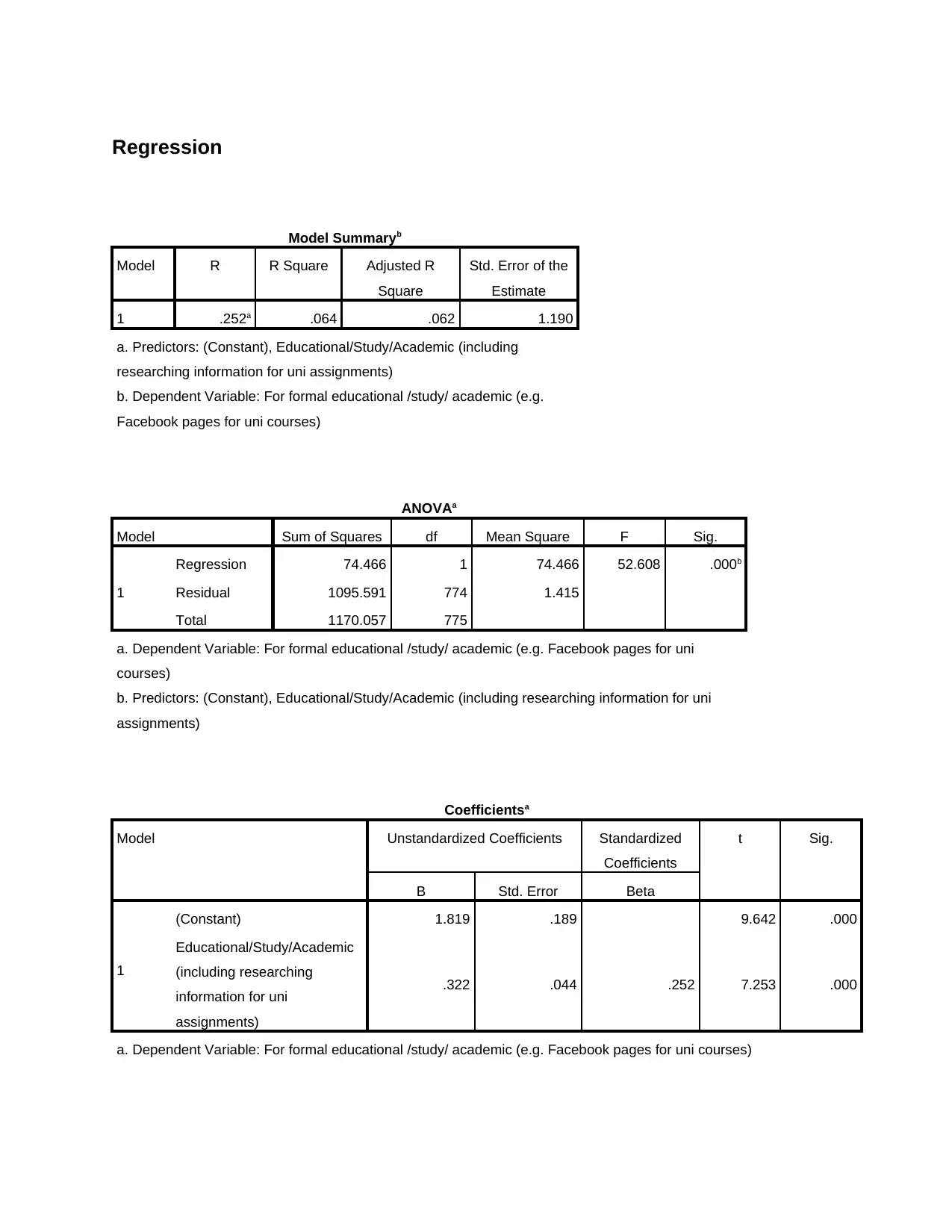
Regression
Model Summaryb
Model R R Square Adjusted R
Square
Std. Error of the
Estimate
1 .252a .064 .062 1.190
a. Predictors: (Constant), Educational/Study/Academic (including
researching information for uni assignments)
b. Dependent Variable: For formal educational /study/ academic (e.g.
Facebook pages for uni courses)
ANOVAa
Model Sum of Squares df Mean Square F Sig.
1
Regression 74.466 1 74.466 52.608 .000b
Residual 1095.591 774 1.415
Total 1170.057 775
a. Dependent Variable: For formal educational /study/ academic (e.g. Facebook pages for uni
courses)
b. Predictors: (Constant), Educational/Study/Academic (including researching information for uni
assignments)
Coefficientsa
Model Unstandardized Coefficients Standardized
Coefficients
t Sig.
B Std. Error Beta
1
(Constant) 1.819 .189 9.642 .000
Educational/Study/Academic
(including researching
information for uni
assignments)
.322 .044 .252 7.253 .000
a. Dependent Variable: For formal educational /study/ academic (e.g. Facebook pages for uni courses)
Model Summaryb
Model R R Square Adjusted R
Square
Std. Error of the
Estimate
1 .252a .064 .062 1.190
a. Predictors: (Constant), Educational/Study/Academic (including
researching information for uni assignments)
b. Dependent Variable: For formal educational /study/ academic (e.g.
Facebook pages for uni courses)
ANOVAa
Model Sum of Squares df Mean Square F Sig.
1
Regression 74.466 1 74.466 52.608 .000b
Residual 1095.591 774 1.415
Total 1170.057 775
a. Dependent Variable: For formal educational /study/ academic (e.g. Facebook pages for uni
courses)
b. Predictors: (Constant), Educational/Study/Academic (including researching information for uni
assignments)
Coefficientsa
Model Unstandardized Coefficients Standardized
Coefficients
t Sig.
B Std. Error Beta
1
(Constant) 1.819 .189 9.642 .000
Educational/Study/Academic
(including researching
information for uni
assignments)
.322 .044 .252 7.253 .000
a. Dependent Variable: For formal educational /study/ academic (e.g. Facebook pages for uni courses)
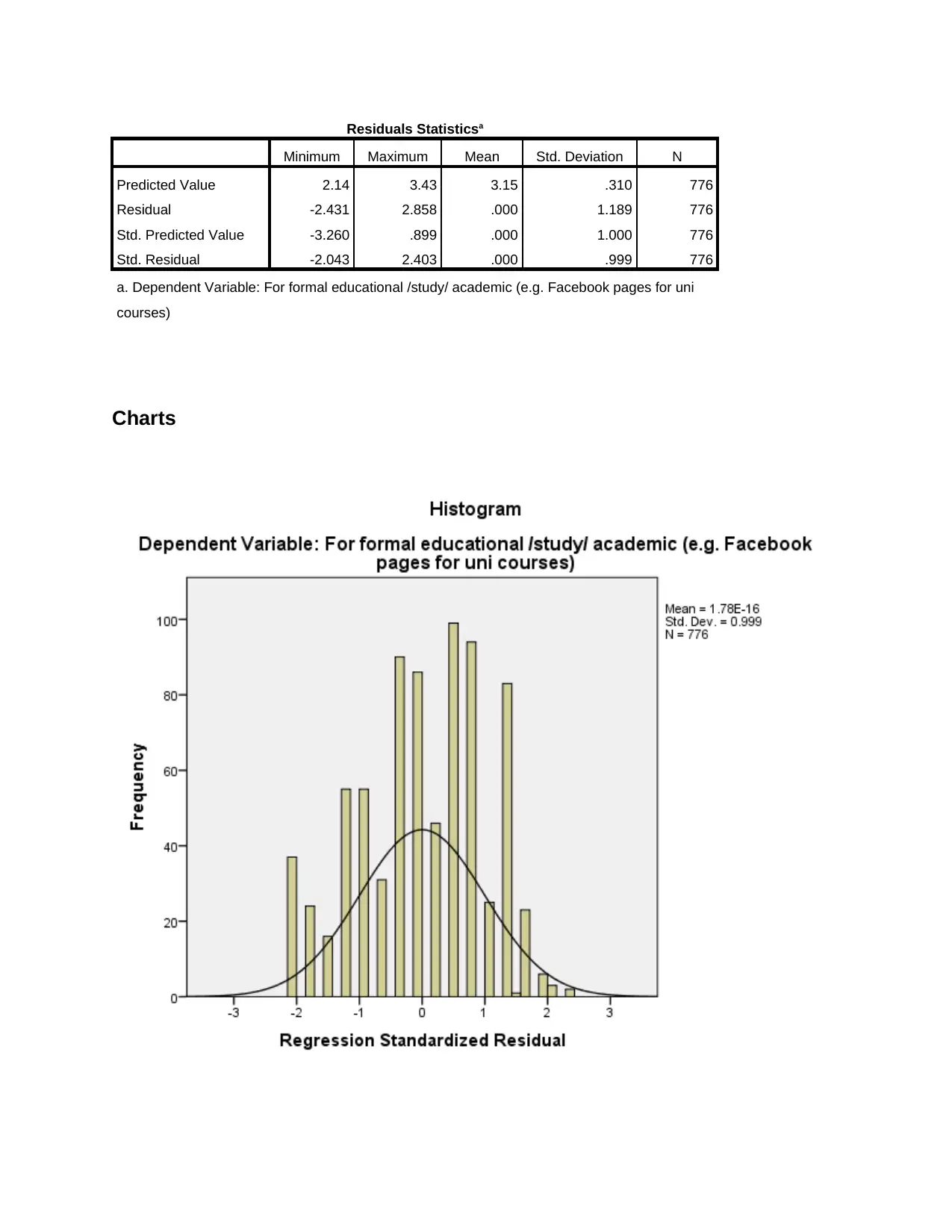
Residuals Statisticsa
Minimum Maximum Mean Std. Deviation N
Predicted Value 2.14 3.43 3.15 .310 776
Residual -2.431 2.858 .000 1.189 776
Std. Predicted Value -3.260 .899 .000 1.000 776
Std. Residual -2.043 2.403 .000 .999 776
a. Dependent Variable: For formal educational /study/ academic (e.g. Facebook pages for uni
courses)
Charts
Minimum Maximum Mean Std. Deviation N
Predicted Value 2.14 3.43 3.15 .310 776
Residual -2.431 2.858 .000 1.189 776
Std. Predicted Value -3.260 .899 .000 1.000 776
Std. Residual -2.043 2.403 .000 .999 776
a. Dependent Variable: For formal educational /study/ academic (e.g. Facebook pages for uni
courses)
Charts
⊘ This is a preview!⊘
Do you want full access?
Subscribe today to unlock all pages.
Trusted by 1+ million students worldwide
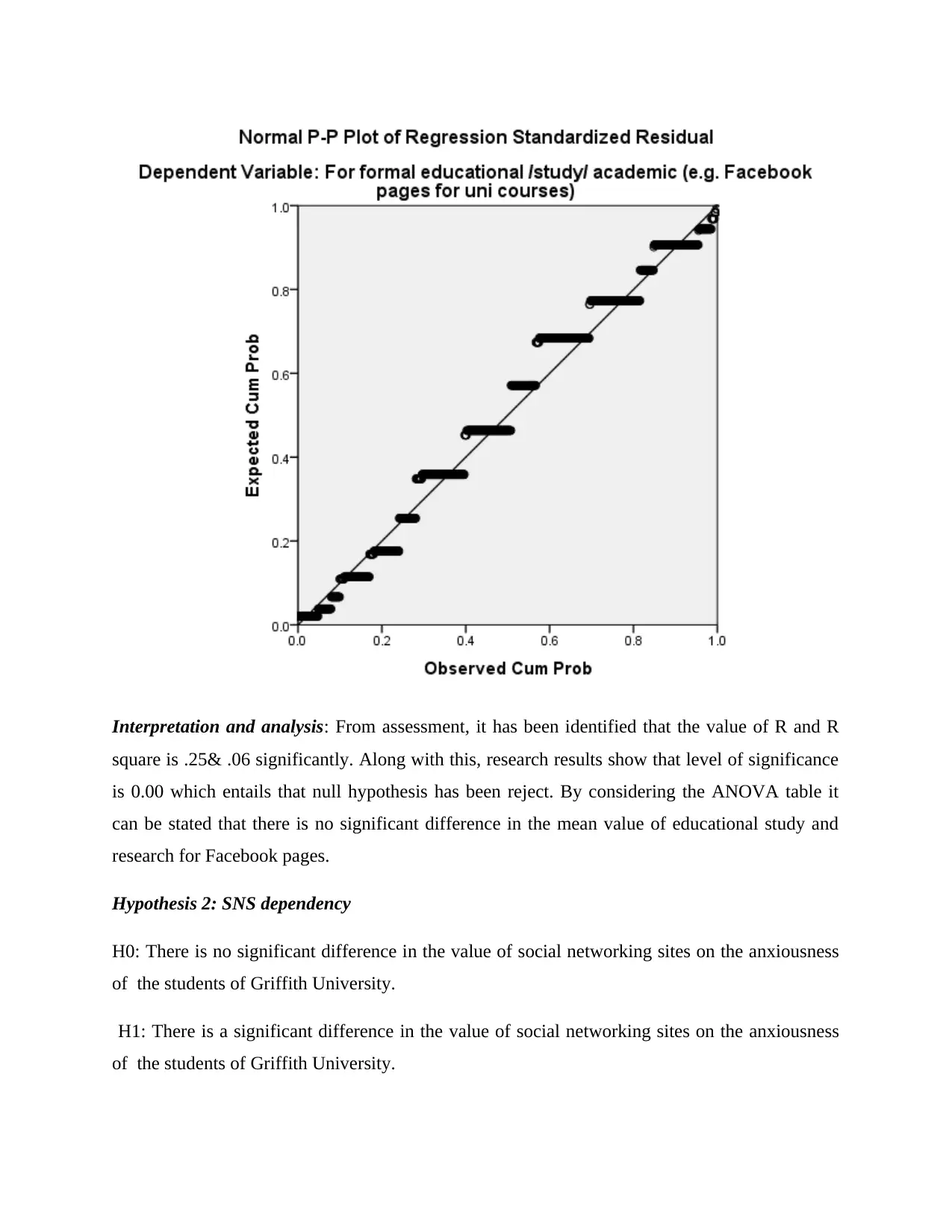
Interpretation and analysis: From assessment, it has been identified that the value of R and R
square is .25& .06 significantly. Along with this, research results show that level of significance
is 0.00 which entails that null hypothesis has been reject. By considering the ANOVA table it
can be stated that there is no significant difference in the mean value of educational study and
research for Facebook pages.
Hypothesis 2: SNS dependency
H0: There is no significant difference in the value of social networking sites on the anxiousness
of the students of Griffith University.
H1: There is a significant difference in the value of social networking sites on the anxiousness
of the students of Griffith University.
square is .25& .06 significantly. Along with this, research results show that level of significance
is 0.00 which entails that null hypothesis has been reject. By considering the ANOVA table it
can be stated that there is no significant difference in the mean value of educational study and
research for Facebook pages.
Hypothesis 2: SNS dependency
H0: There is no significant difference in the value of social networking sites on the anxiousness
of the students of Griffith University.
H1: There is a significant difference in the value of social networking sites on the anxiousness
of the students of Griffith University.
Paraphrase This Document
Need a fresh take? Get an instant paraphrase of this document with our AI Paraphraser
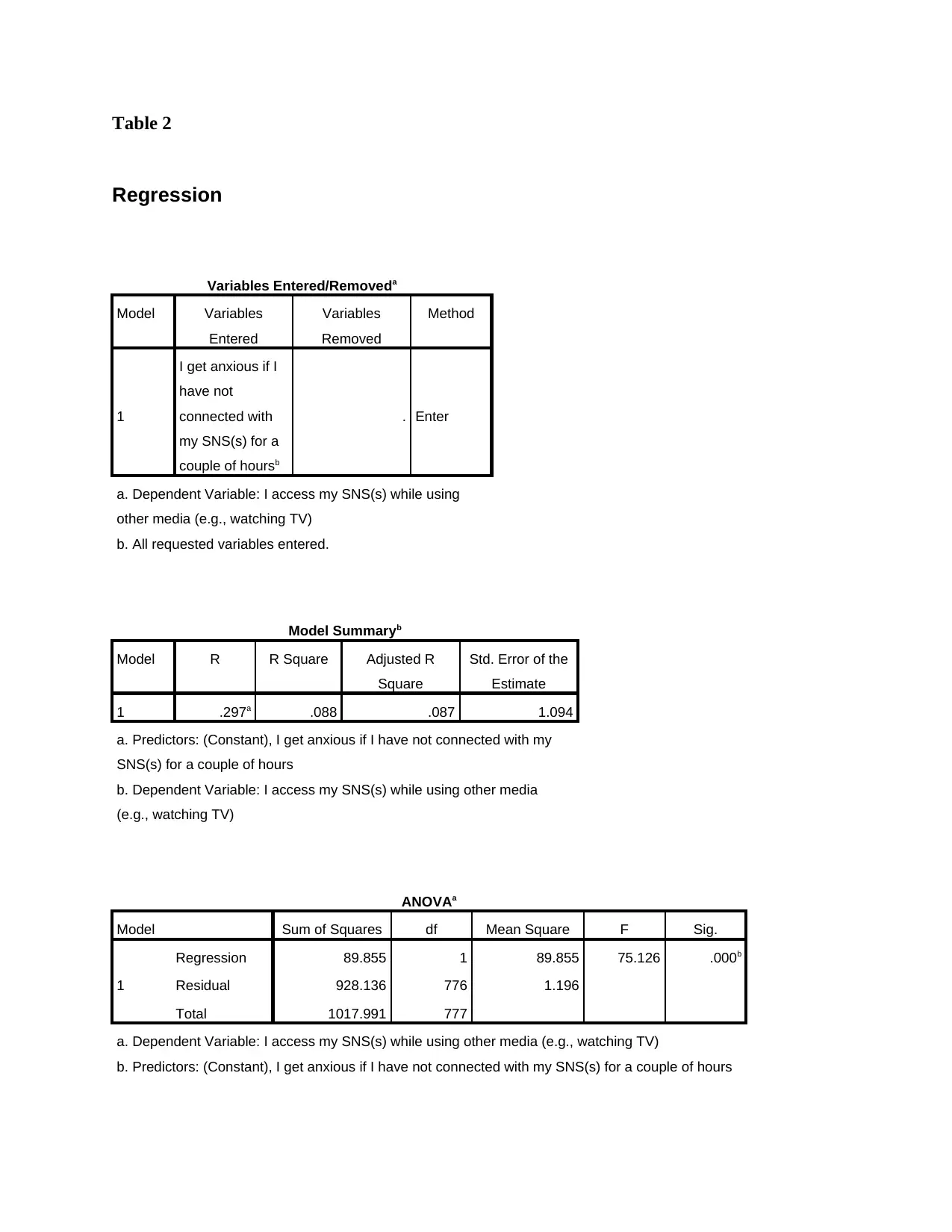
Table 2
Regression
Variables Entered/Removeda
Model Variables
Entered
Variables
Removed
Method
1
I get anxious if I
have not
connected with
my SNS(s) for a
couple of hoursb
. Enter
a. Dependent Variable: I access my SNS(s) while using
other media (e.g., watching TV)
b. All requested variables entered.
Model Summaryb
Model R R Square Adjusted R
Square
Std. Error of the
Estimate
1 .297a .088 .087 1.094
a. Predictors: (Constant), I get anxious if I have not connected with my
SNS(s) for a couple of hours
b. Dependent Variable: I access my SNS(s) while using other media
(e.g., watching TV)
ANOVAa
Model Sum of Squares df Mean Square F Sig.
1
Regression 89.855 1 89.855 75.126 .000b
Residual 928.136 776 1.196
Total 1017.991 777
a. Dependent Variable: I access my SNS(s) while using other media (e.g., watching TV)
b. Predictors: (Constant), I get anxious if I have not connected with my SNS(s) for a couple of hours
Regression
Variables Entered/Removeda
Model Variables
Entered
Variables
Removed
Method
1
I get anxious if I
have not
connected with
my SNS(s) for a
couple of hoursb
. Enter
a. Dependent Variable: I access my SNS(s) while using
other media (e.g., watching TV)
b. All requested variables entered.
Model Summaryb
Model R R Square Adjusted R
Square
Std. Error of the
Estimate
1 .297a .088 .087 1.094
a. Predictors: (Constant), I get anxious if I have not connected with my
SNS(s) for a couple of hours
b. Dependent Variable: I access my SNS(s) while using other media
(e.g., watching TV)
ANOVAa
Model Sum of Squares df Mean Square F Sig.
1
Regression 89.855 1 89.855 75.126 .000b
Residual 928.136 776 1.196
Total 1017.991 777
a. Dependent Variable: I access my SNS(s) while using other media (e.g., watching TV)
b. Predictors: (Constant), I get anxious if I have not connected with my SNS(s) for a couple of hours
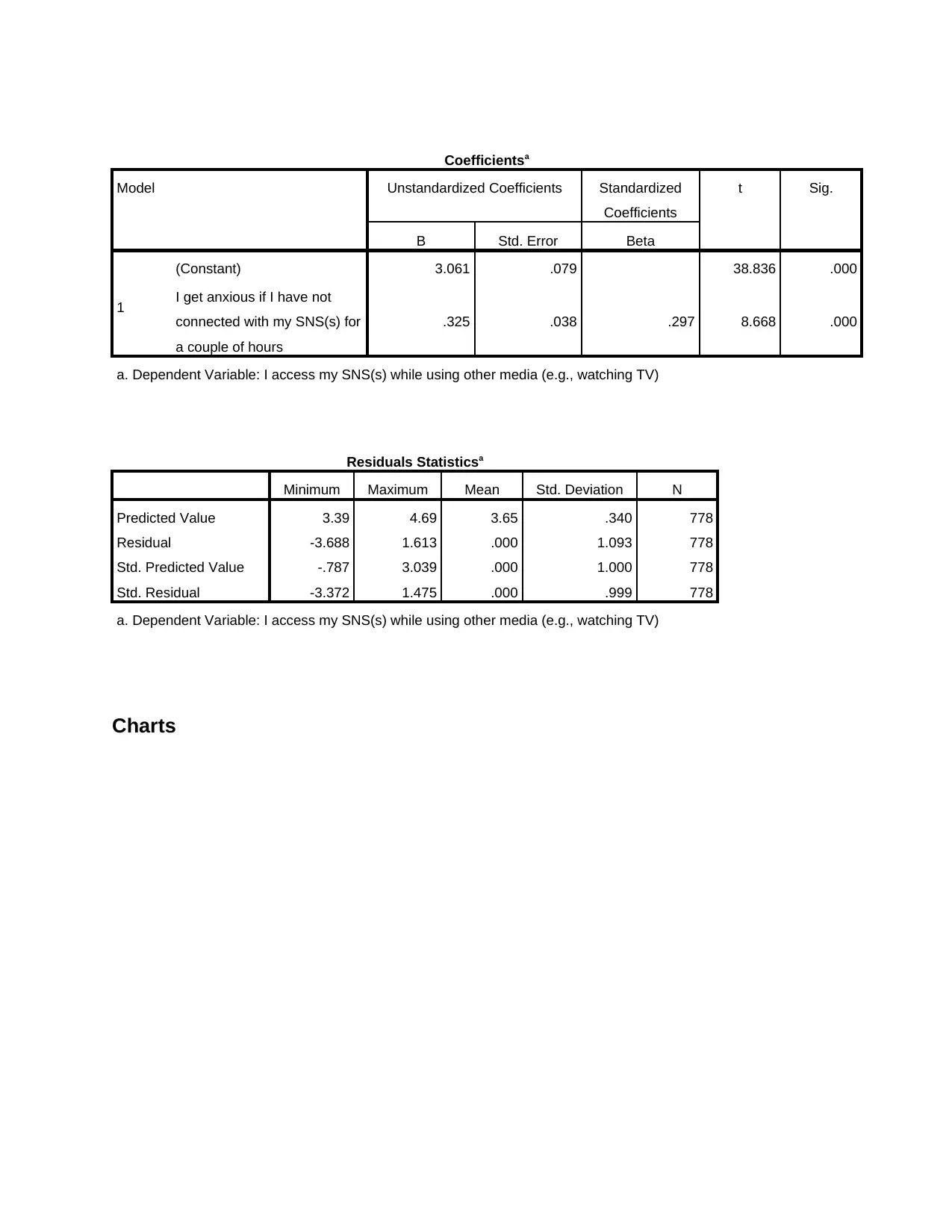
Coefficientsa
Model Unstandardized Coefficients Standardized
Coefficients
t Sig.
B Std. Error Beta
1
(Constant) 3.061 .079 38.836 .000
I get anxious if I have not
connected with my SNS(s) for
a couple of hours
.325 .038 .297 8.668 .000
a. Dependent Variable: I access my SNS(s) while using other media (e.g., watching TV)
Residuals Statisticsa
Minimum Maximum Mean Std. Deviation N
Predicted Value 3.39 4.69 3.65 .340 778
Residual -3.688 1.613 .000 1.093 778
Std. Predicted Value -.787 3.039 .000 1.000 778
Std. Residual -3.372 1.475 .000 .999 778
a. Dependent Variable: I access my SNS(s) while using other media (e.g., watching TV)
Charts
Model Unstandardized Coefficients Standardized
Coefficients
t Sig.
B Std. Error Beta
1
(Constant) 3.061 .079 38.836 .000
I get anxious if I have not
connected with my SNS(s) for
a couple of hours
.325 .038 .297 8.668 .000
a. Dependent Variable: I access my SNS(s) while using other media (e.g., watching TV)
Residuals Statisticsa
Minimum Maximum Mean Std. Deviation N
Predicted Value 3.39 4.69 3.65 .340 778
Residual -3.688 1.613 .000 1.093 778
Std. Predicted Value -.787 3.039 .000 1.000 778
Std. Residual -3.372 1.475 .000 .999 778
a. Dependent Variable: I access my SNS(s) while using other media (e.g., watching TV)
Charts
⊘ This is a preview!⊘
Do you want full access?
Subscribe today to unlock all pages.
Trusted by 1+ million students worldwide

1 out of 21


Related Documents


Your All-in-One AI-Powered Toolkit for Academic Success.
+13062052269
info@desklib.com
Available 24*7 on WhatsApp / Email
![[object Object]](/_next/static/media/star-bottom.7253800d.svg)
Unlock your academic potential
Copyright © 2020–2026 A2Z Services. All Rights Reserved. Developed and managed by ZUCOL.