Social Media and Privacy: Examining Ethical Dilemmas and Solutions

Verified

Added on  2019/09/25

|2
|487
|153
Homework Assignment
AI Summary
This assignment delves into the complex intersection of social media and privacy, exploring ethical and legal implications. It examines the challenges of balancing individual privacy with the public sharing of information, considering the perspectives of users, celebrities, and public figures. The assignment encourages investigation into what constitutes a violation of privacy, how privacy standards vary, and the influence of context on acceptable behavior. It also addresses the ethical frameworks and legal regulations surrounding social media, considering whether current policies are too lenient or restrictive. The assignment could approach the topic from a moral philosophy perspective, examining existing literature, or from a psychological/sociological viewpoint, investigating user perceptions and behaviors. Ultimately, it aims to foster a deeper understanding of the ethical dilemmas and potential solutions related to privacy in the digital age.
Document Page
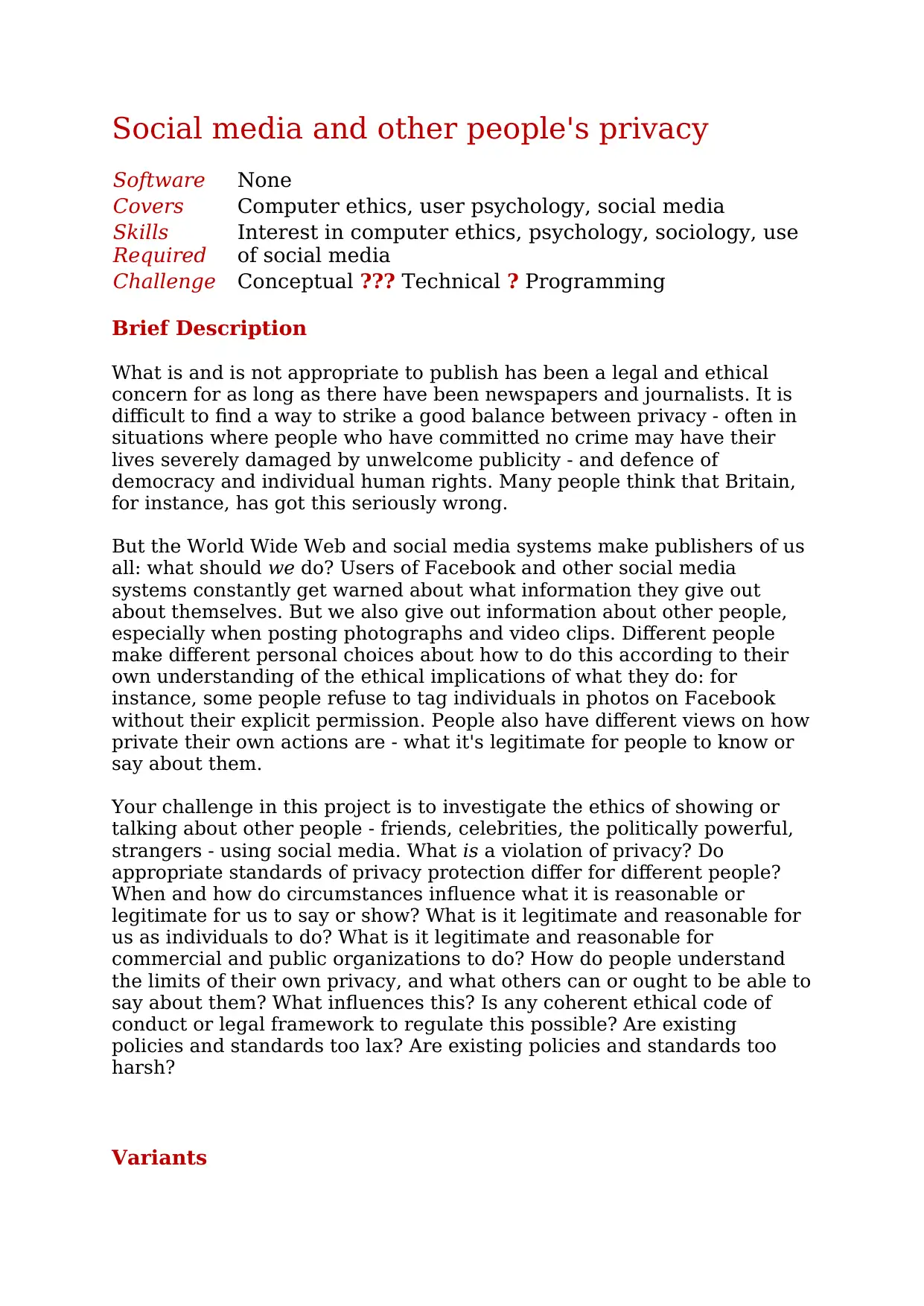
Social media and other people's privacy
Software None
Covers Computer ethics, user psychology, social media
Skills
Required
Interest in computer ethics, psychology, sociology, use
of social media
Challenge Conceptual ??? Technical ? Programming
Brief Description
What is and is not appropriate to publish has been a legal and ethical
concern for as long as there have been newspapers and journalists. It is
difficult to find a way to strike a good balance between privacy - often in
situations where people who have committed no crime may have their
lives severely damaged by unwelcome publicity - and defence of
democracy and individual human rights. Many people think that Britain,
for instance, has got this seriously wrong.
But the World Wide Web and social media systems make publishers of us
all: what should we do? Users of Facebook and other social media
systems constantly get warned about what information they give out
about themselves. But we also give out information about other people,
especially when posting photographs and video clips. Different people
make different personal choices about how to do this according to their
own understanding of the ethical implications of what they do: for
instance, some people refuse to tag individuals in photos on Facebook
without their explicit permission. People also have different views on how
private their own actions are - what it's legitimate for people to know or
say about them.
Your challenge in this project is to investigate the ethics of showing or
talking about other people - friends, celebrities, the politically powerful,
strangers - using social media. What is a violation of privacy? Do
appropriate standards of privacy protection differ for different people?
When and how do circumstances influence what it is reasonable or
legitimate for us to say or show? What is it legitimate and reasonable for
us as individuals to do? What is it legitimate and reasonable for
commercial and public organizations to do? How do people understand
the limits of their own privacy, and what others can or ought to be able to
say about them? What influences this? Is any coherent ethical code of
conduct or legal framework to regulate this possible? Are existing
policies and standards too lax? Are existing policies and standards too
harsh?
Variants
tabler-icon-diamond-filled.svg

Paraphrase This Document

Need a fresh take? Get an instant paraphrase of this document with our AI Paraphraser
Document Page
You could treat this as a moral philosophy topic, focusing on writings
about moral philosophy and privacy. Or you could treat this as primarily
a psychological or sociological topic, investigating what people actually
think about their own and other people's entitlement or lack of it to
conceal things, or not be actively reported on - or if so to whom, and the
limits of private and public spheres.
chevron_up_icon
1 out of 2
circle_padding
hide_on_mobile
zoom_out_icon
[object Object]