Social Media Intelligence: Political Relationships on Twitter

Verified

Added on  2023/06/11

|28
|4655
|461
Project
AI Summary
This Social Media Intelligence project investigates the relationships between politicians and their supporters, as well as the connections among supporters of different political parties. The study aims to determine the extent to which political affiliations affect social relationships. Data is extracted from Twitter, focusing on the friends of prominent Australian political figures from the Liberal, Labor, and National parties. The methodology includes data collection using Twitter apps and analysis with R statistical software. The project tests hypotheses related to the disjointedness of political parties and the persistence of friendships across political divides. The findings reveal insights into the common connections and social capital within these networks, assessing the density and modularity of the relationships to understand the impact of politics on social dynamics. The project concludes that while political affiliations can influence social circles, friendships often persist despite differing political views, showcasing the complexities of social interactions in the digital age. Desklib offers a platform for students to access this and similar solved assignments.
Document Page
1Social Media Intelligence
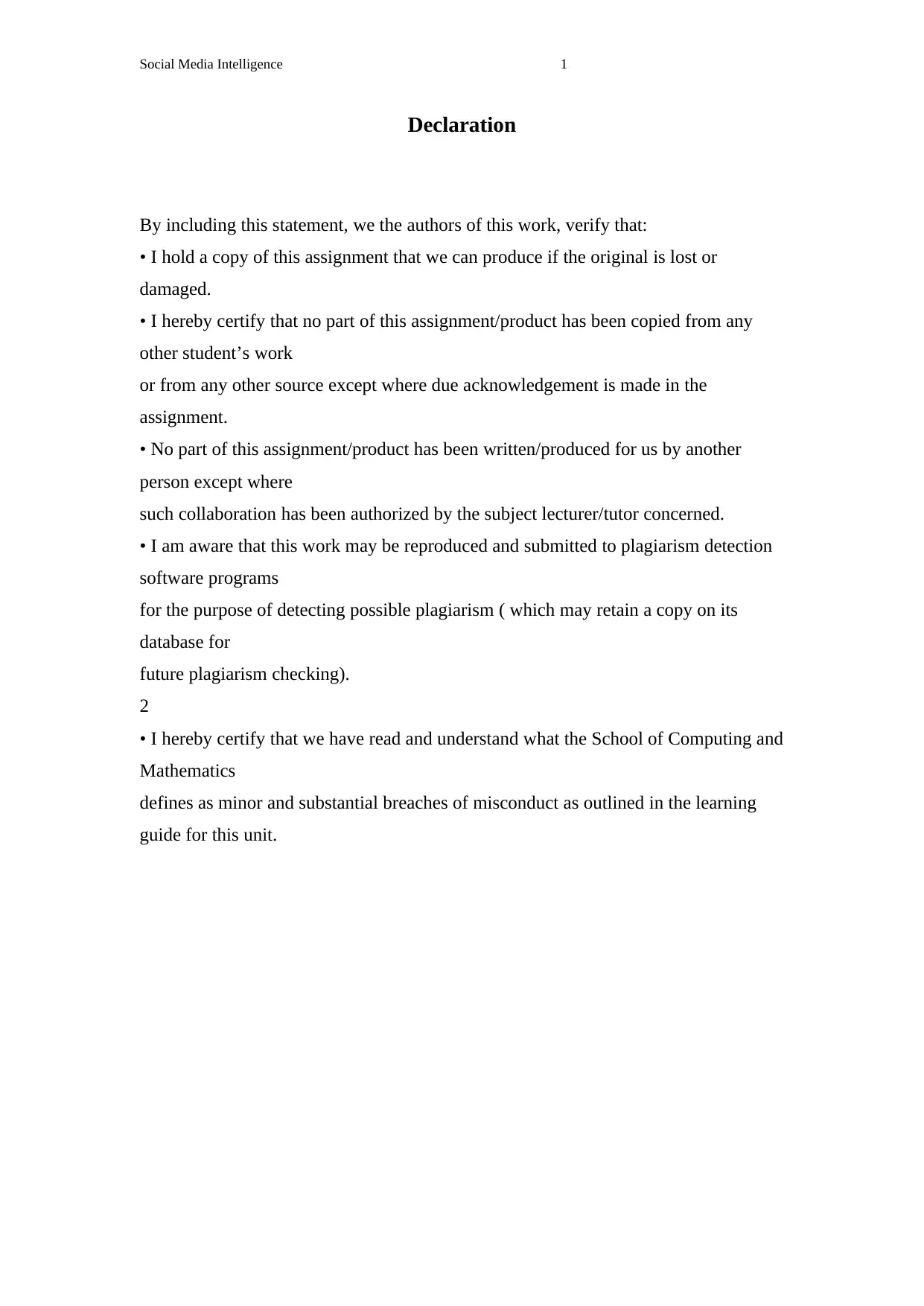
Declaration
By including this statement, we the authors of this work, verify that:
• I hold a copy of this assignment that we can produce if the original is lost or
damaged.
• I hereby certify that no part of this assignment/product has been copied from any
other student’s work
or from any other source except where due acknowledgement is made in the
assignment.
• No part of this assignment/product has been written/produced for us by another
person except where
such collaboration has been authorized by the subject lecturer/tutor concerned.
• I am aware that this work may be reproduced and submitted to plagiarism detection
software programs
for the purpose of detecting possible plagiarism ( which may retain a copy on its
database for
future plagiarism checking).
2
• I hereby certify that we have read and understand what the School of Computing and
Mathematics
defines as minor and substantial breaches of misconduct as outlined in the learning
guide for this unit.
tabler-icon-diamond-filled.svg

Paraphrase This Document

Need a fresh take? Get an instant paraphrase of this document with our AI Paraphraser
Document Page
2Social Media Intelligence
1. Abstract
1.1 Purpose of study
The main objectives of our project include:
i. Exploring the relationship between politicians and their supporters
ii. Examine the relationship among-est different politician supporters
iii. Establish whether politics deeply affects the relationship among citizens and
supporters
iv. Determine the percentage of supporters who keep relationships with each other
despite their political affiliation
1.2 Research Questions
i. Are political parties disjoint?
ii. Are most of the members are friends, with only a few members making the
parties seem like enemies?
1.3 Research design
The design of our research is structured into:
i. Abstract
ii. Introduction
iii. Methodology
iv. Results and Discussion
v. Conclusion
vi. Bibliography
Document Page
3Social Media Intelligence
1.4Major findings and deductions
Following our research, we find out that:
i. Political parties are disjoint
ii. Political party members are not disjoint
iii. Social media intelligence tool is an important digital evolution that has the
potential to further the existing knowledge and insights on different social-
settings, if utilized responsibly
Document Page
4Social Media Intelligence
Table Of Contents
Background Information................................................................................................6
2. Introduction................................................................................................................8
i. Media trends................................................................................................................8
ii. Political trends............................................................................................................8
iii. Business trends..........................................................................................................8
iv. Music trends, etcetera................................................................................................8
3. Methodology............................................................................................................10
3.1 Data........................................................................................................................10
3.2 Research instruments..............................................................................................10
i. Twitter apps...............................................................................................................10
ii. R statistical software................................................................................................10
iii. R dependent packages.............................................................................................10
3.3 Hypotheses.............................................................................................................10
3.4 Assumptions...........................................................................................................11
4. Results and Discussion.............................................................................................12
6. Conclusion................................................................................................................26
7. Bibliography.............................................................................................................27
tabler-icon-diamond-filled.svg

Paraphrase This Document

Need a fresh take? Get an instant paraphrase of this document with our AI Paraphraser
Document Page
5Social Media Intelligence
Background Information
Since the dawn of civilization, politics have been pivotal in both propelling the human
specie to better lives, i.e through being a medium of choosing better leaders with the
potential to oversee achievement of the society’s potential and also, ironically, to a
large extent it has been the source of doom to many a society. This is evident through
the role politics have played and in some cases continues to play in instigating anti-
human activities such as war and neglecting political duties such as pushing for
humanitarian causes such as “climate change control”
Even more amazing is the influence of politics over society’s life. This can generally
be considered to just be on the face value or in some instances it can run deep to
various society nerves.
To explore the effects of politics in the American society, a study by (Wisckol, 2017)
argues that, over the years political disjoint has been on the rise. Statistics indicate
that back in the 60’s only approximately 5 % of either democrats or republicans
would not allow marriage of their kin to someone of a different political view,
however by 2010 the figures had rose to over 30% of the democrats and 50% of
republicans feeling this way.
An article by parliamentary education office of Australia (2018) defines a political
party as “an organization that represents a particular group of people or set of
ideas…” all this in the am of having more members of parliament from their party so
as to effect the governance of Australia.
Document Page
6Social Media Intelligence
Despite the role of politics in the Australian Democracy, in the recent years, the view
of its purpose in the Australian way of life has shifted (Faruqi ,2016).
Document Page
7Social Media Intelligence
2. Introduction
Social systems are defined by relationships among people. With the increasingly
socialized world of today, the media plays a critical role for evaluation of different
social trends. Some of the areas in which social media can be used for monitoring
include:
i. Media trends
ii. Political trends
iii. Business trends
iv. Music trends, etcetera
Over the years, digital and technological innovations have been on what can be
considered “inflation”, with almost each day recording an innovation. This has
simultaneously enabled new methods of collecting useful data, exploring the data and
coming up with important insights that have greatly contributed to the amount of
knowledge on different social issues.
Li et al. (2010) defines social media as “a conversational, distributed mode of content
generation, dissemination, and communication among communities…” According to
their study, social media has defined a whole new meaning of social confines and
interactions. This broadly interprets to freedom from traditional geographical
limitations that hindered interactions and therefore monitoring of social media
interactions among different groups can provide insightful information of:
i. Peoples’ consumer preferences
ii. Peoples political interests and affiliations
iii. The society’s view on current and emerging trends on political
tabler-icon-diamond-filled.svg

Paraphrase This Document

Need a fresh take? Get an instant paraphrase of this document with our AI Paraphraser
Document Page
8Social Media Intelligence
In this study, we will explore different political affiliations for different groups of
people given three political leaders of different political parties. We will explore data
from imported from twitter to establish whether different people keep relations with
people from different political parties or whether they are enemies owing to their
difference in political allegiance. Through this, we will establish the truth of the
common fallacy that: “people with different political affiliations are actually
enemies even in real life”
In the following exploration, we will inspect the relationship between the major
Australian political parties and their adherents. Also, we will explore the influence of
politics in a social system such as that of Australia using data obtained from Twitter, a
social media platform.
Document Page
9Social Media Intelligence
3. Methodology
3.1 Data
Data for this project is extracted from 10 twitter friends from each of:
Malcolm Turnbull of the Liberal Party of Australia
Bill Shorten of the Australian Labor Party
Michael McCormack of the National Party of Australia
In order to explore relationship between different friends of different political leaders,
we will further mine data on 1000 friends of the first ten friends of a each politician.
3.2 Research instruments
i. Twitter apps
ii. R statistical software
iii. R dependent packages
3.3Hypotheses
In this project we will test the following hypotheses:
Null hypothesis
H0: Political parties are disjoint
Alternative hypotheses
H1: Political parties are non-disjoint
Document Page
10Social Media Intelligence
H2: People are still friends despite different political affiliations
3.4Assumptions
In the cause of our research project, we assume that:
i. Every friend of a politician is interested in politics and has a political opinion
ii. Any friend of a politician shares the politician’s political ideology
iii. Every friend is unique, I.e holds a definite political view.
tabler-icon-diamond-filled.svg

Paraphrase This Document

Need a fresh take? Get an instant paraphrase of this document with our AI Paraphraser
Document Page
11Social Media Intelligence
4. Results and Discussion
4.1Data collection and preparation
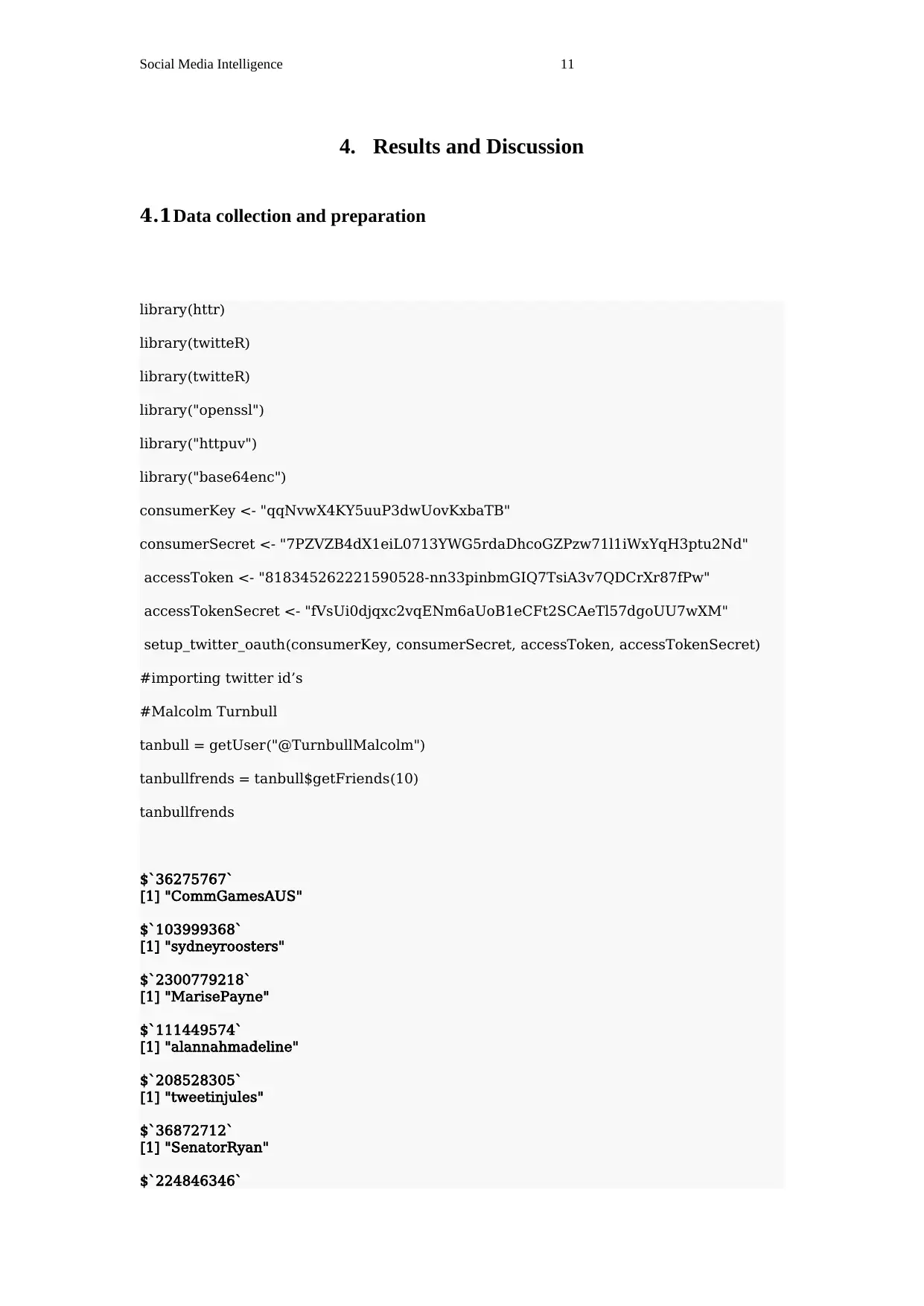
library(httr)
library(twitteR)
library(twitteR)
library("openssl")
library("httpuv")
library("base64enc")
consumerKey <- "qqNvwX4KY5uuP3dwUovKxbaTB"
consumerSecret <- "7PZVZB4dX1eiL0713YWG5rdaDhcoGZPzw71l1iWxYqH3ptu2Nd"
accessToken <- "818345262221590528-nn33pinbmGIQ7TsiA3v7QDCrXr87fPw"
accessTokenSecret <- "fVsUi0djqxc2vqENm6aUoB1eCFt2SCAeTl57dgoUU7wXM"
setup_twitter_oauth(consumerKey, consumerSecret, accessToken, accessTokenSecret)
#importing twitter id’s
#Malcolm Turnbull
tanbull = getUser("@TurnbullMalcolm")
tanbullfrends = tanbull$getFriends(10)
tanbullfrends
$`36275767`
[1] "CommGamesAUS"
$`103999368`
[1] "sydneyroosters"
$`2300779218`
[1] "MarisePayne"
$`111449574`
[1] "alannahmadeline"
$`208528305`
[1] "tweetinjules"
$`36872712`
[1] "SenatorRyan"
$`224846346`
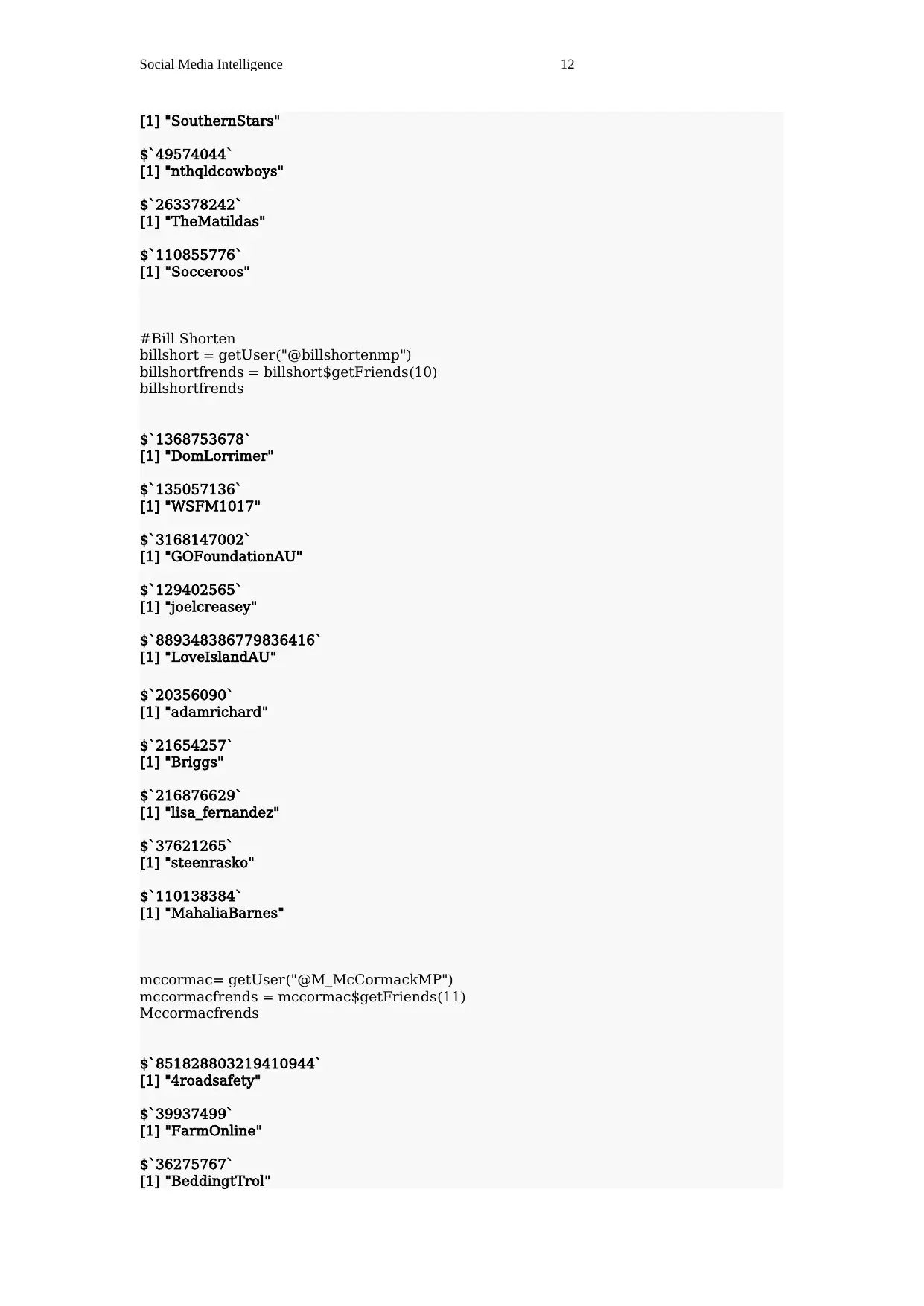
Document Page
12Social Media Intelligence
[1] "SouthernStars"
$`49574044`
[1] "nthqldcowboys"
$`263378242`
[1] "TheMatildas"
$`110855776`
[1] "Socceroos"
#Bill Shorten
billshort = getUser("@billshortenmp")
billshortfrends = billshort$getFriends(10)
billshortfrends
$`1368753678`
[1] "DomLorrimer"
$`135057136`
[1] "WSFM1017"
$`3168147002`
[1] "GOFoundationAU"
$`129402565`
[1] "joelcreasey"
$`889348386779836416`
[1] "LoveIslandAU"
$`20356090`
[1] "adamrichard"
$`21654257`
[1] "Briggs"
$`216876629`
[1] "lisa_fernandez"
$`37621265`
[1] "steenrasko"
$`110138384`
[1] "MahaliaBarnes"
mccormac= getUser("@M_McCormackMP")
mccormacfrends = mccormac$getFriends(11)
Mccormacfrends
$`851828803219410944`
[1] "4roadsafety"
$`39937499`
[1] "FarmOnline"
$`36275767`
[1] "BeddingtTrol"
chevron_up_icon
1 out of 28
circle_padding
hide_on_mobile
zoom_out_icon
[object Object]