Rapid Evidence Review Report: Social Media and Libraries
VerifiedAdded on 2023/03/31
|14
|2627
|382
Report
AI Summary
This report presents a rapid evidence review on the effective use of social media by libraries to engage with their users. The study follows a structured methodology, beginning with a research question and progressing through document searches on Google Scholar and JSTOR, applying exclusion criteria to refine the search, classifying the remaining studies, assessing their quality, and synthesizing the evidence. The findings highlight the importance of social media for marketing library resources, the need for goal setting before implementation, and the significance of tools like instant messaging. The literature review explores the use of social networking sites for information distribution, content creation, and community building, emphasizing the role of platforms like Pinterest and Facebook. The report also addresses social inclusion, mobile-based technologies, open architecture, and the setting of social media goals. The conclusion stresses the importance of adapting to changing technologies and finding mechanisms to encourage user participation to enhance service delivery.
Information Provisioning 1
A RAPID EVIDENCE REVIEW REPORT ON HOW LIBRARIES CAN USE SOCIAL
MEDIA EFFECTIVELY TO ENGAGE WITH THEIR USERS
By
(Name)
(Course)
(Professor’s Name)
(Institution)
(State)
(Date)
A RAPID EVIDENCE REVIEW REPORT ON HOW LIBRARIES CAN USE SOCIAL
MEDIA EFFECTIVELY TO ENGAGE WITH THEIR USERS
By
(Name)
(Course)
(Professor’s Name)
(Institution)
(State)
(Date)

Paraphrase This Document
Need a fresh take? Get an instant paraphrase of this document with our AI Paraphraser
Information Provisioning 2
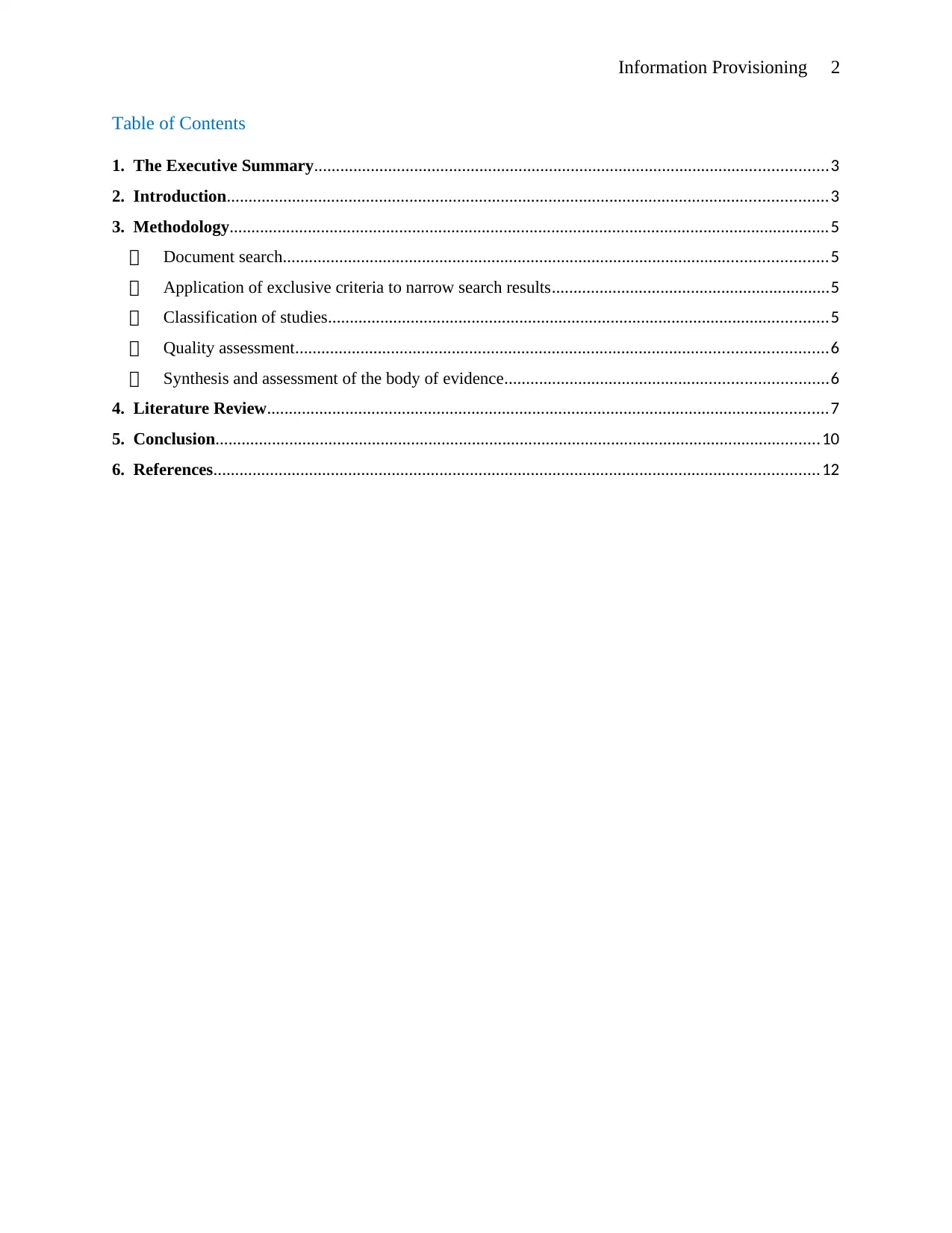
Table of Contents
1. The Executive Summary......................................................................................................................3
2. Introduction..........................................................................................................................................3
3. Methodology..........................................................................................................................................5
Document search.............................................................................................................................5
Application of exclusive criteria to narrow search results................................................................5
Classification of studies...................................................................................................................5
Quality assessment..........................................................................................................................6
Synthesis and assessment of the body of evidence..........................................................................6
4. Literature Review.................................................................................................................................7
5. Conclusion...........................................................................................................................................10
6. References...........................................................................................................................................12
Table of Contents
1. The Executive Summary......................................................................................................................3
2. Introduction..........................................................................................................................................3
3. Methodology..........................................................................................................................................5
Document search.............................................................................................................................5
Application of exclusive criteria to narrow search results................................................................5
Classification of studies...................................................................................................................5
Quality assessment..........................................................................................................................6
Synthesis and assessment of the body of evidence..........................................................................6
4. Literature Review.................................................................................................................................7
5. Conclusion...........................................................................................................................................10
6. References...........................................................................................................................................12
Information Provisioning 3
1. The Executive Summary
The manager issued a directive to write a rapid evidence review report on how libraries can use
social media to engage with their users in an effective way. A rapid evidence review involved
five major steps. Regarding document search, I searched for all the resources from Google
scholar and jstor websites. Then, I excluded some of the resources basing on some specific
criteria such as year of publication, context and not available in full-text. I remained with 16
sources. In classification of studies step, I classified 16 remaining resources into the following
three groups; primary sources, secondary sources and qualitative studies. In step 4, I evaluated
quality of each material. Finally, I assessed the materials that helped me to provide the solution
to the research question. The following are some of the major report findings; social media can
be used to market library resources, goals are important before implementation of social media
technologies and instant messaging is one of the important tools of web 2.0 technologies.
2. Introduction
The report has focused on information provisioning. Information can be defined as processed
data. Currently, it plays some important roles in different companies and organizations
worldwide. It helps an organization to identify the needs of its clients. This enables it to satisfy
its customers’ needs by improving quality of products. Other than identifying customers’ needs,
information is also used to enhance smooth running of day-to-day business operations (Al-
Mamary, Shamsuddin and Hamid 2014, p.3). Finally, information also helps management to
understand the roles of new technologies before implementation. Following these developments,
the manager requested me to write a rapid evidence review report on how libraries can use social
media to engage with their users in an effective way. A rapid evidence review method involves
the following steps:
1. The Executive Summary
The manager issued a directive to write a rapid evidence review report on how libraries can use
social media to engage with their users in an effective way. A rapid evidence review involved
five major steps. Regarding document search, I searched for all the resources from Google
scholar and jstor websites. Then, I excluded some of the resources basing on some specific
criteria such as year of publication, context and not available in full-text. I remained with 16
sources. In classification of studies step, I classified 16 remaining resources into the following
three groups; primary sources, secondary sources and qualitative studies. In step 4, I evaluated
quality of each material. Finally, I assessed the materials that helped me to provide the solution
to the research question. The following are some of the major report findings; social media can
be used to market library resources, goals are important before implementation of social media
technologies and instant messaging is one of the important tools of web 2.0 technologies.
2. Introduction
The report has focused on information provisioning. Information can be defined as processed
data. Currently, it plays some important roles in different companies and organizations
worldwide. It helps an organization to identify the needs of its clients. This enables it to satisfy
its customers’ needs by improving quality of products. Other than identifying customers’ needs,
information is also used to enhance smooth running of day-to-day business operations (Al-
Mamary, Shamsuddin and Hamid 2014, p.3). Finally, information also helps management to
understand the roles of new technologies before implementation. Following these developments,
the manager requested me to write a rapid evidence review report on how libraries can use social
media to engage with their users in an effective way. A rapid evidence review method involves
the following steps:
⊘ This is a preview!⊘
Do you want full access?
Subscribe today to unlock all pages.

Trusted by 1+ million students worldwide
Information Provisioning 4
Research problem: In this step, the research question is formulated.
Document search: This step involves searching for materials such as books and journals that
can provide a solution to the research question (Astell-Burt & Feng 2015).
Application of exclusion criteria to narrow the search results: In this step, some of the
resources are removed basing on some specific criteria such as year of publication and language.
Classification of studies: The remaining materials are divided into different groups not limited
to anecdotal reports and qualitative studies (Astell-Burt & Feng 2015).
Quality assessment: In this step, each resource is evaluated basing on its quality to enhance
reliability.
Synthesis and assessment of the body of evidence: This step is concerned with justification of
the resources (Astell-Burt & Feng 2015).
Definition of terms used in the report:
Social networking sites: These are platforms that enable people to interact with each other.
Resources: These are materials such as books, journals and articles.
Information: It is data that has been processed and can be used to make important decisions.
Quality assessment: This is the process of evaluating resources basing on their quality.
Architecture: This is the structure of something such as library.
Research problem: In this step, the research question is formulated.
Document search: This step involves searching for materials such as books and journals that
can provide a solution to the research question (Astell-Burt & Feng 2015).
Application of exclusion criteria to narrow the search results: In this step, some of the
resources are removed basing on some specific criteria such as year of publication and language.
Classification of studies: The remaining materials are divided into different groups not limited
to anecdotal reports and qualitative studies (Astell-Burt & Feng 2015).
Quality assessment: In this step, each resource is evaluated basing on its quality to enhance
reliability.
Synthesis and assessment of the body of evidence: This step is concerned with justification of
the resources (Astell-Burt & Feng 2015).
Definition of terms used in the report:
Social networking sites: These are platforms that enable people to interact with each other.
Resources: These are materials such as books, journals and articles.
Information: It is data that has been processed and can be used to make important decisions.
Quality assessment: This is the process of evaluating resources basing on their quality.
Architecture: This is the structure of something such as library.
Paraphrase This Document
Need a fresh take? Get an instant paraphrase of this document with our AI Paraphraser
Information Provisioning 5
3. Methodology
Document search
I searched for all the resources that are related to the application of social media in libraries from
online sources such as Google scholar (https://scholar.google.com) and jstor
(https://www.jstor.org). In Google scholar, I used the following keywords ‘application of social
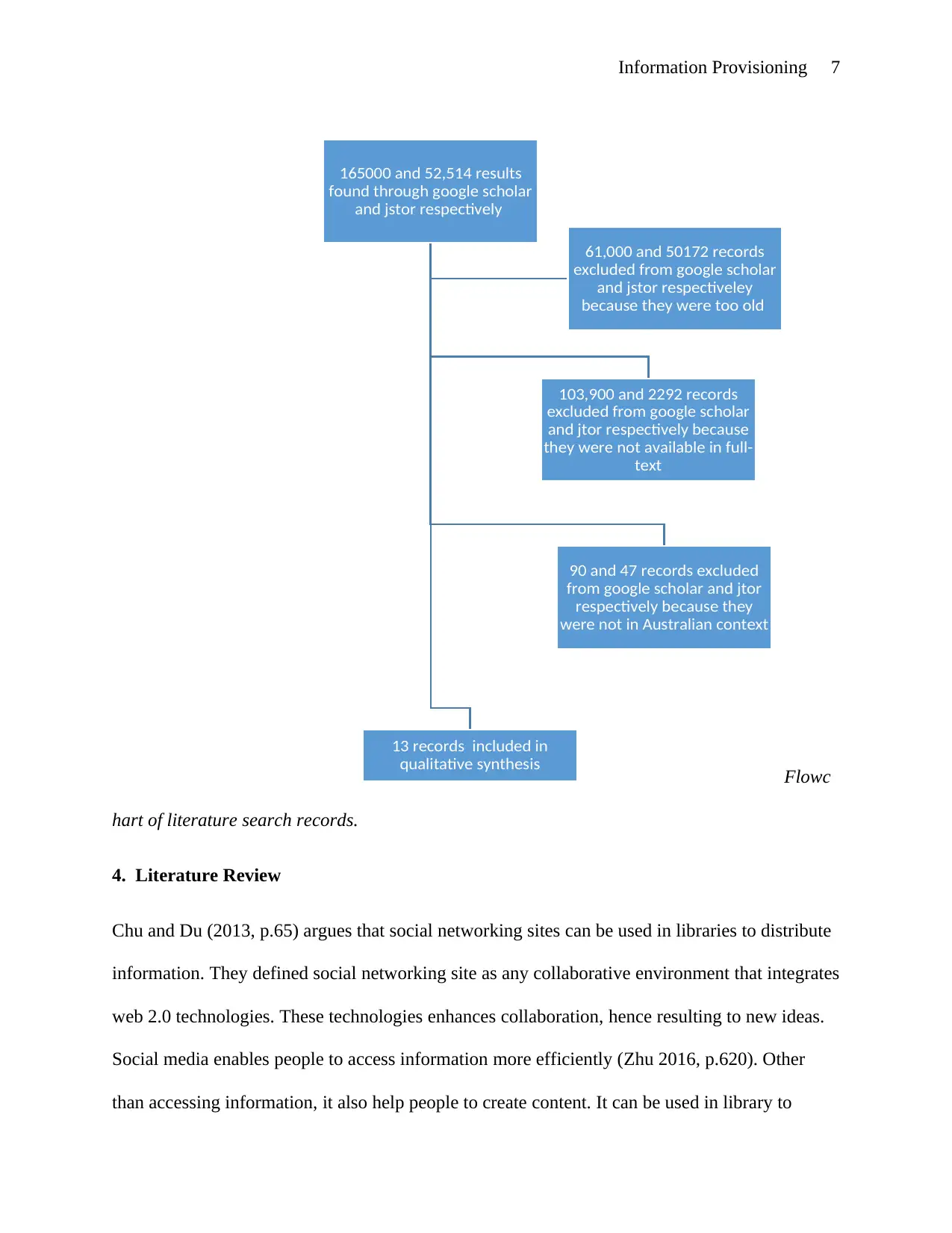
media in libraries’. I found 165,000 results between 2000 and 2019. On the other hand, I used the
following keywords in jstor ‘social media in libraries’. I found 52,514 results. Therefore, I came
up with a list of 217,514 resources.
Application of exclusive criteria to narrow search results
In this step, I excluded some of the resources basing on the following criteria; year of
publication, context and not available in full-text. Regarding the year of publication, I only
considered resources that were published from 2010 to 2019. Therefore, I excluded 61,000
resources from Google scholar. Also, I excluded 50, 172 resources from jtor website.
Furthermore, I excluded 103,900 resources from Google scholar that were not available in full-
text. On the other side, I excluded 2,292 resources from jtor website. Regarding Australian
context, I excluded 90 and 47 resources from Google scholar and jtor respectively. Therefore, I
remained with 13 references in this step.
Classification of studies
I classified 13 remaining resources that I obtained in step II into different groups. I read and
identified the characteristics of each resource. I placed resources with similar characteristics in
the same group. I classified group1 and 2 as primary and secondary sources respectively. They
3. Methodology
Document search
I searched for all the resources that are related to the application of social media in libraries from
online sources such as Google scholar (https://scholar.google.com) and jstor
(https://www.jstor.org). In Google scholar, I used the following keywords ‘application of social
media in libraries’. I found 165,000 results between 2000 and 2019. On the other hand, I used the
following keywords in jstor ‘social media in libraries’. I found 52,514 results. Therefore, I came
up with a list of 217,514 resources.
Application of exclusive criteria to narrow search results
In this step, I excluded some of the resources basing on the following criteria; year of
publication, context and not available in full-text. Regarding the year of publication, I only
considered resources that were published from 2010 to 2019. Therefore, I excluded 61,000
resources from Google scholar. Also, I excluded 50, 172 resources from jtor website.
Furthermore, I excluded 103,900 resources from Google scholar that were not available in full-
text. On the other side, I excluded 2,292 resources from jtor website. Regarding Australian
context, I excluded 90 and 47 resources from Google scholar and jtor respectively. Therefore, I
remained with 13 references in this step.
Classification of studies
I classified 13 remaining resources that I obtained in step II into different groups. I read and
identified the characteristics of each resource. I placed resources with similar characteristics in
the same group. I classified group1 and 2 as primary and secondary sources respectively. They
Information Provisioning 6
consisted of 2 and 9 resources respectively. Other than group1 and 2, I classified group3 as
qualitative studies. It consisted of 2 resources.
Quality assessment
I evaluated all resources basing on their quality to enhance reliability. I ensured that these
resources came from trusted sources rather than people’s opinions. Other than reliability, I also
evaluated authors to ensure that they are authoritative. To achieve this, I ensured that their
resources are recognized in most parts of the world. Other than recognition, I also considered
peer-reviewed sources (White & Fortune 2015).
Synthesis and assessment of the body of evidence
The remaining resources helped me to provide solution to the research problem. I read executive
summary of each resource and ensured that their content is related to how libraries can use social
media to engage with their users. The remaining resources that I used to write the report were
appropriate because they had latest information about how social media can be used in libraries.
This is because I considered resources from 2010 to 2019 only. Apart from updated materials,
the authors of these resources are authoritative. This enhanced reliability of the content that I
used to write the report, hence these resources were appropriate.
consisted of 2 and 9 resources respectively. Other than group1 and 2, I classified group3 as
qualitative studies. It consisted of 2 resources.
Quality assessment
I evaluated all resources basing on their quality to enhance reliability. I ensured that these
resources came from trusted sources rather than people’s opinions. Other than reliability, I also
evaluated authors to ensure that they are authoritative. To achieve this, I ensured that their
resources are recognized in most parts of the world. Other than recognition, I also considered
peer-reviewed sources (White & Fortune 2015).
Synthesis and assessment of the body of evidence
The remaining resources helped me to provide solution to the research problem. I read executive
summary of each resource and ensured that their content is related to how libraries can use social
media to engage with their users. The remaining resources that I used to write the report were
appropriate because they had latest information about how social media can be used in libraries.
This is because I considered resources from 2010 to 2019 only. Apart from updated materials,
the authors of these resources are authoritative. This enhanced reliability of the content that I
used to write the report, hence these resources were appropriate.
⊘ This is a preview!⊘
Do you want full access?
Subscribe today to unlock all pages.
Trusted by 1+ million students worldwide
Information Provisioning 7
Flowc
hart of literature search records.
4. Literature Review
Chu and Du (2013, p.65) argues that social networking sites can be used in libraries to distribute
information. They defined social networking site as any collaborative environment that integrates
web 2.0 technologies. These technologies enhances collaboration, hence resulting to new ideas.
Social media enables people to access information more efficiently (Zhu 2016, p.620). Other
than accessing information, it also help people to create content. It can be used in library to
165000 and 52,514 results
found through google scholar
and jstor respectively
103,900 and 2292 records
excluded from google scholar
and jtor respectively because
they were not available in full-
text
13 records included in
qualitative synthesis
90 and 47 records excluded
from google scholar and jtor
respectively because they
were not in Australian context
61,000 and 50172 records
excluded from google scholar
and jstor respectiveley
because they were too old
Flowc
hart of literature search records.
4. Literature Review
Chu and Du (2013, p.65) argues that social networking sites can be used in libraries to distribute
information. They defined social networking site as any collaborative environment that integrates
web 2.0 technologies. These technologies enhances collaboration, hence resulting to new ideas.
Social media enables people to access information more efficiently (Zhu 2016, p.620). Other
than accessing information, it also help people to create content. It can be used in library to
165000 and 52,514 results
found through google scholar
and jstor respectively
103,900 and 2292 records
excluded from google scholar
and jtor respectively because
they were not available in full-
text
13 records included in
qualitative synthesis
90 and 47 records excluded
from google scholar and jtor
respectively because they
were not in Australian context
61,000 and 50172 records
excluded from google scholar
and jstor respectiveley
because they were too old
Paraphrase This Document
Need a fresh take? Get an instant paraphrase of this document with our AI Paraphraser
Information Provisioning 8
enhance new releases. Moreover, it can help academic libraries to maintain communication with
their student users. Hansen, Nowlan and Winter (2012, p.2) also argues that social media can
play important roles in libraries. They argued that it can help users to access library services with
a lot of ease. Pinterest is an important social media tool. It can be used in libraries to enhance
interaction between library clients and users. Pinterest is becoming popular daily. It has been
adopted by many companies and organizations worldwide. It enables users to post a pin and add
some related information. A pin is used to represent videos.
Besides, Young and Rossmann (2015, p.21) argues that social media is a very important tool in
community-building. Social media can be used to market library resources. Therefore, library
users can access latest services and resources that are available in a particular library. Some
success has been reported in this area. Social medial also enables library users to feel that they
are connected, hence enabling them to share ideas and knowledge. Furthermore, Facebook plays
an important role in community-building by enhancing a shared trust. For instance, Facebook
users feel to be part of an online community when their friends and family members like and
comment on their posts. Abdullah et al. (2015, p.34) says that social media can be used in
libraries to enhance social inclusion. The research that involved libraries from different countries
such as Australia, New Zealand, China and United Kingdom showed that proper implementation
of social media enhances effective communication between librarians and library users. To
achieve social inclusion, libraries should integrate recent technologies in social media since it
keeps on changing from time to time. Social media can be used to connect people remotely,
hence enabling them to access library services.
In addition, Barile (2011, p.222) suggests that social media mobile-based technologies can help
libraries to effectively engage with library users. This is because the number of mobile users has
enhance new releases. Moreover, it can help academic libraries to maintain communication with
their student users. Hansen, Nowlan and Winter (2012, p.2) also argues that social media can
play important roles in libraries. They argued that it can help users to access library services with
a lot of ease. Pinterest is an important social media tool. It can be used in libraries to enhance
interaction between library clients and users. Pinterest is becoming popular daily. It has been
adopted by many companies and organizations worldwide. It enables users to post a pin and add
some related information. A pin is used to represent videos.
Besides, Young and Rossmann (2015, p.21) argues that social media is a very important tool in
community-building. Social media can be used to market library resources. Therefore, library
users can access latest services and resources that are available in a particular library. Some
success has been reported in this area. Social medial also enables library users to feel that they
are connected, hence enabling them to share ideas and knowledge. Furthermore, Facebook plays
an important role in community-building by enhancing a shared trust. For instance, Facebook
users feel to be part of an online community when their friends and family members like and
comment on their posts. Abdullah et al. (2015, p.34) says that social media can be used in
libraries to enhance social inclusion. The research that involved libraries from different countries
such as Australia, New Zealand, China and United Kingdom showed that proper implementation
of social media enhances effective communication between librarians and library users. To
achieve social inclusion, libraries should integrate recent technologies in social media since it
keeps on changing from time to time. Social media can be used to connect people remotely,
hence enabling them to access library services.
In addition, Barile (2011, p.222) suggests that social media mobile-based technologies can help
libraries to effectively engage with library users. This is because the number of mobile users has
Information Provisioning 9
increased greatly. There are many advantages of mobile phones over desktops such as portability
and less costly. Mobile phones are very cheap and also uses less data bundles, hence affordable
by many people. The number of mobile users is expected to increase greatly in future as mobile
technologies are growing rapidly. There are social media applications such as Facebook and
Telegram apps. Therefore, libraries should integrate mobile-based social media sites. Bilandzic
and Foth (2014, p.80) argues that physical libraries enables very little people to access library
services. Social media integration can enhance social learning and improve collaboration among
library users. However, effective implementation of social media requires everyone to participate
equally without restriction. The following things should be considered while developing a library
space; social hangouts, and collaborations. One of the contemporary library trends that should be
considered include open architecture which facilitates integration of social media technologies
(Bilandzic and Foth 2014, p.80).
Furthermore, Mahmood and Richardson (2011, p.370) argues that an organization or a company
should set social media goals before implementation. One of the goals of networking sites
include improving users experience through activities such as photo sharing and instant
messaging. The social media should be user-centered (Mahmood and Richardson 2011, p.370).
Therefore, library users should take part in activities such as creation of virtual services. One of
the most important web 2.0 tools that has been incorporated by many libraries in Australia
include instant messaging and blogs (Dickson and Holley 2010, p.471). Furthermore,
applications that are related to social tagging are equally important. Social media can be used to
identify the needs of library users. The librarians can start an open discussion that users
contribute and share their ideas freely. They can realize interests of library users and ensure that
their needs are met. They can use these information to enhance service delivery. Therefore,
increased greatly. There are many advantages of mobile phones over desktops such as portability
and less costly. Mobile phones are very cheap and also uses less data bundles, hence affordable
by many people. The number of mobile users is expected to increase greatly in future as mobile
technologies are growing rapidly. There are social media applications such as Facebook and
Telegram apps. Therefore, libraries should integrate mobile-based social media sites. Bilandzic
and Foth (2014, p.80) argues that physical libraries enables very little people to access library
services. Social media integration can enhance social learning and improve collaboration among
library users. However, effective implementation of social media requires everyone to participate
equally without restriction. The following things should be considered while developing a library
space; social hangouts, and collaborations. One of the contemporary library trends that should be
considered include open architecture which facilitates integration of social media technologies
(Bilandzic and Foth 2014, p.80).
Furthermore, Mahmood and Richardson (2011, p.370) argues that an organization or a company
should set social media goals before implementation. One of the goals of networking sites
include improving users experience through activities such as photo sharing and instant
messaging. The social media should be user-centered (Mahmood and Richardson 2011, p.370).
Therefore, library users should take part in activities such as creation of virtual services. One of
the most important web 2.0 tools that has been incorporated by many libraries in Australia
include instant messaging and blogs (Dickson and Holley 2010, p.471). Furthermore,
applications that are related to social tagging are equally important. Social media can be used to
identify the needs of library users. The librarians can start an open discussion that users
contribute and share their ideas freely. They can realize interests of library users and ensure that
their needs are met. They can use these information to enhance service delivery. Therefore,
⊘ This is a preview!⊘
Do you want full access?
Subscribe today to unlock all pages.
Trusted by 1+ million students worldwide
Information Provisioning 10
library users will participate actively as a result. Social media sites can also integrate
advertisement in accordance with the interest of its users (Hicks 2012, p.190).
Moreover, libraries can also capture interest of their users (Lloret 2011, p.5). Currently, people
lose interest of chatting especially on Facebook and Telegram. Therefore, librarians should find
some of the ways and mechanisms that they can use to enable library users to participate actively
in discussions. Social media support team should incorporate videos and images alongside
quotes so that that they can interact library users. The librarians can also use social media to
share artefacts that are found in the library. Therefore, library users will be attracted to interact
with the support, hence accessing library services from time to time. Mainka et al. (2013, p.299)
argues that social media sites such as MySpace can be used in libraries to maintain social
visibility of librarians. In addition, sites such Facebook enables people to maintain friendship,
therefore it will reduce the gap between librarians and library clients. Therefore, library users
will not fear librarians as they will be able to communicate freely (Aharony 2012, p.360).
However, I identified some gaps in these resources. There are less researches that have discussed
about the attitude of library users while communicating with users using Facebook and other
social media sites. Also, there is limited research on some of the problems that are encountered
by librarians while using social media sites.
5. Conclusion
In conclusion, a rapid evidence review method involves the following steps; research question,
document search, application of exclusive criteria to narrow the search results, studies
classification, quality assessment and assessment of the body of evidence. I followed all these
steps strictly and came up with quality resources that I used to write the report. These resources
enabled me to provide several solutions to the research problem. First and foremost, social
library users will participate actively as a result. Social media sites can also integrate
advertisement in accordance with the interest of its users (Hicks 2012, p.190).
Moreover, libraries can also capture interest of their users (Lloret 2011, p.5). Currently, people
lose interest of chatting especially on Facebook and Telegram. Therefore, librarians should find
some of the ways and mechanisms that they can use to enable library users to participate actively
in discussions. Social media support team should incorporate videos and images alongside
quotes so that that they can interact library users. The librarians can also use social media to
share artefacts that are found in the library. Therefore, library users will be attracted to interact
with the support, hence accessing library services from time to time. Mainka et al. (2013, p.299)
argues that social media sites such as MySpace can be used in libraries to maintain social
visibility of librarians. In addition, sites such Facebook enables people to maintain friendship,
therefore it will reduce the gap between librarians and library clients. Therefore, library users
will not fear librarians as they will be able to communicate freely (Aharony 2012, p.360).
However, I identified some gaps in these resources. There are less researches that have discussed
about the attitude of library users while communicating with users using Facebook and other
social media sites. Also, there is limited research on some of the problems that are encountered
by librarians while using social media sites.
5. Conclusion
In conclusion, a rapid evidence review method involves the following steps; research question,
document search, application of exclusive criteria to narrow the search results, studies
classification, quality assessment and assessment of the body of evidence. I followed all these
steps strictly and came up with quality resources that I used to write the report. These resources
enabled me to provide several solutions to the research problem. First and foremost, social
Paraphrase This Document
Need a fresh take? Get an instant paraphrase of this document with our AI Paraphraser
Information Provisioning 11
networking sites can be used in libraries to distribute information, hence enhancing
collaboration. Also, libraries should consider Pinterest. It is an important social media tool that
enhances interaction between library clients and users. In addition, social media should be user-
centered. Therefore, library users should take part in activities such as creation of virtual
services. Moreover, social media mobile-based technologies can help libraries to effectively
engage with library users. This is because the number of mobile users has increased greatly.
networking sites can be used in libraries to distribute information, hence enhancing
collaboration. Also, libraries should consider Pinterest. It is an important social media tool that
enhances interaction between library clients and users. In addition, social media should be user-
centered. Therefore, library users should take part in activities such as creation of virtual
services. Moreover, social media mobile-based technologies can help libraries to effectively
engage with library users. This is because the number of mobile users has increased greatly.
Information Provisioning 12
6. References
Abdullah, N., Chu, S., Rajagopal, S., Tung, A. and Kwong-Man, Y 2015, Exploring libraries’
efforts in inclusion and outreach activities using social media. Libri, 65(1), pp.34-47.
Aharony, N 2012, Facebook use in libraries: an exploratory analysis. In Aslib proceedings (Vol.
64, No. 4, pp. 358-372). Emerald Group Publishing Limited.
Al-Mamary, Y.H., Shamsuddin, A. and Hamid, N.A 2014, The role of different types of
information systems in business organizations: a review. International Journal of Research
(IJR), 1(7).
Astell-Burt T & Feng X 2015, The effect of urban form on wellbeing: an Evidence Check rapid
review brokered by the Sax Institute for the NSW Centre for Population Health, viewed 28 May
2019, http://www.saxinstitute.org.au/wp-content/uploads/The-effect-of-urban-form-on-
wellbeing.pdf
Barile, L 2011, Mobile technologies for libraries: A list of mobile applications and resources for
development. College & Research Libraries News, 72(4), pp.222-228.
Bilandzic, M. and Foth, M 2014, Learning beyond books—strategies for ambient media to
improve libraries and collaboration spaces as interfaces for social learning. Multimedia tools
and applications, 71(1), pp.77-95.
Chu, S.K.W. and Du, H.S 2013, Social networking tools for academic libraries. Journal of
librarianship and information science, 45(1), pp.64-75.
Dickson, A. and Holley, R.P 2010, Social networking in academic libraries: the possibilities and
the concerns. New library world, 111(11/12), pp.468-479.
6. References
Abdullah, N., Chu, S., Rajagopal, S., Tung, A. and Kwong-Man, Y 2015, Exploring libraries’
efforts in inclusion and outreach activities using social media. Libri, 65(1), pp.34-47.
Aharony, N 2012, Facebook use in libraries: an exploratory analysis. In Aslib proceedings (Vol.
64, No. 4, pp. 358-372). Emerald Group Publishing Limited.
Al-Mamary, Y.H., Shamsuddin, A. and Hamid, N.A 2014, The role of different types of
information systems in business organizations: a review. International Journal of Research
(IJR), 1(7).
Astell-Burt T & Feng X 2015, The effect of urban form on wellbeing: an Evidence Check rapid
review brokered by the Sax Institute for the NSW Centre for Population Health, viewed 28 May
2019, http://www.saxinstitute.org.au/wp-content/uploads/The-effect-of-urban-form-on-
wellbeing.pdf
Barile, L 2011, Mobile technologies for libraries: A list of mobile applications and resources for
development. College & Research Libraries News, 72(4), pp.222-228.
Bilandzic, M. and Foth, M 2014, Learning beyond books—strategies for ambient media to
improve libraries and collaboration spaces as interfaces for social learning. Multimedia tools
and applications, 71(1), pp.77-95.
Chu, S.K.W. and Du, H.S 2013, Social networking tools for academic libraries. Journal of
librarianship and information science, 45(1), pp.64-75.
Dickson, A. and Holley, R.P 2010, Social networking in academic libraries: the possibilities and
the concerns. New library world, 111(11/12), pp.468-479.
⊘ This is a preview!⊘
Do you want full access?
Subscribe today to unlock all pages.
Trusted by 1+ million students worldwide

1 out of 14


Your All-in-One AI-Powered Toolkit for Academic Success.
+13062052269
info@desklib.com
Available 24*7 on WhatsApp / Email
![[object Object]](/_next/static/media/star-bottom.7253800d.svg)
Unlock your academic potential
Copyright © 2020–2026 A2Z Services. All Rights Reserved. Developed and managed by ZUCOL.