Mental Health and Social Media: Exploring the Negative Impacts

Verified

Added on  2022/12/27

|7
|1938
|28
Report
AI Summary
This report delves into the multifaceted effects of social media on mental health, examining both the positive and negative impacts. The report begins by defining mental health and mental health issues, then proceeds to explore the correlation between social media usage and the development of mental health problems such as depression, anxiety, and feelings of isolation. It highlights several contributing factors, including the fear of missing out, doomscrolling, sleep deprivation, and cyberbullying, as well as the tendency for social comparison that social media facilitates. The report also discusses the impact of social media on teenagers, considering pressures from social activities and the effects of nighttime usage on sleep and mental well-being. The conclusion emphasizes the need for awareness and responsible social media habits to mitigate negative impacts. The report cites various studies and online resources to support its findings. Students can find similar reports and assignments on Desklib.
Document Page
The Effect of Social Media on
Mental Health Issues
tabler-icon-diamond-filled.svg

Paraphrase This Document

Need a fresh take? Get an instant paraphrase of this document with our AI Paraphraser
Document Page
Table of Contents
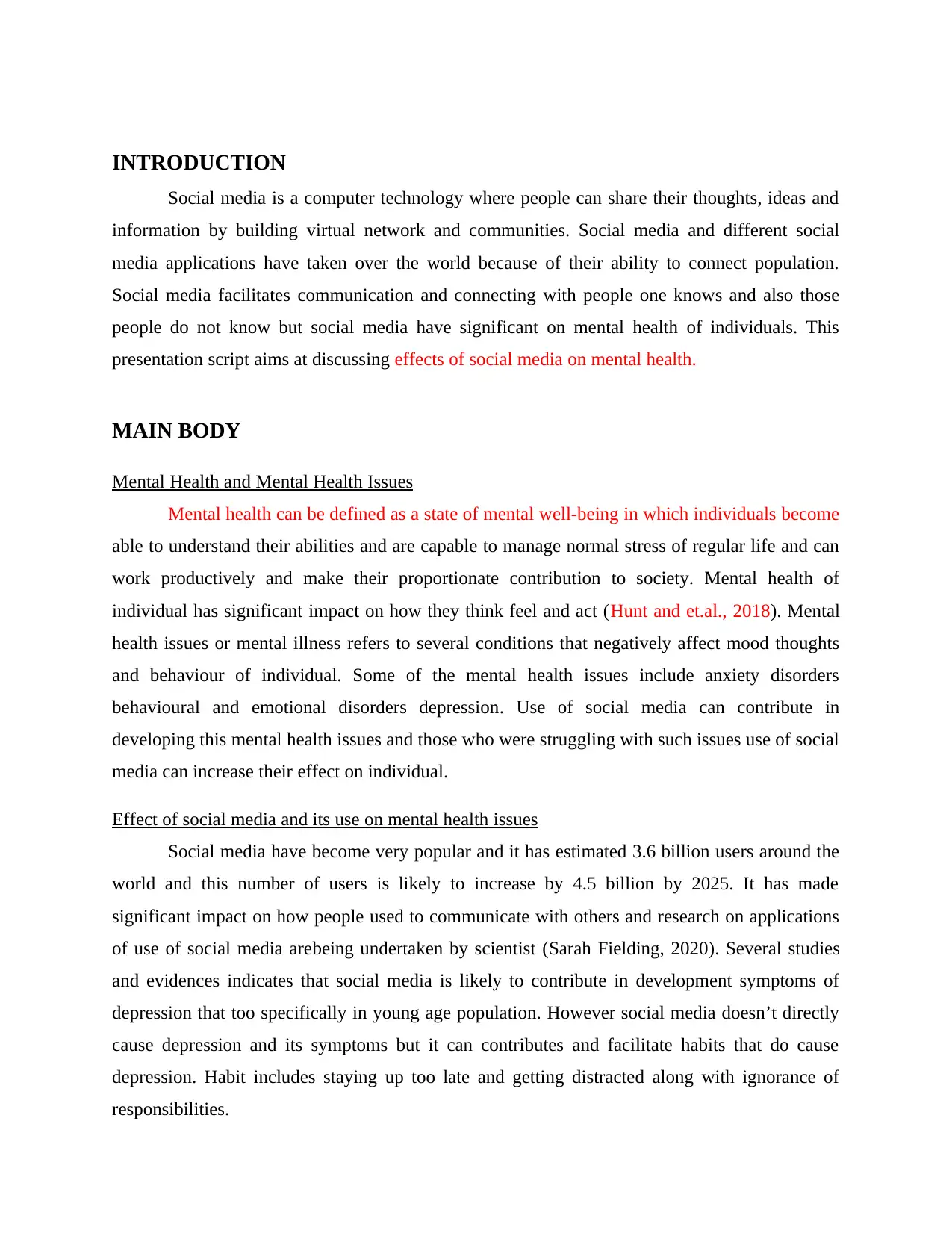
INTRODUCTION...........................................................................................................................3
MAIN BODY..................................................................................................................................3
Mental Health and Mental Health Issues.....................................................................................3
Effect of social media and its use on mental health issues..........................................................3
CONCLUSION................................................................................................................................6
REFERENCES................................................................................................................................7
Document Page
INTRODUCTION
Social media is a computer technology where people can share their thoughts, ideas and
information by building virtual network and communities. Social media and different social
media applications have taken over the world because of their ability to connect population.
Social media facilitates communication and connecting with people one knows and also those
people do not know but social media have significant on mental health of individuals. This
presentation script aims at discussing effects of social media on mental health.
MAIN BODY
Mental Health and Mental Health Issues
Mental health can be defined as a state of mental well-being in which individuals become
able to understand their abilities and are capable to manage normal stress of regular life and can
work productively and make their proportionate contribution to society. Mental health of
individual has significant impact on how they think feel and act (Hunt and et.al., 2018). Mental
health issues or mental illness refers to several conditions that negatively affect mood thoughts
and behaviour of individual. Some of the mental health issues include anxiety disorders
behavioural and emotional disorders depression. Use of social media can contribute in
developing this mental health issues and those who were struggling with such issues use of social
media can increase their effect on individual.
Effect of social media and its use on mental health issues
Social media have become very popular and it has estimated 3.6 billion users around the
world and this number of users is likely to increase by 4.5 billion by 2025. It has made
significant impact on how people used to communicate with others and research on applications
of use of social media arebeing undertaken by scientist (Sarah Fielding, 2020). Several studies
and evidences indicates that social media is likely to contribute in development symptoms of
depression that too specifically in young age population. However social media doesn’t directly
cause depression and its symptoms but it can contributes and facilitate habits that do cause
depression. Habit includes staying up too late and getting distracted along with ignorance of
responsibilities.
Document Page
In a Canadian study it was found that each hour that an individual spent on social media
by seventh grade students’ symptoms of depression like feeling sad alone and dejected
significantly increases. Some of the reasons that contribute to depression includes it fuels
emotions and activity that can cause depression rather than directly causing depression
(Goodyear and Armour, 2019). In addition to this lake of physical activity also contribute to
depressive symptoms. In addition to some other ways in which social media course in depression
are-
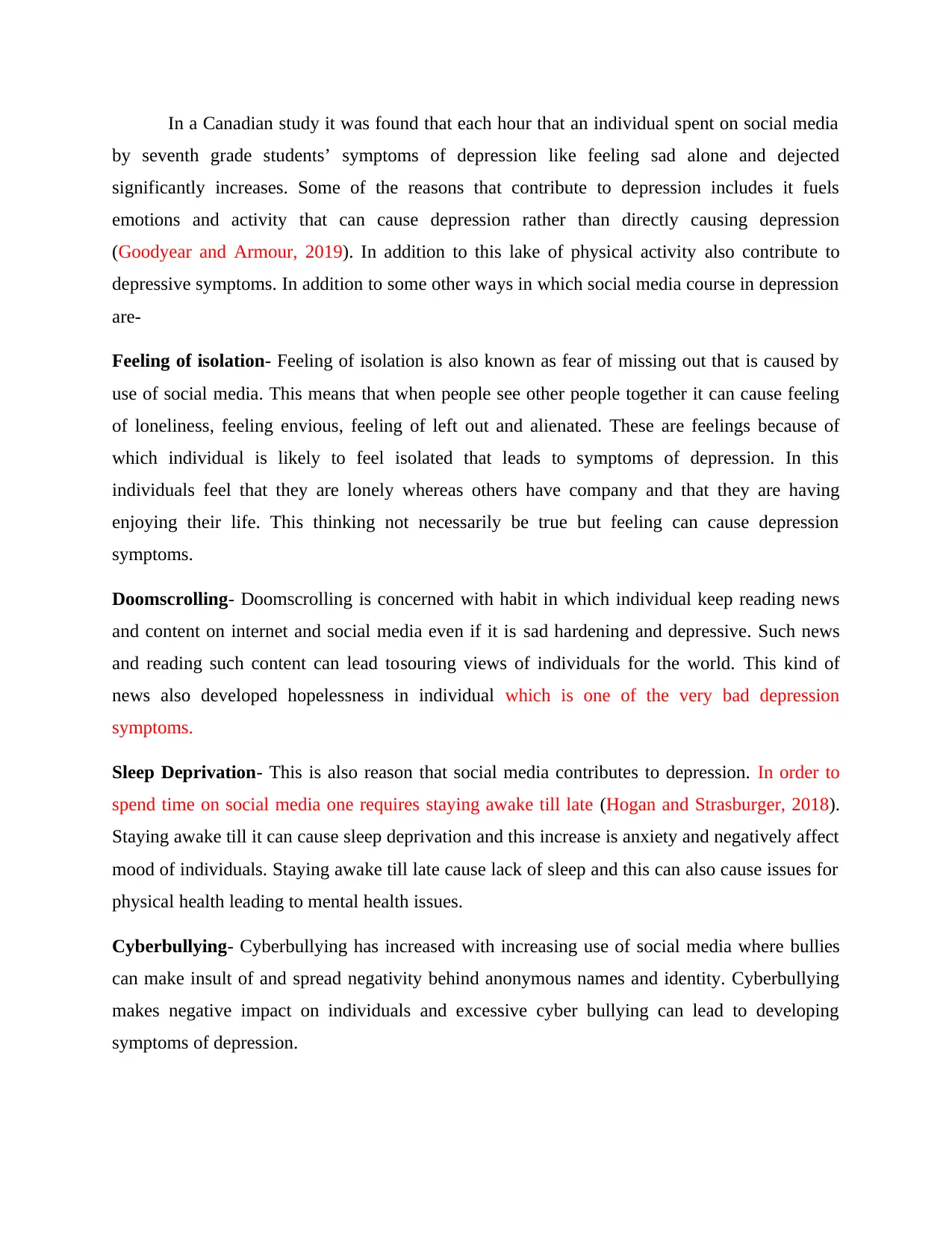
Feeling of isolation- Feeling of isolation is also known as fear of missing out that is caused by
use of social media. This means that when people see other people together it can cause feeling
of loneliness, feeling envious, feeling of left out and alienated. These are feelings because of
which individual is likely to feel isolated that leads to symptoms of depression. In this
individuals feel that they are lonely whereas others have company and that they are having
enjoying their life. This thinking not necessarily be true but feeling can cause depression
symptoms.
Doomscrolling- Doomscrolling is concerned with habit in which individual keep reading news
and content on internet and social media even if it is sad hardening and depressive. Such news
and reading such content can lead tosouring views of individuals for the world. This kind of
news also developed hopelessness in individual which is one of the very bad depression
symptoms.
Sleep Deprivation- This is also reason that social media contributes to depression. In order to
spend time on social media one requires staying awake till late (Hogan and Strasburger, 2018).
Staying awake till it can cause sleep deprivation and this increase is anxiety and negatively affect
mood of individuals. Staying awake till late cause lack of sleep and this can also cause issues for
physical health leading to mental health issues.
Cyberbullying- Cyberbullying has increased with increasing use of social media where bullies
can make insult of and spread negativity behind anonymous names and identity. Cyberbullying
makes negative impact on individuals and excessive cyber bullying can lead to developing
symptoms of depression.
tabler-icon-diamond-filled.svg

Paraphrase This Document

Need a fresh take? Get an instant paraphrase of this document with our AI Paraphraser
Document Page
Comparing to others- Social media have also facilitated and developed a habit of individuals to
compare themselves with others and their lives. This can lead them to believe that other people
are living better life than them which cause lower self-esteem. In this Singh other people having
a perfect life then what their life actually is create negativity.
According to one of the study produced by Johns Hopkins University Bloomberg School
of Public Health, young individuals spending more than 3 hours are more likely to get depressed
and anxious and other illnesses (Joseph Williams, 2019). Excessive use of social media can also
lead teenagers and young people to unconsciously develop negative and bad feelings about
themselves. Internalization of these feelings can affect their mental health and can also create
impact on their personality.
As much time people are active and engaged on social media their probability to get
affected by risk of cyberbullying. Cyberbullying is concerned with harrasement of people using
online platforms and electronic mediums. Cyberbullying can increase risk of depression because
people see lives of others on social media platforms and this negatively affect body image and
also encourage people for social comparison. These problems are likely to have strong impact on
adolescents and because adolescents are a time when people face many other mental issues and
because of this impact of social media can significantly affect their mental health (Katie Collins,
2021). In addition to this, when individuals are using social media they are not doing something
else that might be beneficial for their mental health.
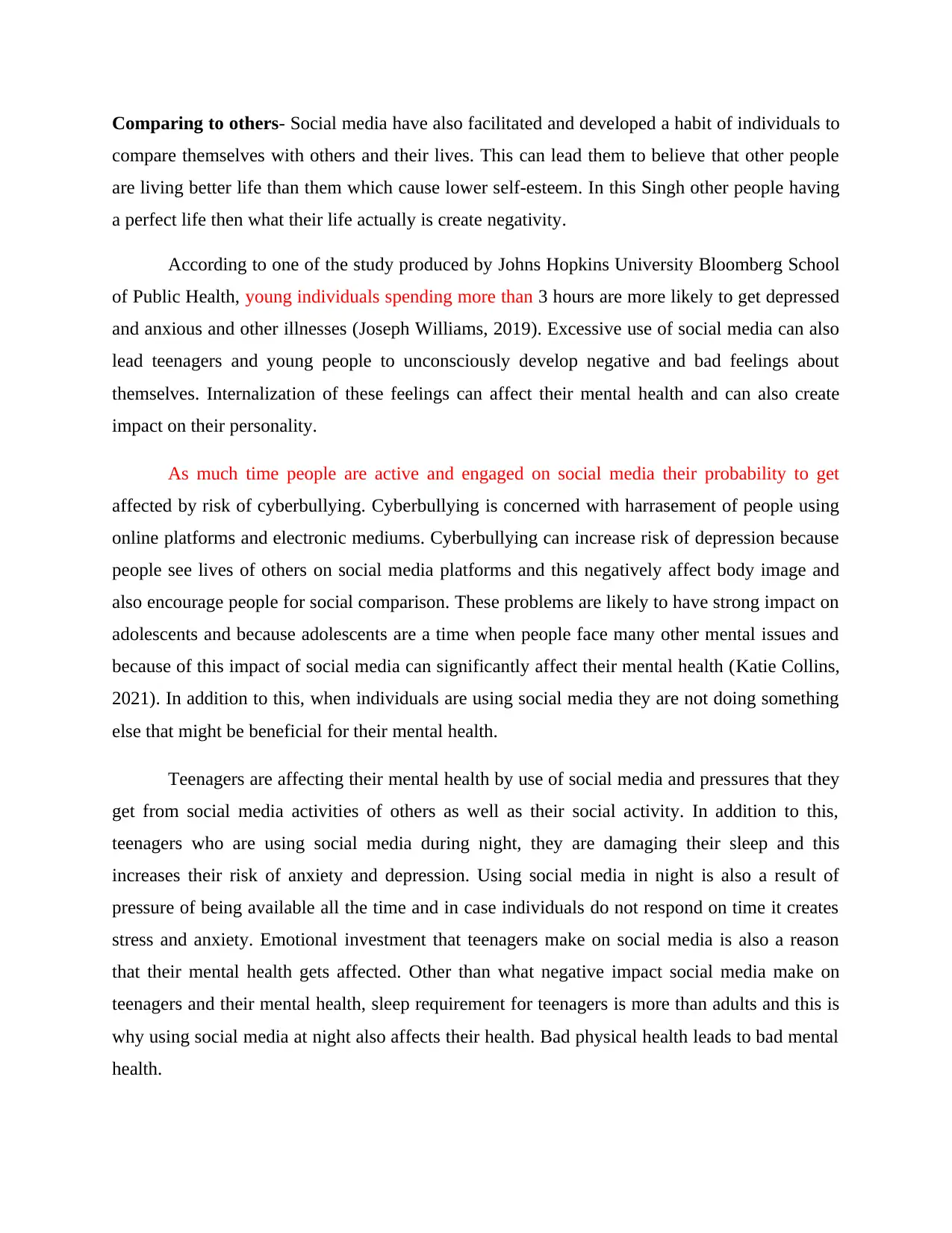
Teenagers are affecting their mental health by use of social media and pressures that they
get from social media activities of others as well as their social activity. In addition to this,
teenagers who are using social media during night, they are damaging their sleep and this
increases their risk of anxiety and depression. Using social media in night is also a result of
pressure of being available all the time and in case individuals do not respond on time it creates
stress and anxiety. Emotional investment that teenagers make on social media is also a reason
that their mental health gets affected. Other than what negative impact social media make on
teenagers and their mental health, sleep requirement for teenagers is more than adults and this is
why using social media at night also affects their health. Bad physical health leads to bad mental
health.
Document Page
Regarding social media use teenagers are highly susceptible to risk of mental health. This
is because heavy use of social media leads to negative well-being and self-esteem of teens
(Sheldon, Rauschnabel and Honeycutt, 2019). However studies have found that engagement on
social media also has positive impact on mental and emotional wellbeing and mainly its impact
is negative on mental and emotional health.
Many of the studies are working on identifying relation between and mental health of
people and their use of social media. Among all these studies most of the studies outlines
negative relation in mental health and use of social media. In one of the research it was identifies
that social media does not predict depression in people however people who are depressed
predicted frequent use of social media (Hayley Simonson, 2020). This means that social media
use and depression are related to each other.
The use of social media is a problems and not social media. This is because social media
is also useful in gaining knowledge and information of what is happening around individuals.
However its use effect mental health and create mental health issues. In this context individual
who are suffering from issues such as depression anxiety and low self esteem using social media
can fuel symptoms of these issues. This is because using social media creates tendency of
comparing individual life with others (Wendy Ryan, 2021). Individuals when become hard and
critical it becomes very difficult for them to understand what to do and they start feelingbad
about themselves. In addition to this using social media also consumes time that individuals can
give to self-care and self protection which enhances their physical as well as mental health.
Individuals also become distant from their real life relationships because of virtual relationships
and because of this day also ending there connections in real life. Real life relations or
connections of individual are very important for strong mental health and have very positive
impact on mental health of individuals.
CONCLUSION
Above discussion out line that there are several ways in which social media is affecting
mental health issues. Mainly the effect is not direct but through different habits and elements that
are developed by social media. However there are ways in which the negative effect of social
media on mental health can be reduced. This includes setting time limits and understanding how
Document Page
it can affect mental health of individual and becoming aware about symptoms of mental health
issues.
REFERENCES
Books and Journals
Goodyear, V.A. and Armour, K.M., 2019. Young people, social media and health (p. 232).
Taylor & Francis.
Hogan, M. and Strasburger, V.C., 2018. Social media and new technology: a primer. Clinical
Pediatrics. 57(10), pp.1204-1215.
Hunt, M.G and et.al., 2018. No more FOMO: Limiting social media decreases loneliness and
depression. Journal of Social and Clinical Psychology. 37(10). pp.751-768.
Sheldon, P., Rauschnabel, P. and Honeycutt, J.M., 2019. The dark side of social media:
psychological, managerial, and societal perspectives. Academic Press.
Online
Hayley Simonson. 2020. [Online]. Available Through:
<https://unfspinnaker.com/89690/features/is-there-a-correlation-between-social-
media-usage-and-depression/>.
Joseph P. Williams. 2019. Social Media Use May Increase Teens Risk of Mental Health Issues.
[Online]. Available Through: <https://www.usnews.com/news/healthiest-
communities/articles/2019-09-12/social-media-use-may-increase-teens-risk-of-mental-
health-issues>.
Katie Collins. 2021. Teens, social media use and mental health: What you really need to know.
[Online]. Available Through: <https://www.cnet.com/news/teens-social-media-use-
and-mental-health-what-you-really-need-to-know/>.
Sarah Fielding. 2020. How your social media habits may contribute to depression — and 4 ways
to fix it. [Online]. Available Through: <https://www.insider.com/does-social-media-
cause-depression>.
Wendy Ryan. 2021. Social media can impact your mental health, so psychologist offers online
tips. [Online]. Available Through:
<https://www.abcactionnews.com/rebound/coronavirus-stress/social-media-can-
impact-your-mental-health-so-psychologist-offers-online-tips>.
chevron_up_icon
1 out of 7
circle_padding
hide_on_mobile
zoom_out_icon
[object Object]