Sunshine 100: Social Media Policy in the Workplace Case Study
VerifiedAdded on 2022/12/30
|8
|1368
|38
Case Study
AI Summary
This case study examines the impact of social media in the workplace, focusing on Sunshine 100, a health food company, and the challenges it faced due to employee social media usage. The case analyzes the differences between social and traditional media, highlighting the challenges of misinformation and employee behavior. It discusses the importance of establishing social media policies, considering legal ramifications, setting expectations, and encouraging positive sharing. The assignment includes a communication plan for implementing the social media policy, outlining methods, frequency, goals, and responsibilities. The case study emphasizes the significance of employee advocacy, feedback, and the overall impact on the company's image and reputation. References to various academic sources support the analysis of social media's influence on organizational communication and management.
Running head: MANAGEMENT
Management
5/4/2019
Management
5/4/2019
Paraphrase This Document
Need a fresh take? Get an instant paraphrase of this document with our AI Paraphraser

MANAGEMENT 1
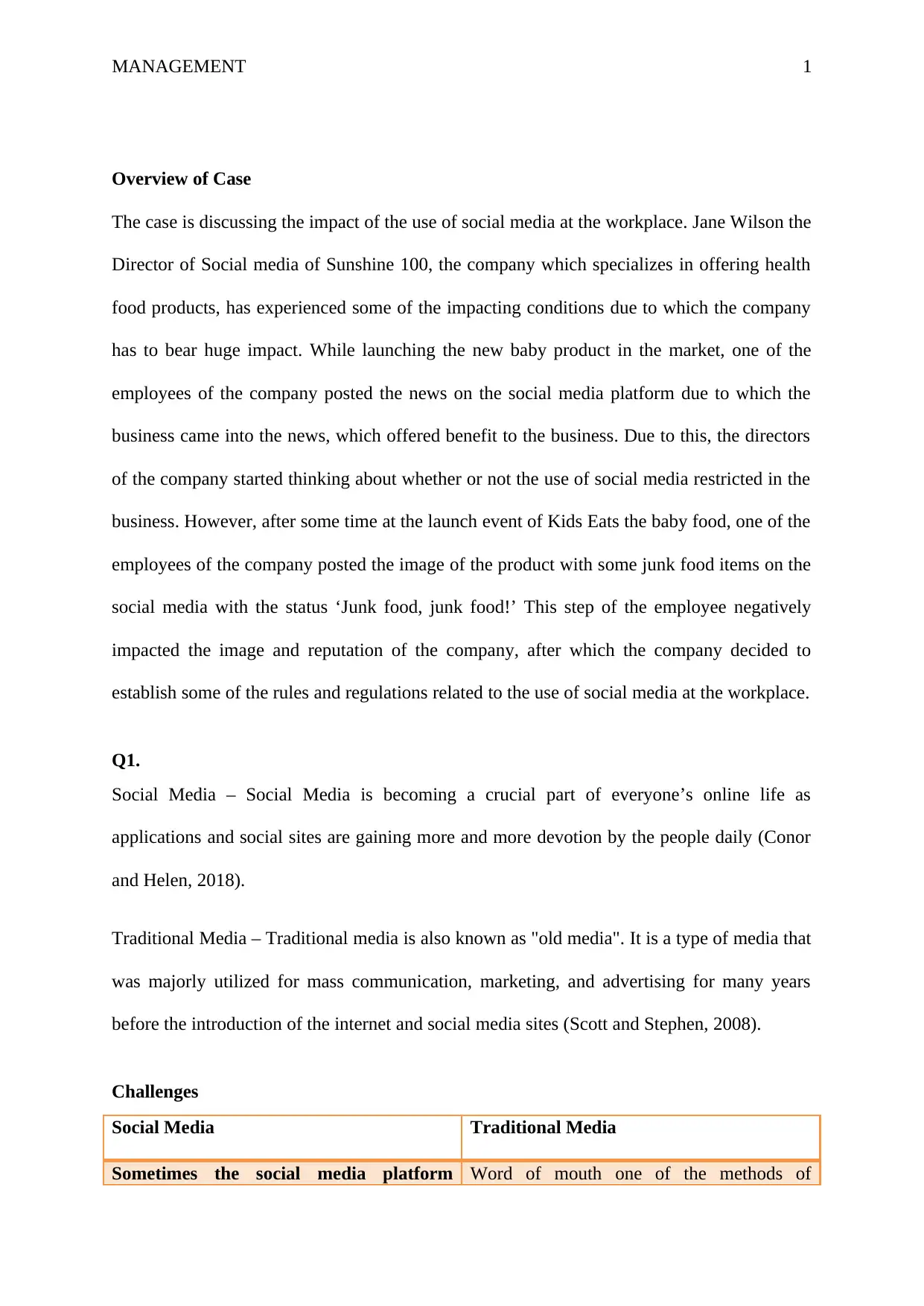
Overview of Case
The case is discussing the impact of the use of social media at the workplace. Jane Wilson the
Director of Social media of Sunshine 100, the company which specializes in offering health
food products, has experienced some of the impacting conditions due to which the company
has to bear huge impact. While launching the new baby product in the market, one of the
employees of the company posted the news on the social media platform due to which the
business came into the news, which offered benefit to the business. Due to this, the directors
of the company started thinking about whether or not the use of social media restricted in the
business. However, after some time at the launch event of Kids Eats the baby food, one of the
employees of the company posted the image of the product with some junk food items on the
social media with the status ‘Junk food, junk food!’ This step of the employee negatively
impacted the image and reputation of the company, after which the company decided to
establish some of the rules and regulations related to the use of social media at the workplace.
Q1.
Social Media – Social Media is becoming a crucial part of everyone’s online life as
applications and social sites are gaining more and more devotion by the people daily (Conor
and Helen, 2018).
Traditional Media – Traditional media is also known as "old media". It is a type of media that
was majorly utilized for mass communication, marketing, and advertising for many years
before the introduction of the internet and social media sites (Scott and Stephen, 2008).
Challenges
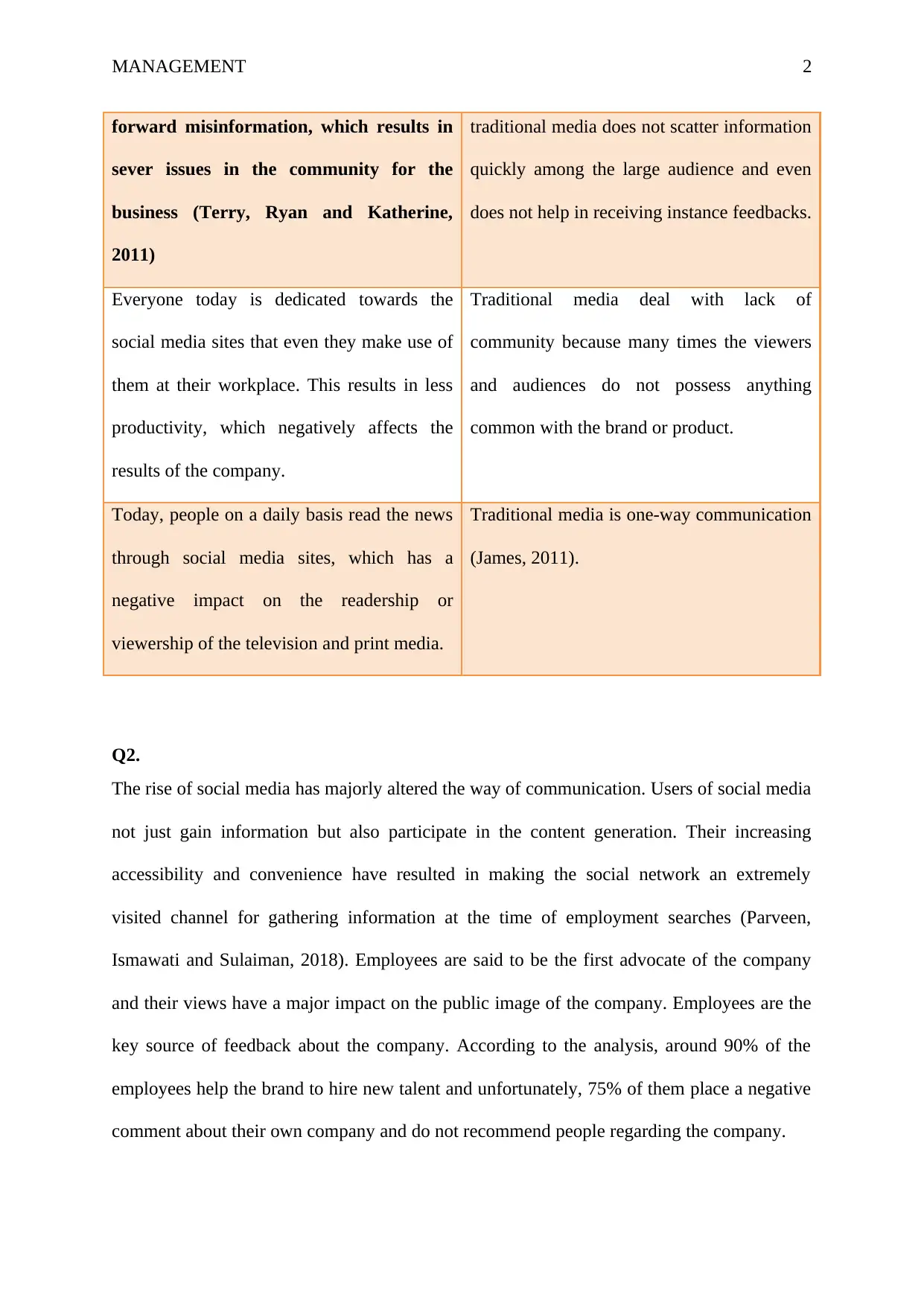
Social Media Traditional Media
Sometimes the social media platform Word of mouth one of the methods of
Overview of Case
The case is discussing the impact of the use of social media at the workplace. Jane Wilson the
Director of Social media of Sunshine 100, the company which specializes in offering health
food products, has experienced some of the impacting conditions due to which the company
has to bear huge impact. While launching the new baby product in the market, one of the
employees of the company posted the news on the social media platform due to which the
business came into the news, which offered benefit to the business. Due to this, the directors
of the company started thinking about whether or not the use of social media restricted in the
business. However, after some time at the launch event of Kids Eats the baby food, one of the
employees of the company posted the image of the product with some junk food items on the
social media with the status ‘Junk food, junk food!’ This step of the employee negatively
impacted the image and reputation of the company, after which the company decided to
establish some of the rules and regulations related to the use of social media at the workplace.
Q1.
Social Media – Social Media is becoming a crucial part of everyone’s online life as
applications and social sites are gaining more and more devotion by the people daily (Conor
and Helen, 2018).
Traditional Media – Traditional media is also known as "old media". It is a type of media that
was majorly utilized for mass communication, marketing, and advertising for many years
before the introduction of the internet and social media sites (Scott and Stephen, 2008).
Challenges
Social Media Traditional Media
Sometimes the social media platform Word of mouth one of the methods of

MANAGEMENT 2
forward misinformation, which results in
sever issues in the community for the
business (Terry, Ryan and Katherine,
2011)
traditional media does not scatter information
quickly among the large audience and even
does not help in receiving instance feedbacks.
Everyone today is dedicated towards the
social media sites that even they make use of
them at their workplace. This results in less
productivity, which negatively affects the
results of the company.
Traditional media deal with lack of
community because many times the viewers
and audiences do not possess anything
common with the brand or product.
Today, people on a daily basis read the news
through social media sites, which has a
negative impact on the readership or
viewership of the television and print media.
Traditional media is one-way communication
(James, 2011).
Q2.
The rise of social media has majorly altered the way of communication. Users of social media
not just gain information but also participate in the content generation. Their increasing
accessibility and convenience have resulted in making the social network an extremely
visited channel for gathering information at the time of employment searches (Parveen,
Ismawati and Sulaiman, 2018). Employees are said to be the first advocate of the company
and their views have a major impact on the public image of the company. Employees are the
key source of feedback about the company. According to the analysis, around 90% of the
employees help the brand to hire new talent and unfortunately, 75% of them place a negative
comment about their own company and do not recommend people regarding the company.
forward misinformation, which results in
sever issues in the community for the
business (Terry, Ryan and Katherine,
2011)
traditional media does not scatter information
quickly among the large audience and even
does not help in receiving instance feedbacks.
Everyone today is dedicated towards the
social media sites that even they make use of
them at their workplace. This results in less
productivity, which negatively affects the
results of the company.
Traditional media deal with lack of
community because many times the viewers
and audiences do not possess anything
common with the brand or product.
Today, people on a daily basis read the news
through social media sites, which has a
negative impact on the readership or
viewership of the television and print media.
Traditional media is one-way communication
(James, 2011).
Q2.
The rise of social media has majorly altered the way of communication. Users of social media
not just gain information but also participate in the content generation. Their increasing
accessibility and convenience have resulted in making the social network an extremely
visited channel for gathering information at the time of employment searches (Parveen,
Ismawati and Sulaiman, 2018). Employees are said to be the first advocate of the company
and their views have a major impact on the public image of the company. Employees are the
key source of feedback about the company. According to the analysis, around 90% of the
employees help the brand to hire new talent and unfortunately, 75% of them place a negative
comment about their own company and do not recommend people regarding the company.
⊘ This is a preview!⊘
Do you want full access?
Subscribe today to unlock all pages.

Trusted by 1+ million students worldwide

MANAGEMENT 3
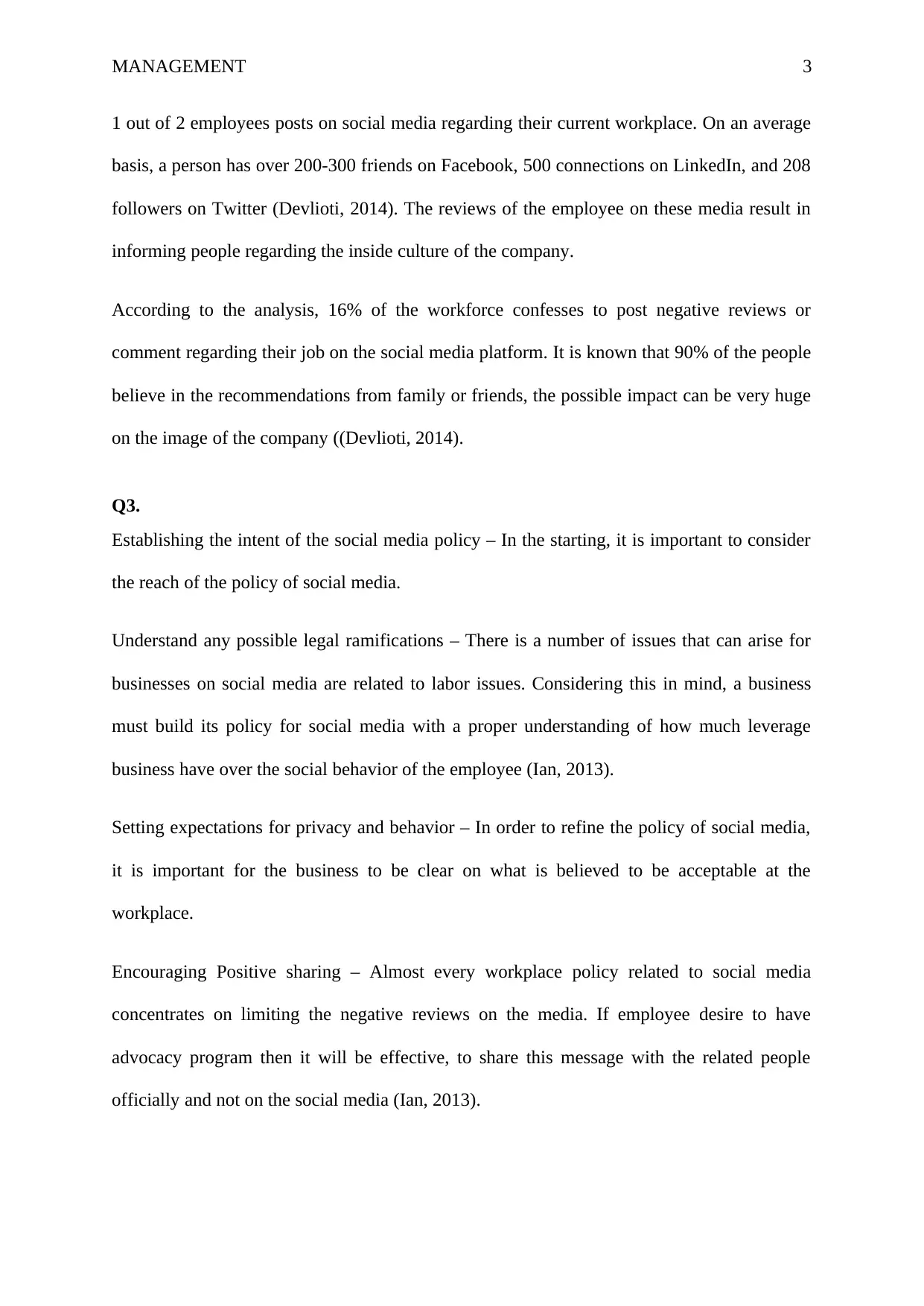
1 out of 2 employees posts on social media regarding their current workplace. On an average
basis, a person has over 200-300 friends on Facebook, 500 connections on LinkedIn, and 208
followers on Twitter (Devlioti, 2014). The reviews of the employee on these media result in
informing people regarding the inside culture of the company.
According to the analysis, 16% of the workforce confesses to post negative reviews or
comment regarding their job on the social media platform. It is known that 90% of the people
believe in the recommendations from family or friends, the possible impact can be very huge
on the image of the company ((Devlioti, 2014).
Q3.
Establishing the intent of the social media policy – In the starting, it is important to consider
the reach of the policy of social media.
Understand any possible legal ramifications – There is a number of issues that can arise for
businesses on social media are related to labor issues. Considering this in mind, a business
must build its policy for social media with a proper understanding of how much leverage
business have over the social behavior of the employee (Ian, 2013).
Setting expectations for privacy and behavior – In order to refine the policy of social media,
it is important for the business to be clear on what is believed to be acceptable at the
workplace.
Encouraging Positive sharing – Almost every workplace policy related to social media
concentrates on limiting the negative reviews on the media. If employee desire to have
advocacy program then it will be effective, to share this message with the related people
officially and not on the social media (Ian, 2013).
1 out of 2 employees posts on social media regarding their current workplace. On an average
basis, a person has over 200-300 friends on Facebook, 500 connections on LinkedIn, and 208
followers on Twitter (Devlioti, 2014). The reviews of the employee on these media result in
informing people regarding the inside culture of the company.
According to the analysis, 16% of the workforce confesses to post negative reviews or
comment regarding their job on the social media platform. It is known that 90% of the people
believe in the recommendations from family or friends, the possible impact can be very huge
on the image of the company ((Devlioti, 2014).
Q3.
Establishing the intent of the social media policy – In the starting, it is important to consider
the reach of the policy of social media.
Understand any possible legal ramifications – There is a number of issues that can arise for
businesses on social media are related to labor issues. Considering this in mind, a business
must build its policy for social media with a proper understanding of how much leverage
business have over the social behavior of the employee (Ian, 2013).
Setting expectations for privacy and behavior – In order to refine the policy of social media,
it is important for the business to be clear on what is believed to be acceptable at the
workplace.
Encouraging Positive sharing – Almost every workplace policy related to social media
concentrates on limiting the negative reviews on the media. If employee desire to have
advocacy program then it will be effective, to share this message with the related people
officially and not on the social media (Ian, 2013).
Paraphrase This Document
Need a fresh take? Get an instant paraphrase of this document with our AI Paraphraser

MANAGEMENT 4
Q4.
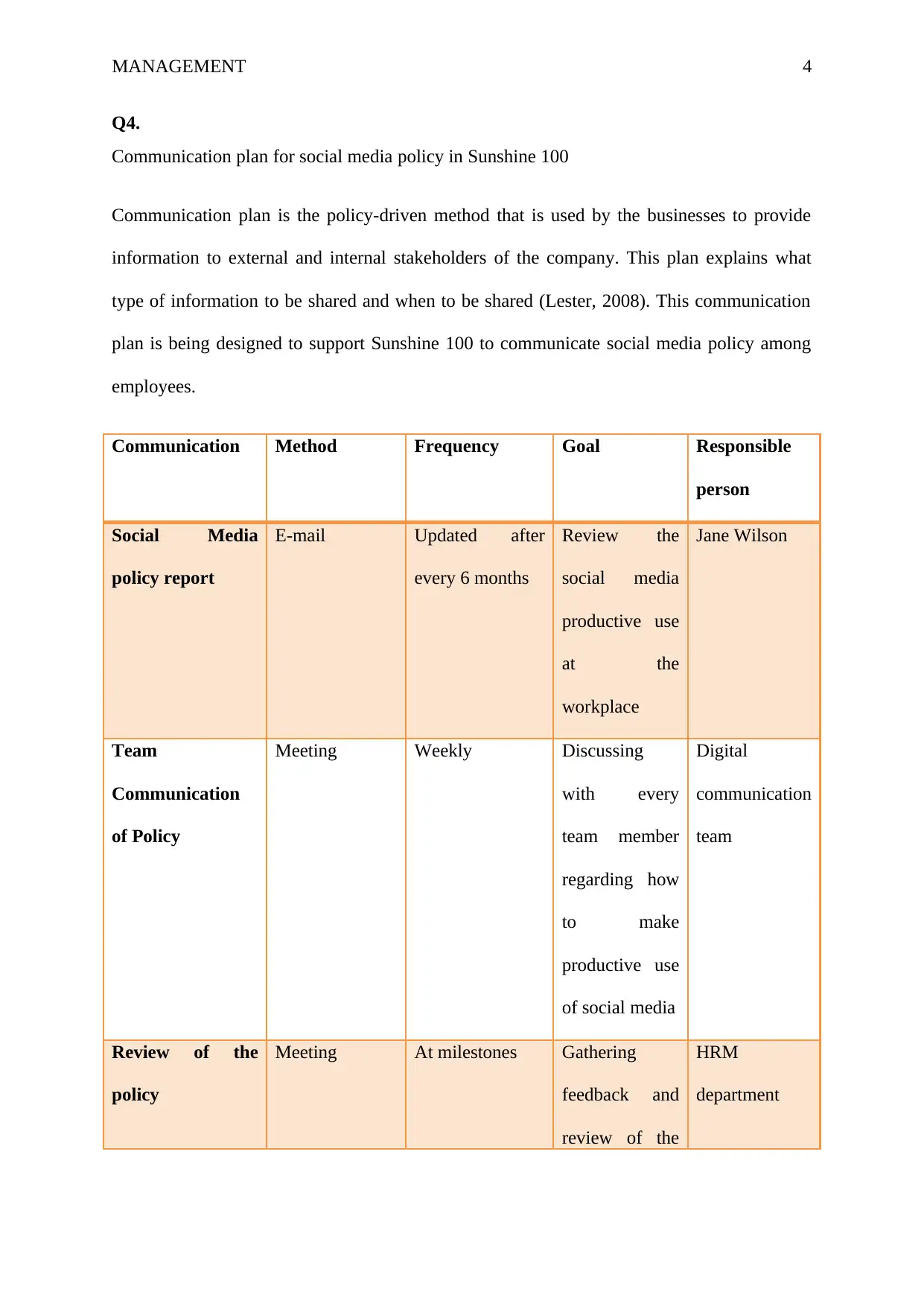
Communication plan for social media policy in Sunshine 100
Communication plan is the policy-driven method that is used by the businesses to provide
information to external and internal stakeholders of the company. This plan explains what
type of information to be shared and when to be shared (Lester, 2008). This communication
plan is being designed to support Sunshine 100 to communicate social media policy among
employees.
Communication Method Frequency Goal Responsible
person
Social Media
policy report
E-mail Updated after
every 6 months
Review the
social media
productive use
at the
workplace
Jane Wilson
Team
Communication
of Policy
Meeting Weekly Discussing
with every
team member
regarding how
to make
productive use
of social media
Digital
communication
team
Review of the
policy
Meeting At milestones Gathering
feedback and
review of the
HRM
department
Q4.
Communication plan for social media policy in Sunshine 100
Communication plan is the policy-driven method that is used by the businesses to provide
information to external and internal stakeholders of the company. This plan explains what
type of information to be shared and when to be shared (Lester, 2008). This communication
plan is being designed to support Sunshine 100 to communicate social media policy among
employees.
Communication Method Frequency Goal Responsible
person
Social Media
policy report
E-mail Updated after
every 6 months
Review the
social media
productive use
at the
workplace
Jane Wilson
Team
Communication
of Policy
Meeting Weekly Discussing
with every
team member
regarding how
to make
productive use
of social media
Digital
communication
team
Review of the
policy
Meeting At milestones Gathering
feedback and
review of the
HRM
department

MANAGEMENT 5
employees
Progress updates Team Gantt Monthly At what extent
the social
media policy is
followed
within the
organization
Digital media
team
employees
Progress updates Team Gantt Monthly At what extent
the social
media policy is
followed
within the
organization
Digital media
team
⊘ This is a preview!⊘
Do you want full access?
Subscribe today to unlock all pages.

Trusted by 1+ million students worldwide

MANAGEMENT 6
References
Conor, D., and Helen, M. (2018) The impact of social media on resource mobilisation in
entrepreneurial firms. Industrial Marketing Management, 70(2018), 68-89.
Devlioti, V. (2014) How Negative Social Media Comments Affect Your Employer [online].
Available from https://wersm.com/how-negative-social-media-comments-affect-your-
employer/ [accessed 5 May 2019]
Ian, M. (2013) Strategic Planning for Social Media in Libraries. The Australian Library
Journal, 62(4), 330-331.
James, K. (2011) Communication perspectives on social networking and citizen journalism
challenges to traditional newspaper. Social and Management Sciences, 19(2), 51-62.
Lester, P. (2008) The Communication Plan. Communication World, 25(3), S4.
Parveen, F., Ismawati, N, and Sulaiman, A. (2018) Understanding the impact of social media
usage among organizations. Information and Management, 55(3), 308-321.
Scott, A.U., and Stephen, R. (2008) Examining the scope of chaqnnel expansion: A test of
Channel Expansion Theory with New and Traditionla Communication Media. Management
Communication Quarterly, 21(4), 486-507.
Terry, K., Ryan, G.S., and Katherine, C. (2011) Advantages and Challenges of Social Media
in Pediatrics. Pediatric Annuals, 40(9), 430.
References
Conor, D., and Helen, M. (2018) The impact of social media on resource mobilisation in
entrepreneurial firms. Industrial Marketing Management, 70(2018), 68-89.
Devlioti, V. (2014) How Negative Social Media Comments Affect Your Employer [online].
Available from https://wersm.com/how-negative-social-media-comments-affect-your-
employer/ [accessed 5 May 2019]
Ian, M. (2013) Strategic Planning for Social Media in Libraries. The Australian Library
Journal, 62(4), 330-331.
James, K. (2011) Communication perspectives on social networking and citizen journalism
challenges to traditional newspaper. Social and Management Sciences, 19(2), 51-62.
Lester, P. (2008) The Communication Plan. Communication World, 25(3), S4.
Parveen, F., Ismawati, N, and Sulaiman, A. (2018) Understanding the impact of social media
usage among organizations. Information and Management, 55(3), 308-321.
Scott, A.U., and Stephen, R. (2008) Examining the scope of chaqnnel expansion: A test of
Channel Expansion Theory with New and Traditionla Communication Media. Management
Communication Quarterly, 21(4), 486-507.
Terry, K., Ryan, G.S., and Katherine, C. (2011) Advantages and Challenges of Social Media
in Pediatrics. Pediatric Annuals, 40(9), 430.
Paraphrase This Document
Need a fresh take? Get an instant paraphrase of this document with our AI Paraphraser

MANAGEMENT 7
1 out of 8
Related Documents
Your All-in-One AI-Powered Toolkit for Academic Success.
+13062052269
info@desklib.com
Available 24*7 on WhatsApp / Email
Unlock your academic potential
Copyright © 2020–2025 A2Z Services. All Rights Reserved. Developed and managed by ZUCOL.