Analyzing Social Media's Impact on UK Hospitality Performance
VerifiedAdded on 2023/01/19
|13
|2725
|57
Project
AI Summary
This project is a research proposal that explores the impact of social media marketing on the hospitality industry within the UK. It begins with an introduction highlighting the shift from traditional to online marketing, emphasizing the efficiency of social media platforms. The study aims to unveil the effects of social media activities on hotel reservations and revenue generation, addressing the problem of cheaper social media advertising compared to traditional methods. The research objectives include evaluating the benefits of social media in hotel marketing, identifying ideal social media networks, and exploring factors for organizations adopting social media strategies. The literature review covers economic and social theories explaining consumer behavior on social media. The empirical review examines the changing landscape of customer loyalty and the role of social media in direct communication. The research design is qualitative, using questionnaires to collect primary data from hotels in Ealing, London. The project also includes a time plan and references.

MANAGEMENT 1
HOSPITALITY
NAME:
ADDRESS:
DATE:
HOSPITALITY
NAME:
ADDRESS:
DATE:

Paraphrase This Document
Need a fresh take? Get an instant paraphrase of this document with our AI Paraphraser
MANAGEMENT 1
Impact of social media marketing in the hospitality industry within the UK
Introduction
Marketing through Social media platforms is a very efficient and reliable mode of marketing
recently most especially in the hospitality industry due to the intensiveness of information. This
has led to the eradication of ancient marketing strategies and adoption of online marketing
procedures and systems (Anjum, 2011). This study is a work based research proposal and strives
to unveil the impacts of social media activities on the hospitality industry for proper reservations
and high revenue generation.
Statement of the problem
Advertisements on Social media is cheaper compared to ancient advertisements. Comparing
advertisement based on regular web pages to social media advertising through Facebook,
Instagram, snap chart and the rest, the Facebook advertisements had more views and likes than
the regular advertisements (Tracy L. Tuten & R., 2014). The study, therefore, tries to analyze the
impacts of social media advertisements on hospitality performance since it is more popular.
Research objectives
Aim
To explore factors that should be considered before an organization in the hospitality industry
adopts a social media strategy as a marketing tool in the UK.
Objectives
Impact of social media marketing in the hospitality industry within the UK
Introduction
Marketing through Social media platforms is a very efficient and reliable mode of marketing
recently most especially in the hospitality industry due to the intensiveness of information. This
has led to the eradication of ancient marketing strategies and adoption of online marketing
procedures and systems (Anjum, 2011). This study is a work based research proposal and strives
to unveil the impacts of social media activities on the hospitality industry for proper reservations
and high revenue generation.
Statement of the problem
Advertisements on Social media is cheaper compared to ancient advertisements. Comparing
advertisement based on regular web pages to social media advertising through Facebook,
Instagram, snap chart and the rest, the Facebook advertisements had more views and likes than
the regular advertisements (Tracy L. Tuten & R., 2014). The study, therefore, tries to analyze the
impacts of social media advertisements on hospitality performance since it is more popular.
Research objectives
Aim
To explore factors that should be considered before an organization in the hospitality industry
adopts a social media strategy as a marketing tool in the UK.
Objectives
MANAGEMENT 1
i. To evaluate the benefits of social media networks in hotels marketing departments in the
UK.
ii. To identify social media networks that are ideal for the hospitality industry in the UK.
Research questions
i. To what extent has the 4 and 5-star hotels in the UK implemented social media strategies
into their marketing procedures?
ii. What are the discrepancies between the hotel customers’ expectations on social media?
iii. What are marketing managers’ expectations on how their consumers perceive their hotel’s
services online?
Literature Review
This section is made up of a review of the previous literature of research comprising of the
objectives of the research. The chapter makes available an explanation of the theoretical basis of
the problem that is being studied in connection to benchmarking research in the field at hand.
Theoretical review
some economic and social theories have elaborated on the factors that make people join and sign
in to social media networks, they include; to learn and express their views on certain matters, to
be entertained to have fun, to interact, to communicate, to transact and to make connections with
others (Evans, 2012). All these reasons make social media networks the most efficient mode of
marketing to reach a large number of people at a cheaper cost. It also creates a connection
amongst people with common purposes and interests (Solomon & Mitchell, 2013).
i. To evaluate the benefits of social media networks in hotels marketing departments in the
UK.
ii. To identify social media networks that are ideal for the hospitality industry in the UK.
Research questions
i. To what extent has the 4 and 5-star hotels in the UK implemented social media strategies
into their marketing procedures?
ii. What are the discrepancies between the hotel customers’ expectations on social media?
iii. What are marketing managers’ expectations on how their consumers perceive their hotel’s
services online?
Literature Review
This section is made up of a review of the previous literature of research comprising of the
objectives of the research. The chapter makes available an explanation of the theoretical basis of
the problem that is being studied in connection to benchmarking research in the field at hand.
Theoretical review
some economic and social theories have elaborated on the factors that make people join and sign
in to social media networks, they include; to learn and express their views on certain matters, to
be entertained to have fun, to interact, to communicate, to transact and to make connections with
others (Evans, 2012). All these reasons make social media networks the most efficient mode of
marketing to reach a large number of people at a cheaper cost. It also creates a connection
amongst people with common purposes and interests (Solomon & Mitchell, 2013).
⊘ This is a preview!⊘
Do you want full access?
Subscribe today to unlock all pages.

Trusted by 1+ million students worldwide
MANAGEMENT 1
Economic theory
Social media networks have earned great attention from marketers and investors due to their
economic strength and ability to bring about businesses ideas from customers complains, create a
strong relationship between the sales agents and the customers. An online community is a group
of customers with a common interest in particular products or services which come about
through social media networks (Singh & Diamond, 2014). Such consumers who are community
members have a great influence on each other to buy the products offered by an industry in
which the community exists. They can, therefore, raise the profits of an industry. These
communities also have the ability to move the power of balance in an industry to the consumers
themselves since they have the ability to gather more information to influence the creation and
promotion of a service or product.
A few researchers have affirmed and recommended the creation of social media networks
through the economic theory that expounds the relevance of participation in online communities
(Dahl, 2018). (Kipp Bodnar & Cohen, 2011)Pointed out the resource-based model, which
consists the notions to understand the values as defined by Zeithaml (1988): if the resources
foregone are less and the consumer gains more benefits than value will be created. The benefits
perceived are the chances to gather information resources and knowledge from others, build
personal connections, etc. consumers have the tendency to feel that they have sacrificed time,
energy, attention and knowledge so as to be compensated with those benefits. If the benefits
perceived are more than what is foregone, then community provides its members with value
therefore increasing the number of participants. Similarly (Schaffer, 2013)said that consumers
who obtain benefits than costs are likely to contribute more. They also tend to increase their
Economic theory
Social media networks have earned great attention from marketers and investors due to their
economic strength and ability to bring about businesses ideas from customers complains, create a
strong relationship between the sales agents and the customers. An online community is a group
of customers with a common interest in particular products or services which come about
through social media networks (Singh & Diamond, 2014). Such consumers who are community
members have a great influence on each other to buy the products offered by an industry in
which the community exists. They can, therefore, raise the profits of an industry. These
communities also have the ability to move the power of balance in an industry to the consumers
themselves since they have the ability to gather more information to influence the creation and
promotion of a service or product.
A few researchers have affirmed and recommended the creation of social media networks
through the economic theory that expounds the relevance of participation in online communities
(Dahl, 2018). (Kipp Bodnar & Cohen, 2011)Pointed out the resource-based model, which
consists the notions to understand the values as defined by Zeithaml (1988): if the resources
foregone are less and the consumer gains more benefits than value will be created. The benefits
perceived are the chances to gather information resources and knowledge from others, build
personal connections, etc. consumers have the tendency to feel that they have sacrificed time,
energy, attention and knowledge so as to be compensated with those benefits. If the benefits
perceived are more than what is foregone, then community provides its members with value
therefore increasing the number of participants. Similarly (Schaffer, 2013)said that consumers
who obtain benefits than costs are likely to contribute more. They also tend to increase their
Paraphrase This Document
Need a fresh take? Get an instant paraphrase of this document with our AI Paraphraser
MANAGEMENT 1
participation when they are awarded tangible or intangible incentives. In conclusion members’
participation is significantly proportional to the benefits they receive from the community.
Social theories
The current study adopts two social theories which include social exchange and social identity
theory to expound consumers’ ‘motivations for social interaction within a social media network.
Contents of social networks include transitivity, density, and abstractions. Networks that are high
intransitivity are the ones that close tension reciprocity. Networks are believed to be denser if a
high segment of a possible connection is real. Closure rises with transitivity, whereby transitivity
is likely to be higher for connections with a positive extract. If the closure amongst the variables
of a connecting actor is low, then the actor may form a bridge and cause a structural gap in the
network (Deckers & Jackson, 2013)
This literature provides classes of social media through criteria such as whether the objective is
to publish, distribute information, or build a community. In relation to this research, the main
objective of social media is to enhance the visibility and to achieve this objective, researchers
suggest that an organization should spend a relevant amount of time and resources to social
media marketing processes in a systematic manner (Zarrella, 2013). Although social media may
be viral and cooperative it may not account fully for market investments for an organization.
Indeed, (Deckers & Lacy, 2017)emphasizes that most organizations perception to the reaction of
consumer-to-consumer relationships in social media is inadequate. This ignorance lasts in spite
of the fact that advertising elasticity exceeds with a large margin This paper affirms that the
participation when they are awarded tangible or intangible incentives. In conclusion members’
participation is significantly proportional to the benefits they receive from the community.
Social theories
The current study adopts two social theories which include social exchange and social identity
theory to expound consumers’ ‘motivations for social interaction within a social media network.
Contents of social networks include transitivity, density, and abstractions. Networks that are high
intransitivity are the ones that close tension reciprocity. Networks are believed to be denser if a
high segment of a possible connection is real. Closure rises with transitivity, whereby transitivity
is likely to be higher for connections with a positive extract. If the closure amongst the variables
of a connecting actor is low, then the actor may form a bridge and cause a structural gap in the
network (Deckers & Jackson, 2013)
This literature provides classes of social media through criteria such as whether the objective is
to publish, distribute information, or build a community. In relation to this research, the main
objective of social media is to enhance the visibility and to achieve this objective, researchers
suggest that an organization should spend a relevant amount of time and resources to social
media marketing processes in a systematic manner (Zarrella, 2013). Although social media may
be viral and cooperative it may not account fully for market investments for an organization.
Indeed, (Deckers & Lacy, 2017)emphasizes that most organizations perception to the reaction of
consumer-to-consumer relationships in social media is inadequate. This ignorance lasts in spite
of the fact that advertising elasticity exceeds with a large margin This paper affirms that the
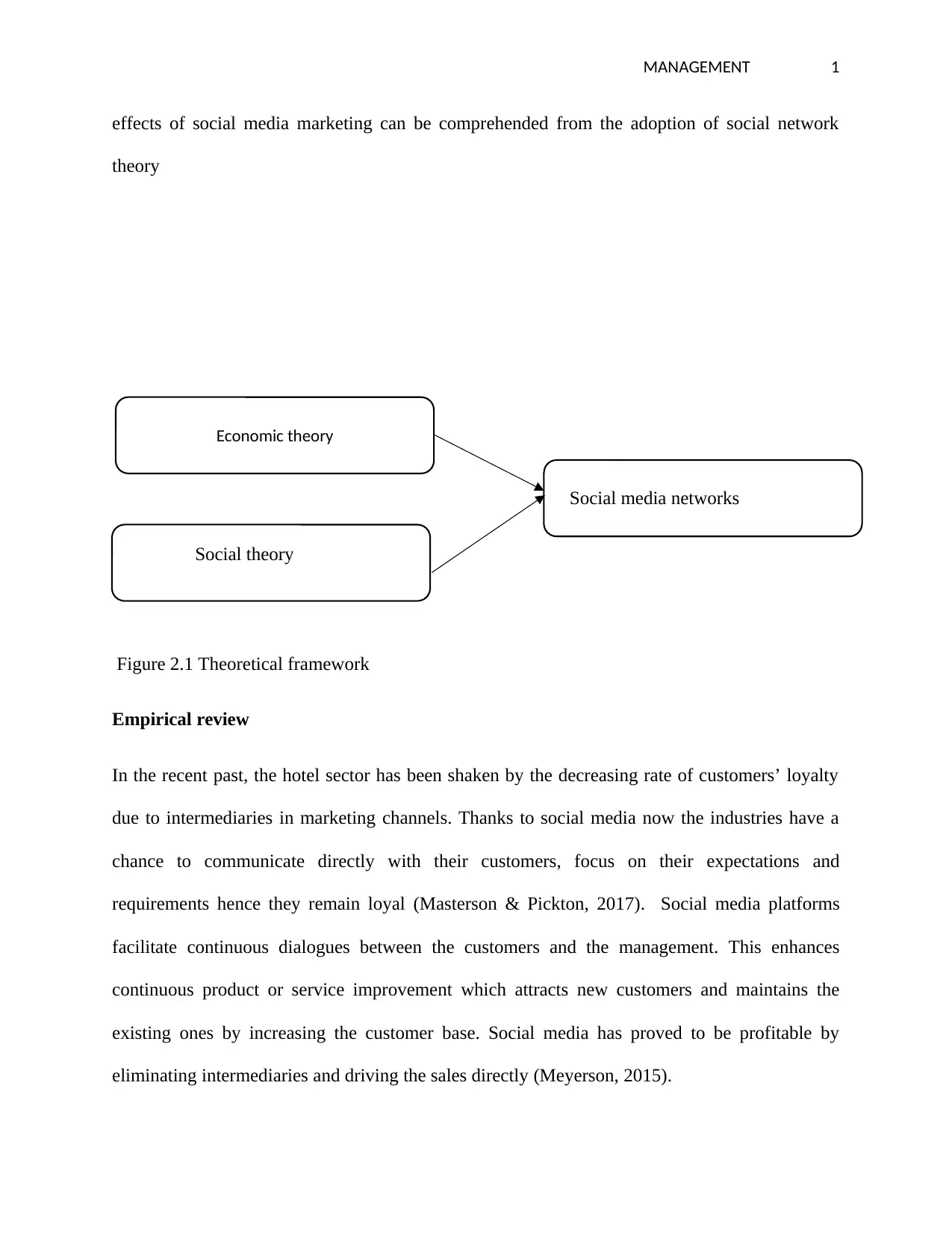
MANAGEMENT 1
effects of social media marketing can be comprehended from the adoption of social network
theory
Social media networks
Social theory
Figure 2.1 Theoretical framework
Empirical review
In the recent past, the hotel sector has been shaken by the decreasing rate of customers’ loyalty
due to intermediaries in marketing channels. Thanks to social media now the industries have a
chance to communicate directly with their customers, focus on their expectations and
requirements hence they remain loyal (Masterson & Pickton, 2017). Social media platforms
facilitate continuous dialogues between the customers and the management. This enhances
continuous product or service improvement which attracts new customers and maintains the
existing ones by increasing the customer base. Social media has proved to be profitable by
eliminating intermediaries and driving the sales directly (Meyerson, 2015).
Economic theory
effects of social media marketing can be comprehended from the adoption of social network
theory
Social media networks
Social theory
Figure 2.1 Theoretical framework
Empirical review
In the recent past, the hotel sector has been shaken by the decreasing rate of customers’ loyalty
due to intermediaries in marketing channels. Thanks to social media now the industries have a
chance to communicate directly with their customers, focus on their expectations and
requirements hence they remain loyal (Masterson & Pickton, 2017). Social media platforms
facilitate continuous dialogues between the customers and the management. This enhances
continuous product or service improvement which attracts new customers and maintains the
existing ones by increasing the customer base. Social media has proved to be profitable by
eliminating intermediaries and driving the sales directly (Meyerson, 2015).
Economic theory
⊘ This is a preview!⊘
Do you want full access?
Subscribe today to unlock all pages.
Trusted by 1+ million students worldwide
MANAGEMENT 1
Through social media potential customers are confident when seeking hospitality services from
the industries by observing or reviewing the recommendations made by hotel guests who have
been there before. This could be done through picture or videos uploaded by happy and satisfied
guests that might actually impress another guest that is potential (Spencer & Sheahan, 2015).
Satisfied customers attract other guests who are their friends and are potentially even when they
had no idea that such a hotel with services that suited their requirements and expectations
existed.
Social media also have some disadvantages besides creating numerous marketing chances by
enabling the creation of online communities. This is because it requires people to disclose their
locations most of the time which is a threat to them their families and friends. Also in other
cases, one guest who is not served to their expectation is enough to bring the whole business
down by posting what made him or her so unhappy (Sweeney & Craig, 2010). When the rest
review such a comment then they may decide never to go back there again, this may also draw
away from other guests who had purposed to visit the hotel and discourage others too.
Organizations should not be too comfortable with the basic social media metrics such as a
number of likes or followers but rather focus on variables that link up with the organizational
goals. Metrics (Levinson & Gibson, 2010). They should not determine their expected (return on
investment) ROI on the basis of page views, unique guests and TAT, standing for "talking about
this" which evaluates conversations on a subject. The rising need for social media networks has
also forced organizations to develop and install software for determining their expected ROI
through the marketing department (Reynolds & Lancaste, 2013).
In spite of confidentiality concerns, social media networks are still considered a relevant tool for
enhancing the online community as mentioned in the above advantages. In order for a hotel to
Through social media potential customers are confident when seeking hospitality services from
the industries by observing or reviewing the recommendations made by hotel guests who have
been there before. This could be done through picture or videos uploaded by happy and satisfied
guests that might actually impress another guest that is potential (Spencer & Sheahan, 2015).
Satisfied customers attract other guests who are their friends and are potentially even when they
had no idea that such a hotel with services that suited their requirements and expectations
existed.
Social media also have some disadvantages besides creating numerous marketing chances by
enabling the creation of online communities. This is because it requires people to disclose their
locations most of the time which is a threat to them their families and friends. Also in other
cases, one guest who is not served to their expectation is enough to bring the whole business
down by posting what made him or her so unhappy (Sweeney & Craig, 2010). When the rest
review such a comment then they may decide never to go back there again, this may also draw
away from other guests who had purposed to visit the hotel and discourage others too.
Organizations should not be too comfortable with the basic social media metrics such as a
number of likes or followers but rather focus on variables that link up with the organizational
goals. Metrics (Levinson & Gibson, 2010). They should not determine their expected (return on
investment) ROI on the basis of page views, unique guests and TAT, standing for "talking about
this" which evaluates conversations on a subject. The rising need for social media networks has
also forced organizations to develop and install software for determining their expected ROI
through the marketing department (Reynolds & Lancaste, 2013).
In spite of confidentiality concerns, social media networks are still considered a relevant tool for
enhancing the online community as mentioned in the above advantages. In order for a hotel to
Paraphrase This Document
Need a fresh take? Get an instant paraphrase of this document with our AI Paraphraser
MANAGEMENT 1
feel and enjoy the significance of online community the organization must make an effort of
identifying the target consumers, set up strategies of motivating and enticing them to visit the
hotels' advertisement walls (Holly Berkley & Walter, 2013).
Data Collection
Research design
For this case, a qualitative research design will be adopted. As exploratory research it intends to
examine the research questions and will not offer a tangible or perceivable solution to the
challenges at hand (Devi, 2017). Primary data will be collected through questionnaires, where
open ended and closed ended questionnaires will be used. Through questionnaires the
respondents will have a chance to give an explanation in open ended questions while the closed
ended questions will enable the researcher to duplicate results.
Target population
The target population for the study will be 10 hotels in Ealing, London with total of 100
questionnaires distributed in the following hotels; Wesley Avenue, Ibis styles, The Kings Arms,
Hotel Xanadu, Park Plaza, The Dome Action, Boston Manor Hotel, Aron guest house, Bromyard
house and Abbey Lodge Hotel. The questionnaires are expected to be filled by 2 front office
managers in every hotel, since they are responsible for creating the very first impression guests
get when they walk into the hotel they are suitable respondents for collecting primary data in this
case. 2 heads of marketing department, 2 subordinate staffs under the marketing department who
are responsible for controlling the social media pages for each of the hotel, 2 heads of public
feel and enjoy the significance of online community the organization must make an effort of
identifying the target consumers, set up strategies of motivating and enticing them to visit the
hotels' advertisement walls (Holly Berkley & Walter, 2013).
Data Collection
Research design
For this case, a qualitative research design will be adopted. As exploratory research it intends to
examine the research questions and will not offer a tangible or perceivable solution to the
challenges at hand (Devi, 2017). Primary data will be collected through questionnaires, where
open ended and closed ended questionnaires will be used. Through questionnaires the
respondents will have a chance to give an explanation in open ended questions while the closed
ended questions will enable the researcher to duplicate results.
Target population
The target population for the study will be 10 hotels in Ealing, London with total of 100
questionnaires distributed in the following hotels; Wesley Avenue, Ibis styles, The Kings Arms,
Hotel Xanadu, Park Plaza, The Dome Action, Boston Manor Hotel, Aron guest house, Bromyard
house and Abbey Lodge Hotel. The questionnaires are expected to be filled by 2 front office
managers in every hotel, since they are responsible for creating the very first impression guests
get when they walk into the hotel they are suitable respondents for collecting primary data in this
case. 2 heads of marketing department, 2 subordinate staffs under the marketing department who
are responsible for controlling the social media pages for each of the hotel, 2 heads of public
MANAGEMENT 1
relations who review the customers’ perceptions of the hotel and 2 security guards who monitor
and direct the guests movement around the hotel. It is normally important that the respondents
chosen to provide the primary data are able to diligently enlighten and construct relationships
amongst concepts (Cooper, 2014).Random sampling design will be used to choose the five hotels
in Ealing London mentioned above from where the data will be collected from.
Limitations
Lack of a good enough system to analyze marketer’s ability to monitor the relationship between
the return on investment and social media. To overcome this challenge data will be analyzed to
zero for the right viewers so as to focus more on marketing campaigns and change them to sales
in the long run.
relations who review the customers’ perceptions of the hotel and 2 security guards who monitor
and direct the guests movement around the hotel. It is normally important that the respondents
chosen to provide the primary data are able to diligently enlighten and construct relationships
amongst concepts (Cooper, 2014).Random sampling design will be used to choose the five hotels
in Ealing London mentioned above from where the data will be collected from.
Limitations
Lack of a good enough system to analyze marketer’s ability to monitor the relationship between
the return on investment and social media. To overcome this challenge data will be analyzed to
zero for the right viewers so as to focus more on marketing campaigns and change them to sales
in the long run.
⊘ This is a preview!⊘
Do you want full access?
Subscribe today to unlock all pages.
Trusted by 1+ million students worldwide
MANAGEMENT 1
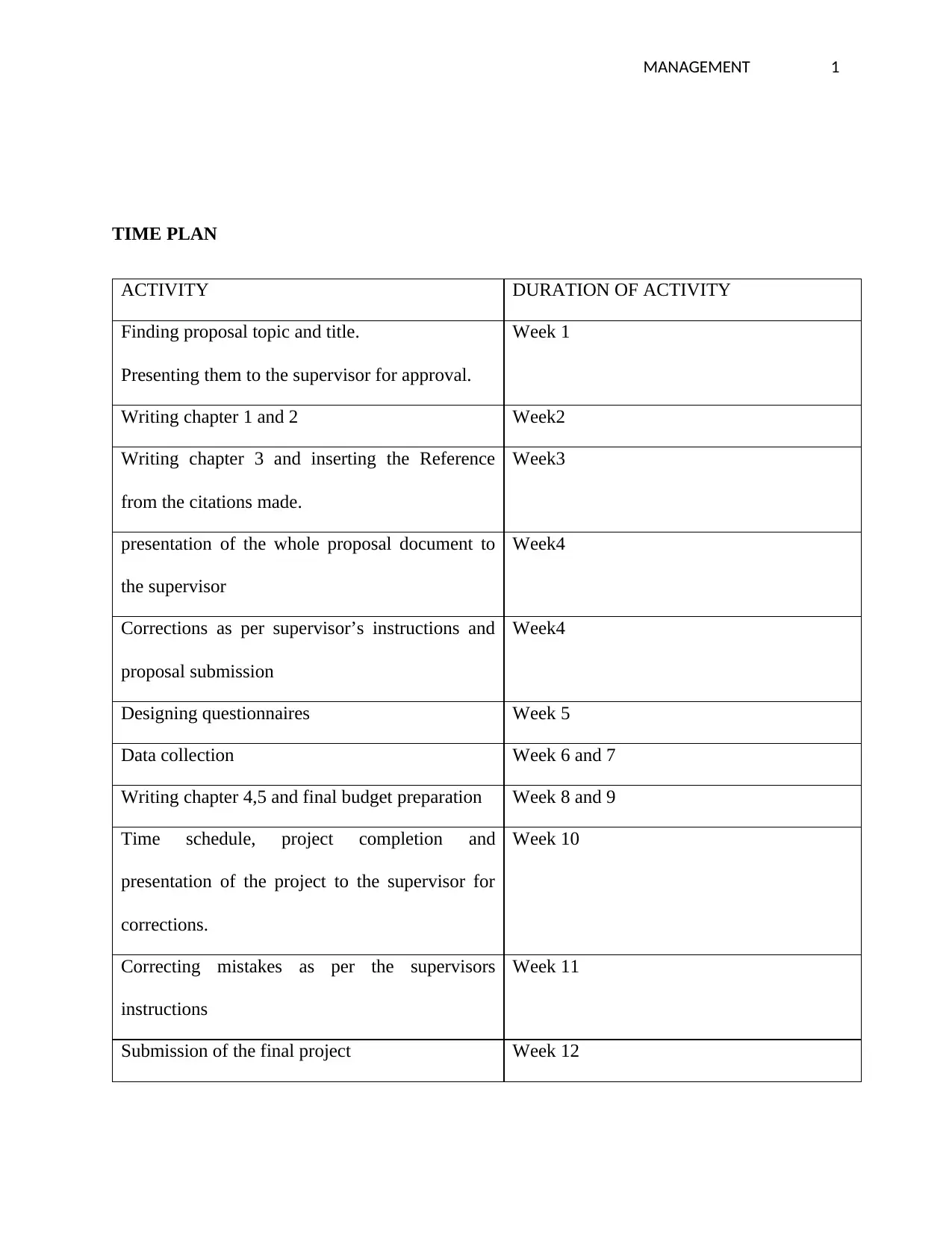
TIME PLAN
ACTIVITY DURATION OF ACTIVITY
Finding proposal topic and title.
Presenting them to the supervisor for approval.
Week 1
Writing chapter 1 and 2 Week2
Writing chapter 3 and inserting the Reference
from the citations made.
Week3
presentation of the whole proposal document to
the supervisor
Week4
Corrections as per supervisor’s instructions and
proposal submission
Week4
Designing questionnaires Week 5
Data collection Week 6 and 7
Writing chapter 4,5 and final budget preparation Week 8 and 9
Time schedule, project completion and
presentation of the project to the supervisor for
corrections.
Week 10
Correcting mistakes as per the supervisors
instructions
Week 11
Submission of the final project Week 12
TIME PLAN
ACTIVITY DURATION OF ACTIVITY
Finding proposal topic and title.
Presenting them to the supervisor for approval.
Week 1
Writing chapter 1 and 2 Week2
Writing chapter 3 and inserting the Reference
from the citations made.
Week3
presentation of the whole proposal document to
the supervisor
Week4
Corrections as per supervisor’s instructions and
proposal submission
Week4
Designing questionnaires Week 5
Data collection Week 6 and 7
Writing chapter 4,5 and final budget preparation Week 8 and 9
Time schedule, project completion and
presentation of the project to the supervisor for
corrections.
Week 10
Correcting mistakes as per the supervisors
instructions
Week 11
Submission of the final project Week 12
Paraphrase This Document
Need a fresh take? Get an instant paraphrase of this document with our AI Paraphraser
MANAGEMENT 1
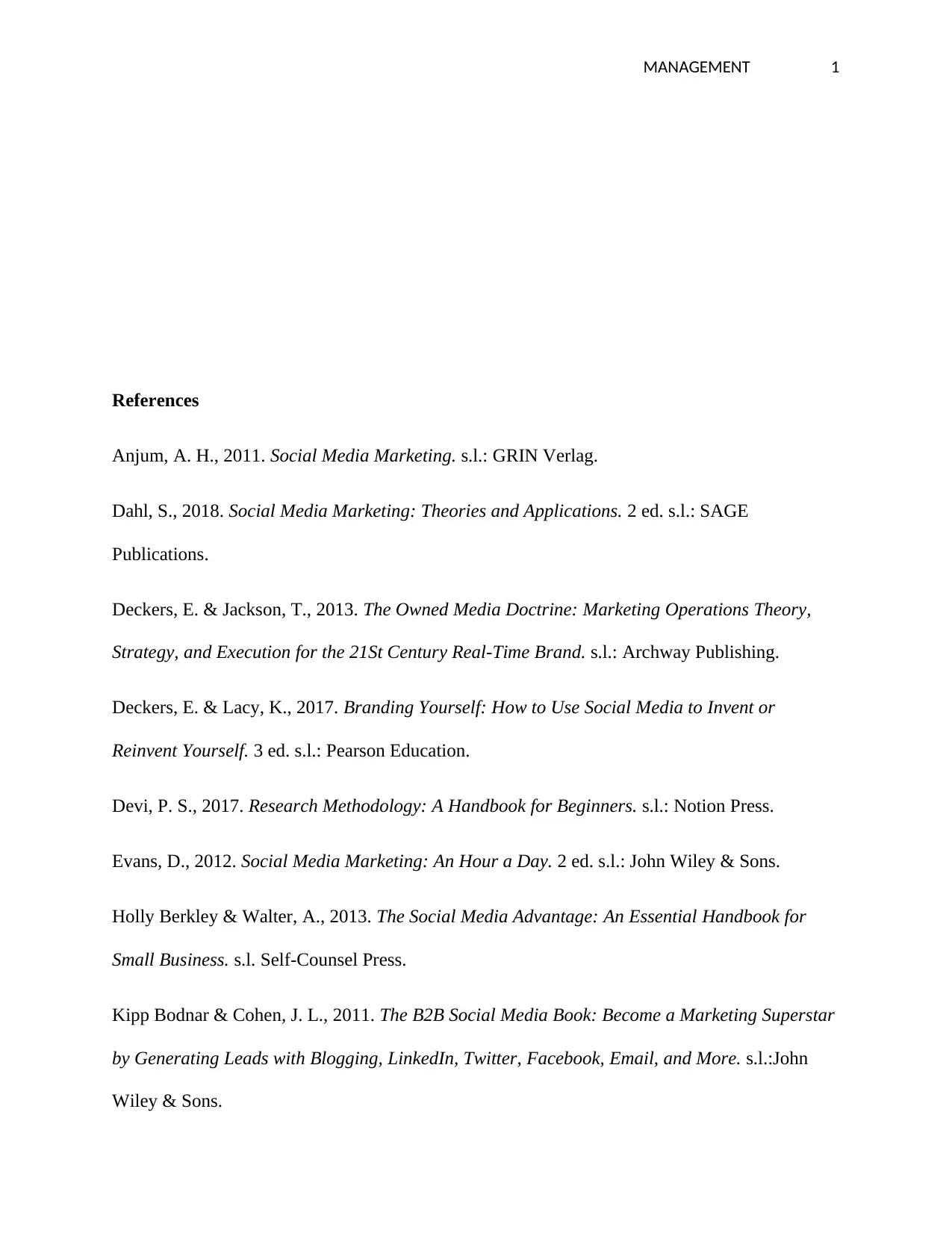
References
Anjum, A. H., 2011. Social Media Marketing. s.l.: GRIN Verlag.
Dahl, S., 2018. Social Media Marketing: Theories and Applications. 2 ed. s.l.: SAGE
Publications.
Deckers, E. & Jackson, T., 2013. The Owned Media Doctrine: Marketing Operations Theory,
Strategy, and Execution for the 21St Century Real-Time Brand. s.l.: Archway Publishing.
Deckers, E. & Lacy, K., 2017. Branding Yourself: How to Use Social Media to Invent or
Reinvent Yourself. 3 ed. s.l.: Pearson Education.
Devi, P. S., 2017. Research Methodology: A Handbook for Beginners. s.l.: Notion Press.
Evans, D., 2012. Social Media Marketing: An Hour a Day. 2 ed. s.l.: John Wiley & Sons.
Holly Berkley & Walter, A., 2013. The Social Media Advantage: An Essential Handbook for
Small Business. s.l. Self-Counsel Press.
Kipp Bodnar & Cohen, J. L., 2011. The B2B Social Media Book: Become a Marketing Superstar
by Generating Leads with Blogging, LinkedIn, Twitter, Facebook, Email, and More. s.l.:John
Wiley & Sons.
References
Anjum, A. H., 2011. Social Media Marketing. s.l.: GRIN Verlag.
Dahl, S., 2018. Social Media Marketing: Theories and Applications. 2 ed. s.l.: SAGE
Publications.
Deckers, E. & Jackson, T., 2013. The Owned Media Doctrine: Marketing Operations Theory,
Strategy, and Execution for the 21St Century Real-Time Brand. s.l.: Archway Publishing.
Deckers, E. & Lacy, K., 2017. Branding Yourself: How to Use Social Media to Invent or
Reinvent Yourself. 3 ed. s.l.: Pearson Education.
Devi, P. S., 2017. Research Methodology: A Handbook for Beginners. s.l.: Notion Press.
Evans, D., 2012. Social Media Marketing: An Hour a Day. 2 ed. s.l.: John Wiley & Sons.
Holly Berkley & Walter, A., 2013. The Social Media Advantage: An Essential Handbook for
Small Business. s.l. Self-Counsel Press.
Kipp Bodnar & Cohen, J. L., 2011. The B2B Social Media Book: Become a Marketing Superstar
by Generating Leads with Blogging, LinkedIn, Twitter, Facebook, Email, and More. s.l.:John
Wiley & Sons.
MANAGEMENT 1
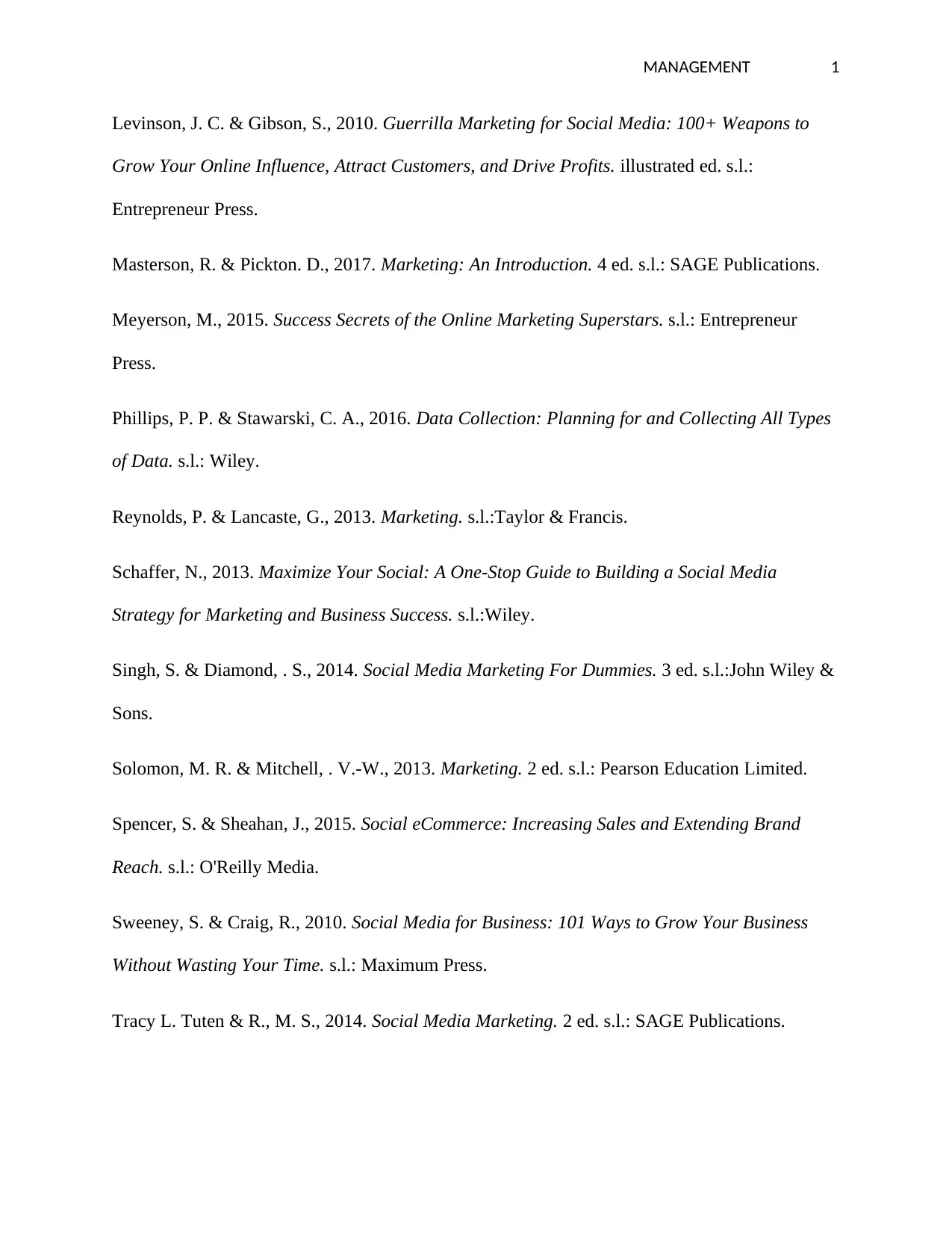
Levinson, J. C. & Gibson, S., 2010. Guerrilla Marketing for Social Media: 100+ Weapons to
Grow Your Online Influence, Attract Customers, and Drive Profits. illustrated ed. s.l.:
Entrepreneur Press.
Masterson, R. & Pickton. D., 2017. Marketing: An Introduction. 4 ed. s.l.: SAGE Publications.
Meyerson, M., 2015. Success Secrets of the Online Marketing Superstars. s.l.: Entrepreneur
Press.
Phillips, P. P. & Stawarski, C. A., 2016. Data Collection: Planning for and Collecting All Types
of Data. s.l.: Wiley.
Reynolds, P. & Lancaste, G., 2013. Marketing. s.l.:Taylor & Francis.
Schaffer, N., 2013. Maximize Your Social: A One-Stop Guide to Building a Social Media
Strategy for Marketing and Business Success. s.l.:Wiley.
Singh, S. & Diamond, . S., 2014. Social Media Marketing For Dummies. 3 ed. s.l.:John Wiley &
Sons.
Solomon, M. R. & Mitchell, . V.-W., 2013. Marketing. 2 ed. s.l.: Pearson Education Limited.
Spencer, S. & Sheahan, J., 2015. Social eCommerce: Increasing Sales and Extending Brand
Reach. s.l.: O'Reilly Media.
Sweeney, S. & Craig, R., 2010. Social Media for Business: 101 Ways to Grow Your Business
Without Wasting Your Time. s.l.: Maximum Press.
Tracy L. Tuten & R., M. S., 2014. Social Media Marketing. 2 ed. s.l.: SAGE Publications.
Levinson, J. C. & Gibson, S., 2010. Guerrilla Marketing for Social Media: 100+ Weapons to
Grow Your Online Influence, Attract Customers, and Drive Profits. illustrated ed. s.l.:
Entrepreneur Press.
Masterson, R. & Pickton. D., 2017. Marketing: An Introduction. 4 ed. s.l.: SAGE Publications.
Meyerson, M., 2015. Success Secrets of the Online Marketing Superstars. s.l.: Entrepreneur
Press.
Phillips, P. P. & Stawarski, C. A., 2016. Data Collection: Planning for and Collecting All Types
of Data. s.l.: Wiley.
Reynolds, P. & Lancaste, G., 2013. Marketing. s.l.:Taylor & Francis.
Schaffer, N., 2013. Maximize Your Social: A One-Stop Guide to Building a Social Media
Strategy for Marketing and Business Success. s.l.:Wiley.
Singh, S. & Diamond, . S., 2014. Social Media Marketing For Dummies. 3 ed. s.l.:John Wiley &
Sons.
Solomon, M. R. & Mitchell, . V.-W., 2013. Marketing. 2 ed. s.l.: Pearson Education Limited.
Spencer, S. & Sheahan, J., 2015. Social eCommerce: Increasing Sales and Extending Brand
Reach. s.l.: O'Reilly Media.
Sweeney, S. & Craig, R., 2010. Social Media for Business: 101 Ways to Grow Your Business
Without Wasting Your Time. s.l.: Maximum Press.
Tracy L. Tuten & R., M. S., 2014. Social Media Marketing. 2 ed. s.l.: SAGE Publications.
⊘ This is a preview!⊘
Do you want full access?
Subscribe today to unlock all pages.
Trusted by 1+ million students worldwide

1 out of 13


Related Documents


Your All-in-One AI-Powered Toolkit for Academic Success.
+13062052269
info@desklib.com
Available 24*7 on WhatsApp / Email
![[object Object]](/_next/static/media/star-bottom.7253800d.svg)
Unlock your academic potential
Copyright © 2020–2026 A2Z Services. All Rights Reserved. Developed and managed by ZUCOL.